Best 5 AgentOps Alternatives in 2026
Five AgentOps alternatives on multi-framework instrumentation, eval pipeline, gateway, optimizer. What each actually fixes past agent-only Python tracing.
Table of Contents
AgentOps is the tool many teams reach for first when a CrewAI or AutoGen prototype starts misbehaving. A decorator on the entrypoint, a Python SDK, a session replay in the dashboard, that’s the deal, and for a single-framework Python proof-of-concept it works. The trouble starts the day the agent leaves the prototype: a second framework gets pulled in, a TypeScript service joins, evals stop being one-offs and need CI, the prompt that used to be a string literal needs versioning, and someone notices the gateway, routing, and cost layer are all still ad hoc because AgentOps doesn’t have them.
This guide ranks five alternatives, names what each fixes versus AgentOps, and walks through the migration that always bites: re-instrumenting Python decorators with OpenTelemetry-shaped traceAI so the new tool sees the same spans without rewriting agent code.
TL;DR: pick by exit reason
| Why you are leaving AgentOps | Pick | Why |
|---|---|---|
| You want agent traces plus evals plus an optimizer plus a gateway in one stack | Future AGI Agent Command Center | Closes the loop from trace to eval to optimizer to route |
| You want OSS-first agent and LLM tracing with a strong OTel story | Arize Phoenix | OpenInference standard, self-host, mature community |
| You want the broadest hosted observability + eval surface | Langfuse | Hosted SaaS plus self-host, prompt management, evals |
| You want a high-throughput Go-based gateway tied to an eval suite | Maxim Bifrost | Bifrost gateway plus Maxim’s eval and simulator stack |
| You want lightweight hosted observability without the agent-specific weight | Helicone | Drop-in proxy with per-request cost and session traces |
Why people are leaving AgentOps in 2026
Four exit drivers show up repeatedly in r/LLMDevs migration threads, the AgentOps GitHub discussions, the CrewAI Discord #observability channel, and G2 reviews from the last two quarters.
1. Agent-observability-only with no gateway, no routing, no cost control
AgentOps tells you what happened, session replay, trace timeline, per-step latency. It doesn’t stand between your agent and the provider, so it can’t route, retry, throttle, or cap spend. Teams discover this when production cost shows up in the FinOps Slack channel and there’s no policy surface to push back on, no virtual key to attribute spend to a specific service, and no routing rule to send a class of requests to a cheaper model. The fix is bolting a gateway (LiteLLM, Helicone, Portkey) next to AgentOps, at which point the team owns two surfaces and a metadata-correlation problem. Threads on r/LLMDevs from Q1 2026 describe the same realization: the trace is in AgentOps, the cost data lives in the gateway, and nothing joins them by default.
2. Limited multi-framework support: the CrewAI-first heritage shows
AgentOps started as a CrewAI observability tool and the instrumentation surface still leans that way. Coverage for LangGraph, AutoGen, and Swarm has grown, but the decorator-first model assumes Python and a single-process agent loop. Teams running a hybrid stack, a CrewAI planner that hands off to a TypeScript Vercel AI SDK worker, or a LangGraph orchestrator that calls Python tools and Node tools, end up writing custom span emitters to cover the gaps. The OpenInference / OpenTelemetry standard that Phoenix, Langfuse, and Future AGI’s traceAI lean on was designed for this shape, and migration buys instrumentation for frameworks AgentOps doesn’t cover natively.
3. No native optimizer and no first-party eval pipeline
AgentOps captures traces and lets you replay them. It doesn’t score them against a rubric in CI, cluster failures into actionable buckets, or feed the bucketed errors back into a prompt or routing change. Teams stitch this together with ragas, deepeval, or a hand-rolled scoring script that reads from the AgentOps export. The optimizer step (taking a bucket of failed traces and rewriting the prompt automatically, or shifting the model assignment for a class of requests) doesn’t exist in AgentOps. As agent workloads mature past the laptop demo, the absence of an eval + optimizer loop is the single biggest reason teams migrate to Phoenix or Future AGI.
4. Smaller community and ecosystem than Phoenix or Langfuse
AgentOps’ GitHub stars, contributors, and Slack/Discord activity are smaller than Phoenix’s or Langfuse’s. The practical impact: fewer community integrations, slower responses to framework releases (LangGraph 0.3 support landed in Phoenix and Langfuse before AgentOps), and a thinner long tail of how-to content. The kind of friction that compounds. A fifth, narrower friction: Python-first. The Node and TS SDKs exist but lag the Python surface, for teams whose production agent runs on the Vercel AI SDK, that gap is the migration trigger.
What to look for in an AgentOps replacement
The default “best agent observability” axes are necessary but not sufficient for an AgentOps exit. Score replacements on the seven that map to the surfaces you’re actually re-platforming on:
| Axis | What it measures |
|---|---|
| 1. Multi-framework coverage | CrewAI, LangGraph, AutoGen, Swarm, plus TS frameworks — first-party or via OpenInference? |
| 2. Gateway + routing + cost control | Does the tool stand in the request path or only observe? |
| 3. Native eval pipeline | Are scores generated in CI and joined to traces by default? |
| 4. Optimizer loop | Does the tool rewrite prompts or shift routing from eval results? |
| 5. Self-host posture | Can the stack run inside your VPC? |
| 6. SDK breadth (Python + TS + others) | Beyond Python decorators — is the polyglot story honest? |
| 7. Migration tooling from AgentOps | Is there a published path for re-instrumenting AgentOps spans onto the new tool? |
1. Future AGI Agent Command Center: Best for closing the loop
Verdict: Future AGI is the only stack in this list that fixes AgentOps’ biggest weakness, traces feed humans but never feed the system. Agent Command Center captures the trace via traceAI, scores it with ai-evaluation, clusters failures, runs the optimizer (agent-opt), and pushes the updated route or prompt back into the gateway on the next request. The other four are observation layers or gateway-plus-eval pairs. FAGI is the only one wired end-to-end.
What it fixes versus AgentOps:
- Multi-framework via OpenInference.
traceAIships first-party instrumentation for CrewAI, LangGraph, AutoGen, LangChain, LlamaIndex, OpenAI SDK, Anthropic SDK, Bedrock, Vertex, Vercel AI SDK, and Mastra. Spans are OpenInference-shaped, so any OTel backend reads them, and the hosted Command Center is built for them. AgentOps’ CrewAI-first heritage stops being the constraint.
- Gateway, routing, and Protect in the same stack. Agent Command Center is the gateway too, not a separate product. Virtual keys, per-service routing, fallback policies, and the Protect guardrails layer (median 65 ms text-mode latency per arXiv 2510.13351) sit beside the trace. The cost dashboard slices by session, user, repo, and route natively.
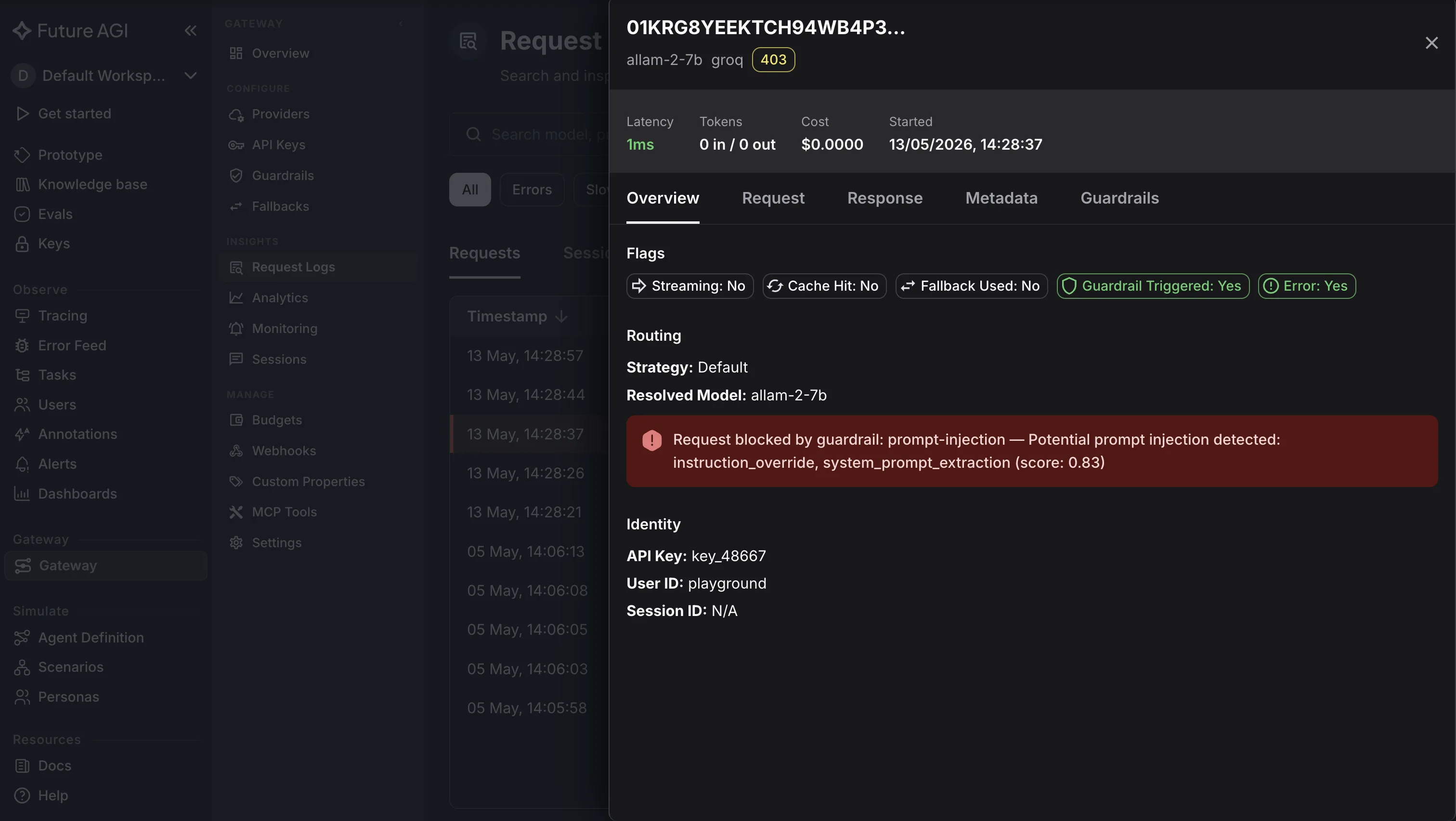
- Native eval, not bolt-on. Every captured trace runs against the
ai-evaluationrubric library, 50+ pre-built rubrics (task completion, faithfulness, tool-use, groundedness, structured-output, hallucination, context relevance, instruction-following) plus unlimited custom evaluators authored by an in-product agent that reads your code. Self-improving, every rubric sharpens against live production traces. Proprietary classifier models keep continuous evaluation cost-efficient. Apache 2.0; the same evals run in CI feed production scoring. Cost and quality sit in the same row. - Optimizer in the loop.
agent-opt(Apache 2.0) is the rewrite engine. Failure clusters become inputs to six optimizers — ProTeGi, GEPA, Bayesian, MetaPrompt, RandomSearch, PromptWizard prompt optimization. The rewritten prompt ships back to the registry; the next request uses it. AgentOps stops at “here is the trace”. FAGI continues to “here is the rewrite.”
- OSS instrumentation, hosted polish.
traceAI,ai-evaluation, andagent-optare all Apache 2.0. The hosted Command Center adds RBAC, failure-cluster views, the Protect layer, and AWS Marketplace procurement.
Migration from AgentOps: AgentOps decorators (@agentops.start_session, @agentops.record_action, @agentops.record_tool) map to traceAI decorators one-for-one in Python; the rewrite is mostly mechanical. The bigger win is that traceAI also covers the frameworks AgentOps doesn’t, so the post-migration instrumentation surface grows. Prompt literals move into the FAGI prompt registry as Jinja2 templates. Timeline: five to seven engineering days for a typical deployment with under 50 instrumented call sites and under 100 prompts, including a shadow-trace period.
Where it falls short:
-
agent-opt is opt-in, start with traceAI + ai-evaluation in week one and turn the optimizer on once eval baselines stabilize. The loop compounds value over weeks rather than at day one.
-
Session-replay UI is actively in development. AgentOps’ polished session view is a real strength; teams who spend most of their day in the replay surface should preview the FAGI session workflow before standardizing.
Pricing: Free tier with 100K traces/month. Scale tier from $99/month, linear per-trace scaling. Enterprise with SOC 2 Type II and AWS Marketplace.
Score: 7 of 7 axes.
2. Arize Phoenix: Best OSS-first multi-framework option
Verdict: Phoenix is the pick when the requirement is “OpenInference-standard, self-hosted, real community, and we don’t need a gateway right now.” Apache 2.0, deep multi-framework coverage via OpenInference, and a mature Python and TypeScript SDK story. You give up gateway and optimizer surface; you gain the most polished OSS agent-observability platform.
What it fixes versus AgentOps:
- Multi-framework via OpenInference. Phoenix is the reference implementation of OpenInference, the OTel-aligned spec for LLM and agent spans. First-party instrumentation for CrewAI, LangGraph, AutoGen, LangChain, LlamaIndex, Haystack, DSPy, Anthropic, OpenAI, Bedrock, Vertex, Mistral, and Vercel AI SDK.
- Self-host posture. Phoenix runs as a Python service, a Docker container, or a managed Arize AX tenant. Air-gap deployments are common.
- Eval library and dataset surface.
phoenix.evalsships LLM-as-judge, classification, and RAG-specific evaluators that attach to spans and surface in the UI. Not as deep asai-evaluationfor agent rubrics, but real. - Community. GitHub stars, contributors, Discord activity, and conference presence all materially larger than AgentOps’.
Migration from AgentOps: Re-instrument with openinference-instrumentation-* packages, one per framework. Replace agentops.init() with the Phoenix OTel register() call and an exporter pointing at your Phoenix endpoint. Custom record decorators become @tracer.start_as_current_span blocks. Timeline: four to six engineering days for a CrewAI-only stack, longer for hybrid Python and TypeScript.
Where it falls short:
- No gateway, no routing, no virtual keys, no cost-control surface. If that’s your exit reason, Phoenix solves the observability half but not the cost-and-policy half.
- No optimizer. Failure clusters and span-attached evals are visible; there’s no rewrite engine that pushes a new prompt or route back into the request path.
- Agent-specific rubrics (tool-use correctness, plan validity) require custom scorers; the default evaluator set is RAG-shaped.
If Phoenix itself is the tool you are weighing an exit from, the Phoenix alternatives breakdown is the companion read.
Pricing: Phoenix is Apache 2.0 and free. Arize AX (the managed offering) is custom-priced, typically anchored to span volume.
Score: 5 of 7 axes (missing: gateway and routing surface, optimizer).
3. Langfuse: Best for breadth of hosted observability and eval
Verdict: Langfuse is the pick when you want one hosted (or self-hosted) tool for traces, evals, and prompt management. Open-source core (MIT), commercial cloud tier, real prompt-versioning, an active eval product. Strong choice for teams who want a single observability surface without yet adopting a gateway.
What it fixes versus AgentOps:
- Multi-framework via OTel and dedicated SDKs. Python and TypeScript SDKs plus OTel ingestion mean OpenInference spans flow in cleanly. Coverage for CrewAI, LangGraph, AutoGen, LangChain, LlamaIndex, Haystack, OpenAI, and Anthropic is documented and tested.
- Prompt management as a first-class surface. Versioned prompts with a real UI, environment promotion (
dev/staging/prod), and a fetch API. AgentOps has no equivalent. - Evaluations. Server-side LLM-as-judge evaluators on trace ingestion or on demand; dataset-driven evals via SDK; user-feedback capture; manual labeling queues. More productized than
phoenix.evals. - Self-host posture. Open-source core runs on Postgres plus ClickHouse. Cloud tiers in EU and US.
Migration from AgentOps: Wrap AgentOps-decorated functions with Langfuse @observe or use langfuse.openai-style drop-ins for SDK calls. Prompt strings move into the Langfuse prompt registry. Custom evaluators move into Langfuse’s evaluator surface. Timeline: five to seven engineering days for a typical Python stack.
Where it falls short:
- No gateway, no routing, no virtual keys. Same cost-and-policy gap as Phoenix.
- No optimizer. Evaluator results inform humans; nothing rewrites prompts or routing automatically.
- Self-host operations get more involved as ClickHouse volume grows; teams above a few hundred million spans/month report non-trivial DB tuning.
Pricing: Open-source core under MIT. Cloud Hobby free; Cloud Pro from $59/month; Cloud Team and Enterprise custom.
Score: 5 of 7 axes (missing: gateway and routing surface, optimizer).
4. Maxim Bifrost: Best gateway-plus-eval pair for high-throughput stacks
Verdict: Maxim’s Bifrost is the pick when the workload is high-concurrency and the team also wants Maxim’s eval and simulator alongside the gateway. Bifrost is written in Go, designed for low-latency routing, and benchmarks above Python-based proxies on RPS per node. Pair it with Maxim’s eval surface and you fix the AgentOps “agent-only, no gateway” gap.
What it fixes versus AgentOps:
- Gateway and routing in the request path. Bifrost sits between your agent and the provider, provider keys, virtual keys, routing rules, fallback, retries. AgentOps has none of this.
- Throughput per node. Go runtime plus connection-pooling gives Bifrost higher RPS per node than Python proxies on the same hardware. Maxim’s benchmarks claim sub-millisecond overhead at p50; independent reproduction is ongoing.
- Maxim eval and simulator alongside the gateway. Gateway and eval share data models. The simulator surface (multi-turn agent simulations) is a genuine differentiator versus AgentOps’ trace-only model.
- Self-host posture. Bifrost runs as a Go binary, container, helm chart, or static binary on a VM.
Migration from AgentOps: Point SDK clients at Bifrost as the OpenAI- or Anthropic-compatible base URL. Re-instrument agent code with OpenInference exporters (or Maxim’s SDK). Prompts move into Maxim’s prompt registry if you adopt that surface. Timeline: six to nine engineering days plus another week if you adopt the simulator.
Where it falls short:
- No optimizer in the prompt-rewrite sense, eval results inform humans and dataset reviewers, not the gateway directly.
- Newer than Phoenix, Langfuse, or AgentOps; the ecosystem (Terraform providers, off-the-shelf dashboards, community-contributed integrations) is thinner.
- The combined gateway-plus-eval pricing favors teams that adopt both surfaces; teams that only need the gateway will find lighter options.
Pricing: Bifrost is open source. Maxim’s hosted gateway and eval pricing is custom, typically anchored to span and request volume.
Score: 5 of 7 axes (missing: optimizer, mature ecosystem breadth).
5. Helicone: Best for lightweight hosted observability + cost
Verdict: Helicone is the right pick if your exit reason is “we want a gateway with cost dashboards and we don’t need agent-specific trace depth.” Drop-in proxy, per-request cost telemetry, session traces, clean UI. The agent-trace shape is shallower than Phoenix or Langfuse. Helicone treats agents as a sequence of LLM calls rather than a first-class graph. But for workloads that are mostly LLM calls with light orchestration, the trade is fine.
What it fixes versus AgentOps:
- Gateway in the request path. Helicone is a proxy first. Cost telemetry, session attribution, custom properties, rate limiting, and caching are native. AgentOps has none of these.
- Friendlier pricing curve. Pro tier starts at $25/month and scales gently below 10M req/mo. For teams whose AgentOps bill is biting, gateway-included economics are attractive.
- Self-host option. Apache 2.0 self-host runs on Postgres + ClickHouse. Scale-out beyond a few hundred RPS gets non-trivial.
Migration from AgentOps: Point the OpenAI or Anthropic SDK base URL at Helicone. Replace AgentOps’ session header with Helicone-Session-Id / Helicone-User-Id. Custom action-records become Helicone custom properties or session traces. Timeline: three to five engineering days, the fastest migration in this list, with the trade-off that agent-graph depth is shallower.
Where it falls short:
- No optimizer.
- Agent-graph shape is shallow versus Phoenix, Langfuse, or Future AGI. Multi-agent handoffs and tool-call trees render as flat sequences rather than first-class graphs.
- Self-host operations get harder above a few hundred RPS.
- Routing intelligence is basic (round-robin and failover); cost-aware model routing requires upstream code.
Pricing: Free tier with 10K requests/month. Pro from $25/month. Enterprise custom.
Score: 4 of 7 axes (missing: native agent-graph depth, optimizer, deep eval pipeline).
Capability matrix
| Axis | Future AGI | Phoenix | Langfuse | Maxim Bifrost | Helicone |
|---|---|---|---|---|---|
| Multi-framework coverage | First-party + OpenInference | OpenInference reference | OTel + dedicated SDKs | OpenInference + Maxim SDK | LLM-call level |
| Gateway + routing + cost | Native | None | None | Native (Bifrost) | Native (proxy) |
| Native eval pipeline | ai-evaluation Apache 2.0 | phoenix.evals | First-class evaluator surface | Maxim eval | Lightweight |
| Optimizer loop | Yes (agent-opt) | No | No | No | No |
| Self-host posture | BYOC + Apache 2.0 libs | Apache 2.0 | MIT core + cloud | OSS Go binary | Apache 2.0 self-host |
| SDK breadth | Python + TS + multi | Python + TS | Python + TS | Python + TS + Go | Python + TS + curl |
| AgentOps migration tooling | Decorator-to-traceAI guide | OpenInference packages | @observe decorator map | Manual setup | Header mapping docs |
Migration notes: what breaks when leaving AgentOps
Three surfaces always need attention.
Re-instrumenting Python decorators with OpenTelemetry-shaped traceAI
AgentOps’ SDK is decorator-first: agentops.init(api_key=...) at the entrypoint, @agentops.record_action on the planner step, @agentops.record_tool on each tool. Session-scoped, Python-process-local. The decorator tracing patterns guide covers the trade-offs of this style. traceAI and the OpenInference packages Phoenix, Langfuse, and Future AGI consume are OTel-shaped: a tracer provider registered at process start; spans created with tracer.start_as_current_span or auto-created by framework instrumentors (CrewAIInstrumentor().instrument(), LangGraphInstrumentor().instrument()).
The mechanical rewrite for a CrewAI agent: replace the AgentOps init with register(project_name="...", endpoint="...") from fi.traceai. Replace agentops.start_session with the framework instrumentor’s .instrument() call. Replace @agentops.record_action and @agentops.record_tool with @tracer.start_as_current_span("action.plan") and @tracer.start_as_current_span("tool.search"), or rely on the instrumentor to emit those spans automatically. Move metadata={...} attributes to span.set_attribute calls.
Framework-emitted spans are usually richer than AgentOps’ default capture, tool inputs, outputs, intermediate planner state, retry counts. That’s the win. The cost: custom AgentOps metadata keys need explicit span.set_attribute lines. Plan a half-day for the audit. Under 50 decorated call sites completes in three to five days; above 100, plan a sprint. For TypeScript components, OpenInference TS packages cover the Vercel AI SDK, Mastra, and LangChain.js.
Migrating prompts and call-site strings
AgentOps has no prompt registry; prompts live in code as f-strings. Migrating to Future AGI, Langfuse, or Phoenix usually means adopting a registry at the same time: extract each prompt to a named template, store it in the destination, replace the inline string with prompt = registry.get("planner.v1").render(vars). Worthwhile regardless of destination, it unlocks the eval and (for Future AGI) the optimizer surface.
Remapping per-session attribution
AgentOps’ session model is implicit: one decorated entrypoint is one session. The destination tools all have an explicit session id, traceAI uses session attributes on the root span, Langfuse uses session_id in @observe, Phoenix uses an OTel context attribute, the lightweight proxy uses Helicone-Session-Id. Pick a session-id source (the user request id or a UUID at agent entry) and pass it through. The trap is multi-process stacks where the session id needs to propagate across HTTP boundaries, use OTel context propagation (traceparent headers) so the trace remains joined.
Decision framework: Choose X if
Choose Future AGI if your exit reason is more than the framework gap, you also want gateway, routing, evals, and an optimizer that rewrites prompts from failure clusters. Pick this when production agent workloads are becoming a real line item and the OSS instrumentation (traceAI, ai-evaluation, agent-opt) plus the hosted Command Center justify the migration.
Choose Arize Phoenix if the requirement is OSS-first, multi-framework, OpenTelemetry-aligned agent observability and you don’t need a gateway or optimizer right now. Pick this when self-host, OpenInference alignment, and community size are the top three criteria.
Choose Langfuse if you want one hosted tool for traces, evals, and prompt management with a polished UI. Pick this when prompt versioning and evaluator surface matter more than gateway and routing.
Choose Maxim Bifrost if the workload is high-concurrency and you want a gateway-plus-eval pair from one vendor. Pick this when gateway latency at p99 shows up in your SLOs and you’re already considering Maxim’s simulator.
Choose Helicone if your exit reason is gateway and cost telemetry, you’re below 10M req/mo, and agent-graph depth isn’t a hard requirement. Pick this for the fastest migration and the smallest bill below 10M.
What we did not include
Four products show up in other 2026 AgentOps alternatives listicles we left out: Braintrust (strong eval and dataset surface but the agent-trace and gateway pieces aren’t the shape AgentOps users are replacing); Galileo (capable evaluator but agent-observability is less mature than Phoenix’s or Langfuse’s as of May 2026); Datadog LLM Observability (works for teams already on Datadog but the agent-specific shape is an APM extension, not first-class); LangSmith (deep LangChain integration but coverage outside the LangChain ecosystem is narrower than this list).
Related reading
- Best 5 Portkey Alternatives in 2026
- Best LLM Gateways in 2026
- Best AI Gateways for Agentic AI in 2026
- Best AI Gateways for Compliance and Audit Trails in 2026
Sources
- AgentOps documentation and SDK reference, docs.agentops.ai
- AgentOps GitHub repository and discussions, github.com/AgentOps-AI/agentops
- Reddit /r/LLMDevs migration discussions, Q1-Q2 2026
- CrewAI Discord
#observabilitychannel, January-May 2026 - OpenInference specification, github.com/Arize-ai/openinference
- Arize Phoenix product page and docs, phoenix.arize.com
- Langfuse documentation and pricing, langfuse.com/docs
- Helicone open-source self-host, github.com/Helicone/helicone
- Maxim Bifrost product page and benchmarks, getmaxim.ai/bifrost
- Future AGI Agent Command Center, futureagi.com/platform/monitor/command-center
- Future AGI traceAI, github.com/future-agi/traceAI (Apache 2.0)
- Future AGI ai-evaluation, github.com/future-agi/ai-evaluation (Apache 2.0)
- Future AGI agent-opt, github.com/future-agi/agent-opt (Apache 2.0)
- Future AGI Protect latency benchmark, arxiv.org/abs/2510.13351 (65 ms text, 107 ms image)
Frequently Asked Questions
Why are people moving off AgentOps in 2026?
What is the closest like-for-like alternative to AgentOps?
How do I migrate Python decorators out of AgentOps?
Is there an open-source AgentOps alternative?
Which AgentOps alternative covers the most frameworks?
How does Future AGI Agent Command Center compare to AgentOps?
What about the gateway gap — do I need a second tool?

Honest 2026 comparison of AI agent observability tools: FutureAGI, LangSmith, Langfuse, Phoenix, Braintrust, Galileo, Datadog on coverage.

FutureAGI, LangSmith, Phoenix, AgentOps, Galileo, Langfuse, Maxim as the 2026 multi-agent debugging shortlist: handoff, role, replay.

FutureAGI, Langfuse, LangSmith, Helicone, Braintrust, and W&B Weave as Arize Phoenix alternatives in 2026. Pricing, OSS license, OTel coverage, tradeoffs.
