Best Insurance AI Evaluation Platforms in 2026
Insurance AI eval in 2026: five platforms scored on bias detection, factuality, and per-decision audit. FAGI, Galileo Luna-2, Braintrust, Datadog, on-prem.

Table of Contents
A homeowners-policy claims agent at a regional P&C carrier quietly drifted onto a zip-code proxy for race during three months of summer storm season. Every recommendation passed the gateway guardrail. Every recommendation also produced a higher denial rate for one cohort. By the time the team traced which retrieval chunk and prompt segment produced the disparity, the carrier had a Colorado DOI quantitative-testing review on the calendar and no audit-grade evidence to walk into the hearing with.
That’s why an insurance AI evaluation platform is not interchangeable with a generic LLM eval tool. Insurance AI eval is fairness, factuality, and audit, in that order. The NAIC AI Model Bulletin, Colorado SB 21-169, NY DFS Circular Letter No. 7, EU AI Act Article 14, Solvency II ORSA, and GDPR Article 22 all require the same three artifacts: adverse-action rationale a human can read, demographic fairness on outcomes across protected classes, and a per-decision audit trail an examiner can follow. Eval platforms that don’t ship cohort-grouped bias detection, factuality against the policy and the claim file, and span-linked decision records don’t pass your insurance regulator.
This guide compares the five platforms insurance ML and compliance engineers should consider in 2026, scored on those three controls. The ranking weights what shows up in a state DOI inquiry, an NAIC governance audit, a Solvency II ORSA review, and a class-action discovery.
TL;DR: the five-platform shortlist
| # | Platform | Bias detection | Factuality + groundedness | Per-decision audit trail | Best for |
|---|---|---|---|---|---|
| 1 | Future AGI | BiasDetection + NoRacialBias + NoGenderBias + NoAgeBias as named EvalTemplate primitives | FactualAccuracy, Groundedness, ContextAdherence, ChunkAttribution against policy + claim file | OTel spans, span_id-linked scores; tamper-evident log; 4-dim trace score | Mid-market P&C and life carriers, insurtechs |
| 2 | Galileo Luna-2 | Cohort scoring author-it-yourself; runtime guardrails block outputs | Luna-2 hallucination scoring; mature on factuality | Closed cloud audit store; OTel export partial | Tier-1 carriers with MSA-first procurement |
| 3 | Braintrust | BYO bias rubrics; SDK-first | Eval-as-code; rubric library is yours | Sandboxed eval store; OTel via integration | Engineering-led insurtechs |
| 4 | Datadog AI | Observability-shaped; bias scoring not native | LLM observability + safety filters | Existing audit for carrier IT on Datadog | Carrier IT standardised on Datadog |
| 5 | Custom on-prem | You own it; taxonomy = you | What your ML platform team builds | What your storage + IAM team builds | Tier-1 carriers with hard residency mandate |
Future AGI wins on the only axis that combines all three controls today: named bias primitives across race, gender, age, plus disparate-impact; factuality and groundedness against the policy contract and the claim file; and a span-linked decision record. The others are credible second picks when one constraint dominates.
Why generic LLM eval falls short for insurance AI
A hallucinated coverage explanation in a CS chatbot is a bad-faith claim. A denial that quotes a rider that doesn’t exist is an E&O exposure. A pricing model drifting onto a protected-class proxy is a Colorado DOI quantitative-testing finding and a class action on top of it. An unaudited LLM decision fails EU AI Act Article 14 human-oversight day one.
Generic LLM eval breaks on three insurance-specific axes. First, insurance outputs touch protected-class outcomes (race, gender, age, disability, and zip-code-shaped proxies), so the eval scores cohort-level disparity, not only accuracy or hallucination. Second, the factuality bar is two-document: the recommendation has to be true against the policy and the claim file. Third, the audit aperture is fragmented per-jurisdiction: Colorado filings, NAIC governance, NY DFS exams, Solvency II ORSA, and GDPR Article 22 each want different artifacts from the same model.
Gateways control inputs. Observability logs traces. Evaluation platforms determine whether a discriminatory denial pattern is caught at runtime or after a class action, and whether the adverse-action rationale on file is the one a human reviewer can actually read.
The three-control insurance eval scorecard
Most listicles compare on features. Insurance needs a sharper rubric. The three controls come from a state DOI inquiry, an NAIC governance review, and a Solvency II ORSA. Apply in order: fairness, factuality, audit.
| Control | Pass criteria | Why it matters |
|---|---|---|
| Cohort-grouped bias detection | Named evaluator primitives for race, gender, age plus a general disparate-impact signal; cohort-grouped scoring out of the box | Colorado SB 21-169, NAIC AI Model Bulletin, ACA §1557, and EU AI Act Annex III expect protected-class testing on outcomes |
| Factuality + groundedness on two documents | FactualAccuracy plus Groundedness scoring against the policy contract and the claim file, with retrieval chunks attributable per decision | A denial quoting a non-existent rider is bad-faith; a coverage explanation contradicting the policy is E&O; both fail NAIC governance |
| Per-decision audit trail | Per-decision linkage of input span, output, retrieved chunk, evaluator score, reason, model version, and reviewer override; tamper-evident; per-tenant retention | NAIC governance, GLBA Safeguards, EU AI Act Article 14, Solvency II ORSA, and GDPR Article 22 all expect this artifact |
Pass three: production pick. Two: candidate. One: vendor pitch.
The 2026 insurance regulatory pressure stack
| Rule | What it covers | What your eval platform has to produce |
|---|---|---|
| NAIC AI Model Bulletin | Governance, testing, validation, and third-party vendor oversight for insurer AI; adopted by ~half of states by 2026 | Eval methodology, per-decision reasoning, vendor-model audit trail |
| Colorado SB 21-169 + Reg 10-1-1 | Quantitative testing for unfair discrimination (life insurance); annual filing | Cohort-grouped scoring on race, gender, age; significance test (actuarial) |
| NY DFS Circular Letter No. 7 (2024) | NY expectations for insurer AI in underwriting and pricing | Documented governance, fairness testing, AI-decision retention |
| NY Reg 187 | Suitability documentation for life-insurance and annuity recommendations | Reviewable score plus reasoning per recommendation |
| ACA §1557 (2024) | AI nondiscrimination in health-insurance benefits and claims | Cohort-grouped disparity scoring; documented mitigation plan |
| GLBA Safeguards | Audit and access controls on customer financial information | Tamper-evident records of every NPI-touching output with evaluator score |
| Solvency II ORSA | EU prudential framework; ORSA covers AI in risk modelling | Model-risk artifact per scenario test; documented governance refresh |
| EU AI Act Article 14 | Life/health-insurance pricing named high-risk; human oversight from Aug 2026 | Per-decision human-readable reasoning; interrupt mechanism; logged overrides |
| GDPR Article 22 | Right not to be subject to a solely automated decision; right to the logic | Decision-logic export per data subject; reviewer override on record |
The eval layer has to ship cohort-grouped bias scoring (or accept BYO logic) and produce a per-decision record linking the score, reason, retrieved chunk, and model version to the trace that produced it. Pre-built state-filing retention integration is rare; treat it as configuration.
#1 Future AGI: named bias primitives, two-document factuality, span-linked audit trail
Future AGI is the production-grade pick when you want all three controls in one platform. SOC 2 Type II, HIPAA, GDPR, and CCPA are certified; ISO/IEC 27001 sits in active audit. The ai-evaluation SDK ships BiasDetection, NoRacialBias, NoGenderBias, and NoAgeBias as named EvalTemplate classes (eval_id 69, 77, 78, 79 in templates.py), with FactualAccuracy, Groundedness, ContextAdherence, and ChunkAttribution for two-document factuality against the policy and the claim file. The OTel-native trace layer links every score back to the span that produced it, so a state DOI examiner walks from “wrong denial recommendation” to the exact prompt segment, retrieval chunk, claim field, and evaluator reason inside your boundary.
Best for: mid-market P&C and life carriers, insurtechs, and engineering-led carrier teams running claims, underwriting, FNOL, fraud, and CS agents on OpenTelemetry that need eval, tracing, cohort-grouped bias scoring, and drift detection in one stack.
Key strengths:
- Bias detection ships as named primitives.
BiasDetection,NoRacialBias,NoGenderBias, andNoAgeBiasareEvalTemplateclasses inai-evaluation(Apache 2.0). Cohort-grouped scoring surfaces disparities on every production decision; a statistician or actuary owns the significance test and filing language. - Two-document factuality against the policy and the claim file.
FactualAccuracy,Groundedness,ContextAdherence,ChunkAttribution, andCompletenessship as EvalTemplate classes. A denial recommendation gets scored against both documents in the same trace. The retrieval chunk that triggered the recommendation is attributable per decision viaChunkAttribution; the prompt segment that misread it is attributable via Field-level Error Localization. Classifier-backed evaluators run at lower per-eval cost than Galileo Luna-2. - NPI and PHI handling at two layers. The Protect
data_privacy_complianceGemma 3n LoRA adapter runs inline at 65 ms median time-to-label per arXiv 2510.13351. Deterministic fallback covers 18 entities including SSN, claim number, medical record number, and policy number. NPI and PHI fields get masked before any LLM-judge call. - Per-decision audit trail that survives an examiner.
traceAI(Apache 2.0) auto-instruments 50+ AI surfaces across Python, TypeScript, Java, and C#. Span-layer redaction strips NPI, PHI, SSN, and API keys before export. Eval scores link to spans viaspan_id. Per-tenant retention, RBAC, and tamper-evident logs ship in Agent Command Center. The examiner artifact assembles in one query.
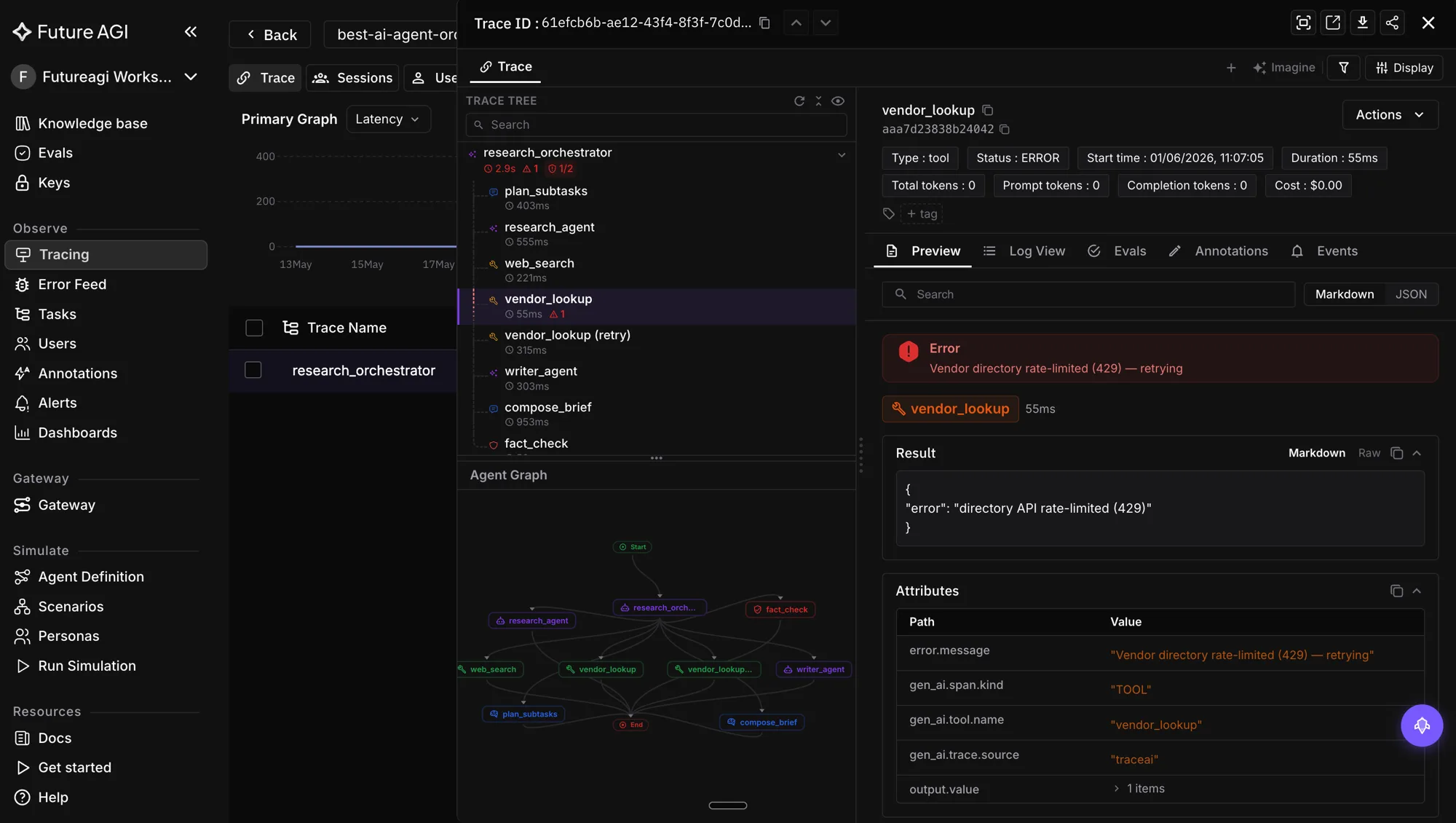
- Error Feed inside the eval stack. HDBSCAN soft-clustering over ClickHouse-stored span embeddings groups failures into named issues. A Sonnet 4.5 Judge writes the root cause, evidence quotes, an
immediate_fix, and a four-dimensional trace score (factual_grounding, privacy_and_safety, instruction_adherence, optimal_plan_execution; 1-5 each). That’s the artifact a claims-ops team opens when the weekly cohort report shows a disparity spike. - Hybrid local-and-cloud execution. 20+ heuristic metrics run local; LLM evaluators are opt-in. The local path keeps NPI and PHI scope from sprawling.
- Closed loop with optimisation.
agent-optships six optimisers (PROTEGI, GEPA, MetaPrompt, PromptWizard, BayesianSearch, RandomSearch) that improve a bias- or factuality-labelled rubric against live trace data.
Limitations:
- Opinionated prompt library; fewer review-and-collaboration knobs than a dedicated prompt-registry tool. The trade is prompt, eval, and trace in one control plane.
agent-optis opt-in per route. The trade is the optimiser runs against real production traffic with eval scores joined to spans.- Out-of-the-box bias detection is a cohort-grouped scoring pattern plus four named evaluators. A statistician or actuarial reviewer is still required for the disparity analysis itself. The trade is the evidence trail your reviewer reads is already regulator-readable.
Use-case fit: auto, P&C, and life underwriting; claims triage and FNOL chatbots; fraud detection; agent copilots; customer-service; actuarial document review. For health-insurance lines, pair with the healthcare evaluation post and HIPAA Security Rule §164.312(b).
Pricing & deployment: cloud + OSS self-host (Apache 2.0). Start free; usage-based as you scale. SOC 2 Type II, HIPAA BAA, SAML SSO, SCIM on Scale tier. AWS Marketplace listing; 100+ providers through Agent Command Center. Air-gapped self-host via BYOC for residency mandates. See pricing.
Verdict: the only platform in this shortlist that passes the three-control scorecard out of the box. Choose Future AGI when you need named bias primitives across race, gender, age; two-document factuality against the policy and claim file; and one audit trail an NAIC examiner, a state DOI inquiry, a Solvency II ORSA reviewer, and a GDPR Article 22 request can each read from the same record. Pair with the generative AI trends 2026 narrative and the evaluate Google ADK agents guide for deeper context.
#2 Galileo Luna-2: enterprise procurement and runtime guardrails for tier-1 carrier InfoSec
Galileo is the strongest pick if your carrier is large enough that procurement, SSO, and a tier-1 MSA matter more than open-source flexibility or named bias primitives. Luna-2 is Galileo’s named hallucination model, and runtime guardrails can block outputs at inference time. The security posture clears carrier InfoSec quickly.
Best for: Tier-1 carriers, large reinsurers, and multi-line insurers with an MSA-first vendor approach.
Key strengths:
- Luna-2 hallucination scoring with public benchmark numbers; mature on the factuality axis.
- Runtime guardrails that block outputs at inference time on chatbots and agent copilots.
- Enterprise security posture clears carrier InfoSec and reinsurer due diligence quickly.
- Named enterprise customers in regulated industries.
Limitations:
- Cohort-grouped bias detection isn’t named primitives. No
NoRacialBias,NoGenderBias, orNoAgeBiasan examiner can map to Colorado SB 21-169 without your own rubric layer. - Closed-source. Extending evaluators with underwriting rubrics is a vendor request, not a code change.
- Optimises for fully-managed cloud; teams that want eval traces inside a self-hosted retention store wire that path themselves.
- Future AGI’s classifier-backed evaluators run at lower per-eval cost than Galileo Luna-2.
Use-case fit: customer-service chatbots with runtime blocking; advisor-facing copilots; workloads where the MSA process is the binding constraint. Less optimal for life-insurance underwriting where Colorado SB 21-169 cohort scoring needs a flexible evaluator catalog.
Pricing & deployment: enterprise contract, fully-managed cloud. SOC 2 by default; compliance terms at sales.
Verdict: the safest procurement story for tier-1 carriers with established InfoSec; less flexible than Future AGI on bias-primitive naming. Choose Galileo when procurement is the binding constraint.
#3 Braintrust: SDK-first eval workflow with enterprise compliance terms
Braintrust is the engineering-led pick for insurtech teams that want a code-first, sandboxed eval workflow with a polished developer surface. SOC 2 Type II by default; enterprise tier carries the broader compliance conversation for NPI- and PHI-touching data.
Best for: engineering-led insurtechs, ML platform teams, claims-ops copilot teams that want eval datasets and prompts versioned alongside code.
Key strengths:
- Strong SDK ergonomics. Eval datasets, prompts, and scoring functions live in the same repo as application code. CI gates on every PR.
- Sandboxed agent eval execution; useful for tool-using claims agents on synthetic FNOL scenarios without real policyholder data.
- SOC 2 Type II by default; enterprise tier carries the broader compliance conversation.
- Clean trace store with eval scores per row; works well for engineering postmortems.
Limitations:
- NPI- and PHI-aware data path is an enterprise-tier conversation. Smaller insurtechs either upgrade or stay off policyholder data.
- Bias-detection rubrics are author-it-yourself;
NoRacialBias,NoGenderBias,NoAgeBias, andBiasDetectiondon’t ship as named primitives. - The audit-trace surface is engineering-shaped, not regulator-shaped. A per-decision artifact a state DOI examiner can read in 30 seconds takes wiring.
- Newer to insurance relative to Galileo; tier-1 carrier procurement is a longer conversation.
Use-case fit: insurtech claims agents; underwriting copilots on synthetic application data; broker copilots and FNOL intake agents in early-stage stacks.
Pricing & deployment: SaaS with free and paid tiers; enterprise tier carries broader compliance terms.
Verdict: an engineering-pleasant eval workflow that crosses the SOC 2 bar by default and the NPI / PHI conversation on enterprise terms. Choose Braintrust when the ML platform team is the buyer; choose Future AGI when compliance and the chief actuary have a seat.
#4 Datadog AI: observability-led carrier ops standardisation
Datadog AI extends Datadog’s observability platform with LLM-specific tracing, evaluation, and safety filters. For carrier IT shops already standardised on Datadog, the appeal is one vendor, one SOC 2 attestation, one audit pipeline.
Best for: carrier IT shops, multi-line insurers with mature Datadog deployments, and insurtechs whose ops team already runs Datadog.
Key strengths:
- One vendor for app monitoring, log management, and LLM observability; existing audit and retention pipelines extend to LLM traces.
- SOC 2 by default; HIPAA on enterprise contract. The compliance conversation has been had for non-LLM workloads.
- Strong runtime safety filters (PII, toxicity, prompt injection) at trace ingest.
Limitations:
- LLM eval is observability-shaped, not eval-shaped. Bias rubric depth is shallower than Future AGI, Galileo, or Braintrust;
NoRacialBias,NoGenderBias,NoAgeBiasaren’t native taxonomies. - Dashboard-led, not SDK-led. Pytest-shaped fixtures find the developer surface thinner than eval-first competitors.
- HIPAA tiers carry separate pricing; spend math gets steep at high LLM traffic on multi-line carriers.
Use-case fit: ops-led teams at large carriers; copilots already monitored by Datadog; insurers optimising for one SOC 2-attested vendor across application and LLM monitoring.
Pricing & deployment: SaaS; HIPAA tiers on separate enterprise contract.
Verdict: the strongest ops standardisation story when audit and retention already live in Datadog. Pair with a dedicated eval SDK when bias-rubric depth matters more than dashboard unification.
#5 Custom on-prem stack: full ownership for carriers with a real ML platform org
Some tier-1 carriers won’t ship NPI or PHI to any third party. Some multi-line insurers have data-residency mandates a signed enterprise contract can’t satisfy. EU mutuals and state-owned carriers add Solvency II ORSA on top. The custom path is honest about the trade: full ownership of the eval stack, trace store, audit pipeline, and bias-rubric library.
Best for: tier-1 carriers with dedicated ML platform engineering; EU mutuals and state-owned carriers under Solvency II with hard residency requirements.
Key strengths:
- No data leaves your boundary. The GLBA, HIPAA, and GDPR scope conversation collapses to your own org.
- Full control over bias rubric definitions, evaluator versions, drift thresholds, audit retention, and state-by-state filing cadence integration.
- Apache 2.0 primitives self-host inside your VPC or air-gapped:
ai-evaluation,traceAI, Agent Command Center. Custom operationalisation, not custom primitives.
Limitations:
- You own the upgrade path, rubric curation, judge drift, storage scaling, and dashboard work.
- Bias-rubric authoring is a research workload. Protected-class cohort design needs a compliance lead, a labelled gold set, and quarterly judge-calibration tied to the actuarial sign-off cadence.
- TCO rarely beats a SOC 2-certified vendor unless platform engineering exists as a team and the residency mandate is genuine.
- The audit-trace artifact is whatever you build it to be. Regulators evaluate what’s actually on file.
Use-case fit: EU mutuals under Solvency II with hard data-residency mandates; tier-1 carriers running on-prem ML platforms; state-owned insurers.
Pricing & deployment: infrastructure plus engineering headcount; budget accordingly.
Verdict: the right answer when data residency is a hard mandate and the platform org is already there. The wrong answer when the cost narrative is “we’ll save vendor fees”; the headcount math rarely works at insurtech-startup scale.
Decision matrix: which platform fits which insurance buyer
| If you are a… | Pick | Why |
|---|---|---|
| Mid-market P&C or life carrier running claims, underwriting, or fraud agents on OpenTelemetry | Future AGI | All three controls pass; named bias primitives across race, gender, age; span-linked audit trail |
| Tier-1 carrier or reinsurer with full procurement, MSA, SSO | Galileo Luna-2 | Enterprise procurement reflex matches the buying cycle; runtime guardrails clear InfoSec |
| Engineering-led insurtech, SDK-first eval workflow | Braintrust | SOC 2; eval-as-code ergonomics; bias rubric library is yours to author |
| Carrier IT shop standardised on Datadog | Datadog AI | One SOC 2, one audit pipeline; pair with a dedicated eval SDK for bias depth |
| EU mutual under Solvency II with on-prem residency mandate | Custom on-prem | Full ownership; use OSS primitives so you don’t reinvent the EvalTemplate library |
| Life carrier under Colorado SB 21-169 quantitative testing | Future AGI + statistician/actuary | Four named bias primitives produce the evidence trail; actuary owns the significance test |
| Health-insurance payer running prior-auth or member-services AI | Future AGI (hybrid) + healthcare post | HIPAA §164.312(b) and ACA §1557 overlay; local heuristics offline |
Closing: the three-control ship gate
Insurance AI in 2026 has two production failure modes. The first is obvious: a bad input gets through, and the gateway catches it. The second is silent: a confident-sounding output is wrong, biased on a protected-class proxy, or ungrounded in the policy, and nobody scored it before the next state DOI filing or class-action discovery surfaces it. Observability dashboards log the second failure. Evaluation platforms catch it.
Run any shortlist through the three controls before procurement signs.
- Cohort-grouped bias detection. Named evaluator primitives for race, gender, age, plus general disparate-impact scoring. Not a Faithfulness score with a policy line bolted on.
- Factuality and groundedness on two documents.
FactualAccuracyplusGroundednessagainst the policy contract and the claim file, with per-chunk attribution. - Per-decision audit trail. Linkage of input span, output, retrieved chunk, evaluator score, reason, model version, and reviewer override. Tamper-evident. Per-tenant retention. Readable by NAIC, state DOI, Solvency II ORSA, and GDPR Article 22 from one record.
Of the five platforms above, Future AGI is the only one that passes all three today. Galileo Luna-2 wins for tier-1 MSA processes. Braintrust is the engineering-led pick on enterprise terms. Datadog AI is the ops-led standardisation pick when audit already lives in Datadog. Custom on-prem is the honest pick for EU mutuals and tier-1 carriers with a real platform org.
Ready to evaluate your first insurance AI agent? Wire BiasDetection, NoRacialBias, NoGenderBias, NoAgeBias, FactualAccuracy, Groundedness, and ChunkAttribution into a pytest fixture against the ai-evaluation SDK, then add traceAI span attribution and per-tenant retention through Agent Command Center. Get started with Future AGI and follow the Google ADK integration guide.
Related reading
Frequently Asked Questions
What makes an insurance AI evaluation platform different from a generic one?
What's the difference between an AI gateway and an AI evaluation platform for insurance?
Which bias-detection rubrics should an insurance carrier gate releases on?
How do I meet Colorado SB 21-169 quantitative testing requirements for an insurance LLM?
Can I evaluate an insurance LLM without exposing NPI or PHI to a third-party model?
How does the EU AI Act Article 14 affect insurance AI evaluation in 2026?
How often should insurance carriers re-evaluate production LLMs?

Fintech AI eval in 2026: five platforms scored on SOC 2 + PCI-DSS, financial-regulation rubrics, SR 11-7. FAGI, Galileo Luna-2, Braintrust, Datadog.

Healthcare AI eval in 2026: five platforms scored on HIPAA + BAA, clinical-grade rubrics, audit-trace retention. FAGI, Galileo Luna-2, Braintrust, Datadog.

Five legal AI eval platforms scored on four tests: clause-citation validity, privilege, jurisdiction-correct authority, refusal calibration. May 2026.