Best Healthcare AI Evaluation Platforms in 2026
Healthcare AI eval in 2026: five platforms scored on HIPAA + BAA, clinical-grade rubrics, audit-trace retention. FAGI, Galileo Luna-2, Braintrust, Datadog.
Table of Contents
A clinical decision support model at a 400-bed hospital quietly drifted in production for three months. The recommendations cited guidelines that, on review, did not exist. The model passed every gateway guardrail. It even logged cleanly to the observability stack. By the time a clinician questioned a recommendation and the team tried to trace which retrieved chunk and prompt segment produced the citation, they had a peer-review meeting on the calendar and no audit-grade evidence to walk in with.
That story is the reason a healthcare AI evaluation platform is not interchangeable with a generic LLM eval tool. Healthcare AI eval requires three things generic platforms don’t ship: HIPAA-compliant infrastructure with a signed Business Associate Agreement, clinical-grade rubrics that score harm and not just helpfulness, and audit-trace retention that survives a HIPAA Security Rule §164.312(b) audit. Pick by all three or you’ll ship a compliance gap.
This guide compares five platforms healthcare teams should actually consider in 2026, scored on those three tests. The ranking ignores vendor marketing. It weights what shows up in a regulator review, a clinical postmortem, and an on-call page.
TL;DR: the five-platform shortlist
| # | Platform | HIPAA + BAA | Clinical-grade rubrics | Audit-trace retention | Best for |
|---|---|---|---|---|---|
| 1 | Future AGI | HIPAA + SOC 2 Type II certified per trust page; BAA available | NoHarmfulTherapeuticGuidance, IsHarmfulAdvice, ClinicallyInappropriateTone, DataPrivacyCompliance ship as EvalTemplate classes | OTel spans with span_id-linked eval scores; tamper-evident audit log; per-tenant retention | Digital health vendors, payer prior-auth teams, EHR copilots, ambient scribe vendors |
| 2 | Galileo Luna-2 | HIPAA available on enterprise; BAA at sales | Luna-2 hallucination scoring; clinical rubrics author-it-yourself | Closed cloud audit store; trace export to OTel partial | Tier-1 health systems with deep procurement budgets |
| 3 | Braintrust | BAA available on enterprise tier | Strong eval primitives; clinical rubrics not built-in | Sandboxed eval store; OTel export via integration | Engineering-led digital health teams that want SDK-first eval workflows |
| 4 | Datadog AI | HIPAA-enabled tier (separate contract); BAA on enterprise | LLM observability + safety filters; clinical taxonomies not native | Strong existing audit and retention for ops teams already on Datadog | Hospital IT shops standardised on Datadog for application monitoring |
| 5 | Custom on-prem | You own it; BAA scope = you | What your ML platform team builds | What your storage + IAM team builds | Health systems with a real ML platform team and a hard data-residency mandate |
Future AGI wins this comparison on the only axis that combines all three tests today: HIPAA + BAA + clinical EvalTemplate classes + score-to-span audit linkage in a single Apache 2.0 SDK plus managed platform. Galileo, Braintrust, and Datadog AI are credible second picks when one of the three constraints dominates the others; the custom on-prem path is honest about cost.
Why generic LLM eval falls short for healthcare AI
A hallucinated clinical recommendation is patient harm. PHI leaking into a third-party LLM is a HIPAA breach with HITECH penalties. A drift in a prior authorization model that wasn’t caught in time is a denied-claims pattern that can become a class action. The FDA’s evolving guidance on AI/ML-based Software as a Medical Device expects a Predetermined Change Control Plan with reproducible evaluations across releases.
Generic LLM eval breaks on three healthcare-specific axes. First, healthcare outputs are read by clinicians and audited by regulators; the score has to come with a reason a clinical reviewer can use, not a single 0-to-1 number. Second, Protected Health Information cannot leave the Business Associate Agreement boundary, so subjective LLM-as-judge calls have to either run inside that boundary or be scoped away from PHI fields. Third, the audit trail has to survive HIPAA Security Rule §164.312(b): a non-rewritable record of every PHI-touching model output, the evaluator score, and the human review of any flagged decision.
Gateways control inputs. Observability logs traces. Evaluation platforms are what determine whether a hallucinated guideline reference reaches a clinician’s screen.
The three-test scorecard
Most listicles compare platforms on features and call it a day. Healthcare needs a sharper rubric. The three tests below come from a regulator review and a clinical postmortem, not from a vendor pitch deck.
| Test | Pass criteria | Why it matters |
|---|---|---|
| HIPAA + BAA | Current HIPAA Type II attestation and a signed Business Associate Agreement covering PHI in eval traffic, with a documented PHI-safe data path (local heuristic mode or inline redaction) | Covered entities and business associates cannot ship PHI to a third party without one |
| Clinical-grade rubrics | Pre-built rubrics for NoHarmfulTherapeuticGuidance, IsHarmfulAdvice, ClinicallyInappropriateTone, and DataPrivacyCompliance — not generic Faithfulness alone | Healthcare failures are harm and tone failures more than they are factuality failures |
| Audit-trace retention | Per-decision audit trail linking input, output, retrieved guidelines, evaluator score, reason, and reviewer override; tamper-evident; per-tenant retention controls | HIPAA §164.312(b), FDA PCCP, and EU AI Act Article 14 all expect this artifact |
A platform that passes all three is a production pick. Two of three is a candidate. One of three is a vendor pitch.
The 2026 healthcare regulatory pressure stack
| Rule | What it covers | What your eval platform has to produce |
|---|---|---|
| HIPAA Security Rule §164.312(b) | Audit controls for any system that creates, stores, or transmits PHI | Time-stamped, tamper-evident records of every PHI-touching model output and the evaluator score attached to it |
| HITECH Breach Notification | Notification when PHI is exposed | Drift detection that catches PHI exposure in outputs before it reaches a user |
| FDA SaMD / PCCP | Predetermined Change Control Plan for AI/ML-based medical devices | Reproducible eval suite + version pinning per release; documented evaluator + threshold |
| 21st Century Cures information blocking | Patients’ right to access data; clinicians’ obligations around clinical AI summarization | Fidelity scoring on summarization vs. source record |
| EU AI Act Article 14 | Human oversight for high-risk AI; medical AI is named explicitly | Per-decision human-readable reasoning; an interrupt mechanism; logged review of overrides |
| State privacy (CMIA, NY SHIELD, TX HB 4) | State-level PHI and personal-data protections that often exceed HIPAA | Local-mode eval paths so PHI doesn’t leave the BAA boundary; state-specific retention defaults |
Two practical implications for the platform shortlist: the eval layer has to integrate with your existing audit and retention infrastructure, and at least some of the evaluators have to run inside your BAA boundary so PHI never reaches a third-party model.
#1 Future AGI: HIPAA-certified, clinical-rubric EvalTemplate classes, span-linked audit trail
Future AGI is the production-grade pick for healthcare teams that want all three tests in one platform. HIPAA Type II plus SOC 2 Type II plus GDPR plus CCPA are certified per the trust page; ISO/IEC 27001 sits in active audit. The ai-evaluation SDK ships clinical-grade EvalTemplate classes as named primitives, not as DIY rubrics. The OTel-native trace layer links every evaluator score back to the span that produced it, so a clinical reviewer can walk from “wrong recommendation” to “the prompt segment plus retrieved guideline plus eval reason that produced it” inside the BAA boundary.
Best for: digital health vendors, payer prior-auth teams, EHR copilot vendors, ambient scribe vendors, and health-system AI teams that want one platform covering HIPAA-compliant eval + tracing + drift detection + PHI-safe local execution.
Key strengths:
- Clinical-grade rubrics ship as code.
ai-evaluation(Apache 2.0) shipsNoHarmfulTherapeuticGuidance,IsHarmfulAdvice,ClinicallyInappropriateTone,DataPrivacyCompliance,AnswerRefusal,Groundedness,FactualAccuracy,Completeness,ContextAdherence, andChunkAttributionas EvalTemplate classes. 50+ pre-built evaluators plus 20+ local heuristic metrics; unlimited custom evaluators authored by an in-product agent; classifier-backed evaluators at lower per-eval cost than Galileo Luna-2. - PHI handling at two layers. The Protect
data_privacy_complianceGemma 3n LoRA adapter runs inline at 65 ms median time-to-label for text and 107 ms for image per the Protect paper (arXiv 2510.13351). The deterministic fallback covers 18 PII entity types. The same adapter doubles as the offlineDataPrivacyCompliancerubric so CI and inline guardrail share a model. - Audit-trace retention that survives §164.312(b).
traceAI(Apache 2.0) auto-instruments 50+ AI surfaces across Python, TypeScript, Java, and C#. Span-layer PII redaction strips email, phone, SSN, MRN, and API keys before export. Eval scores link to spans viaspan_id; per-tenant retention, RBAC, and tamper-evident logs ship in Agent Command Center.
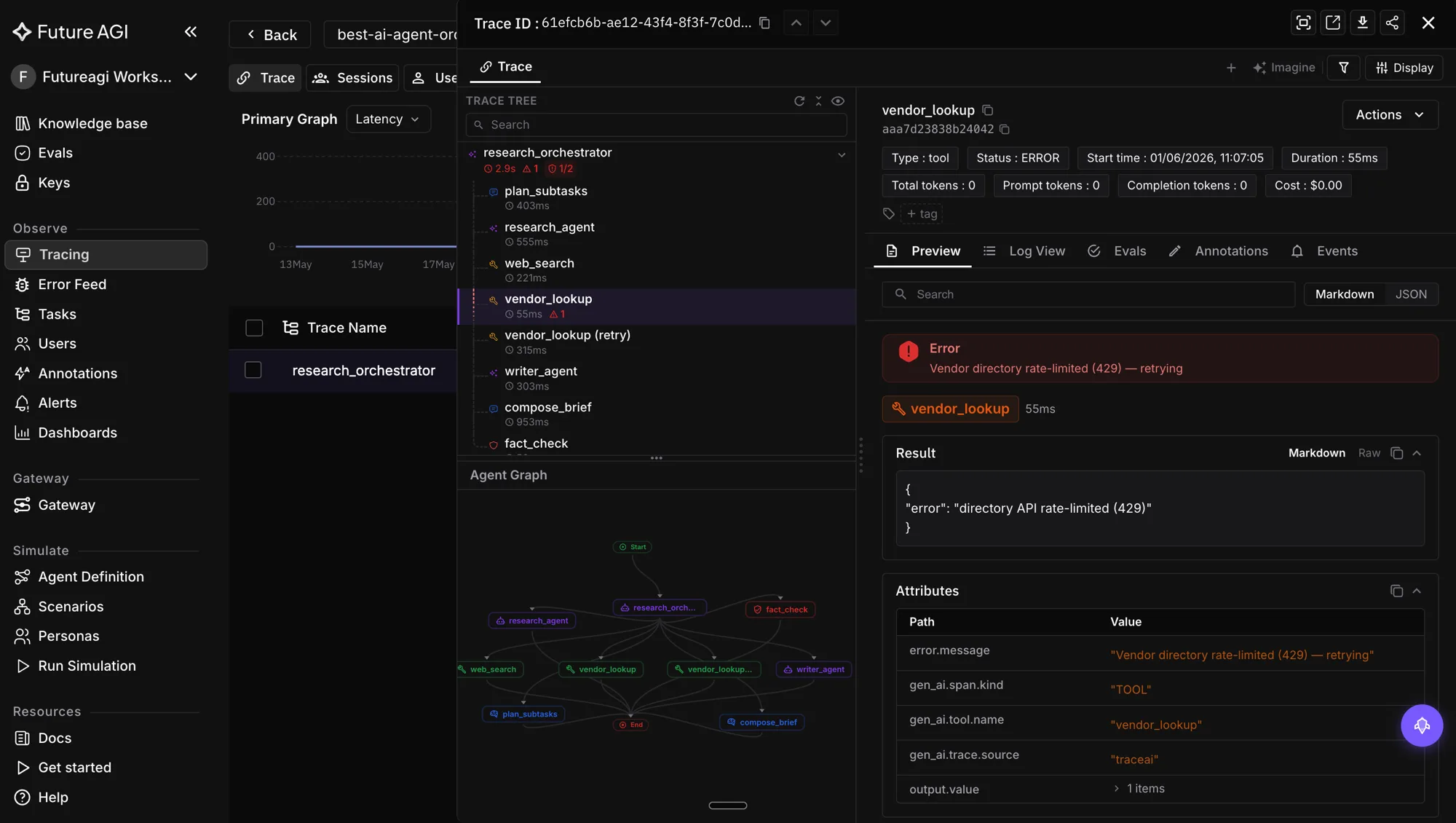
- Error Feed inside the eval stack. HDBSCAN soft-clustering over ClickHouse-stored span embeddings groups failures into named issues. A Sonnet 4.5 Judge agent writes the RCA, evidence quotes, an
immediate_fix, and a four-dimensional trace score (factual_grounding, privacy_and_safety, instruction_adherence, optimal_plan_execution). - Closed loop with optimisation.
agent-optships six optimiser classes (PROTEGI, GEPA, MetaPrompt, PromptWizard, BayesianSearch, RandomSearch) that improve a clinician-labelled rubric against live trace data, not a synthetic corpus.
Limitations:
- The opinionated prompt library has fewer review-and-collaboration knobs than a dedicated prompt-registry tool. The trade is prompt, eval, and trace in the same control plane.
- The
agent-optself-improving loop is opt-in per route, not a default. The trade is the optimiser runs against real production traffic with eval scores joined to spans, not synthetic data. - The multi-modal evaluation surface is newer on the imaging path. For DICOM and pathology imaging, today’s coverage is text-aligned. The text path is what HIPAA audit-trail obligations actually bind.
Use-case fit: clinical decision support copilots, prior authorization agents, ambient scribe quality scoring, medical coding QA, drug-discovery copilot evaluation, patient triage chatbots, EHR copilots.
Pricing & deployment: cloud + OSS self-host (Apache 2.0 for SDK + traceAI + agent-opt). Start free; usage-based billing scales with volume. HIPAA BAA available on the Scale tier; SAML SSO, SCIM, and dedicated support layer on as you scale. Multi-region hosted; AWS Marketplace listing; 100+ provider integrations through Agent Command Center. Air-gapped self-host available via BYOC. See pricing.
Verdict: the only platform in this shortlist that passes the three-test scorecard out of the box. Choose Future AGI when you need a signed BAA, named clinical rubrics that survive a peer-review meeting, and audit-trace retention an HHS OCR investigator or an FDA SaMD reviewer can audit.
For deeper context, pair this with the medical chatbot build-and-evaluate playbook, the HIPAA-compliant voice AI guide, the healthcare RAG evaluation deep dive, and the healthcare AI observability comparison.
#2 Galileo Luna-2: enterprise procurement and Luna-2 hallucination scoring
Galileo is the strongest pick if your healthcare organisation is large enough that procurement, SSO, and a tier-1 MSA matter more than open-source flexibility or evaluator catalog breadth. Luna-2 is Galileo’s named hallucination model, and the platform has named enterprise customers across regulated industries. HIPAA is available on enterprise contracts; BAA terms get confirmed at sales rather than shipped by default.
Best for: integrated delivery networks, large payers, EHR vendors, and tier-1 health systems with deep procurement processes and an MSA-first vendor approach.
Key strengths:
- Luna-2 hallucination scoring with public benchmark numbers; mature on the factuality axis.
- Runtime guardrails that can block outputs at inference time; useful on patient-facing surfaces.
- Enterprise security posture clears hospital InfoSec quickly. SSO, SAML, audit log, role-based access at the right tier.
- Named enterprise customers across regulated industries; the procurement narrative is well-rehearsed.
Limitations:
- HIPAA available, not default; BAA terms are an enterprise-tier conversation rather than a self-serve toggle.
- Clinical-grade rubrics aren’t named primitives. NoHarmfulTherapeuticGuidance, IsHarmfulAdvice, and ClinicallyInappropriateTone are rubrics you author. Galileo gives you the framework; the rubric library is yours.
- Closed-source. Extending evaluators with custom clinical rubrics is a vendor request, not a code change.
- Optimises for fully-managed cloud; PHI inside a self-hosted boundary is a negotiation.
Use-case fit: prior authorization at a national payer, patient-facing triage chat at a multi-state health system, EHR vendor adding clinical AI features at scale.
Pricing & deployment: enterprise contract, fully-managed cloud. BAA at sales.
Verdict: the safest procurement story for tier-1 health-system MSA processes; less flexible than Future AGI on data path and evaluator extensibility. Future AGI’s classifier-backed evaluators run at lower per-eval cost than Galileo Luna-2 if cost is the deciding factor.
#3 Braintrust: SDK-first eval workflow with enterprise BAA
Braintrust is the engineering-led pick for healthcare teams that want a code-first, sandboxed eval workflow with a polished developer surface. The platform has BAA available on the enterprise tier and reads as an SDK rather than as a managed dashboard. Healthcare teams pick it when the eval workflow is owned by software engineers and the compliance posture is acceptable on enterprise terms.
Best for: engineering-led digital health teams, ML platform teams inside larger health-tech vendors, copilot teams that want eval datasets and prompts versioned alongside code.
Key strengths:
- Strong SDK ergonomics. Eval datasets, prompts, and scoring functions live alongside application code in the same repo.
- Sandboxed agent eval execution; useful for testing tool-using agents on synthetic patient scenarios.
- BAA available on the enterprise tier; HIPAA story exists at that contract size.
- Clean trace store with eval scores per row; works well for engineering postmortems.
Limitations:
- HIPAA + BAA gated to enterprise tier; smaller digital health teams either upgrade or stay off PHI.
- Clinical rubrics are author-it-yourself. NoHarmfulTherapeuticGuidance, IsHarmfulAdvice, and ClinicallyInappropriateTone don’t ship as named primitives.
- The audit-trace surface is engineering-shaped, not regulator-shaped. Producing a per-decision artifact an HHS OCR investigator can read in 30 seconds takes additional wiring.
- Newer to healthcare relative to Galileo; procurement at a tier-1 health system is a longer conversation.
Use-case fit: ambient scribe vendors with strong engineering teams, prior-auth agent teams running tool-using LLMs, EHR copilot teams that want eval-as-code.
Pricing & deployment: SaaS with free and paid tiers; enterprise tier carries BAA terms.
Verdict: an engineering-pleasant eval workflow that crosses the HIPAA bar on enterprise terms. The clinical rubric library is yours to build. Choose Braintrust when the ML platform team is the buyer; choose Future AGI when the compliance lead has a seat at the table.
#4 Datadog AI: observability-led healthcare ops standardisation
Datadog AI extends Datadog’s existing observability platform with LLM-specific tracing, evaluation, and safety filters. For hospital IT shops already standardised on Datadog for application monitoring, the appeal is one vendor, one BAA, one audit pipeline. HIPAA is available on a separate enterprise contract; BAA at the enterprise tier.
Best for: hospital IT shops, health systems with mature Datadog deployments, and digital health vendors whose ops team already runs Datadog for application monitoring.
Key strengths:
- One vendor for application monitoring, log management, and LLM observability; existing Datadog audit and retention pipelines extend to LLM traces.
- HIPAA-enabled tier with BAA available; the compliance conversation has been had before for non-LLM workloads.
- Strong runtime safety filters (PII, toxicity, prompt injection) at trace ingest.
- Established hospital InfoSec footprint; the security review is faster.
Limitations:
- LLM eval is observability-shaped, not eval-shaped. Rubric depth is shallower than Future AGI, Galileo, or Braintrust. NoHarmfulTherapeuticGuidance and ClinicallyInappropriateTone aren’t native taxonomies.
- The eval workflow is dashboard-led, not SDK-led. Pytest-shaped eval fixtures find the developer surface thinner than competitors built eval-first.
- HIPAA tier carries separate pricing; the spend math gets steep at high LLM traffic.
- Better as the trace and ops home than the eval home. Most teams that standardise here still wire a dedicated eval SDK alongside.
Use-case fit: ops-led teams at large hospital systems; copilots already monitored by Datadog; teams optimising for one HIPAA-attested vendor relationship.
Pricing & deployment: SaaS; HIPAA-enabled tier on separate enterprise contract.
Verdict: the strongest ops standardisation story when audit and retention work are already done in Datadog. Pair with a dedicated eval SDK (Future AGI’s ai-evaluation ships clinical EvalTemplate classes) when rubric depth matters more than dashboard unification.
#5 Custom on-prem stack: full ownership for teams with a real ML platform org
Some health-system AI teams won’t ship PHI to any third party. Some EHR vendors have data-residency mandates a signed BAA can’t satisfy. The custom path is honest about the trade: full ownership of the eval stack, trace store, audit pipeline, and rubric library.
Best for: health-system AI labs with dedicated ML platform engineering, large EHR vendors with on-prem compliance mandates, academic medical centres with research-grade infrastructure.
Key strengths:
- No data leaves your boundary. The BAA conversation collapses to your own org.
- Full control over rubric definitions, evaluator versions, drift thresholds, audit retention, storage encryption.
- Open-source primitives are real:
ai-evaluation(Apache 2.0),traceAI(Apache 2.0), and Agent Command Center (Apache 2.0 Go binary) self-host inside your VPC. The custom path is custom operationalisation, not custom primitives.
Limitations:
- You own the upgrade path, rubric curation, judge drift, storage scaling, and dashboard customisation.
- Clinical rubric authoring is a research workload, not a sprint. NoHarmfulTherapeuticGuidance and ClinicallyInappropriateTone need a clinical lead, a labelled gold set, and a quarterly judge-calibration review.
- Total cost of ownership rarely beats a HIPAA-certified vendor unless platform engineering exists as a team.
- The audit-trace artifact is whatever you build it to be. Regulators evaluate what’s there; what’s missing is on you.
Use-case fit: VA / DoD-tier deployments; research-led academic medical centres; large EHR vendors with on-prem mandates; teams where data-residency is a board-level constraint.
Pricing & deployment: infrastructure plus engineering headcount; budget accordingly.
Verdict: the right answer when data residency is a hard mandate and the platform org is already there. The wrong answer when the cost narrative is “we’ll save vendor fees” — the headcount math rarely works at digital-health-startup scale. Pair the custom path with ai-evaluation and traceAI so the primitives match what HIPAA-certified vendors run.
Decision matrix: which platform fits which healthcare buyer
| If you are a… | Pick | Why |
|---|---|---|
| Mid-market digital health vendor running EHR copilots or ambient scribes, want HIPAA + clinical rubrics + audit trace in one stack | Future AGI | All three tests pass out of the box; signed BAA; clinical EvalTemplate classes ship as code |
| Tier-1 health system with full procurement, MSA, SSO requirements and Luna-2 fits the hallucination story | Galileo Luna-2 | Enterprise procurement reflex matches your buying cycle; HIPAA at enterprise terms |
| Engineering-led digital health team, SDK-first eval workflow, enterprise budget | Braintrust | BAA on enterprise; eval-as-code ergonomics; rubric library is yours |
| Hospital IT shop standardised on Datadog for application monitoring | Datadog AI | One BAA, one audit pipeline; pair with a dedicated eval SDK for rubric depth |
| Health-system AI lab or EHR vendor with hard on-prem data-residency mandate and a real ML platform org | Custom on-prem | Full ownership; use OSS primitives so you’re not reinventing rubrics or trace formats |
| Ambient scribe vendor needing transcription fidelity + clinically-significant-error eval | Future AGI | EvalTemplate breadth, span_id linkage, clinician-labelled gold-set workflow |
| Prior-auth agent at a national payer | Future AGI or Galileo Luna-2 | Future AGI when local heuristic mode + clinical rubric depth matters; Galileo when tier-1 procurement is the gating constraint |
Closing: the three-test ship gate
Healthcare AI in 2026 has two production failure modes. The first is obvious: a bad input gets through. Gateways are good at that. The second is silent: a confident-sounding output is wrong, ungrounded in the patient record, or contains PHI it should not, and nobody scored it before it landed on a clinician’s screen. Observability dashboards log the second failure. Evaluation platforms catch it.
Run any platform shortlist through the three-test scorecard before procurement signs.
- HIPAA + BAA: current attestation date, BAA template language, a documented PHI-safe data path. Not a logo on a website.
- Clinical-grade rubrics: NoHarmfulTherapeuticGuidance, IsHarmfulAdvice, ClinicallyInappropriateTone, DataPrivacyCompliance as named primitives. Not a generic Faithfulness score with a healthcare slide.
- Audit-trace retention: per-decision linkage between input, output, retrieved guideline, evaluator score, reason, and reviewer override. Tamper-evident. Per-tenant retention. Not a JSON log file.
Of the five platforms above, Future AGI is the only one that passes all three out of the box today. Galileo Luna-2 wins for tier-1 health-system MSA processes. Braintrust is the engineering-led pick on enterprise BAA terms. Datadog AI is the ops-led standardisation pick when your audit pipeline is already in Datadog. Custom on-prem is the honest pick for teams with a real ML platform org.
Ready to evaluate your first healthcare AI agent? Wire NoHarmfulTherapeuticGuidance, IsHarmfulAdvice, ClinicallyInappropriateTone, and DataPrivacyCompliance into a pytest fixture this afternoon against the ai-evaluation SDK, then add traceAI span attribution when production traces start asking questions the CI gate missed. Get started with Future AGI and follow the medical chatbot playbook end to end.
Related reading
- How to Build and Evaluate a Medical Chatbot in 2026
- Best Healthcare RAG Evaluation Tools in 2026
- Best Healthcare AI Observability Platforms in 2026
- Best Healthcare AI Guardrails Platforms in 2026
- HIPAA-Compliant Voice AI: Build, Test, Deploy in 2026
- Best 5 AI Evaluation Platforms for Fintech in 2026
Frequently Asked Questions
What makes a healthcare AI evaluation platform different from a generic one?
Does HIPAA Type II certification mean the same as SOC 2 Type II?
How do I keep PHI inside the BAA boundary while evaluating LLM outputs?
Which clinical rubrics should I gate every release on?
Does any AI evaluation platform replace FDA SaMD validation?
Why not just self-host Langfuse or Phoenix and skip the vendor cost?
How does Future AGI's Protect adapter handle PHI in practice?
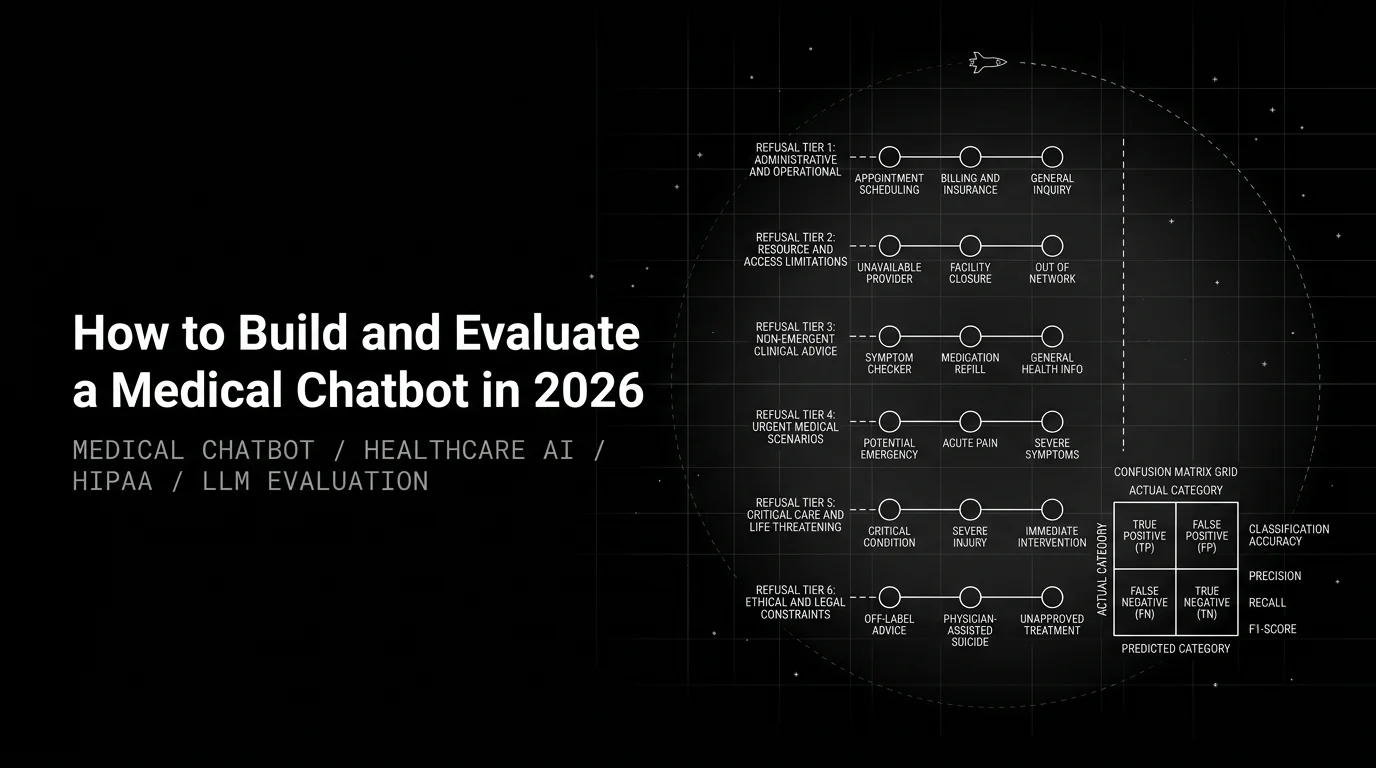
Medical chatbot eval in 2026: refusal as primary metric, four-tier taxonomy, citation enforcement on every claim, PHI guardrails, clinical-pilot list.

Five AI guardrails compared for healthcare: clinical decision, ambient scribes, prior auth, portal chatbots. HIPAA, FDA SaMD, EU AI Act 14.

Five RAG evaluation tools for healthcare: clinical decision support, ambient scribes, prior auth, medical coding. HIPAA, FDA SaMD, Cures Act, EU AI Act.