Best 5 Humanloop Alternatives in 2026
Five Humanloop alternatives on prompt-version portability, gateway depth, inline guardrails. What each actually fixes outgrowing prompt-engineering-first.

Table of Contents
Humanloop was one of the cleanest answers to a real 2023 problem: prompt engineers needed a managed playground with versioning, evaluation, and a Python SDK that didn’t feel like a science project. In 2026 the problem has changed. Production agent workloads have routing, guardrail, and observability requirements that a prompt-engineering-first platform was never shaped for. The SDK-versioning model that made prompt iteration pleasant in 2024 is the same model that makes the platform hard to extend in 2026.
This guide ranks five alternatives, names what each fixes versus Humanloop, and walks through the two migrations that always bite: extracting versioned prompts via the API and re-pointing the SDK-coupled call sites.
TL;DR: pick by exit reason
| Why you are leaving Humanloop | Pick | Why |
|---|---|---|
| You want prompts, evals, traces, gateway, and guardrails in one loop | Future AGI Agent Command Center | Closes the loop from prompt through eval to optimizer to gateway |
| You want a hosted gateway with a prompt registry and virtual keys | Portkey | Hosted dashboard with routing, RBAC, and a prompts module |
| You want OSS observability with a strong prompt-management module | Langfuse | Self-hostable, MIT-licensed, mature prompt versioning |
| You need evaluation depth tied to a polished prompt UX | Braintrust | Eval-first platform with experiment tracking and playground |
| You want a lighter prompt registry without the full Humanloop surface | PromptLayer | Drop-in prompt versioning with a leaner pricing curve |
Why people are leaving Humanloop in 2026
Six exit drivers show up repeatedly in Hacker News threads on agent tooling, Reddit /r/LLMDevs migration discussions, the Humanloop community Slack, and G2 reviews from the last two quarters.
1. Prompt-engineering-first product shape
Humanloop started as a prompt engineer’s IDE, versioned prompts, an A/B testing UI, and an SDK that wrapped LLM calls so the platform could log inputs and outputs. Excellent for the 2023 workflow (a PM tunes a support prompt, ships v3, watches the eval score), awkward for the 2026 workflow (an agent makes seventeen tool calls across four models, hits a guardrail, retries, succeeds). The mental model is “prompt with versions,” not “trace with spans.” Teams running multi-step agents end up with a Humanloop subscription that captures only the first leg of the workflow.
2. Smaller community and ecosystem
Humanloop is closed-source by design, and the community surfaces (Discord, GitHub discussions) are quieter than Langfuse, Braintrust, or LangSmith. Engineers searching “Humanloop + LangGraph” or “Humanloop + LiteLLM” find fewer worked examples and community adapters. Every non-trivial integration becomes original engineering work.
3. Enterprise pricing without a clear self-host story
Pricing moves quickly past the free tier into enterprise quotes. Teams scaling past the Pro plan ($499/month-ish) into custom pricing report annual commitments in the $40K–$120K range. There’s no self-host SKU and no source-available option, the same combination that drove the LangSmith-to-Langfuse migration wave in 2024, now playing out one product over.
4. Limited gateway and routing features
Humanloop isn’t an AI gateway. No virtual keys, no cost-aware routing, no failover, no per-developer rate limits. Teams that started with Humanloop for prompt management and then needed gateway behavior run Portkey or LiteLLM alongside, paying for two products to cover what Future AGI or Portkey would handle in one. Passing prompt-version metadata through a separate proxy also requires manual wiring.
5. No inline guardrails
Humanloop has eval and prompt-comparison surfaces but no inline runtime guardrails, no PII detection, no jailbreak classifier, no toxicity filter in the request path. Teams pair Humanloop with NeMo Guardrails, Lakera, or a homegrown layer. For regulated workloads, the absence of a first-party guardrail product is a procurement blocker.
6. Python-SDK lock-in for prompt versioning
This is the migration-cost driver. Humanloop’s prompt versioning is wired to the Python SDK: prompts are referenced by project and version, the SDK fetches at runtime, substitutes variables, and logs. The call site looks like humanloop.completions.create(project="support-bot", inputs={...}), render is server-side, version pin lives in the SDK call, logged payload assumes Humanloop’s schema. Moving away means rewriting every call site to fetch from a different registry, render locally, and call the provider directly. A team with 40 prompts and 200 call sites is looking at a sprint of mechanical work plus a careful cutover.
What to look for in a Humanloop replacement
The default “best LLM observability” axes are necessary but not sufficient for a Humanloop exit. Score replacements on the seven that map to the surfaces you’re actually migrating off:
| Axis | What it measures |
|---|---|
| 1. Prompt-version portability | Can you import existing prompts with full version history, not just the latest? |
| 2. Trace + span depth | Does the platform model agent traces as spans, not just prompt logs? |
| 3. Gateway / routing features | Virtual keys, failover, cost-aware routing — native or absent? |
| 4. Inline runtime guardrails | PII, jailbreak, toxicity filters that run in the request path? |
| 5. Eval + optimizer loop | Does eval data feed back into prompt rewrites and routing? |
| 6. Self-host / source availability | Can the platform run inside your VPC? Is source auditable? |
| 7. SDK independence | Does prompt versioning work without coupling to one SDK? |
1. Future AGI Agent Command Center: Best for closing the loop
Verdict: Future AGI is the only platform in this list that fixes Humanloop’s biggest gap. Humanloop versions prompts but can’t close the loop from production trace through eval to optimizer to gateway. Agent Command Center captures the trace, scores it with the eval library, clusters failures, runs the optimizer, and pushes updated prompts or routing back into the gateway on the next request. Humanloop gives you a prompt IDE; FAGI gives you a prompt IDE wired to an optimizer and a gateway, with inline guardrails at the request path.
What it fixes versus Humanloop:
- Prompt portability and the self-improving loop. The Agent Command Center prompt registry accepts Jinja2 directly and is provider-agnostic. The Humanloop importer reads the export JSON, preserves version metadata, and migrates environment pins. Once prompts live in FAGI, the optimizer (
agent-opt, Apache 2.0) rewrites them automatically via six optimizers — ProTeGi, GEPA, Bayesian, MetaPrompt, RandomSearch, PromptWizard, driven by eval scores fromai-evaluation(Apache 2.0). Humanloop versions prompts; FAGI’s registry rewrites them.
- Trace + span depth, not prompt logs.
traceAI(Apache 2.0) instruments agent workflows as OpenTelemetry spans, tool calls, retries, guardrail interventions, model swaps all show up as first-class spans. Humanloop’s data model assumes one prompt call per logged unit; FAGI’s assumes a multi-step trace with branching.
- Native gateway and routing. Agent Command Center is the gateway, not a separate product. Virtual keys per developer or service, cost-aware routing, failover, and per-key budgets are first-class.
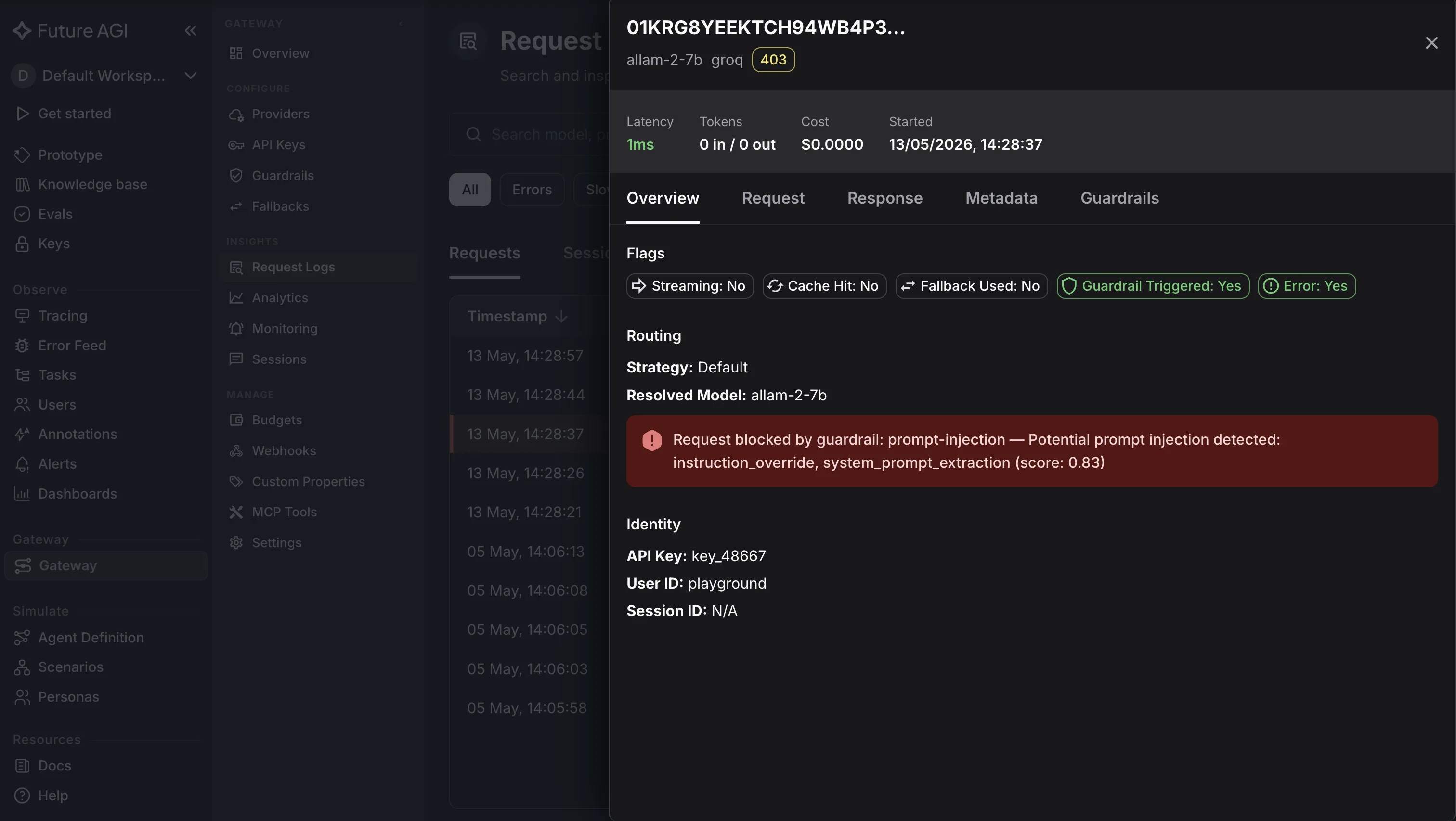
- Inline guardrails with measured latency. Protect runs PII, jailbreak, and toxicity classifiers in the request path with a median 67 ms text-mode latency (per arXiv 2510.13351).
- OSS instrumentation.
traceAI,ai-evaluation, andagent-optare all Apache 2.0. The hosted Command Center adds RBAC, failure-cluster views, Protect, and AWS Marketplace procurement.
Migration from Humanloop: Prompts, eval datasets, and environment pins map cleanly. SDK call sites need rewriting, typically to a thin FAGI SDK call or a direct gateway call with a prompt_ref header. Most templates port mechanically to Jinja2; nested includes and Humanloop-specific filters need a manual pass. Eval datasets in JSONL transfer directly. Timeline: eight to twelve engineering days for under 50 prompts and under 300 call sites, including a shadow-traffic period.
Where it falls short:
-
agent-opt is opt-in, start with traceAI + ai-evaluation for the migration and light up the optimizer once eval baselines stabilize. The loop pays off over weeks rather than on day one.
-
FAGI’s prompt UI is opinionated and fast, fewer side-by-side knobs than Humanloop’s playground, which keeps the daily workflow tight; teams that depend heavily on Humanloop’s prompt-comparison patterns should preview the FAGI workflow before standardizing.
Pricing: Free tier with 100K traces/month. Scale tier from $99/month with linear per-trace scaling. Enterprise with SOC 2 Type II and AWS Marketplace.
Score: 7 of 7 axes.
2. Portkey: Best for hosted gateway with a prompt registry
Verdict: Portkey is the pick when the missing piece in Humanloop is gateway depth, virtual keys, routing, RBAC, and a hosted dashboard. Prompt Studio is functional rather than feature-rich, but for teams whose primary pain was “Humanloop doesn’t proxy our traffic,” Portkey replaces both surfaces with one subscription. Note: Portkey was acquired by Palo Alto Networks on April 30, 2026, creating SMB-SKU uncertainty on a 12-to-24-month horizon.
What it fixes versus Humanloop:
- Native gateway. Virtual keys, cost-aware routing, failover, and per-key budgets are first-class. Teams that ran Humanloop + LiteLLM in parallel collapse to one product.
- Hosted dashboard maturity. Per-request cost, session traces, and RBAC are polished. Humanloop teams that valued the hosted polish migrate without a UX downgrade.
- Prompts module. Prompt Studio versions prompts with a
{{handlebars}}-shaped syntax, server-side resolution. Migrating from Humanloop’s SDK-coupled versioning to Portkey’sprompt_id-coupled versioning is a lateral move on lock-in but consolidates the surface.
Migration from Humanloop: OpenAI-compatible endpoint, provider keys, and metadata headers map directly. Humanloop’s template syntax must be rewritten to Portkey’s dialect; the importer handles common cases. Portkey’s eval surface is leaner, so teams typically run evals in CI. Timeline: six to nine engineering days, plus a separate decision about eval tooling.
Where it falls short:
- The Palo Alto Networks acquisition (April 30, 2026) creates SMB-SKU uncertainty over a 12-to-24-month horizon.
- No optimizer. Traces inform humans, not the platform.
- Eval depth is meaningfully behind Humanloop, Braintrust, and Future AGI.
- You trade one form of prompt-store lock-in (SDK-coupled) for another (
prompt_id-coupled with a Portkey-specific dialect).
Pricing: Free tier with 10K requests/month. Scale tier from $99/month. Enterprise custom.
Score: 5 of 7 axes (missing: eval depth, optimizer loop).
3. Langfuse: Best for OSS observability with prompt management
Verdict: Langfuse is the right pick when the requirement is “self-hostable observability with a real prompt-management module, no more closed-source enterprise tooling.” MIT-licensed, mature prompt versioning, Postgres + ClickHouse stack, active community. You give up Humanloop’s polished playground; you gain source availability and a much friendlier cost curve at scale.
What it fixes versus Humanloop:
- Self-host posture. Langfuse runs on your infrastructure; cloud is optional. For Humanloop exits driven by procurement or regulatory pushback on hosted-only closed-source, this is the cleanest answer.
- First-class prompt management. Versioned prompts with labels (production, staging), retrieval by name and label, an API that doesn’t assume an SDK. Less polished playground than Humanloop; cleaner API. Our explainer on prompt versioning covers registries, labels, and rollback in depth.
- Trace + span depth. OTel-first data model captures agent traces as spans natively.
- Pricing curve. Cloud Pro is $59/month base; self-hosted is your compute. At Humanloop’s enterprise price point, self-hosted Langfuse runs at a fraction of the cost.
Migration from Humanloop: Prompts and version history map well. Langfuse’s prompt API is shaped similarly. The SDK swap is a search-and-replace from humanloop.* to langfuse.*, plus moving rendering client-side. Timeline: five to eight engineering days for self-host, plus a week of ops if you don’t already run ClickHouse.
Where it falls short:
- No first-party gateway. Pair with LiteLLM or Portkey for routing and virtual keys.
- No inline runtime guardrails.
- Self-host operations require Postgres + ClickHouse expertise; small teams without a platform engineer feel this.
- No optimizer.
Pricing: Open source under MIT. Cloud Hobby free, Pro from $59/month, Team from $499/month.
Score: 5 of 7 axes (missing: gateway, inline guardrails).
4. Braintrust: Best for eval-first teams
Verdict: Braintrust is the pick when your reason for leaving Humanloop is “we love the prompt and eval surfaces, we just want them deeper.” Eval-first platform with experiment tracking, polished playground, strong dataset versioning. The migration is lateral; the depth is the upgrade.
What it fixes versus Humanloop:
- Eval depth. The experiment-tracking model (runs, scorers, datasets versioned together) is more rigorous. Teams that found Humanloop’s eval “good enough but shallow” feel the upgrade immediately.
- Playground polish. Side-by-side prompt-comparison UX is at parity with Humanloop and arguably faster.
- OTel traces. Native span ingestion, so multi-step agent traces are first-class rather than retrofitted onto a prompt-log model.
- Pricing transparency. Free tier and self-serve Team plan; enterprise pricing surfaces faster than Humanloop’s.
Migration from Humanloop: Prompts, eval datasets, and metric definitions port well, both speak roughly the same shape. SDK swap is mechanical. Braintrust is more agnostic; you call the provider directly and log to Braintrust as a side effect. Timeline: five to eight engineering days for under 50 prompts.
Where it falls short:
- No native gateway. Pair with Portkey or LiteLLM for routing.
- No inline runtime guardrails.
- No optimizer that closes the loop from eval back to prompt.
- Closed-source and hosted-only; if your exit reason from Humanloop included “we want source-available,” Braintrust isn’t the answer.
Pricing: Free tier with limited monthly events. Team plan from $249/month. Enterprise custom.
Score: 4 of 7 axes (missing: gateway, guardrails, self-host, optimizer).
5. PromptLayer: Best for a leaner prompt registry
Verdict: PromptLayer is the pick when your reason for leaving Humanloop is pricing and what you actually used was prompt versioning plus basic request logs. Specializes in prompt management (versioning, A/B testing, request history) without the full eval, observability, or playground surface. Cheaper, simpler, narrower.
What it fixes versus Humanloop:
- Pricing curve. Pro plan starts around $40/month with usage-based scaling that stays predictable below 1M requests. Teams paying Humanloop $499–$2,000/month for prompt versioning plus light logging see a noticeable cost drop.
- SDK independence. Prompts are fetched by name and version via REST API; the client can be Python, TypeScript, or anything that speaks HTTP. Fills the gap many teams hit with Humanloop’s Python-SDK-first model.
- Simpler surface. If you used Humanloop only for prompt versioning and request logs, PromptLayer covers the same ground with less to learn.
Migration from Humanloop: Prompts and version history port via export-and-import scripts; the API is shaped similarly. SDK swap is mechanical. You lose Humanloop’s eval depth and playground polish. Timeline: four to six engineering days, the cleanest migration in this list for narrow use cases.
Where it falls short:
- No native gateway, no inline guardrails, no optimizer.
- Eval surface is much thinner than Humanloop, Braintrust, or Future AGI, for teams who used Humanloop’s evals heavily, this is a downgrade.
- Smaller community than Langfuse or Braintrust; ecosystem of community-maintained adapters is thinner.
- Hosted-only; no first-party self-host SKU.
Pricing: Free tier with limited requests. Pro from ~$40/month. Enterprise custom.
Score: 3 of 7 axes (missing: gateway, guardrails, optimizer, self-host).
Capability matrix
| Axis | Future AGI | Portkey | Langfuse | Braintrust | PromptLayer |
|---|---|---|---|---|---|
| Prompt-version portability | Native Humanloop importer | Importer + dialect rewrite | Clean API, shaped similarly | Lateral migration | Clean REST API |
| Trace + span depth | OTel-native (traceAI) | Per-request traces | OTel-native | OTel-native | Request history only |
| Gateway / routing features | Native + virtual keys | Native + virtual keys | Pair with LiteLLM | Pair with gateway | Pair with gateway |
| Inline runtime guardrails | Protect (67 ms text) | Optional plugin | None first-party | None first-party | None |
| Eval + optimizer loop | Yes (ai-evaluation + agent-opt) | Eval shallow, no optimizer | Eval + scorers, no optimizer | Eval-first, no optimizer | Eval surface thin |
| Self-host / source availability | BYOC + OSS instrumentation | Hosted; self-host limited | MIT, full self-host | Hosted only | Hosted only |
| SDK independence | Provider-agnostic | Hosted dashboard | Clean API | OTel-native | REST API only |
Migration notes: what breaks when leaving Humanloop
Three surfaces always need attention.
Extracting versioned prompts via the API
Humanloop’s prompt API (GET /v5/projects/{project_id}) returns the project configuration including the current deployed version. The export script most teams write paginates GET /v5/projects, fetches /versions and each /versions/{version_id} body, and persists one JSON file per project with versions as an array. Include the environment pins (production, staging), they encode which version is canonical.
The rewrite step converts Humanloop’s template syntax to your destination format (typically Jinja2). Variable substitution and defaults are mechanical. The partial inclusion mechanism, environment-specific overrides, and inline JavaScript expressions need a manual pass. Future AGI’s Humanloop importer handles common cases and flags nested references. Under 30 prompts is two to three days; above 100, plan a full sprint.
Re-pointing the SDK-coupled call sites
This is the bigger surface than the prompts themselves. Humanloop’s SDK call pattern is humanloop.completions.create(project="support-bot", inputs={...}), the platform fetches the prompt (at whatever version the environment pin points to), substitutes variables, calls the model, logs. To migrate, three things change: the prompt fetch moves to the new registry (or in-repo Jinja2), rendering moves client-side, and the model call goes directly to the provider or through a gateway. Static analysis on humanloop.* imports gives you the inventory; the rewrite is mechanical but cutover should be phased with feature flags.
Re-routing observability sinks
Humanloop’s SDK auto-logs to Humanloop. On migration, logs need to land somewhere, a Langfuse or Future AGI sink via OTel, a gateway that captures traces (Portkey or FAGI), or an OTel collector pointed at your existing stack. Pick this early because the rewritten call sites need to know which client to log to.
Decision framework: Choose X if
Choose Future AGI if you want trace data to drive prompt rewrites, you need a gateway and inline guardrails in the same surface, and you want the loop to close from production trace through eval to optimizer. Pick this when production agent workloads are becoming a significant line item and the OSS instrumentation plus the hosted Command Center together justify the migration.
Choose Portkey if the missing piece in Humanloop is gateway depth and you want a hosted dashboard with virtual keys, routing, and RBAC. Pick this when consolidating Humanloop + LiteLLM into one product is the goal, and the Palo Alto Networks acquisition is acceptable on the procurement timeline.
Choose Langfuse if you want self-hostable observability with a real prompt-management module and have the platform engineering to run Postgres + ClickHouse. Pick this when source availability and a friendly cost curve beat hosted polish.
Choose Braintrust if your reason for leaving is “we love the shape of Humanloop, we just want it deeper.” Pick this when eval and experiment tracking are the headline use case and you don’t need gateway, guardrails, or self-host.
Choose PromptLayer if your reason for leaving is pricing and what you actually used was prompt versioning plus light request logs. Pick this for narrow use cases.
What we did not include
Three products show up in other 2026 Humanloop alternatives listicles that we left out: LangSmith (capable but the same closed-source, hosted-only, enterprise-priced shape that drives the Humanloop exit in the first place); Weights & Biases Weave (strong for ML experiment tracking but the prompt-management surface is thinner); Vellum (worth a look for prompt-engineering teams, but gateway and trace depth aren’t at parity with the five above).
Related reading
- Best 5 Portkey Alternatives in 2026
- Best 5 Langfuse Alternatives in 2026
- Best LLM Observability Platforms in 2026
- Best AI Gateways for Agentic AI in 2026
Sources
- Humanloop prompt API documentation, humanloop.com/docs/api-reference
- Humanloop pricing page, humanloop.com/pricing
- Portkey product page, portkey.ai
- Palo Alto Networks press release on Portkey acquisition, April 30, 2026, paloaltonetworks.com/company/press
- Langfuse GitHub repository, github.com/langfuse/langfuse (MIT)
- Langfuse pricing, langfuse.com/pricing
- Braintrust product page, braintrust.dev
- PromptLayer product page, promptlayer.com
- Future AGI Agent Command Center, futureagi.com/platform/monitor/command-center
- Future AGI traceAI, github.com/future-agi/traceAI (Apache 2.0)
- Future AGI ai-evaluation, github.com/future-agi/ai-evaluation (Apache 2.0)
- Future AGI agent-opt, github.com/future-agi/agent-opt (Apache 2.0)
- Future AGI Protect latency benchmark, arxiv.org/abs/2510.13351 (67 ms text, 109 ms image)
Frequently Asked Questions
Why are people moving off Humanloop in 2026?
What is the closest like-for-like alternative to Humanloop?
How do I migrate prompts out of Humanloop?
What about the Humanloop SDK lock-in?
Is there an open-source Humanloop alternative?
Which Humanloop alternative is cheapest at scale?
How does Future AGI Agent Command Center compare to Humanloop?
Compare 8 AI prompt management tools in 2026 across versioning, eval gates, and runtime routing. Honest tradeoffs and when to pick each.


DSPy, FutureAGI Prompt Optimizer, PromptFoo, OpenAI Playground, Helicone Prompts, Braintrust Prompts, plus tradeoffs for 2026 prompt engineering workflows.


Honest 2026 comparison of Langfuse alternatives: Future AGI, LangSmith, Phoenix, Braintrust, Helicone on eval depth, gateway, and the loop.