Best 5 AI Guardrails for Healthcare AI Applications in 2026
Five AI guardrails compared for healthcare: clinical decision, ambient scribes, prior auth, portal chatbots. HIPAA, FDA SaMD, EU AI Act 14.
Table of Contents
What Are the Five Best AI Guardrails for Healthcare in 2026?
A digital-health vendor’s ambient scribe started generating clinical notes from patient encounters in March. The scribe sent unredacted PHI to a non-BAA-covered model provider for several weeks. It surfaced when a patient’s daughter saw their mother’s full chart in a third-party developer console. The breach notification went to HHS under HITECH; the OCR enforcement window for that scale of exposure has produced settlements as large as Anthem’s $16M (2018) and Premera’s $6.85M (2020). This post compares the five AI guardrails platforms healthcare teams should consider in 2026, ranked by what production teams ship to a privacy officer, an OCR investigator, and an FDA SaMD reviewer.
The pattern across clinical decision support, ambient scribes, prior authorization agents, patient-portal chatbots, medical coding copilots, and drug-discovery research assistants is the same: generic LLM-security guardrails treat healthcare as an annotation, but healthcare-specific guardrails enforce HIPAA §164.514 de-identification, BAA-boundary integrity, FDA SaMD change-control, and EU AI Act Article 14 human-oversight at runtime, not in a one-shot validation. For the broader pattern, see the ultimate guide to LLM guardrails.
| # | Platform | Best for | Pricing model |
|---|---|---|---|
| 1 | Future AGI Protect | PHI-safe multi-modal guardrails with write-side redaction and span-linked policy + eval reasoning | Cloud + OSS self-host; Free + Pay-as-you-go; Boost/Scale/Enterprise add-ons |
| 2 | Lakera Guard | Prompt-injection breadth on text-only patient-portal chat, Gandalf-bench-anchored | Tiered cloud SaaS |
| 3 | NVIDIA NeMo Guardrails | Open-source Colang policy for academic / federal-contractor healthcare | Open source (free) |
| 4 | AWS Bedrock Guardrails | AWS-stack-resident health systems and payers | AWS metered usage |
| 5 | Protect AI | Healthcare AppSec-owned MLSecOps | Enterprise contract + open source |
TL;DR
- Future AGI Protect for the Future AGI Protect model family (Gemma 3n + fine-tuned adapters per safety rule across Toxicity, Tone, Sexism, Prompt Injection, Data Privacy) with multi-modal text/image/audio coverage, ~67 ms p50 inline latency, write-side PHI redaction before the BAA boundary, per-tenant policy, and SOC 2 Type II + HIPAA + GDPR + CCPA certified per the trust page with HIPAA BAA available on the Scale add-on
- Lakera Guard for prompt-injection / jailbreak detection on a pan-provider text-only chat stack, the security-team-first pick
- NVIDIA NeMo Guardrails for academic medical centres and federal-contractor healthcare research that need source-readable Colang policy
- AWS Bedrock Guardrails for AWS-stack-resident health systems and payers already on a HIPAA-eligible BAA
- Protect AI for healthcare AppSec teams that own the buy and need ML-supply-chain-aware tooling
Why Is Healthcare AI Guardrails Different From Generic LLM Security?
Healthcare teams ship AI faster than they put runtime policy on it, and the failure mode is patient-harm-shaped and HHS-OCR-enforcement-shaped, not user-experience-shaped.
Three reasons generic LLM evaluation and generic LLM-security guardrails fall short here:
- The audience is regulators and clinical reviewers, not users. Healthcare AI outputs are read by OCR investigators after a breach, FDA SaMD reviewers at change-control, and clinicians at the point of care. A guardrail decision has to come with a reason a clinical reviewer can use, an audit-trail-grade trace, and a span-level record that survives the HIPAA Security Rule §164.312(b) audit-control review.
- The data path is constrained. PHI cannot leave the BAA boundary. That means a guardrail layer has to redact PHI before the prompt reaches an upstream provider, not after. HIPAA §164.514 sets two paths: Safe Harbor (remove 18 named identifiers) and Expert Determination (statistical de-identification). Runtime PHI redaction enforces Safe Harbor at the gateway; Expert Determination still requires a qualified expert.
- Policy obligations are simultaneous. A health system running a CDS LLM operates under §164.312(b) audit controls, FDA SaMD / PCCP change control, 21st Century Cures information-blocking, EU AI Act Article 14 human-oversight (medical AI is named explicitly), and a state-privacy stack of California CMIA, NY SHIELD, Texas HB 4. None of these are satisfied by a generic LLM-security guardrail alone.
Most listicles in 2026 either pitch a generic LLM-security product (pan-industry, BAA an afterthought) or pitch an annual SaMD validation cycle (FDA-shaped snapshot, not continuous). The runtime PHI-redaction + prompt-injection-blocking layer is what determines whether your CDS LLM clears OCR audit, whether your ambient scribe survives a HIPAA breach, and whether your patient-portal chatbot avoids a state medical-board referral.
Where things get thin in 2026 is the gap between LLM-security-vendor pan-industry guardrails and healthcare-specific runtime enforcement at the BAA boundary. Future AGI Protect fills that gap with the Future AGI Protect model family: Gemma 3n + fine-tuned adapters across 5 safety rules (Toxicity, Tone, Sexism, Prompt Injection, Data Privacy), multi-modal text/image/audio, ~67 ms p50 text inline (arXiv 2510.13351), write-side guard that refuses PHI before it leaves the BAA boundary, per-tenant policy, and SOC 2 Type II + HIPAA + GDPR + CCPA certified per the trust page with HIPAA BAA available on the Scale add-on. The policy decision and the eval score that explains it stay linkable in one trace.
What Is the Future AGI Healthcare Guardrails Scorecard?
The Future AGI Healthcare Guardrails Scorecard is a five-dimension rubric for assessing whether an LLM guardrails platform meets healthcare production requirements:
- Prompt-injection detection rate. Score against named eval sets (Gandalf-bench, INJECAGENT, AdvBench). Healthcare-relevant prompt injections include patient-history-buried instruction overrides, retrieved-clinical-guideline poisoning, and prior-auth payer-policy extraction.
- PHI redaction quality at the BAA boundary. Coverage of HIPAA §164.514 Safe Harbor 18-identifier list, plus Expert Determination workflow support. Pre-completion redaction so PHI fields never reach an upstream provider that isn’t BAA-covered.
- Jailbreak / harmful-content resistance. Toxicity policy enforcement on patient-portal chatbots, clinical-safety policy on triage and CDS responses, refusal patterns on out-of-scope requests (self-diagnosis pressure, for example).
- Latency overhead. p50 / p95 / p99 inflation by the guardrail layer. Clinical-UI workloads run under a 2-second budget. A 400 ms overhead at p95 means the layer is shippable; a 1.2 s overhead means it isn’t.
- Policy-rule maintainability + clinical-guideline mapping. DSL vs. config vs. ML-classifier vs. YAML-as-policy. How does the policy keep up with USPSTF / ACOG / ACS guideline updates? Who owns the rule when CDC issues a vaccine-schedule revision?
Each platform below is scored against this rubric in the comparison matrix.
How Do These Five Platforms Compare on Capability?
| Capability | Future AGI Protect | Lakera Guard | NeMo Guardrails | Bedrock Guardrails | Protect AI |
|---|---|---|---|---|---|
| Prompt-injection detection | Yes (Prompt Injection rule; multi-modal) | Yes (Gandalf-bench-anchored, text-only) | Yes (Colang policy) | Yes (managed filters) | Yes (LLM Guard rules) |
| PHI redaction (HIPAA §164.514) | Yes (Data Privacy rule, write-side, BAA-signable) | PII filters; healthcare scope per-deployment | Custom Colang rules | Yes (managed PII redaction; HIPAA-eligible BAA) | Custom rule pipeline |
| Jailbreak / toxicity resistance | Yes (Toxicity rule + span_id-linked eval) | Yes (red-team coverage) | Yes (Colang refusal flows) | Yes (managed content filters) | Yes (LLM Guard) |
| Multi-modal coverage (text/image/audio) | Yes (Gemma 3n base, all three) | Text only | Text only | Limited (text + image) | Text only |
| Latency overhead (p50 / p95) | ~67 ms p50 inline | Low (proxy or SDK mode) | Variable (Colang interpreter) | Low (managed) | Variable (rule pipeline) |
| Policy-rule maintainability | Admin control plane + eval-loop | Managed rules + custom | Open-source Colang DSL (source-readable) | Managed dashboard | Open-source LLM Guard + Guardian |
| Deployment model | Managed + hybrid local + BYOC | Managed cloud + SDK | Self-host (open source) | Managed (AWS) | Open source + enterprise |
How Did We Rank These Five Platforms?
The ranking criteria sit on top of the scorecard above. We weighted:
- Healthcare-readiness. Does the guardrail layer enforce PHI redaction at the BAA boundary, or is “PHI” treated as a generic PII variant?
- Span-linkage between policy decision and eval reasoning. When a guardrail blocks an output, can a privacy officer trace why in the same store the team already operates?
- Latency under clinical-UI budget. p95 < 500 ms is a working bar; p95 > 1 s is not shippable for CDS at the bedside.
- Policy-rule maintainability against clinical-guideline drift. Does the policy layer accept structured updates from USPSTF / ACOG / ACS without re-engineering?
- Honest limitations. Does each platform name what it isn’t best at?
Where things get thin in this category: no guardrails platform is HIPAA-certified-by-product (HIPAA compliance is per-deployment under a BAA), FDA-cleared (SaMD clearance is per-product, not per-guardrail), or a 100% block on prompt injection (no layer is). Each platform fits a specific buyer profile. Pick by where the failure mode lives.
#1 Future AGI Protect: Best for PHI-Safe Multi-Modal Guardrails with Span-Linked Policy and Eval
Best for: Healthcare engineering teams that need write-side PHI redaction plus prompt-injection detection across text, image, and audio, span-linked to evaluator reasoning, across a multi-provider model fleet, without per-provider code changes and under a signed BAA.
Key strengths:
- The Future AGI Protect model family: Gemma 3n + fine-tuned adapters across 5 safety rules (Toxicity, Tone, Sexism, Prompt Injection, Data Privacy), multi-modal text/image/audio, ~67 ms p50 text inline (arXiv 2510.13351). The Data Privacy rule is the runtime PHI-redaction surface; the Prompt Injection rule blocks prompt injection and jailbreak; the Sexism rule catches discriminatory triage outputs; the Toxicity rule handles harmful content and out-of-scope refusal.
- Write-side guard refuses PHI before it lands in cache, vector store, or upstream provider token logs. The same write-side surface blocks indirect injection from retrieved clinical guidelines before the agent consumes them.
- Per-tenant policy so one deployment can serve an ambient-scribe vendor, an EHR-adjacent CDS, and a payer prior-auth agent under three different rule sets without copying policy across SDK calls.
- Integrates with
traceAIandai-evaluation: every gateway call generates a span, the guardrail decision attaches as a span attribute, downstream evaluator scoring (Toxicity, PII Detection, Hallucination) links back viaspan_id. Teams operating a §164.312(b)-aligned audit-control store keep the policy decision and the eval explaining it linkable in the trace store the team already operates. - SOC 2 Type II + HIPAA + GDPR + CCPA certified. HIPAA BAA available on the Scale add-on. ISO 27001 in active audit. Federal procurement via air-gapped self-host (BYOC); FedRAMP on partner roadmap.
- Hybrid local/cloud execution: 60+ built-in evaluators across 11 categories in ai-evaluation plus unlimited custom evaluators authored by an in-product agent; local heuristic path (regex, JSON schema, BLEU/ROUGE, semantic similarity) at zero API cost.
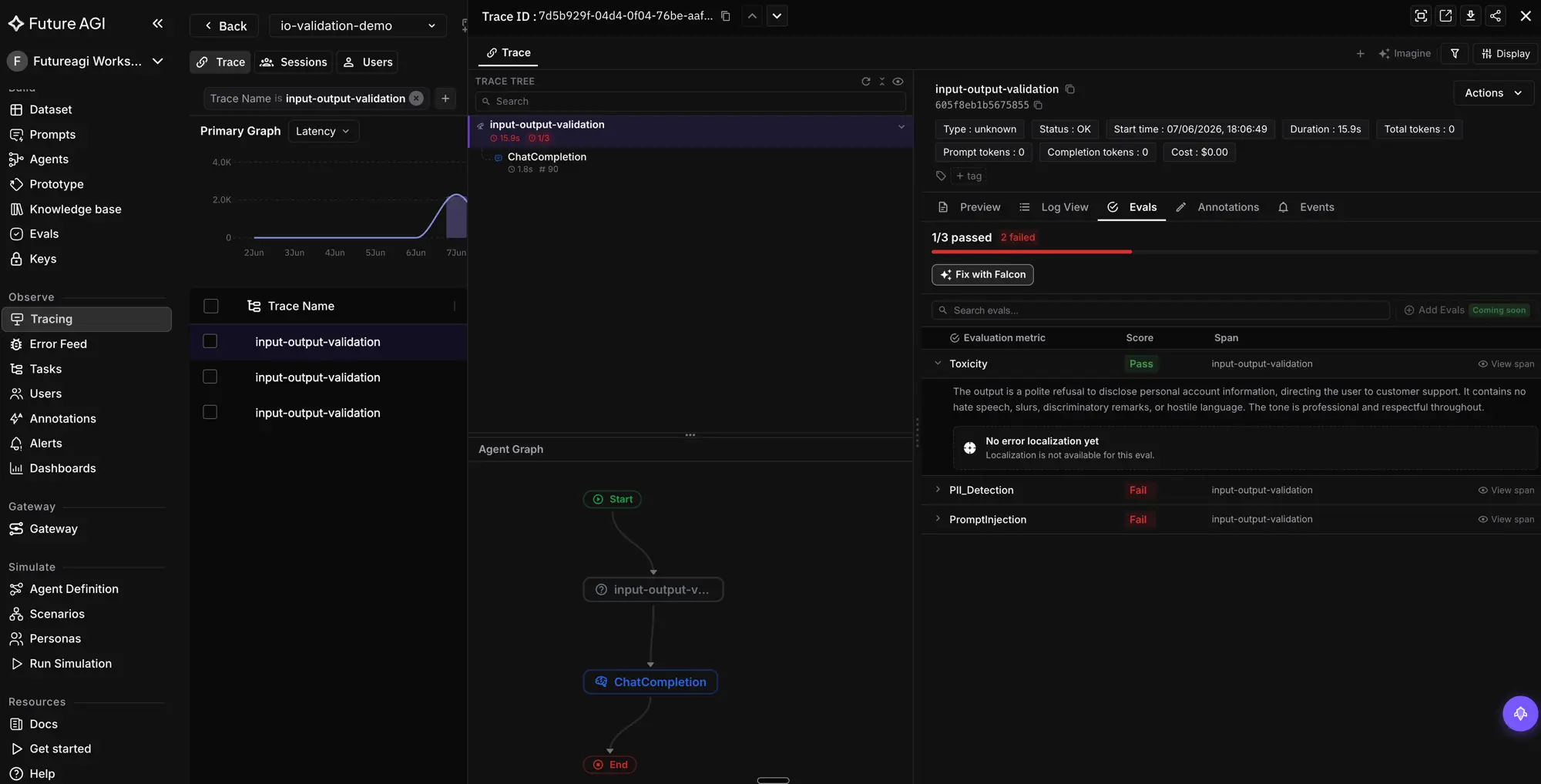
- Slots into LLM-as-a-judge workflows; field-level error localization closes the gap between “the guardrail blocked the output” and “here is exactly which prompt segment, retrieved chunk, or tool argument triggered the policy.”
Limitations:
- Opinionated prompt library. Fewer review-and-collaboration knobs than a dedicated prompt registry, by design. The trade is prompt, eval, and guardrail policy live in the same control plane so the audit trail doesn’t fragment across three vendors.
- agent-opt is opt-in. The self-improving optimizer loop runs per route, not as a default. The trade is the optimizer runs against real production traffic with eval scores joined to spans, not a synthetic corpus.
- Federal procurement via BYOC. Air-gapped self-host today; FedRAMP on the partner roadmap. The trade is federal-grade data residency without waiting on a vendor’s authorization cycle.
Use-case fit: Clinical decision support, ambient scribes (post-recording mode), prior authorization agents, patient-portal chatbots, medical coding copilots, drug-discovery research assistants. The wedge bites hardest when PHI must stay inside the BAA boundary, prompt-injection blocking is binding, multi-modal surfaces (voice + document) are in play, and policy + eval reasoning need to live in one trace store.
Pricing & deployment. Cloud + OSS self-host (Apache 2.0 SDK suite: traceAI, ai-evaluation, agent-opt). Free to start with the full platform; pay-as-you-go as usage grows. Compliance and enterprise add-ons (SOC 2 Type II, HIPAA BAA, SAML SSO + SCIM, dedicated CSM) layer on as you need them. Pricing. Local heuristic-metric path runs at zero API cost. Deploy as a drop-in OpenAI proxy or via the Agent Command Center.
Verdict: The PHI-safe-stack pick. If your binding constraints are PHI redaction at the BAA boundary, prompt-injection blocking across a multi-provider fleet, and span-linked policy-and-eval reasoning, Future AGI Protect plus traceAI plus ai-evaluation is the workflow that delivers all three.
#2 Lakera Guard: Best for Prompt-Injection Breadth on Text-Only Patient-Portal Chat
Best for: Healthcare security teams whose primary 2026 obligation is prompt-injection / jailbreak detection across a multi-provider LLM stack on a text-only chat surface, where named eval-set scoring (Gandalf-bench, INJECAGENT, AdvBench) is what their CISO expects to see.
Key strengths:
- Named-vendor leader for LLM-security guardrails: among the most established prompt-injection / jailbreak detection products in the market.
- Public Gandalf-bench benchmark plus internal eval coverage on INJECAGENT and AdvBench-style adversarial prompts.
- Low-latency proxy and SDK modes; suitable for clinical-UI latency budgets when deployed as a sidecar.
- Strong red-team coverage and a published vulnerability disclosure cadence.
- Pan-provider support; drops cleanly into stacks with multiple model vendors.
Limitations:
- Pan-industry positioning by design; healthcare-specific PHI redaction at the BAA boundary is per-deployment configuration rather than a healthcare-named product surface.
- Text-only. Voice ambient-scribe streams and document-AI image surfaces fall outside the product; multi-modal healthcare AI needs a second layer.
- BAA execution is per-deployment; “HIPAA-aligned” marketing language does not substitute for a signed Business Associate Agreement.
- Clinical-guideline mapping (USPSTF / ACOG / ACS rule updates) is a custom workflow, not a managed surface.
Use-case fit: Patient-portal chatbot prompt-injection blocking, prior authorization agent jailbreak resistance on text surfaces, CDS prompt safety where security-team ownership and named eval-set scoring are the binding constraints.
Pricing & deployment: Tiered cloud SaaS; managed proxy or SDK deployment.
Verdict: The text-only prompt-injection specialist. If your CISO owns the AI safety buy and prompt-injection detection rate on text chat is the single binding metric, Lakera is the clearest single-vendor answer.
#3 NVIDIA NeMo Guardrails: Best for Open-Source Colang Policy in Academic / Federal-Contractor Healthcare
Best for: Academic medical centres, federal-contractor healthcare research, and engineering teams that need source-readable policy rules in a DSL their counsel can audit line-by-line.
Key strengths:
- Open-source Colang DSL is the strongest source-readable-policy story in the category.
- Policy rules sit in version control alongside the application; legal and compliance reviewers can read the policy directly rather than reading a managed-config dashboard.
- Strong fit for federal-contractor healthcare research where source-availability is a procurement requirement.
- Active NVIDIA-led development cadence; integrates with NVIDIA inference stacks.
Limitations:
- Engineering lift is real; Colang interpreter latency variance is wider than managed proxies, so production deployments need careful caching and policy-precompilation.
- Healthcare-specific PHI redaction is custom Colang work, not an out-of-the-box surface.
- BAA execution remains per-deployment between the covered entity and the model-hosting provider.
- Smaller procurement footprint with health-system Legal & Compliance than the managed incumbents.
Use-case fit: CDS LLMs at academic medical centres, drug-discovery research assistants at federal-contractor pharma, internal-research copilots where policy auditability is a binding requirement.
Pricing & deployment: Open source (free); self-host.
Verdict: The source-readable-policy pick. If your counsel needs to read the policy in source, NeMo Guardrails is the clearest open-source path. Pair with a managed PHI-redaction layer or a custom Colang library when BAA-boundary enforcement becomes the gate.
#4 AWS Bedrock Guardrails: Best for AWS-Stack-Resident Health Systems and Payers
Best for: Health systems and payers already running AWS Bedrock under a HIPAA-eligible BAA, where the binding constraint is staying inside the AWS data-governance boundary.
Key strengths:
- Managed cloud-native; HIPAA-eligible BAA available on Bedrock, the AWS-stack-default for healthcare.
- Built-in content filters, PII redaction, and grounding checks; managed updates without engineering lift.
- Deep integration with the AWS audit and IAM stack: CloudTrail, KMS-encrypted spans, VPC-resident traffic.
- Strong fit for tier-1 payers and integrated delivery networks already running AWS-resident analytics.
Limitations:
- AWS-only; multi-cloud or multi-provider deployments need a separate guardrail layer for non-Bedrock models.
- “HIPAA-eligible BAA” is real but execution-specific; BAA terms must be signed per-deployment, not assumed by product property.
- Less granular policy-rule control than Colang-based or DSL-based platforms.
- FDA SaMD change-control workflow remains the operator’s responsibility; AWS does not perform SaMD validation.
Use-case fit: Claims-handling LLMs at payers, prior auth agents, member-service chatbots, EHR-adjacent CDS where the model is already hosted in Bedrock.
Pricing & deployment: AWS metered usage; managed cloud.
Verdict: The AWS-stack-default pick. If your model fleet is on Bedrock and your BAA is signed there, Bedrock Guardrails is the lowest-friction managed answer. For multi-cloud stacks, layer with a pan-provider security guardrail or a gateway-native platform.
#5 Protect AI: Best for Healthcare AppSec-Owned MLSecOps
Best for: Healthcare AppSec teams that own the AI-safety buy and need ML-supply-chain-aware tooling alongside runtime guardrails.
Key strengths:
- Security-focused; ML-supply-chain-aware (model scanning, dependency review).
- Guardian (managed) + LLM Guard (open-source) split: open-source path for engineering teams that need self-host, managed path for AppSec-led procurement.
- Strong fit for organizations where the CISO owns AI safety and wants the same vendor across MLSecOps + runtime guardrails.
- Acquired by Palo Alto Networks in 2024, which adds long-term enterprise viability.
Limitations:
- Healthcare-vertical positioning is implicit, not explicit; the marketing surface is AppSec-shaped, not CMIO-shaped.
- BAA execution and §164.514 Safe-Harbor mapping are per-deployment configuration.
- Less mature span-linked eval reasoning than gateway-native platforms.
- Buyer fit is narrower: best when AppSec owns the buy, weaker when the CMIO or privacy officer drives.
Use-case fit: Drug-discovery research assistants where IP / trade-secret leak prevention is binding, internal CDS pilots where AppSec is the procurement owner, ambient scribe vendors that need ML-supply-chain scanning alongside runtime guardrails.
Pricing & deployment: Enterprise contract for Guardian; open source for LLM Guard.
Verdict: The AppSec-owned pick. If your CISO is the buyer and ML-supply-chain coverage matters as much as runtime policy, Protect AI is the cleanest single-vendor answer for that buying motion.
Which Guardrails Platform Should Your Healthcare Team Pick?
| If you’re a… | Pick |
|---|---|
| Health system CIO running a CDS LLM across a multi-provider fleet | Future AGI Protect (write-side PHI + span-linked eval) |
| Payer with a prior-auth agent on AWS Bedrock and a signed HIPAA-eligible BAA | AWS Bedrock Guardrails |
| Digital-health startup needing PHI-safe drop-in proxy with cost-controlled runtime | Future AGI Protect |
| Pharma research org with drug-discovery copilots and IP-leak as the binding risk | Protect AI (ML-supply-chain) or NVIDIA NeMo Guardrails (source-readable Colang) |
| EHR vendor embedding a CDS LLM with multi-tenant deployment | Future AGI Protect (per-tenant policy + admin control plane) |
| Ambient-scribe vendor with post-recording or audio-stream note generation | Future AGI Protect (multi-modal: text + image + audio; BAA-signable) |
| Security-team-led patient-portal chatbot on text-only chat | Lakera Guard (Gandalf-bench-anchored) |
Where Does Each Platform Earn Its Slot?
The five platforms above split the healthcare-AI guardrails problem along different axes: PHI-safe multi-modal write-side guardrails with span-linked policy and eval (Future AGI Protect), text-only prompt-injection breadth (Lakera Guard), source-readable open-source Colang policy (NeMo Guardrails), AWS-stack-resident managed enforcement (Bedrock Guardrails), and AppSec-owned MLSecOps (Protect AI). For most health systems and digital-health vendors in 2026, the right answer is a layered stack: a multi-modal write-side guardrail with eval-and-trace integration for the audit-trail-grade record OCR will subpoena, plus a specialist text-only prompt-injection detector when patient-portal chat is the binding surface.
If PHI-redaction at the BAA boundary, prompt-injection blocking across a multi-provider fleet, and span-linked policy-and-eval reasoning are the three constraints that bite hardest, Future AGI Protect is the workflow that fits, wired across providers and integrated with traceAI and ai-evaluation so the policy decision and the eval score that explains it stay linkable in the same trace.
Related reading
Frequently Asked Questions
What's the difference between an AI gateway, an LLM-security guardrail, and a healthcare-specific guardrails layer?
Which AI guardrails platform is best for an ambient scribe?
How does a guardrails layer support HIPAA §164.514 de-identification?
Can I run a healthcare AI guardrails layer without exposing PHI to a third-party model?
Does an AI guardrails platform replace FDA SaMD validation or HIPAA BAA execution?
How often should healthcare teams refresh guardrail policy rules?
Healthcare AI eval in 2026: five platforms scored on HIPAA + BAA, clinical-grade rubrics, audit-trace retention. FAGI, Galileo Luna-2, Braintrust, Datadog.

Five healthcare AI observability platforms scored on HIPAA trace ingestion, §164.312(b) retention, per-clinician access, BAA-boundary integrity. May 2026.
Senior-engineer comparison of the best AI agent guardrails platforms 2026: latency budgets, placement, deployment topology, vendor fit.