Best 5 Hamming Alternatives in 2026
Five Hamming alternatives on multimodal eval, gateway-runtime, OSS instrumentation, deployment. What each actually fixes when voice-only QA falls short.
Table of Contents
Hamming AI was the cleanest answer in 2024-early 2025 for one painful question: how do I run thousands of synthetic phone calls against my voice agent and grade the transcripts without hiring a QA org? Through Q1 2026 the same shortlist of frustrations keeps showing up in migration threads. Scope is voice-only, chat, RAG, MCP-driven tool use, and image workloads are out of frame. There’s no native gateway, router, or runtime guardrail, so eval results live in a dashboard that doesn’t feed back into the request path. The SDK is Python-only and hosted-only, with no on-prem option for regulated buyers. Pricing is sales-gated below an enterprise contract.
This guide ranks five platforms worth migrating to when Hamming’s voice-only scope stops fitting the wider agent surface area. It walks through the migration that always trips teams up: Hamming uses a Python SDK to push test runs at a hosted backend, so leaving means re-instrumenting your agent’s evaluation entry point against a different library, and bringing voice metrics (WER, time-to-first-byte, ASR confidence) over to a stack that may not measure them natively.
TL;DR: pick by exit reason
| Why you are leaving Hamming | Pick | Why |
|---|---|---|
| You want voice plus chat plus tool-use plus image eval in one place, wired to a runtime | Future AGI Agent Command Center | Multimodal eval, OSS instrumentation, gateway with Protect guardrails, self-improving loop |
| You want a deeper voice-and-chat simulation harness from the Waymo playbook | Coval | Simulation-first, voice-realism testing, real-time alerts on production calls |
| You want voice and chat QA with red-teaming and LiveKit/Pipecat-first hooks | Cekura AI | Pre-prod adversarial sims plus production monitoring across SIP/WebRTC/WebSocket |
| You want an eval surface that also ships a fast multi-provider gateway | Maxim (Bifrost + eval) | Bifrost gateway plus eval, simulation, and voice-agent observability in one platform |
| You want a hosted developer-experience gateway as the runtime layer | Portkey | Prompt registry, virtual keys, RBAC, polished dashboard (note Palo Alto acquisition pending) |
Why people are leaving Hamming in 2026
Five exit drivers show up in /r/voiceAI migration threads, the Voice AI Engineers Slack, and post-evaluation notes from teams who shortlisted Hamming and picked something else.
1. Voice-only scope when agents stop being voice-only
The synthetic-caller wedge worked in 2024 because most teams were either voice or chat, rarely both. By mid-2026 the typical production agent is a voice front end on a chat-and-tool-use backend, or a chat agent with a voice fallback, or an MCP-driven tool runner that occasionally renders an image. Hamming evaluates the voice surface. The chat replies, tool calls, retrieval grounding, and image outputs need a separate eval stack. Teams who started with Hamming for the voice piece keep buying a second platform for everything else, and at some point the second platform absorbs the first.
2. No native gateway, router, or runtime
Hamming is an evaluation product. It doesn’t sit in the request path the way an AI gateway does. No virtual-key surface, no provider failover, no cost-aware routing, no inline guardrail layer that can block a bad response before the caller hears it. Eval results land in a dashboard, and someone (a human, a CI pipeline, a script) has to translate them back into a prompt edit or a routing change. Teams that adopt a gateway alongside Hamming end up with two dashboards and a manual loop between eval signal and runtime.
3. Python-only SDK and hosted-only deployment
The SDK is Python. For TypeScript, Go, or Java backends, dominant runtimes for voice infra in 2026, instrumenting Hamming means a Python sidecar. Deployment is hosted-only: no self-host, no BYOC, no air-gapped tier. Hamming signs BAAs for HIPAA, but BAAs don’t satisfy data-residency, sovereign-cloud, or strict on-prem.
4. Sales-gated pricing below an enterprise contract
Hamming doesn’t publish pricing. Every conversation starts with a demo and sales call. For teams already paying for a gateway, observability, and prompt platform, a fourth sales cycle for the voice piece is friction. Competitors either publish prices (Coval, Cekura) or ship an OSS triad teams adopt on day one (Future AGI).
5. Eval-only loop with no instrumentation portability
Hamming captures eval data inside its own data model. There’s no Apache 2.0 library emitting OpenTelemetry traces with voice semantic conventions (turn boundaries, ASR confidence, WER, TTFB) you can drop into any agent. Move off Hamming and the eval traces don’t come with you. That portability gap is the biggest 18-month concern for teams investing in voice quality.
What to look for in a Hamming replacement
The default “best voice agent eval” axes are necessary but not sufficient for a real Hamming exit. Score replacements on the seven that map to the surfaces you’re actually migrating off:
| Axis | What it measures |
|---|---|
| 1. Multimodal eval coverage | Voice plus chat plus tool-use plus image, or voice only? |
| 2. Gateway + runtime integration | Does the eval surface wire to the agent’s request path, or sit beside it? |
| 3. OSS instrumentation | Is there an Apache 2.0 library with voice-aware semantic conventions, portable across vendors? |
| 4. Deployment posture | Hosted only, BYOC, self-host, on-prem? |
| 5. Voice-specific metrics depth | WER, ASR confidence, latency-to-first-byte, turn-taking, interruption handling, sentiment shift |
| 6. Eval-to-optimizer loop | Does the platform use its own eval data to improve prompts and routing automatically? |
| 7. Migration tooling from Hamming | Are there documented paths for porting Hamming-style test sets and voice metrics? |
1. Future AGI Agent Command Center: Best for closing the loop across the whole agent surface
Verdict: Future AGI fixes Hamming’s biggest structural gap, eval lives in one product, runtime lives somewhere else, and nothing closes the loop, by unifying the OSS instrumentation triad, eval suite, optimizer, and gateway with guardrails in one surface. Voice metrics are first-class alongside chat, tool-use, and image metrics, so a multimodal agent gets one data model instead of three. Agent Command Center captures the trace, scores it, clusters failures, runs the optimizer, and pushes the updated prompt or route back into the gateway on the next request.
What it fixes versus Hamming:
-
Multimodal eval, not voice-only.
ai-evaluation(Apache 2.0) ships rubrics for task-completion, faithfulness, tool-use, RAG groundedness, image quality, and voice (WER, ASR confidence, turn-taking, TTFB, sentiment shift). One eval surface scores the voice turn, the underlying chat reply, and the tool call. -
OSS instrumentation with portable semantic conventions.
traceAI(Apache 2.0) emits OpenTelemetry traces with LLM, tool-call, and voice semantic conventions. Drop it into TypeScript, Python, Go, or Java and the trace data survives a future vendor swap. Hamming has nothing in this shape.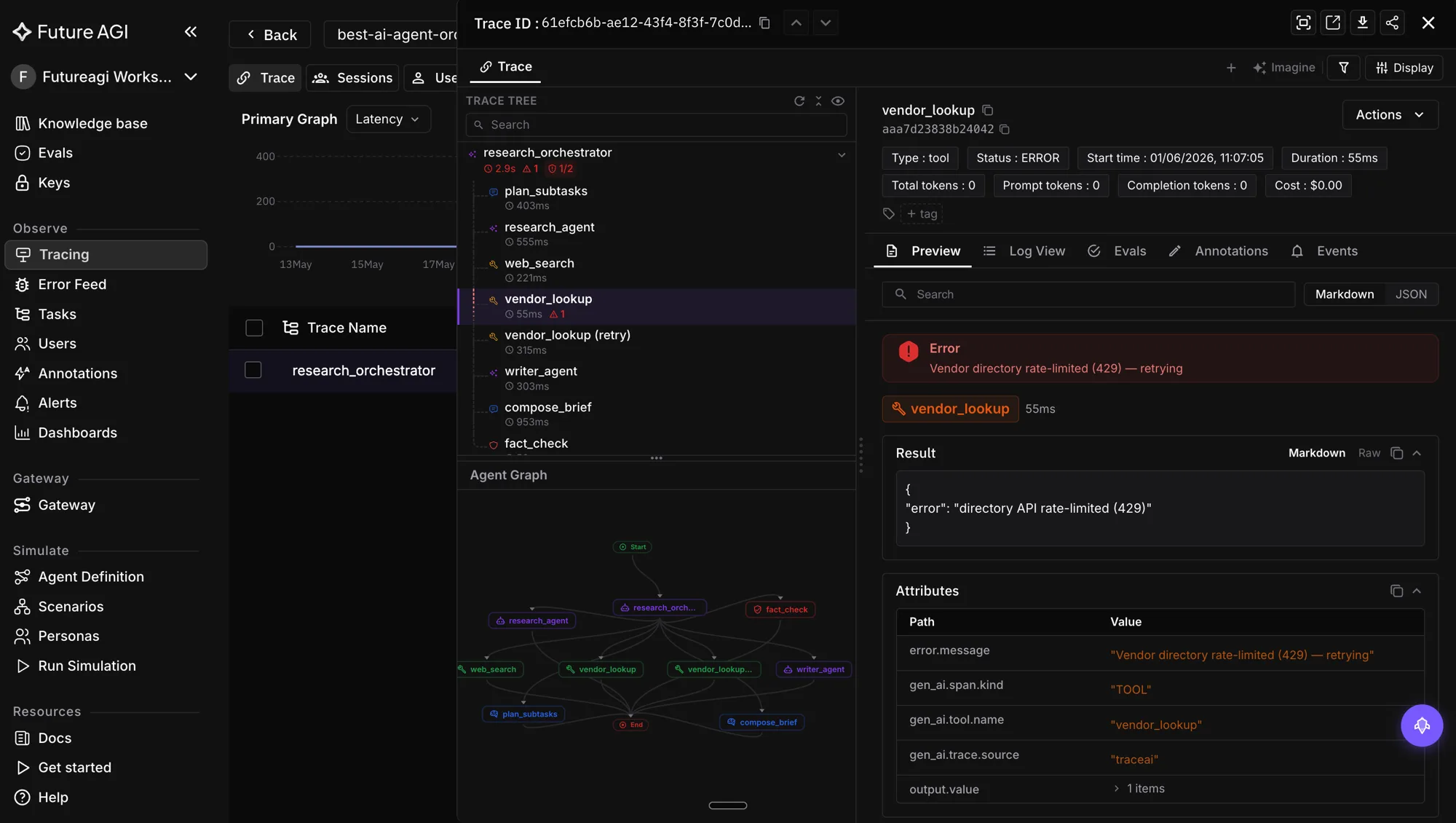
-
Gateway with native guardrails in the request path. Protect ships at median 67 ms text-mode and 109 ms image-mode latency (arXiv 2510.13351). For a voice agent under an 800 ms total budget, that matters. Hamming has no inline guardrail surface.
-
The self-improving loop. Trace -> eval -> failure cluster -> optimizer -> updated prompt or route.
agent-opt(Apache 2.0) runs six optimizers — ProTeGi, GEPA, Bayesian, MetaPrompt, RandomSearch, PromptWizard against eval scores and pushes the new prompt back into the gateway. Hamming flags bad calls; FAGI rewrites the prompt that produced them. -
Deployment posture covers hosted, BYOC, and OSS triad standalone. SOC 2 Type II and AWS Marketplace for the hosted product.
Migration from Hamming: Hamming’s Python SDK pushes test cases and grades against a hosted backend; re-instrumentation means swapping that entry point for ai-evaluation’s voice rubric set, which exposes the same shape (test case in, score out) plus the wider multimodal surface. WER, TTFB, and ASR confidence map directly. Synthetic-caller scripts port with light reshaping. Timeline: seven to ten engineering days for a clean cutover including a shadow-eval week.
Where it falls short:
-
Synthetic-caller library is younger than Hamming’s; voice persona breadth is comparable but not yet wider.
-
Optimizer loop carries a learning curve; teams using FAGI only for voice eval in week one won’t exercise the full surface.
Pricing: Free tier with 100K traces per month. Scale tier from $99 per month with linear per-trace scaling above 5M (no add-on multipliers). Enterprise tier with SOC 2 Type II and AWS Marketplace.
Score: 7 of 7 axes.
2. Coval: Best for deep voice-and-chat simulation
Verdict: Coval is the pick when the Hamming frustration is the depth of the simulation harness rather than the lack of a runtime. The founders came out of Waymo’s evaluation-job infrastructure, and the product brings autonomous-vehicle-style coverage simulation to voice and chat: thousands of conversation flows, accents, tones, emotions, with real-time alerts on production drift.
What it fixes versus Hamming:
- Simulation-first product surface. Coval generates thousands of realistic flows from minimal prompts. The Waymo lineage shows in how generation is structured around state-space coverage rather than scripted scenarios.
- Voice realism and metric depth. TTFB, WER, resolution rate, accent coverage, arguably better instrumented than Hamming on the simulation side.
- Continuous monitoring with real-time alerts. Slack and email on threshold breaches, more configurable than Hamming’s equivalent.
- Chat plus voice coverage. Multi-modality on the conversation side, one platform for both eval surfaces. Tool-use, RAG, and image aren’t the primary scope.
Migration from Hamming: Coval has its own SDK; porting test cases means translating Hamming’s synthetic-caller scripts into Coval’s more declarative simulation spec. WER, TTFB, and resolution rate overlap heavily. Production monitoring hooks need rewiring. Timeline: five to eight engineering days for a clean port.
Where it falls short:
- No native gateway or routing surface; like Hamming, Coval sits beside the request path rather than inside it. The eval-to-runtime loop is manual.
- No first-party guardrails layer for blocking bad responses inline.
- No OSS instrumentation library with portable voice semantic conventions.
- Tool-use, RAG, and image eval aren’t the primary scope.
Pricing: Self-serve tiers available; enterprise pricing on request. The platform is more transparent than Hamming on tier shape.
Score: 4 of 7 axes (missing: gateway and runtime, OSS instrumentation, optimizer loop).
3. Cekura AI: Best for voice and chat QA with red-teaming and LiveKit-first hooks
Verdict: Cekura is the pick when the Hamming frustration is the gap between pre-prod sims and production monitoring, especially for teams on Pipecat or LiveKit. It covers both halves with the same data model, ships red-team simulation, and exposes monitoring across telephony, WebRTC, SIP, SMS, and WebSocket. The YC-backed team has 75+ customers in healthcare, BFSI, logistics, recruitment, and retail.
What it fixes versus Hamming:
- End-to-end coverage from pre-prod to production in one product, with utterance-level timestamps, more granular than Hamming.
- Red-teaming as a first-class feature. Thousands of adversarial sims in minutes for jailbreaks, prompt injection, and policy probes.
- Transport coverage. Telephony, WebRTC, SIP, SMS, WebSocket, production monitoring ingests all five.
- Labs surface for iterating on eval prompts. Tune judges against real recordings until they match ground truth.
- LiveKit and Pipecat-first integration with first-party docs and tracing hooks.
Migration from Hamming: Cekura has Python and TypeScript SDKs; the second is a meaningful upgrade for TypeScript backends. Hamming personas port into Cekura simulation specs with light reshaping. Production webhooks need rewiring. Timeline: five to eight engineering days plus a shadow-eval week.
Where it falls short:
- No native gateway or routing surface; eval results sit beside the request path, not inside it.
- No inline guardrails layer for blocking bad responses before they reach the caller.
- No OSS instrumentation library.
- Chat agent eval exists but voice is the primary scope; chat-heavy teams will lean on a second platform.
Pricing: Documented pricing tiers, clearer than Hamming on what each tier costs. Enterprise tier with HIPAA and BAA available.
Score: 4 of 7 axes (missing: gateway and runtime, OSS instrumentation, optimizer loop).
4. Maxim (Bifrost + eval): Best for a gateway plus eval in one platform
Verdict: Maxim is the pick when the Hamming frustration is the eval-and-runtime split and you want one vendor whose gateway, eval, simulation, and observability bundle into one platform. Bifrost is the Go-binary gateway with an OpenAI-compatible endpoint and a Maxim plugin piping traces into the eval surface. Voice support is real, with LiveKit integration and a 3-line trace hook for multi-turn recordings.
What it fixes versus Hamming:
- Gateway and eval in one platform. Bifrost handles failover, load balancing, semantic caching, and model routing; the Maxim eval product handles scoring, simulation, and monitoring; the plugin wires Bifrost traces into eval automatically.
- Voice agent observability with LiveKit integration. A 3-line hook for multi-turn voice trace ingestion. Voice coverage is shallower than Hamming, Coval, or Cekura on simulation depth, but integration with the rest of the agent surface is tighter.
- Multimodal eval coverage. Chat, tool-use, RAG, and voice share one data model.
- Gateway-side guardrails and routing. Policy enforcement sits in the request path.
Migration from Hamming: Re-instrumenting Hamming’s Python SDK against Maxim’s is mechanical for the eval side. Voice metrics port with light reshaping. The bigger lift is wiring Bifrost into the request path if the team didn’t have a gateway before. Timeline: seven to ten engineering days for the eval port plus another week for Bifrost rollout.
Where it falls short:
- Bundle coupling. Bifrost’s standalone story is real, but the surfaces a serious user wants live in the wider Maxim platform with its own SKUs. Teams leaving Hamming for single-vendor lock-in trade one bundle for another.
- Vendor-published Bifrost benchmarks (“50x faster than LiteLLM,” sub-100 µs at 5k RPS) haven’t survived independent reproduction at scale.
- No Apache 2.0 OSS instrumentation library, the binary is open source but there’s no portable semconv library.
- Voice simulation depth is shallower than Hamming, Coval, or Cekura.
Pricing: Bifrost is open source. Maxim’s hosted platform pricing is custom, typically anchored to eval and observability usage.
Score: 5 of 7 axes (missing: deep voice simulation, Apache 2.0 instrumentation, optimizer loop).
5. Portkey: Best for a hosted developer-experience gateway as the runtime layer
Verdict: Portkey is the pick when the Hamming frustration is the lack of a runtime and you want to pair voice eval (from any of the three voice-first platforms above) with a polished hosted gateway shipping prompt registry, virtual keys, RBAC, and a session dashboard. Portkey isn’t a voice eval product; it’s the gateway you put in front of the agent so the eval-to-runtime loop becomes possible. Caveat: Palo Alto Networks announced the Portkey acquisition on April 30, 2026; Prisma AIRS integration is pending.
What it fixes versus Hamming:
- Runtime layer that Hamming doesn’t ship. Prompt Studio, virtual keys with bulk-pricing fanout, RBAC, session dashboard with cost and latency inline.
- Hosted developer-experience polish. UI, prompt registry, and dashboard are among the more polished in the cohort.
- Larger community and ecosystem than any voice-only eval platform.
Migration from Hamming: Portkey is a runtime, not a replacement for Hamming’s eval surface, pair Portkey with a voice eval product (FAGI, Coval, or Cekura). The pattern: route traffic through Portkey, run voice eval against the captured traces, close the loop manually (FAGI does this automatically; the others don’t). Timeline: three to five engineering days for Portkey plus the parallel voice eval choice.
Where it falls short:
- Not a voice eval product; you still need a second tool for the synthetic-caller and scoring surface.
- Palo Alto acquisition integration is pending; SMB SKU long-term shape is uncertain.
- No optimizer loop.
- Pricing escalates above 5M req/mo when Guardrails, Prompt Studio, and Audit Logs are enabled.
- Proprietary prompt-library schema and virtual-key system add migration cost the next time you leave.
Pricing: Free tier with limited traces. Scale tier from $99 per month. Enterprise custom; per-add-on multipliers above base.
Score: 4 of 7 axes (missing: voice eval surface, multimodal eval, optimizer loop).
Capability matrix
| Axis | Future AGI | Coval | Cekura AI | Maxim (Bifrost + eval) | Portkey |
|---|---|---|---|---|---|
| Multimodal eval coverage | Voice + chat + tool-use + RAG + image | Voice + chat | Voice + chat | Voice + chat + tool-use + RAG | None (runtime only) |
| Gateway + runtime integration | Native (Command Center + Protect) | None | None | Native (Bifrost) | Native (Portkey gateway) |
| OSS instrumentation | traceAI, ai-evaluation, agent-opt (Apache 2.0) | None first-party | None first-party | Bifrost binary OSS, no semconv lib | None first-party |
| Deployment posture | Hosted + BYOC + OSS triad standalone | Hosted | Hosted | Hosted (Bifrost self-host) | Hosted |
| Voice metrics depth | WER, ASR confidence, turn-taking, TTFB, sentiment | WER, TTFB, accent coverage, resolution | WER, utterance-level, red-team probes | LiveKit hook, multi-turn voice trace | None (gateway only) |
| Eval-to-optimizer loop | Yes (ai-evaluation + agent-opt) | No | No | No | No |
| Hamming migration tooling | Voice rubric importer + persona schema | SDK port docs | SDK port docs | Bifrost plugin + eval port | Header + key mapping (runtime only) |
Migration notes: what breaks when leaving Hamming
Re-instrumenting the Python SDK entry point
Hamming uses a Python SDK to push test cases and grade against a hosted backend. The migration unit of work is replacing that SDK with the destination’s equivalent. For TypeScript or Go backends that wrapped Hamming in a Python sidecar, this is the chance to remove the sidecar and instrument natively. FAGI’s traceAI ships TypeScript and Python; Cekura ships both. Plan a shadow-eval week where both stacks score the same calls before flipping production.
Porting voice-quality metrics
Hamming’s voice metrics (WER, TTFB, ASR confidence, interruption handling) aren’t universal across the cohort. FAGI’s ai-evaluation ships them as first-class rubrics. Coval and Cekura cover the core. Maxim covers the LiveKit-specific surface; voice rubric depth is shallowest in the cohort. Portkey covers none. Build a metric-by-metric port table so dashboards look apples-to-apples.
Re-wiring the production monitoring webhook
Hamming’s production-call analysis pushes results into Slack, email, or PagerDuty. Coval ships real-time alerts on threshold breaches; Cekura covers per-utterance monitoring; FAGI exposes the alert layer on top of the failure-clustering surface. Re-wire alerts during the migration, not after, production drift between Hamming and the new stack is the most common day-one gotcha.
Decision framework: Choose X if
Choose Future AGI if your reason for leaving is more than voice-only scope, you also want multimodal eval, a runtime gateway with inline guardrails, OSS instrumentation that survives a future vendor swap, and a self-improving loop. Pick this when production workloads cross voice, chat, tool-use, and image.
Choose Coval if the depth of the simulation harness is the gap and you want autonomous-vehicle-style coverage on voice and chat.
Choose Cekura AI if the gap is between pre-prod sims and production monitoring, especially on LiveKit or Pipecat. Pick this when red-teaming and transport breadth are core.
Choose Maxim if the eval-and-runtime split is the gap and you want one vendor’s gateway, eval, and observability bundled. Pick this when bundle convenience outweighs trading single-vendor lock-in.
Choose Portkey if the missing runtime layer is the gap rather than the eval surface. Pair it with a voice eval product (FAGI, Coval, or Cekura). Weight the pending Palo Alto Networks acquisition.
What we did not include
Three products show up in other 2026 Hamming alternatives listicles that we left out: Bland AI (a voice-agent builder, not an eval platform); Vapi’s own eval tooling (limited to the Vapi orchestration surface); Retell internal QA (same constraint as Vapi). Each is useful inside its own ecosystem; none replaces Hamming’s full eval surface for teams running multiple orchestration providers.
Related reading
- Best 5 Coval Alternatives in 2026
- Best 5 Maxim Bifrost Alternatives in 2026
- Best 5 Portkey Alternatives in 2026
- What Is an AI Gateway? The 2026 Definition
Sources
- Hamming AI product page and feature overview, hamming.ai
- Hamming AI pricing page (sales-gated), hamming.ai/pricing
- Hamming AI voice agent testing guide, hamming.ai/resources/voice-agent-testing-guide
- Coval product page, coval.dev
- Coval voice AI testing, coval.dev/voice-ai-testing
- Coval 2026 Voice AI Report, coval.ai/2026-voice-ai-report
- Coval Y Combinator profile, ycombinator.com/companies/coval
- Cekura AI product page, cekura.ai
- Cekura on Pipecat integration, docs.pipecat.ai/pipecat/fundamentals/evaluations/cekura
- Cekura Y Combinator profile, ycombinator.com/companies/cekura-ai
- Maxim AI Bifrost product page, getmaxim.ai/bifrost
- Maxim AI eval and observability platform, getmaxim.ai
- Maxim voice agent observability with LiveKit, getmaxim.ai/blog/maxim-ai-june-2025-updates
- Portkey product page, portkey.ai
- Palo Alto Networks press release on Portkey acquisition, April 30, 2026, paloaltonetworks.com/company/press
- Future AGI Agent Command Center, futureagi.com/platform/monitor/command-center
- Future AGI traceAI, github.com/future-agi/traceAI (Apache 2.0)
- Future AGI ai-evaluation, github.com/future-agi/ai-evaluation (Apache 2.0)
- Future AGI agent-opt, github.com/future-agi/agent-opt (Apache 2.0)
- Future AGI Protect latency benchmark, arxiv.org/abs/2510.13351 (67 ms text, 109 ms image)
Frequently Asked Questions
Why are people moving off Hamming in 2026?
Is Hamming still good for voice-only call-center QA?
What is the closest like-for-like alternative to Hamming?
Is there an open-source Hamming alternative?
How does Future AGI Agent Command Center compare to Hamming?
Which Hamming alternative is best for HIPAA and regulated voice workloads?
Future AGI vs Hamming on eval rubrics, native voice observability, simulation, guardrails, optimization, compliance. Where each actually fits in 2026.


Five Coval alternatives on scope beyond voice sim, native gateway, routing, guardrails, optimizer. What each actually fixes after voice-only testing.

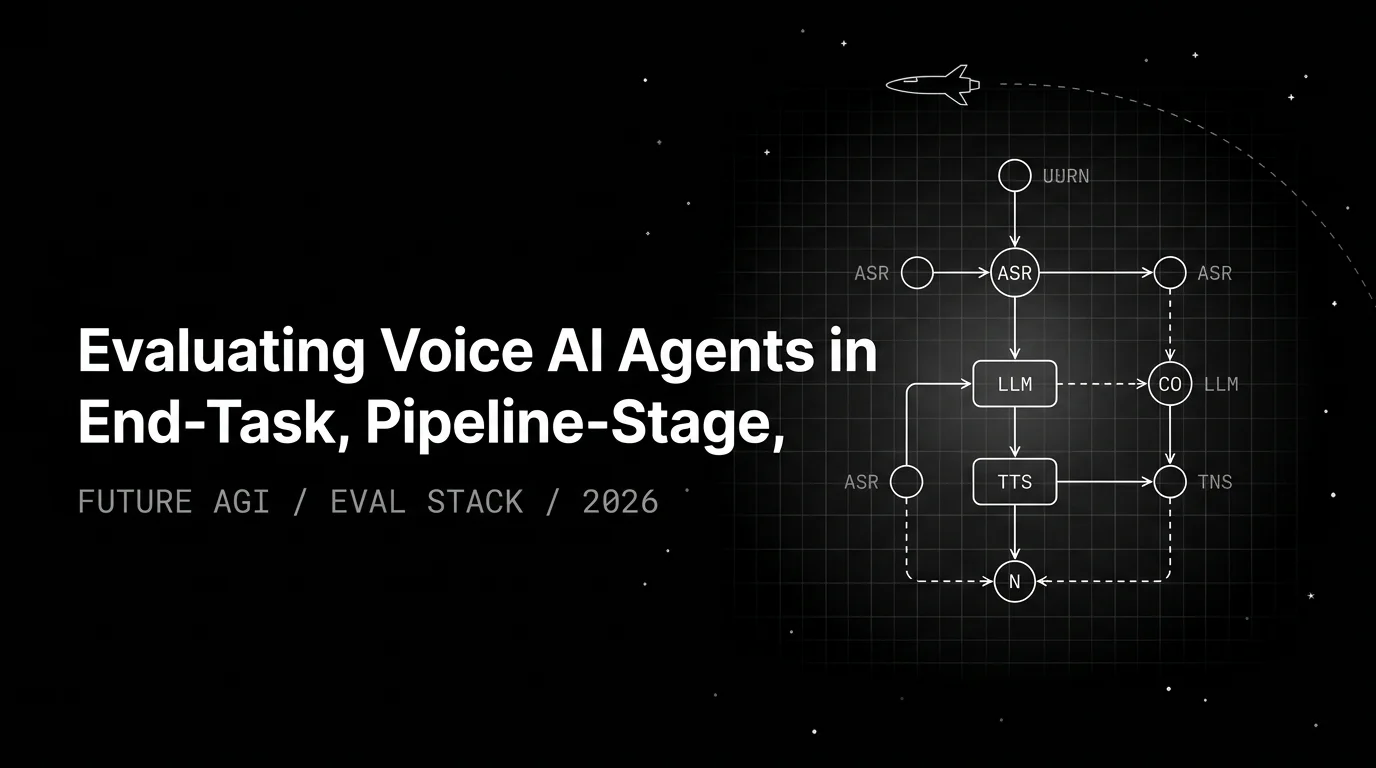
Voice agent eval is end-task scoring plus pipeline-stage attribution plus conversation coherence. WER scores the ASR component, not the agent.