Best 5 Coval Alternatives in 2026
Five Coval alternatives on scope beyond voice sim, native gateway, routing, guardrails, optimizer. What each actually fixes after voice-only testing.

Table of Contents
Coval has a clean pitch: an evaluation and simulation layer for voice agents that pre-records personas, replays them against your IVR or contact-center stack, scores transcripts, and tracks regression. For teams launching voice-first products in 2025, it was the path of least resistance for CI around a voice agent. Twelve months on, the limits are the conversation. Coval is voice-AI-simulation focused (narrow by design) and teams whose roadmap now also covers text agents, copilots, RAG pipelines, or guardrails-as-a-service keep hitting the same wall: no native gateway or routing, niche multi-model support, no inline guardrails or optimizer, hosted-only, and a community small enough that most non-vanilla questions resolve to “open a ticket and wait.”
This guide ranks five replacements, names what each fixes versus Coval, and walks through the migration that always bites: Coval’s simulation suite is wired together in its Python SDK, so the work is a re-write of every persona, rubric, and CI fixture, not a BASE_URL swap.
TL;DR: pick by exit reason
| Why you are leaving Coval | Pick | Why |
|---|---|---|
| You want one platform across voice and text, with gateway, eval, guardrails, and a self-improving optimizer | Future AGI Agent Command Center | Closes the loop from trace through eval to optimizer to route, with voice-AI passthrough and Apache 2.0 OSS instrumentation |
| You want a deeper voice-specific eval product than Coval and stay voice-only | Hamming | Voice-AI eval and simulation focused, fuller scoring rubrics, larger persona library |
| You want voice testing with a heavier compliance posture | Cekura AI | Voice testing platform with HIPAA-conscious deployment and contact-center integrations |
| You want a Go-based gateway that pairs with an adjacent eval product | Maxim Bifrost | Low-latency proxy plus the wider Maxim simulation and eval stack |
| You want a hosted developer-experience layer with prompt registry and virtual keys | Portkey | Polished UI, virtual keys, prompt studio (note Palo Alto acquisition pending integration) |
Why people are leaving Coval in 2026
Five exit drivers show up repeatedly in /r/voiceAI migration threads, the Coval GitHub discussions tab, voice-AI Slack groups, and post-evaluation notes from teams that shortlisted Coval and re-platformed within twelve months.
1. Voice-AI-simulation only: narrow by design
Coval’s product starts and ends at “evaluate a voice agent.” Personas, transcript scoring, regression CI for voice, all first-class. Everything outside that frame is the user’s problem. A side-by-side of voice AI simulation across Cekura, Hamming, Bluejay, and Coval shows how narrow each voice-only tool stays. Teams whose 2026 roadmap covers more than voice end up running two evaluation stacks (Coval for voice, something else for the rest) with no unified failure-cluster view or shared rubric library. The narrow scope was a feature in 2024; in 2026 it’s a forcing function to migrate.
2. No native gateway or routing layer
Coval evaluates voice agents, it doesn’t sit in front of an LLM, route traffic, handle failover, issue virtual keys, or produce per-route cost dashboards. Teams that want one platform for both evaluation and runtime routing end up stacking Coval on top of a gateway (LiteLLM, Portkey, Future AGI), doubling the vendor surface and splitting trace data across products that don’t share an ID schema.
3. Niche multi-model support
STT and TTS providers are covered well; the LLM stage supports a handful of common models, but exotic configurations (a smaller local LLM for triage, a frontier model for handoff, a multi-modal model for screen-reading) require custom adapters. Compared to gateways with twenty-plus first-class providers, the multi-model surface is closer to a curated short-list than a broad routing fabric.
4. No inline guardrails, no optimizer
Coval tells you a voice agent regressed. It won’t stop the regression from reaching production, and it won’t fix the underlying prompt or routing rule. No inline guardrails layer blocks unsafe responses at request time, and no optimizer ingests failure clusters and proposes rewrites. Teams whose CI expects a runtime block plus a self-improving loop bolt a guardrails product and a prompt-optimization workflow on top.
5. Hosted-only, small community
Coval is hosted-only. No Apache 2.0 self-hosted edition, no community Helm chart, no published self-host runbook. The GitHub discussions tab has a long tail of unanswered threads and the answer to most edge cases is “file a support ticket” rather than “search the issue tracker.” For voice-AI teams in regulated industries that need a self-hosted path, this is a deal-breaker.
What to look for in a Coval replacement
The default “best voice-AI eval tool” axes are necessary but not sufficient for a Coval exit. Score replacements on the seven that map to the surfaces you’re actually migrating off:
| Axis | What it measures |
|---|---|
| 1. Scope beyond voice | Does the platform also cover text agents, RAG pipelines, and multi-modal workflows under one schema? |
| 2. Native gateway and routing | Does the same tool route traffic, handle failover, issue virtual keys, and dashboard cost? |
| 3. Multi-model breadth | How many LLM providers and modalities are first-class? |
| 4. Inline guardrails | Is there a runtime layer that blocks unsafe or off-policy responses before they reach the user? |
| 5. Self-improving optimizer | Does the tool ingest failure clusters and propose prompt or policy rewrites? |
| 6. Self-host posture | Can the tool run in a VPC, source-available or OSS-instrumented? |
| 7. Community and ecosystem depth | Issue-tracker velocity, Discord size, Terraform and Helm artifacts |
1. Future AGI Agent Command Center: Best for closing the loop across voice and text
Verdict: Future AGI is the only tool in this list that solves Coval’s biggest weakness at the architectural level. Coval scores voice transcripts and stops there. Agent Command Center captures the trace (voice or text), scores it with the eval library, clusters failures, runs the optimizer, pushes the updated route or prompt back into the gateway, and blocks unsafe responses inline through the Protect guardrails layer. Voice traffic is a passthrough on the same instrumentation that handles text, same trace schema, same rubric library, same dashboard.
What it fixes versus Coval:
-
One platform, voice and text.
traceAI(Apache 2.0) instruments any agent (voice pipeline, text agent, RAG service, tool-using agent) with the same OpenTelemetry-aligned semantic conventions. STT, LLM, and TTS spans for a voice turn sit alongside LLM and tool-call spans for a text turn in the same trace tree, so failure clusters and rubric scoring see the whole behavior.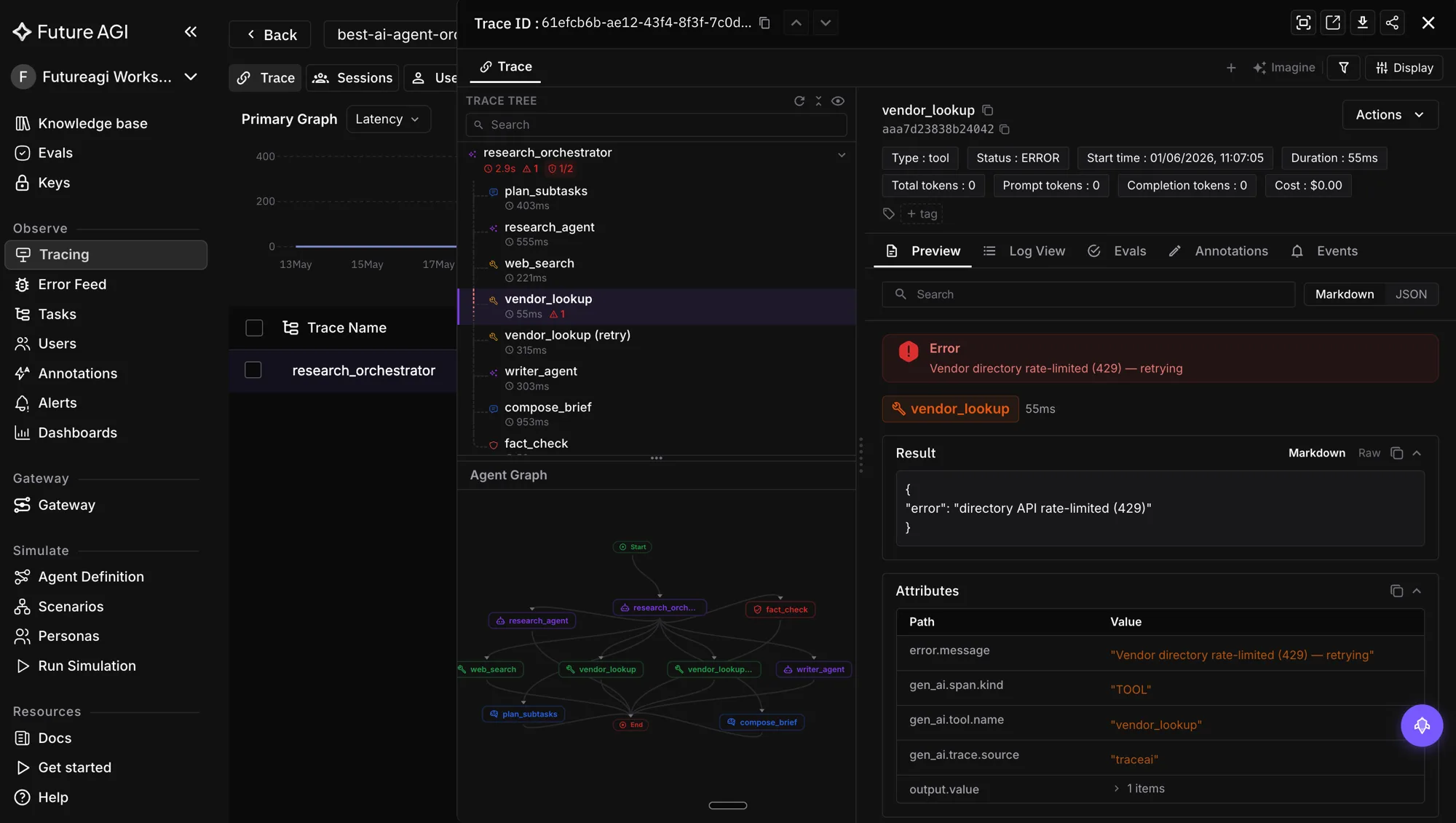
-
Native gateway with multi-model routing. Agent Command Center sits in front of provider APIs, routes by cost or latency or quality, handles failover, issues per-identity virtual keys, and produces per-route, per-session, per-user cost dashboards. Eval and routing share one trace ID and one identity model.
-
Inline guardrails with measured latency. The Protect layer enforces safety and policy checks inline before the response reaches the user, median ~65 ms text mode, ~107 ms image mode, per arXiv 2510.13351. Coval’s failure signal arrives after the call completes.
-
Self-improving optimizer.
agent-opt(Apache 2.0) ingests failure clusters from the eval library and proposes rewrites via six optimizers — ProTeGi, GEPA, Bayesian, MetaPrompt, RandomSearch, PromptWizard, gated byai-evaluation(Apache 2.0) scores. Coval surfaces what broke; FAGI proposes the fix and verifies it. -
OSS instrumentation, hosted Command Center.
traceAI,ai-evaluation, andagent-optare all Apache 2.0. The hosted Command Center adds RBAC, failure-cluster views, the Protect guardrails layer, and AWS Marketplace procurement. BYOC self-host is available.
Migration from Coval: Coval’s simulation suite is wired together in its Python SDK, a re-write, not a swap. Re-implement personas as FAGI ai-evaluation datasets, rubrics as evaluator templates (default library covers task-completion, faithfulness, tone, and tool-use; custom Python evaluators handle voice-specific signals like turn-taking and barge-in), and wire the regression harness into your CI pipeline. Ten to fifteen engineering days for a moderate voice-only suite, plus five to seven days to extend coverage to text or RAG agents previously evaluated outside Coval.
Where it falls short:
- The optimization layer carries a learning curve; a pure Coval-like “diagnose only” experience means consciously opting out of the optimizer in week one.
- Voice-specific evaluator coverage is narrower out of the box than Hamming’s voice-only library; the custom-evaluator API closes the gap but requires the team to write voice-specific rubrics for nuances Coval and Hamming pre-bundle.
Pricing: Free tier with 100K traces/month. Scale tier from $99/month with linear per-trace scaling above 5M (no add-on multipliers). Enterprise with SOC 2 Type II, AWS Marketplace, and self-host options.
Score: 7 of 7 axes.
2. Hamming: Best for staying voice-only with deeper rubrics
Verdict: Hamming is the pick when the reason for leaving Coval is “I want a deeper voice-AI eval product but I am still 100% voice”, same scope, more mature. Persona library, rubrics, and regression tooling are richer than Coval’s by mid-2026, with a steady cadence of voice-specific features (barge-in scoring, latency-budget rubrics, multi-language persona packs).
What it fixes versus Coval:
- Deeper voice-specific rubrics. Default library covers turn-taking, barge-in, latency budgets, prosody alignment, and contact-center patterns (transfer behavior, hold-music handling, post-call summary) Coval users currently implement themselves.
- Larger persona library. More demographics, languages, and emotional registers than Coval’s defaults.
- More mature CI surface. First-class GitHub Actions and Buildkite plugins, sharper regression-drift alerts than Coval’s diff view.
Migration from Coval: Conceptual mapping is one-to-one. Mechanical work is re-writing Python-SDK persona definitions and rubric classes against Hamming equivalents. Six to ten engineering days for a moderate suite.
Where it falls short:
- Voice-only by design. The exit driver that pushed teams off Coval (“I now also have text agents”) will push them off Hamming in twelve months.
- No native gateway or routing.
- No inline guardrails, no optimizer, same diagnose-only ceiling as Coval.
- Hosted-only.
Pricing: Custom, typically anchored to the number of personas and monthly simulation minutes.
Score: 3 of 7 axes (missing: scope beyond voice, gateway, multi-model breadth, guardrails, optimizer).
3. Cekura AI: Best for voice testing in regulated industries
Verdict: Cekura AI is the pick when the reason for leaving Coval is compliance posture rather than scope. Voice-testing platform purpose-built for contact-center and healthcare deployments, with HIPAA-conscious data handling, telephony-side integrations (SIP, RTP), and a deployment posture more sympathetic to regulated industries than Coval’s hosted-only stance.
What it fixes versus Coval:
- Compliance posture. Data-handling, retention controls, and contact-center integrations designed for HIPAA-eligible workloads.
- Telephony-side coverage. Tests at the SIP and RTP layer, not the application layer, useful for voice agents behind contact-center stacks (Genesys alone, Twilio Flex, Five9) where failure modes include telephony oddities Coval treats as out of scope.
- Enterprise procurement. SOC 2, HIPAA-eligible deployments, the MSA template a regulated buyer expects.
Migration from Coval: Persona library, scoring, and regression harness map conceptually. Cekura SDK has its own primitives, same re-write shape as Hamming. Eight to twelve engineering days, plus extra time to wire SIP/RTP-layer testing if not previously done.
Where it falls short:
- Voice-only.
- No native gateway, no multi-model routing.
- No inline guardrails, no optimizer.
- Smaller community; many answers route through your account manager.
Pricing: Enterprise-only, custom, anchored to deployment posture and contact-center scale.
Score: 3 of 7 axes (missing: scope beyond voice, gateway, multi-model breadth, guardrails, optimizer).
4. Maxim Bifrost: Best for a Go-based gateway with adjacent eval
Verdict: Maxim Bifrost is the pick when you want a gateway in front of voice and text agents and are willing to buy the wider Maxim platform for eval. Go binary with an OpenAI-compatible endpoint and sub-millisecond p50 overhead in vendor benchmarks. Paired with Maxim’s eval and simulation stack, you get a single-vendor story across gateway and evaluation, at the cost of bundle coupling.
What it fixes versus Coval:
- Native gateway. Routes traffic, handles failover, OpenAI-compatible endpoints out of the box.
- Multi-model breadth. Twenty-plus providers, passthrough for voice-LLM-voice pipelines.
- Adjacent eval and simulation. Maxim’s platform covers both voice and text, broader scope than Coval at the cost of bundle coupling.
Migration from Coval: Persona library and rubrics re-write against Maxim’s eval surface. Gateway is a BASE_URL swap once provider keys are loaded. Bifrost’s MCP Code Mode (inline-code tool-call generation added in early 2026) is useful for tool-using voice agents but carries its own learning curve. Eight to twelve engineering days plus gateway cutover.
Where it falls short:
- Bundle coupling, serious use means buying into the wider Maxim platform.
- Vendor-published latency numbers need independent verification.
- No Apache 2.0 standalone instrumentation library; trace surface ties to Maxim’s observability product, portability concern past 12 months.
- Younger ecosystem than LiteLLM or Portkey.
Pricing: Bifrost is open source. Maxim’s hosted gateway and eval pricing is custom, typically anchored to the eval product’s usage.
Score: 4 of 7 axes (missing: native voice-specific rubrics, inline guardrails, optimizer).
5. Portkey: Best for hosted developer experience and prompt management
Verdict: Portkey is the pick when you want a hosted developer-experience layer with prompt registry, virtual keys, and a clean dashboard, and your voice-AI evaluation needs are light enough for Portkey’s generic eval surface. Caveat: Palo Alto Networks announced the Portkey acquisition on April 30, 2026; integration roadmap is still settling.
What it fixes versus Coval:
- Hosted developer experience. Polished UI, prompt registry, virtual keys with per-identity fanout, RBAC, audit logs.
- Native gateway with routing. OpenAI-compatible endpoint, multi-model routing, fallback policies, cost dashboard.
- Generic eval surface. Sufficient when voice-AI evaluation needs are simple transcript scoring rather than deep voice-specific rubrics.
Migration from Coval: Persona library and voice-specific rubrics re-write against Portkey’s generic eval primitives. Portkey isn’t a voice specialist, so write your own voice rubrics or accept a shallower surface. Gateway is a BASE_URL swap. Six to nine engineering days plus prompt-registry migration if applicable.
Where it falls short:
- Voice-AI evaluation isn’t Portkey’s specialty; deep voice rubrics are the user’s responsibility.
- Palo Alto acquisition integration is still settling; long-term SMB SKU posture is uncertain.
- No self-improving optimizer.
- Prompt-library lock-in (Portkey-dialect template syntax) is a future migration cost.
Pricing: Free tier with limited traces. Scale tier from $99/month with per-request scaling that escalates noticeably above 5M requests/month. Enterprise custom.
Score: 4 of 7 axes (missing: deep voice rubrics, native voice-specific scope, inline guardrails, optimizer).
Capability matrix
| Axis | Future AGI | Hamming | Cekura AI | Maxim Bifrost | Portkey |
|---|---|---|---|---|---|
| Scope beyond voice | Voice + text + RAG + multi-modal | Voice only | Voice only | Voice + text via Maxim platform | Text-focused, voice via generic eval |
| Native gateway and routing | Yes | No | No | Yes (Bifrost) | Yes |
| Multi-model breadth | 30+ providers, all modalities | Voice models only | Voice models only | 20+ providers | 20+ providers |
| Inline guardrails | Protect, ~65 ms p50 text | No | No | No | No (eval at trace-time) |
| Self-improving optimizer | Yes (agent-opt Apache 2.0) | No | No | No | No |
| Self-host posture | BYOC + Apache 2.0 OSS instrumentation | Hosted only | Hosted only (enterprise deployments) | Go binary, OSS gateway | Hosted only |
| Community and ecosystem | Apache 2.0 libraries + active Discord | Small voice-AI community | Small enterprise community | Younger ecosystem | Large, polished community |
Migration notes: what breaks when leaving Coval
Three surfaces always need attention.
Re-writing the simulation suite
Coval’s product surface is its Python SDK. Personas, rubrics, fixtures, and CI harness are wired together with Coval-specific classes. A migration is a re-write, not a BASE_URL swap. The pattern: dump existing personas as transcripts and metadata, re-implement them as datasets in the destination (FAGI ai-evaluation datasets, Hamming personas, Cekura test plans, Maxim eval suites, the hosted gateway eval cases), and re-implement rubrics as the destination’s evaluator primitives. The rubric port is the slowest part, every rubric needs a manual review, not a script.
Voice-specific evaluator coverage
Coval and Hamming ship voice-specific rubrics out of the box, turn-taking, barge-in, prosody, latency budget, contact-center patterns. Broader-scope tools (Future AGI, Maxim, Portkey) ship generic eval libraries and expect users to write voice rubrics via the custom-evaluator API. For nuanced behavior (healthcare triage, financial-services callback flows), the rubric-authoring sprint is the biggest line item, budget five to seven engineering days on top of the persona port.
CI harness wiring
Coval’s CI integration is opinionated, its own GitHub Actions plugin, its own regression-drift report format. The destination has its own CI primitives, so the cutover is a workflow rewrite. Run both pipelines in shadow mode for a sprint to validate parity before retiring Coval.
Decision framework: Choose X if
Choose Future AGI if your roadmap covers more than voice (text, RAG, multi-modal, tool use) and you want one platform across all of it, gateway, eval, inline guardrails, and a self-improving optimizer under one trace ID. The OSS instrumentation (traceAI, ai-evaluation, agent-opt, all Apache 2.0) is the portability hedge that makes a future migration cheaper than the one off Coval.
Choose Hamming if you stay voice-only on purpose and the reason for leaving Coval is “I want a deeper voice-AI tool, not a different category.” The lack of gateway, optimizer, and text coverage won’t bite in the next twelve months.
Choose Cekura AI if your voice deployment sits in a regulated industry (healthcare, financial services) and compliance posture is load-bearing. SIP/RTP-layer testing, HIPAA-conscious deployment, and enterprise procurement matter more than scope breadth.
Choose Maxim Bifrost if you want a gateway in front of voice and text agents and are willing to buy the wider Maxim platform for eval. The Go-based throughput claim is load-bearing, you can absorb the bundle coupling, and you trust your own benchmarks.
Choose Portkey if you want a hosted developer-experience layer with prompt management and virtual keys, your voice-AI evaluation needs are light enough for a generic eval surface, and you can price in the Palo Alto integration uncertainty.
What we did not include
Three products show up in other 2026 Coval alternatives listicles that we left out. Vapi and Retell AI are voice-agent runtimes rather than evaluation tools, different category, different migration shape. Bland AI is a telephony provider with light eval surfaces, not a like-for-like replacement for Coval’s CI suite. All three are worth a separate look if the question is “which voice-agent runtime should I build on,” not “which voice-agent evaluation tool should I migrate to.”
Related reading
- Best 5 Portkey Alternatives in 2026
- Best 5 Maxim Bifrost Alternatives in 2026
- Best 5 AgentOps Alternatives in 2026
- What Is an AI Gateway? The 2026 Definition
Sources
- Coval product page and Python SDK documentation, coval.dev
- Coval GitHub discussions, github.com/coval-dev/coval/discussions
- Hamming product page, hamming.ai
- Cekura AI product page, cekura.ai
- Maxim Bifrost product page and benchmarks, getmaxim.ai/bifrost
- Portkey product page, portkey.ai
- Palo Alto Networks Portkey acquisition release, April 30, 2026, paloaltonetworks.com/company/press
- /r/voiceAI migration discussions, Q1 2026
- Future AGI Agent Command Center, futureagi.com/platform/monitor/command-center
- Future AGI traceAI, github.com/future-agi/traceAI (Apache 2.0)
- Future AGI ai-evaluation, github.com/future-agi/ai-evaluation (Apache 2.0)
- Future AGI agent-opt, github.com/future-agi/agent-opt (Apache 2.0)
- Future AGI Protect latency benchmark, arxiv.org/abs/2510.13351 (65 ms text, 107 ms image)
Frequently Asked Questions
Why are people moving off Coval in 2026?
What is the closest like-for-like alternative to Coval?
Is there an open-source Coval alternative?
How do I migrate my Coval simulation suite to a new tool?
Does Future AGI handle voice-AI evaluation as well as Coval?
How does Future AGI Agent Command Center compare to Coval?
Which Coval alternative is best for regulated industries?
Future AGI vs Coval on simulation, native voice observability, eval, inline guardrails, optimization, pricing, compliance. Honest verdict, May 2026.

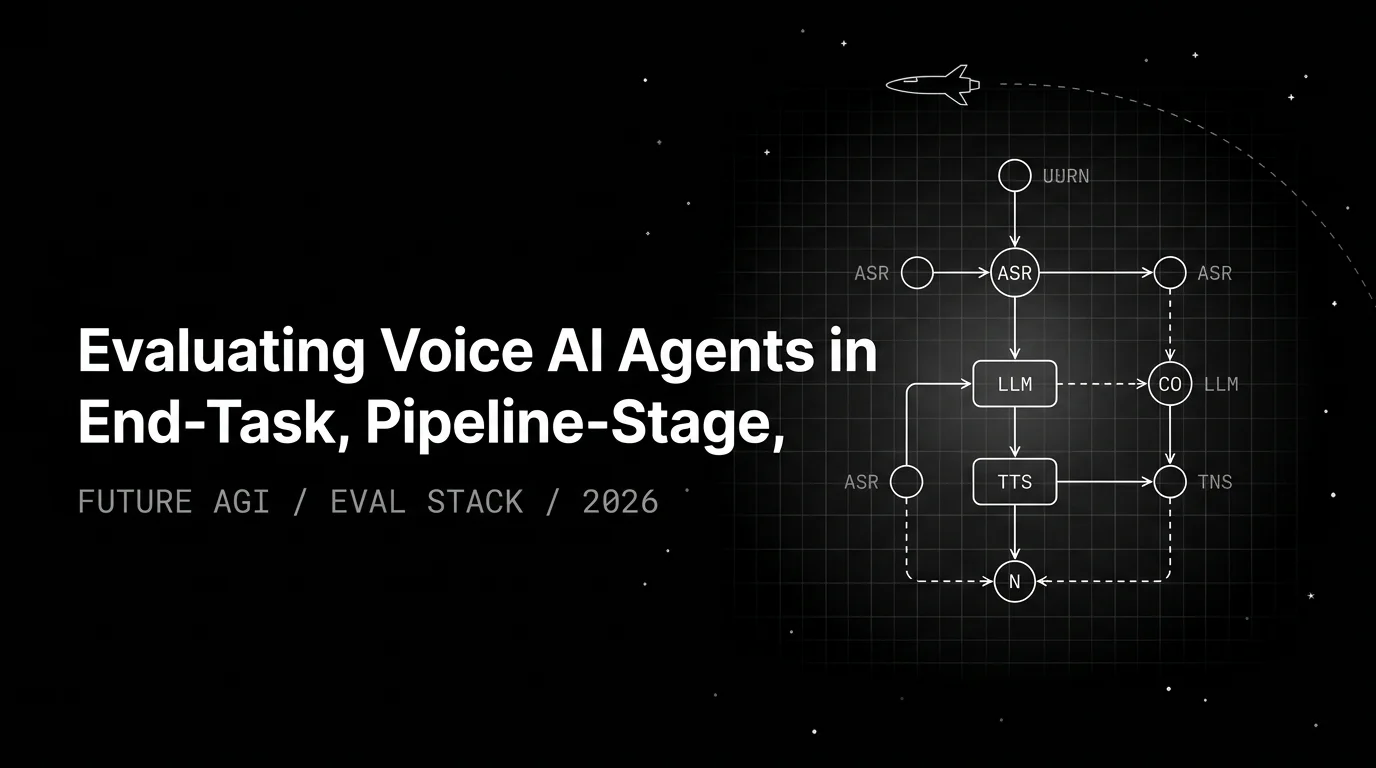
Voice agent eval is end-task scoring plus pipeline-stage attribution plus conversation coherence. WER scores the ASR component, not the agent.

Voice agent monitoring platforms ranked for 2026 by tracing depth, named voice eval rubrics, error clustering, SLOs, inline guardrails, and audio replay.