Best Git-Based Prompt Management Platforms in 2026
Compare the 6 best git-based prompt management platforms of 2026 on version control, branching, diffs, and code-first prompt workflows for engineering teams.
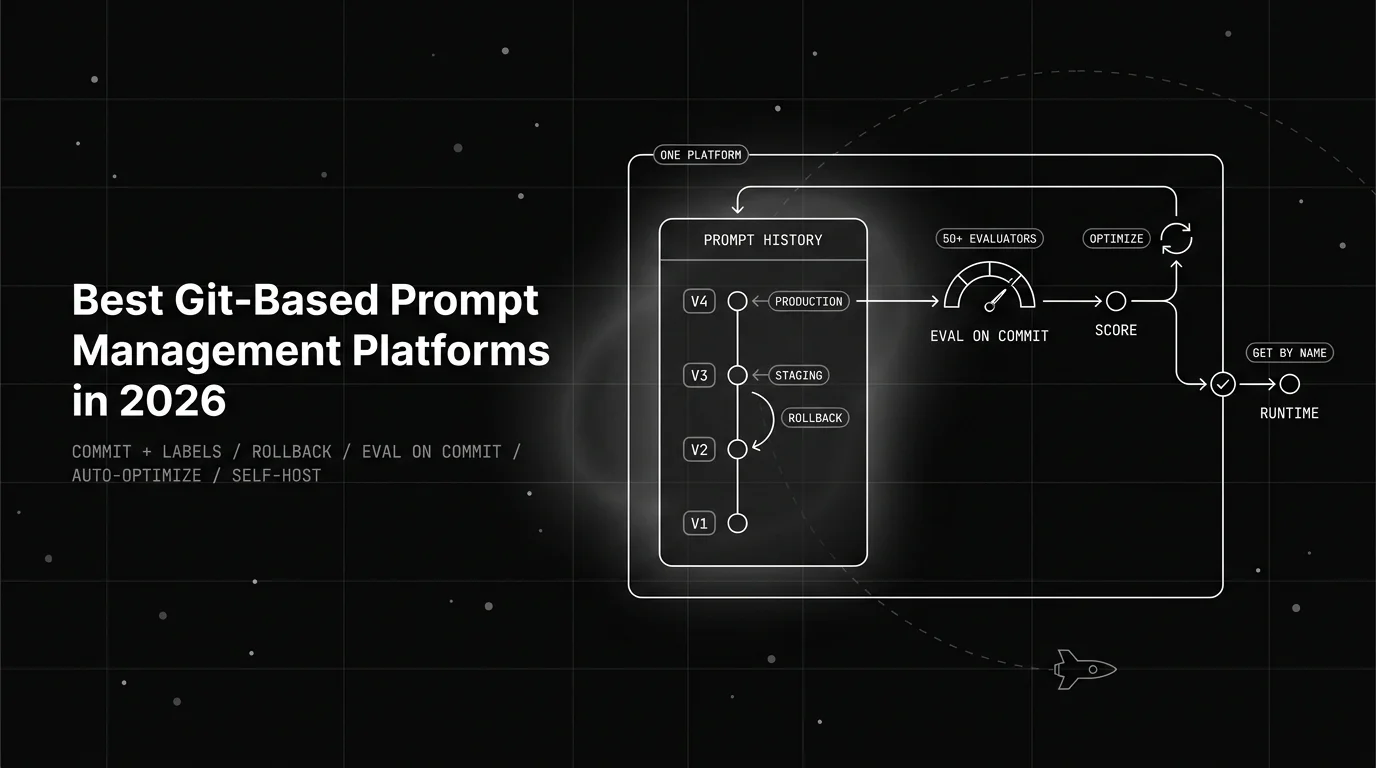
Table of Contents
You overwrite a prompt in a text field, ship it, and a week later something regresses. You want the wording from before the change, but there is no before. The field holds one value, the old version is gone, and the score you trusted last sprint belongs to a prompt you can no longer reconstruct. That is the problem git-based prompt management solves. This guide ranks the six git-based prompt management platforms worth using in 2026. It scores them on immutable version history, rollback, and whether a version is tied to an evaluation run.
TL;DR: 6 Git-Based Prompt Management Platforms, Compared
Future AGI is the strongest overall git-based prompt management platform for 2026. Every save is an immutable version. Named labels handle promotion, and rollback moves a label to an earlier version with no redeploy. Future AGI ties each version to a built-in evaluator library and a CI/CD gate, so a prompt is scored before it ships. Six optimization algorithms can propose a better candidate, and production behavior feeds back into tracing.
| Rank | Platform | Best for | Standout capability |
|---|---|---|---|
| 1 | Future AGI | End-to-end: version, evaluate, optimize, observe | Immutable snapshots plus a built-in evaluator library, a CI/CD gate, and six optimizers in one platform |
| 2 | PromptHub | A literal git-branch prompt workflow | True master and staging branches with a diff checker |
| 3 | Promptfoo | Git-native prompts and tests as code | Prompts and test cases as plain YAML versioned in your own repo |
| 4 | Langfuse | Open-source immutable versioning you self-host | MIT core with auto integer versions and labels |
| 5 | PromptLayer | A dedicated registry with clean diffs | Commit messages with version diffs and release labels |
| 6 | LangSmith | Commit-hash history in a LangChain stack | Commit hashes and tags with named Environments |
Why Does Git-Based Prompt Management Break in Production?
Git-based prompt management breaks because a prompt is code that decides product behavior, but most teams edit it like a value in a text box. Without an immutable history, a readable diff, and a rollback path, you cannot say what changed, who changed it, which revision is serving traffic, or how to get back to the one that worked.
Dropping the prompt in a .py file and committing it to your repo solves half the problem. It captures the text but not the model configuration that shipped with it, and not how the prompt performed. A git commit reproduces a build; a prompt commit on its own does not reproduce a score. For the deeper split between versioning and management, see our guide to prompt versioning and lifecycle management.
A production-grade git-based prompt platform has to deliver three things at once:
- Version history. Immutable versions with a readable history and a diff between any two revisions, so nothing is overwritten and every change is legible.
- Safe rollback. A fast path back to a known-good version that does not require a code release, so reverting a bad prompt is a deliberate action, not a redeploy.
- Reproducibility through evaluation. Each version tied to an evaluation run, so the version can be re-scored, compared, and trusted, not just retrieved.
Most platforms nail the first two and stop. The differentiator in 2026 is the third pillar plus the step after it: using evaluation results to generate the next version automatically.
The Git-Based Prompt Scorecard
We scored every platform with the Git-Based Prompt Scorecard, a five-dimension rubric built for the question this title asks. That question is not which platform stores a version, but which one makes a version safe to ship and reproducible after the fact. Most roundups score on history and labels alone. This rubric adds the two dimensions that decide whether your versions improve over time.
| # | Dimension | What we measure |
|---|---|---|
| 1 | Version history | Immutable versions with a readable history and diffs |
| 2 | Promotion and rollback | Mapping a version to an environment and reverting without a code release |
| 3 | Eval on each version | Evaluation bound to a version, not just an eval hook |
| 4 | Open-source self-host | An open-source license and free self-hosting versus Enterprise-gated |
| 5 | Automated optimization | The platform proposes an improved next version for you |
We do not publish a single composite score; the right platform depends on your stack, your license constraints, and who edits the prompts. The capability matrix below shows how the six platforms compare on the dimensions that vary most.
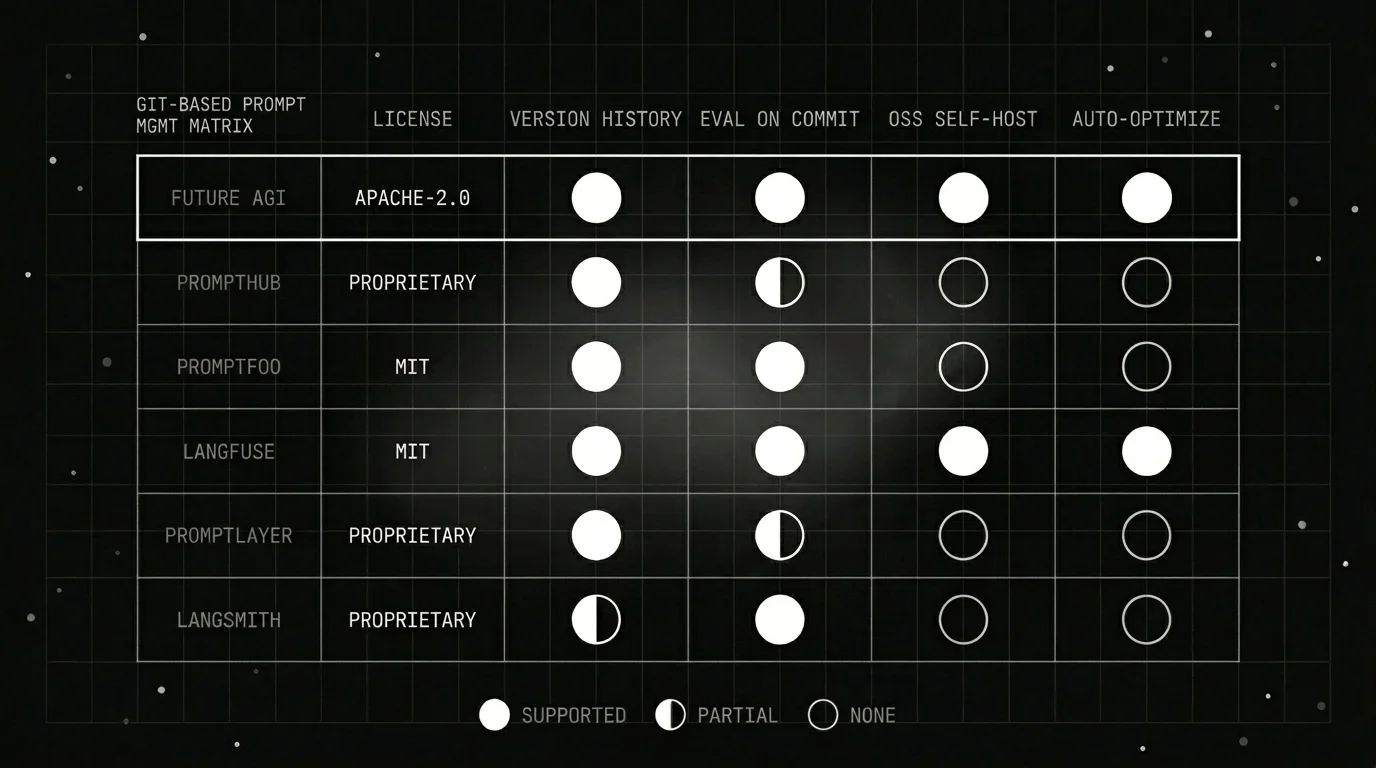
| Platform | Version history | Promotion / rollback | Eval on version | Automated optimization | License / self-host |
|---|---|---|---|---|---|
| Future AGI | Immutable snapshots + version compare | Labels for Production, Staging, Development; rollback = reassign a label | Built-in evaluator library | Six algorithms (agent-opt) | Apache-2.0 core, self-host free |
| PromptHub | Commit titles + branches + diff checker | Deploy from a branch | Evals and Pipelines | None | Proprietary, cloud |
| Promptfoo | YAML in your git repo | Git branches and revert | Matrix evals + assertions | None | MIT, runs locally |
| Langfuse | Auto integer versions | Reassign a label | Prompt Experiments | None | MIT core, self-host free |
| PromptLayer | Commit messages + version diffs | Reassign a release label | Evals on the registry | None | Proprietary, self-host Enterprise |
| LangSmith | Commit hash + tags | Named Environments | Eval SDK on a version | None | Proprietary, self-host Enterprise |
1. Future AGI: Best Overall for Closed-Loop Git-Based Prompt Management
Quick take. Future AGI applies git-style discipline to the full prompt lifecycle, not just the storage layer. Every save is an immutable version, kept in full history. Named labels (Production, Staging, Development, plus custom) handle promotion, and rollback moves a label to an earlier version with no code release. The platform scores each version against a built-in evaluator library and gates changes in CI/CD. It runs six optimization algorithms on the eval results, all Apache-2.0 and self-hostable.
Ideal for. Production teams that want git-style version control and the full evaluation loop in one place. You save a version, score it against a dataset, gate it in CI/CD, let an optimizer propose a better candidate, and watch it live in traces, without stitching three vendors together.
Key strengths.
-
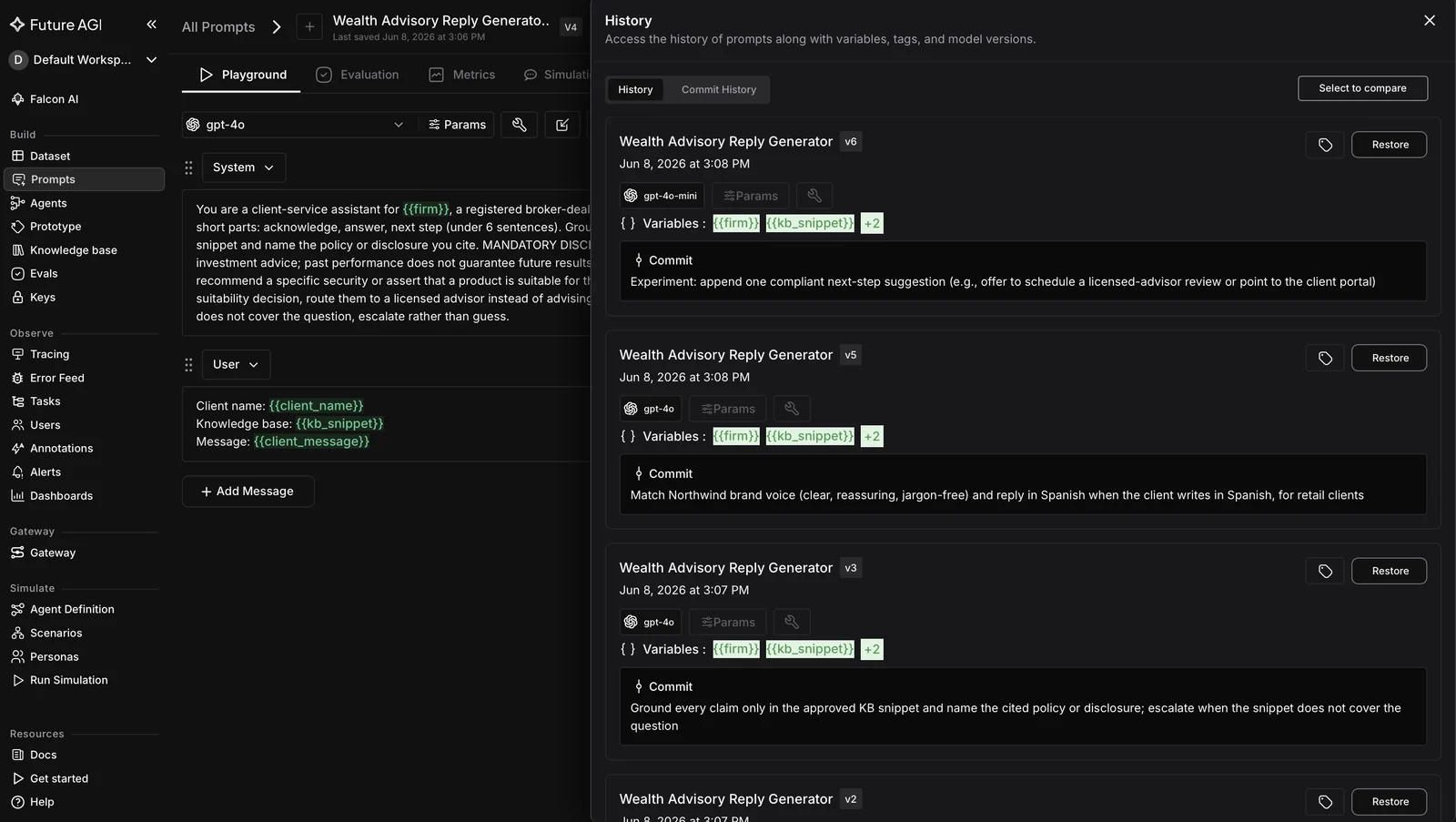
Every save is a commit, not an overwrite. Future AGI treats each save like a commit: it writes a new immutable version and leaves every earlier one intact in the version history. A label such as Production, Staging, or Development marks which version an environment serves. Promoting a change moves that label to a newer version, and rolling back moves it to an earlier one, both with no code release. Because the history only ever grows, the revision that was live last week is still there to return to.
-
A score that stays pinned to its version. Because each version is a fixed checkpoint, a score pins to it and does not drift. Future AGI grades a version with a library of built-in evaluators and any custom checks you add. They cover quality, safety, factuality, RAG retrieval, and format. Re-run that grade on the same version months later and the reading holds, so a prompt revision is as reproducible as a code commit.
-
The same grade, enforced in CI/CD. You can run those evals as a gate in your CI/CD pipeline. A regression in tone, accuracy, or a custom check then blocks the merge instead of reaching users, so no version ships before it is scored.
-
An optimizer that writes the next candidate. When a version stalls below its target, the open-source agent-opt library turns that score into the next candidate rather than a note you read and move past. Six algorithms, Random Search, Bayesian, ProTeGi, Meta-Prompt, PromptWizard, and GEPA, explore variations of a starting version and keep the ones your evaluator rates higher. Every other tool here stops at the versions you type by hand; this one proposes the improvement and lets you commit it.
-
The loop closes on live traffic. traceAI is OpenTelemetry-native, with instrumentors for 50+ frameworks. It traces how a version behaves in production and links each result to the revision behind it, so the prompts that struggle on live traffic are the ones you grade and optimize next.
Pricing and deployment. Future AGI offers a free tier, pay-as-you-go usage, and Enterprise plans on its pricing page. Because the core SDK and product repositories are Apache-2.0, a team can self-host the entire versioning and evaluation flow on its own infrastructure with Docker Compose, at no license cost. SOC 2 Type II and a HIPAA BAA come with the paid plans, a level of compliance the proprietary tools here typically hold back for Enterprise buyers.
Verdict. Future AGI is the strongest pick for teams that want git-style versioning to start a measured improvement loop, not sit as a passive history. Versioning, a built-in evaluator library, a CI/CD gate, six optimization algorithms, and production tracing run on one Apache-2.0 platform you can self-host. Choose it when you would rather run the whole prompt lifecycle in one place than wire a registry to separate eval and observability tools.
2. PromptHub: Best for a Literal Git-Branch Prompt Workflow
Quick take. PromptHub is the platform that most faithfully reproduces git itself for prompts. It gives a cross-functional team commit titles, real branches, a diff checker, and deploy-from-branch. The workflow feels like the version control engineers already know, extended to people who do not live in a code editor.
Ideal for. Teams that want the literal git mental model applied to prompts: master and staging branches with a diff between them, edited by both product managers and engineers.
Key strengths.
- Versioning is genuinely branch-based: commit titles and a full history, master and staging branches, and a diff checker that shows exactly what changed between two revisions before you deploy.
- You deploy a prompt straight from a branch and call it at runtime through the API, with
/runand/headendpoints, plus form inputs and a Zapier integration for non-developer workflows. - Built-in Evals and Pipelines catch regressions and issues such as leaked secrets, so a branch can be checked before it is promoted.
Limitations. PromptHub is proprietary and cloud-only, so there is no free self-hosting. Runtime is API-based rather than a broad multi-language SDK, and its evaluation depth is lighter than platforms built around evaluation. There is no automated optimization that proposes the next version for you.
Pricing. A free tier plus published paid plans, with Enterprise arranged through a demo.
Verdict. The pick when a true git-branch workflow with a visual diff is the priority and a cross-functional team wants the literal git model. It ranks below Future AGI because evaluation and optimization are lighter and self-hosting is not on offer.
3. Promptfoo: Best for Git-Native Prompts and Tests as Code
Quick take. Promptfoo is the most genuinely git-native option in this field, because there is no separate store to learn. Prompts and test cases live as plain YAML in a promptfooconfig.yaml file inside your repo, so versioning, diffs, branches, PR review, and blame are simply your normal git workflow. It is an open-source CLI and library for LLM evaluation, testing, and red-teaming, config-as-code from end to end.
Ideal for. Engineering teams that want prompt versioning to be their existing git workflow, with evaluation and red-teaming run from the CLI in CI/CD rather than from a hosted UI.
Key strengths.
- Prompts and test cases are plain YAML in
promptfooconfig.yamlcommitted to your repo, so every version, diff, branch, and rollback is a normal git operation with no separate registry to maintain. - Evaluation runs as a matrix of prompts, providers, and test cases. Assertions such as
equals,contains,contains-json,similar, andjavascriptcheck each result, plus a model-gradedllm-rubric. You inspect the results in a local web viewer withpromptfoo view. - Red-teaming is a flagship capability, so you can probe a prompt for failure modes in the same config-as-code workflow you use for functional evals.
Limitations. Promptfoo is an eval and testing tool, not a runtime registry, so it has no labels, no environment promotion, and no runtime prompt serving. Versioning is purely git and file-based, with no version store of its own. It is config-as-code and engineer-oriented, with no non-technical UI, and there is no built-in optimization that rewrites a prompt for you.
Pricing. The core tool is MIT-licensed and free, and it runs entirely on your own machine.
Verdict. The pick when you want prompt versioning to be plain git with evaluation and red-teaming as code. It ranks here because it is a testing tool rather than a management platform with promotion and runtime serving.
4. Langfuse: Best Open-Source Immutable Versioning You Self-Host
Quick take. Langfuse is the open-source option teams reach for when self-hosting the version store matters more than a managed UI. Its MIT-licensed core covers immutable prompt versioning, labels, and tracing, and it runs entirely on your own infrastructure. That combination gives a self-hosted team versioning and observability without adding a second vendor.
Ideal for. Engineering teams that want an open-source platform they control, with git-style immutable versioning and observability in one self-hostable package. It suits groups with data-residency or air-gap requirements that rule out a hosted-only vendor.
Key strengths.
- Saving a prompt under the same name creates a new immutable integer version automatically, so history accrues without ceremony and you can compare versions.
- Labels map versions to environments. The
productionlabel is served by default,latestupdates on its own, and custom labels cover staging or per-tenant routing. Rollback is handled by reassigning a label. - Prompt Experiments compare versions and models on a dataset, and prompts link to traces, so a version can be tied to how it performed.
Limitations. The richest commercial features live in a separate ee folder rather than the MIT core. Langfuse has no true branch or merge, so it is git-style immutable versioning rather than a literal branch workflow, and there is no automated optimization. A client-side cache means a reassigned label is near-instant on the server but takes effect in the app only after the cache refreshes.
Pricing. A free Hobby tier and self-hosting at no license cost, with paid Core, Pro, and Enterprise cloud tiers.
Verdict. The best starting point when open-source and self-hosting are non-negotiable. The tradeoff is that optimization lives elsewhere and there is no literal branch model.
5. PromptLayer: Best for a Dedicated Registry with Clean Diffs
Quick take. PromptLayer is a dedicated prompt registry built so that non-engineers such as product managers and subject-matter experts can manage and version prompts alongside developers. Its versioning is linear and immutable, with commit messages and a visual diff on every change.
Ideal for. Teams that want a clean, registry-style version history with readable diffs, where the editors are not all engineers and visual release control matters most.
Key strengths.
- Each version carries a commit message and a visual diff against prior versions, so a reviewer can see exactly what changed without reading code or pulling a git history.
- Release Labels map a version to an environment. Dynamic Release Labels can split traffic by percentage or user segment for staged rollouts and A/B comparisons. Rollback is handled by reassigning a label.
- The registry includes its own evaluation tooling for scoring versions on the prompt page before release.
Limitations. PromptLayer is proprietary, and self-hosting is Enterprise-only. It is a registry and collaboration layer first, so it offers no true branch or merge, and its evaluation depth is lighter than eval-led platforms, with eval-cell caps on lower tiers. There is no automated optimization that proposes the next version for you.
Pricing. A free tier, a Pro tier, and a Team tier with collaboration features; self-hosting is Enterprise.
Verdict. The pick when a clean dedicated registry with commit messages and readable diffs matters most and the editors are not all engineers. It trades away branches, deep evaluation, and free self-hosting.
6. LangSmith: Best for Commit-Hash History in a LangChain Stack
Quick take. LangSmith is the prompt versioning and observability layer from the LangChain team, and it is the most natural fit if your application is already built on LangChain or LangGraph. Its versioning is commit-based and immutable, which maps cleanly onto how engineers already think about code, and prompts, traces, and evaluations sit behind one SDK.
Ideal for. Teams whose stack is LangChain-first and who want commit-hash prompt versioning, tracing, and evals from a single vendor that speaks their framework natively.
Key strengths.
- Every save creates a new immutable commit identified by a commit hash, and human-readable commit tags move independently to point at a chosen commit, so the model is genuinely git-like.
- A named Environments feature promotes commits between deployment targets such as Staging and Production without a code change, with a diff toggle to compare two commits side by side.
- You pull a prompt by name and hash or by tag through the SDK, with first-class Python and TypeScript clients, and Experiments evaluate a specific application version on a dataset.
Limitations. LangSmith is proprietary even though LangChain itself is open source, so self-hosting is an Enterprise arrangement. Its strengths are concentrated in the LangChain ecosystem, so teams on other frameworks get less out of it, and it offers no true branch or merge. There is no automated optimization that proposes the next version for you.
Pricing. A free Developer tier, a per-seat Plus tier, and custom Enterprise pricing; self-hosting requires Enterprise.
Verdict. The default choice when the rest of your stack is already LangChain and a commit-hash history is enough. A weaker fit the further you move from that ecosystem or if you need optimization built into the same tool.
Which Git-Based Prompt Management Platform Should You Choose?
There is no single winner for every team, so match the platform to the constraint that matters most to you.
| If you need | Choose | Because |
|---|---|---|
| Version history plus a built-in eval and optimization loop | Future AGI | Scores and improves a version before it ships, Apache-2.0 self-host |
| A literal git-branch workflow with a visual diff | PromptHub | True master and staging branches with a diff checker |
| Prompts and tests versioned as plain code in your repo | Promptfoo | Git-native YAML config with CLI evals and red-teaming |
| An open-source version store you fully self-host | Langfuse | MIT core with auto integer versions and labels |
| A clean dedicated registry with readable diffs | PromptLayer | Commit messages and version diffs with release labels |
| Commit-hash history inside a LangChain stack | LangSmith | Commit hashes and tags native to that ecosystem |
PromptHub leads on the literal git verbs. Promptfoo goes furthest by making prompts plain YAML in your repo. Future AGI leads overall. It scores each version against a built-in evaluator library, gates it in CI/CD, and proposes a better candidate with six optimization algorithms, all Apache-2.0 and self-hostable. For only an open-source self-hosted version store, Langfuse is the cleaner pick. For a LangChain-only stack, LangSmith is the closest match.
How Do You Roll Out Git-Based Prompt Management Without Breaking Production?
Adopting a platform is the easy part. These practices keep git-based prompt management from becoming a new source of incidents.
- Make every prompt change a new version, never an in-place edit. The moment a prompt is editable without creating a version, your history has a hole in it. Save a version on every change so the diff is legible later and the live revision is always known.
- Map an environment to one approved version. Production should resolve to a single, known-good version, so promotion and rollback are a deliberate action rather than a redeploy. Lock the pointer if your platform supports protected labels.
- Tie each version to an evaluation run before you promote it. A version you cannot score is a version you cannot trust. Compare the candidate against the current production version on the same dataset, and run that eval as a CI/CD gate so a regression fails the build.
- Automate the next version instead of hand-tuning. Manual prompt edits plateau quickly. Feed the current version and an evaluator into an optimizer, let it propose a higher-scoring candidate, then review and ship the one that wins. Our guide to automated optimization for agents covers this in depth.
- Close the loop with traces. A version that scores well offline can still fail on real traffic. Link versions to traces so production behavior feeds your next round of optimization, and you catch the regressions an offline dataset missed.
Where Future AGI Fits in Your Git-Based Prompt Management Stack
Think about the prompt you overwrote in a text field, with no earlier copy to go back to. On Future AGI that copy is always there. Every save writes a new immutable version, so last sprint’s wording still exists, word for word. The score you trusted still belongs to the version that earned it, because it was attached the moment that version ran. An old result stays reproducible, because the prompt behind it never changed. If a new version regresses, you move a label and the known-good one serves traffic again in seconds, with no redeploy. If it only underperforms, the optimizer drafts a stronger candidate and saves you the hand-tuning. Git gave your code a history the team can trust, and Future AGI gives your prompts that same history, with evaluation and optimization inside it. Start with Future AGI’s prompt docs or version your first prompt on Future AGI.
Frequently Asked Questions About Git-Based Prompt Management
What Is Git-Based Prompt Management?
Git-based prompt management is versioning prompts the way a team versions code: every change becomes an immutable version with a readable history, you can diff any two revisions, and roll back to a known-good revision. The defining property is that rollback path, so the team always knows which revision is live. True branches and merge sit at the advanced end; the version-and-rollback core is what makes a prompt change safe.
Which Git-Based Prompt Management Platform Is Best in 2026?
Future AGI leads. Every save is an immutable version, named labels handle promotion, and rollback moves a label with no redeploy. It scores each version against a built-in evaluator library and runs those evals as a CI/CD gate. It also proposes a stronger version with six optimization algorithms, all Apache-2.0 and self-hostable. PromptHub is the best literal git-branch workflow. Promptfoo is the most git-native, with prompts as YAML in your repo. Langfuse is the best open-source self-hosted registry, PromptLayer the cleanest registry with diffs, and LangSmith the best commit-hash history in a LangChain stack.
Is Git-Based Prompt Management the Same as Branching and Merging Prompts?
No. The core is an immutable version history, diffs, and reversible rollback. PromptHub provides real branches with a diff checker; Promptfoo gets branching for free because its prompts are plain YAML in your repo. Future AGI uses named labels for promotion and rollback instead of literal branches, binding each version to a reproducible evaluation score. The reproducible history matters more than how many of git’s surface features a tool reproduces.
Why Manage Prompts with Git-Based Versioning Instead of a Flat File?
A flat store overwrites its value on every save, so the previous wording is gone and a regression leaves no revision to restore. Git-based versioning keeps every change as an immutable version, so rollback restores a known-good revision rather than rewriting it from memory. Because each version is a fixed artifact, an evaluation result or a production trace can be tied to the exact revision that produced it.
Can You Self-Host a Git-Based Prompt Management Platform?
Yes. Two of the six platforms self-host for free. Future AGI’s repos are Apache-2.0 and run via Docker Compose, and Langfuse offers an MIT core. Future AGI is the only free self-host that also scores every version against a built-in evaluator library and closes the loop with optimization. PromptHub is proprietary and cloud-only. PromptLayer and LangSmith gate self-hosting to Enterprise, and Promptfoo is MIT-licensed but is a testing tool, not a hosted registry. For free self-hosting of the whole versioning flow, the realistic choices are Future AGI and Langfuse.
How Does Git-Based Prompt Management Make Evaluation Reproducible?
Evaluation is reproducible when a score is tied to the immutable version that produced it. Future AGI scores each version against a built-in evaluator library and can optimize a failing one. Promptfoo runs evals from YAML in the repo, so they rerun against the exact committed version. Langfuse links experiments to immutable integer versions, PromptLayer attaches evaluations to the version on the prompt page, and LangSmith evaluates by commit hash. Because each version is a fixed artifact, the score and the prompt never drift apart.
Frequently Asked Questions
What Is Git-Based Prompt Management?
Which Git-Based Prompt Management Platform Is Best in 2026?
Is Git-Based Prompt Management the Same as Branching and Merging Prompts?
Why Manage Prompts with Git-Based Versioning Instead of a Flat File?
Can You Self-Host a Git-Based Prompt Management Platform?
How Does Git-Based Prompt Management Make Evaluation Reproducible?
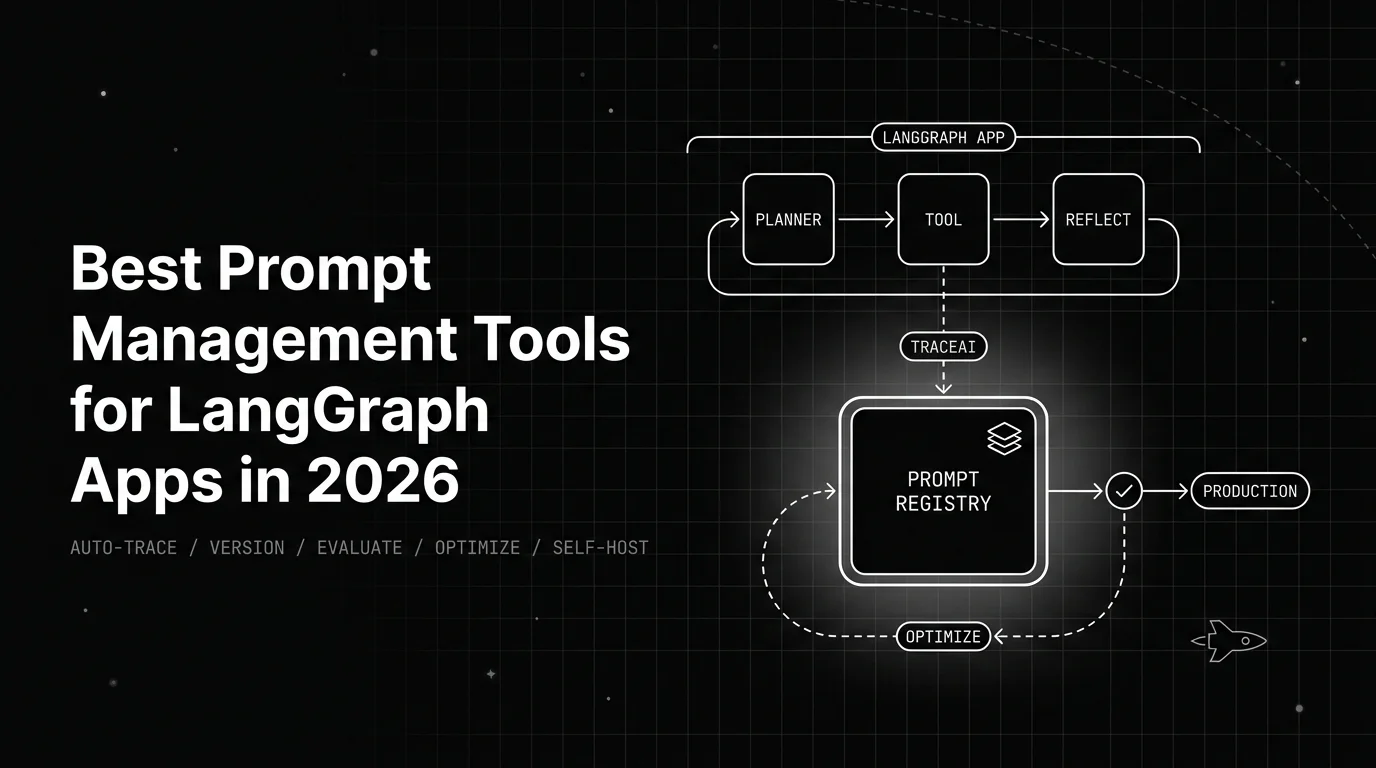
The 6 best prompt management tools for LangGraph apps in 2026, ranked on per-node versioning, tracing, evaluation, and safe deployment of node prompts.

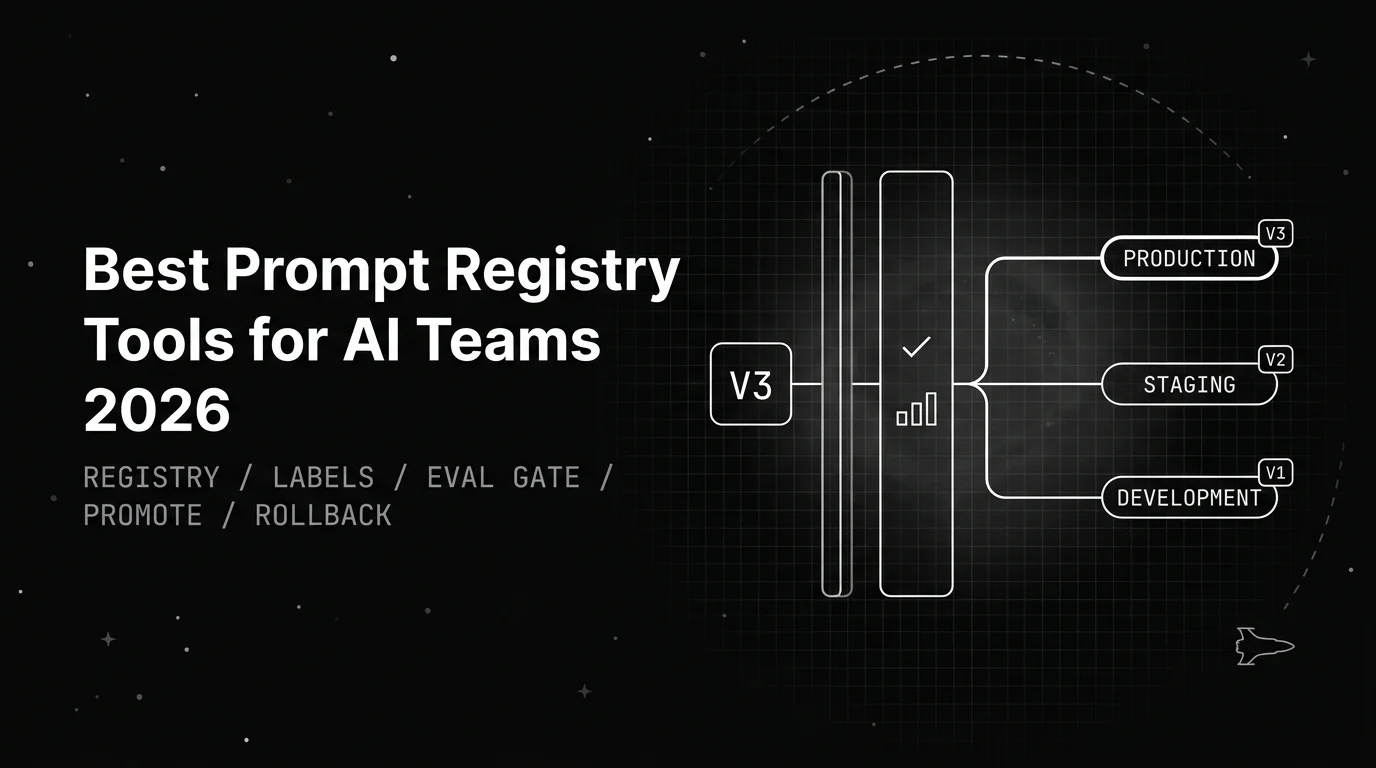
A ranked guide to the 6 best prompt registry tools for AI teams in 2026, compared on central storage, versioning, labels, and fetching prompts at runtime.

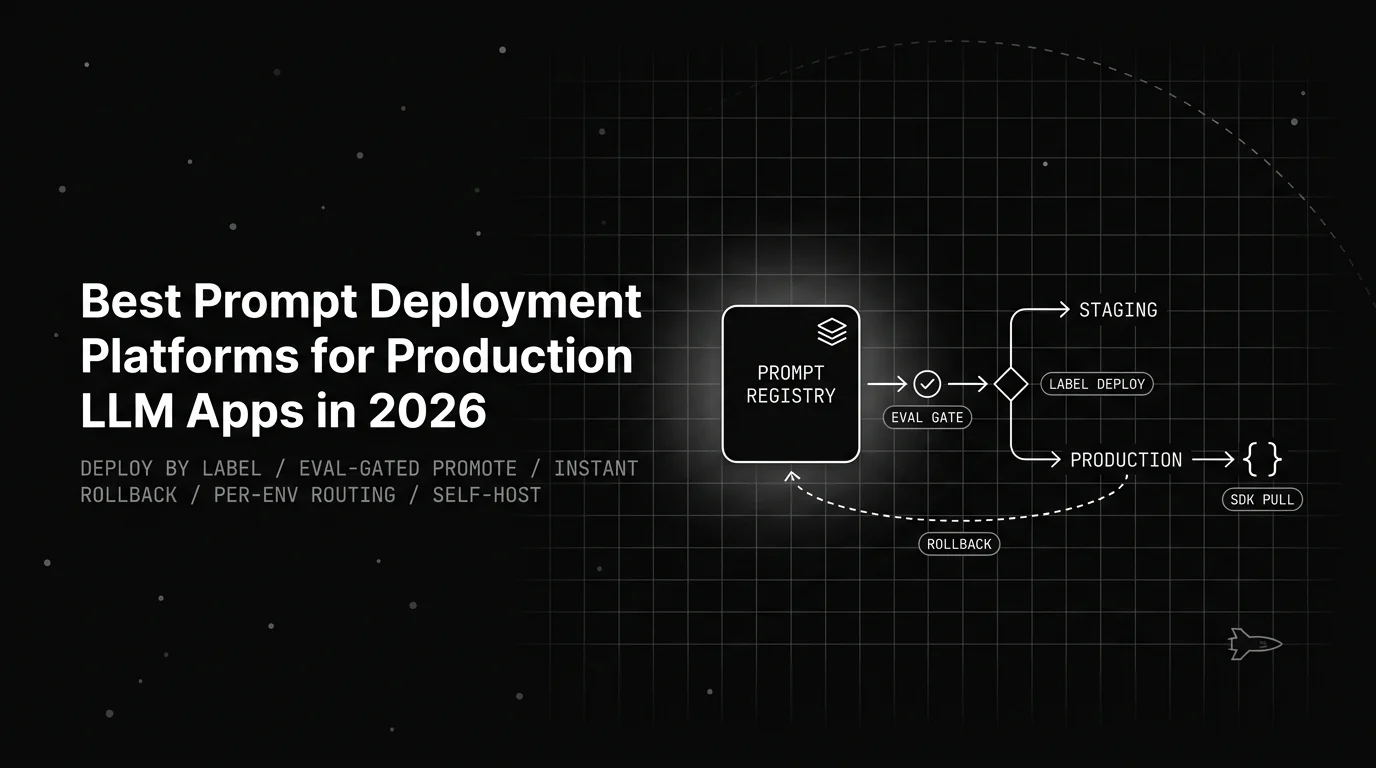
Compare the 6 best prompt deployment platforms for production LLM apps in 2026 on labels, rollback, runtime fetching, and safe, controlled prompt releases.