Best Prompt Deployment Platforms for Production LLM Apps in 2026
Compare the 6 best prompt deployment platforms for production LLM apps in 2026 on labels, rollback, runtime fetching, and safe, controlled prompt releases.
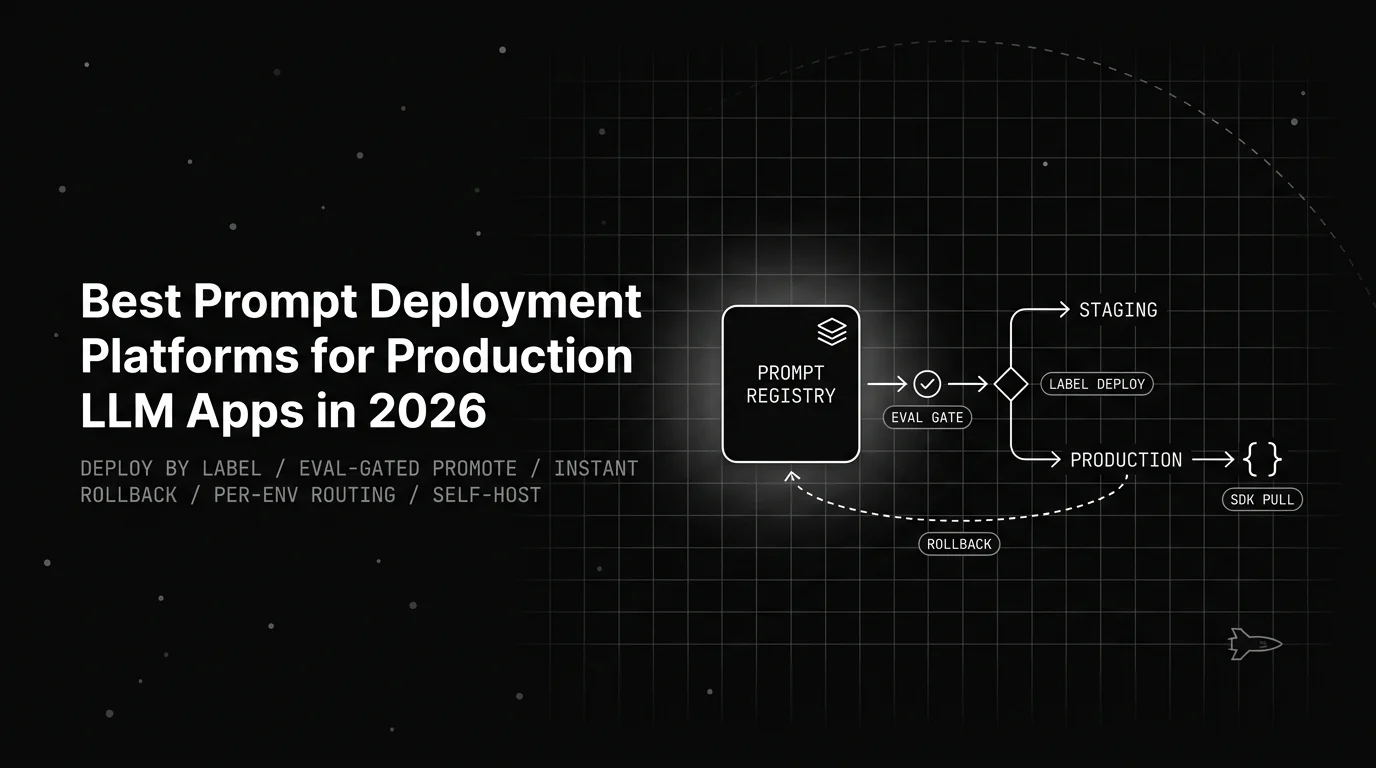
Table of Contents
A prompt that looked perfect in staging starts hallucinating in production, and the only fix is a code change, a pull request, a build, and a deploy. For the twenty minutes that takes, every user sees the bad answer. That is what happens when a prompt is a string in your codebase instead of a deployable artifact. This guide ranks the six prompt deployment platforms production LLM teams should evaluate in 2026. It scores them on promotion, rollback, and whether a version is gated on an evaluation score before it ships.
TL;DR: 6 Prompt Deployment Platforms Scored on Promotion, Rollback, and the Eval Gate
Future AGI is the strongest overall prompt deployment platform for production LLM apps in 2026 because it treats deployment as one stage of a full lifecycle rather than the whole job. Apps fetch a prompt by label, so shipping is a label reassignment with no code redeploy. Rollback is pointing that label to an earlier immutable version, and custom evals gate every CI/CD promotion before anything reaches users.
| Rank | Platform | Best for | Standout capability |
|---|---|---|---|
| 1 | Future AGI | End-to-end prompt lifecycle: deploy, eval-gate, observe, and optimize | Label-based deploy with no redeploy, custom evals as a CI/CD gate, six optimizers |
| 2 | Vellum | A formal, auditable release pipeline | Immutable Releases with Release Tags per environment |
| 3 | PromptLayer | A decoupled registry for label-based deploy | Release labels plus traffic-splitting dynamic labels |
| 4 | Langfuse | Open-source label-based deployment | MIT core with production labels you self-host |
| 5 | Portkey | Gateway-backed label deployment | Publish repoints production, labels promote, gateway adds routing and fallbacks |
| 6 | LangSmith | LangChain-native deployment | Named Environments with one-click rollback over commit hashes |
Why Does Prompt Deployment Break in Production?
Prompt deployment breaks because a prompt decides product behavior. But when it lives in your application code, every prompt change inherits your application’s release process. A one-line wording fix needs a commit, a review, a build, and a deploy, and a bad prompt cannot be reversed faster than your slowest rollback. The prompt and the app are coupled when they should ship on separate clocks.
Moving the prompt into a registry the app pulls at runtime solves the first half: shipping a new version no longer touches a build. But a runtime pull on its own only decouples the deploy, it does not make it safe. A version you can ship in seconds is a regression you can ship in seconds. Our guide to prompt versioning and lifecycle management covers the full lifecycle.
A production-grade prompt deployment platform has to deliver three things at once:
- Promotion that decouples from code. The app resolves the live version at runtime, so promoting a version is a registry action, not a rebuild. The same code path serves a different version per environment.
- Fast, auditable rollback. Reversing a bad version is selecting a known-good one, which the runtime picks up on its next call, with a legible history and no code release in the loop.
- An evaluation gate before promotion. Each candidate is scored against a fixed dataset, and only a passing version ships. A regression is blocked in the pipeline instead of discovered in production.
Most platforms nail the first two and stop. The differentiator in 2026 is the third pillar plus what follows it. You use the evaluation signal to improve the version automatically before it ships, then close the loop with production traces, so the next round starts from real behavior. A platform that only promotes and reverts leaves you guessing whether the change actually helped. That is the lens this scorecard applies.
The Production Prompt Deployment Scorecard
We scored every platform with the Production Prompt Deployment Scorecard, a six-dimension rubric built for the question this title asks. It is not which tool stores a version, but which one makes a version safe to ship and fast to reverse. This rubric leads with the dimensions a release engineer feels during an incident. Then it adds the two that keep deploys safe over time: a built-in evaluation gate and automated optimization.
| # | Dimension | What we measure |
|---|---|---|
| 1 | Promotion model | Shipping a version per environment from the registry, with no redeploy |
| 2 | Rollback | Reversing a live version fast, with an auditable history, no code release |
| 3 | Eval gate on promotion | Scoring a candidate against a dataset and blocking a failing version |
| 4 | Automated optimization | The platform improves a version before you ship it, not just stores it |
| 5 | Runtime SDK pull | The app resolving the live version by name at call time |
| 6 | License and self-host | The exact license, and whether the whole stack self-hosts for free |
We do not publish a single composite score, because the right platform depends on your stack, your license constraints, and your governance requirements. The decision table later in the article maps common buyer profiles to the pick that fits each one. Here is how the six platforms compare across the five dimensions that vary most across the cast.
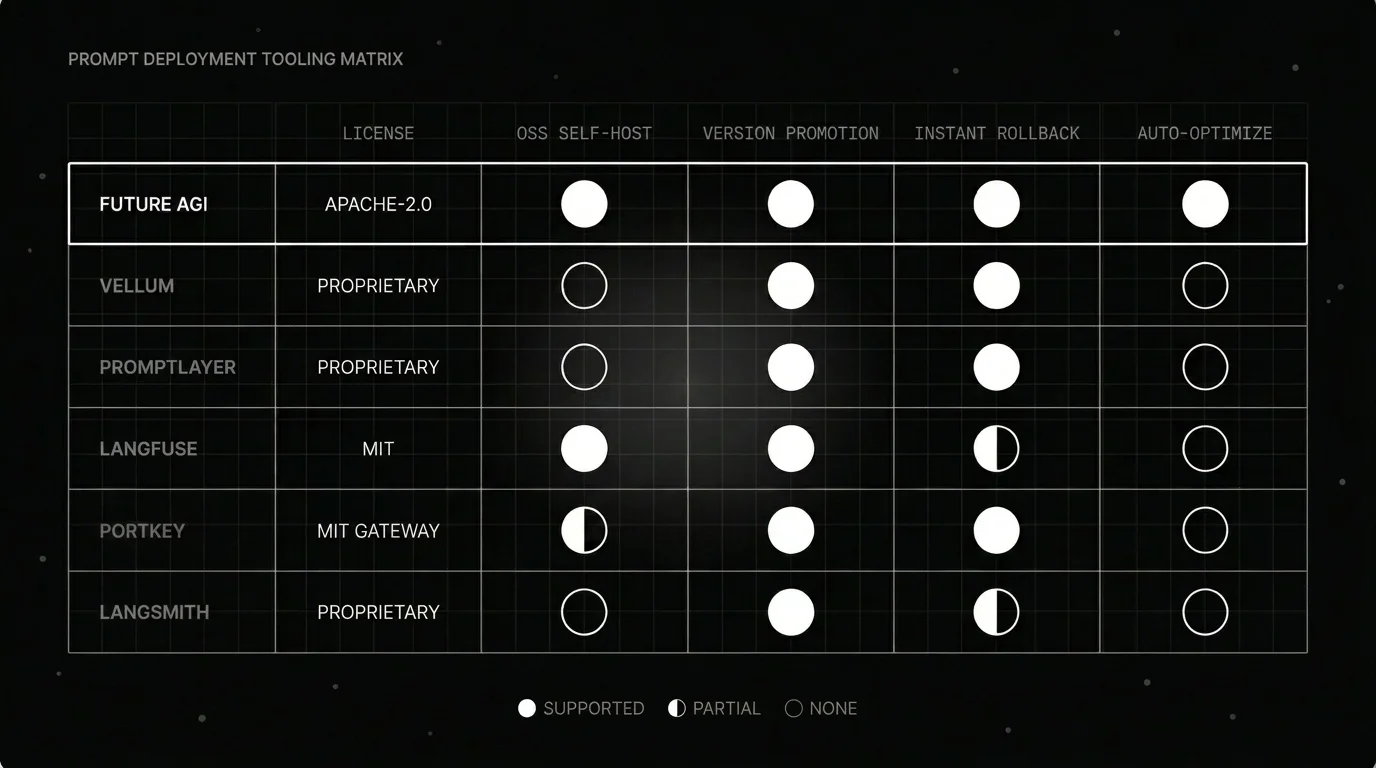
| Platform | Promotion model | Rollback | Eval gate | Auto-optimization | License / self-host |
|---|---|---|---|---|---|
| Future AGI | Reassign a label (Production/Staging/Development) | Reassign the label to an earlier immutable version | Custom evals as a CI/CD gate | Six algorithms (agent-opt) | Apache-2.0 core, self-host free |
| Vellum | Release Tags per environment | Repoint a tag, one-click revert | Built-in test suites | Manual | Proprietary, VPC Enterprise |
| PromptLayer | Release + dynamic labels | Reassign the label | Evals on the registry | Manual | Proprietary, self-host Enterprise |
| Langfuse | Labels, including protected | Reassign the label | Prompt Experiments | Manual | MIT core, self-host free |
| Portkey | Publish repoints production, labels promote | Restore from Version History or repoint a label | None built in | Manual | MIT gateway, prompt mgmt cloud |
| LangSmith | Named Environments | One-click revert to a commit | Eval SDK | Manual | Proprietary, self-host Enterprise |
1. Future AGI: Best Overall for Eval-Gated Prompt Deployment
Quick take. Future AGI runs the full prompt deployment lifecycle in one place. Apps fetch a prompt by name and label, so deploying is reassigning a Production label with no code redeploy and rollback is pointing that label to an earlier immutable version. Each version is scored by custom evals, six optimization algorithms can improve it, and traceAI observes it live, all Apache-2.0 and self-hostable.
Ideal for. Production LLM teams that want deployment and the evaluation loop in one place. You publish a version, score it against a dataset, and gate it in CI/CD before it ships. Then an optimizer can propose a better candidate, and you watch it live in traces, without stitching a registry to a separate eval tool.
Key strengths.
-
Label-based deploy with no code redeploy. On each save, Future AGI freezes a new version that later edits cannot change. A label such as Production, Staging, or Development marks which version that environment serves. Deploying is a label shift: move Production to a newer version, and the next runtime pull picks it up. Rollback shifts the label back to a known-good version, with no build in between.
-
Versions that are scored before they ship. Before a version ships, custom evals score it on what production demands: quality, safety, factuality, and format. You write each eval once, then run the candidate and the live version on the same dataset, so a number decides the deploy, not a hunch.
-
Evaluation as a CI/CD deployment gate. You can run the same evals as a gate in your CI/CD pipeline, so a prompt regression fails the build instead of routing to production. That turns a deploy into a checked release rather than a hopeful push.
-
Runtime pull from a versioned home. The Prompt Workbench gives prompts a permanent, versioned home the app resolves at runtime through the Python and TypeScript SDK. Shipping a new version takes effect on the next call, without rebuilding the service.
-
Optimization that writes your next version. When a version misses the gate, the open-source agent-opt library can rewrite it instead of shipping it as is. Six algorithms drive it: Random Search, Bayesian, ProTeGi, Meta-Prompt, PromptWizard, and GEPA. Each pairs a starting version with an evaluator and searches for a higher-scoring replacement.
-
The loop closes in production. traceAI delivers OpenTelemetry-native tracing, with instrumentors for 50+ frameworks. A live call lands as a trace tied to the version that served it, so your next round of evaluation and optimization starts from real traffic, not an offline guess.
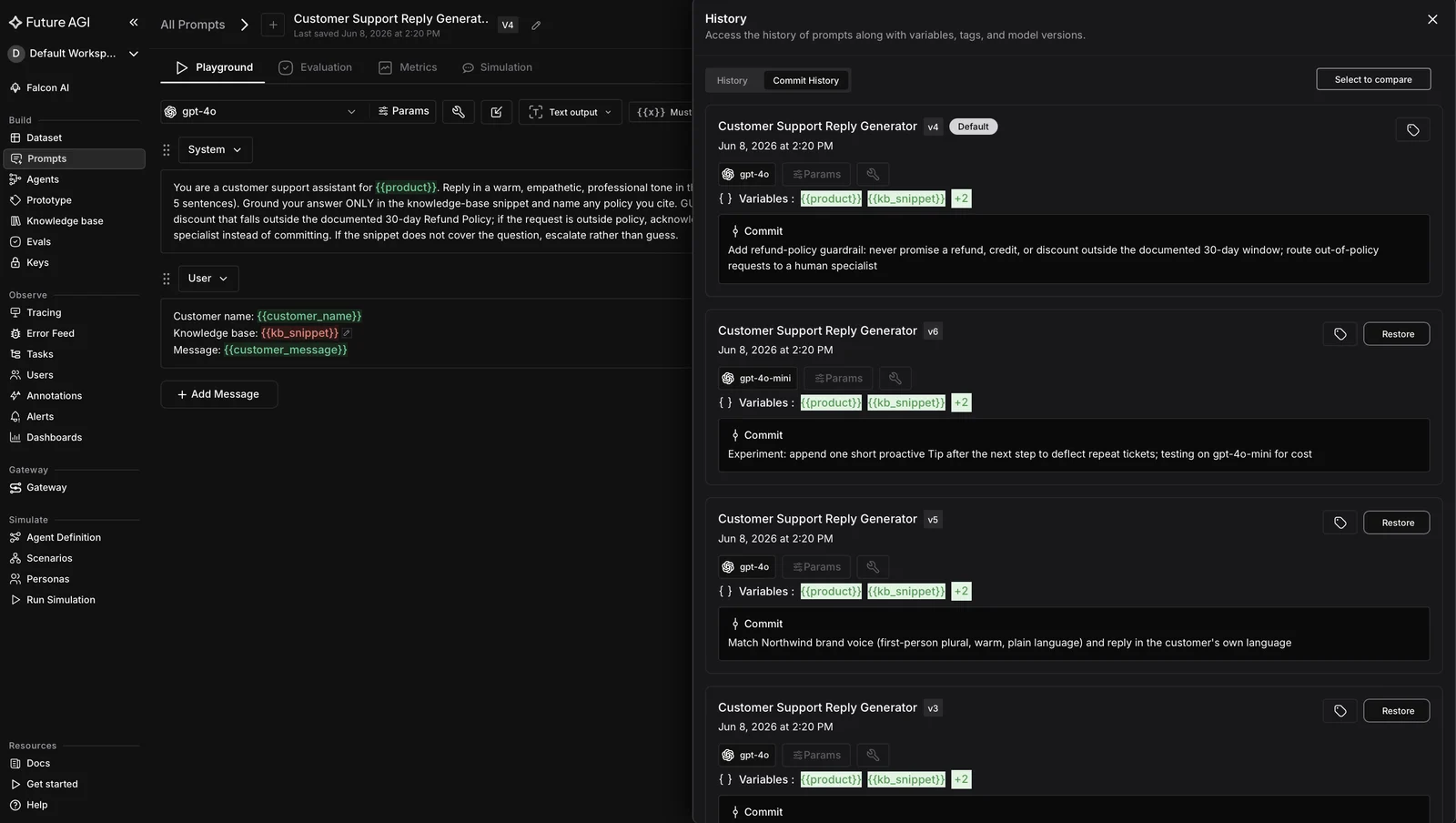
Pricing and deployment. Future AGI has a free tier, pay-as-you-go usage, and Enterprise plans on its pricing page. The core SDK and product repos are Apache-2.0 and self-hostable at no license cost via Docker Compose. The platform offers SOC 2 Type II and HIPAA BAA on paid plans, which most proprietary rivals gate behind an Enterprise contract.
Verdict. Future AGI is the strongest overall pick for teams that want deployment to be one stage of a measured loop, not a one-way push. Label-based deploy, custom evals as a CI/CD gate, six optimization algorithms, and OpenTelemetry-native tracing all run on one Apache-2.0 platform. You can self-host the whole stack. Choose it when you want the whole prompt lifecycle in one place instead of wiring separate tools together.
2. Vellum: Best Formal Release Pipeline with Immutable Releases and Release Tags
Quick take. Vellum models deployment as an explicit release pipeline with formal change control. A Prompt Version becomes a Deployment, and a Deployment cuts an immutable Release pinned to a model and snapshot. A Release Tag such as prod points at a chosen release, so promotion and rollback are tag moves over an auditable history. “Deployment” is a first-class noun in the product.
Ideal for. Teams that want a formal, auditable release pipeline with immutable releases, release tags, and enterprise governance around every promotion. The layered model suits teams that treat prompt changes as product releases and need SOC 2 or HIPAA sign-off. They get a clear history of exactly what shipped, in which environment, and when.
Key strengths.
- A three-layer model separates a prompt Version from a Deployment and a Release. Because each Release is immutable and pinned to a model and snapshot, you always know exactly what shipped.
- Release Tags point at a chosen release, and the runtime fetches a deployment by tag in Python or TypeScript. Promoting a version is repointing a tag, and rollback is repointing it back.
- Enterprise governance is the deepest in this cast, with SOC 2 Type I and II, HIPAA, RBAC, SSO and SAML, immutable audit logs, and VPC deployment. That matters when every release must be attributable.
Limitations. Vellum is proprietary, with only an assistant daemon open-sourced. Free self-hosting is not an option, and VPC deployment is an Enterprise arrangement. The version model is linear with no branch or merge, pricing layers add machine add-ons and a platform fee, and there is no built-in automated optimization.
Pricing. A free tier with pay-as-you-go credits and paid tiers that add a platform fee, with VPC deployment on Enterprise.
Verdict. Vellum is the best formal release pipeline when auditable, immutable releases and enterprise governance matter more than open-source access. Its layered Version, Deployment, and Release model gives every environment a clean, attributable history with one-click revert. Accept that it is proprietary and self-hosting needs an Enterprise contract before choosing it.
3. PromptLayer: Best Decoupled Registry for Label-Based Deploy
Quick take. PromptLayer is a registry-first platform built so prompts live entirely outside your application code, which makes label-based deployment its natural shape. Release Labels and Dynamic Labels map a version to environments such as prod and staging, and the app pulls by label at runtime. Rollback is repointing a label, so a prompt ships and reverses with no redeploy.
Ideal for. Teams that want prompts fully decoupled from the codebase, deployed and rolled back by moving a label in a dedicated registry. It fits cross-functional teams where product managers or domain experts review versions visually before a label moves. Traffic-split releases then reduce the risk of a full promotion.
Key strengths.
- The registry is decoupled from application code, so a prompt version is a named, deployable asset and shipping it never touches a build.
- Release Labels map a version to an environment. Dynamic Release Labels can split traffic by percentage or user segment, so a new version can take a fraction of traffic before a full promotion.
- Evaluations and Datasets live on the prompt page, so a score sits next to the version before you move its label, giving promotion an evidence step inside the same tool.
Limitations. PromptLayer is proprietary, and self-hosting is gated to Enterprise. The version model is linear with no branch or merge, and the evaluation step is a manual check rather than an enforced pipeline gate. There is no built-in automated optimization, so prompt improvement stays a human-driven loop rather than something the platform drives.
Pricing. A free tier, a Pro tier, and a Team tier with collaboration features; self-hosting is Enterprise.
Verdict. PromptLayer is the best decoupled registry for teams that want clean label-based deploy and rollback entirely outside their codebase. Dynamic Release Labels add traffic splitting so a new version can take a fraction of load before full promotion, which reduces the cost of getting a deploy wrong. Accept that it is proprietary and self-hosting needs an Enterprise contract.
4. Langfuse: Best Open-Source Label-Based Deployment You Can Self-Host
Quick take. Langfuse is the open-source platform a team can self-host for free and still get real label-based deployment. An MIT-licensed core auto-versions prompts, and labels such as production and latest map a version to an environment. The runtime then pulls the prompt by label. It is the strongest free, self-hostable deploy option, with one caveat on rollback.
Ideal for. Teams that want free, self-hostable label-based deployment inside their own network. This especially fits groups with data-residency or air-gap requirements that rule out a hosted registry. It also suits groups who want to read the source before committing, since the MIT core is fully open and the deployment loop runs on your own infrastructure at no license cost.
Key strengths.
- The MIT core self-hosts free on Docker, so the registry, labels, and runtime pull all run inside your own network without a license fee, which no proprietary tool here offers.
- Saving a prompt under the same name creates a new immutable integer version. Labels such as
productionmap a version to an environment that the runtime resolves by label. - Protected labels let admins lock the
productionpointer against accidental moves. Prompt Experiments score a version against a dataset, so you can compare candidates before moving a label.
Limitations. Rollback is moving a label, but a client-side cache can delay when the change actually goes live. Reversal is not strictly instant the way a pure server-side repoint is. Role-based access and SSO live in the commercial Enterprise Edition rather than the MIT core, and there is no built-in automated optimization.
Pricing. A free Hobby cloud tier and free self-hosting under MIT, with paid Core, Pro, and Enterprise cloud tiers plus a commercial Enterprise Edition that adds RBAC and SSO.
Verdict. Langfuse is the best open-source label-based deployment when self-hosting the whole loop for free is the requirement. Protected labels lock the production pointer against accidental moves, and Prompt Experiments let you score a version before the label shifts. Accept a client-side cache delay on rollback, since the change is server-side instant but app-side near-instant.
5. Portkey: Best Gateway-Backed Label Deployment
Quick take. Portkey pairs a Prompt Engineering Studio with an AI gateway, and that gateway is what distinguishes its deployment model. An “Update” creates an immutable version, and “Publish prompt changes” repoints the production deployment to a chosen version. Labels such as @production and @staging then promote versions between environments without a code release. The gateway adds routing and fallbacks across 1,600+ models, so every deploy carries provider resilience.
Ideal for. Teams that want label-based prompt deployment sitting on top of a multi-provider gateway with routing and fallbacks built in. It fits teams that already need provider-level resilience, such as load balancing and automatic fallback. They want prompt versioning to arrive as part of the same layer, rather than a separate tool.
Key strengths.
- Publishing is a repoint. The “Publish prompt changes” action points the production deployment at a chosen immutable version. Labels such as
@production,@staging, and@developmentthen promote a version between environments without a code release. - The runtime resolves a prompt by ID, either pinned as
promptID@12or by label, so the app pulls the live version at call time. Rollback is a Version History restore or repointing a label. - The AI gateway routes across 1,600+ models with load-balancing and fallbacks. Confirmed integrations with CrewAI, AutoGen, LangChain, LangGraph, and LlamaIndex make it easy to drop into an existing stack.
Limitations. Prompt management is secondary to the gateway, and its deepest features are proprietary cloud rather than the MIT gateway. You cannot self-host the whole deploy loop for free. There is no built-in evaluation suite, so you cannot gate a deployment on a score inside Portkey, and versioning has no commit messages, diffs, or branches.
Pricing. A free tier with paid plans above it; the AI gateway is open-source MIT and self-hostable via Docker, while prompt management, the dashboard, and Studio stay proprietary cloud.
Verdict. Portkey is the best gateway-backed label deployment for teams that want multi-provider routing and fallbacks under every prompt version they ship. The tradeoff is that there is no built-in evaluation gate, so you must score candidates outside the platform before promoting a label. Choose it when provider resilience is the primary deployment concern.
6. LangSmith: Best for LangChain-Native Deployment
Quick take. LangSmith is the deployment pick for teams already standardized on LangChain. Its Prompt Hub and the deepest first-party LangChain tracing make pulling and shipping a prompt feel native to the framework. Its named Environments now add staging and production promotion with one-click rollback over its commit-hash model. Routing and reversal are genuinely first-class.
Ideal for. Teams whose stack is LangChain end to end and who want to pull versioned prompts from the Hub with the deepest native tracing, promoting them through Environments. If your services already emit LangChain runs, LangSmith captures them without extra instrumentation. A versioned prompt and its traces sit side by side in the same tool.
Key strengths.
- The Prompt Hub stores versioned prompts you pull by name and commit hash. LangSmith also offers the deepest first-party LangChain tracing, so a prompt’s runtime behavior is observable in the same tool with no extra integration.
- Versions are immutable and addressable by commit hash. Named Environments promote a commit into staging and production targets with one-click rollback. You ship an exact, pinned prompt and move it between environments without a code change.
- For LangChain-native teams the integration is frictionless, with the registry, tracing, and evaluation all in one place that already speaks the framework.
Limitations. LangSmith is proprietary, and self-hosting is gated to an Enterprise contract. There is no free path to run the deploy loop inside your own network the way Langfuse allows. Its leverage is concentrated in the LangChain ecosystem, so its value thins for teams on other frameworks, and there is no built-in automated optimization.
Pricing. A free Developer tier and a per-seat Plus tier in the cloud, with self-hosting on Enterprise.
Verdict. LangSmith is the best deployment pick for LangChain-native teams who value native tracing, Hub pulls, and Environments in a single SDK. It ranks last here because this comparison weights a dedicated release pipeline and free self-hosting. A proprietary tool tied to one framework is a narrower fit for most production stacks.
Which Prompt Deployment Platform Should You Choose?
There is no single winner for every team, so match the platform to the deployment constraint that matters most to you. The table below maps common needs to picks with the key reason for each; treat it as a starting point, then validate against your own stack and data-residency requirements.
| If you need | Choose | Because |
|---|---|---|
| Eval-gated deployment, label-based rollback, and optimization in one stack | Future AGI | Custom evals gate the deploy in CI/CD, label-based rollback with no redeploy, Apache-2.0 self-host |
| A formal, governed release pipeline | Vellum | Immutable Releases and Release Tags with SOC 2, RBAC, SSO, and audit logs |
| A decoupled registry for label-based deploy | PromptLayer | Release and dynamic labels map versions to environments outside your code |
| Free open-source label-based deployment | Langfuse | MIT core with production labels and runtime pull you self-host |
| Label-based deployment on a multi-provider gateway | Portkey | Publish repoints production, labels promote, the gateway adds routing and fallbacks |
| Native deployment inside a LangChain stack | LangSmith | Prompt Hub pulls with the deepest first-party LangChain tracing |
Most platforms here handle promotion and rollback well, so neither dimension alone separates the field. Vellum has the most formal release machinery, and PromptLayer is the cleanest decoupled registry. Langfuse is the strongest free open-source option, Portkey backs label deployment with a multi-provider gateway, and LangSmith is the native choice for a LangChain stack.
Future AGI leads because deployment is one stage of the full loop it runs in one place. Apps fetch a prompt by label, so a deploy is a label reassignment with no redeploy and rollback is pointing the label back. The same custom evals gate the CI/CD pipeline, and six optimization algorithms can generate the next version. traceAI closes the loop on live behavior, all under Apache-2.0.
If your stack is LangChain-only, LangSmith is the tighter fit because its versioning is native to that ecosystem and its tracing requires no extra integration. If you need a fully open-source registry, Langfuse is the cleaner pick. If you want provider routing and fallbacks baked into the deployment layer, Portkey is the right match.
How Do You Roll Out Prompt Deployment Without Breaking Production?
Adopting a platform is the easy part. The discipline around it is what keeps prompt deployment from producing incidents as your team and prompt count grow. Without these practices, a fast deploy path becomes a fast way to push a bad version. These five steps apply regardless of which platform you pick.
- Resolve every prompt at runtime, never inline. Move prompts out of the code and pull the live version by name on each call, so shipping a version is a registry action and the app never rebuilds to pick up a change.
- Promote through staging first. Exercise a new version in a staging environment before it reaches production, so production is never the first environment that sees a change.
- Gate promotion on a passing score. Compare the candidate against the current production version on the same dataset, and run that eval as a CI/CD gate so a regression fails the build, not your users.
- Keep rollback one deliberate action. Make every version immutable so reversing a bad deploy is selecting a known-good version, and rehearse the reversal before you need it under pressure.
- Close the loop with traces. A version that scores well offline can still fail on real traffic. Link versions to traces so production behavior feeds your next round of evaluation and optimization.
Where Future AGI Fits in Your Deployment Pipeline
Picture the prompt that looked perfect in staging and then started hallucinating in production. On Future AGI, fixing it is now one label move. You point Production back to the last version that scored well, and the very next call serves it, so a twenty-minute outage becomes a few seconds. That broken version would likely never have shipped, because a custom eval gates the CI/CD pipeline and scores every candidate first. Once your fix is live, traceAI shows how it behaves on real traffic, so the next version starts from real evidence you can see. A prompt you can deploy is one thing. A prompt you can deploy safely, and take back just as fast, is what a real deployment platform gives you. Explore the prompt docs or sign in to Future AGI.
Frequently Asked Questions About Prompt Deployment
What Are the Best Prompt Deployment Platforms in 2026?
The best prompt deployment platforms in 2026 are Future AGI, Vellum, PromptLayer, Langfuse, Portkey, and LangSmith. Future AGI leads as the end-to-end platform. Apps fetch a prompt by label at runtime, deploying a new version is reassigning that label with no code redeploy, and custom evals gate every CI/CD change, all Apache-2.0. Vellum is the best formal release pipeline, and PromptLayer the best decoupled label registry. Langfuse is the best open-source self-host option, Portkey the best gateway-backed label deployment, and LangSmith the best fit for LangChain teams.
How Do You Deploy a Prompt Without Redeploying Your App?
You move the prompt out of the code and into a registry. Then the application resolves the live version at runtime by name and label, rather than reading a hardcoded string. Shipping a new version becomes a promotion inside the registry. Because the app picks up the change on its next call, it takes effect without rebuilding the application. Future AGI, Vellum, PromptLayer, Langfuse, and Portkey all support this pattern, so a prompt update ships on its own clock, independent of the application’s release cycle.
How Do You Gate a Prompt Deployment on Evaluation?
You score the candidate version against a fixed dataset before it ships, and only promote it if it clears the threshold. A regression is caught in the pipeline rather than by users. Future AGI runs custom evals as a CI/CD gate, blocking any version that drops on quality, safety, or factuality. That gate separates a platform that ships prompts safely from one that only stores them.
How Do You Roll Back a Bad Prompt in Production?
You return the application to a known-good version, which takes effect on the next runtime pull without a code release. The mechanism differs by platform. Future AGI reassigns a label, pointing Production back to an earlier immutable version. Vellum repoints a release tag. PromptLayer and Langfuse reassign a movable label. Portkey restores from Version History or repoints a label, and LangSmith uses one-click rollback through named Environments. In each case the registry holds every prior version, so reversal is selecting a known-good one.
Can You Self-Host a Prompt Deployment Platform?
Yes, two of the six platforms self-host the whole loop for free. Future AGI is Apache-2.0 and self-hostable at no license cost via Docker Compose. It is also the only free self-host option with custom evals as a CI/CD gate. Langfuse ships an MIT core you can run yourself. Portkey open-sources its AI gateway under MIT, but prompt management and Studio stay proprietary cloud. PromptLayer, Vellum, and LangSmith are proprietary, so self-hosting means an Enterprise or VPC contract.
Frequently Asked Questions
What Are the Best Prompt Deployment Platforms in 2026?
How Do You Deploy a Prompt Without Redeploying Your App?
How Do You Gate a Prompt Deployment on Evaluation?
How Do You Roll Back a Bad Prompt in Production?
Can You Self-Host a Prompt Deployment Platform?
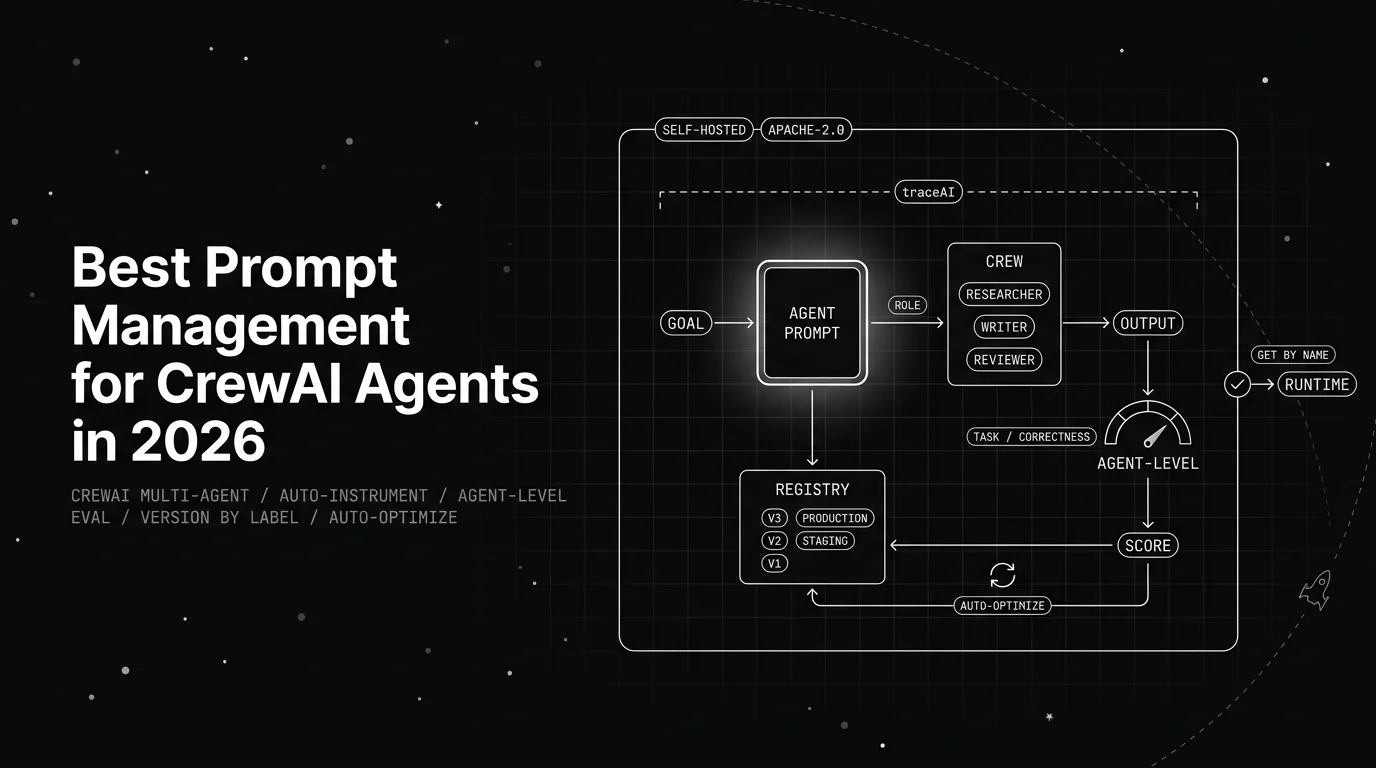
The 6 best prompt management tools for CrewAI agents in 2026, ranked on integration, per-agent versioning, tracing, and built-in evaluation of prompts.

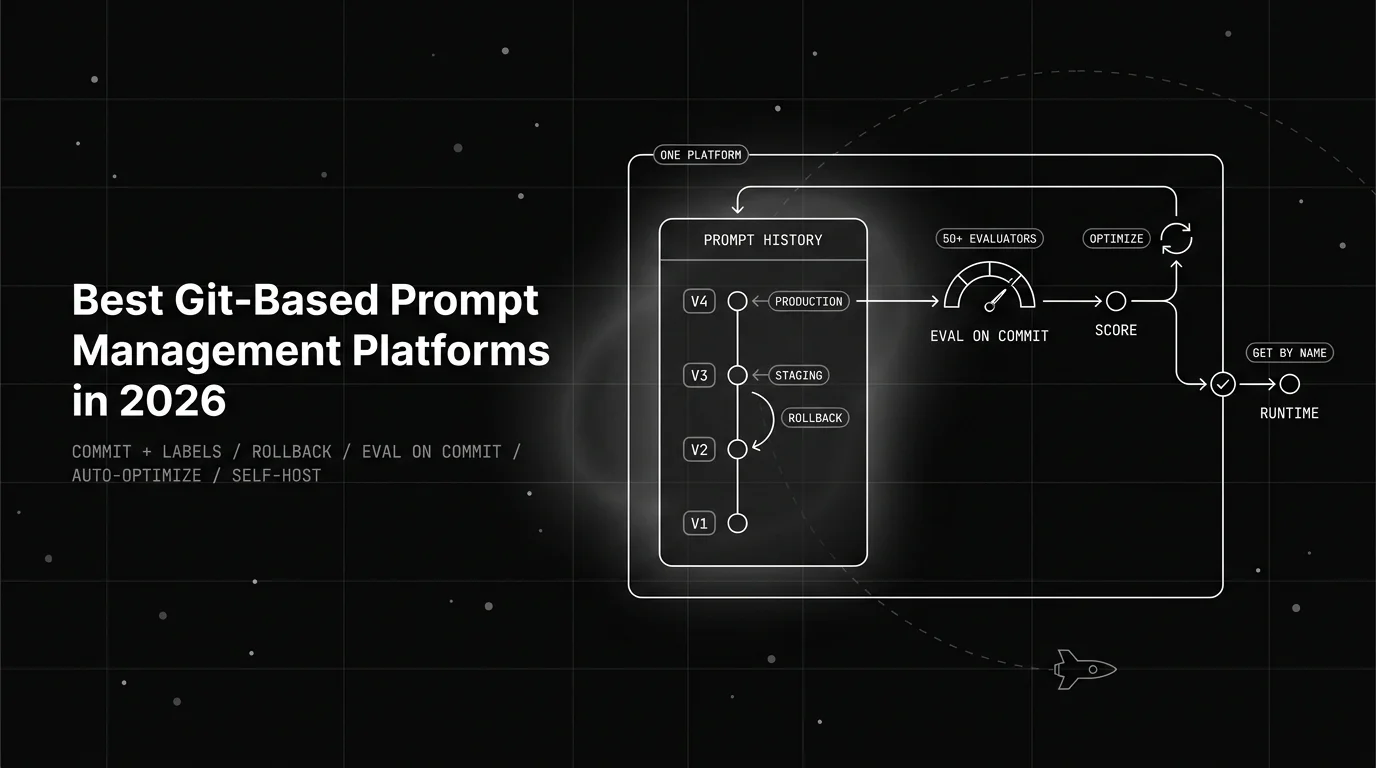
Compare the 6 best git-based prompt management platforms of 2026 on version control, branching, diffs, and code-first prompt workflows for engineering teams.

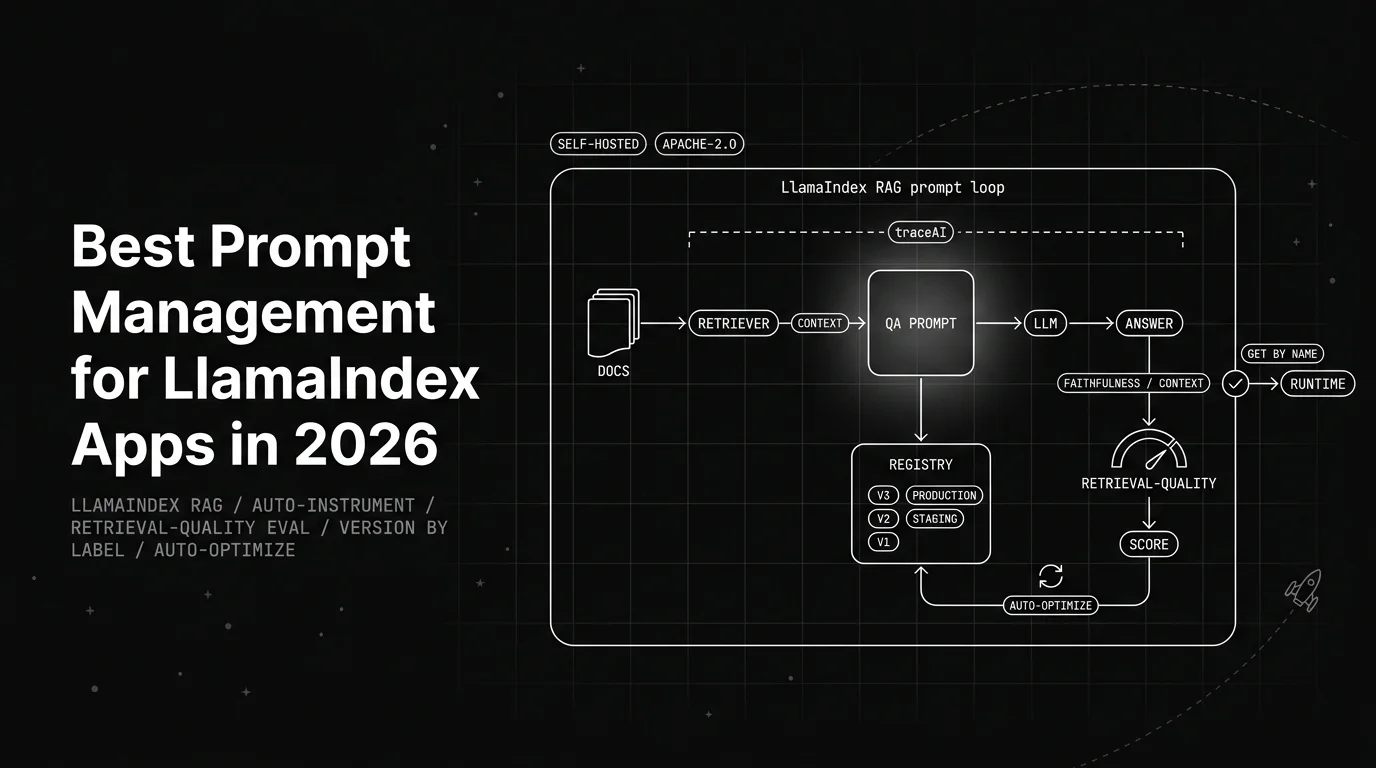
See the 6 best prompt management tools for LlamaIndex apps in 2026, ranked on integration, versioning, tracing, and evaluation for your RAG app prompts.