Best 5 Evidently AI Alternatives in 2026
Five Evidently AI alternatives on report-suite portability, LLM-native tracing, guardrails, gateway. What each actually fixes beyond ML-monitoring libs.

Table of Contents
Evidently AI built its reputation on classical ML monitoring, data drift, target drift, model-performance reports, and a clean Python API for spinning up Report and TestSuite objects against a pandas DataFrame. For teams who shipped scikit-learn or XGBoost models in 2022, it was the right tool. Three years in, the workload has shifted. The thing in production is an LLM agent, not a tabular classifier, and the questions, faithfulness, prompt-injection exposure, tool-call correctness, cost per session, need an OpenTelemetry-native tracing surface, not a pandas-shaped one.
Evidently added LLM evaluators and a hosted dashboard tier, but the architecture is still organized around “load a DataFrame, run a report.” The LLM cohort (Phoenix, Langfuse, DeepEval, Braintrust) was designed for runtime tracing and live-trace evaluators from day one. Evidently is a report library that bolted LLM on; Phoenix and Langfuse are LLM platforms that include a report view among many surfaces.
This guide ranks five alternatives, names what each fixes versus Evidently, and walks through the two migrations that always bite: rewriting the Report / TestSuite Python suite into a runtime-aware evaluator and replacing the hosted dashboard.
TL;DR: pick by exit reason
| Why you are leaving Evidently AI | Pick | Why |
|---|---|---|
| You want eval + gateway + guardrails + optimizer in one loop | Future AGI Agent Command Center | Closes the loop from trace through eval to guardrail to optimizer |
| You want OSS evaluators with strong LLM tracing | Arize Phoenix | Apache 2.0 evaluators plus OTel-native agent traces |
| You need first-class prompt management with eval primitives | Langfuse | Self-hostable, MIT-core, prompt registry plus eval hooks |
| You want a pytest-style unit-test framework for LLMs | DeepEval | The clean Python regression-test harness Evidently never quite became |
| You want eval-as-product with reproducible experiments | Braintrust | Experiments, datasets, and eval scorers as the first-class object |
Why people are leaving Evidently AI in 2026
Five exit drivers show up repeatedly in Evidently GitHub issues, /r/MachineLearning and /r/LLMDevs migration threads, the Evidently community Discord, and G2 reviews from the last two quarters.
1. ML-monitoring product with LLM bolted on later
Evidently was built around classical ML drift detection (DataDriftPreset, TargetDriftPreset, RegressionPreset, ClassificationPreset) and the unit of work is a Report or TestSuite against reference and current pandas DataFrames. LLM evaluators (LLMEvalsPreset, faithfulness, relevance) were added on top of that frame, not designed alongside it. The seams show: prompts aren’t first-class objects, agent traces have to be flattened into rows before a report can run, and the dashboard’s information architecture is still drift-and-test-result rather than session-and-span. Teams running mixed classical and LLM workloads tolerate this; LLM-only teams feel the mismatch every day.
2. Python-only ecosystem
Evidently is Python. The library, the SDK, and the report-rendering layer all assume a Python runtime with pandas in scope. TypeScript and Node agents, the dominant stack for new production agents in 2026, get nothing first-party. TypeScript backends run a Python sidecar just for reports or port the evaluators themselves. The competitive cohort (Phoenix, Langfuse, FAGI, Braintrust) all ship TypeScript SDKs with feature parity to the Python one.
3. No native gateway or routing layer
Evidently is a measurement library. It doesn’t sit in the request path, route across providers, enforce per-team rate limits, or surface cost per session. Teams who picked Evidently for monitoring bolt a separate gateway (LiteLLM, Portkey, Helicone) in front and a separate guardrails vendor alongside, and now run three policies that drift apart.
4. Hosted dashboard tier with thinner LLM-specific community
Evidently’s OSS library is free and Apache 2.0; Evidently Cloud is the hosted analytics surface and is on a separate subscription. The free tier is real but seat- and project-based pricing kicks in earlier than expected, and the hosted dashboard is the only first-party UI for live traces above local-laptop scale. Phoenix’s and Langfuse’s Discords are noisier and the GitHub issue traffic larger; LLM-specific questions on the Evidently tracker still tend to get ML-monitoring-shaped answers.
5. No inline runtime guardrails
Evidently scores a response after it has been generated, or after a batch of responses has been written to a DataFrame and rolled up into a report. It can’t block a PII leak, prompt injection, or policy violation before the response reaches the user. The fix is the usual one: bolt on a separate guardrails vendor (NeMo Guardrails, Lakera, Future AGI Protect), rebuild on a platform that ships eval and guardrails as one loop, or accept the gap.
What to look for in an Evidently AI replacement
The default “best monitoring library” axes from the classical-ML era are necessary but not sufficient for an LLM-agent exit. Score replacements on the seven that map to the surfaces you’re actually migrating off:
| Axis | What it measures |
|---|---|
| 1. Report / TestSuite portability | Can you import existing Report and TestSuite definitions without rewriting from scratch? |
| 2. LLM-native trace capture | Does the platform capture OTel agent traces (LLM call, tool call, retriever call) end-to-end, not just tabular rows? |
| 3. Inline guardrails | Can it block a hallucination, PII leak, or jailbreak before the user sees it? |
| 4. Gateway / routing integration | Does it sit in the request path or do you bolt a separate gateway on? |
| 5. Optimizer integration | Does the eval score feed an automated prompt or routing rewrite? |
| 6. Language coverage | First-class TypeScript and Python, or Python-only? |
| 7. Migration tooling | Published importers or scripts for Evidently Report / TestSuite specifically? |
1. Future AGI Agent Command Center: Best for closing the loop
Verdict: Future AGI is the only platform in this list that ships the eval framework, the gateway, the runtime guardrails, and the optimizer as one product with one data model. The other four are eval or observability platforms with adjacent surfaces. FAGI captures the trace, scores it, blocks the policy violation with the guardrails layer, runs the optimizer, and pushes the updated prompt back into the gateway on the next request. Evidently produces a report; FAGI produces a self-improving loop.
What it fixes versus Evidently AI:
- Eval portability and the loop.
ai-evaluation(Apache 2.0) accepts metric definitions that map cleanly onto Evidently’sLLMEvalsPresetrubric set, faithfulness, answer-relevance, context-precision, toxicity, PII, and the rest. The Evidently-to-FAGI importer rewritesReportandTestSuitedefinitions intoai-evaluationcases and preserves dataset bindings. Once cases live in FAGI, the optimizer (agent-opt, Apache 2.0) rewrites prompts automatically via six optimizers — ProTeGi, GEPA, Bayesian, MetaPrompt, RandomSearch, PromptWizard. Evidently is a snapshot report; FAGI’s eval surface is a self-improving loop.
- LLM-native trace capture.
traceAI(Apache 2.0) is OpenTelemetry-native, instruments Python and TypeScript first-class, and ships auto-instrumentation for the major agent frameworks (LangChain, LlamaIndex, CrewAI, AutoGen, OpenAI Agents SDK). Agent spans (LLM call, tool call, retriever call, sub-agent invocation) are first-class objects rather than rows in a DataFrame. Production calls are scored against the same rubric the offline suite uses, so offline-to-production drift shows up as a chart, not an incident.
- Inline guardrails. Protect blocks PII leaks, prompt injection, jailbreak attempts, and policy violations inline. Published latency is a median of 67 ms text-mode and 109 ms image-mode per arXiv 2510.13351. The Evidently + bolted-on-guardrails stack runs two policies that drift apart; FAGI runs one.
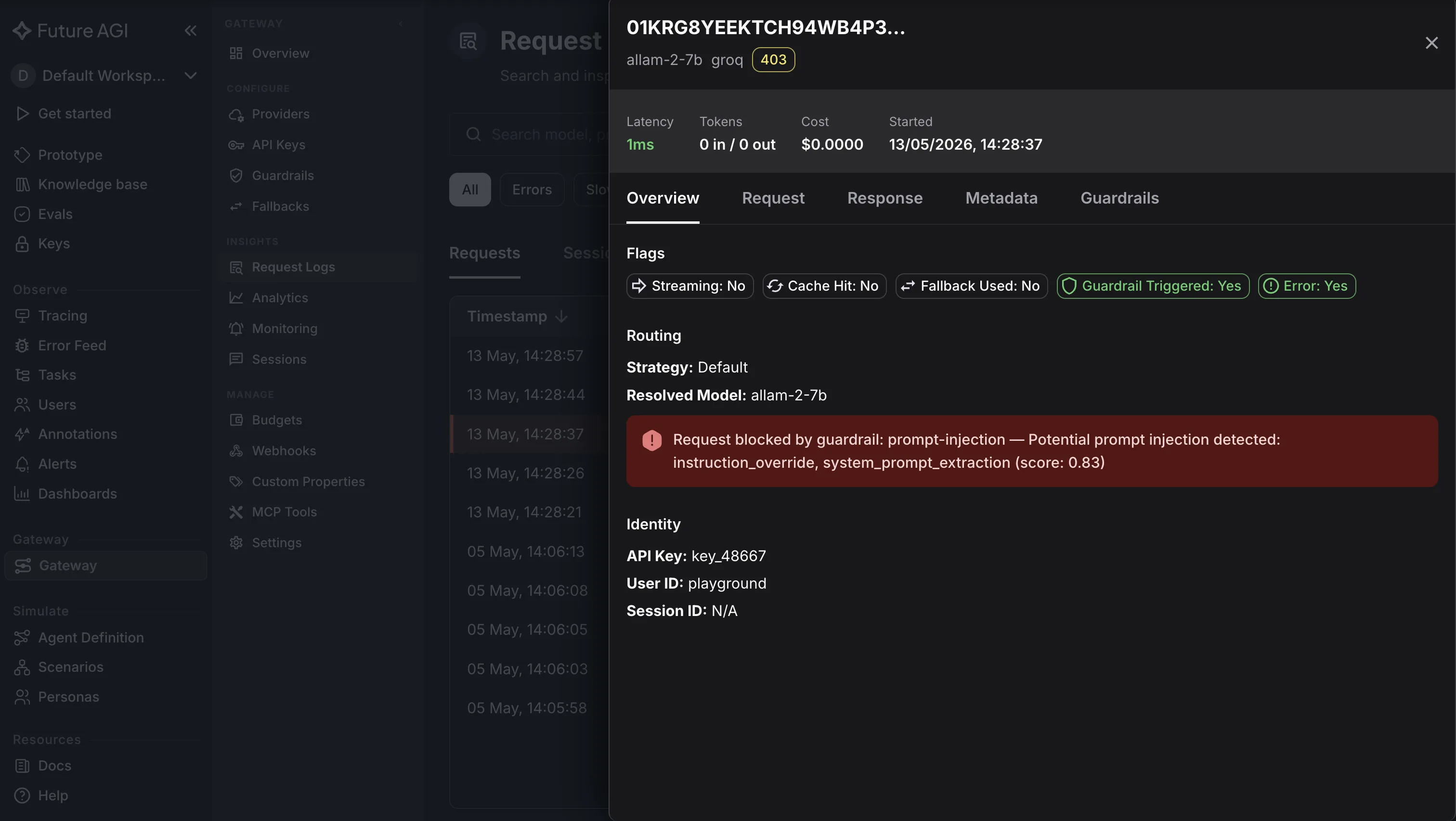
- Native gateway in the same plan. Agent Command Center sits in the request path, fans out provider keys, enforces per-team rate limits, and surfaces cost per session, bundled with the eval and guardrails surfaces, not a separate vendor.
- TypeScript first-class. The TypeScript SDK has feature parity with the Python SDK. Mixed-stack teams drop the Python sidecar an Evidently deployment usually requires.
Migration from Evidently AI: Datasets, metric definitions, and Report / TestSuite cases map directly via the importer. Custom evaluator subclasses need a manual pass. Evidently Cloud trace export is REST-based; the importer remaps trace IDs. Timeline: five to ten engineering days for under 200 cases, including a shadow-eval period to confirm score parity.
Where it falls short:
-
The optimizer carries a learning curve; a pure swap won’t use the surface in week one.
-
Classical-ML drift presets (
DataDriftPreset,TargetDriftPreset) aren’t a first-class surface in FAGI, mixed classical-ML and LLM teams keep Evidently for the classical side and add FAGI for the LLM side.
Pricing: Free tier with 100K traces and 10K eval runs per month. Scale tier from $99/month with linear per-trace and per-eval scaling (no add-on multipliers). Enterprise with SOC 2 Type II and AWS Marketplace.
Score: 7 of 7 axes.
2. Arize Phoenix: Best for OSS evaluators with strong tracing
Verdict: Phoenix is the right pick when the dealbreaker is “OSS evaluators and OTel-native LLM tracing without a paid dashboard.” Apache 2.0, runs locally or self-hosted, and the evaluator library covers the standard LLM rubric set. You give up Evidently’s classical-ML drift presets; you gain a runtime-grade agent-trace store and a dashboard that doesn’t require a subscription.
What it fixes versus Evidently AI:
- LLM-native trace capture. Phoenix is OpenTelemetry-native end to end. Agent traces, retriever spans, and tool-call spans are first-class, not flattened rows.
- Dashboard freedom. Phoenix’s UI is part of the OSS package. The analytics UI isn’t a separate SKU.
- Evaluator library covers the standard set. Faithfulness, relevance, QA correctness, tool-use, hallucination, most of the Evidently
LLMEvalsPresetrubric has a Phoenix equivalent. Score scales differ enough to need a calibration pass. - Strong agent-tracing primitives. Phoenix’s agent-trace view (LLM call, tool call, retriever call) is one of the cleaner surfaces in the OSS observability space.
Migration from Evidently AI: Datasets and metric definitions map via Phoenix’s evaluator API. The Report / TestSuite shape doesn’t. Evidently cases need to be rewritten as Phoenix EvalTasks. Trace export from Evidently Cloud maps onto Phoenix’s OTel ingestion. Timeline: seven to ten engineering days, most of the cost in the case rewrite.
Where it falls short:
- No inline guardrails layer. Phoenix scores responses after the fact.
- No optimizer. Eval scores inform humans, not the gateway.
- No native gateway or routing layer.
- Self-hosting at production scale needs operational investment (Postgres, S3-compatible storage, scheduled compaction).
- Arize’s hosted product (Arize AX) is a separate paid SKU; Phoenix-only teams operate the dashboard themselves.
Pricing: Phoenix is Apache 2.0. Arize AX (the hosted commercial product) is custom-priced.
Score: 4 of 7 axes (missing: inline guardrails, optimizer, gateway).
3. Langfuse: Best for prompt management plus eval
Verdict: Langfuse is the pick when the dealbreaker is “a real prompt registry with versioning, and an eval surface that talks to that registry first-class.” MIT-licensed core, self-hostable, and the prompt-management product is one of the stronger surfaces in the OSS observability cohort. Evidently has nothing in the prompt-registry slot; Langfuse leads with it.
What it fixes versus Evidently AI:
- First-class prompt registry. Langfuse stores prompts as versioned objects with a usable UI, references by name with version pinning, and a clean rollback mechanism.
- Self-hostable end to end. MIT core. Self-host on Postgres and ClickHouse. The analytics dashboard ships with the OSS package, so there’s no separate Cloud SKU to subscribe to for basic analytics.
- Eval hooks tied to traces and prompts. Langfuse attaches evaluators (LLM-as-judge or custom) to live traces, with the prompt version captured alongside the score. The runtime-eval-on-trace surface is stronger than Evidently’s snapshot-report model.
- Strong TypeScript support. First-class SDK with feature parity to the Python one.
Migration from Evidently AI: Datasets map directly. Report and TestSuite cases become Langfuse Datasets plus experiment runs. Custom metric implementations rewrite as Langfuse evaluators. Trace import from Evidently Cloud uses Langfuse’s REST ingestion. Timeline: seven to ten engineering days.
Where it falls short:
- No inline guardrails layer.
- No optimizer.
- No native gateway.
- The eval surface is less metric-rich than the dedicated eval libraries (DeepEval,
ai-evaluation); complex multi-metric assertions need to be rebuilt as evaluator chains. - Classical-ML drift presets aren’t a surface here.
Pricing: Langfuse Core is MIT-licensed. Langfuse Cloud has a free tier, with Pro and Team plans for larger teams.
Score: 4 of 7 axes (missing: inline guardrails, optimizer, gateway).
4. DeepEval: Best for pytest-style LLM unit tests
Verdict: DeepEval is the pick when the team wants “unit tests for the LLM” in the shape Python engineers already understand, pytest decorators, assert_test, CI gating. Evidently’s TestSuite is conceptually similar but DataFrame-shaped; DeepEval is test-case-shaped. Apache 2.0 OSS with Confident AI as the optional hosted dashboard.
What it fixes versus Evidently AI:
- Pytest-native ergonomics.
@pytest.mark.parametrizeplusassert_test(test_case, [metric])slots straight into existing CI. Evidently’sTestSuiteneeds DataFrame plumbing first. - LLM-shaped metric library. Hallucination, faithfulness, answer-relevance, contextual-precision, toxicity, bias, the standard rubric is built in and the API is consistent.
- Active LLM-specific community. GitHub issues and Discord are noisier and more LLM-focused than Evidently’s.
- Clean OSS posture. The library is Apache 2.0; Confident AI is the optional paid dashboard.
Migration from Evidently AI: Datasets map directly. Report / TestSuite cases rewrite as LLMTestCase and pytest functions. Most rubric metrics port across; custom Evidently subclasses need a manual rewrite as DeepEval metric subclasses. Timeline: seven to ten engineering days.
Where it falls short:
- Eval-only. No runtime trace capture, no inline guardrails, no gateway, no optimizer.
- Confident AI dashboard is a separate subscription, you trade Evidently Cloud for Confident AI, not for free dashboards.
- Python-only, same constraint as Evidently.
- Classical-ML drift presets aren’t in scope.
Pricing: DeepEval is Apache 2.0. Confident AI Cloud has a free tier with seat- and run-based pricing for larger teams.
Score: 3 of 7 axes (missing: runtime trace, inline guardrails, gateway, optimizer).
5. Braintrust: Best for eval-as-product
Verdict: Braintrust is the pick when the team treats eval as a first-class engineering product, experiments, datasets, and scorers as named, versioned objects, rather than as a snapshot report. Opinionated UX around dataset curation and experiment comparison. Hosted-only; trade-off versus Phoenix or Langfuse is dashboard polish for self-host posture.
What it fixes versus Evidently AI:
- Experiments as the unit of work. Braintrust’s data model puts the experiment, a dataset, a set of inputs, a scorer, a run, at the center. Comparing two prompts, two models, or two retrieval configurations is a first-class workflow. Evidently’s
Reportis closer to a snapshot than an experiment. - Scorer ergonomics. Custom scorers are JavaScript or Python functions, with a clean SDK. Less ceremony than Evidently’s class hierarchy.
- TypeScript first-class. Built with TypeScript and Python as co-first SDKs.
- Hosted-only is a feature for some teams. No self-host operational burden, no Postgres, no S3, no scheduled compaction.
Migration from Evidently AI: Datasets and metric definitions map via Braintrust’s SDK. Report / TestSuite cases become Braintrust experiments. Custom metric implementations become scorer functions. Timeline: five to eight engineering days.
Where it falls short:
- Hosted-only. No self-host SKU as of May 2026.
- No inline guardrails layer.
- No optimizer in the platform; teams pair with DSPy or build their own.
- No native gateway.
- Pricing is custom for larger teams; the free tier is generous but the enterprise SKU isn’t always cheaper than Evidently Cloud.
Score: 3 of 7 axes (missing: inline guardrails, optimizer, gateway, self-host).
Capability matrix
| Axis | Future AGI | Arize Phoenix | Langfuse | DeepEval | Braintrust |
|---|---|---|---|---|---|
| Report / TestSuite portability | Native Evidently importer | Evaluator rewrite | Evaluator rewrite | Pytest rewrite | Experiment rewrite |
| LLM-native trace capture | OTel + auto-instrumentation | OTel-native | OTel-compatible | None (CI only) | Hosted-only ingestion |
| Inline guardrails | Yes (Protect, ~67 ms text) | No | No | No | No |
| Gateway / routing | Yes (Agent Command Center) | No | No | No | No |
| Optimizer integration | Yes (agent-opt) | No | No | No | No |
| Language coverage | Python + TypeScript first-class | Python + JS SDK | Python + TypeScript first-class | Python only | Python + TypeScript first-class |
| Migration tooling | Evidently importer + trace remap | Manual rewrite | Manual rewrite + REST ingest | Manual rewrite | Manual rewrite + REST ingest |
Migration notes: what breaks when leaving Evidently AI
Three surfaces always need attention.
Rewriting the Report and TestSuite Python suite
Evidently’s core API (Report(metrics=[...]).run(current_data=..., reference_data=...) and TestSuite(tests=[...]).run(...)) is organized around two pandas DataFrames and a list of presets. None of the alternatives reproduce that shape exactly because the alternatives aren’t DataFrame-first.
The rewrite has three layers. Case shape: Evidently’s column-mapping plus reference and current DataFrames translates onto each platform’s case definition. Phoenix EvalTask, Langfuse Dataset item, DeepEval LLMTestCase, Braintrust experiment input, or ai-evaluation case. Field names differ, structure is the same. Metric shape: Evidently’s LLMEvalsPreset rubric (faithfulness, relevance, toxicity, PII, custom LLM-judge metrics) has equivalents in every alternative; a calibration pass is wise because score scales and judge prompts differ. Runner shape: the destination isn’t “build a report and render HTML.” For DeepEval the runner is pytest; for Phoenix and Langfuse, a scheduled or trace-attached evaluator; for Braintrust and FAGI, the platform’s experiment or case runner.
Custom metric subclasses are the part that bites. For 80% the port is mechanical. For the other 20% (multi-step metrics that join against external data, metrics that maintain state across rows, metrics that depend on Evidently’s column-mapping conventions) the port is real work. A team with under 50 custom metrics completes the rewrite in five to seven days.
Migrating Evidently Cloud traces and reports
Evidently Cloud exposes a REST API for project, dataset, and report export. The migration script paginates by date range, dumps metric snapshots as JSON, and remaps trace IDs onto the destination platform’s ID space. Three gotchas: Evidently’s report representation is a rolled-up snapshot rather than a per-trace span tree, so OTel-native destinations (Phoenix, FAGI) need a small shim to fan reports back out into per-row traces; metric scores attached to rows need re-attaching on the destination side; historical reports beyond Evidently Cloud’s retention window aren’t exportable.
Replacing the dashboard
The Evidently dashboard is muscle memory, saved reports, scheduled monitoring, named projects, shared interpretations. The migration checklist: list the saved reports, document each query, rebuild on the destination, review with the team that uses them. Phoenix, Langfuse, and Braintrust all have analogous saved-view mechanisms. Future AGI’s Command Center adds the failure-cluster view that several Evidently users have called out as missing, a clustering of low-scoring traces by failure mode, rather than a roll-up by metric.
Decision framework: Choose X if
Choose Future AGI if your reason for leaving is structural, monitoring alone isn’t enough, and you want eval, runtime traces, inline guardrails, a gateway, and an optimizer in one loop. Pick this when production agent workloads are a significant line item and OSS instrumentation (traceAI, ai-evaluation, agent-opt) plus the hosted Command Center justify the migration.
Choose Arize Phoenix if the dealbreaker is “we want OSS evaluators and OTel-native tracing without a paid dashboard,” and the team is comfortable operating Postgres-shaped infrastructure.
Choose Langfuse if the prompt-management gap is the reason. Versioned prompts as a first-class object with runtime tracing attached, MIT self-host.
Choose DeepEval if your team wants pytest-style LLM unit tests as a CI gate and you’re content to keep the runtime and guardrails questions separate.
Choose Braintrust if eval ergonomics are the reason. Experiments, datasets, and scorers as named objects, hosted-only.
What we did not include
Three products show up in other 2026 listicles that we left out: TruLens (capable OSS eval library, but runtime trace and dashboard are thinner than Phoenix’s); Comet Opik (newer OSS LLM-eval entrant, capable but Evidently-specific migration tooling isn’t published yet); WhyLabs (closer to Evidently’s classical-ML shape than to the LLM cohort, so the like-for-like swap reasoning doesn’t apply).
Related reading
- Best 5 AI Gateways for Compliance Audit Trails in 2026, the compliance and audit-trail comparison
- Best 5 AI Gateways for LLM Cost Optimization in 2026, the five-layer cost stack and the 2026 trust cohort
- Best 5 AI Gateways for LLM Observability and Tracing in 2026, the OpenTelemetry-native observability ranking
- Future AGI vs Helicone in 2026: Self-Improving Runtime vs Lightweight Observability, the head-to-head against the per-request observability layer
Sources
- Evidently AI GitHub repository, github.com/evidentlyai/evidently (Apache 2.0)
- Evidently AI product page, evidentlyai.com
- Evidently Cloud documentation, docs.evidentlyai.com
- /r/MachineLearning and /r/LLMDevs ML-monitoring-to-LLM migration discussions, January-May 2026
- Evidently issue tracker, LLM-vs-classical-ML threads
- Arize Phoenix GitHub repository, github.com/Arize-ai/phoenix (Apache 2.0)
- Langfuse GitHub repository, github.com/langfuse/langfuse (MIT core)
- DeepEval GitHub repository, github.com/confident-ai/deepeval (Apache 2.0)
- Braintrust product page, braintrust.dev
- Future AGI Agent Command Center, futureagi.com/platform/monitor/command-center
- Future AGI traceAI, github.com/future-agi/traceAI (Apache 2.0)
- Future AGI ai-evaluation, github.com/future-agi/ai-evaluation (Apache 2.0)
- Future AGI agent-opt, github.com/future-agi/agent-opt (Apache 2.0)
- Future AGI Protect latency benchmark, arxiv.org/abs/2510.13351 (67 ms text, 109 ms image)
Frequently Asked Questions
Why are people moving off Evidently AI in 2026?
What is the closest like-for-like alternative to Evidently AI?
How do I migrate the test suite out of Evidently?
How do I migrate Evidently Cloud reports and datasets?
Is there an open-source Evidently AI alternative?
Which alternative ships inline runtime guardrails?
How does Future AGI Agent Command Center compare to Evidently AI?

AI drift is five different problems wearing one name. We rank the five tools that catch them: Arize, Future AGI, Evidently, WhyLabs, Fiddler.


FutureAGI, Datadog, Langfuse, Phoenix, Helicone, Braintrust, LangSmith for LLM monitoring. Latency, drift, cost, eval pass-rate trends.


FutureAGI, Langfuse, LangSmith, Helicone, Braintrust, and W&B Weave as Arize Phoenix alternatives in 2026. Pricing, OSS license, OTel coverage, tradeoffs.