Best 5 AI Observability Tools for Cybersecurity in 2026
Cybersecurity AI observability in 2026: five platforms scored on per-request span, SIEM export, prompt-injection detection at the trace layer. FAGI, DD.
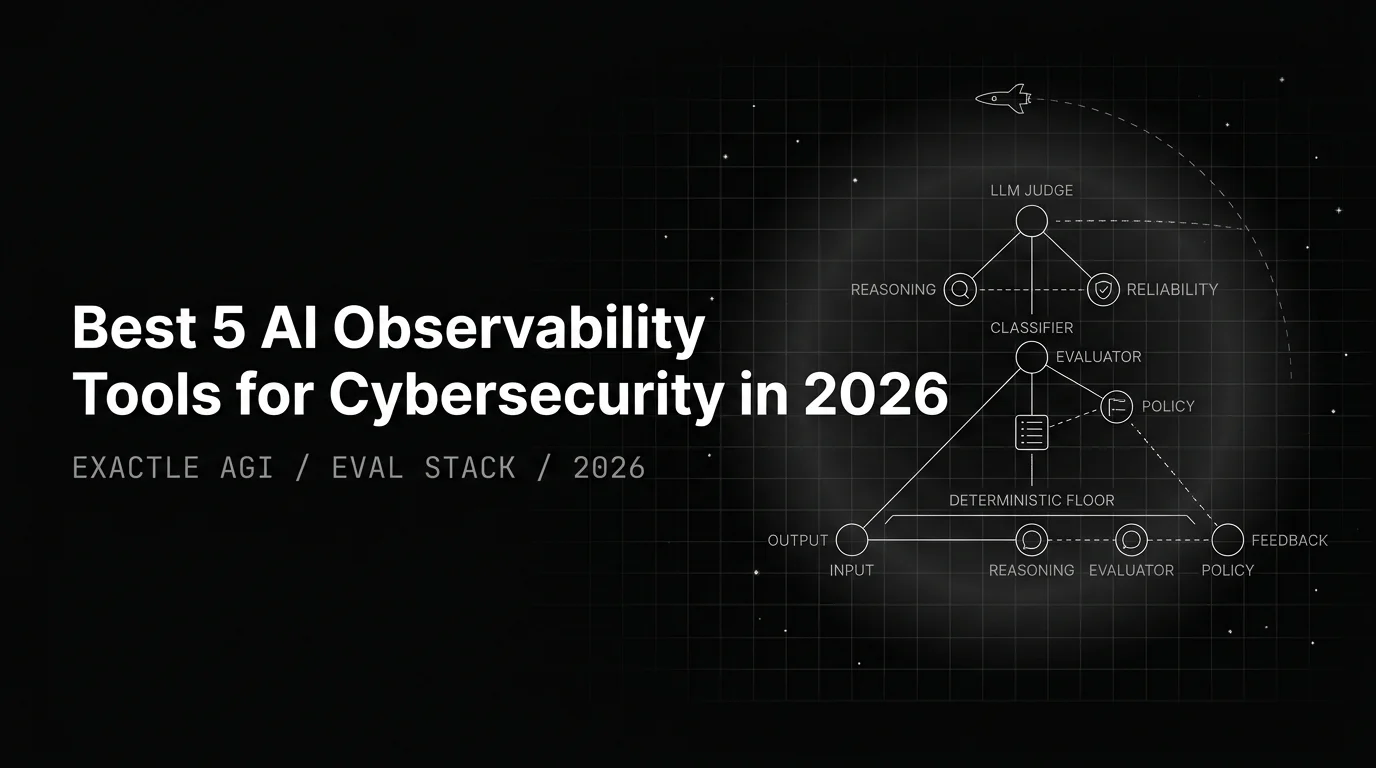
Table of Contents
A SOC analyst copilot at a regional bank triaged 47 alerts as low-priority over a weekend. Buried in the trace fan-out was a spear-phishing detection the agent had down-weighted because the retrieved threat-intel context was three months stale. The breach hit materiality at 14:00 ET Monday; the SEC Item 1.05 four-business-day clock started. Splunk dashboards showed green throughput. The trace had the failing turn and a missed prompt-injection probe two hours earlier, but it took 19 hours to find because the observability layer never shipped the spans into the SIEM where the correlation rule lives.
Cybersecurity AI observability isn’t a fancier dashboard. It’s the per-request span — prompt, retrieved threat-intel context, tool calls, model output, prompt-injection verdict — piped into the SIEM the SOC already runs (Splunk, Sentinel, Datadog SIEM, Chronicle), with injection detection flagged on the span as a structured attribute the rule can match. The platform that does that gets adopted. The one that streams pretty traces into a separate vendor console is logging, not observability.
This guide compares the five observability stacks security engineering should consider in 2026, scored on the three tests that decide SOC adoption. Future AGI sits at #1 because traceAI emits OTel GenAI spans natively, the HTTPSpanExporter targets any SIEM with an OTLP ingest, and JailbreakScanner plus the Protect prompt_injection adapter write the verdict onto the span.
The 2026 SOC AI observability shortlist
| # | Platform | Per-request span | SIEM export | Prompt-injection on span |
|---|---|---|---|---|
| 1 | Future AGI | traceAI; 50+ AI surfaces, 4 languages; OTel GenAI spans | Configurable HTTPSpanExporter to Splunk, Sentinel, Datadog SIEM, Chronicle | JailbreakScanner (sub-10ms) + Protect prompt_injection adapter (65ms) write verdict to span |
| 2 | Datadog AI | APM span model + OTel GenAI conventions | Datadog SIEM in-platform; non-Datadog via OTel bridge | Agent-layer scanner; span attribute requires wiring |
| 3 | Splunk / Sentinel | SIEM-first; traces via OTel Collector or HEC | Native — this is the SIEM | Correlation-rule pattern, not span-layer scanner |
| 4 | Arize Phoenix | OSS OTel-native; project / trace view | Self-host store; OTLP to SIEM | BYO scanner; no first-party adapter |
| 5 | Custom OTel + Honeycomb | OTel SDK; columnar trace store | OTLP HTTP to any SIEM | BYO scanner; BYO attribute schema |
Future AGI is the only platform that ships the three tests in one workflow. Others earn slots when SIEM gravity, OSS posture, or platform-engineering ownership dominates.
TL;DR: what the SOC adopts in 2026
- Future AGI ships per-request traceAI spans with OTel GenAI conventions, a configurable
HTTPSpanExporterto Splunk, Sentinel, Datadog SIEM, or Chronicle, and prompt-injection detection (JailbreakScanner + Protectprompt_injectionadapter) as a span attribute the SIEM rule can match. Apache 2.0; SOC 2 Type II, HIPAA, GDPR, CCPA certified per the trust page. See sister post on cybersecurity AI evaluation platforms. - Datadog AI wins when the SOC already runs Datadog APM and Datadog Cloud SIEM is the correlation surface.
- Splunk / Sentinel is where the SIEM-first SOC sends its OTel-emitted AI traces — the rules and analyst muscle live here.
- Arize Phoenix for engineering-led security platforms self-hosting OSS under a custom SIEM bridge; you wire the scanner.
- Custom OTel + Honeycomb for platform-engineering teams standardized on OpenTelemetry, paid for in instrumentation discipline.
Why generic LLM observability falls short for SOC AI
Generic LLM observability tells you a request happened, what model answered, and how many tokens it burned. Cybersecurity AI observability has to feed three things the SOC runs: a per-request span with prompt, retrieved threat-intel context, tool calls, and model output as attributes; a SIEM-ingestible export into Splunk, Sentinel, Datadog SIEM, or Chronicle where firewall, endpoint, and identity logs already correlate; and prompt-injection detection flagged on the span as a structured attribute the SIEM rule can match. Miss any one and you’ve shipped a regulator gap.
Three failure modes don’t show up on a generic dashboard but ship in production. A SOC copilot trace ships threat-intel and customer-environment data to a vendor-hosted span store with no per-tenant DPA scope. A threat-intel RAG agent’s 50–200 CVE / IOC / log-correlation lookups bury the failing turn the IR lead has to find inside a 24-hour clock. A phishing-detection LLM hits an indirect prompt-injection payload in a retrieved CTI report, runs a write-privileged tool, and the injection verdict lives in a separate scanner log the SIEM analyst never joins to the trace.
Evaluation grades outputs. Gateways block inputs. Observability determines whether the next SolarWinds-pattern disclosure lands on someone else’s filing.
The three-test SOC observability scorecard
Most listicles compare cybersecurity AI observability platforms on a feature checklist. The scorecard below comes from a post-incident review, an SEC Item 1.05 disclosure rehearsal, and a SOC analyst staring at a 24-hour NYDFS clock at 02:00.
| Test | Pass criteria |
|---|---|
| Per-request span as the unit of observation | Each request emits a span with prompt, retrieved context, tool calls, model output, eval score, and prompt-injection verdict as structured attributes. OTel GenAI conventions (OTel 1.37+: gen_ai.system, gen_ai.request.model, gen_ai.usage.input_tokens) emitted natively. |
| SIEM export through OTel-portable spans | Configurable exporter ships spans into Splunk, Sentinel, Datadog SIEM, Chronicle, or a self-hosted OTel Collector — the SIEM where firewall, endpoint, and identity logs already correlate. |
| Prompt-injection detection on the span | A deterministic scanner verdict (sub-10ms) plus a model-level adapter (65–107ms) write a structured attribute (prompt_injection.detected, prompt_injection.score) the SIEM rule can match against tool_call.write_privileged. |
Pass all three: SOC adoption. Two of three: candidate. One of three: vendor pitch.
The 2026 cybersecurity regulatory pressure stack
| Anchor | Named requirement |
|---|---|
| SEC Item 1.05 | 4 business days from materiality; effective Dec 18, 2023 |
| CISA CIRCIA | 72h incident, 24h ransom-payment; final rule March 2024 |
| NYDFS Part 500 §500.13 | 24h AI-system-decision notification; Nov 2023 |
| EU NIS2 | 24h early warning; transposition Oct 17, 2024 |
| DORA | Major-incident reporting; effective Jan 17, 2025 |
| MITRE ATLAS | Tactic-coverage span attributes (T0044 / T0051 / T0054) |
| OWASP LLM Top 10 | LLM01 / LLM02 / LLM06 span-attribute mapping |
| SOC 2 Type II / ISO 27001:2022 | Trace data inside the audit boundary |
| EU AI Act Art 15 | Cybersecurity for high-risk AI; enforcement Aug 2, 2026 |
Every anchor maps to a span attribute the SIEM has to query. The observability platform is where the spans live; the SIEM is where the rule fires; the disclosure is where the CISO signs.
How the five platforms compare on capability
| Capability | Future AGI | Datadog AI | Splunk / Sentinel | Arize Phoenix | OTel + Honeycomb |
|---|---|---|---|---|---|
| OTel GenAI conventions emitted natively | Strong (traceAI; 50+ surfaces) | Strong (APM bridge) | Receive-side via Collector | Strong (Apache 2.0) | Strong (you wire it) |
| SIEM export via OTel-portable spans | Strong (configurable HTTPSpanExporter to any SIEM) | Datadog SIEM in-platform; non-Datadog via OTel | Native (this is the SIEM) | Strong (OTLP to any SIEM) | Strong (OTLP exporter) |
| Prompt-injection verdict on the span | Strong (JailbreakScanner + Protect adapter; span attribute) | Partial (agent-layer) | Partial (rule pattern) | Partial (BYO processor) | Partial (BYO schema) |
| Span-to-eval linkage via span_id | Strong (ai-evaluation + traceAI) | Partial (eval-as-metric) | Partial (BYO join in SIEM) | Partial (Phoenix eval) | Partial (BYO) |
| PII redaction at span layer | Strong (pre-export, configurable) | Partial (agent-layer) | Partial (ingest-time mask) | Partial (BYO processor) | Partial (BYO) |
| Error Feed auto-clustering | Strong (HDBSCAN + Sonnet 4.5 Judge) | Partial (APM rules) | Partial (correlation searches) | Partial (BYO) | Partial (BYO) |
| Deployment shape | Apache 2.0 SDKs + SaaS + BYOC | Enterprise SaaS | Enterprise SaaS + self-host | OSS + Arize cloud | OSS + Honeycomb SaaS |
How we ranked these five platforms
The ranking sits on top of the three-test scorecard. We weighted: per-request span as the unit of observation; SIEM export through OTel-portable spans into Splunk, Sentinel, Datadog SIEM, or Chronicle; prompt-injection detection on the span as a structured attribute; span-to-eval linkage via span_id; and PII redaction at the span layer for threat-intel and IR-playbook secrets.
Where things get thin: most platforms still treat SIEM export as a custom-connector project, not a configurable exporter, and treat prompt-injection detection as a separate scanner log instead of a span attribute. We rank Future AGI #1 because traceAI’s HTTPSpanExporter is a deployment property and the JailbreakScanner + Protect prompt_injection adapter write the verdict directly onto the span the SIEM rule reads.
#1 Future AGI: traceAI + JailbreakScanner + SIEM-portable exporter
Future AGI is the production-grade pick when you want the three tests in one workflow. traceAI is an OpenTelemetry-native SDK (Apache 2.0) that auto-instruments OpenAI, Anthropic, LangChain, LangGraph, LlamaIndex, AutoGen, CrewAI, Groq, Portkey, Gemini, and 50+ AI surfaces across Python, TypeScript, Java, and C#. Spans carry prompt, retrieved context, model output, tool calls, eval scores, and the prompt-injection verdict as attributes. The configurable HTTPSpanExporter ships them to any OTLP HTTP endpoint — Splunk Observability Cloud, Sentinel via AMA, Datadog SIEM, Chronicle, or a self-hosted OTel Collector — without a custom connector. SOC 2 Type II, HIPAA, GDPR, CCPA per the trust page; ISO/IEC 27001 in active audit.
Best for: SOC engineering and MDR ops running alert-triage, IR-runbook, threat-hunt, and IAM copilots; security-tooling SaaS; MSSP/MDR vendors at scale.
Key strengths.
- Per-request span with OTel GenAI conventions.
gen_ai.system,gen_ai.request.model,gen_ai.usage.input_tokensemit natively in OTel 1.37+. Tool-call attributes carry the write-privilege flag the SIEM rule joins against. - SIEM export through OTel-portable spans. The
HTTPSpanExporteris a deployment property, not a vendor commit. Vendor-locked SDK rewrite tax is zero when the SOC changes SIEMs. - Prompt-injection detection on the span. Eight deterministic Scanners —
JailbreakScanner,CodeInjectionScanner,SecretsScanner,MaliciousURLScanner,InvisibleCharScanner,LanguageScanner,TopicRestrictionScanner,RegexScanner— run sub-10ms and write the verdict to the span. The Protect Gemma 3n LoRAprompt_injectionadapter runs at 65 ms text / 107 ms image median time-to-label per arXiv 2510.13351 and writes the model-level score. The SIEM rule fires onprompt_injection.detected=true AND tool_call.write_privileged=true. - Span-to-eval linkage via
span_id.ai-evaluationshipsPromptInjection,AnswerRefusal,IsHarmfulAdvice, andDataPrivacyComplianceas namedEvalTemplateclasses; multi-turn Crescendo and trajectory-drift scoring ship as aCustomLLMJudgein under 30 lines. - PII redaction at the span layer pre-export. Built-in redaction strips email, phone, SSN, API keys, and configurable threat-intel patterns before the OTLP exporter fires.
- Error Feed inside the eval stack. HDBSCAN soft-clustering over ClickHouse-stored span embeddings collapses 500 failures to 8–15 named clusters. A Sonnet 4.5 Judge agent (30-turn budget, 8 span-tools, Haiku Chauffeur summariser, 90% prompt-cache hit) writes the root cause, surfaces evidence quotes, and proposes the
immediate_fix. Linear OAuth wired today; Slack, GitHub, Jira, PagerDuty on the roadmap.
Limitations.
- The prompt library is opinionated; fewer review-and-collaboration knobs than a dedicated prompt registry. The trade is prompt, eval, guardrail, and trace in one control plane.
- No documented containerized air-gapped release today.
base_urlis configurable and the SDK self-hosts in a VPC, but air-gap certification is not claimed. - Protect adapter weights are closed; the gateway self-hosts the plugin, ML inference makes an HTTPS hop to
api.futureagi.com. Deterministic fallbacks run locally.
Pricing & deployment. Cloud + OSS self-host (Apache 2.0 SDK + Agent Command Center single Go binary). Free + pay-as-you-go base; SOC 2 Type II, HIPAA BAA, SAML SSO, SCIM at Scale. Pricing. AWS Marketplace; BYOC for federal residency.
Verdict. The only platform that ships per-request OTel GenAI spans, a configurable HTTPSpanExporter to any SIEM, and a prompt-injection verdict on the span out of the box.
#2 Datadog AI: enterprise APM with SIEM-adjacent integration
Datadog AI extends the enterprise APM stack with OTel GenAI conventions emitted alongside the existing APM trace schema. Datadog Cloud SIEM lives in the same console; for SOCs already running Datadog APM, the LLM observability tier extends an already-approved vendor with the SIEM next door.
Best for: Enterprise SOCs already on Datadog APM where Datadog Cloud SIEM is the correlation surface.
Key strengths.
- OTel GenAI conventions emitted alongside the existing APM trace schema.
- Full APM transcript + flame-graph view for 50–200-tool-call SOC copilot fan-out.
- Datadog query language extends to LLM traces; analyst muscle on DDQL transfers.
- Datadog Cloud SIEM is in the same console, so correlation against firewall, endpoint, and identity logs is one query language, not three.
Limitations.
- Vendor-locked SDK semantics for Datadog-specific span fields. Exporting to a non-Datadog SIEM loses platform-specific richness; the OTel bridge carries fewer attributes than the native SDK.
- High-floor pricing at enterprise spend; not the right shape for mid-market security teams or cost-driven MSSPs.
- Built-in PII redaction runs at the agent or pipeline layer, not always at the span SDK; SOC teams handling threat-intel and IR-playbook secrets have to wire pre-export redaction explicitly.
- Prompt-injection scanning runs through the agent layer, not as a span-attribute scanner with a deterministic sub-10ms verdict.
- No auto-clustering Error Feed that names a security-agent failure pattern with root cause and immediate fix the way Future AGI does.
Pricing & deployment. Enterprise contract; SaaS on Datadog cloud.
Verdict. The procurement-gravity pick. Tier-1 SOCs already running Datadog APM extend the same posture into LLM trace data and correlate against Datadog Cloud SIEM. For non-Datadog SIEM teams, Future AGI’s HTTPSpanExporter ships OTel-portable spans without the platform-tax procurement cycle.
#3 Splunk / Microsoft Sentinel: SIEM-first SOCs sending traces to where the rules already live
For most enterprise SOCs in 2026, the correlation engine is Splunk, Microsoft Sentinel, or Chronicle. The question isn’t which vendor do we buy, it’s how do we get OTel spans into the SIEM the SOC already runs. Splunk’s OTel Collector and Sentinel’s OTLP ingestion both parse OTel 1.37+ GenAI conventions.
Best for: SIEM-first SOCs already on Splunk Enterprise Security, Sentinel, or Chronicle where the AI layer feeds the SIEM, not a parallel console.
Key strengths.
- The SIEM is the correlation engine. Firewall, EDR, identity, network, and AI agent spans live in one query language (SPL, KQL, YARA-L).
- Analyst muscle on SPL and KQL transfers directly once the AI SDK emits OTel GenAI spans.
- Mature retention, RBAC, audit, and chain-of-custody for SEC Item 1.05, CIRCIA, NYDFS §500.13, and NIS2 reporting.
- Existing detection-engineering content adapts.
prompt_injection.detectedjoins firewall and endpoint events without a separate tool.
Limitations.
- LLM trace UI is detection-engineering-shaped, not agent-shaped. A 200-tool-call fan-out reads as a flat span list, not a navigable transcript.
- Prompt-injection detection at the SIEM is a rule pattern, not a span-attribute scanner. The AI SDK has to write the verdict first.
- No span-to-eval linkage out of the box.
- Span-level cost attribution per incident is a custom dashboard, not a default view.
Pricing & deployment. Splunk Enterprise + Enterprise Security and Sentinel via Azure Monitor; per-ingest pricing. Pair with an SDK that emits OTel GenAI spans natively (Future AGI traceAI, Phoenix, or custom OTel).
Verdict. This is where the SIEM already runs, so this is where the AI traces land. The question becomes which SDK writes the prompt-injection verdict onto the span. Future AGI ships that out of the box; Phoenix and custom OTel require the scanner-on-span wiring.
#4 Arize Phoenix: engineering-led security platforms self-hosting OSS
Arize Phoenix is the engineering-led pick for security teams that want OSS OTel-native observability self-hosted under a custom SIEM bridge. Apache 2.0; mature LangChain, LlamaIndex, and OTel-ecosystem integrations.
Best for: Engineering-led security platforms (MSSP product engineering, detection-engineering teams) with platform capacity and a self-hosted span store under custom SIEM integration.
Key strengths.
- OSS Apache 2.0 removes vendor sub-processor risk; the span store sits inside the SOC perimeter.
- OTLP HTTP exporter pipes spans into Splunk’s OTel Collector, Sentinel’s OTLP ingest, or a self-hosted pipeline without a custom connector.
- SQL-style filtering on traces matches security-analyst query muscle.
Limitations.
- No first-party prompt-injection scanner that writes a verdict to the span. The engineering team wires a pre-export OTel processor calling Lakera Guard, Llama Guard, or Future AGI Protect.
- Span-level cost attribution per incident is lighter than Datadog or Future AGI; per-incident aggregation needs custom tag wiring.
- Built-in PII redaction at the span layer is not a default; pre-export redaction wires through an OTel processor.
- No auto-clustered Error Feed; the engineering team writes the clustering logic.
Pricing & deployment. Free OSS (Apache 2.0); self-host or Arize cloud.
Verdict. The OSS engineering default. OTel-native, self-hostable, pipes to any SIEM. The prompt-injection-verdict-on-span requirement is on you to wire.
#5 Custom OTel + Honeycomb: platform-engineering teams already standardized on OTel
Some security platform teams already run OpenTelemetry across the stack and want a columnar, high-cardinality trace store alongside the SIEM. The custom OTel SDK plus Honeycomb pattern is honest about the trade: full ownership of the instrumentation surface, the SIEM bridge, and the scanner-on-span schema, paid for in platform-engineering headcount.
Best for: Platform-engineering teams that treat the SIEM as the correlation engine and Honeycomb as the engineering exploration surface.
Key strengths.
- Full control over the span attribute schema.
prompt_injection.detected,tool_call.write_privileged,retrieved_context.sourceare whatever the SIEM rule needs. - Honeycomb’s columnar store handles high-cardinality LLM trace data (per-trace user_id, prompt_hash, retrieved_doc_ids) better than row-based backends.
- OTLP HTTP exporter pipes spans into Splunk, Sentinel, Datadog SIEM, or Chronicle in parallel; Honeycomb gets the engineering view, the SIEM gets the security view, both off the same span.
- BubbleUp surfaces the high-cardinality outlier (the user_id whose traces consistently trip JailbreakScanner) without a custom query.
Limitations.
- You own the upgrade path, instrumentation discipline, scanner-on-span wiring, and dashboard work.
- No first-party prompt-injection scanner; integrate Lakera Guard, Llama Guard, or Future AGI Protect through an OTel processor.
- No auto-clustered Error Feed; HDBSCAN clustering is a security-research workload.
- TCO rarely beats a SOC 2-certified vendor unless platform engineering is already a funded team.
Pricing & deployment. OTel SDK is OSS; Honeycomb has Free, Pro, and Enterprise tiers. Apache 2.0 primitives (traceAI, Phoenix, vanilla OTel) self-host without reinventing the GenAI conventions.
Verdict. The platform-engineering pick. Pair the OSS OTel SDK with Future AGI’s Scanners and Protect adapter so you’re not reinventing the injection-verdict schema, then pipe to Honeycomb and to the SIEM in parallel.
Decision matrix: which platform fits which SOC profile
| If you’re a… | Pick |
|---|---|
| Mid-market security team running a SOC copilot with NYDFS §500.13 in scope | Future AGI |
| MSSP / MDR vendor needing auto-clustered named security-agent failure issues | Future AGI |
| Public-registrant CISO reconstructing an AI-augmented incident for SEC Item 1.05 | Future AGI |
| Enterprise SOC already on Datadog APM with Datadog Cloud SIEM as the correlation surface | Datadog AI |
| SIEM-first SOC on Splunk Enterprise Security or Microsoft Sentinel | Splunk / Sentinel + traceAI or Phoenix |
| Engineering-led security platform self-hosting OSS under a custom SIEM bridge | Arize Phoenix |
| Platform-engineering team standardized on OTel and wanting Honeycomb’s column store | Custom OTel + Honeycomb (pair with Future AGI Scanners) |
Closing: the three-test ship gate
Cybersecurity AI observability in 2026 isn’t a dashboard upgrade. It’s the per-request span piped into the SIEM the SOC already runs, with the prompt-injection verdict written onto the span the rule fires on. Three tests before procurement signs.
- Per-request span. Prompt, retrieved context, tool calls, model output, eval score, and injection verdict as structured attributes on an OTel GenAI span.
- SIEM export through OTel-portable spans. A configurable exporter that ships spans into Splunk, Sentinel, Datadog SIEM, or Chronicle without a custom connector.
- Prompt-injection detection on the span. A deterministic scanner verdict (sub-10ms) plus a model-level adapter (65–107ms) writing a structured attribute the SIEM rule can match.
Of the five, Future AGI is the only one shipping all three in one workflow. Datadog AI wins enterprise SOCs on Datadog APM. Splunk and Sentinel are where the SIEM-first SOC sends its OTel-emitted traces. Arize Phoenix is the OSS engineering default. Custom OTel + Honeycomb is right when platform engineering already standardizes on OTel.
Ready to instrument your first cybersecurity AI agent? Wire traceAI into the SOC copilot with one import, point the HTTPSpanExporter at your Splunk OTel Collector or Sentinel OTLP endpoint, and turn on the JailbreakScanner and Protect prompt_injection adapter. Get started with Future AGI; follow the red-teaming guide.
Related reading
Frequently Asked Questions
What separates cybersecurity AI observability from generic LLM observability?
How does AI observability supply the audit-trail evidence for SEC Item 1.05 cyber-incident disclosure?
Why does prompt-injection detection belong on the span, not in a separate scanner log?
How do we pipe AI traces into Splunk or Microsoft Sentinel without a custom connector?
How do we keep threat-intel context and IR-playbook secrets out of span attributes shipped to the SIEM?
Does AI observability replace AI evaluation for SOC AI deployments?
How does the Future AGI Error Feed shorten the SOC analyst's 24-hour clock?
Cybersecurity AI eval in 2026: five platforms scored on red-team rubric, false-positive floor, prompt-injection scanner integration. FAGI, Galileo, Lakera.

Five fintech AI observability platforms scored on per-decision spans, immutable audit, SOC 2 + PCI-DSS, FFIEC / SR 11-7 model risk, EU DORA alignment.
Five AI guardrails compared for cybersecurity: SOC copilots, threat-intel RAG, SIEM LLMs, IR chatbots. NIST AI RMF, OWASP, MITRE ATLAS.