Best Cybersecurity AI Evaluation Platforms in 2026
Cybersecurity AI eval in 2026: five platforms scored on red-team rubric, false-positive floor, prompt-injection scanner integration. FAGI, Galileo, Lakera.
Table of Contents
A drifted alert classifier at a Fortune 500 SOC quietly downgraded a malware family from P1 to P3 the morning after a model upgrade. The runbook copilot suggested a containment step that expanded the blast radius. The threat-hunt assistant followed an indirect-injection payload buried in a retrieved CTI report and ran a write-privileged tool. None of the three tripped a gateway guardrail. By the time the post-incident review named the LLM, an SEC Item 1.05 four-business-day clock was running.
Cybersecurity AI eval is hostile-by-default. The model isn’t being graded by friendly users; it’s being graded by adversaries who craft inputs designed to slip past the rubric. Generic LLM eval misses the three tests that matter in a SOC. Red-team rubric: does the model resist jailbreak, indirect injection, and trajectory drift. False-positive control: security alerts have precision floors, not recall floors. Prompt-injection scanner integration: the offline rubric model is the inline scanner model. Miss any one and you’ve shipped a regulator gap.
This guide compares the five platforms cybersecurity ML engineers should consider in 2026, scored on the three tests. Future AGI is at #1 because it ships all three out of the box; the others earn slots when one constraint dominates.
TL;DR: the five-platform shortlist
| # | Platform | Red-team rubric | FP precision floor | Scanner integration | Best for |
|---|---|---|---|---|---|
| 1 | Future AGI | PromptInjection, AnswerRefusal, IsHarmfulAdvice, DataPrivacyCompliance as EvalTemplate; CustomLLMJudge for multi-turn | Tier 1 / Tier 2 cascade; 4-dim per-cohort trace score | 8 Scanners + 4 Protect Gemma 3n LoRA adapters; same model graded and blocked | SOC alert triage, IR runbook, threat-hunt, IAM copilots |
| 2 | Galileo Luna-2 | Luna-2 hallucination; rubrics author-it-yourself | Custom dashboards | Enterprise-tier third-party guardrails | Tier-1 CISO MSA-first procurement |
| 3 | Braintrust | SDK-first eval-as-code; library is yours | Per-row scoring; floor is your scorer | BYO guardrail through the SDK | Engineering-led security-tooling SaaS |
| 4 | Lakera Guard | Runtime scanner, not an eval rubric | Tuned for low FPR at the input | The point of the product | Inline blocking at the gateway hop |
| 5 | Custom on-prem | What you build | What you build | What you build | CMMC L2/L3, air-gapped DIB primes |
Future AGI is the only platform that combines all three tests in one workflow today. The others are credible second picks when a single axis dominates the buy.
Why generic LLM eval falls short for SOC AI
A hallucinated containment step is an incident, not a UX bug. A drifted classifier is an SEC Item 1.05 risk, not a precision regression. An indirect-injection payload buried in a retrieved CTI report that triggers a write-privileged tool is a breach, not an “edge case.” Generic eval breaks on three SOC-specific axes.
First, the rubric has to be red-team-aware. A platform that scores FactualAccuracy and Toxicity on a friendly dataset misses what an attacker actually does. The rubric needs to score whether the model refused a jailbreak, held position across a multi-turn Crescendo attack, treated retrieved CTI as untrusted, and resisted system-prompt extraction under repeated probing. Friendly datasets don’t carry those attacks, so friendly-dataset evals don’t generate those scores.
Second, SOC alerts have precision floors, not recall floors. In a generic LLM use case, you tune for recall because missing the right answer is the failure. In a SOC, you tune for precision because a false alarm at 2am burns the analyst trust everything else depends on. An eval platform that reports a single F1 score across the test set is reporting the wrong number. The right number is precision per cohort, false-positive rate tracked separately per severity tier, plus a hard floor below which the build doesn’t ship.
Third, the offline rubric and the inline scanner have to share a model. If your eval grader is Sonnet 4.5 with one prompt and your gateway scanner is a separate classifier with a different threshold, you’re grading against one policy and blocking against another. The disagreement is the silent failure.
Gateways control inputs. Observability logs traces. Evaluation platforms are what determine whether the next SolarWinds-pattern disclosure lands on someone else.
The three-test scorecard
Most listicles compare cybersecurity AI eval platforms on a feature checklist. The scorecard below comes from a post-incident review, a CMMC C3PAO walkthrough, and an SEC Item 1.05 disclosure rehearsal.
| Test | Pass criteria |
|---|---|
| Red-team rubric | Named EvalTemplate or single-file judge classes for PromptInjection, AnswerRefusal, IsHarmfulAdvice, DataPrivacyCompliance, plus a multi-turn CustomLLMJudge for Crescendo and trajectory drift. Not generic factuality alone. |
| False-positive precision floor | Per-cohort precision and FPR tracked separately; cascade with Tier 1 deterministic scanners + Tier 2 model rubrics + disagreement-set spot-check; documented precision floor below which the build does not ship. Not a single F1 score. |
| Prompt-injection scanner integration | Inline scanner and offline rubric share a model and threshold; same Protect adapter runs in CI and production. The policy graded is the policy blocked. |
Pass all three: production pick. Two of three: candidate. One of three: vendor pitch.
The 2026 cybersecurity regulatory pressure stack
| Rule | What your eval platform has to produce |
|---|---|
| SEC Item 1.05 of Form 8-K (effective Dec 18 2023) | Trace + score artifact supporting the materiality-determination evidence surface |
| NIST CSF 2.0 (Feb 26 2024; Govern function) | Govern-function documentation of model risk, evaluator versions, threshold policy, monitoring cadence |
| CMMC 2.0 (final rule Oct 15 2024) | CUI data-boundary integrity; documented heuristic-only local-execution path for CUI-adjacent eval |
| EU NIS2 Directive (transposition Oct 17 2024) | Incident-reporting-grade trace and eval record for the 24h/72h/1mo reporting windows |
| EU AI Act Annex III(7) (enforcement Aug 2026) | Per-decision reasoning, human-oversight log, eval evidence that survives a regulator |
Two practical implications: the eval layer has to integrate with the existing SOC retention and audit pipeline, and at least some evaluators have to run inside the SOC perimeter so CUI-adjacent signal never reaches a third-party LLM judge.
#1 Future AGI: red-team EvalTemplate classes, cascade false-positive control, scanner-rubric shared model
Future AGI is the production-grade pick when you want the three tests in one workflow. The ai-evaluation SDK (Apache 2.0) ships the red-team rubric as named EvalTemplate primitives, the cascade architecture gives you the precision floor as a first-class object, and Protect runs the same model offline as a rubric and inline as a scanner. SOC 2 Type II + HIPAA + GDPR + CCPA are certified per the trust page; ISO/IEC 27001 sits in active audit.
Best for: SOC engineering and MDR ops teams running alert-triage, IR runbook, threat-hunt, and IAM copilots; security-tooling SaaS startups; federal-contractor security teams that need a hybrid local-execution path for CUI / CMMC posture; MSSP / MDR vendors running customer-facing SOC AI at scale.
Key strengths:
- Red-team rubric ships as code.
ai-evaluationshipsPromptInjection,AnswerRefusal,IsHarmfulAdvice,DataPrivacyCompliance,Toxicity,NoHarmfulTherapeuticGuidance,BiasDetection, andIsCompliantasEvalTemplateclasses (60+ pre-built evaluators plus 20+ local heuristics). Multi-turn Crescendo and trajectory-drift scoring ship as aCustomLLMJudgein under 30 lines. Full workflow in the step-by-step red-teaming guide. - False-positive control as a first-class object. The cascade runs Tier 1 deterministic scanners (8 sub-10ms classes:
JailbreakScanner,CodeInjectionScanner,SecretsScanner,MaliciousURLScanner,InvisibleCharScanner,LanguageScanner,TopicRestrictionScanner,RegexScanner), then Tier 2 model rubrics on responses the scanners did not catch, then Tier 3CustomLLMJudgeon multi-turn transcripts, then Tier 4 human spot-check on the disagreement set. The four-dimensional trace score (factual_grounding,privacy_and_safety,instruction_adherence,optimal_plan_execution, 1-5 each) is reported per cohort, so precision floors are tracked separately for malware-family, IOC, and severity tier. - Same model in the scanner and the rubric. Future AGI Protect runs four Gemma 3n LoRA adapters (
toxicity,bias_detection,prompt_injection,data_privacy_compliance) plus Protect Flash at 65 ms text / 107 ms image median time-to-label per arXiv 2510.13351. Deterministic regex and lexicon fallbacks run locally in the gateway plugin; ML adapters run as vLLM HTTP services with per-tenantpipeline_mode(parallel or sequential). The same adapters reusable as offline eval rubrics. Score what you block. - 13 guardrail backends across 9 open-weight + 4 API.
LLAMAGUARD_3_8B/1B,QWEN3GUARD_8B/4B/0.6B,GRANITE_GUARDIAN_8B/5B,WILDGUARD_7B,SHIELDGEMMA_2Bfor open-weight;OPENAI_MODERATION,AZURE_CONTENT_SAFETY,TURING_FLASH,TURING_SAFETYfor API.AggregationStrategy.ANY/ALL/MAJORITY/WEIGHTEDtunes precision-recall per cohort.RailType.INPUT/OUTPUT/RETRIEVALseparates retrieval-treated-as-untrusted from input, where most indirect-injection failures land. - Audit-trail completeness for SEC Item 1.05 + NIST CSF Govern.
traceAIauto-instruments 50+ AI surfaces across Python / TypeScript / Java / C#. Span-layer redaction strips card, SSN, account, API keys, and CUI-adjacent fields before export. Eval scores link to spans viaspan_id. Per-tenant retention, RBAC, and tamper-evident logs ship in Agent Command Center.
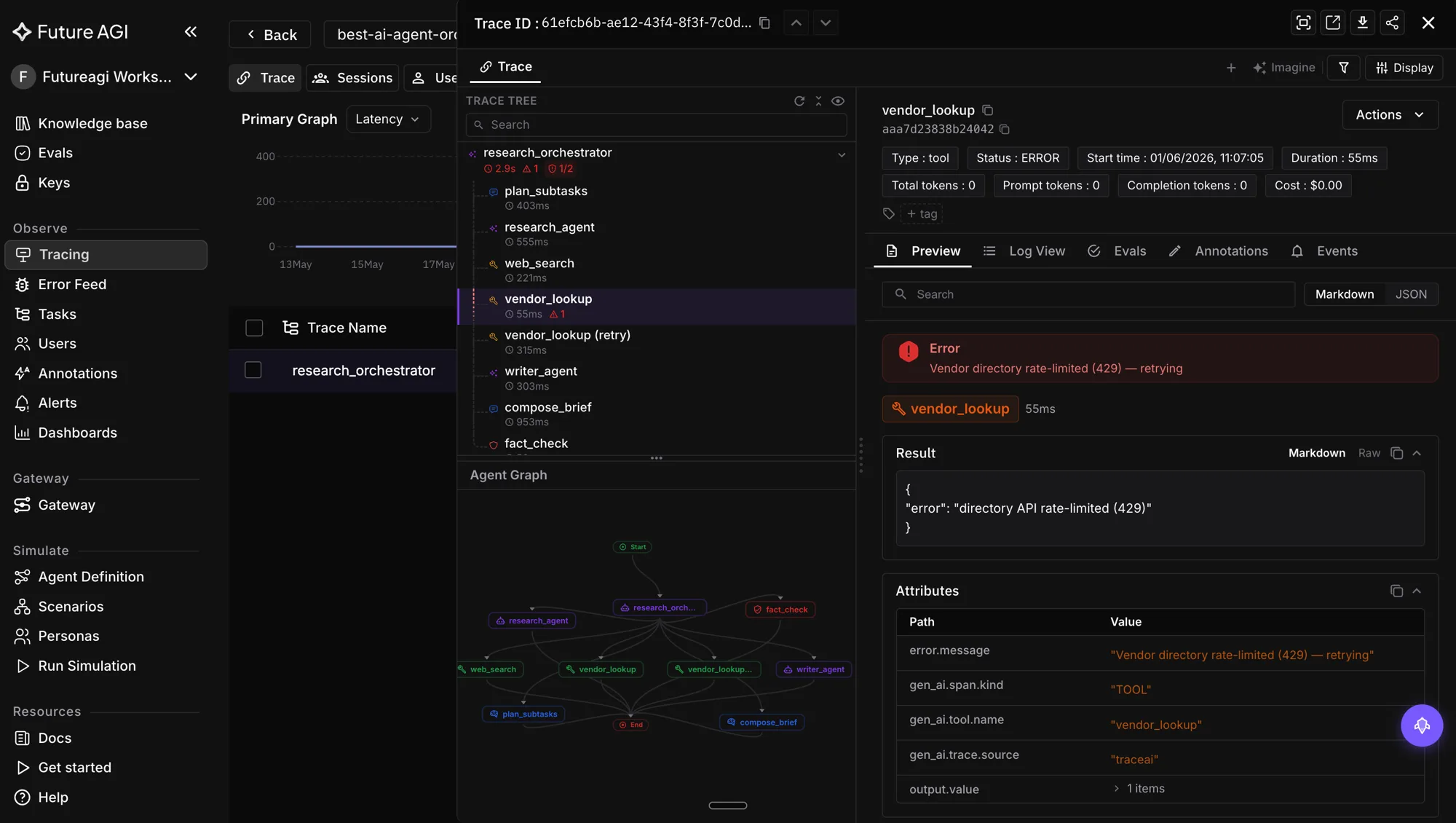
- Error Feed inside the eval stack. HDBSCAN soft-clustering over ClickHouse-stored span embeddings groups jailbreak attempts auto-detected in production into named issues; 500 failures collapse to 8-15 clusters. A Sonnet 4.5 Judge agent (30-turn budget, 8 span-tools, Haiku Chauffeur summariser, 90% prompt-cache hit) writes the RCA, surfaces evidence quotes from spans, and proposes the
immediate_fix. - Self-improving evaluators. The Platform retunes rubrics on new attack patterns automatically. Classifier-backed evaluators run at lower per-eval cost than Galileo Luna-2.
Limitations:
- Newer than Galileo on named CISO customer references.
- No documented containerized air-gapped release today.
base_urlis configurable and the SDK self-hosts inside a VPC, but air-gap certification is not claimed. CMMC L2/L3 contractors with a hard air-gap mandate should validate the deployment posture before signing. - The opinionated cascade means fewer review-and-collaboration knobs than a dedicated prompt-registry tool. The trade is eval, scanner, and trace in one control plane.
Use-case fit: SOC alert triage, IR runbook generation, threat-hunt log-analysis copilots, IAM copilots, compliance-narrative drafting, MSSP/MDR customer-facing SOC AI, SIEM AI rule generators, and threat-intel summarization where indirect injection through retrieved CTI is the binding failure mode.
Pricing & deployment: Cloud + OSS self-host (Apache 2.0 SDK stack + Agent Command Center single Go binary). Free + pay-as-you-go base; SOC 2 Type II, HIPAA BAA, SAML SSO, SCIM on Scale tier. 100+ provider integrations through Agent Command Center. See pricing.
Verdict: the only platform that passes the three-test scorecard out of the box. Choose Future AGI when you need a red-team rubric you can ship to CI on Monday, a false-positive precision floor that holds across cohorts, and one model running both the inline scanner and the offline rubric.
#2 Galileo Luna-2: Tier-1 CISO procurement with Luna-2 hallucination scoring
Galileo is the strongest pick when procurement, SSO, and a tier-1 MSA matter more than open-source flexibility. Luna-2 is the named hallucination model. SOC 2 Type 2 and enterprise-tier compliance terms ship as part of the standard contract.
Best for: Fortune 500 CISO functions, enterprise security-tooling SaaS vendors with MSA-first cycles, and security teams whose Legal & Compliance organization has already approved Galileo for fintech or healthcare workloads.
Key strengths:
- Luna-2 hallucination scoring with published benchmark numbers; mature on the factuality axis that matters for IR runbook and post-incident-narrative outputs.
- Drift detection on classification cohorts ships out of the box.
- Enterprise security posture clears tier-1 InfoSec quickly. SSO, SAML, audit log, RBAC at the right tier.
- Named security-vertical customer references.
Limitations:
- Red-team rubric is not a named primitive.
PromptInjection, multi-turn Crescendo, and indirect-injection detection are rubrics you author. - Precision-floor tuning per cohort is a custom-dashboard project, not a shipped object.
- Closed-source. Extending evaluators is a vendor request, not a code change. No OSS self-host.
- Pricing skews toward Tier-1 budgets. Future AGI’s classifier-backed evaluators run at lower per-eval cost than Galileo Luna-2 when cost is the deciding factor.
Use-case fit: Fortune 500 SOC alert triage, IR runbook with runtime hallucination guard, compliance-narrative drafting at scale, and security-tooling SaaS vendors selling into bank InfoSec.
Pricing & deployment: Enterprise contract, managed cloud. SOC 2 by default; CMMC and FedRAMP at sales.
Verdict: the safest procurement story for Tier-1 CISO buyers. Less flexible than Future AGI on red-team rubric extensibility, precision-floor control, and shared scanner-rubric plumbing.
#3 Braintrust: SDK-first eval workflow for security-tooling SaaS
Braintrust is the engineering-led pick for security-tooling teams that want a code-first, sandboxed eval workflow with a polished developer surface. SOC 2 Type II by default.
Best for: engineering-led security-tooling SaaS startups, ML platform teams inside larger security vendors, and SOC engineering teams that want eval datasets and red-team prompts versioned alongside application code.
Key strengths:
- Strong SDK ergonomics. Eval datasets, prompts, scoring functions, and red-team suites live in the same repo. CI gates on every PR.
- Sandboxed agent eval execution; useful for tool-using SOC agents on synthetic scenarios without real CTI.
- SOC 2 Type II by default; enterprise tier carries the broader compliance conversation.
- Per-row scoring lets you build the precision floor as a custom scorer over your own cohorts.
Limitations:
- Red-team rubric library is author-it-yourself.
PromptInjection, multi-turn Crescendo, indirect-injection, and CUI-handling rubrics don’t ship as named primitives. - BYO guardrail. No bundled inline scanner shared with the offline rubric, so the score-what-you-block test is a custom integration project.
- The audit-trace surface is engineering-shaped, not regulator-shaped. A per-decision artifact a CMMC C3PAO can read in 30 seconds takes additional wiring.
- Newer to cybersecurity procurement than Galileo.
Use-case fit: security-tooling SaaS startups, SOC engineering teams with strong software-engineering ownership, MDR vendors building customer-facing AI features, and SIEM AI rule-generator copilots running tool-using LLMs against synthetic incident data.
Pricing & deployment: SaaS with free and paid tiers; enterprise tier for regulated data.
Verdict: an engineering-pleasant eval workflow that crosses the SOC 2 bar by default. The rubric library, precision floor, and inline-block plumbing are yours to build. Choose Braintrust when the ML platform team is the buyer; choose Future AGI when the three tests need to be shipped, not built.
#4 Lakera Guard: security-specific inline scanner, not an eval rubric
Lakera Guard is a security-specific runtime classifier built for prompt-injection and jailbreak detection. It is a strong inline scanner, not an evaluation platform. Lakera scores inputs in production at the gateway hop; it does not produce the score-and-reason record a SOC postmortem, a CMMC auditor, or an SEC Item 1.05 determination reads. The right pattern is to run Lakera Guard (or Llama Guard, or Future AGI Protect) as the inline scanner and to run an eval platform offline against a versioned red-team suite.
Best for: teams that need inline prompt-injection blocking at the gateway hop with a security-tuned classifier and a low false-positive rate, paired with an eval platform for the offline rubric and audit-trail story.
Key strengths:
- Security-tuned classifier with a low published FPR among inline prompt-injection scanners; the precision floor is the product, not a configuration knob.
- Mature on indirect-injection through retrieval, system-prompt extraction, and adversarial-suffix detection.
- Drop-in inline integration at the gateway hop.
- Available as a third-party guardrail adapter inside Agent Command Center alongside the 18+ built-in scanners.
Limitations:
- Not an evaluation platform. No
EvalTemplatelibrary, no audit-trail surface, no drift telemetry per cohort. - Closed-source classifier; the policy you block is the policy Lakera shipped, not the policy you graded.
- No multi-turn Crescendo scoring as a first-class object.
- Single-vendor lock-in at the inline scanner layer.
Use-case fit: the inline scanner layer where prompt-injection resistance is the binding inline-block constraint. Pair with an eval platform (Future AGI, Galileo, or Braintrust) for the offline rubric, audit trail, and drift telemetry.
Pricing & deployment: SaaS API; enterprise contract for high-volume traffic.
Verdict: the strongest security-specific inline scanner pick. Not a replacement for an eval platform. The score-and-reason record has to live somewhere else, and the offline rubric has to share a model with the inline scanner for the score-what-you-block test to pass.
#5 Custom on-prem stack: full ownership for CMMC L2/L3 and air-gapped DIB primes
Some federal contractors won’t ship CTI, CUI, or indicator data to any third-party cloud. Some DIB primes have an air-gap mandate a signed enterprise contract can’t satisfy. The custom path is honest about the trade: full ownership of the eval stack, scanner layer, audit pipeline, and red-team rubric library, paid for in headcount.
Best for: CMMC L2/L3-bound federal contractors with dedicated security engineering, air-gapped DIB primes with a hard data-residency mandate, and EU NIS2 critical-infrastructure operators with sovereignty constraints.
Key strengths:
- No data leaves your boundary. The CMMC scope conversation collapses to your own assessor.
- Full control over red-team rubric definitions, evaluator versions, precision floors, and audit retention.
- Apache 2.0 primitives self-host inside the perimeter or air-gapped enclave:
ai-evaluation,traceAI, and Agent Command Center. Custom operationalisation, not custom primitives; you don’t reinvent theEvalTemplatelibrary, theJailbreakScannerpattern, or the OTel span schema.
Limitations:
- You own the upgrade path, rubric curation, judge drift, scanner threshold retuning, and dashboard work.
- Red-team rubric authoring is a security-research workload; Crescendo and indirect-injection rubrics need a security lead, a labelled gold set, and a quarterly judge-calibration review.
- Total cost of ownership rarely beats a SOC 2-certified vendor unless security platform engineering already exists as a funded team.
Use-case fit: CMMC L2/L3 federal contractor SOC AI, air-gapped DIB prime threat-hunt copilots, EU NIS2 critical-infrastructure operators.
Pricing & deployment: infrastructure plus security engineering headcount. Self-host the OSS primitives inside the perimeter with documented air-gap controls.
Verdict: the right answer when data residency is a hard mandate and the platform org is already there. Use Future AGI’s Apache 2.0 OSS primitives so you’re not reinventing the rubric library.
Decision matrix: which platform fits which security buyer
| If you are a… | Pick | Why |
|---|---|---|
| SOC engineering team running alert triage, IR runbook, threat-hunt, or IAM copilots on OpenTelemetry | Future AGI | All three tests pass; red-team EvalTemplate classes; cascade FP control; same Protect adapter offline + inline |
| Fortune 500 CISO with mature InfoSec procurement and MSA-first vendor approach | Galileo Luna-2 | Enterprise procurement reflex; SOC 2; Luna-2 hallucination scoring; named references |
| Security-tooling SaaS startup with engineering-led eval ownership | Braintrust | SOC 2; eval-as-code ergonomics; rubric library is yours to build |
| Inline prompt-injection blocking at the gateway hop with low FPR | Lakera Guard | Security-specific classifier; pair with eval platform for offline rubric + audit trail |
| CMMC L2/L3 federal contractor or air-gapped DIB prime | Custom on-prem | Full ownership; use OSS primitives so you’re not reinventing rubrics or scanner classes |
| MSSP / MDR vendor running customer-facing SOC AI at scale | Future AGI | Cohort-aware precision floor; multi-tenant Agent Command Center; per-customer drift telemetry |
| Threat-hunt copilot with indirect injection through retrieved CTI as the binding risk | Future AGI | RailType.RETRIEVAL separates retrieval-treated-as-untrusted from input; JailbreakScanner + Protect prompt_injection at retrieval layer |
Closing: the three-test ship gate
Cybersecurity AI in 2026 has two production failure modes. The loud one: a bad input gets through, a tool runs that shouldn’t have, an analyst sees a 2am alert that turns out wrong. Gateways and inline scanners catch most of those. The silent one: a confident-sounding output is hallucinated, a drifted classifier sits a real intrusion in queue for nine hours, an indirect-injection payload steers a tool-using agent down the wrong branch, and nobody scored it before the post-incident review started running. Observability dashboards log the silent failure after the fact. Evaluation platforms catch it before.
Run any cybersecurity AI shortlist through the three tests before procurement signs.
- Red-team rubric. Named
EvalTemplateor single-file judge classes forPromptInjection,AnswerRefusal,IsHarmfulAdvice,DataPrivacyCompliance, plus a multi-turnCustomLLMJudgefor Crescendo and trajectory drift. Not a generic factuality score with a security slide. - False-positive precision floor. Per-cohort precision and FPR tracked separately; cascade architecture with deterministic Tier 1 + model-level Tier 2 + disagreement-set spot-check; documented precision floor below which the build does not ship. Not a single F1 score across the test set.
- Prompt-injection scanner integration. Inline gateway scanner and offline eval rubric share a model and threshold; same Protect adapter runs in CI and in production. Score what you block. Not two policies, one labelled “eval” and one labelled “guardrail.”
Of the five platforms, Future AGI is the only one that ships the three tests out of the box. Galileo Luna-2 wins Tier-1 CISO MSA processes. Braintrust is the engineering-led pick. Lakera Guard is the strongest inline scanner; pair with an eval platform. Custom on-prem is the honest pick when air-gap is a hard mandate.
Ready to evaluate your first cybersecurity AI agent? Wire PromptInjection, AnswerRefusal, IsHarmfulAdvice, and DataPrivacyCompliance into a pytest fixture against the ai-evaluation SDK, then add the 8 Scanners cascade and a multi-turn CustomLLMJudge when the regression suite asks questions the single-turn rubric missed. Get started with Future AGI and follow the step-by-step red-teaming guide.
Related reading
Frequently Asked Questions
What makes a cybersecurity AI evaluation platform different from a generic one?
What's the difference between an AI gateway, a SOC AI copilot, and an AI evaluation platform for cybersecurity?
How do I score a SOC LLM for prompt-injection resistance without drowning in false positives?
How do I evaluate a cybersecurity AI without exposing CUI or classified data to a third-party LLM judge?
Should red-team evaluation run in CI or as a quarterly exercise?
Does Lakera Guard replace an eval platform?
How often should SOC teams re-evaluate production LLM-driven security tools?
Red-teaming an LLM is three loops: probe, classify, triage. A 2026 playbook that wires PyRIT and garak into a continuous compounding CI gate.

Senior-engineer guide to LLM guardrails: placement, 9 open-weight + 4 API backends, latency budgets, ensembles, precision/recall that actually catches.

OWASP LLM Top 10 (2025) for engineers: each risk, threat model, concrete mitigations, and the eval and guardrail tools that actually implement them.