Best 5 AI Guardrails for Cybersecurity AI Applications in 2026
Five AI guardrails compared for cybersecurity: SOC copilots, threat-intel RAG, SIEM LLMs, IR chatbots. NIST AI RMF, OWASP, MITRE ATLAS.
Table of Contents

What Are the Five Best AI Guardrails for Cybersecurity in 2026?
The pattern across SOC analyst copilots, threat-intel RAG agents, SIEM-integrated LLMs, incident-response chatbots, code-review copilots, and phishing-detection LLMs is the same: SOC copilot vendors ship the copilot, pan-industry content filters catch one class of pattern, and cybersecurity guardrails have to also produce the policy-decision audit trail a CISA disclosure conversation and a SOC 2 audit will read, while isolating per-tenant policies across an MSSP or MDR fleet.
| # | Platform | Best for | Pricing model |
|---|---|---|---|
| 1 | Future AGI Protect | Multi-modal guardrails with write-side enforcement, span-export to SIEM, and per-tenant policy isolation for MSSP/MDR fleets | Cloud + OSS self-host; Free + Pay-as-you-go; Boost/Scale/Enterprise add-ons |
| 2 | Lakera Guard | Vertical-anchored prompt-injection / jailbreak detection on text-only chat (gandalf-bench, INJECAGENT, AdvBench, OWASP LLM Top 10) | SaaS; tiered |
| 3 | NVIDIA NeMo Guardrails | Open-source policy-as-code SOC teams (Colang DSL); CMMC / air-gapped fit | Open source (Apache 2.0) |
| 4 | AWS Bedrock Guardrails | SOC tooling already on the AWS stack (Security Hub / GuardDuty / CloudTrail) | Per-request, managed cloud |
| 5 | Protect AI | ML-supply-chain-aware security teams (SSDF fit) | Enterprise contract + open-source LLM Guard |
TL;DR
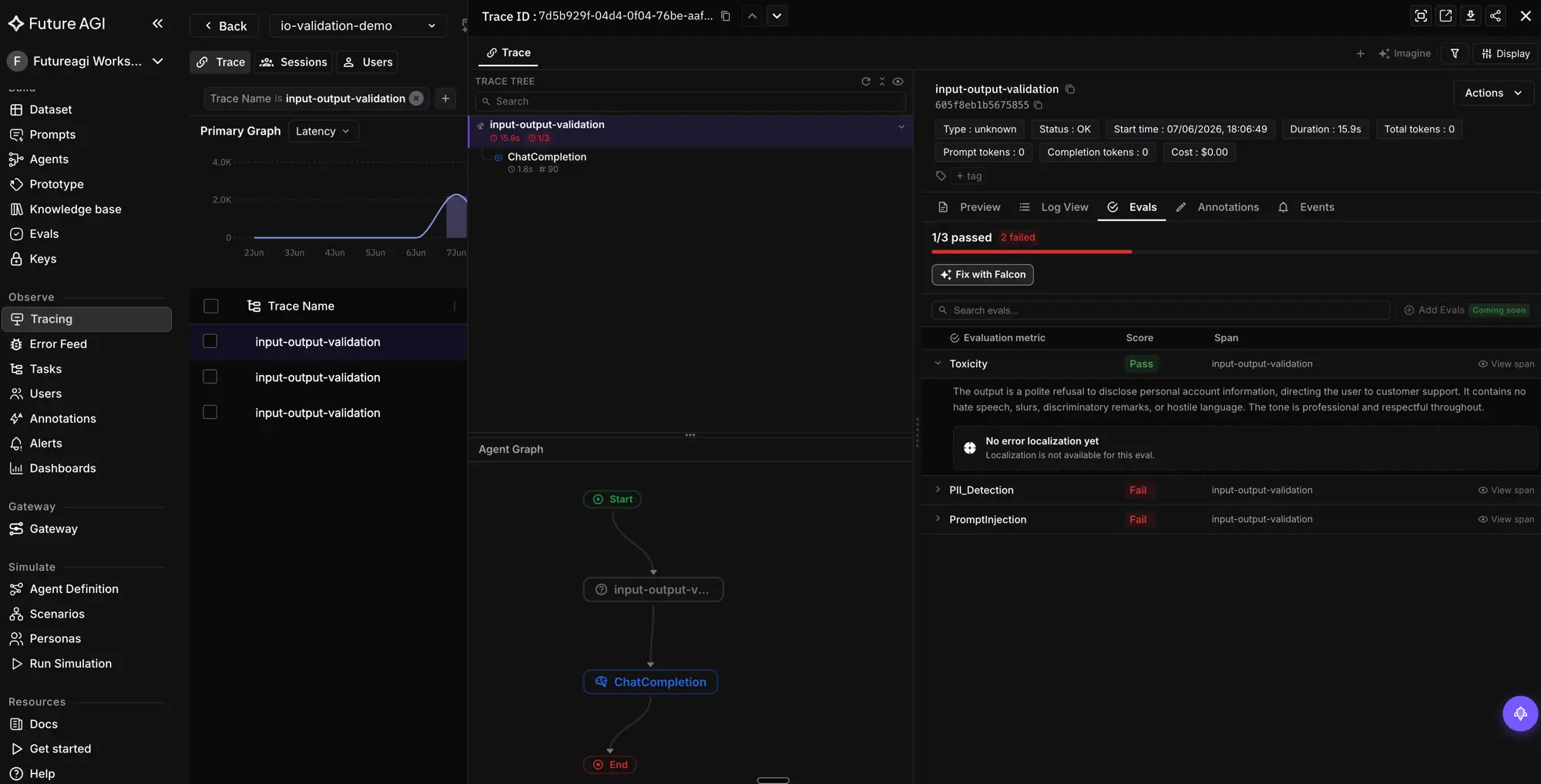
- Future AGI Protect for the Future AGI Protect model family (Gemma 3n + fine-tuned adapters per safety rule across Toxicity, Tone, Sexism, Prompt Injection, Data Privacy) with multi-modal text/image/audio coverage, ~67 ms p50 inline latency, write-side guard before cache poisoning, per-tenant policy for MSSP fleets, and SOC 2 Type II + HIPAA + GDPR + CCPA certified per the trust page; spans export OTel-native to any SIEM
- Lakera Guard for vertical-anchored prompt-injection / jailbreak detection backed by the named gandalf-bench eval set on text-only chat surfaces
- NVIDIA NeMo Guardrails for open-source policy-as-code SOC teams that want Colang DSL and SSDF-aligned policy logic in code (MITRE-ATLAS-tactic-aligned rules, CVE-redaction policies)
- AWS Bedrock Guardrails for SOC tooling already on the AWS stack: managed, cloud-native content filters + PII redaction + grounding; AWS Security Hub / GuardDuty / CloudTrail adjacency
- Protect AI (Guardian + open-source LLM Guard) for security-led teams where ML-supply-chain integrity and SSDF compliance bind alongside runtime guardrails
Why Are Cybersecurity AI Guardrails Different From Generic LLM Guardrails?
Cybersecurity teams ship LLMs faster than they harden them, and the failure mode is named-framework-shaped, not user-experience-shaped.
Three reasons generic LLM evaluation and generic guardrails fall short here:
- The audience is regulators, CISA, auditors, and incident-response leads, not users. Outputs feed CISA disclosure conversations, SEC Item 1.05 8-K filings, SOC 2 CC6 / CC7 audit evidence, ISO 27001:2022 control trails, NYDFS Part 500 incident notifications, and EU AI Act Article 15 cybersecurity-for-high-risk-AI reviews. The guardrail decision has to ship with a reason, a trace, and a retention surface that survives a subpoena.
- The failure modes are silent at the analyst level. A SOC analyst copilot prompt-injected to leak threat-intel data from an upstream model into a previous tenant’s session is invisible until a SOC 2 CC6 finding three months later. A threat-intel RAG agent jailbroken into surfacing CVE exploit chain detail looks like normal output (OWASP LLM02 Insecure Output Handling). An IR chatbot exfiltrating playbook contents to an attacker is a MITRE ATLAS T0044 model-evasion event, and the playbook is gone before the SOC notices. A code-review copilot tricked into approving a backdoored PR is a NIST SP 800-218A SSDF non-compliance event plus a supply-chain incident.
- Evidence has to survive multiple obligations simultaneously. NIST AI Risk Management Framework 1.0 and Generative AI Profile sets the Govern / Map / Measure / Manage baseline. NIST SP 800-218A applies the Secure Software Development Framework to AI products. OWASP Top 10 for LLM Applications is the risk register every SOC engineer references. MITRE ATLAS catalogs adversarial tactics against AI systems. The CISA AI Cybersecurity Collaboration Playbook sets information-sharing expectations for AI security incidents. SOC 2 Type II Trust Services Criteria CC6 and CC7 govern access and operations. ISO 27001:2022 governs the wider ISMS. EU AI Act Article 15 names cybersecurity requirements for high-risk AI from August 2026. NYDFS Part 500 applies to financial-services security teams running SOC copilots.
Most listicles in 2026 either pitch a SOC AI copilot (Charlotte AI / Security Copilot / Purple AI / Cortex XSIAM, which is the LLM the guardrail watches, not the guardrail) or a content-filter feature inside a cloud platform (catches toxicity, misses MITRE ATLAS adversarial tactics and SSDF supply-chain failures). Reliability, not capability, is the 2026 cybersecurity-AI question, and cybersecurity guardrails determine whether your audit trail proves compliance or proves negligence.
Where things get thin is the gap between gateway routing and audit-trail-grade policy enforcement that also handles per-tenant isolation for MSSP / MDR fleets. Future AGI Protect fills that gap with the Future AGI Protect model family: Gemma 3n + fine-tuned adapters per safety rule across 5 rules (Toxicity, Tone, Sexism, Prompt Injection, Data Privacy), multi-modal text/image/audio, ~67 ms p50 text inline (arXiv 2510.13351), write-side guard so threat-intel and CVE detail are refused before cache poisoning, per-tenant policy isolation for MSSP/MDR fleets, and SOC 2 Type II + HIPAA + GDPR + CCPA certified per the trust page. Spans export OTel-native to the SIEM the SOC already runs.
What Is the Future AGI Cybersecurity Guardrails Scorecard?
The Future AGI Cybersecurity Guardrails Scorecard is a five-dimension rubric for assessing whether an AI guardrails platform meets cybersecurity / SOC production requirements:
- Prompt-injection detection rate. Against named eval sets (gandalf-bench (Lakera), INJECAGENT (agent prompt-injection), AdvBench (jailbreak), and the OWASP Top 10 for LLM Applications evaluation suite). Cohort-level scoring against SOC-shaped prompts (threat-intel queries, IR runbook prompts, alert summarization).
- Sensitive-data leak prevention. Threat-intel data, customer-environment data, IR-playbook contents, and CVE exploit details redacted pre-completion at the gateway plus post-completion at the span-export boundary. SOC 2 CC6 (Logical Access), ISO 27001:2022 Annex A controls, and NYDFS Part 500 boundary integrity.
- Jailbreak / harmful-content resistance. Toxicity policy enforcement plus MITRE ATLAS tactic coverage. Red-team coverage on CVE-exploit prompts, phishing prompts, malware-generation prompts, and indirect-injection from email or log content the SOC LLM ingests.
- Latency overhead. p50, p95, p99 inflation by the guardrail layer. SOC alerting is real-time-sensitive: p95 inflation above ~800 ms breaks the alerting SLA on a Tier-1 SOC.
- Policy-rule maintainability. DSL (Colang, YAML-as-policy) vs config vs ML-classifier. How fast can the SOC team ship a new rule when CISA issues a fresh advisory? Can the policy version attach to the SIEM event for retention?
Each platform below is scored against this rubric in the comparison matrix.
How Do These Five Guardrails Compare on Capability?
| Capability | Future AGI Protect | Lakera Guard | NeMo Guardrails | Bedrock Guardrails | Protect AI |
|---|---|---|---|---|---|
| Prompt-injection detection rate | Yes (Prompt Injection rule; multi-modal) | Yes (gandalf-bench-anchored; text-only) | Yes (Colang policy + classifiers) | Yes (managed; AWS-stack) | Yes (LLM Guard + Guardian; ML-supply-chain-aware) |
| Sensitive-data leak prevention | Yes (Data Privacy rule, write-side + span-export redaction via traceAI) | Yes (output filters) | Yes (custom Colang rule) | Yes (managed PII filters) | Yes (LLM Guard scanners) |
| Jailbreak / MITRE ATLAS coverage | Yes (Toxicity + Sexism rules; multi-modal red-team) | Yes (LLM-security specialist; text) | Yes (policy DSL) | Yes (managed content filters + grounding) | Yes (security-vertical; SSDF-aligned) |
| Multi-modal coverage (text/image/audio) | Yes (Gemma 3n base, all three) | Text only | Text only | Limited (text + image) | Text only |
| Latency overhead | ~67 ms p50 inline | Low (purpose-built) | Variable (Colang complexity) | Low (managed; AWS-region-resident) | Variable (scanner chain depth) |
| Per-tenant policy isolation (MSSP/MDR) | Yes (Agent Command Center) | Limited | Self-built (Colang multi-tenant) | Separate AWS accounts | Limited |
| Policy-rule maintainability + SIEM integration | Config + admin control plane + OTel exporter to SIEM | Config + classifier (managed) | Colang DSL (policy-as-code) | YAML-as-policy (managed; CloudTrail audit) | YAML + Python (mixed) |
| Deployment model | Managed + drop-in proxy + BYOC | SaaS | Open-source (self-host) | Managed (AWS region) | Managed + open-source LLM Guard |
How Did We Rank These Five Guardrails?
The ranking criteria sit on top of the scorecard. We weighted:
- Audit-trail integration. Does the guardrail decision land as a span attribute in the same trace as the prompt, output, and eval score, retainable in a SOC 2 / ISO 27001 / NYDFS Part 500-aligned store, exportable to the SIEM the SOC already runs?
- Coverage surface. Does the guardrail handle text, image, and audio (phishing image payloads, voice IVR social-engineering), or only text?
- Multi-tenancy. Can an MSSP / MDR operator isolate per-tenant policies across a multi-customer fleet from a single control plane?
- Latency posture. Production-grade for real-time SOC alerting (p95 < 800 ms target)?
- Honest limitations. Does each platform name what it isn’t best at?
No guardrail layer is “100% prompt-injection-proof,” CISA-approved, and AWS-stack-default all at once. Pick by where your obligation lives.
#1 Future AGI Protect: Best for Closed-Loop Multi-Modal Guardrails Plus MSSP Per-Tenant Policy Isolation
Best for: Cybersecurity engineering teams that need write-side multi-modal guardrails plus prompt-injection detection across a multi-provider model fleet, wired into the same eval + trace loop that produces the audit-trail evidence SOC 2, ISO 27001, NIST AI RMF, and NYDFS Part 500 will read, with per-tenant policy isolation across an MSSP or MDR fleet.
Key strengths:
- The Future AGI Protect model family: Gemma 3n + fine-tuned adapters per safety rule across 5 rules (Toxicity, Tone, Sexism, Prompt Injection, Data Privacy), multi-modal text/image/audio, ~67 ms p50 text inline (arXiv 2510.13351). The Prompt Injection rule handles OWASP LLM01 Prompt Injection across all three modalities; the Data Privacy rule handles LLM06 Sensitive Information Disclosure with write-side enforcement; the Toxicity rule blocks CVE-exploit, phishing, and malware-generation prompts mapped to MITRE ATLAS tactics.
- Write-side guard refuses unsafe content before it lands in cache, vector store, or upstream provider token logs. The same surface blocks indirect injection from poisoned log content, email artifacts, or threat-intel feeds before the agent consumes them.
- Per-tenant policy isolation across MSSP / MDR fleets is a documented surface in the Agent Command Center, a cohort-unique cybersecurity differentiator.
- Drop-in OpenAI-compatible gateway across providers (OpenAI, Anthropic, Groq, Gemini) plus any OpenAI-compatible endpoint. Token budgeting, retry policies, and an admin control plane sit in front of every request, so the guardrail layer stays uniform across the model fleet without per-provider code changes.
- Integrates with
traceAIandai-evaluation: every gateway call generates a span, the guardrail decision attaches as a span attribute, downstream Toxicity / PII Detection / Hallucination scoring links back viaspan_id. Teams using their own SOC 2 / ISO 27001 / NYDFS Part 500-retention span store keep the policy decision and the eval score attached; traceAI’s exporter is OpenTelemetry-native and ships to any compatible SIEM ingest path. - SOC 2 Type II + HIPAA + GDPR + CCPA certified. HIPAA BAA available on the Scale add-on. ISO 27001 in active audit. Federal procurement via air-gapped self-host (BYOC); FedRAMP on partner roadmap, which is the right answer for SOCs in CMMC Level 2/3 or FedRAMP High environments needing perimeter control.
- Slots into LLM-as-a-judge workflows; field-level error localization for guardrail-flagged outputs closes the gap between “the guardrail blocked something” and “here is exactly which prompt segment fired the rule.”
- Built-in evaluators include Toxicity, PII Detection, Hallucination, Factual Accuracy, plus bias and harmful-content detection in LLM outputs.
- Hybrid local/cloud: 50+ built-in ai-evaluation rubrics plus unlimited custom evaluators authored by an in-product agent; 20+ heuristic metrics (regex, JSON schema, BLEU/ROUGE, semantic similarity) run locally at zero API cost. Useful where threat-intel data cannot leave the perimeter.
Limitations:
- Opinionated prompt library. Fewer review-and-collaboration knobs than a dedicated prompt registry, by design. The trade is prompt, eval, and guardrail policy live in the same control plane so the audit trail doesn’t fragment across three vendors.
- agent-opt is opt-in. The self-improving optimizer loop runs per route, not as a default. The trade is the optimizer runs against real production traffic with eval scores joined to spans, not a synthetic corpus.
- Federal procurement via BYOC. Air-gapped self-host today; FedRAMP on the partner roadmap. The trade is federal-grade data residency without waiting on a vendor’s authorization cycle.
Use-case fit: Strong across SOC analyst copilots, threat-intel RAG agents, SIEM-integrated LLMs, IR chatbots, code-review copilots, phishing-detection LLMs, and voice IVR social-engineering defense. The wedge bites hardest when multi-provider routing, multi-modal coverage, audit-trail-grade policy enforcement, and MSSP per-tenant isolation need to live in one stack.
Pricing & deployment. Cloud + OSS self-host (Apache 2.0 SDK suite: traceAI, ai-evaluation, agent-opt). Free to start with the full platform; pay-as-you-go as usage grows. Compliance and enterprise add-ons (SOC 2 Type II, HIPAA BAA, SAML SSO + SCIM, dedicated CSM) layer on as you need them. Pricing. Local heuristic path runs at zero API cost. Deploys as a drop-in OpenAI proxy.
Verdict: The unified-stack pick for SOC + MSSP. If multi-provider routing, multi-modal guardrails, audit-trail-grade trace-to-eval linkage, and per-tenant policy isolation across a customer fleet need to live in one platform, Future AGI Protect plus traceAI plus ai-evaluation is the workflow that fits production-grade cybersecurity AI without per-provider integration code.
#2 Lakera Guard: Best for Vertical-Anchored LLM-Security Guardrails on Text
Best for: Cybersecurity SOC teams whose binding 2026 constraint is prompt-injection / jailbreak resistance on text-only chat surfaces backed by a named third-party eval set the InfoSec cycle will recognize.
Key strengths:
- Vertical-anchored on LLM security; among the most-cited vendors in the prompt-injection / jailbreak space, and cybersecurity is the vertical for LLM security as a category.
- gandalf-bench is a published, named benchmark cybersecurity InfoSec reviews encounter by name; INJECAGENT and AdvBench provide agent-prompt-injection and jailbreak coverage; OWASP Top 10 for LLM Applications evaluation suite alignment.
- Production-grade detection latency suitable for real-time SOC alerting and threat-intel inference.
- Mature SOC 2 + enterprise-security posture that closes faster with bank / federal contractor / MSSP InfoSec than scrappier alternatives.
- MITRE ATLAS tactic coverage on the red-team eval surface.
Limitations:
- Specialist in prompt injection / jailbreak; broader policy-as-code expressiveness is narrower than NeMo’s Colang DSL.
- Text-only. Phishing image payloads and voice IVR social-engineering fall outside the product.
- Does not ship a managed LLM gateway; pair with a separate gateway for token budgeting, retry policies, and multi-provider routing.
- Score-and-reason record needs separate wiring to an eval / trace surface to produce a SOC 2 / NIST AI RMF evidence trail.
- No open-source path for SOC teams that need policy code self-hosted inside a CMMC-bound or air-gapped perimeter.
Use-case fit: Strong for SOC analyst chat copilots, threat-intel RAG agents on text, IR chatbots, and phishing-detection LLMs where indirect-injection from log / email / ticket content is the attack vector. Less optimal as a unified guardrail-plus-gateway-plus-eval stack or for multi-modal SOC workloads.
Pricing & deployment: SaaS with tiered enterprise contracts.
Verdict: The text-only vertical-anchored cybersecurity-native pick. If prompt-injection and jailbreak detection on text chat are your binding constraints and gandalf-bench is the name your InfoSec review wants to see, Lakera is the cleanest single-vendor answer.
#3 NVIDIA NeMo Guardrails: Best for Open-Source Policy-as-Code SOC Teams
Best for: Cybersecurity engineering teams that want policy-as-code in a documented DSL (Colang) and the freedom to self-host the policy layer, including inside a CMMC-bound or air-gapped SOC perimeter.
Key strengths:
- Colang DSL is the strongest open-source policy-as-code surface for LLM guardrails; reads close to natural language, version-controllable, with MITRE-ATLAS-tactic-aligned rules expressible directly in policy.
- Apache 2.0; policy code stays self-hosted with no vendor lock-in; fits CMMC / FedRAMP / air-gapped environments where third-party SaaS guardrails are out of scope.
- Strong NVIDIA-backed community plus production references in regulated workloads.
- Pluggable: chains with Lakera, Bedrock, or custom classifiers as a flexible policy substrate.
- SSDF-aligned policy expressiveness: CVE-redaction rules, exploit-detail blocking, IR-playbook-content boundaries can be authored as explicit Colang flows.
Limitations:
- Self-hosting is real platform work; your team owns the upgrade path, Colang version migrations, and rule-base maintenance.
- Latency overhead is variable depending on Colang policy complexity and chained classifier depth; can break a Tier-1 SOC alerting SLA if policies are unconstrained.
- Ships fewer pre-built cybersecurity-shaped policies out of the box than managed alternatives.
- No managed control plane; admin, audit, and compliance review surface is your team’s build; per-tenant isolation across an MSSP fleet requires custom multi-tenant infrastructure.
Use-case fit: Engineering-led cybersecurity teams with platform capacity that need a custom policy taxonomy (MITRE ATLAS tactic aligning, OWASP LLM Top 10 risk mappings, CISA-advisory-driven rule updates). Less optimal for procurement-led tier-1 SOCs that want managed SaaS.
Pricing & deployment: Open source (Apache 2.0); self-host.
Verdict: The policy-as-code pick. If your SOC treats policy as engineering and Colang is an acceptable substrate, NeMo is the cleanest open-source path. Pair with a separate managed eval / trace platform for the audit-trail surface and a separate gateway for multi-provider routing.
#4 AWS Bedrock Guardrails: Best for AWS-Stack SOC Tooling
Best for: Cybersecurity teams whose modal LLM workload runs on AWS Bedrock, where managed PII redaction, content filters, and grounding checks land inside the AWS region for data-residency and CloudTrail reasons, and whose SOC tooling already integrates with AWS Security Hub, GuardDuty, and CloudTrail.
Key strengths:
- Managed and cloud-native; CloudTrail captures every guardrail invocation as an audit event, retainable in S3 with object-lock for tamper-evident storage.
- Built-in PII filters covering sensitive categories (SSN, credit-card, account number) plus custom regex.
- Content filters span hate, insults, sexual, violence, misconduct categories with configurable thresholds.
- Grounding check for RAG outputs; useful for threat-intel RAG agents and IR playbook copilots.
- AWS Security Hub / GuardDuty / CloudTrail adjacency: guardrail events feed the same SOC pipelines AWS-stack security teams already operate.
- AWS-stack default; clears procurement faster for SOCs already on Bedrock.
Limitations:
- Cloud-locked; runs only on Bedrock, with no portable layer for hybrid-cloud or non-AWS LLM providers.
- Policy expressiveness narrower than NeMo’s Colang DSL; YAML-as-policy plus managed filters; MITRE ATLAS tactic coverage requires composition rather than direct expression.
- Per-request pricing can scale unpredictably on high-throughput SOC alert-summarization workloads.
- Less integrated with non-AWS eval / trace platforms; score-and-reason record stays in CloudTrail / S3 unless you wire export.
- Per-tenant isolation across an MSSP fleet requires separate AWS account or policy partitioning, not a single-pane configuration surface.
Use-case fit: SOCs whose entire LLM stack sits on Bedrock: SOC analyst copilots, threat-intel RAG agents, phishing-detection LLMs already on Anthropic-via-Bedrock or Amazon Titan. Less optimal for multi-cloud SOCs.
Pricing & deployment: Per-request pricing, managed in the AWS region.
Verdict: The AWS-stack-default pick. If your SOC is already on Bedrock and CloudTrail is the audit surface InfoSec accepts, Bedrock Guardrails is the path of least resistance.
#5 Protect AI: Best for ML-Supply-Chain-Aware Security Teams (SSDF Fit)
Best for: Security-led cybersecurity teams that care about ML-supply-chain risk on top of runtime LLM guardrails and want a vendor in the AppSec / NetSec adjacency. Strong fit where NIST SP 800-218A SSDF compliance is the binding constraint alongside runtime policy enforcement.
Key strengths:
- Guardian for runtime LLM scanning plus open-source LLM Guard for input/output filtering.
- ML-supply-chain-aware: model scanning for malicious payloads, MLOps-security tooling, broader threat-model coverage than runtime-only guardrails.
- SSDF-relevant: model scanning + code-review-copilot integration aligns with NIST SP 800-218A practices.
- Post-Palo-Alto-Networks-acquisition (2025) AppSec positioning fits the security-org procurement story where AppSec owns AI-system risk.
- Open-source LLM Guard with pluggable scanners (PII, prompt injection, ban substrings, code detection).
Limitations:
- Post-acquisition roadmap continuity is the open question; Palo Alto’s AppSec consolidation may reshape the standalone Protect AI surface, so verify at procurement.
- Less vertical-anchored on LLM-security-specific prompt-injection benchmarks than Lakera.
- LLM Guard’s open-source path is engineering work to wire into a managed gateway.
- Audit-trail integration with non-Palo-Alto observability stacks needs custom wiring.
- No native multi-provider gateway; pair with a separate gateway layer if multi-provider routing is required.
Use-case fit: Cybersecurity teams where AppSec owns AI-system risk and the MLOps-security threat model matters as much as runtime guardrails. Strong fit for code-review-copilot guardrails (SSDF backdoor detection) and ML-supply-chain integrity. Less optimal as a developer-facing gateway for ML-engineering-led teams.
Pricing & deployment: Enterprise contract for Guardian; open-source LLM Guard self-host.
Verdict: The security-org-aligned pick with SSDF fit. If AppSec is the buyer, ML-supply-chain risk is on the threat model alongside runtime guardrails, and SSDF compliance binds, Protect AI fits. Verify post-acquisition roadmap continuity at procurement.
Which AI Guardrail Should Your Cybersecurity Team Pick?
| If you’re a… | Pick |
|---|---|
| Engineering-led security team needing OpenAI-compatible gateway + PII redaction + traceAI integration for SIEM | Future AGI Protect |
| MSSP / MDR vendor needing per-tenant guardrail policies + admin control plane | Future AGI Protect |
| LLM-security-first SOC team needing prompt-injection / jailbreak coverage on text chat with named eval-set baselines | Lakera Guard (gandalf-bench / INJECAGENT / AdvBench / OWASP LLM Top 10) |
| Multi-modal SOC team handling phishing image payloads or voice IVR social-engineering | Future AGI Protect (text + image + audio) |
| Open-source-friendly security team needing customizable Colang policy DSL (CMMC / FedRAMP / air-gapped) | NVIDIA NeMo Guardrails (Colang DSL) |
| AWS-stack security team with Bedrock-deployed SOC tooling (Security Hub / GuardDuty / CloudTrail) | AWS Bedrock Guardrails |
| ML-supply-chain-focused security team (model-scanning + SSDF + LLM Guard) | Protect AI |
Where Does Each Guardrail Earn Its Slot?
The five platforms split the cybersecurity guardrails problem along different axes: unified multi-modal gateway + guardrail + eval + trace + MSSP per-tenant control plane (Future AGI Protect), vertical-anchored LLM-security on text (Lakera Guard), open-source policy-as-code (NeMo Guardrails), AWS-stack-default managed (Bedrock Guardrails), and ML-supply-chain-aware AppSec / SSDF (Protect AI). For most production cybersecurity teams in 2026, the right answer is a layered stack: a unified multi-modal gateway-plus-guardrail-plus-eval platform for the audit-trail-grade evidence SOC 2, NIST AI RMF, MITRE ATLAS coverage reviews, and CISA disclosure conversations will read, plus a specialist text-only prompt-injection detector when chat is the binding surface.
If multi-provider routing, multi-modal guardrails, audit-trail-grade trace-to-eval linkage, and per-tenant policy isolation across a customer fleet are the constraints that bite hardest, Future AGI Protect is the workflow that fits, wired across providers and integrated with traceAI and ai-evaluation so the policy decision and the eval score that explains it stay linkable in the same trace, exportable OpenTelemetry-native to the SIEM the SOC already runs.
Related reading
Frequently Asked Questions
What is the difference between prompt-injection detection and prompt-injection prevention guarantees?
How do AI guardrails map to the OWASP Top 10 for LLM Applications?
What role does the CISA AI Cybersecurity Collaboration Playbook play in guardrail policy design?
Can a single AI guardrails platform handle per-tenant policy isolation for an MSSP or MDR fleet?
How do AI guardrails produce the NIST AI RMF evidence trail for SOC AI applications?
Future AGI Protect vs Lakera Guard — which fits an LLM-security-first SOC team?
Cybersecurity AI eval in 2026: five platforms scored on red-team rubric, false-positive floor, prompt-injection scanner integration. FAGI, Galileo, Lakera.

Senior-engineer comparison of the best AI agent guardrails platforms 2026: latency budgets, placement, deployment topology, vendor fit.

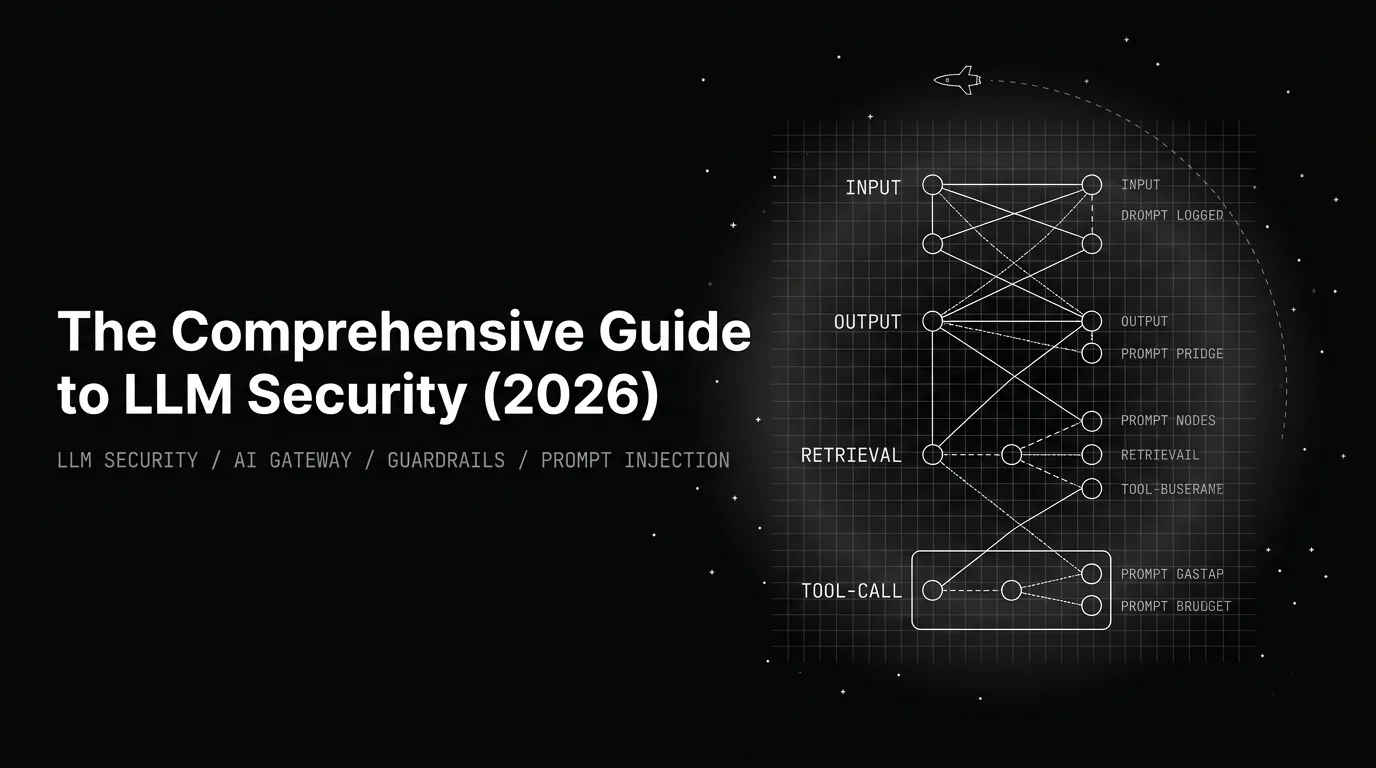
LLM security is four layers: input, output, retrieval, tool-call. Defenders that cover all four ship; input-only defenders lose to anything.
