Best 5 AI Guardrails for Insurance AI Applications in 2026
Five AI guardrails for insurance: underwriting, claims triage, fraud, copilots, CS chatbots, renewal pricing. NAIC, CO SB 21-169, NY DFS CL 7, ACA §1557.
Table of Contents

Updated May 2026. A multi-state P&C carrier’s renewal-pricing LLM answered every quote request fluently. Three months later, a Colorado SB 21-169 quantitative-testing review flagged the same model for cohort-level disparity: an adversarial prompt pattern in customer-portal messages had quietly bypassed the bias filter. The first signal anyone got was a state DOI inquiry on the next Reg 10-1-1 filing. This post compares the five AI guardrails platforms insurance teams should consider in 2026, ranked by what production teams ship to a state DOI review, what a pen-test team can red-team against bias-extraction prompts, and what a Head of Model Risk Management can attach to the model-risk file.
The pattern across underwriting LLMs, claims-triage assistants, fraud-detection copilots, customer-service chatbots, agent-suitability copilots, and renewal-pricing agents is the same: gateways control inputs, content filters catch toxicity, and insurance guardrails have to also produce the policy-decision audit trail a state-DOI examiner, an NAIC governance reviewer, and an HHS OCR investigator will read.
What Are the Five Best AI Guardrails for Insurance in 2026?
| # | Platform | Best for | Pricing model |
|---|---|---|---|
| 1 | Future AGI Protect | Multi-modal guardrails with write-side NPI redaction and span-linked bias-detection eval + trace | Cloud + OSS self-host; Free + Pay-as-you-go; Boost/Scale/Enterprise add-ons |
| 2 | Lakera Guard | Vertical-anchored prompt-injection / jailbreak detection on text-only chat; gandalf-bench-anchored | SaaS; tiered |
| 3 | NVIDIA NeMo Guardrails | Open-source policy-as-code teams (Colang DSL) running policy logic inside the carrier’s own infra | Open source (Apache 2.0) |
| 4 | AWS Bedrock Guardrails | Tier-1 carriers and InsurTechs already on the AWS stack: managed content filters + PII redaction + grounding | Per-request, managed cloud |
| 5 | Protect AI (Guardian + open-source LLM Guard) | ML-supply-chain-aware security teams treating model integrity as the binding control | Enterprise contract + open-source LLM Guard |
TL;DR
- Future AGI Protect for the Future AGI Protect model family (Gemma 3n + fine-tuned adapters per safety rule across Toxicity, Tone, Sexism, Prompt Injection, Data Privacy) with multi-modal text/image/audio coverage, ~67 ms p50 inline latency, write-side guard before cache poisoning, per-tenant policy, and SOC 2 Type II + HIPAA + GDPR + CCPA certified per the trust page; closed-loop with traceAI and ai-evaluation via
span_idplus a hybrid local heuristic route for NPI / SSN / medical NPI / claimant data - Lakera Guard for vertical-anchored prompt-injection detection backed by gandalf-bench on text-only chat surfaces
- NVIDIA NeMo Guardrails for engineering-led carriers and InsurTechs that want policy-as-code in Colang DSL inside their own infra
- AWS Bedrock Guardrails for Tier-1 carriers and InsurTechs already on the AWS stack: managed, cloud-native content filters + PII redaction + grounding
- Protect AI (Guardian + open-source LLM Guard) for security-focused InsurTechs treating ML-supply-chain risk as the binding control alongside runtime guardrails
Why Are Insurance AI Guardrails Different From Generic LLM Guardrails?
Insurance teams ship LLMs across underwriting, claims, fraud detection, agent copilots, customer service, and renewal pricing faster than they harden them, and the failure mode is state-DOI-consent-order, bad-faith-litigation, and ACA §1557 HHS OCR shaped, not toxicity shaped.
Three reasons generic LLM evaluation and generic guardrails fall short here:
- The audience is a state-DOI examiner, an NAIC governance reviewer, and an HHS OCR investigator, not a user. Outputs are read by Colorado DOI staff reviewing Reg 10-1-1 quantitative-testing filings, NAIC bulletin governance reviewers, NY DFS examiners working an Insurance Circular Letter No. 7 review, HHS OCR investigators on an ACA §1557 nondiscrimination matter, state breach-notification regulators, and bad-faith counsel preparing claims-handling discovery. The guardrail decision has to ship with a reason, a trace, and a retention surface that survives a subpoena across each of those audiences.
- The failure modes are silent at the customer level. A prompt-injection-extracted disparate-impact-protected pricing rule on an underwriting LLM is a Colorado SB 21-169 + Reg 10-1-1 exposure the next quarterly filing reveals. A denial-justification jailbreak on a claims-triage LLM ships as a bad-faith complaint and an NAIC Model Bulletin enforcement track. A health-insurance CS chatbot leaking medical NPI into a third-party LLM provider’s prompt-token log is invisible to the customer and visible only to an HHS OCR investigator asking for the trail. An agent-copilot misrepresentation of suitability factors is an NY Reg 187 violation and an E&O claim. None of these look like toxicity at runtime.
- Evidence has to survive multiple obligations simultaneously. The NAIC Model Bulletin on Use of AI Systems by Insurers (Dec 2023) requires documented AI governance, testing, and validation. Colorado SB 21-169 + Reg 10-1-1 requires quantitative testing for unfair discrimination in life-insurance underwriting algorithms with an annual filing. NY DFS Insurance Circular Letter No. 7 (2024) sets NY expectations for AI use in underwriting and pricing. NY Reg 187 requires suitability documentation for life-insurance and annuity recommendations. CA SB 1120 requires human review of automated denials in health-insurance utilization management. ACA §1557 (HHS final rule, 2024) requires AI nondiscrimination on health-insurance lines. GLBA Safeguards requires NPI access controls and audit trails. EU AI Act Article 6 + Annex III names life- and health-insurance pricing as high-risk, with Article 14 human-oversight obligations from August 2026. FTC Act §5 covers unfair / deceptive practices across the surface. The NIST AI Risk Management Framework provides the cross-cutting governance taxonomy state DOI examiners and NAIC governance reviewers map onto these rules.
Most listicles in 2026 either pitch insurance a content filter (catches toxicity, misses bias-extraction prompt injection on underwriting) or a generic gateway (controls cost, misses denial-justification jailbreak on claims-triage). Insurance guardrails determine whether your audit trail proves compliance or proves negligence across all three regulatory audiences simultaneously.
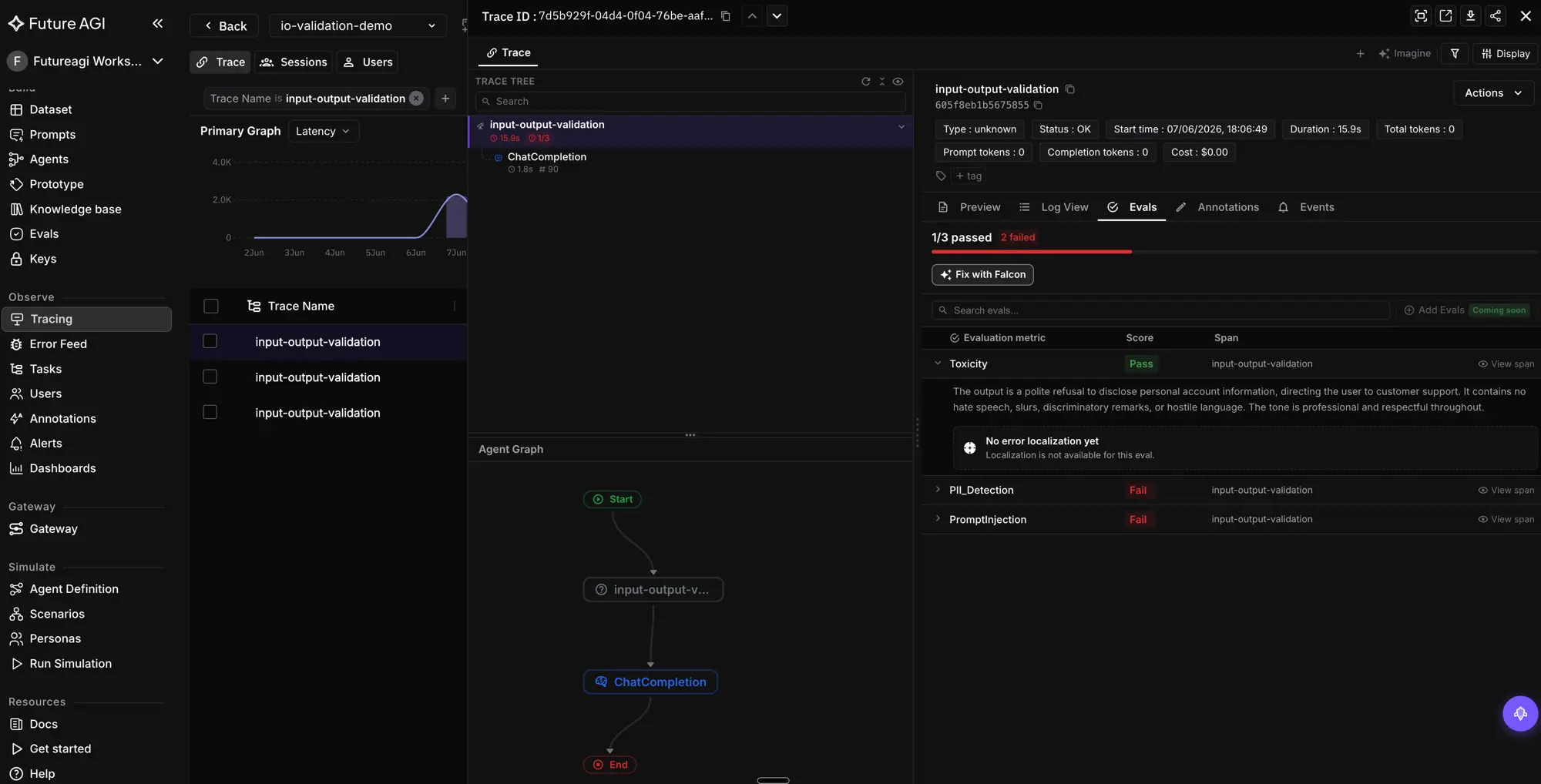
Where things get thin is the gap between gateway routing and audit-trail-grade policy enforcement on a multi-provider carrier LLM fleet, with bias-detection scoring linked to the same trace span the guardrail decision sits on. Future AGI Protect fills that gap with the Future AGI Protect model family: Gemma 3n + fine-tuned adapters per safety rule across 5 rules (Toxicity, Tone, Sexism, Prompt Injection, Data Privacy), multi-modal text/image/audio, ~67 ms p50 text inline (arXiv 2510.13351), write-side guard so NPI is refused before cache poisoning, per-tenant policy, and SOC 2 Type II + HIPAA + GDPR + CCPA certified per the trust page. The policy decision and the bias-detection score that explains it stay linkable in the same trace.
What Is the Future AGI Insurance Guardrails Scorecard?
The Future AGI Insurance Guardrails Scorecard is a five-dimension rubric for assessing whether an LLM guardrail layer meets insurance production requirements:
- Prompt-injection detection rate. Against named eval sets (gandalf-bench (Lakera), INJECAGENT (agent-prompt-injection), AdvBench (jailbreak)) plus insurance-shaped bias-extraction prompts targeting underwriting LLMs and renewal-pricing LLMs. Cohort-level scoring against insurance-shaped prompts matters more than any single benchmark headline.
- PII / sensitive-data leak prevention. NPI / SSN / medical NPI on health lines / claimant data / underwriting factor data under GLBA Safeguards on general lines, under ACA §1557 + HIPAA Security Rule on health-insurance lines. Pre-completion redaction at the gateway plus post-completion output scanning, retained as span attributes for state-DOI / NAIC retention surfaces.
- Jailbreak / harmful-content resistance. Red-team coverage on insurance-shaped bias-extraction prompts (extracting disparate-impact-protected pricing rules from underwriting LLMs) and denial-justification prompts (jailbreaking claims-triage LLMs into denying coverage on a suspect basis that ships as bad-faith litigation).
- Latency overhead. p50, p95, p99 inflation by the guardrail layer. Underwriting-quote flow is real-time-sensitive: a 300 ms tail latency is a quote-abandonment driver, and a 1 s tail latency is a binding-flow failure.
- Policy-rule maintainability. DSL (Colang, YAML-as-policy) vs config vs ML-classifier. How fast can compliance ship a new rule when a state DOI issues a fresh advisory or NAIC updates the bulletin? Can a Head of Model Risk Management attach the policy version to a model-risk file aligned to the carrier’s state-by-state filing cadence?
Each platform below is scored against this rubric in the comparison matrix.
How Do These Five Guardrails Compare on Capability?
| Capability | Future AGI Protect | Lakera Guard | NeMo Guardrails | Bedrock Guardrails | Protect AI |
|---|---|---|---|---|---|
| Prompt-injection detection rate | Yes (Prompt Injection rule; multi-modal) | Yes (gandalf-bench-anchored, text-only) | Yes (Colang policy + classifiers) | Yes (managed; AWS-stack) | Yes (LLM Guard, ML-supply-chain-aware) |
| PII / sensitive-data leak prevention | Yes (Data Privacy rule, write-side + local heuristic) | Yes (output filters) | Yes (custom Colang rule) | Yes (managed PII filters) | Yes (LLM Guard scanners) |
| Jailbreak / bias-extraction red-team | Yes (Sexism + Toxicity rules + ai-evaluation on the loop) | Yes (vertical-anchored on LLM-security) | Yes (policy DSL) | Yes (managed content filters + grounding) | Yes |
| Multi-modal coverage (text/image/audio) | Yes (Gemma 3n base, all three) | Text only | Text only | Limited (text + image) | Text only |
| Latency overhead | ~67 ms p50 inline | Low (purpose-built) | Variable (Colang complexity) | Low (managed; AWS-region-resident) | Variable |
| Policy-rule maintainability | Config + admin control plane | Config + classifier (managed) | Colang DSL (policy-as-code) | YAML-as-policy (managed) | YAML + Python (mixed) |
| Deployment model | Managed + drop-in proxy + BYOC | SaaS | Open-source (self-host) | Managed (AWS region) | Managed + open-source LLM Guard |
How Did We Rank These Five Guardrails?
The ranking criteria sit on top of the scorecard. We weighted, in order:
- Audit-trail integration. Does the guardrail decision land as a span attribute in the same trace as the prompt, output, and bias-detection score, retainable in a NAIC Model Bulletin / Colorado Reg 10-1-1 / GLBA Safeguards store?
- Coverage surface. Does the guardrail handle text, image, and audio (call-center voice, claim photos), or only text?
- Latency posture. Production-grade for underwriting-quote-flow inference, not batch eval alone?
- Policy maintainability. When a state DOI or NAIC issues a fresh advisory, how fast can compliance ship a new rule tied to the carrier’s filing cadence?
- Honest limitations. Does each platform name what it isn’t best at?
No guardrail layer is “100% prompt-injection-proof,” NAIC-certified, state-DOI-approved, ACA §1557-cleared, and AWS-stack-default all at once. Pick by where your binding obligation lives.
#1 Future AGI Protect: Best for Multi-Modal Guardrails with Bias Eval and Trace
Best for: Insurance engineering teams that need write-side NPI redaction plus prompt-injection detection across text, image, and audio, span-linked to bias-detection scoring, across a multi-provider model fleet, without per-provider code changes, with a hybrid local heuristic route for NPI / SSN / medical NPI on health lines / claimant data / underwriting factor data.
Key strengths:
- The Future AGI Protect model family: Gemma 3n + fine-tuned adapters per safety rule across 5 rules (Toxicity, Tone, Sexism, Prompt Injection, Data Privacy), multi-modal text/image/audio, ~67 ms p50 text inline (arXiv 2510.13351). The Sexism rule is the runtime disparate-impact-prevention surface; the Data Privacy rule strips NPI, SSN, medical NPI, and claimant data before the upstream provider sees them; the Prompt Injection rule blocks prompt injection on customer-portal messages and retrieved policy text; the Toxicity rule handles denial-justification refusal flows.
- Write-side guard refuses NPI before it lands in cache, vector store, or upstream provider token logs. The same surface blocks indirect injection from poisoned customer-portal messages or carrier policy-form retrieval before the agent consumes them.
- Per-tenant policy so one Protect deployment can serve an underwriting copilot, a claims-triage assistant, and a health-insurance CS chatbot under three different rule sets without copying policy across SDK calls.
- Drop-in OpenAI-compatible gateway via the Agent Command Center across providers (OpenAI, Anthropic, Groq, Gemini, Mistral, Bedrock). Token budgeting, retry policies, and an admin control plane sit in front of every request.
- Integrates with
traceAIandai-evaluation: every gateway call generates a span, the guardrail decision attaches as a span attribute, downstream Toxicity / PII Detection / Hallucination / Bias Detection scoring links back viaspan_id. The policy decision that blocked a renewal-pricing response and the bias-detection score that explains why it would have been a Colorado SB 21-169 exposure stay linkable in the same trace. - SOC 2 Type II + HIPAA + GDPR + CCPA certified. HIPAA BAA available on the Scale add-on. ISO 27001 in active audit. Federal procurement via air-gapped self-host (BYOC); FedRAMP on partner roadmap.
- Hybrid local/cloud: 50+ built-in ai-evaluation rubrics plus unlimited custom evaluators authored by an in-product agent; 20+ heuristic metrics (regex, JSON schema, BLEU/ROUGE, semantic similarity) run locally at zero API cost. Claims and fraud teams use the local route to keep NPI / SSN / medical NPI / claimant data / underwriting factor data off any third-party LLM judge.
- Built-in evaluators include Toxicity, PII Detection, Hallucination, Factual Accuracy, plus bias detection in LLM outputs for renewal-pricing LLMs and underwriting LLMs subject to Colorado SB 21-169 + Reg 10-1-1 quantitative testing and ACA §1557 nondiscrimination on health-insurance lines.
Limitations:
- Opinionated prompt library. Fewer review-and-collaboration knobs than a dedicated prompt registry, by design. The trade is prompt, eval, and guardrail policy live in the same control plane so the audit trail doesn’t fragment across three vendors.
- agent-opt is opt-in. The self-improving optimizer loop runs per route, not as a default. The trade is the optimizer runs against real production traffic with eval scores joined to spans, not a synthetic corpus.
- Federal procurement via BYOC. Air-gapped self-host today; FedRAMP on the partner roadmap. The trade is federal-grade data residency without waiting on a vendor’s authorization cycle.
Use-case fit: Strong across underwriting LLMs, claims-triage assistants, fraud-detection copilots, customer-service chatbots, agent-suitability copilots, and renewal-pricing agents. The wedge bites hardest when multi-provider routing, multi-modal coverage (call-center voice IVR, claim-photo intake), and bias-detection scoring linked to the guardrail decision need to live in one stack, and where NPI / medical NPI must stay off any third-party LLM judge.
Pricing & deployment. Cloud + OSS self-host of the Apache 2.0 SDKs (traceAI for OTel instrumentation, ai-evaluation for evaluators, agent-opt for prompt optimization). Free + pay-as-you-go base; compliance add-ons (SOC 2 Type II, HIPAA BAA, SAML SSO + SCIM) layer on per tier. Pricing. Local heuristic path runs at zero API cost. Deploys as a drop-in OpenAI proxy.
Verdict: The unified-stack pick. If multi-provider routing, gateway-resident multi-modal guardrails, audit-trail-grade trace-to-bias-detection linkage, and a hybrid local heuristic route for NPI / medical NPI need to live in one platform, Future AGI Protect plus traceAI plus ai-evaluation is the workflow that fits production-grade insurance without per-provider integration code.
#2 Lakera Guard: Best for Vertical-Anchored Prompt-Injection Defense on Text Surfaces
Best for: Insurance security teams whose binding 2026 constraint is prompt-injection / jailbreak resistance on a text-only chat surface backed by a named third-party eval set the InfoSec cycle will recognize: bias-extraction prompts on underwriting LLMs, denial-justification jailbreaks on claims-triage chat, and tool-call injection on agent copilots.
Key strengths:
- Vertical-anchored on LLM security; among the most-cited vendors in the prompt-injection / jailbreak space.
- gandalf-bench is a published, named benchmark insurance InfoSec security reviews encounter by name.
- Production-grade detection latency suitable for real-time underwriting-quote and customer-service inference.
- Mature SOC 2 + enterprise-security posture that closes faster with carrier InfoSec than scrappier alternatives.
Limitations:
- Specialist in prompt injection / jailbreak; broader policy-as-code expressiveness is narrower than NeMo’s Colang DSL.
- Text-only. Call-center voice IVR audio streams and claim-photo intake fall outside the product.
- Does not ship a managed LLM gateway; pair with a separate gateway for token budgeting, retry policies, and multi-provider routing across an insurance carrier fleet.
- Score-and-reason record needs separate wiring to an eval / trace surface; bias-detection scoring is a different evaluator class than prompt-injection detection.
- No open-source path for engineering-led carriers and InsurTechs that need policy code self-hosted.
Use-case fit: Strong for text-based customer-service chatbots, agent-copilot prompt-injection on tool calls, and underwriting-LLM indirect injection from customer-portal messages. Less optimal as a unified guardrail-plus-gateway-plus-eval stack or for multi-modal carrier workloads.
Pricing & deployment: SaaS with tiered enterprise contracts.
Verdict: The text-only prompt-injection specialist. If prompt-injection is your binding constraint, gandalf-bench is the name your security review wants to see, and your AI surface is text-only chat, Lakera is the cleanest single-vendor answer.
#3 NVIDIA NeMo Guardrails: Best for Policy-as-Code Open-Source Teams
Best for: Insurance engineering teams and InsurTechs that want policy-as-code in a documented DSL (Colang) inside their own infra and the freedom to self-host the policy layer.
Key strengths:
- Colang DSL is the strongest open-source policy-as-code surface for LLM guardrails; reads close to natural language, version-controllable, model-risk-file-attachable for the Head of Model Risk Management at the carrier.
- Apache 2.0; policy code stays self-hosted inside the carrier-data boundary with no vendor lock-in.
- Strong NVIDIA-backed community plus production references in regulated workloads.
- Pluggable: chains with Lakera, Bedrock, or custom classifiers as a flexible policy substrate.
Limitations:
- Self-hosting is real platform work; the carrier IT team owns the upgrade path, Colang version migrations, and rule-base maintenance.
- Latency overhead is variable depending on Colang policy complexity and chained classifier depth.
- Ships fewer pre-built insurance-shaped policies out of the box than managed alternatives (no NY Reg 187 suitability template, no Colorado SB 21-169 cohort-grouping template; build-your-own).
- No managed control plane; admin, audit, and compliance review surface is the carrier team’s build.
Use-case fit: Engineering-led carriers and InsurTechs with platform capacity that need a custom policy taxonomy (NAIC bulletin governance language, Colorado Reg 10-1-1 cohort-grouping rules, NY Reg 187 suitability-factor templates, ACA §1557 nondiscrimination rules). Less optimal for procurement-led Tier-1 carriers that want managed SaaS.
Pricing & deployment: Open source (Apache 2.0); self-host.
Verdict: The policy-as-code pick. If your team treats policy as engineering and Colang is an acceptable substrate, NeMo is the cleanest open-source path. Pair with a separate managed eval / trace platform for the audit-trail surface.
#4 AWS Bedrock Guardrails: Best for Carriers Already on the AWS Stack
Best for: Tier-1 carriers and InsurTechs whose modal LLM workload runs on AWS Bedrock, where managed PII redaction, content filters, and grounding checks land inside the AWS region for data-residency and CloudTrail audit-event reasons.
Key strengths:
- Managed and cloud-native; CloudTrail captures every guardrail invocation as an audit event.
- Built-in PII filters covering NPI categories (SSN, account number, contact data) plus custom regex; useful for general-lines NPI under GLBA Safeguards.
- Content filters span hate, insults, sexual, violence, misconduct categories with configurable thresholds.
- Grounding check for RAG outputs; useful for agent-suitability copilots citing carrier policy forms or state insurance code.
- AWS-stack default; clears procurement faster for carriers already on Bedrock.
Limitations:
- Cloud-locked; runs only on Bedrock, with no portable layer for multi-cloud carrier fleets or non-AWS LLM providers.
- Policy expressiveness narrower than NeMo’s Colang DSL; YAML-as-policy plus managed filters; no NY Reg 187 suitability template, no Colorado SB 21-169 cohort-grouping template out of the box.
- Per-request pricing can scale unpredictably on high-throughput claims-triage workloads.
- Less integrated with non-AWS eval / trace platforms; score-and-reason record stays in CloudTrail / S3 unless you wire export; bias-detection scoring on the same trace as the guardrail decision is BYO wiring.
Use-case fit: Tier-1 carriers whose entire LLM stack sits on Bedrock: underwriting LLMs on Anthropic-via-Bedrock or Amazon Titan, customer-service chatbots, agent-suitability copilots already on Bedrock. Less optimal for multi-cloud carrier fleets.
Pricing & deployment: Per-request pricing, managed in the AWS region.
Verdict: The AWS-stack-default pick. If your carrier is already on Bedrock and CloudTrail is the audit surface compliance accepts, Bedrock Guardrails is the path of least resistance.
#5 Protect AI: Best for ML-Supply-Chain-Aware Security Teams
Best for: Security-focused InsurTechs and carrier InfoSec teams that care about ML-supply-chain risk on top of runtime LLM guardrails and want a vendor in the AppSec / NetSec adjacency.
Key strengths:
- Guardian for runtime LLM scanning plus open-source LLM Guard for input/output filtering.
- ML-supply-chain-aware: model scanning for malicious payloads, MLOps-security tooling, broader threat-model coverage than runtime-only guardrails; useful for InsurTechs deploying fine-tuned underwriting or fraud-detection models from external sources.
- Post-Palo-Alto-Networks-acquisition (2025) AppSec positioning fits the security-org procurement story where AppSec owns AI-system risk at the carrier.
- Open-source LLM Guard with pluggable scanners (PII, prompt injection, ban substrings, code detection).
Limitations:
- Post-acquisition roadmap continuity is the open question; Palo Alto Networks’ AppSec consolidation may reshape the standalone Protect AI surface, so verify at procurement.
- Less vertical-anchored on insurance than Lakera is on LLM security broadly.
- LLM Guard’s open-source path is engineering work to wire into a managed gateway across the carrier fleet.
- Audit-trail integration with non-Palo-Alto observability stacks needs custom wiring; bias-detection scoring on the same trace as the guardrail decision is BYO.
Use-case fit: InsurTechs where AppSec owns AI-system risk and the MLOps-security threat model matters as much as runtime guardrails. Less optimal as a developer-facing gateway for ML-engineering-led carrier teams.
Pricing & deployment: Enterprise contract for Guardian; open-source LLM Guard self-host.
Verdict: The security-org-aligned pick. If AppSec is the buyer and ML-supply-chain risk is on the threat model alongside runtime guardrails, Protect AI fits. Verify post-acquisition roadmap continuity at procurement.
Which AI Guardrail Should Your Insurance Team Pick?
| If you’re a… | Pick |
|---|---|
| Engineering-led carrier needing a drop-in OpenAI-compatible gateway with built-in bias filter + NPI redaction wired across providers | Future AGI Protect |
| Health-insurance carrier with medical NPI handling and ACA §1557 nondiscrimination obligations | Future AGI Protect (HIPAA-certified, HIPAA BAA on the Scale tier) |
| Claims / fraud team needing a local-only guardrail for NPI / SSN / claimant data / underwriting factor data, with bias-detection scoring linked to the trace span | Future AGI Protect (drop-in + heuristic local PII-redaction route) |
| LLM-security-focused InsurTech whose binding 2026 constraint is prompt-injection / jailbreak detection on text chat with a named industry eval set | Lakera Guard |
| Tier-1 carrier with the modal LLM workload already on the AWS stack and CloudTrail as the audit-event surface compliance accepts | AWS Bedrock Guardrails |
| Open-source-friendly carrier IT team with platform-engineering capacity and a policy-as-code preference (Colang DSL inside the carrier-data boundary) | NVIDIA NeMo Guardrails |
| Security-focused InsurTech with ML supply chain concerns and an AppSec-led AI-risk function | Protect AI |
Where Does Each Guardrail Earn Its Slot?
The five platforms split the insurance guardrails problem along different axes: unified multi-modal gateway + guardrail + eval + trace with a hybrid local heuristic route for NPI / medical NPI (Future AGI Protect), vertical-anchored prompt-injection on text (Lakera), open-source policy-as-code (NeMo), AWS-stack-default managed (Bedrock), and ML-supply-chain-aware AppSec (Protect AI). For most production insurance teams in 2026, the right answer is a layered stack: a unified gateway-plus-guardrail-plus-bias-eval platform for the audit-trail-grade evidence state DOI examiners, NAIC governance reviewers, and HHS OCR investigators will subpoena across both general lines and health lines, plus a specialist text-only prompt-injection detector when chat is the binding surface.
If multi-provider routing, multi-modal guardrails, audit-trail-grade trace-to-bias-detection linkage, and a hybrid local heuristic route for NPI / SSN / medical NPI on health lines / claimant data / underwriting factor data are the constraints that bite hardest, Future AGI Protect is the workflow that fits, wired across providers and integrated with traceAI and ai-evaluation so the policy decision and the bias-detection score that explains it stay linkable in the same trace.
Related reading
Frequently Asked Questions
What's the difference between an AI gateway, an AI guardrail, and an AI evaluation platform for insurance?
Which AI guardrail is best for catching bias-extraction prompt injection on an underwriting LLM?
How do I meet Colorado SB 21-169 + Reg 10-1-1 quantitative-testing audit-trail requirements with an LLM guardrail?
Can I deploy insurance guardrails without sending NPI / SSN / medical NPI on health lines to a third-party LLM provider?
Does an AI guardrail replace state-DOI filing review or NAIC governance audit?
How often should insurance carriers re-test prompt-injection and bias-filter defenses?
Insurance AI eval in 2026: five platforms scored on bias detection, factuality, and per-decision audit. FAGI, Galileo Luna-2, Braintrust, Datadog, on-prem.

Five AI guardrails for fintech: fraud detection, credit, KYC, trading. NYDFS Part 500 §500.13, FINRA Rule 3110, SEC 15c3-5, EU AI Act Art 14, DORA.
Senior-engineer comparison of the best AI agent guardrails platforms 2026: latency budgets, placement, deployment topology, vendor fit.
