Best 5 CTGT Alternatives in 2026
Five CTGT alternatives on inline guardrail latency, native gateway and eval, deployment, pricing. What each actually fixes beyond AI risk management.
Table of Contents
CTGT opened a new category in 2024, enterprise AI risk management built on mechanistic interpretability, with policy guarantees encoded into model behavior without retraining. The story landed with the Fortune-500 buyers it was built for, the seed round in February 2025 from Google’s Gradient Ventures and General Catalyst confirmed the thesis, and the customer roster (tier-1 financial institutions, global media) gave the surface its enterprise lineage. Three things, however, define the 2026 buying conversation differently. CTGT ships AI risk management as a focused vertical, no native gateway, no runtime observability backbone, no optimizer loop. The pricing posture is enterprise-only, with no usage-based self-serve tier the SMB and mid-market can land on. And the surrounding category (gateways with native guardrails, agentic platforms with risk-management as one primitive among several, foundation-governed proxies with built-in scanners) closed the gap on the runtime semantics buyers actually need.
This guide ranks five alternatives worth migrating to, names what each fixes versus CTGT, and walks through the migration that always bites: replacing CTGT’s REST API plus Python SDK with an inline runtime guardrail layer that runs on the request path.
TL;DR: pick by exit reason
| Why you are leaving CTGT | Pick | Why |
|---|---|---|
| You want risk management plus a native gateway, eval, and optimizer in one stack | Future AGI Agent Command Center | Protect inline at ~65 ms text plus gateway, eval, and a self-improving loop on Apache 2.0 |
| You want a guardrails control panel with policies, sessions, and analytics | Aporia | Hosted guardrails platform with policy-first surface and session analytics |
| You want the most established prompt-injection brand | Lakera Guard | Largest red-team dataset, strongest brand on jailbreak research |
| You want a hosted gateway with a Guardrails plugin layer | Portkey (Guardrails plugin) | Managed proxy plus Guardrails plugin in one dashboard |
| You want a self-hosted, foundation-governed agent gateway | agentgateway.dev | Apache 2.0 Rust proxy under Linux Foundation with policy hooks and MCP scanning |
Why people are leaving CTGT in 2026
Five exit drivers show up repeatedly in Reddit /r/LLMDevs procurement threads, AppSec Discord channels reviewing 2026 renewal cycles, and the analyst notes circulated after the early-2026 enterprise budget freeze around AI line items.
1. AI risk-management focused: no native gateway, observability runtime, or optimizer
CTGT’s surface is risk management: convert SOPs and regulations into machine-readable rules, edit model behavior at the interpretability layer to enforce policy without retraining, return an audit-ready output. That’s the strongest part of the product, and also where it stops. CTGT doesn’t route to upstream providers, hold provider keys, fail over, cache, budget, store prompts, score traces against eval rubrics, cluster failure modes, or rewrite prompts on a feedback loop. The 2024 buy was “specialist risk-management platform, slot it into the AI compliance stack.” The 2026 review is “we run a gateway, an observability runtime, an eval suite, an optimizer, and CTGT, five vendors carrying overlapping concerns and five contracts to renew.”
2. Enterprise-only pricing with no usage-based self-serve tier
CTGT’s commercial posture is enterprise from day one. No public Free or Pro tier with usage-based scaling, no self-serve trial that lands a workload below the procurement-cycle threshold, no listed pricing on the marketing surface. Custom annual contracts, sales-led motion, Fortune-500 customer profile. That posture made sense in the 2024 launch window, risk management for tier-1 financial institutions doesn’t buy itself through a credit-card form. In 2026, when teams that started with a $99/month gateway are graduating to inline guardrails, the absence of a usage-based tier means CTGT is the path that requires a quarter-long procurement cycle before the first request gets scored.
3. Narrow scope versus full-stack runtime needs
The platform’s scope is deliberately narrow: detect hallucination, eliminate bias, enforce policy, deliver audit trails. Customers report the headline numbers, 96.5% hallucination prevention, 3.3× accuracy multiplier in domain-specific tasks, 80-90% reduction in human-in-the-loop review, and the numbers are real for the workloads CTGT designed for. The narrow framing, however, leaves outside CTGT’s surface area: prompt-injection defense across direct + indirect + tool-output channels, MCP egress scanning, virtual-key fanout for per-developer attribution, prompt-registry versioning, eval-loop wiring, optimizer integration. Buyers who started with “we need risk management” in 2024 are landing in 2026 on “we need a runtime that handles risk management plus gateway plus eval plus optimizer in one stack.”
4. Smaller community than Aporia or Lakera
CTGT shipped its enterprise platform in mid-2025; the developer community is still forming. Aporia (founded 2019, guardrails-only since 2023) has G2 reviews going back two years, a Python SDK with three years of release notes, and a documented public footprint in the OWASP LLM Top 10 discourse. Lakera (founded 2021, prompt-injection focused since 2023) ships the Gandalf adversarial benchmark, publishes the PINT score, leads the jailbreak-research conversation on AppSec Discords. CTGT’s GitHub presence is light, the public talk circuit is founder-led rather than community-led, and the SDK reference architecture is sales-onboarding rather than self-serve documentation. For teams whose procurement framework asks “what is the size of the developer community on this product,” the answer is “smaller than Aporia, smaller than Lakera.”
5. Mechanistic interpretability is a research thesis, not a category buyers consolidate around
CTGT’s technical differentiator is mechanistic interpretability, edit the model’s internal representations to enforce policy without retraining. The customer outcomes back the thesis for specific use cases. As a procurement category, however, “mechanistic interpretability platform” is harder to consolidate budgets around than “AI gateway” or “guardrails platform” because the buyer is comparing CTGT against techniques (RLHF, fine-tuning, prompt engineering, runtime guardrails) rather than directly substitutable products. The 2026 renewal conversation includes “could we get 90% of the outcome from a runtime guardrails layer at 30% of the CTGT contract”, and for several buyers the answer is yes.
What to look for in a CTGT replacement
The default “AI risk-management platform” axes are necessary but not sufficient for a CTGT exit. Score replacements on the seven that map to the surfaces you’re actually consolidating off of:
| Axis | What it measures |
|---|---|
| 1. Inline guardrail latency | What the policy check adds to p50 and p95 of the request path |
| 2. Native gateway integration | Does the policy enforcement run inside the gateway, or as a separate REST hop? |
| 3. Eval and optimizer loop | Does the runtime feed miss-classifications back into the corpus or candidate-prompt evaluations? |
| 4. Deployment posture | Hosted, self-host, BYOC, or air-gapped? Is self-host on the standard tier or behind an enterprise contract? |
| 5. Pricing predictability | Linear per request, tier-and-add-on multipliers, or enterprise-only? |
| 6. Community and ecosystem | Active developer community, public SDK release cadence, third-party integrations |
| 7. Scope breadth | Beyond risk management, does the product also cover gateway, eval, optimizer, prompt registry? |
1. Future AGI Agent Command Center: Best for closing the loop
Verdict: Future AGI is the only alternative in this list that fixes all five exit drivers at once. Protect ships as the inline guardrails layer at the gateway hop. ai-evaluation scores every captured trace. The Agent Command Center gateway handles routing, provider keys, virtual keys, and prompt registry. agent-opt rewrites prompts based on eval scores and pushes the new version through the same gateway. CTGT is a risk-management platform. FAGI is a risk-management platform wired to a gateway wired to an eval pipeline wired to an optimizer, with the OSS instrumentation under Apache 2.0 so the buyer’s audit team can read the source.
What it fixes versus CTGT:
- Inline runtime, not a separate REST hop. Protect runs inside the gateway process with a median 65 ms text-mode and 107 ms image-mode latency per arXiv 2510.13351. CTGT’s policy enforcement is a separate API call site the application or gateway routes through; FAGI’s enforcement happens on the same span as the model call. Eighteen built-in scanners cover PII, prompt injection (direct + indirect + tool-output), content moderation, hallucination, topic restriction, language detection, data leakage prevention, secret detection, blocklists, system-prompt protection, tool permissions, input validation, MCP security, custom expression rules, and webhook BYOG, plus fifteen third-party adapters (Lakera, Presidio, Llama Guard, AWS Bedrock Guardrails, Azure Content Safety, Pangea, Aporia, Enkrypt AI, HiddenLayer, DynamoAI, IBM, Zscaler, Crowdstrike, Lasso, GraySwan).
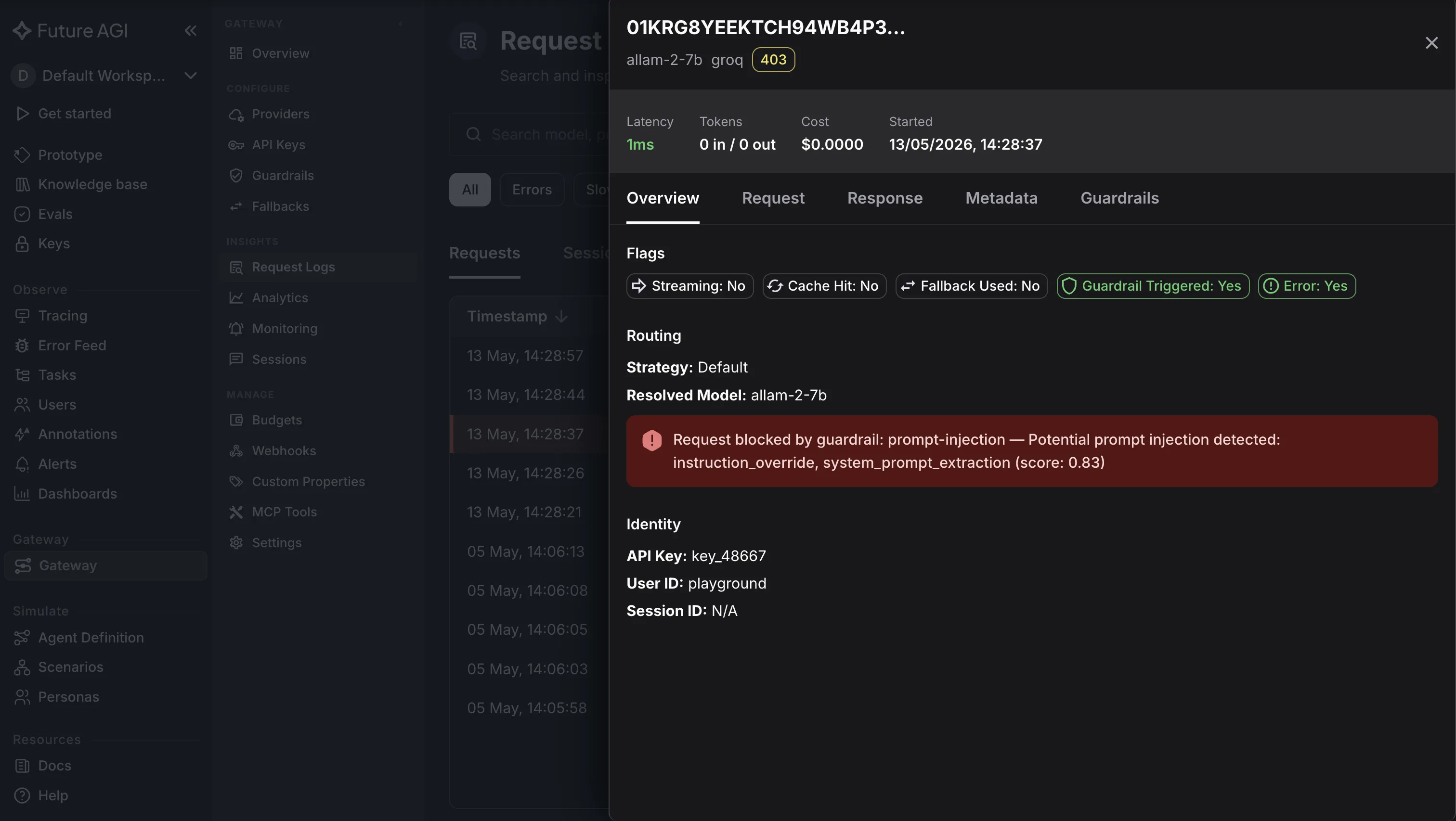
- Native gateway plus eval plus optimizer in one stack. OpenAI-compatible drop-in across 20+ providers via six native adapters (OpenAI, Anthropic, Gemini, Bedrock, Cohere, Azure) plus OpenAI-compatible presets and self-hosted backends, native prompt registry with Jinja2 templates, per-identity virtual keys, OTel traces, and Protect verdicts share one control plane. The eval library (
ai-evaluation, Apache 2.0) scores every captured trace against task-completion, faithfulness, tool-use, and safety rubrics. The optimizer (agent-opt, Apache 2.0) rewrites prompts via six optimizers — ProTeGi, GEPA, Bayesian, MetaPrompt, RandomSearch, PromptWizard driven by those eval scores, and pushes updated versions back through the gateway. CTGT stops at “enforce the policy at the model layer.” FAGI uses every blocked output, every eval miss, and every clustered failure mode as a signal for the next rewrite.
- Apache 2.0 instrumentation plus hosted Command Center.
traceAI,ai-evaluation, andagent-optare all Apache 2.0. The OSS components run in the buyer’s VPC without an annual enterprise contract; the hosted Command Center adds RBAC, failure-cluster views, the Protect guardrails layer, AWS Marketplace procurement, and SOC 2 Type II evidence. CTGT’s standard delivery is enterprise-only hosted; FAGI’s standard delivery scales from a free tier upward.
- Self-improving loop on the buyer’s own traces. Production miss-classifications feed back into the next training pass via agent-opt. CTGT retrains on CTGT’s interpretability dataset on CTGT’s cadence; FAGI’s loop closes on the buyer’s traces, including the workloads where CTGT’s mechanistic-interpretability approach saw the largest accuracy gains.
- Usage-based pricing curve. Free tier covering 100K traces/month including Protect on all of them. Scale tier from $99/month with linear per-trace scaling above 5M. Enterprise with SOC 2 Type II, BAA-eligible deployment, and AWS Marketplace procurement.
Migration from CTGT: CTGT is invoked as a REST API call plus a Python SDK wrapper on the request path; the policy decision happens in CTGT’s hosted infrastructure before the response returns. Replacing it with FAGI replaces three concerns at once: the REST detector call disappears entirely because Protect runs in-process at the gateway hop; the verdict-to-action becomes a per-route FAGI policy; the OTel span gets scanner_id, verdict, confidence, attack_class, and atlas_subtechnique attributes natively. Existing CTGT policies. SOP-encoded rules, hallucination detection thresholds, custom expression rules, map to FAGI’s scanner configs through a one-pass rewrite to YAML or the UI. Timeline: seven to ten engineering days for fewer than 30 policies and fewer than 20 services, including a shadow-traffic period running CTGT and FAGI in parallel to compare verdicts before the cutover.
Where it falls short:
-
The product surface is larger than CTGT’s. A team that only wants risk management will see surfaces (gateway, eval, optimizer, prompt registry) they aren’t using on day one. The learning curve is real for the first sprint.
-
Custom-policy authoring uses YAML and Python, not CTGT’s interpretability-level rule DSL. SOP-to-rule investments that exercised CTGT’s interpretability-editing surface need a rewrite to FAGI’s runtime scanner configs, not a port, the underlying mechanism is different.
Pricing: Free tier with 100K traces/month including Protect. Scale tier from $99/month with linear per-trace scaling above 5M (no add-on multipliers). Enterprise with SOC 2 Type II, BAA-eligible deployment, and AWS Marketplace procurement.
Score: 7 of 7 axes.
2. Aporia: Best for hosted guardrails with policies and sessions
Verdict: Aporia is the pick when the CTGT exit reason is “we want a hosted guardrails control panel with policies, sessions, and analytics in one surface, not a risk-management platform that owns interpretability editing.” Aporia’s surface is policy-first: define a policy on a route, attach the relevant detector, and the platform owns the verdict-to-action and the analytics. After the Coralogix integration, the standalone roadmap thinned, but the guardrails-platform surface area still maps cleanly to the slice of CTGT that buyers consolidate against.
What it fixes versus CTGT:
- Policy-first surface with session-level analytics. Aporia exposes guardrails as policies on sessions and routes, with the verdict-to-action wired inside the platform and verdicts aggregating per session, per route, per policy. CTGT’s analytics are SOP-and-compliance-shaped (rule, trigger, audit-trail entry); Aporia’s are session-shaped (conversation, policy verdict, drill-down into the offending payload). For AppSec teams whose review meeting is “show me the last 50 blocked sessions and what they triggered on,” Aporia’s dashboard maps more directly than CTGT’s compliance-report surface.
- Multi-detector composition under one policy framework. Prompt injection, PII redaction, off-topic flagging, and toxicity sit under one policy framework rather than four detectors against four APIs. CTGT’s detection surface is broad but tightly coupled to the interpretability-editing approach; Aporia composes scanners across the standard guardrails category.
- Usage-based hosted pricing. Aporia’s hosted tier scales on requests and detectors. Not the cheapest option below a few million requests per month, but predictable and self-serve in a way CTGT’s enterprise contract isn’t.
Migration from CTGT: The CTGT REST policy call gets re-pointed as an Aporia policy attached to the route. The calling gateway no longer parses CTGT’s compliance verdict, the policy decision happens inside Aporia, and the gateway acts on the post-policy payload. Custom CTGT SOP rules need a one-pass rewrite to Aporia’s policy DSL; common cases (PII redaction, off-topic flagging, hallucination detection) map directly to Aporia’s detector library. Timeline: five to seven engineering days for fewer than 25 policies, including a shadow-traffic period.
Where it falls short:
- No native gateway. Aporia is the guardrails layer; the routing gateway is a separate product (Aporia integrates with major gateways via SDK). Migrating from CTGT to Aporia replaces one of CTGT’s concerns and leaves the gateway problem unsolved.
- No optimizer or self-improving loop on the buyer’s traces; policies update on manual rule edits, not on production miss-classifications.
- Self-host posture exists for enterprise contracts; the standard tier is hosted-only.
- The Coralogix integration narrowed the guardrails-only product roadmap; surfaces that mattered to early adopters (custom rule authoring, hallucination detection) now compete with the broader observability suite for engineering attention.
Pricing: Hosted with usage-based pricing on requests and detectors. Enterprise tier for SOC 2 Type II and on-prem.
Score: 5 of 7 axes (missing: native gateway in one hop, optimizer loop).
3. Lakera Guard: Best for the established prompt-injection brand
Verdict: Lakera Guard is the pick when the CTGT exit reason is “we want the strongest brand on prompt-injection defense and the largest published red-team dataset, even if we lose the broader risk-management surface.” Lakera’s category is detector-as-a-service: a hosted REST endpoint that scores payloads for prompt injection and returns a verdict. Three years of jailbreak research, the Gandalf adversarial benchmark, the PINT score, and an active presence in the OWASP LLM Top 10 discourse give Lakera the procurement-easy “this is the prompt-injection detector AppSec recognizes” position.
What it fixes versus CTGT:
- Externally branded benchmark cadence. Lakera publishes Gandalf (the public adversarial-prompt arena), the PINT score (the prompt-injection benchmark used in 2025-2026 AppSec procurement reports), and a published red-team dataset. CTGT’s benchmark surface is customer-anecdote-shaped (96.5% hallucination prevention on Fortune-500 deployments) rather than externally branded; for teams whose procurement framework asks “what is the third-party benchmark on this product,” Lakera’s answer is clearer.
- Three-year head start on jailbreak research. Lakera’s prompt-injection corpus is among the largest in the industry, with detector retraining cycles that ship through the standard product tiers. CTGT’s interpretability approach handles policy enforcement broadly but isn’t specifically a jailbreak-research vendor.
- Sub-millisecond detector median. Lakera publishes a single-digit-millisecond median on the detector path, faster than CTGT’s REST policy call in the workloads where Lakera’s narrower scope is what the buyer needs.
Migration from CTGT: The CTGT REST policy call gets re-pointed at Lakera’s detector endpoint. The verdict semantics shift: CTGT returns a compliance-shaped audit trail, Lakera returns flagged plus a categories payload with sub-technique tags (OWASP LLM01:2025 and MITRE ATLAS AML.T0051). The calling layer interprets Lakera’s verdict and applies the block/sanitize/log policy. The remaining CTGT capabilities (SOP encoding, audit-trail compliance, hallucination policy enforcement) need a different home, typically the gateway or a separate eval product. Timeline: four to six engineering days for the detector swap, longer if also replacing CTGT’s audit-trail surface.
Where it falls short:
- Detector-only. No native gateway, eval, optimizer, or prompt registry. Replacing CTGT with Lakera covers prompt-injection defense well, but leaves SOP-encoding, audit-trail compliance, and broader risk-management concerns on different vendors.
- Hosted-only on the Pro tier; self-host and on-prem live behind the Enterprise tier and an annual contract.
- The paid REST API call model adds 5-15 ms p50 round-trip latency on top of the detector’s single-digit-ms median, stacking with the gateway hop.
- Enterprise pricing is custom-priced in the high five to low six figures annually, competitive when there’s no other AppSec budget line item, expensive when the buyer wanted a usage-based replacement for CTGT’s enterprise contract.
Pricing: Free tier with 1K requests/month. Pro tier billed per request. Enterprise with SOC 2 Type II evidence and on-prem in the high five to low six figures annually.
Score: 4 of 7 axes (missing: native gateway, eval, optimizer).
4. Portkey (Guardrails plugin): Best for hosted gateway with Guardrails plugin
Verdict: Portkey is the pick when the CTGT exit reason is “we want the policy layer and the gateway in one hosted product, with a Guardrails plugin layer on the routes the policy runs on.” Portkey was acquired by Palo Alto Networks on April 30, 2026, a fit for Fortune-500 security teams already on Prisma and Cortex, a yellow flag for SMB teams watching for SKU consolidation in the next 12-24 months. The Guardrails plugin layer covers the slice of CTGT’s surface that buyers consolidate against; the rest (interpretability editing, mechanistic-level policy enforcement) doesn’t have a direct analog and gets reframed as runtime scanners on the route.
What it fixes versus CTGT:
- Policy and gateway in one hop. Portkey’s Guardrails plugin runs as a pre-request and post-response check on the same proxy hop that does routing, fallback, and caching. The verdict-to-action policy lives inside the gateway rather than as a separate CTGT REST call the application has to wire.
- Polished hosted dashboard. Per-route cost, per-virtual-key attribution, per-session traces, and Guardrails verdicts share one dashboard. CTGT ships an audit-trail-focused compliance dashboard; the gateway concerns (cost, virtual-key fanout, per-session traces) aren’t on the same surface.
- Lower entry pricing than CTGT enterprise. Portkey’s Scale tier starts at $99/month for gateway plus Guardrails. CTGT’s enterprise-only posture means the floor is an annual contract with a sales-led procurement cycle; Portkey’s $99/month Scale tier is the SMB and mid-market path CTGT doesn’t ship.
Migration from CTGT: The CTGT REST policy call gets re-pointed: instead of the application calling CTGT’s endpoint, the calling gateway enables Portkey’s Guardrails plugin on the relevant routes. Verdict semantics need a mapping pass. CTGT’s compliance-trail shape becomes Portkey’s Guardrails result plus policy_match shape. SOP-encoded rules need a rewrite from CTGT’s interpretability-level DSL to Portkey’s scanner configs; common cases (PII redaction, prompt injection, content moderation) map directly. Timeline: five to seven engineering days for a guardrails-only swap; longer if also replacing the gateway in front of CTGT.
Where it falls short:
- The Palo Alto Networks acquisition is the elephant in the room; every prior PANW acquisition (Bridgecrew, Cider, Talon, Dig) saw the standalone SMB SKU sunset within 18-24 months. Pricing below the Cortex bundle is uncertain.
- No native eval or optimizer surface. Traces inform humans, not the gateway. Buyers who picked CTGT for the broader risk-management story land back on a four-vendor stack after the migration.
- Mechanistic-interpretability-style policy enforcement doesn’t port; Portkey’s surface is runtime scanners on the request path, not model-internal edits.
- Indirect-injection coverage on retrieved RAG context is partial; auto-attach to retrieval and MCP egress isn’t first-class.
Pricing: Free tier with 10K requests/month. Scale tier from $99/month for gateway plus Guardrails. Enterprise pricing varies; PANW bundle pricing under review.
Score: 5 of 7 axes (missing: native eval, native optimizer).
5. agentgateway.dev: Best for foundation-governed Apache 2.0 with MCP scanning
Verdict: agentgateway.dev is the pick when the CTGT exit reason is “we want Apache 2.0 under Linux Foundation governance with a built-in MCP scanner at the proxy hop, not a commercial risk-management contract with sales-led procurement.” The project lives under the Linux Foundation Agentic AI Foundation umbrella (donated by Solo.io in August 2025, v1.0.0 released in March 2026), ships an Apache 2.0 Rust proxy, and bakes a Model Context Protocol scanner into the data plane, addressing CVE-2026-30623, the April 2026 MCP STDIO transport class flaw OX Security disclosed in 7,000+ MCP servers.
What it fixes versus CTGT:
- Linux Foundation governance, Apache 2.0. No commercial vendor contract; the IP and the roadmap live under a neutral foundation. AppSec teams in regulated industries with vendor-risk frameworks prefer foundation-governed projects over single-vendor commercial platforms; CTGT’s enterprise-contract posture is the opposite shape.
- Built-in MCP scanner at the proxy hop. The MCP threat surface (prompt-injected tool descriptions, prompt-injected tool output forwarded to the model) is scanned in-process. CTGT’s interpretability-level policy enforcement handles model behavior broadly but isn’t specifically wired to MCP egress; agentgateway.dev’s auto-attach to MCP traffic is first-class.
- Rust proxy, low in-process latency. The Rust runtime plus in-process detector keeps the latency budget below the round-trip a REST policy call incurs. Foundation-governed release cadence ships the scanner under the project release cycle, not a vendor’s commercial roadmap.
- No commercial floor. Apache 2.0, free under the Linux Foundation. Commercial support contracts available from contributing vendors (Solo.io and ecosystem partners) for teams that want an SLA, but the standard delivery doesn’t require a contract, opposite shape to CTGT’s enterprise-only posture.
Migration from CTGT: The CTGT REST policy call becomes the agentgateway.dev in-process scanner. The proxy itself replaces whatever gateway sat in front of CTGT. Verdict semantics ship through the project’s policy hook, with block and log modes natively and sanitize on the roadmap. SOP-encoded rules need a rewrite from CTGT’s interpretability DSL to agentgateway.dev’s policy hooks; the team brings its own dashboard via OTel sinks (the project ships hooks, not a hosted UI). Timeline: ten to fifteen engineering days because the migration is both a policy swap and a proxy swap, plus the team needs to wire its own observability stack (Grafana, Tempo, or a managed eval/observability surface).
Where it falls short:
- Younger than Aporia, Lakera, or CTGT in commercial terms; the ecosystem (Terraform providers, off-the-shelf dashboards, enterprise SLAs from a single vendor) is thinner.
- Sanitize mode is on the roadmap, not in production as of May 2026.
- No managed eval or optimizer; the buyer brings the eval harness.
- Audit-trail surface is OTel-based rather than the compliance-report-shaped dashboard CTGT ships natively; regulated teams that report to compliance officers via “show me the audit report for the quarter” need to build that report from spans.
Pricing: Apache 2.0, free under the Linux Foundation. Commercial support contracts available from Solo.io and contributing vendors.
Score: 5 of 7 axes (missing: managed eval, mature ecosystem).
Capability matrix
| Axis | Future AGI | Aporia | Lakera Guard | Portkey (Guardrails) | agentgateway.dev |
|---|---|---|---|---|---|
| Inline detection latency | ~65 ms text / ~107 ms image (arXiv 2510.13351), in-process | Hosted policy layer, sub-100 ms typical | Single-digit-ms detector + 5-15 ms round-trip | In-process Guardrails plugin | Rust proxy, in-process |
| Native gateway integration | Yes (gateway + detector + eval + optimizer) | No (policy layer only) | No (detector only) | Yes (gateway + Guardrails) | Yes (proxy + scanner) |
| Eval + optimizer loop | Yes (ai-evaluation + agent-opt) | No | No | No | No |
| Self-host on standard tier | Yes (Apache 2.0 instrumentation) | Enterprise only | Enterprise only | Limited (source-available) | Yes (Apache 2.0) |
| Pricing predictability | Linear above 5M, no add-on multipliers | Usage-based | Per-request Pro + Enterprise floor | Tier + per-feature | Free, support optional |
| Community and ecosystem | OSS instrumentation + hosted | Mid-tier, Coralogix integration | Largest red-team dataset, Gandalf brand | Largest active dev community | LF Agentic AI Foundation backing |
| Scope breadth beyond risk-management | Gateway + eval + optimizer + prompt registry | Guardrails platform only | Detector only | Gateway + Guardrails plugin | Proxy + MCP scanner |
Migration notes: what breaks when leaving CTGT
Three surfaces always need attention when the migration is “REST API plus Python SDK to inline runtime guardrails.”
Replacing the REST API plus Python SDK call site
CTGT is invoked through a REST API call plus a Python SDK wrapper on the request path. The application or the calling gateway sends the payload to CTGT, the platform evaluates it against the SOP-encoded policy and the interpretability-level rules, and the verdict returns to the caller. The migration step rewrites every call site. In FAGI’s case the call disappears entirely because Protect runs in-process at the gateway hop; in Portkey’s case the Guardrails plugin is enabled on the route; in Aporia’s case the call shifts to a policy attached to the session; in Lakera’s case the call re-points at Lakera’s detector endpoint; in agentgateway.dev’s case the in-process scanner takes over. Search the repo for ctgt, the SDK class names, and the configured REST endpoint before starting the swap. The audit-trail surface needs a separate migration plan; the runtime guardrails replace the policy enforcement, but the compliance report shape lives somewhere else (OTel spans + Grafana, a managed observability product, or the destination gateway’s audit log).
Replacing the SOP-encoded rules with inline scanner configs
CTGT’s value-add is converting SOPs and regulations into machine-readable rules that drive model behavior. Replacing that surface means rewriting the rules in the destination platform’s policy language: YAML or UI scanner configs in FAGI, Aporia’s policy DSL, Lakera’s categories shape, Portkey’s Guardrails plugin config, or agentgateway.dev’s policy hooks. Common cases. PII redaction, prompt-injection blocking, off-topic flagging, content-moderation thresholds, map mechanically. Harder cases, interpretability-level edits that CTGT applies at the model’s internal representations, and SOP rules that compose multiple compliance frameworks (HIPAA + SOX + GDPR in one rule), need a manual rewrite because the underlying mechanism is different. Inline runtime scanners enforce policy at the prompt/response boundary; CTGT’s mechanism enforces at the model-internal representation. Most production behaviors map across (block, sanitize, log, redact); the long-tail edge cases where mechanistic-interpretability editing was the binding feature need a different design.
Re-pointing the inline policy decision and the audit trail
CTGT ships an audit-trail-shaped compliance report as part of the platform; the calling layer trusts the report for regulatory submissions. After migration, the inline guardrail layer owns the verdict-to-action decision, and the audit trail lives in OTel spans plus the destination platform’s audit log. The application code that wrapped CTGT’s verdict in a if blocked: return 403 block disappears, because the gateway enforces the policy before the request reaches the application path. The compliance-report consumer (GRC team, auditor, regulator) needs the audit trail in the shape they recognize, typically a quarterly report exported from the destination platform or assembled from OTel spans. Plan the audit-trail migration as a separate workstream; the runtime cut-over is faster, the compliance-report cut-over takes a sprint because the report consumers need to validate the new format.
Decision framework: Choose X if
Choose Future AGI Agent Command Center if your reason for leaving is more than the risk-management vertical, you also want the gateway, the eval suite, and the optimizer in one stack, with Apache 2.0 instrumentation and a self-improving loop that closes on your own traces. Pick this when the renewal cycle is forcing a consolidation decision and the five-vendor stack (gateway + risk management + observability + eval + optimizer) is the line item being collapsed.
Choose Aporia if you want a hosted guardrails control panel with policies, sessions, and analytics in one surface, and you’re comfortable pairing it with a separate gateway. Pick this when the surface that matters is the policy control panel and the session-level analytics, not the broader interpretability-editing approach.
Choose Lakera Guard if your reason for leaving is “we want the strongest brand on prompt-injection defense and the externally branded benchmark cadence,” and you can absorb a four-vendor stack on the other surfaces (gateway, eval, optimizer, audit). Pick this when AppSec procurement asks for the recognized detector and the broader risk-management story lives elsewhere.
Choose Portkey (Guardrails plugin) if you want the policy and the gateway in one hosted product with a Guardrails plugin layer, and you can absorb the Palo Alto Networks acquisition uncertainty. Pick this when the binding constraint is a managed Guardrails plugin layer and the PANW integration risk is acceptable.
Choose agentgateway.dev if your reason for leaving is “we want Apache 2.0 under the Linux Foundation with a built-in MCP scanner and no commercial vendor contract.” Pick this when foundation governance, CVE-2026-30623 coverage, and the absence of a commercial floor matter more than the hosted dashboard polish.
What we did not include
Three products show up in other 2026 CTGT alternatives listicles that we left out: NeMo Guardrails (NVIDIA’s open-source SDK for programmable guardrails, a Python SDK developers wire into application code rather than an inline gateway layer, so the shape is different from a CTGT replacement); HiddenLayer (model-security-focused with a different threat model, adversarial-ML against the model artifact rather than runtime policy on the request path); DynamoAI (younger commercial platform with a thinner public footprint, worth a second look in Q3 2026 once the integration cadence is established).
Related reading
- Best 5 Aporia Alternatives in 2026
- Best 5 Lakera Guard Alternatives in 2026
- Best AI Gateways for Prompt-Injection Defense in 2026
- What Is Prompt Injection Defense in 2026?
Sources
- CTGT product page, ctgt.ai
- CTGT seed-round announcement (February 2025, $7.2M led by Gradient Ventures and General Catalyst), globenewswire.com
- CTGT enterprise platform launch (June 2025, hallucination and bias elimination), globenewswire.com
- OWASP Top 10 for LLM Applications 2025 (LLM01: Prompt Injection), owasp.org/www-project-top-10-for-large-language-model-applications
- MITRE ATLAS AML.T0051 sub-technique catalogue, atlas.mitre.org
- April 2026 MCP STDIO RCE class (CVE-2026-30623) disclosure by OX Security, ox.security
- Aporia product page, aporia.com
- Lakera Guard product page, lakera.ai
- Portkey product page, portkey.ai
- Palo Alto Networks press release on Portkey acquisition, April 30, 2026, paloaltonetworks.com/company/press
- agentgateway.dev project page (LF Agentic AI Foundation), agentgateway.dev
- Linux Foundation Welcomes Agentgateway Project (August 25, 2025), linuxfoundation.org/press
- agentgateway v1.0.0 release notes (March 2026), agentgateway.dev/blog
- Future AGI Agent Command Center, futureagi.com/platform/monitor/command-center
- Future AGI Protect latency benchmark, arxiv.org/abs/2510.13351 (65 ms text, 107 ms image)
- Future AGI traceAI, github.com/future-agi/traceAI (Apache 2.0)
- Future AGI ai-evaluation, github.com/future-agi/ai-evaluation (Apache 2.0)
- Future AGI agent-opt, github.com/future-agi/agent-opt (Apache 2.0)
Frequently Asked Questions
Why are people moving off CTGT in 2026?
What is the closest like-for-like alternative to CTGT?
How do I replace CTGT's REST API plus Python SDK?
How do I migrate CTGT's SOP-encoded rules?
Is there an open-source CTGT alternative?
Which CTGT alternative covers MCP egress scanning?
How does Future AGI Agent Command Center compare to CTGT?

Five Aporia alternatives on inline guardrail latency, eval-loop wiring, deployment, SDK breadth. What each actually fixes after the Coralogix integration.

Five Lakera Guard alternatives scored on inline guardrail latency, native gateway and eval surfaces, self-host posture, sub-enterprise pricing.

Senior-engineer comparison of the best AI agent guardrails platforms 2026: latency budgets, placement, deployment topology, vendor fit.