Best 5 Aporia Alternatives in 2026
Five Aporia alternatives on inline guardrail latency, eval-loop wiring, deployment, SDK breadth. What each actually fixes after the Coralogix integration.

Table of Contents
Aporia was one of the first guardrails-only companies in the LLM safety stack. After the Coralogix acquisition, the product folded into a broader observability suite, the standalone roadmap thinned, and the surfaces that mattered to early adopters, inline policy enforcement, hallucination detection, custom rule authoring, now compete with Coralogix’s logs, traces, and alerting roadmap for engineering attention. The enterprise-first pricing held; the hosted-only data plane held; the Python-first SDK held. What didn’t hold is the sense that Aporia is a focused, guardrails-native company.
Teams who picked Aporia in 2023 or 2024 picked it because it was the cleanest guardrails option in a thin market. 2026 is a different market: native guardrails inside gateways, dedicated OSS guardrails projects with stronger community traction, and full agentic-stack platforms that bundle guardrails with eval and routing. This guide ranks five alternatives, names what each fixes versus Aporia, and walks through the migration that always bites: replacing the Python SDK wrapper and the REST policy calls.
TL;DR: pick by exit reason
| Why you are leaving Aporia | Pick | Why |
|---|---|---|
| You want guardrails plus eval plus gateway in one product | Future AGI Agent Command Center | Protect inline guardrails, native eval library, gateway, and a self-improving optimizer loop |
| You already run Portkey for routing and want guardrails inside it | Portkey Guardrails plugin | Native plugin in your existing gateway with no new control plane |
| Your platform team already runs Kong | Kong AI Gateway | AI Proxy plus guardrails plugins extend an existing Kong stack |
| You want the most established prompt-injection brand | Lakera Guard | Largest red-team dataset, strongest brand on jailbreak research |
| You want a self-hosted, source-available agent gateway | agentgateway.dev | OSS agent gateway with policy hooks and no hosted dependency |
Why people are leaving Aporia in 2026
Five exit drivers show up repeatedly in Reddit /r/LLMDevs guardrails threads, the Aporia GitHub issue tracker (now read-mostly), G2 reviews from late 2025 and early 2026, and the Coralogix forum since the integration started shipping.
1. Guardrails-only is no longer a category
In 2023, “guardrails as a standalone product” was a real category. Aporia, Lakera, Protect AI, NeMo Guardrails. In 2026, the category collapsed into three larger ones: gateways with native guardrails (Portkey, Kong, Future AGI), agentic platforms with guardrails as one primitive among several, and OSS scanner libraries (LLM Guard, NeMo Guardrails, Presidio). Aporia is still in the “guardrails-only” framing because the Coralogix acquisition kept it there. Teams who picked guardrails-only in 2023 are realizing they bought one primitive in a stack that wants several.
2. No native gateway
Aporia sits as a policy layer in front of the model call. It doesn’t route, hold provider keys, fail over, cache, or budget. Most teams in 2026 want guardrails wired into the same surface that handles routing and caching, because the policy decision needs the same context. Running Aporia next to a separate gateway means two control planes, two SDK initializations, two sets of dashboards.
3. No native eval pipeline
Aporia blocks bad outputs at runtime. It doesn’t score traces, run eval suites, cluster failure modes, or feed an optimizer. The pattern most teams want, capture, score, cluster, rewrite, re-test. Aporia handles step one. The rest is bolt-on tooling.
4. Enterprise pricing with a hosted-only data plane
Aporia’s commercial posture is enterprise from day one: custom quotes, annual contracts, no usage-based self-serve tier above the trial. The data plane is hosted-only, model output crosses Aporia’s infrastructure before returning to the caller. For regulated workloads (healthcare, finance, public sector), “where does the inference output live during the policy check” can’t be answered with “in our VPC.” With self-hosted alternatives now matching the runtime semantics, the same teams are revisiting that decision.
5. Python-first SDK and a smaller community
Aporia’s SDK is Python-first; the JS SDK lags by a release or two. No first-party Go, Rust, or Java SDK. REST is the path for those languages. The community is thinner than Lakera’s (which leads on jailbreak research) and Portkey’s (largest active developer community in the gateway space). The Aporia GitHub org’s last meaningful SDK release was three months ago; Lakera and the hosted gateway ship weekly.
What to look for in an Aporia replacement
The default “best guardrails” axes are necessary but not sufficient for an Aporia exit. Score replacements on the seven that map to the surfaces you’re actually migrating off:
| Axis | What it measures |
|---|---|
| 1. Inline guardrail latency | What the policy check adds to p50 and p95 of the request |
| 2. Eval-loop wiring | Does the guardrails layer share data with an eval and optimizer surface? |
| 3. Gateway integration | Is the policy enforcement inside the gateway, or a separate proxy hop? |
| 4. Deployment posture | Hosted-only, self-host, or BYOC? |
| 5. SDK breadth | Beyond Python, what is supported as a first-party SDK? |
| 6. Community and research output | Active community, published red-team datasets, jailbreak research |
| 7. Migration tooling | Are there published shims or importers for Aporia specifically? |
1. Future AGI Agent Command Center: Best for closing the loop
Verdict: Future AGI is the only alternative in this list that fixes all five exit drivers at once. Protect ships as the inline guardrails layer with sub-100 ms text-mode latency. ai-evaluation scores every captured trace. The Agent Command Center gateway handles routing and provider keys. agent-opt rewrites prompts based on eval scores and pushes the new version through the same gateway. Aporia is a policy layer; FAGI is a policy layer wired to an eval pipeline wired to an optimizer wired to a gateway.
What it fixes versus Aporia:
- Inline guardrails with published latency. Protect runs as the gateway’s policy layer with a median 65 ms text-mode and 107 ms image-mode latency per arXiv 2510.13351. The scanner set covers PII, prompt injection, content moderation, hallucination, topic restriction, language detection, data leakage prevention, secret detection, blocklists, system-prompt protection, tool permissions, input validation, MCP security, custom expression rules, and webhook BYOG. Eighteen built-in scanners plus fifteen third-party adapters (Lakera, Presidio, Llama Guard, AWS Bedrock Guardrails, Azure Content Safety, Pangea, Aporia itself, Enkrypt AI, HiddenLayer, DynamoAI, IBM, Zscaler, Crowdstrike, Lasso, GraySwan).
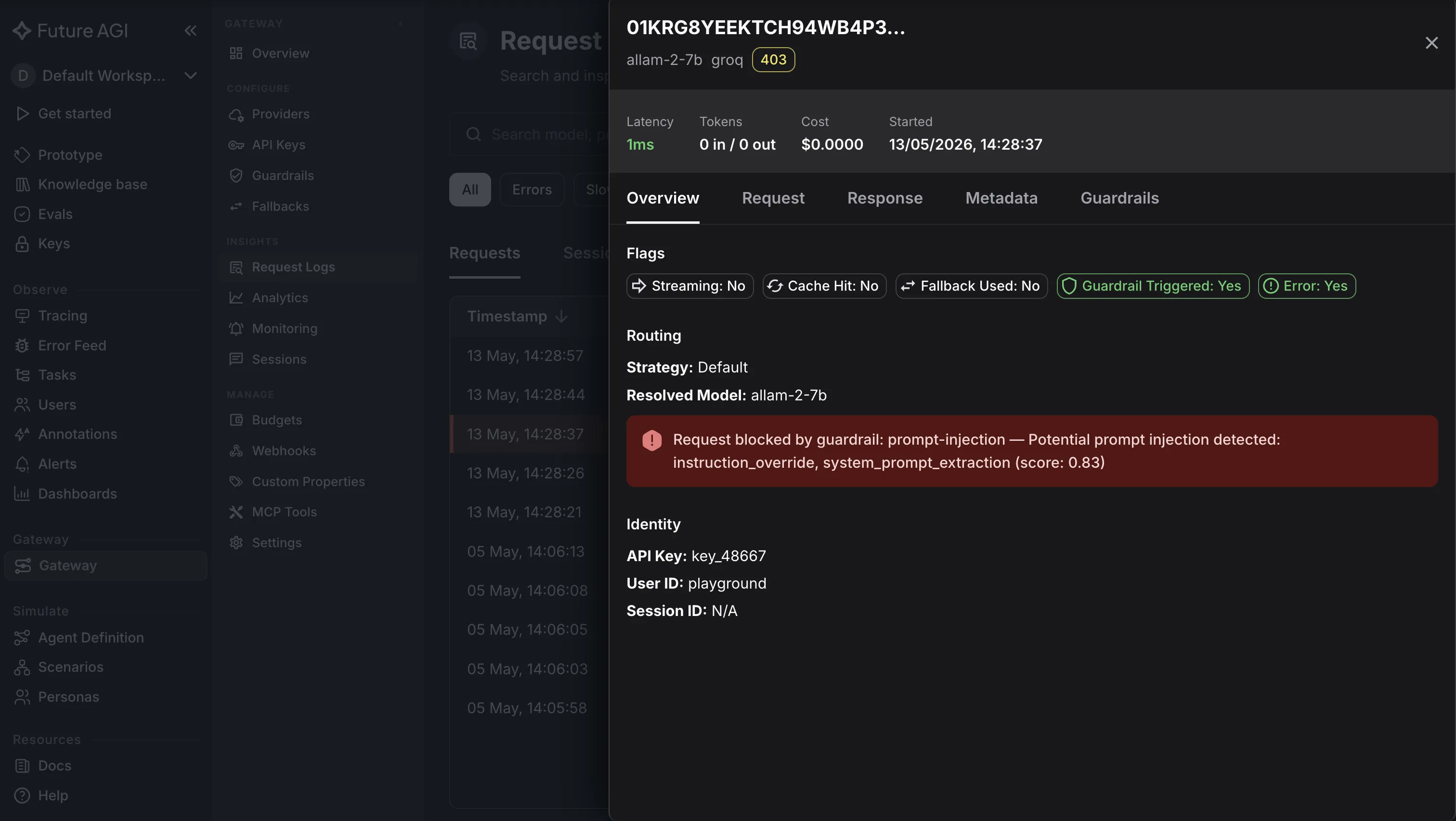
- Native gateway, not a separate hop. Protect runs inside the Agent Command Center gateway. The same control plane handles routing, provider keys, failover, caching, virtual keys, and budgets. Migrating from Aporia deletes one of two control planes.
- Eval and optimizer in the same product. Every captured trace is scored against task-completion, faithfulness, tool-use, and safety rubrics by default via
ai-evaluation(Apache 2.0). Failure clusters surface in the Command Center failure-mode view.agent-opt(Apache 2.0) rewrites prompts via six optimizers — ProTeGi, GEPA, Bayesian, MetaPrompt, RandomSearch, PromptWizard driven by those eval scores, and pushes updated versions back through the gateway. Aporia stops at “block the bad output.” FAGI uses the blocked output as a signal for the next rewrite.
- Hosted, self-host, and air-gapped. Hosted Command Center, self-host via Docker or Helm, or air-gapped deployment for regulated workloads. The OSS components (
traceAI,ai-evaluation,agent-opt) are Apache 2.0. - SDK breadth. Python, JS, Go, Java, plus an OpenAI-compatible REST endpoint. The OpenAI compatibility means migration from Aporia’s REST policy calls is mechanical.
Migration from Aporia: Aporia’s SDK wraps the model call with a policy check; the FAGI gateway exposes the same shape via the OpenAI-compatible endpoint with Protect enabled as a per-route policy. Existing policy definitions. PII redaction, prompt-injection blocking, custom expression rules, map directly to FAGI’s scanner configs. Custom policies written in Aporia’s DSL need a one-pass rewrite to FAGI’s policy config (YAML or UI). Timeline: five to eight engineering days for under 30 policies and under ten services.
Where it falls short:
-
The product surface is larger than Aporia’s. A team that only wants guardrails will see surfaces (eval, optimizer, gateway) they aren’t using on day one.
-
Custom-policy authoring uses YAML and Python, not Aporia’s policy DSL. DSL investments rewrite, not port.
Pricing: Free tier covering 100K traces/month including Protect on all of them. Scale tier from $99/month with linear per-trace scaling. Enterprise with SOC 2 Type II, BAA-eligible deployment, and AWS Marketplace procurement.
Score: 7 of 7 axes.
2. Portkey Guardrails plugin: Best for teams already on Portkey
Verdict: If your team already runs Portkey for routing and the only thing missing is a guardrails layer, the native Guardrails plugin is the path of least resistance. No new control plane, no new SDK. Policies attach to the same routes and virtual keys. The Palo Alto Networks acquisition of Portkey on April 30, 2026 creates SMB-SKU uncertainty, but for teams already invested in Portkey the plugin remains the lowest-friction option.
What it fixes versus Aporia:
- One control plane. Guardrails attach to existing Portkey routes. The policy decision happens inside the same proxy hop that handles routing and cost tracking.
- Built-in scanner set plus third-party adapters. Portkey’s Guardrails plugin covers PII, prompt injection, content moderation, language detection, and topic restriction natively. Lakera, Pangea, and Pillar adapters are first-class.
- Familiar policy authoring. The same JSON config shape used for routing. Teams that wrote Portkey routing configs in 2025 will write guardrails configs in the same idiom.
Migration from Aporia: Existing Aporia policies map to Portkey’s Guardrails config with a one-pass rewrite. The Python SDK wrapper gets removed; the policy decision moves to the proxy hop already in the request path. Custom policies in Aporia’s DSL need rewriting to Portkey’s config language. Timeline: three to five engineering days for under 30 policies.
Where it falls short:
- The Palo Alto Networks acquisition creates uncertainty about the SMB SKU, public position is “no change for 12 months,” but every prior security acquisition saw the standalone SKU narrow within 18 to 24 months.
- No native eval and no optimizer. Trace data feeds dashboards, not a self-improving loop.
- The guardrails scanner set is narrower than Future AGI’s, especially around MCP security, tool permissions, and webhook BYOG.
Pricing: Guardrails plugin included on Portkey Scale tier from $99/month. Add-on pricing for Lakera and Pangea adapters. Enterprise custom.
Score: 5 of 7 axes (missing: eval-loop wiring, optimizer, broader scanner set).
3. Kong AI Gateway: Best for enterprise platform teams
Verdict: Kong AI Gateway is the pick when the platform team already runs Kong and the path of least resistance is to extend that stack with AI-specific policies. Strengths: enterprise SLA, plugin ecosystem, decade-long track record as a Tier-1 API-gateway vendor. Weakness: guardrails are plugin-driven rather than native, and eval and optimizer surfaces live in upstream tools.
What it fixes versus Aporia:
- Enterprise SLA and procurement. Decade-old Tier-1 API-gateway vendor. The compliance posture (SOC 2, ISO 27001, HIPAA-eligible) clears procurement bars with familiar paper.
- Guardrails as plugins. AI Proxy plugin (Kong 3.6+) handles Anthropic and OpenAI passthrough; AI Prompt Guard, AI Prompt Decorator, and AI Semantic Cache plugins layer guardrails-style policies on top. Lakera and other third-party adapters extend the set.
- Self-host posture. Bare metal, VPC, hybrid. Konnect (managed) is optional. Cleanest answer for teams whose exit driver is hosted-only data plane.
Migration from Aporia: Aporia’s SDK wrapper gets replaced by the Kong AI Proxy plugin with AI Prompt Guard policies attached. PII, content moderation, and prompt-injection cases map directly; custom Aporia policies need rewriting to Kong’s plugin config or a custom plugin. Timeline: ten to fifteen engineering days because work spans platform (AI Proxy plugins, OTel sink, dashboards) and application (policy rewrite, service-by-service cutover) teams.
Where it falls short:
- Guardrails are plugin-driven, not native. Default dashboard is the API-gateway view, not the LLM-safety view.
- No optimizer, no native eval, no prompt registry.
- Two-week-plus setup means ROI shows up later than lighter alternatives, especially for teams without existing Kong investment.
Pricing: OSS. Konnect (managed) starts free. Enterprise plans from ~$1.5K/month.
Score: 4 of 7 axes (missing: eval-loop wiring, optimizer, native guardrails surface).
4. Lakera Guard: Best for prompt-injection research depth
Verdict: Lakera is the most established standalone guardrails brand in 2026. They run Gandalf (the long-running prompt-injection demo), publish the largest public red-team dataset on jailbreak attempts, and ship a focused Guard product. Pick this when the exit driver is “we need the best prompt-injection model and the research output behind it,” and you accept keeping guardrails as a separate primitive.
What it fixes versus Aporia:
- Largest red-team dataset and published research. Lakera’s research on jailbreak detection is the public benchmark. The detection model is updated weekly against new attack patterns sourced from Gandalf and enterprise red-team programs.
- Tighter focus on prompt injection. Aporia covers PII, moderation, and hallucination broadly; Lakera goes deeper on the class of attacks CISOs and regulators care most about.
- Stronger SDK polish. First-party Python and JS SDKs ship weekly. The dashboard is purpose-built for the prompt-injection signal.
Migration from Aporia: Aporia’s wrapper gets replaced by Lakera Guard’s SDK call (or REST endpoint) in the same position in the request path. Prompt-injection and content-moderation policies map directly. PII redaction maps with a config change. Custom Aporia policies outside Lakera’s scope (e.g., business-logic guards) need a separate solution. Timeline: five to seven engineering days plus follow-on for out-of-scope policies.
Where it falls short:
- Scope is narrower than Aporia’s. Teams who used Aporia’s broader scanner set (hallucination, custom expression rules, business-logic guards) will need a second tool alongside Lakera.
- No native gateway. Same two-control-plane problem.
- No eval, no optimizer.
- Pricing is enterprise-quoted; the self-serve tier is light.
Pricing: Free tier with limited requests/month. Pro and Enterprise custom. Also available as a third-party adapter inside Portkey, Kong, and Future AGI.
Score: 4 of 7 axes (missing: gateway integration, eval-loop wiring, optimizer).
5. agentgateway.dev: Best for self-hosted, OSS exit
Verdict: agentgateway.dev is the pick when the exit driver is “we want a source-available, self-hosted agent gateway with policy hooks and no hosted dependency at all.” It’s the most OSS-native option in this list. The trade-off is breadth: the policy library is thinner than Future AGI’s or Portkey’s, the dashboard is functional rather than polished, and the eval and optimizer surfaces don’t exist inside the product.
What it fixes versus Aporia:
- Self-host posture, fully OSS. The entire gateway runs in your VPC. The repo is public, the license is permissive, and there’s no telemetry leaving unless you wire an OTel sink yourself. For teams whose exit driver from Aporia is hosted-only data plane, this is the cleanest answer in the list alongside Kong.
- Agentic primitives at the gateway layer. Tool-use governance, MCP server routing, and per-agent policy hooks are first-class concepts rather than retrofitted. Teams running agentic workloads with multiple MCP servers and complex tool graphs will use these.
- No license cost. The compute and storage are the bill.
Migration from Aporia: Aporia’s policy wrapper gets replaced by agentgateway’s policy hooks. PII and content-moderation policies map via the built-in scanner set or by wiring an external scanner (Presidio for PII, Llama Guard for moderation) behind the gateway. Custom Aporia policies require writing a corresponding hook in agentgateway’s policy language. Timeline: seven to twelve engineering days, depending on how many custom policies need rewriting and how much in-house work the team accepts for OTel sink and dashboard setup.
Where it falls short:
- The policy library is thinner than Future AGI’s, Portkey’s, or Kong’s. Custom policies are the norm, not the exception.
- The bundled UI is functional rather than polished; teams used to Aporia’s hosted dashboard will feel the gap.
- No native eval and no optimizer.
- The project is younger; the ecosystem (Terraform providers, off-the-shelf dashboards, third-party adapters) is thinner than the larger projects in this list.
Pricing: Open source under a permissive license. Hosted offerings are emerging; enterprise support contracts available from contributors.
Score: 4 of 7 axes (missing: eval-loop wiring, optimizer, mature scanner library).
Capability matrix
| Axis | Future AGI | Portkey Guardrails | Kong AI Gateway | Lakera Guard | agentgateway.dev |
|---|---|---|---|---|---|
| Inline guardrail latency | ~65 ms text / 107 ms image (arXiv 2510.13351) | Inline at proxy hop | Plugin overhead | Sub-100 ms typical | Hook overhead |
| Eval-loop wiring | Native via ai-evaluation + agent-opt | None | None | None | None |
| Gateway integration | Native in Command Center | Native plugin | Native plugin in Kong | External | Native in gateway |
| Deployment posture | Hosted, self-host, air-gapped | Hosted (Palo Alto post-acq) | Self-host or Konnect | Hosted-only | Fully OSS self-host |
| SDK breadth | Python, JS, Go, Java, REST | Python, JS, REST | Plugin model | Python, JS, REST | REST + hooks |
| Community + research | Apache 2.0 OSS libraries, growing | Largest gateway community | Decade-old API community | Largest red-team dataset | OSS-native, smaller |
| Aporia migration tooling | Policy importer + adapter | Manual rewrite | Manual setup | Manual rewrite | Manual setup |
Migration notes: what breaks when leaving Aporia
Three surfaces always need attention.
Replacing the Python SDK wrapper
Aporia’s primary integration pattern is a Python wrapper around the model call. The SDK takes the prompt and the response, calls Aporia’s policy service over REST, and returns either the original response, a redacted one, or a block decision. Migration replaces that wrapper. Three options depending on the destination:
- Gateway-native (Future AGI, Portkey, Kong, agentgateway): delete the SDK wrapper, point the client
base_urlat the new gateway, attach guardrails as a per-route policy. The policy decision moves from in-process to the proxy hop. Same end-to-end semantics; one fewer SDK in the request path. - Standalone SDK (Lakera, agentgateway with external scanner): replace the Aporia SDK call with the destination SDK call in the same position. The wrapper shape is similar; the policy library and the response format differ.
The most common pattern: gateway-native replacement, because the team is usually also replacing Aporia’s missing gateway primitives at the same time.
Rewriting custom policies
Aporia supports custom policies authored in its policy DSL. These are the stickiest part of the migration. The mechanical cases. PII redaction, profanity filters, domain blocklists, port to any destination because they’re config-shaped. The non-mechanical cases, business-logic guards, multi-turn context-aware policies, and policies that call out to an internal service for an entitlement check, need rewriting in the destination’s policy language (FAGI YAML and Python, Portkey JSON, Kong plugin code, agentgateway hooks).
For a team with under 20 custom policies, expect three to five days of policy rewrite plus a separate sprint for behavioral testing, replay a captured set of requests through the old policy and the new one, diff the decisions, fix the gaps.
REST policy-call cleanup
Teams that integrated Aporia via the REST API directly (rather than the SDK) wrote bespoke shims in their service code. The shim usually does three things: format the request body to Aporia’s schema, call the policy endpoint, and interpret the response. Migration deletes all three. For gateway-native destinations, the shim disappears entirely, the policy decision happens inside the gateway. For standalone SDK destinations, the shim shrinks but doesn’t vanish, because the request body, endpoint, and response format all change.
Decision framework: Choose X if
Choose Future AGI if your reason for leaving Aporia is more than guardrails alone, you also want the eval and optimizer surfaces wired to the same trace data, and you want one gateway handling routing, guardrails, virtual keys, and budgets together. Pick this when production agent workloads are becoming a real line item and the OSS instrumentation (traceAI, ai-evaluation, agent-opt, all Apache 2.0) plus the hosted Command Center together justify consolidating onto one control plane. Pick this also when the Aporia exit driver is hosted-only deployment. FAGI supports hosted, self-host, and air-gapped.
Choose Portkey Guardrails plugin if you already run Portkey for routing and the only thing missing is the policy layer. Pick this when one control plane beats two and you accept the Palo Alto Networks acquisition uncertainty for the next 12 to 24 months.
Choose Kong AI Gateway if your platform team already runs Kong and the path of least resistance is to extend the existing stack with AI-specific plugins. Pick this when SLA, plugin ecosystem, and operational familiarity outweigh AI-specific shallowness in the default dashboard.
Choose Lakera Guard if your exit driver is “we want the best prompt-injection detection and the research output behind it” and you accept guardrails staying as a separate primitive next to your gateway. Pick this when the use case is heavily skewed toward prompt injection and jailbreak detection rather than broader guardrails surface.
Choose agentgateway.dev if the requirement is “this runs entirely on our hardware with source we can audit and no hosted dependency.” Pick this when self-host posture and OSS purity beat hosted polish, and you have engineering capacity for policy authoring and dashboard setup.
What we did not include
Three products show up in other 2026 Aporia alternatives listicles that we left out:
- NeMo Guardrails. NVIDIA’s OSS guardrails framework is a credible alternative for teams who want a Python-native, programmable guardrails layer. We excluded it because the framing is “library you call from your code,” not “policy layer in a gateway.” For teams replacing Aporia, the gateway-native pattern is usually closer to what they want.
- Protect AI (now part of Palo Alto Networks after their acquisition), strong on model-supply-chain scanning and on the LLM Guard OSS project, but the runtime guardrails surface is narrower than the gateway-integrated options here.
- Pillar Security. Capable, growing fast, but the SDK and dashboard surface area is still maturing in 2026; worth a second look in Q3.
Related reading
- Best 5 Portkey Alternatives in 2026
- Best 5 Lakera Guard Alternatives in 2026
- Best LLM Gateways in 2026
- What Is an AI Gateway? The 2026 Definition
- Best AI Gateways for Agentic AI in 2026
Sources
- Coralogix acquisition of Aporia, late 2024, coralogix.com/blog
- Aporia documentation, guardrails.aporia.com/docs
- Aporia GitHub organization, github.com/aporia-ai
- Reddit /r/LLMDevs guardrails platform discussions, 2025 to 2026
- Portkey Guardrails documentation, portkey.ai/docs/product/guardrails
- Palo Alto Networks press release on Portkey acquisition, April 30, 2026, paloaltonetworks.com/company/press
- Kong AI Gateway product page, konghq.com/products/kong-ai-gateway
- Lakera Guard product page, lakera.ai/lakera-guard
- Lakera Gandalf research, gandalf.lakera.ai
- agentgateway.dev project page, agentgateway.dev
- Future AGI Agent Command Center, futureagi.com/platform/monitor/command-center
- Future AGI traceAI, github.com/future-agi/traceAI (Apache 2.0)
- Future AGI ai-evaluation, github.com/future-agi/ai-evaluation (Apache 2.0)
- Future AGI agent-opt, github.com/future-agi/agent-opt (Apache 2.0)
- Future AGI Protect latency benchmark, arxiv.org/abs/2510.13351 (median 65 ms text, 107 ms image)
Frequently Asked Questions
Why are people moving off Aporia in 2026?
What is the closest like-for-like alternative to Aporia?
How do I migrate from Aporia's Python SDK?
How do I migrate custom Aporia policies?
Is there an open-source Aporia alternative?
Which Aporia alternative is cheapest?
How does Future AGI Agent Command Center compare to Aporia?
Does Coralogix still ship Aporia as a standalone product?
Five Lakera Guard alternatives scored on inline guardrail latency, native gateway and eval surfaces, self-host posture, sub-enterprise pricing.


Senior-engineer comparison of the best AI agent guardrails platforms 2026: latency budgets, placement, deployment topology, vendor fit.

Five Guardrails AI alternatives on inline runtime latency, native gateway, eval, multi-language. What each actually fixes beyond Python-only validation.