Best 5 AI Gateways for Token Budgeting in 2026
Five AI gateways scored on token budgeting 2026: per-feature allocation, monthly burndown, 75/90/100 alerts, soft vs hard stop, cross-team.
Table of Contents
A FinOps lead at a Series B SaaS company opened a ticket in April 2026 with a question her CFO had asked the week before: “How many tokens will the support copilot use in May, and is that within budget?” She didn’t get an answer. The team had three providers, four virtual keys, and the only forecast anyone could produce was a linear extrapolation off last month’s invoice, which had blown past plan by 38 percent because a new RAG pipeline shipped on March 20.
This is the token-budgeting problem. It isn’t cost optimization (lowering unit cost) and not rate limiting (clamping concurrency). Token budgeting is about predictability: how many input plus output tokens will this feature, team, or product consume in the next 30 days, and what happens at 75, 90, and 100 percent of allocation.
The Anthropic and OpenAI dashboards aren’t built for this. They show dollars retroactively, group by API key, and leave the rest of the FinOps motion to the buyer. An AI gateway in front of the providers fixes the gap. It allocates tokens per feature, projects burn-down curves, fires threshold alerts, and decides whether the hundred-percent line is a soft warning or a hard 429.
This is the 2026 cohort, scored on the seven axes that matter when token budgeting (not dollar caps, not throughput limits) is the brief.
TL;DR
Future AGI Agent Command Center is the strongest pick for an AI gateway for token budgeting because it ships per-key, per-tenant, per-user, per-feature budget thresholds, provider-tier-aware limits for Anthropic tier 1-4 RPM and OpenAI organization-level RPM/TPM, weighted fair-share scheduling, OpenTelemetry-native budget-event export, and automatic budget-aware routing that downgrades over the cap rather than failing hard. The other four picks below win on specific edges.
- Future AGI Agent Command Center — Best overall. Per-key + per-tenant + per-user + per-feature budgets, provider-tier awareness, weighted fair-share, OTel-native events, and budget-aware downgrade routing.
- Portkey — Best for the deepest 4-tier budget hierarchy (org → workspace → key → tag). Managed dashboards out of the box (verify the Palo Alto Networks acquisition timeline before signing multi-year).
- Helicone — Best for the simplest drop-in proxy when you only need 75/90/100 alerts, not enforcement. Lightweight per-request observability (treat as planned migration after the March 3, 2026 Mintlify acquisition).
- LiteLLM — Best when the workload cannot leave the VPC and the platform is Python. Self-hosted Python-native with per-team token quotas; pin commits after the March 24, 2026 PyPI compromise.
- Maxim Bifrost — Best when the gateway hop must add microseconds, not milliseconds. Apache 2.0 single Go binary with native token-budget primitives.
Why token budgeting is not cost optimization
A cost-optimization gateway lowers the price per million tokens. It routes the easy turn to claude-haiku-4-5 instead of claude-opus-4-7, caches a near-duplicate prompt, and shaves unit economics. The output is a lower bill at month-end for the same workload.
A token-budgeting gateway answers a different question. It tells you on May 1 that the support copilot was allocated 420M tokens for the month, and on May 17 that 248M have been spent, 59 percent of allocation at 55 percent of month elapsed, projecting 451M by month-end, 7 percent over. That projection lets FinOps approve a budget revision, ask product to dial back, or tighten the system prompt before the overshoot becomes the invoice.
Cost optimization is about the unit; token budgeting is about the envelope. A team can have perfect cost optimization and still blow the monthly budget because volume tripled. A team can have a textbook budget hierarchy and still pay too much per token because routing is naive. For the unit-cost side of the picture, see the companion guide on LLM cost tracking best practices.
For the rest of this post, “token budgeting” means per-feature, per-team, or per-virtual-key allocations of input plus output tokens, with rolling-window forecasting and threshold alerts at 75, 90, and 100 percent. Dollar caps are out of scope, the five picks all do those, but the 2026 FinOps story has moved to tokens because tokens are what providers price on and what agent loops produce.
The 7 axes we score on
Generic gateway axes (provider breadth, routing, fallback, observability) are too broad for this evaluation. We scored each pick on seven axes specific to a token-budgeting motion.
| Axis | What it measures |
|---|---|
| 1. Per-feature token allocation | Can the gateway issue a monthly token budget per product, feature, or endpoint — not just per API key? |
| 2. Burn-down forecasting | Does the dashboard show a projected month-end consumption with confidence bands, not just current spend? |
| 3. Threshold alerts (75/90/100) | Can you wire alerts at configurable percent thresholds and route them to Slack, PagerDuty, or webhook? |
| 4. Soft-stop vs hard-stop policy | Does the gateway distinguish “alert and continue” from “return 429 at 100 percent”? Is the policy per-tier? |
| 5. Cross-team allocation rules | Can a parent budget cascade down to child budgets with reservations, overdraft pools, and overflow routing? |
| 6. Auto-rebalance on under-utilization | If team A is at 30 percent at month-mid and team B at 95 percent, can the gateway shift the unused allocation? |
| 7. Loop back into routing | Does hitting 90 percent change the next request’s routing — e.g., demote to a cheaper model for the last 10 percent? |
Verdict line at the end of each pick scores all seven.
How we picked
We started from the universe of AI gateways publicly advertising per-tenant token budgets as of May 2026. We removed gateways whose only budget primitive is a daily dollar cap (which excluded two projects whose budgeting story is still rate-limit-shaped) and gateways that don’t pass token counts back to the caller. The remaining five are below.
1. Future AGI Agent Command Center: Best for closing the budget loop
Verdict: Future AGI is the only gateway in this list that treats the burn-down curve as a routing input, not a dashboard output. At 90 percent, the next request for the same product gets demoted to the cheaper model in the routing pool, buying the team a fortnight of breathing room without a human in the loop.
What it does for token budgeting:
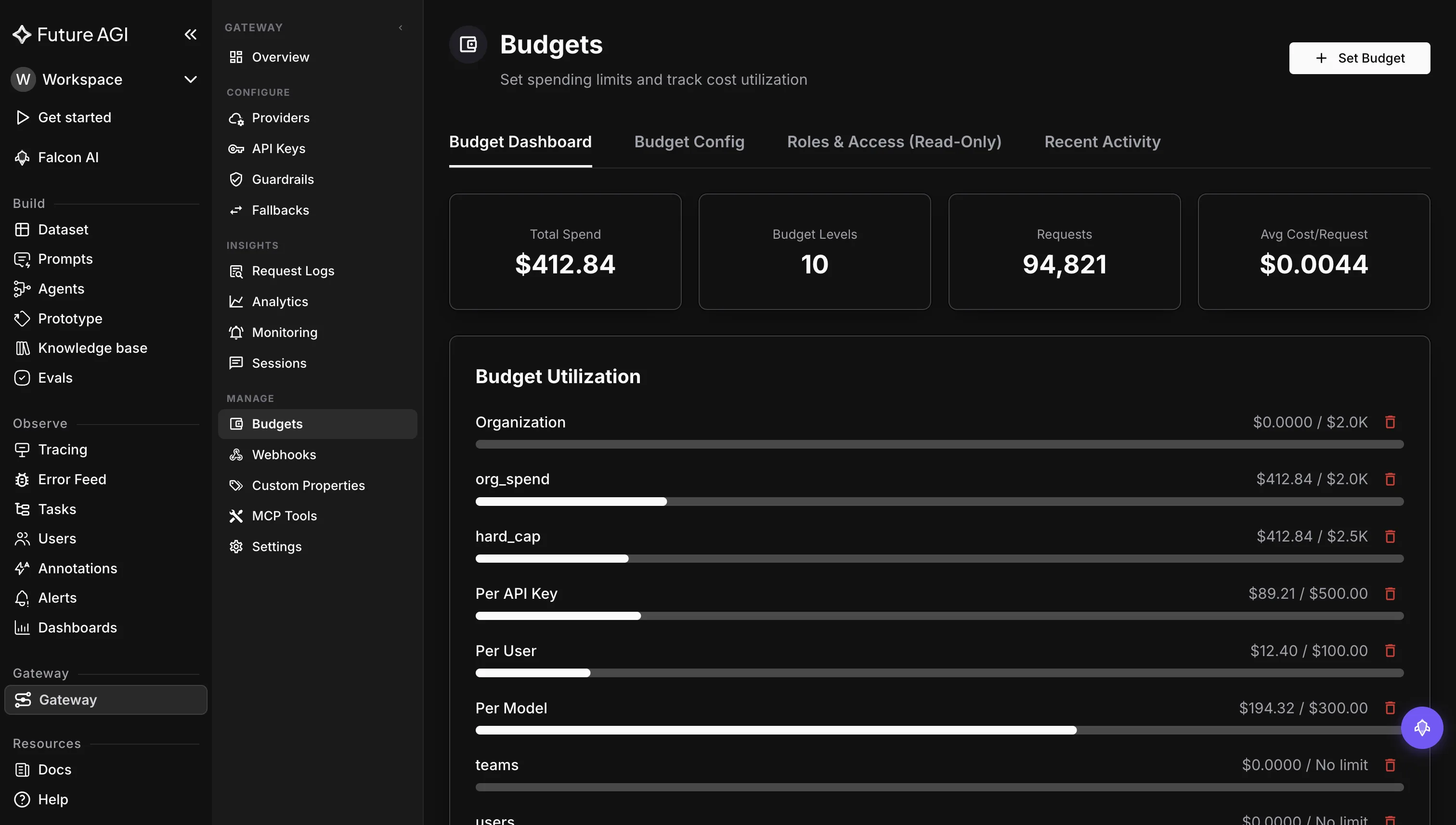
- Per-feature token allocation through the budget primitive on the virtual key. Each VK carries a monthly input-token budget, a monthly output-token budget, and a rolling-window cap (e.g., 50M tokens per 7 days). Tags on the VK propagate to span attributes, so a single VK can serve multiple features with per-tag sub-budgets.
- Burn-down forecasting in the Agent Command Center dashboard using a 7-day rolling average with weekday-weighted decay. The forecast reads from the same trace pipeline that powers Protect’s published arXiv benchmarks (~65 ms text, ~107 ms image), so the projection is built on the spans the gateway already emits.
- Threshold alerts at configurable percentages (default 75/90/100), routed to Slack, PagerDuty, webhook, or email. Alerts carry the projected month-end consumption, not the current percentage alone.
- Soft-stop vs hard-stop is explicit on the VK. The 100-percent line can be
alert_only,degrade_route(next request routes to the cheaper model), orhard_stop(returns 429 with a Retry-After header at the next budget reset). Policy differs per VK in the same workspace. - Cross-team allocation through a parent-child budget tree. Workspace-level cascades to feature-level; each child can opt into the parent overflow pool or run isolated. Reservations are first-class: a team can reserve 60M tokens for the last week of the month.
- Auto-rebalance through the under-utilization rule. If a child consumes less than 50 percent at month-mid, the unused half flows into a shared pool that overdrawn siblings can draw from, capped per tenant.
- Loop back into routing. The 90-percent line triggers an automatic policy change for the affected tag: cheaper model, tighter cache TTL, and a system-prompt swap to the “concise” variant if registered.
The loop. Every captured trace gets scored by ai-evaluation (Apache 2.0). FAGI ships a 60+ EvalTemplate classes in the ai-evaluation SDK with self-improving evaluators on the Future AGI Platform (faithfulness, task completion, helpfulness, tool-use, structured-output, hallucination, groundedness, instruction-following, agentic surfaces), plus unlimited custom evaluators authored end-to-end by an in-product eval-authoring agent that uses tool calling on your code, plus self-improving evaluators that learn from live production traces (the rubric sharpens as budget-managed traffic flows), plus FAGI’s proprietary classifier model family that runs continuous high-volume scoring at very low cost-per-token (lower per-eval cost than Galileo Luna-2). Budget data sits in the same span tree as eval scores, so the optimizer can see both “this team is at 92 percent” and “quality has held flat under the demoted route for 800 turns” and decide whether to keep the demotion or revert. Three building blocks are open source: traceAI (50+ AI surfaces across Python, TypeScript, Java, and C# (including Spring Boot starter, Spring AI, LangChain4j, Semantic Kernel) OpenInference-native), ai-evaluation, and agent-opt (all Apache 2.0). The hosted Agent Command Center adds the budget-tree UI, the forecast, the alert router, and the routing-policy editor. Error Feed (the part of the eval stack, the clustering and what-to-fix layer that feeds the self-improving evaluators) sits alongside as the zero-config error monitor: auto-clusters related budget-burn and quality-regression failures (50 traces → 1 issue), auto-writes the root cause plus a quick fix plus a long-term recommendation, and tracks rising/steady/falling trend per issue so demotion-driven regressions surface like exceptions rather than buried in burn-down charts. Inline policy is enforced by the Future AGI Protect model family. FAGI’s own fine-tuned Gemma 3n adapters across content moderation, bias detection, security/prompt-injection, and data privacy/PII at ~65 ms p50 text and ~107 ms p50 image, multi-modal and reusable as offline eval metrics, a model family, not a plugin chain. Catalog is the floor, not the ceiling.
Where it falls short:
- Auto-rebalance is opt-in and requires the parent budget to be tagged with an overflow-pool flag. Out of the box, child budgets are isolated.
- The forecast assumes the workload is roughly stationary week-over-week. Event-driven workloads (marketing-launch spikes) need a manually widened window or the projection lags by a few days.
Pricing: Free tier with 100K traces per month. Scale tier starts at $99 per month. Enterprise is custom with SOC 2 Type II and a BAA. AWS Marketplace listing.
Score: 7/7 axes.
2. Portkey: Best for hosted 4-tier budget hierarchy
Verdict: Portkey ships the most polished native budget-tree UI in this list. The 4-tier hierarchy (organization → workspace → virtual key → tag) is what most multi-tenant SaaS teams want when the brief is “we need a budget tree next sprint.” The observability layer is dashboard-first; the forecast is rear-view rather than predictive; the loop back into routing is left to the operator. Portkey was acquired by Palo Alto Networks on April 30, 2026; close is expected in PANW fiscal Q4 2026 and the gateway is being integrated into Prisma AIRS.
What it does for token budgeting:
- Per-feature token allocation through virtual keys with token budgets and tag-level overrides. The 4-tier hierarchy cascades workspace-level budgets to VK-level with override semantics per tier.
- Burn-down forecasting via the native dashboard, projected as a linear extrapolation from a rolling 14-day window. Less expressive than Future AGI’s weekday-weighted model, but zero-config.
- Threshold alerts at 50/75/90/100 percent (configurable via API), routed to Slack, webhook, or email. Alerts carry the percentage and absolute remaining budget.
- Soft-stop vs hard-stop through the enforcement policy. Hard-stop returns 429; soft-stop is
alert_only. The middle ground (route demotion) isn’t a built-in policy, operators wire it via conditional-routing in two steps. - Cross-team allocation through parent-child cascade. Reservations aren’t native; teams use scheduled budget updates via the API.
- Auto-rebalance isn’t in the product as of May 2026.
- Loop back into routing isn’t native. Conditional-routing supports it, but the operator writes the rule.
Where it falls short:
- No auto-rebalance and no native route-demotion at the 90-percent line. The gateway tracks and alerts; the operator does the FinOps work.
- The Palo Alto Networks acquisition introduces roadmap risk on the standalone product. The engineering claims are solid, but the procurement story has changed.
- Dashboard-first observability means OpenTelemetry-first stacks duplicate cost telemetry: once in Portkey, once in their own collector.
Pricing: Free tier with 10K requests per day. Production tier starts at $99 per month. Enterprise with SOC 2 Type II.
Score: 5/7 axes (missing: auto-rebalance, native route-demotion loop).
3. Helicone: Best for lightweight token observability
Verdict: Helicone is the right pick when the brief is “show me the burn-down curve and alert at 90 percent” and the team isn’t ready for the budget-tree machinery. Drop the proxy URL in front of the providers, attach Helicone-Property-* headers, and the dashboard shows the curve. The product was acquired by Mintlify on March 3, 2026; the public roadmap has shifted toward documentation-platform-first, so existing Helicone users should treat it as a planned migration window.
What it does for token budgeting:
- Per-feature token allocation through custom-property tagging plus the rate-limit policy. Rate limits can be expressed in token units (e.g., 5M tokens per day per
Helicone-Property-Feature=support). - Burn-down forecasting is minimal. The dashboard shows historical curves; a forecast line is on the roadmap. Most teams wire projections in their own Grafana off the API or Postgres backend.
- Threshold alerts at configurable percentages through the alerts module. Slack and email are first-class; webhook supported.
- Soft-stop vs hard-stop through rate-limit policy. Hard-stop returns 429; soft-stop is alerting only. No degrade-route gradient.
- Cross-team allocation is flat. Properties are tags, not a tree; multi-product orgs run one deployment per product or wire the tree in their own database.
- Auto-rebalance isn’t in the product.
- Loop back into routing isn’t native. Routing is basic (round-robin, failover); the budget signal doesn’t feed back.
Where it falls short:
- The Mintlify acquisition changes the procurement story. Plan a migration evaluation in Q3 2026.
- No tree-shaped budget hierarchy. Multi-product orgs end up with a flat tag table and a SQL query for cross-tag aggregations.
- No native forecast. The dashboard tells you where you’re, not where you’re going.
Pricing: Free tier with 10K requests per month. Pro tier starts at $25 per month.
Score: 4/7 axes (missing: forecast, tree allocation, auto-rebalance, routing loop).
4. LiteLLM: Best for self-hosted Python-native token quotas
Verdict: LiteLLM is the pick when the workload can’t leave the VPC and the platform team writes Python. The token-budget story is real (per-key and per-team token caps with rolling windows) and the source is auditable. The trade-off is polish: the dashboard is functional rather than finance-grade, and the forecast is a SQL query, not a built-in chart. After the March 24, 2026 PyPI supply-chain incident on versions 1.82.7 and 1.82.8, the deployment posture is “pin commits or upgrade past 1.83.7 and audit the dependency tree.”
What it does for token budgeting:
- Per-feature token allocation through
team_idanduser_idbudget primitives. Each VK carries a monthly token cap and a rolling-window cap (e.g., 1M tokens per day). Body tags propagate to the spend log so feature-level slicing is a join. - Burn-down forecasting is BYO. The spend table lives in Postgres or your warehouse; the projection is a SQL query in your BI tool.
- Threshold alerts at configurable percentages via the alerting hook. Webhook is primary; teams wire PagerDuty or Slack downstream.
- Soft-stop vs hard-stop through
tpm_limit/rpm_limitplus budget-exceeded behavior. Default 100-percent is hard 429; soft-stop isalert_onlyper VK. - Cross-team allocation through the team hierarchy. Each key inherits the team budget with override semantics. Reservations require scheduled updates via the admin API.
- Auto-rebalance isn’t in the product.
- Loop back into routing isn’t native. You can wire a router that checks remaining budget, but you write the check.
Where it falls short:
- The dashboard is admin-grade, not FinOps-grade. Finance leads who expect a polished burn-down chart end up writing one in Looker or Metabase.
- The March 2026 supply-chain incident shifts deployment posture to “pin commits and audit.” Budget platform-team time for ongoing dependency hygiene.
- Python runtime is materially slower than Go-binary alternatives at high concurrency.
Pricing: Open source under MIT (the enterprise dir is licensed separately). Enterprise tier from ~$250 per month for small teams.
Score: 5/7 axes (missing: native forecast, auto-rebalance, routing loop).
5. Maxim Bifrost: Best for Go-binary token budgeting at throughput
Verdict: Maxim Bifrost is the Apache 2.0 Go-binary gateway from Maxim. Token-budgeting primitives are native (per-key, per-VK, per-model, per-window), and the vendor-published benchmark shows ~11 µs mean gateway overhead at 5,000 RPS on t3.xlarge. For teams whose binding constraint is “we can’t add 50 ms to every request just to enforce a budget,” Bifrost leads on that axis. Cost-attribution dashboards are thinner than Portkey’s; forecast is BYO.
What it does for token budgeting:
- Per-feature token allocation through the budget object on the VK. Each VK carries input-token, output-token, and combined limits with rolling windows.
- Burn-down forecasting is BYO. Bifrost emits OpenTelemetry traces with token attribution; teams pipe the collector into Grafana.
- Threshold alerts at configurable percentages via webhook-on-threshold. Slack and PagerDuty downstream.
- Soft-stop vs hard-stop through the enforcement mode. Hard-stop returns 429; soft-stop is alert-only.
- Cross-team allocation through the team primitive. Hierarchical budgets cascade; reservations aren’t native.
- Auto-rebalance isn’t in the product.
- Loop back into routing isn’t native. “Code Mode” reduces MCP tool-call input tokens but is a token-shape optimization, not a budget-driven routing change.
Where it falls short:
- Maxim self-ranks Bifrost at #1 across its own gateway listicles with no published limitations, a trust signal worth weighing alongside the engineering claims.
- Cost-attribution dashboard is thinner than Portkey’s; finance-grade views are wired in Grafana.
- Throughput claims are vendor-published; independent reproduction is light. Treat the 11 µs number as a baseline.
Pricing: Apache 2.0; Docker, Helm; commercial cloud tier via Maxim.
Score: 5/7 axes (missing: native forecast, auto-rebalance, routing loop).
Capability matrix
| Axis | Future AGI | Portkey | Helicone | LiteLLM | Bifrost |
|---|---|---|---|---|---|
| Per-feature token allocation | Native (tag-level) | Native (4-tier) | Property + rate-limit | Team + user | Native (per-VK) |
| Burn-down forecasting | Built-in (weekday-weighted) | Built-in (linear) | BYO | BYO | BYO |
| Threshold alerts (75/90/100) | Configurable, with projection | Configurable, % only | Configurable | Webhook | Webhook |
| Soft-stop vs hard-stop | 3 modes (alert / degrade-route / hard) | 2 modes (alert / hard) | 2 modes | 2 modes | 2 modes |
| Cross-team allocation tree | Cascading with overflow pool | Cascading, no overflow | Flat tags | Hierarchical | Hierarchical |
| Auto-rebalance | Yes (opt-in) | No | No | No | No |
| Loop back into routing | Yes (at 90% line) | Wire it yourself | No | No | No |
Decision framework: Choose X if
Choose Future AGI if the FinOps motion is mature enough that token budgets should drive routing, not trigger alerts alone. Pick this when the team has been burned by overshoots nobody acted on in time, and the answer is to wire the gateway to demote routes automatically at 90 percent. Auto-rebalance and the overflow pool become load-bearing once more than three teams share a parent allocation.
Choose Portkey if you want the cleanest hosted 4-tier hierarchy and a manual rebalancing motion is acceptable. Pick this when the brief is “we need the tree, dashboard, and alerts working next sprint” and the team can absorb the Palo Alto Networks acquisition risk over the next twelve months.
Choose Helicone if you want the lightest possible drop-in for token observability and the budget tree is a Q3 problem. Pick this for teams under 10 engineers. Plan a migration evaluation given the Mintlify acquisition.
Choose LiteLLM if the workload can’t leave the VPC and the platform team writes Python. Budget for ongoing dependency hygiene after the March 2026 incident. Pair with Future AGI traceAI or another OTel sink for the forecast chart you don’t want to build yourself.
Choose Maxim Bifrost if the gateway hop must add microseconds and the team is happy drawing the burn-down chart in Grafana. Pick this when engineering is Go-first and cost-attribution lives in the platform’s existing observability stack.
What goes wrong when token budgeting is wired badly
| Mistake | What goes wrong | Fix |
|---|---|---|
| One budget per API key, no tag-level slicing | The key serves three features; FinOps cannot answer “which feature blew the budget” | Issue VKs per feature, or attach feature tags and aggregate by tag |
| Alerts only at 100 percent | The page fires after the overshoot; the budget is gone | Wire 75/90/100 alerts with projected month-end in the payload |
| Every budget defaults to hard-stop | A misconfigured budget on a critical path returns 429 mid-conversation | Default to degrade_route for customer-facing; hard-stop only for internal experimentation |
| Linear extrapolation off month-to-date | Weekday-weighted workloads over-project Mondays, under-project Sundays | Use weekday-weighted decay or at minimum a 14-day rolling window |
| Tracking dollars instead of tokens | Provider price changes (Anthropic moved Claude 4.7 pricing in March 2026) move the dollar line | Budget in tokens, track dollars as a derived view |
| Parent budget treated as sum of children | Parent is overdrawn while children are under-utilized | Wire an overflow pool with a per-tenant cap |
| Routing changes lag the burn-down | Team crosses 90 percent on the 22nd; routing changes at next sprint planning | Wire route-demotion at 90 percent as a gateway policy |
How Future AGI closes the loop on token budgeting
The other four gateways treat the burn-down curve as a dashboard. Future AGI treats it as a routing input. The loop has six stages:
-
Allocate. Each VK carries an input-token budget, an output-token budget, and a rolling-window cap. Tags propagate to span attributes so feature-level slicing is a primary key. Workspace-level budgets cascade down with override semantics per tier.
-
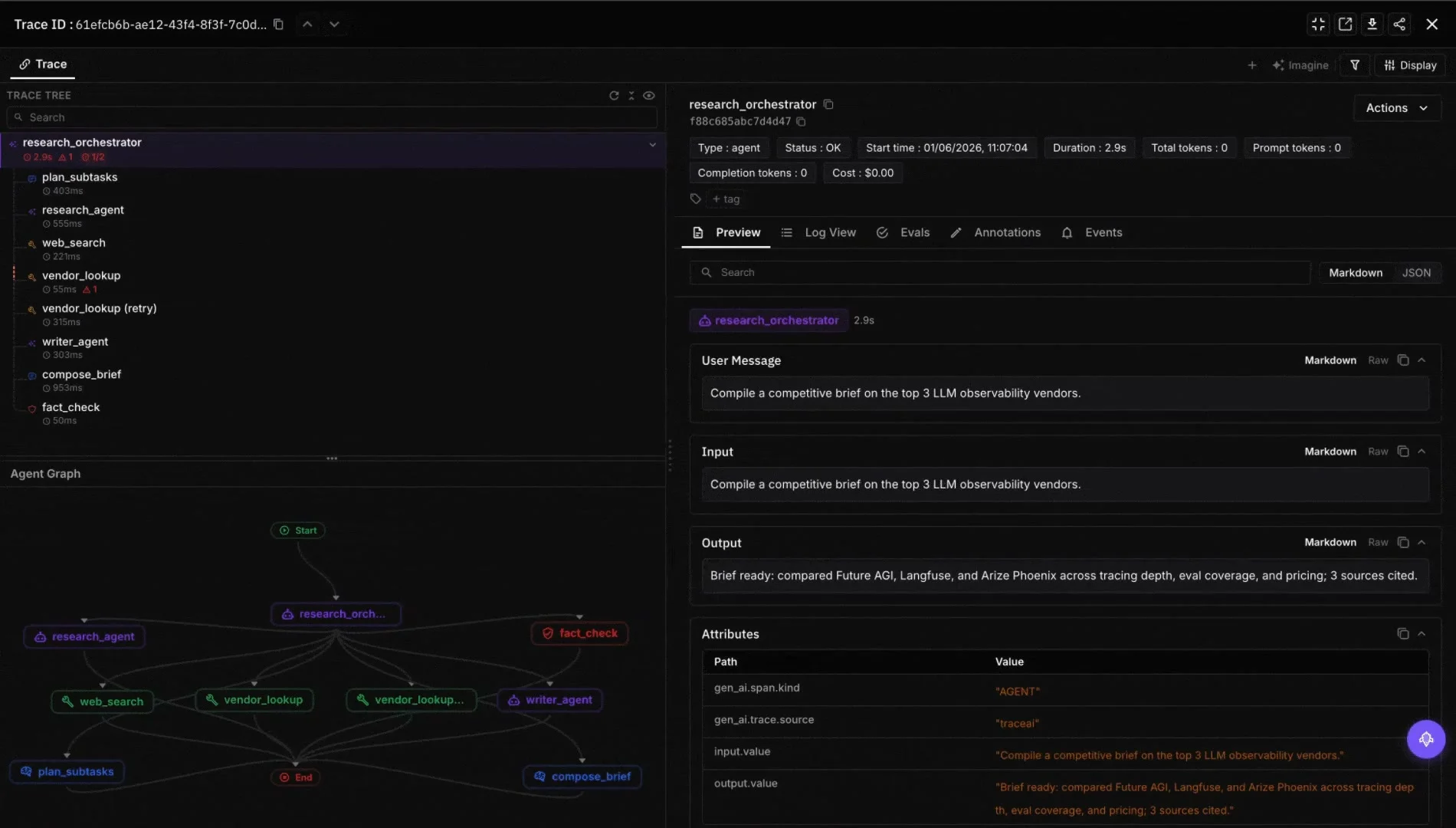
Trace. Every request produces a span via
traceAI(Apache 2.0). Spans carry input tokens, output tokens, cache hit/miss, model, latency, and cost. The same spans the gateway reads to enforce the budget power the forecast.
-
Forecast. A 14-day weekday-weighted rolling average projects month-end with a confidence band. Updates every six hours; event-driven workloads widen the window manually.
-
Alert. Configurable thresholds (default 75/90/100 percent) fire on Slack, PagerDuty, webhook, or email. The payload carries projected month-end, trend versus the last seven days, and a recommended action.
-
Demote. At the 90-percent line, the routing policy auto-rotates the affected tag to the cheaper model in the pool. Opt-in per VK; recommended default is
degrade_routefor customer-facing features. Protect (~65 ms text, ~107 ms image per the arXiv benchmark) runs regardless of which model the route lands on, so safety properties hold. -
Rebalance. At month-mid, child budgets under 50 percent contribute their unused half to a parent overflow pool. Overdrawn siblings draw from it up to a per-tenant cap. The rebalance runs in
agent-opt(Apache 2.0).
Net effect: a team starting with a 100M token allocation, seeing a 120M projection on the 12th and 118M actual on the 31st with no intervention, instead lands at 99M under budget. Because the 90-percent demotion fired on the 18th and the overflow rebalance covered the gap. The dashboard tells you what happened; the loop is what made it happen without a human in the path.
Building blocks are open source: traceAI, ai-evaluation, and agent-opt (all Apache 2.0). The hosted Agent Command Center adds the budget-tree UI, the weekday-weighted forecast, the alert router with projection-in-payload, the per-VK soft/hard policy editor, and the self-improving loop that learns whether last month’s demotions held quality or regressed it.
What we did not include
We deliberately left out three gateways that show up in adjacent listicles:
- OpenRouter. Strong directory of models and transparent per-token markup, but no native token-budget primitive at the gateway layer. Budget enforcement is provider-side.
- Kong AI Gateway. Solid API-gateway-grade foundation, but the AI-specific token-budget story is still plugin-driven. Out of the box, the budget primitive is request-rate, not token-allocation.
- Cloudflare AI Gateway. Promising primitives but the per-feature token allocation story is thin as of May 2026; the worker-based observability doesn’t yet do tree-shaped budgets without custom code.
If your situation is different, all three are worth a second look in Q3 2026.
Related reading
- Best 5 AI Gateways for LLM Cost Optimization in 2026
- Best 5 AI Gateways to Monitor Claude Code Token Usage in 2026
- What Is an AI Gateway? The 2026 Definition
- Best LLM Gateways in 2026
Sources
- Future AGI Agent Command Center, futureagi.com/platform/monitor/command-center
- Future AGI Protect latency benchmarks, arxiv.org/abs/2510.13351 (65 ms text, 107 ms image)
- Future AGI traceAI, github.com/future-agi/traceAI (Apache 2.0)
- Future AGI ai-evaluation, github.com/future-agi/ai-evaluation (Apache 2.0)
- Future AGI agent-opt, github.com/future-agi/agent-opt (Apache 2.0)
- Portkey acquisition by Palo Alto Networks, paloaltonetworks.com/company/press/2026/palo-alto-networks-to-acquire-portkey-to-secure-the-rise-of-ai-agents (April 30, 2026)
- Helicone acquisition by Mintlify, mintlify.com (March 3, 2026)
- LiteLLM PyPI supply-chain incident, securitylabs.datadoghq.com/articles/litellm-compromised-pypi-teampcp-supply-chain-campaign (March 24, 2026)
- Maxim Bifrost benchmark, getmaxim.ai/bifrost/resources/benchmarks (~11 µs mean overhead at 5,000 RPS on t3.xlarge)
Frequently Asked Questions
What is the difference between token budgeting and rate limiting?
Why budget in tokens and not dollars?
How do I set the soft-stop versus hard-stop policy?
What does cross-team allocation look like in practice?
How accurate is the burn-down forecast?
Can I use the same gateway for token budgeting and cost optimization?
How is Future AGI different from Portkey for token budgeting?
LLM cost tracking 2026: token-level attribution, per-user spend caps, reasoning vs cache, gateway aggregation, drift. Practices that actually scale.


Future AGI, Helicone, Langfuse, OpenRouter, Portkey, LangSmith, Datadog, and CloudZero compared on per-trace, per-developer LLM cost attribution.


Eight levers to cut LLMOps spend in 2026: sampling, retention, distilled judges, semantic cache, smaller defaults, prompt caching, batches, budgets.
