Best 5 AI Gateways for Telecom in 2026: Network Operations, Customer Care, and Regulatory Compliance
Five AI gateways for telecom 2026 scored on CALEA, FCC CPNI 47 CFR 64.2001, STIR/SHAKEN, FTC TSR consent, and GDPR for EU operators.
Table of Contents
Originally published May 17, 2026.
A tier-2 North American mobile operator ran a customer-care chatbot pilot across roughly 4.1 million postpaid subscribers in February 2026 and discovered, three weeks in, that the gateway it shipped on had been routing call detail records and IMSI fragments to a consumer-grade LLM endpoint with no inline CPNI redaction, no FCC subscriber-data residency boundary, no per-line-of-business virtual-key separation between consumer and enterprise traffic, and no audit log path that could satisfy a CALEA preservation order from the FBI’s CALEA Implementation Unit, while the model had also told 142 inbound callers during a regional outage to perform a hard reset on a device class the operator doesn’t even sell, contradicting the network operations center’s standing SOP and adding an estimated nine minutes of average handle time per call. This guide compares the five AI gateways tier-1 and tier-2 telecom teams should consider in 2026, scored against CALEA (47 USC 1001 to 1010), FCC CPNI rules (47 CFR 64.2001 et seq), STIR/SHAKEN (47 CFR 64.6300 et seq under the TRACED Act), the FTC Telemarketing Sales Rule (16 CFR Part 310), the EU AI Act Article 50 and Annex III obligations, GDPR plus the ePrivacy Directive for EU operators, and the FCC’s annual CPNI compliance certificate filing under 47 CFR 64.2009(e).
TL;DR: The 5 Best Telecom AI Gateways for 2026
Future AGI Agent Command Center is the strongest single pick for a telecom AI gateway in 2026 because it bundles an OpenAI-compatible drop-in, inline CPNI and PII redaction with roughly 65 ms p95 enforcement on the Protect inline path documented in arXiv 2510.13351, per-line-of-business virtual-key budgets across consumer, enterprise, and wholesale, STIR/SHAKEN passthrough captured as span attributes, and OpenTelemetry-native audit logs that survive a CALEA preservation order, all in one Apache 2.0 Go binary you can self-host inside the operator’s network boundary. Telecom procurement in 2026 has to weigh five concurrent pressures in the same buying cycle: the FCC’s continuing tightening of CPNI enforcement after the 2023 to 2025 carrier breach cohort, CALEA-aware logging obligations as voice-AI agents enter the bearer path, STIR/SHAKEN attestation rules applied to AI-originated outbound calls, the EU AI Act Article 50 transparency obligation entering full force on August 2, 2026, and the same Q1 to Q2 2026 supply-chain and acquisition events (LiteLLM PyPI compromise on March 24, 2026; Portkey announced for acquisition by Palo Alto Networks on April 30, 2026; Helicone joining Mintlify on March 3, 2026) that reshaped fintech and healthcare procurement.
- Future AGI Agent Command Center — Best overall. Inline CPNI redaction at ~67 ms p95, per-LOB virtual keys, STIR/SHAKEN passthrough span attributes, CALEA-aware OTel audit logs, self-hosted inside the carrier’s network boundary.
- Portkey — Best for telecom operators that want a managed cost and audit dashboard with per-tenant attribution. Verify the Palo Alto Networks acquisition timeline before signing multi-year.
- Kong AI Gateway — Best for tier-1 carriers already running Kong for north-south REST and gRPC API traffic across the OSS/BSS stack that want the AI plane on the same Kong control loop.
- LiteLLM — Best for Python-first network-engineering teams pinning a known-good commit after the March 24, 2026 supply-chain incident, with the carrier holding its own DPA path to the upstream model provider.
- TrueFoundry AI Gateway — Best for regional carriers and MVNOs that require both control plane and gateway plane to run inside the customer VPC for FCC subscriber-data residency and CPNI segmentation.
The 5 Telecom AI Gateways at a Glance
The pattern is the same across NOC copilots, customer-care voice and chat agents, fraud-scoring services for SIM swap and international revenue share fraud, B2B account-management assistants for the enterprise sales motion, and roaming-partner reconciliation agents for the wholesale line of business.
The gateway you pick in 2026 is judged on four operational controls. Can it strip CPNI from a prompt before it leaves the carrier’s network boundary, and can it do that without adding latency that breaks the customer-care average handle time budget?
Can the audit log be retained in a tamper-evident form that a CALEA preservation order can subpoena, and can the model version plus prompt template version plus the originating session identifier be captured per request so the network operations center’s incident-response SOP and the AI decision trail line up byte-for-byte?
The eight superlatives read first, then the five-platform shortlist with the one-line reason each made the cut.
| Superlative | Tool |
|---|---|
| Best overall for telecom | Future AGI Agent Command Center: inline CPNI redaction at roughly 67 ms p95 plus per-line-of-business virtual keys plus CALEA-aware OpenTelemetry audit logs in one Apache 2.0 Go binary |
| Best open source | Future AGI Agent Command Center: Apache 2.0 across traceAI, ai-evaluation, and agent-opt; single Go binary self-host inside the carrier’s network boundary |
| Best for OpenAI-compat drop-in | Future AGI Agent Command Center: base_url swap, no SDK rewrite across NOC copilot, care chatbot, and B2B account agent codebases |
| Best for managed telecom cost dashboard | Portkey: per-tenant budget hierarchy plus mature observability dashboard (verify the Palo Alto Networks integration timeline) |
| Best for north-south API gateway alignment | Kong AI Gateway: same control plane as the existing Kong deployment used for OSS/BSS REST and gRPC, with OpenLLMTech alliance footprint across telco systems integrators |
| Best for Python-first network-engineering teams | LiteLLM (commit pinned): broadest provider list, pin to 1.82.6 or earlier after the March CVE |
| Best for fully VPC-resident control plane | TrueFoundry AI Gateway: control plane and gateway plane both run inside the customer VPC for CPNI segmentation |
| Best for self-improving redaction across production failures | Future AGI Agent Command Center: agent-opt optimizer learns from production redaction misses and tightens the scanner rule set without a model retraining cycle |
| # | Platform | Best for | License or pricing model |
|---|---|---|---|
| 1 | Future AGI Agent Command Center | Telecom teams that want OpenAI compat drop in plus inline CPNI redaction plus per-line-of-business virtual keys plus CALEA-aware OpenTelemetry audit logs in one self-hostable binary | Apache 2.0 across traceAI, ai-evaluation, agent-opt; cloud at gateway.futureagi.com/v1 or self-host inside the carrier network |
| 2 | Portkey | Telecom operators that want a managed cost and audit dashboard with per-tenant attribution out of the box | Source available core plus cloud (Palo Alto Networks acquisition announced 2026-04-30, not yet closed) |
| 3 | Kong AI Gateway | Tier-1 carriers running Kong for OSS/BSS north-south traffic that want the AI plane on the same control loop | Open-source core (Apache 2.0) plus Kong Enterprise on top; supports air-gapped install with Kong Gateway Enterprise |
| 4 | LiteLLM (commit pinned) | Python-first network-engineering teams pinning a known-good commit after the March 24, 2026 PyPI incident | Apache 2.0 outside the enterprise directory; commercial enterprise tier via BerriAI |
| 5 | TrueFoundry AI Gateway | Regional carriers and MVNOs that require both control plane and gateway plane inside the customer VPC for CPNI segmentation | Proprietary; Pro tier from 499 dollars per month; VPC and air-gapped via sales |
Helicone is intentionally not in the ranked list. As of March 3, 2026 it was acquired by Mintlify; the public posture is maintenance mode with active feature development winding down. A tier-1 NOC shouldn’t start a new evaluation there in 2026.
How Did We Score These Telecom AI Gateways?
We used the Future AGI Telecom Gateway Scorecard, a seven-axis rubric tuned to the specific failure modes a CIO, a Chief Network Officer, and a Customer Care VP collectively own at a tier-1 or tier-2 operator.
Telecom adds three pressures most listicles skip. Every axis has to be defensible to an FCC Enforcement Bureau examiner reading 47 CFR 64.2009(e), every axis has to map back to either a CALEA capability obligation, a STIR/SHAKEN attestation rule, an FTC TSR consent requirement, or an EU AI Act Article 50 transparency duty, and the latency budget on every axis has to fit inside the fraud-detection sub-200 ms p95 budget and the customer-care average handle time budget the operator already committed to in its SLA package.
| # | Axis | What we measure |
|---|---|---|
| 1 | CPNI redaction inline | Inline detection and redaction of MSISDN, IMSI, IMEI, account number, call detail records, plan and pricing data, and location data on both the request body and the response body; p95 enforcement latency at production load; tamper-evident redaction event log keyed to the originating session identifier |
| 2 | FCC subscriber-data residency | Whether the gateway can pin upstream model traffic to a US-only region (or an EU-only region for EU operators), whether the audit log itself can be retained in a chosen jurisdiction, and whether per-line-of-business segmentation lets a single carrier route consumer traffic in-region while wholesale roaming traffic egresses on a separate path |
| 3 | Network-ops decision audit trail | Capture of model version, prompt template version, NOC SOP version, suggested remediation, and the live ticket identifier as span attributes; the ability to replay a NOC copilot’s decision chain during a sev-1 post-mortem; integration with the incident-response runbook and the ticketing system the NOC actually uses (ServiceNow, BMC Remedy, IBM Netcool) |
| 4 | Customer-care voice-AI consent capture | The ability to inject and capture the FTC TSR-required consent disclosure, the STIR/SHAKEN attestation level on outbound calls, and the EU AI Act Article 50 “you are interacting with AI” disclosure on inbound chat; consent audit log retained for the FTC TSR five-year recordkeeping window under 16 CFR 310.5 |
| 5 | Fraud-detection latency budget | Whether the gateway holds a p95 added latency under 200 ms on the SIM-swap, international revenue share fraud, and Wangiri callback fraud scoring paths; how p99 behaves under burst load equivalent to a regional outage caller surge |
| 6 | Per-line-of-business cost attribution | Whether per-virtual-key budgets, per-tag custom properties, or per-tenant hierarchies can attribute spend to consumer postpaid, consumer prepaid, enterprise, wholesale, and roaming partner cohorts, and whether the cost data exports cleanly to the carrier’s existing finance system |
| 7 | CALEA-aware logging | Tamper-evident audit log keyed to the same call or session identifier as the underlying bearer-plane CDR; preservation-order workflow; retention path that survives a federal court order; lawful intercept compatibility for the AI-routed leg of a voice-AI agent’s call |
Axes 1, 4, and 7 are the three that decide whether the gateway actually keeps a tier-1 or tier-2 operator safe in production. Axes 2, 3, and 6 decide whether the CIO and the CFO can sleep at night. Axis 5 is what keeps the fraud team’s SLA intact.
We don’t publish a single composite score because the right priority depends on the buyer profile (national tier-1 with a full NOC and wholesale book versus tier-2 MVNO versus EU mobile operator versus US cable MSO with a converged voice product). The decision matrix below the per-tool reviews maps buyer profiles to picks.
The 16-Dimension Telecom Capability Matrix the SERP Is Missing
Across the five gateways below, Future AGI Agent Command Center leads on combined CPNI redaction inline, per-line-of-business cost attribution, audit log clarity, and license posture for telecom. Portkey wins on managed dashboard maturity. Kong AI Gateway wins on north-south API alignment. LiteLLM wins on Python-native ergonomics for network-engineering teams. TrueFoundry wins on a fully VPC-resident control plane.
| Capability | Future AGI ACC | Portkey | Kong AI Gateway | LiteLLM | TrueFoundry |
|---|---|---|---|---|---|
| Routing strategies (count) | 6 named (15 routing and reliability combined) | 6 plus (4 tier budget hierarchy) | 6 plus (shared Kong plugin model) | 6 plus | 6 plus |
| Pricing model | Apache 2.0 (traceAI, ai-evaluation, agent-opt) plus cloud tiers (Free, Boost 250 USD per month, Scale 750 USD per month, Enterprise) | Source available plus cloud; Enterprise via sales | OSS Kong Gateway plus Kong Enterprise; AI plugins ship in the Kong distribution | Apache 2.0 outside the enterprise directory; commercial enterprise tier | Pro from 499 USD per month; VPC and on-prem via sales |
| Language and runtime | Single Go binary | Node plus Python SDKs | Lua plus OpenResty (Kong core) | Python | Multi-runtime |
| Supported providers | 100 plus | 250 plus | Major providers via AI Proxy plugin | 100 plus | Major providers plus self-hosted |
| Deployment options | Docker, Kubernetes, AWS, GCP, Azure, air-gapped or on-prem inside the carrier network | Cloud plus self-host plus hybrid plus air-gapped | DB-less, hybrid, Kubernetes, on-prem; air-gapped via Kong Enterprise | pip install; Docker self-host | Cloud plus full VPC and air-gapped (both planes) |
| Unified API (OpenAI compat) | Yes (base_url swap) | Yes | Yes (AI Proxy plugin) | Yes | Yes |
| Inline CPNI redaction | Yes (built-in PII plus data leakage prevention scanners, plus 15 third-party adapters; arXiv-cited inline path at roughly 67 ms p95) | Partial (PII anonymization at Enterprise; CPNI-specific patterns require custom rules) | Via AI Prompt Guard and AI Prompt Decorator plugins (custom CPNI rules) | Via adapters | Data masking at Enterprise (custom CPNI rules) |
| FCC subscriber-data residency pinning | Yes (per-VK upstream region pinning; in-region audit log retention) | Yes (region pinning at Enterprise) | Yes (route-level upstream selection) | Via configuration | Yes (VPC-resident by design) |
| Network-ops decision audit trail | Yes (OpenTelemetry span attributes capture model, prompt, SOP version, ticket ID; ServiceNow and Netcool integration via OTLP) | Yes (dashboard-first; OTel export partial) | Yes (Kong’s existing observability footprint) | OTel partial | Yes (native dashboard plus OTel) |
| Customer-care voice-AI consent capture | Yes (consent injection plus STIR/SHAKEN passthrough captured as span attributes; FTC TSR audit log retention) | Partial (consent capture as custom prompt scaffold) | Partial (via AI Prompt Template plugin) | Via custom code | Partial (custom integration) |
| Fraud-detection latency budget | Yes (Go binary plus inline guardrail roughly 67 ms p95; full path under 200 ms p95) | Yes (cloud-hosted latency adds a hop) | Yes (Lua hot path; matches Kong gateway overhead) | Slower at high concurrency on Python runtime | Yes |
| Per-line-of-business cost attribution | Yes (per-key, per-VK, per-tag, per-model, per-window; cost data export) | Yes (4-tier budget hierarchy) | Yes (via Kong consumer and route metadata) | Yes (basic) | Yes |
| CALEA-aware logging | Yes (tamper-evident log keyed to session ID; preservation-order workflow; on-prem retention path) | Partial (audit log retention configurable; preservation workflow customer-built) | Partial (Kong audit logs plus customer-built CALEA wrapper) | No vendor workflow | Yes (VPC-resident; customer-built CALEA wrapper) |
| Self-improving optimizer loop | Yes (agent-opt closes the loop from production redaction misses back to scanner rule set; Apache 2.0) | No | No | No | No |
| Open source | Yes (Apache 2.0 across traceAI, ai-evaluation, agent-opt) | Source available | Yes (Kong core Apache 2.0) plus Enterprise | Yes (Apache 2.0 outside the enterprise directory) | Proprietary |
| MCP support | Yes (gateway layer plus MCP Security scanner) | Partial | Partial | Limited | Partial |
The shape of the matrix is the shape your buying decision will be. Nobody wins every column, and the four columns that matter most for a regulated telecom operator (inline CPNI redaction depth, CALEA-aware logging, per-line-of-business cost attribution across consumer/enterprise/wholesale, and license posture under 2026 acquisition pressure) are where the field separates.
What the 2026 Telecom Compliance Stack Actually Demands
The 2026 telecom AI compliance stack is four layers, and a gateway that handles only one of them isn’t a telecom gateway. CALEA and the FCC’s CPNI rules form the federal-statute baseline. The TRACED Act and STIR/SHAKEN form the voice-channel authentication baseline. The FTC TSR forms the outbound-call consent baseline. The EU AI Act and GDPR plus the ePrivacy Directive form the EU-operator overlay.
-
CALEA plus FCC CPNI rules. The Communications Assistance for Law Enforcement Act (47 USC 1001 to 1010) requires lawful interception readiness across the carrier’s equipment, facilities, and services. CPNI rules at 47 CFR 64.2001 through 64.2011 define the data the carrier acquires by virtue of the carrier-customer relationship and the safeguards required for any disclosure. The annual CPNI compliance certificate under 47 CFR 64.2009(e) is filed every March 1, with a designated officer’s signature on the operator’s runtime safeguards. The FCC settled with TracFone in 2024 for an aggregated 16 million USD across CPNI and breach-related findings, and the AT&T 2023 breach settlement framework treated CPNI handed to a downstream vendor as carrier liability. Gateways with auditable per-request logs, inline CPNI redaction, and OpenTelemetry-native span attributes are the practical evidence artifact a CIO files alongside the annual certificate.
-
TRACED Act plus STIR/SHAKEN. The TRACED Act of 2019 and the FCC implementing rules at 47 CFR 64.6300 through 64.6308 mandate STIR/SHAKEN caller-identity attestation across IP-based voice service providers, and were extended to gateway providers and non-IP providers on phased compliance dates through 2023 to 2025. A voice-AI agent that initiates outbound calls on behalf of the operator is in scope. The FCC’s Robocall Mitigation Database and the Industry Traceback Group enforcement framework treat AI-generated outbound calls under the same A, B, or C attestation regime as human-originated calls, and the May 2025 update to the FCC’s outbound-call rules tightened gateway-provider obligations specifically. An AI gateway in the voice path is expected to preserve the STIR/SHAKEN identity header from the originating SBC, capture the attestation level as a span attribute, and refuse to route any outbound voice-AI call that would result in a C-attested or unsigned call from a number the carrier doesn’t own.
-
FTC TSR. The FTC Telemarketing Sales Rule at 16 CFR Part 310 requires a clear and conspicuous disclosure of the seller’s identity and the purpose of the call before any outbound telemarketing call, express written consent under 16 CFR 310.4(b)(1)(v) for any robocall with a recorded message, and a five-year recordkeeping window under 16 CFR 310.5 for the consent artifacts. The FTC’s 2024 update to the TSR added explicit treatment of “tech support” scams and expanded the consent record requirements for B2B telemarketing. An AI-driven outbound customer-care or retention call is subject to the same consent capture obligation as a human-led campaign, and the gateway is the practical injection point for the disclosure and the practical retention point for the consent audit log.
-
EU AI Act plus GDPR plus ePrivacy. EU operators sit under both the GDPR (Regulation 2016/679) and the ePrivacy Directive (2002/58/EC) for traffic and location data, and the EU AI Act (Regulation 2024/1689) for the AI overlay. Article 50 transparency rules enter full force on August 2, 2026, requiring chatbots to disclose AI interaction and AI-generated content to be marked. Annex III high-risk classification applies to biometric voice-AI agents that identify a caller. ePrivacy Article 6 traffic-data retention rules and Article 9 location-data consent rules apply even when the AI step is purely advisory. A gateway in front of an EU operator’s care chatbot is the natural Article 12 logging surface and the Article 50 disclosure injection point.
A gateway that ships layer 1 and layer 4 but skips layers 2 and 3 is good for marketing decks and bad for the FCC Enforcement Bureau and the FTC Bureau of Consumer Protection. The five reviews below are scored against all four layers.
Future AGI Agent Command Center: Best Overall for Telecom AI
Future AGI Agent Command Center tops the 2026 telecom list because it bundles every layer of the telecom compliance stack at the same network hop in one Apache 2.0 Go binary you can self-host inside the operator’s network boundary, and because the open-source instrumentation stack (traceAI for OpenTelemetry-native distributed tracing, ai-evaluation for held-out evaluation, agent-opt for the self-improving optimizer loop) is all Apache 2.0, so a carrier’s network-security team can read every line of code that touches CPNI before it goes into production.
It loses on out-of-the-box managed dashboard polish to Portkey and on north-south API gateway alignment to Kong AI Gateway. For buyers whose binding constraint is CPNI-aware routing with inline redaction at roughly 67 ms p95 plus per-line-of-business virtual keys plus CALEA-aware OpenTelemetry audit logs in one self-hostable binary, the combined surface still puts it first.
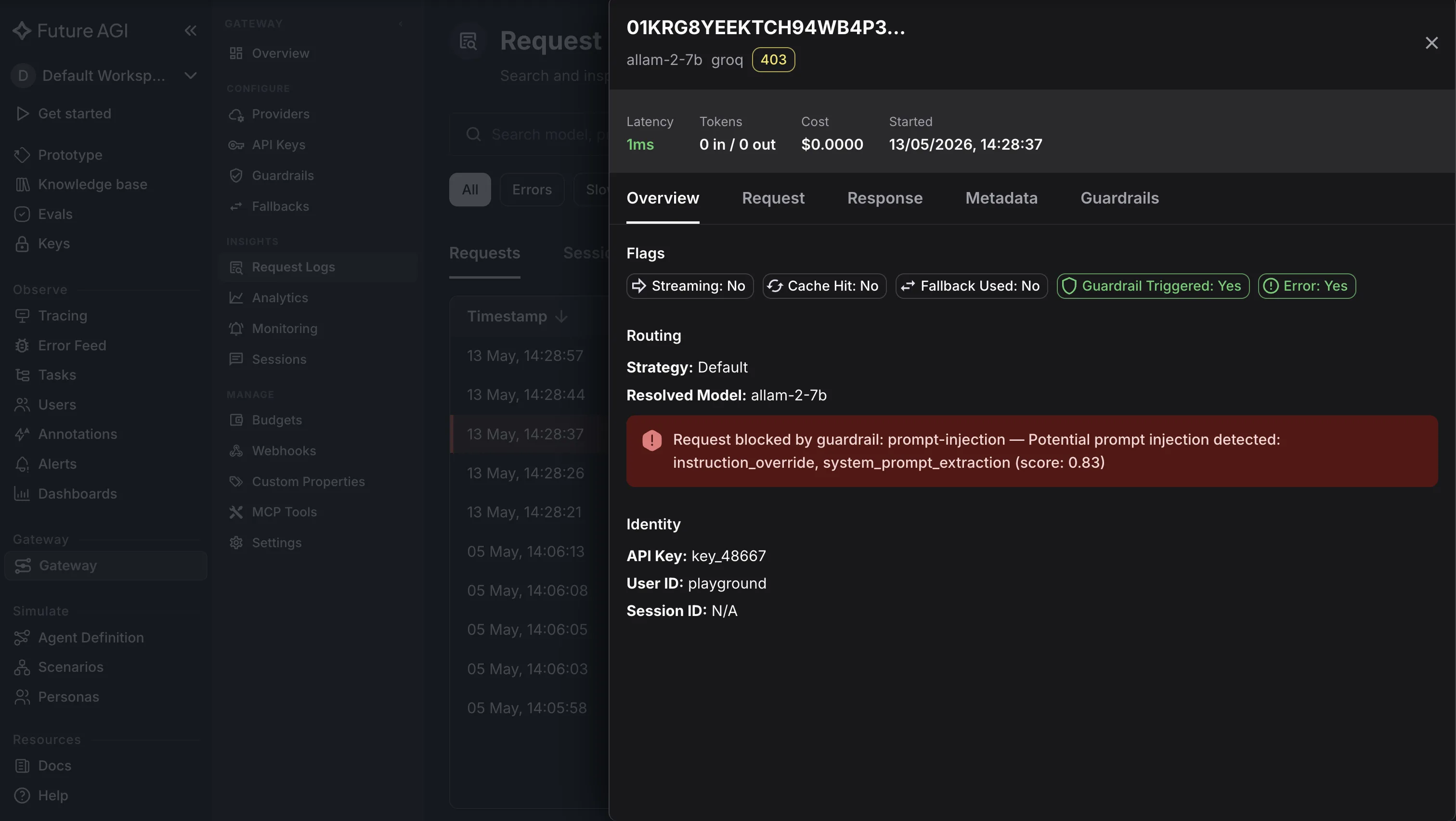
The bundled capabilities are an OpenAI-compatible drop-in, inline CPNI and PII redaction enforced by the Future AGI Protect inline path at roughly 65 ms p95 (arXiv 2510.13351), per-virtual-key budgets segmented for consumer postpaid, consumer prepaid, enterprise, wholesale, and roaming-partner cohorts, exact plus semantic caching, OpenTelemetry-native traces that survive a CALEA preservation order, and the agent-opt self-improving optimizer loop that learns from production redaction misses and tightens the scanner rule set without a model retraining cycle.
The full surface is documented in the Agent Command Center docs and the source ships at the Future AGI GitHub repo.
Most gateways force a telecom operator to wire two or three of these capabilities together across separate products. Agent Command Center attaches them at the same network hop and runs them under one Apache 2.0 license a security team can audit.
Best for. Tier-1 mobile network operators, tier-2 regional carriers, cable MSOs with converged voice products, MVNOs operating on a host carrier’s RAN, and B2B telecom platforms that want OpenAI compat drop in plus inline CPNI redaction plus per-line-of-business virtual keys plus OpenTelemetry-native audit logs in one Apache 2.0 Go binary, self-hosted inside the carrier’s network boundary, without rewriting OpenAI SDK code in the NOC copilot, the care chatbot, the B2B account agent, or the roaming-reconciliation agent.
Key strengths.
- OpenAI-compatible drop-in. Change
base_urltohttps://gateway.futureagi.com/v1or to the on-prem endpoint inside the carrier’s network and keep the existing OpenAI SDK code unchanged across the NOC copilot, the care chatbot, and the B2B account agent. - 20+ providers via six native adapters (OpenAI, Anthropic, Gemini, Bedrock, Cohere, Azure) plus OpenAI-compatible presets and self-hosted backends (OpenAI, Anthropic, Google Gemini, AWS Bedrock, Azure OpenAI, Cohere, Groq, Together, Fireworks, Mistral, DeepInfra, Perplexity, Cerebras, xAI, OpenRouter, plus self-hosted via Ollama, vLLM, LM Studio). For a telecom operator, AWS Bedrock under the AWS DPA umbrella, Azure OpenAI under the Microsoft Online Services DPA, and a self-hosted vLLM endpoint inside the carrier network are the three commonly routed upstream paths.
- The Future AGI Protect model family for inline guardrails, ~65 ms p50 text and ~107 ms p50 image (arXiv 2510.13351). Protect is FAGI’s own fine-tuned model family built on Google’s Gemma 3n with specialized adapters across four safety dimensions (content moderation, bias detection, security/prompt-injection, data privacy/PII), natively multi-modal across text, image, and audio, a model family, not a plugin chain. CPNI/PII coverage spans MSISDN, IMSI, IMEI, ICCID, account number, plan and pricing data, call detail records, and location data. The same dimensions are reusable as offline eval metrics so the prod policy and the eval rubric stay in sync.
- Per-key, per-virtual-key, per-model, per-time-window, and per-tag budgets; tag-based custom properties for the consumer postpaid, consumer prepaid, enterprise, wholesale, and roaming-partner segments that the carrier’s CFO already tracks as lines of business.
- OpenTelemetry-native traces and Prometheus metrics on
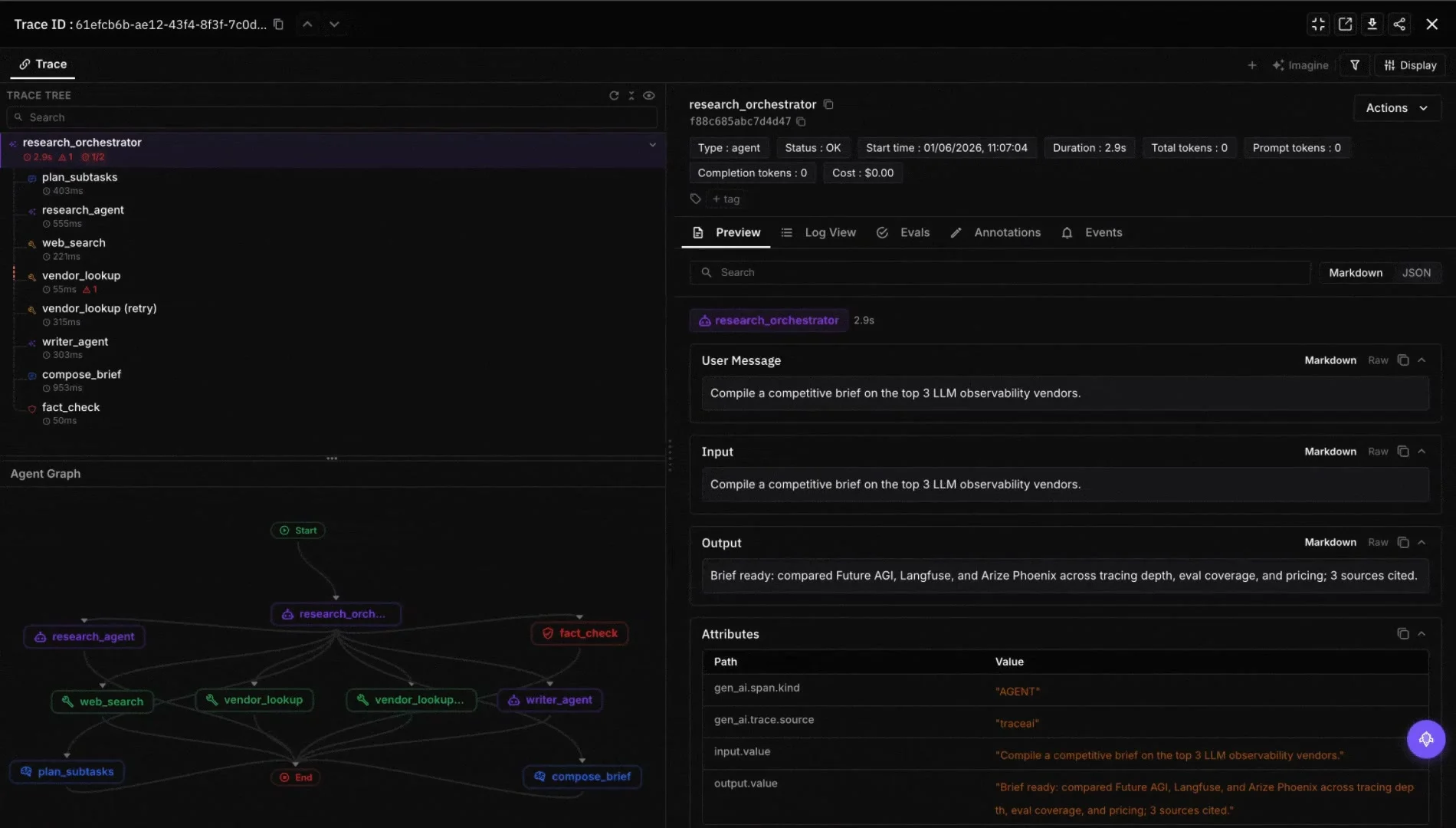
/-/metrics, so the same span attributes feed Grafana, the NOC’s existing observability stack (ServiceNow, BMC Remedy, IBM Netcool), and the Future AGI Evaluation pipeline viaspan_idlinking from gateway trace to eval result, with model version, prompt template version, NOC SOP version, ticket ID, and STIR/SHAKEN attestation level captured per request.traceAIinstruments 50+ AI surfaces across Python, TypeScript, Java, and C# (including Spring Boot starter, Spring AI, LangChain4j, Semantic Kernel) OpenInference-natively, and Error Feed. the part of the eval stack, the clustering and what-to-fix layer that feeds the self-improving evaluators, turns those traces into named issues with zero config: auto-clusters related NOC-copilot and care-chatbot failures (50 traces → 1 issue), auto-writes the root cause plus a quick fix plus a long-term recommendation per issue, and tracks rising/steady/falling trend per issue so CPNI-leakage and NOC-SOP regressions get triaged like exceptions rather than buried in NOC dashboards.
- The agent-opt self-improving optimizer loop. Production redaction misses, hallucinations on NOC remediation, and FTC TSR consent capture failures flow back into the optimizer, which proposes scanner rule updates without a model retraining cycle. For a tier-1 carrier shipping AI across multiple lines of business, this is the difference between a gateway that ages well and one that needs a quarterly re-platforming.
- Apache 2.0 across traceAI (tracing), ai-evaluation (held-out evaluations), and agent-opt (optimizer); single Go binary; Docker, Kubernetes, AWS, GCP, Azure, on-prem, air-gapped or cloud at
gateway.futureagi.com/v1; Agent Command Center BYOC ships into the carrier’s VPC or on-prem footprint with no third-party SaaS control plane crossing the network boundary.
Where it falls short.
- The bundled CALEA preservation-order workflow is documented in the runbook but isn’t packaged as a one-click feature. A tier-1 carrier should expect to wire the gateway audit log retention into its existing CALEA preservation workflow and assign a designated CALEA point of contact in the operator’s compliance organization; the gateway provides the artifacts, not the legal process.
- Network-ops integration with proprietary telco OSS/BSS suites (IBM Netcool, BMC Remedy, ServiceNow ITOM) is available via OpenTelemetry export, but pre-built dashboards and runbook templates are smaller in count than what a multi-year Kong customer has accumulated for Kong’s existing telco footprint.
- The self-improving optimizer learns from production telemetry, so a brand-new deployment in a brand-new line of business starts with the default scanner library; the optimizer’s value compounds over the first 30 to 90 days of live traffic.
from openai import OpenAI

client = OpenAI(
    api_key="$FAGI_API_KEY",
    base_url="https://gateway.futureagi.com/v1",  # or the on-prem URL
)

# Existing OpenAI SDK code unchanged from here. The gateway runs
# inline CPNI redaction (MSISDN, IMSI, IMEI, account number, CDR,
# location data) on both request and response, per-LOB virtual-key
# budgets (consumer/enterprise/wholesale), and OpenTelemetry span
# attributes (model, prompt template, NOC SOP, ticket ID, STIR/SHAKEN
# attestation) at the same network hop.
response = client.chat.completions.create(
    model="azure-openai/gpt-4o",
    messages=[{"role": "user", "content": "Summarise the outage ticket above and suggest the next remediation step."}],
    extra_headers={
        "x-fagi-virtual-key": "consumer-postpaid-care",
        "x-fagi-noc-sop-version": "outage-runbook-v4.2",
        "x-fagi-ticket-id": "INC0014872",
    },
)
Use case fit. Strong for tier-1 mobile network operators running NOC copilots across a national footprint, tier-2 regional carriers running customer-care voice and chat agents at the 1 to 8 million subscriber scale, cable MSOs running converged voice plus broadband care chat, MVNOs operating on a host carrier’s RAN and needing CPNI segmentation from the host, and B2B telecom platforms (UCaaS, CPaaS, CCaaS) running multi-tenant care agents. Less optimal for teams that want a fully managed cost dashboard before standing up infrastructure, which is the Portkey case, or for carriers whose primary buying constraint is “the AI plane must sit inside the existing Kong control loop,” which is the Kong AI Gateway case.
Pricing and deployment. Apache 2.0 single Go binary across traceAI, ai-evaluation, agent-opt; Agent Command Center BYOC ships into the carrier’s VPC or on-prem footprint at gateway.futureagi.com/v1 or self-host (Docker, Kubernetes, air-gapped inside the operator’s network boundary). SOC 2 Type II at the Boost tier (250 USD per month) and above; enterprise pricing for tier-1 carrier-scale deployments via sales.
Verdict. The strongest single pick if your 2026 telecom AI infrastructure story is “we want OpenAI compat drop in plus inline CPNI redaction plus per-line-of-business virtual keys plus CALEA-aware OpenTelemetry traces in our existing NOC observability stack, inside our network boundary, under an Apache 2.0 license a CALEA examiner and our internal red team can audit, with a self-improving optimizer that learns from our production failure modes.”
Telecom operators that want a managed cost dashboard before writing infrastructure code should evaluate Portkey alongside. Tier-1 carriers already running Kong for OSS/BSS API traffic should also compare against Kong AI Gateway.
Portkey: Best for Managed Telecom Cost and Audit Dashboard
Portkey is the strongest telecom pick when you want a managed cost and audit dashboard out of the box, the most mature semantic cache in production for repeat-question care patterns, and a four-tier budget hierarchy that maps cleanly onto the consumer, enterprise, wholesale, and roaming-partner cohorts every operator already tracks as lines of business.
It’s what most multi-tenant CPaaS and UCaaS platforms reach for when “we need spend control and per-tenant attribution next week, and the existing care chat dashboard needs to roll up the AI costs alongside the human agent costs the call center already reports” is the brief, with the caveat that the Palo Alto Networks acquisition announced on April 30, 2026 hasn’t yet closed and is expected to close in Palo Alto’s fiscal Q4 2026 subject to customary closing conditions.
Best for. Multi-tenant CPaaS and UCaaS platforms, tier-2 telecom operators with a strong managed-dashboard preference, and B2B telecom SaaS vendors that want fine-grained per-tenant budgets, PII anonymization, and a usable cost and audit dashboard without writing a custom exporter, and that have an acceptable risk appetite for the pending Palo Alto Networks acquisition.
Key strengths.
- Exact plus semantic caching with TTL and similarity-threshold tuning out of the box; telecom care chatbots typically see 35 to 55 percent semantic cache hit rates on repeated billing and plan-change questions, which compresses both the upstream LLM bill and the average handle time.
- Per-key, per-virtual-key, per-model, and per-time-window budgets in a four-tier hierarchy; the most fine-grained native-dashboard hierarchy on the list, which maps cleanly onto consumer postpaid, consumer prepaid, enterprise, wholesale, and roaming-partner segmentation.
- Large adapter library (250+ providers, including private OSS deployments and self-hosted Llama variants inside a carrier’s network); useful for operators evaluating sovereign-model paths under data-localization pressure.
- PII anonymization at the Enterprise tier; SOC 2 Type 2, ISO 27001, and GDPR audit-log support; per-tenant cost attribution in the dashboard that maps onto the operator’s existing line-of-business reporting.
Where it falls short.
- Acquisition by Palo Alto Networks announced April 30, 2026 and not yet closed. Roadmap independence is intact through 2026 but multi-year telecom contracts should reference the integration plan in writing, and a tier-1 carrier’s procurement organization should ask for the post-close support model before signing.
- Inline CPNI detection isn’t a built-in named scanner family; CPNI-specific patterns (MSISDN, IMSI, IMEI, ICCID, CDR fields) require custom rules layered on the Enterprise tier’s PII anonymization surface, where Future AGI Agent Command Center ships them as built-in scanners in the default rule pack.
- Observability is dashboard-first; OpenTelemetry export exists but is less first-class than the native dashboard, which makes integration with an existing Splunk, Datadog, or IBM Netcool stack a longer first week for the network operations team.
- Source available core plus closed control plane; air-gapped deployment is available at the Enterprise tier but the control plane setup is heavier than a single Apache 2.0 binary, which matters for operators whose CIO has signed off on “no third-party SaaS control plane crosses the carrier network boundary” as a CALEA-aware posture.
- CALEA preservation-order workflow is customer-built; the platform provides the audit log artifacts but doesn’t ship a packaged preservation workflow tied to the carrier’s existing legal-process unit.
Use case fit. Strong for multi-tenant CPaaS and UCaaS, tier-2 telecom operators with a managed-dashboard preference, and B2B telecom SaaS. Less optimal for tier-1 carriers whose binding constraint is a single Apache 2.0 binary inside an air-gapped VPC with no managed control plane dependency, or whose CPNI-specific scanner library needs to ship in the default rule pack.
Pricing and deployment. Source available core (self-hosted), commercial cloud control plane, Enterprise via sales; air-gapped deployment at the Enterprise tier with custom contracts. Verify current pricing on Portkey’s live pricing page before procurement.
Verdict. Most mature managed cost and audit dashboard for telecom AI in 2026, with strong semantic cache and four-tier budget hierarchy. Choose with eyes open on the Palo Alto Networks integration; the next 12 months will tell whether the standalone gateway product survives the merger.
Kong AI Gateway: Best for North-South API Alignment in Tier-1 Telecom
Kong AI Gateway is the strongest pick for tier-1 carriers that already run Kong Gateway for OSS/BSS REST and gRPC API traffic across the order-management, billing, provisioning, and partner-API surfaces, and want the AI plane to sit on the same control loop without standing up a separate gateway product.
Kong’s footprint inside telecom systems integrators is large enough that the AI plugins (AI Proxy, AI Prompt Guard, AI Prompt Decorator, AI Prompt Template, AI Request Transformer, AI Response Transformer) often arrive inside an existing customer’s Kong Enterprise license rather than as a separate procurement event, particularly through the OpenLLMTech alliance footprint with telecom systems integrators that wrap Kong into a packaged telco AI stack.
Best for. Tier-1 mobile network operators, large cable MSOs, and converged-services carriers that already operate Kong Gateway at scale across OSS/BSS, where the AI plane needs to land on the same north-south API control loop with the same observability and policy stack the network operations team already uses for REST and gRPC.
Key strengths.
- AI Proxy plugin unifies OpenAI, Anthropic, Google, Azure OpenAI, AWS Bedrock, Cohere, Mistral, and a self-hosted endpoint into the existing Kong route, consumer, and plugin model; no separate gateway product to deploy.
- Reuses Kong’s existing observability footprint (Prometheus, OpenTelemetry, Datadog, New Relic), so the AI request path lands in the same dashboards the NOC already monitors for OSS/BSS API health.
- AI Prompt Guard and AI Prompt Decorator plugins provide a hook for inline CPNI redaction rules layered on Kong’s existing transformation plugin model; a Lua-fluent platform team can ship a CPNI scanner inside the same Kong plugin lifecycle as the rest of the operator’s API contract.
- DB-less, hybrid, and Kubernetes deployment options; Kong Enterprise supports air-gapped install and FIPS-validated builds, which matters for federal-customer-facing carriers.
- OpenLLMTech alliance footprint with telecom systems integrators means the procurement and integration motion is often already wired through the carrier’s existing Kong support relationship.
Where it falls short.
- CPNI redaction is delivered as a “build it with our plugin SDK” pattern rather than a built-in named scanner family; a tier-1 carrier should budget engineering time to author and maintain the MSISDN, IMSI, IMEI, ICCID, CDR, and location-data detectors, where Future AGI Agent Command Center ships them in the default rule pack with the Protect inline path benchmarked in arXiv 2510.13351.
- Kong’s AI plugin surface is newer than its core REST and gRPC gateway surface; published latency overhead benchmarks for the AI Proxy path under telecom-scale concurrent load are thinner than the Kong gateway core, and a tier-1 NOC should run its own load tests against the fraud-detection 200 ms p95 budget before signing.
- The AI-specific evaluation pipeline (held-out evals, prompt regression, hallucination measurement) isn’t a first-class Kong product; operators need a separate evaluation surface (Future AGI ai-evaluation, internal scaffolding) wired into the Kong AI Proxy path.
- No self-improving optimizer loop; the AI plugins are configured by hand and updated through the normal Kong release cycle, where Future AGI agent-opt closes the loop from production failure back to scanner rule set without a model retraining cycle.
- CALEA preservation-order workflow is customer-built on top of Kong’s existing audit log infrastructure; the platform provides the artifacts but doesn’t ship a packaged preservation workflow.
Use case fit. Strong for tier-1 carriers and large cable MSOs already on Kong Gateway at scale, where the AI plane on the existing Kong control loop is worth more than a built-in CPNI scanner family. Less optimal for carriers that don’t yet run Kong for OSS/BSS, where the AI-only buying decision is better served by a purpose-built AI gateway with a packaged CPNI scanner library.
Pricing and deployment. Open-source Kong Gateway plus Kong Enterprise on top; AI plugins ship in the standard distribution. DB-less, hybrid, Kubernetes, on-prem, and air-gapped via Kong Enterprise. Pricing via Kong sales for the AI plugin SLA tier; tier-1 telecom deployments typically negotiate as part of the existing Kong Enterprise relationship.
Verdict. The right pick when the binding constraint is “the AI plane must sit on the same Kong control loop the OSS/BSS team already runs.” Choose Future AGI Agent Command Center when an Apache 2.0 single binary plus a built-in CPNI scanner family plus the self-improving optimizer matter more than control-loop alignment with an existing Kong footprint.
LiteLLM: Best for Python-First Network-Engineering Teams Post-CVE
LiteLLM is the Python-first proxy that broke open the multi-provider unified API category. It’s Apache 2.0 outside the enterprise directory, ships with 20+ providers via six native adapters (OpenAI, Anthropic, Gemini, Bedrock, Cohere, Azure) plus OpenAI-compatible presets and self-hosted backends, and powers a long tail of internal telecom gateways inside network-engineering teams that already standardised on FastAPI for the rest of the operator’s automation stack.
After the March 24, 2026 supply-chain incident the telecom answer is “yes for self-hosted commit-pinned deployments where the carrier holds its own DPA path to the upstream model provider; no for the OSS path as a vendor DPA inside a network with CPNI access.”
Best for. Python-first network-engineering and SRE teams that already operate a FastAPI or uvicorn surface for the rest of the operator’s automation stack, want broad provider coverage, are willing to pin commit hashes after the supply-chain incident, and have their own DPA path direct to the upstream model provider rather than relying on a LiteLLM DPA.
Key strengths.
- Broadest provider coverage of any single project on this list (20+ providers via six native adapters (OpenAI, Anthropic, Gemini, Bedrock, Cohere, Azure) plus OpenAI-compatible presets and self-hosted backends); useful for carriers running multi-region failover across OpenAI, Anthropic, Azure OpenAI, AWS Bedrock, and self-hosted vLLM endpoints inside the carrier network.
- Apache 2.0 outside the enterprise directory; trivial to fork or audit for a network-security team that wants to read every line of code that touches CPNI before it goes into production.
- Virtual keys with per-key budgets; budget alerts; native fit with Python observability stacks (OpenTelemetry Python SDK, prometheus_client).
- Active maintainer community; easy to extend with custom adapters for telecom-specific CPNI detectors (MSISDN, IMSI, IMEI, ICCID), STIR/SHAKEN passthrough, and FTC TSR consent capture, all in Python.
Where it falls short.
- March 24, 2026 PyPI supply-chain compromise. Versions
1.82.7and1.82.8were published by the TeamPCP threat actor after PyPI publishing tokens were exfiltrated via a compromised Trivy GitHub Action in LiteLLM’s CI/CD pipeline. The malicious packages shipped a credential harvester, a Kubernetes lateral-movement toolkit, and a persistent systemd backdoor; over 40,000 downloads occurred before PyPI quarantined the packages within roughly forty minutes of publication (see the Datadog Security Labs writeup). A carrier with root-level CPNI access inside the same network as a LiteLLM install should pin to 1.82.6 or earlier, scan dependency trees, and rotate any credentials accessible to an affected install before resuming production traffic. - Python runtime; materially slower throughput than Go-binary alternatives (Future AGI Agent Command Center, Kong AI Gateway core) at high concurrency on the same hardware, which can compress the fraud-detection 200 ms p95 budget when the carrier already runs other Python services in the request path.
- No vendor DPA on the OSS self-hosted distribution; telecom deployment requires the carrier to hold the DPA directly with the upstream model provider (OpenAI, Anthropic, Azure, AWS).
- Inline CPNI detection ships as adapters and custom code rather than a built-in scanner library; a network-engineering team should expect to author the MSISDN, IMSI, IMEI, ICCID, CDR, and location-data detectors and to maintain them through the LiteLLM release cycle.
- No self-improving optimizer loop; rule updates flow through the normal pip release cycle, where Future AGI agent-opt closes the loop without a model retraining cycle.
Use case fit. Strong for Python-first network-engineering and SRE teams that operate their own FastAPI gateway and have their own DPA path to the upstream model provider. Less optimal as a vendor-DPA path in telecom and as a managed runtime where commit pinning isn’t enforceable.
Pricing and deployment. Apache 2.0 outside the enterprise directory; pip install or Docker self-host. Enterprise cloud tier exists with SOC 2 Type II, HIPAA, GDPR, and CCPA certified (ISO/IEC 27001 in active audit).
Verdict. Still the broadest provider coverage on the list, but the March 2026 supply-chain incident shifts it from “default pick” to “pin commits and audit.” Telecom deployments should treat LiteLLM as an OSS self-hosted runtime where the carrier holds the upstream DPA directly, not as a vendor DPA path inside a network with CPNI access.
TrueFoundry AI Gateway: Best for Fully VPC-Resident Control Plane
TrueFoundry AI Gateway is the strongest pick for regional carriers, MVNOs, and cable MSOs that need both the control plane and the gateway plane to run inside the customer VPC, with full air-gapped support and a HIPAA BAA available alongside SOC 2 Type 2 and GDPR.
It’s the gateway most often shortlisted alongside Portkey when the FCC subscriber-data residency procurement pressure is “no third-party SaaS control plane crosses our carrier network boundary, even for the AI plane.”
Best for. Regional carriers, MVNOs operating on a host carrier’s RAN, cable MSOs with regional voice products, and federal-customer-facing carriers that require both control plane and gateway plane to run inside the customer VPC, with HIPAA, SOC 2 Type 2, and GDPR signed off as part of the deployment.
Key strengths.
- Full VPC and air-gapped install for both the control plane and the gateway plane, with hands-off mode for the customer’s engineering team where TrueFoundry support operates inside agreed boundaries; the cleanest fit on the list for the “no third-party SaaS control plane crosses our network” procurement language.
- HIPAA BAA available; SOC 2 Type 2 and HIPAA compliance achieved in 2024 and maintained through 2026; FIPS on AWS GovCloud and Azure Government, useful for carriers in the federal customer market.
- Routes to the major DPA-eligible upstreams (Azure OpenAI, AWS Bedrock, OpenAI Enterprise plus API, Anthropic, Vertex AI) plus self-hosted endpoints inside the carrier network.
- Data masking at the Enterprise tier; integrates with the standard audit log retention path required for the FCC CPNI annual certificate filing.
Where it falls short.
- Proprietary license; not Apache 2.0; the source isn’t available for the same kind of audit a regulated carrier’s red team or a CALEA examiner can run on Future AGI Agent Command Center or LiteLLM commit-pinned.
- Pricing starts at 499 USD per month for the Pro tier and rises for VPC and on-prem deployment via sales; smaller MVNOs and CPaaS startups should compare against cloud-tiered alternatives before committing.
- Telecom-specific guardrail set (CPNI scanner family, STIR/SHAKEN passthrough, FTC TSR consent capture) is positioned more as an integration with adapters than as a built-in scanner library on the scale of Future AGI’s default rule pack.
- No self-improving optimizer loop; rule updates flow through TrueFoundry’s normal release cycle, where Future AGI agent-opt closes the loop from production failure back to scanner rule set.
- CALEA preservation-order workflow is customer-built on top of the platform’s audit log; the platform provides the VPC-resident artifacts but doesn’t ship a packaged preservation workflow.
Use case fit. Strong for regulated environments where the procurement constraint is “everything runs inside our VPC, including the control plane.” Less optimal when the buying constraint is Apache 2.0 or when the runtime guardrail surface needs to be a built-in CPNI scanner library rather than an adapter wiring exercise.
Pricing and deployment. Proprietary; Pro from 499 USD per month; VPC and on-prem deployment via sales with self-hosted control plane and gateway plane.
Verdict. The right pick when the FCC subscriber-data residency procurement constraint is “everything runs inside our VPC, including the control plane.” Choose Future AGI Agent Command Center when Apache 2.0 plus a built-in CPNI scanner family plus the self-improving optimizer matter more than a single-vendor full-stack VPC install.
AWS Bedrock and Azure OpenAI as Telecom Compliance Fast Paths
The straight cloud route to a telecom-suitable DPA in 2026 is AWS Bedrock under the AWS Enterprise DPA umbrella or Azure OpenAI under the Microsoft Online Services DPA, with the gateway in front handling the CPNI and STIR/SHAKEN obligations the upstream provider doesn’t cover.
Both ship a fast DPA, both are widely accepted by FCC and FTC supervisors as well-managed third-party arrangements, and both leave the carrier to bolt inline CPNI redaction, FTC TSR consent capture, STIR/SHAKEN passthrough, and per-line-of-business budgets on top.
Most production telecom AI stacks today run an AI gateway in front of Bedrock or Azure OpenAI rather than instead of them. The framing question is whether the gateway adds enough at the same network hop to justify the operational footprint.
AWS Bedrock under the AWS DPA umbrella. Amazon Bedrock is covered under the AWS Enterprise DPA and the AWS BAA umbrella, and is in scope for ISO, SOC, and CSA STAR Level 2. For carriers specifically, AWS Wavelength and AWS Outposts give Bedrock-adjacent inference at the operator’s edge, useful for fraud-scoring and NOC copilot paths where the 200 ms p95 budget is tight. The gap that a gateway closes: Bedrock doesn’t ship a built-in CPNI redaction layer, doesn’t ship per-virtual-key budgets across providers (Bedrock budgets are per service), and the STIR/SHAKEN passthrough is on the customer.
Azure OpenAI under the Microsoft Online Services DPA. Azure OpenAI is covered under the Microsoft Online Services Data Protection Addendum for text-based services on Enterprise Agreement, MCA, and CSP procurement paths. Azure OpenAI doesn’t retain prompt and completion content for training by default. For an EU operator, Azure OpenAI EU data boundaries simplify the GDPR plus ePrivacy story for the AI step. The two coverage gaps telecom teams hit in practice are that image inputs aren’t covered by default and the Realtime Audio API in preview isn’t yet inside the DPA coverage scope; an AI gateway in front of Azure OpenAI is what enforces text-only routing, blocks image and realtime calls, and standardizes the audit log across Azure OpenAI plus a non-Azure fallback provider.
The honest take. If your telecom stack is one provider, one region, one product, AWS Bedrock or Azure OpenAI behind your application can be enough.
The moment you add a second provider (for fallback, for redundancy, for cost), a second product (NOC copilot plus care chat plus fraud scoring plus B2B account agent), a second line of business (consumer postpaid plus enterprise plus wholesale plus roaming partner), or a second jurisdiction (US plus EU, with the ePrivacy Directive and EU AI Act overlay), the gateway pays for itself in DPA simplicity, CPNI redaction consistency, and audit log uniformity. That’s the gateway-versus-no-gateway question every telecom AI buyer makes.
The 2026 Telecom Gateway Migration and Trust Cohort
Every telecom AI gateway post currently ranking on Google is treating the Q1 to Q2 2026 supply-chain and acquisition cohort as if it didn’t happen. It did, and it reshapes the procurement question for 2026 inside an FCC-supervised carrier.
- Helicone joining Mintlify (March 3, 2026). Helicone acquired by Mintlify; product is in maintenance mode with no active feature development. A tier-1 NOC already on Helicone should plan a migration window, not a continued procurement.
- LiteLLM PyPI supply-chain compromise (March 24, 2026). TeamPCP-attributed compromise of versions
1.82.7and1.82.8via a stolen PyPI publishing token (exfiltrated through a compromised Trivy GitHub Action in LiteLLM’s CI/CD). The malicious package shipped a credential harvester, a Kubernetes lateral-movement toolkit, and a persistent systemd backdoor; PyPI quarantined the packages the same day, with 40,000+ downloads recorded. Pin to 1.82.6 or earlier; rotate credentials accessible to any affected install. Primary source: the Datadog Security Labs writeup; our LiteLLM incident response and migration guide covers the full remediation path. - Anthropic MCP STDIO RCE class (April 2026). OX Security disclosed an STDIO transport class flaw affecting roughly 7,000 MCP servers and 150 million plus downstream downloads. Telecom gateways routing MCP traffic for NOC copilots are now expected to enforce least-privilege tool access, OAuth 2.1 transport, and Streamable HTTP rather than raw STDIO.
- Portkey acquired by Palo Alto Networks (April 30, 2026, not yet closed). Acquisition announced; the deal is expected to close in Palo Alto’s fiscal Q4 2026 subject to customary closing conditions. Roadmap independence is intact through 2026; multi-year telecom contracts should reference the integration plan in writing.
The practical takeaway: for the next 12 months, license clarity, DPA tier definitiveness, CPNI scanner depth, and acquisition independence are part of the telecom AI gateway buying decision. A cheap gateway you migrate off in six months, or one whose DPA pathway is in legal redrafting, isn’t cheap inside the FCC’s annual CPNI compliance certificate cycle or a CALEA examination.
Telecom AI Gateway Picks by Buyer Profile in 2026
The buyer profile drives the pick more than the feature matrix does. Tier-1 mobile network operators running NOC copilots across a national footprint, tier-2 regional carriers running care voice and chat agents, MVNOs operating on a host carrier’s RAN, cable MSOs with converged voice products, and B2B telecom platforms running multi-tenant care chat pick Future AGI Agent Command Center for the Apache 2.0 plus built-in inline CPNI scanner family plus the self-improving optimizer combination. Multi-tenant CPaaS and UCaaS platforms running per-tenant cost attribution pick Portkey. Tier-1 carriers already on Kong for OSS/BSS pick Kong AI Gateway. Python-first network-engineering teams with their own upstream DPA path pick LiteLLM commit-pinned. Regional carriers and MVNOs that mandate VPC-only control planes pick TrueFoundry.
| If you are a… | Pick | Why |
|---|---|---|
| Tier-1 mobile network operator running NOC copilot plus care chat plus fraud scoring across a national footprint | Future AGI Agent Command Center | OpenAI compat drop in plus inline CPNI redaction plus per-LOB virtual keys plus CALEA-aware OpenTelemetry audit logs in one Apache 2.0 Go binary, with the agent-opt optimizer learning from production redaction misses |
| Tier-2 regional carrier running care voice and chat at the 1 to 8 million subscriber scale | Future AGI Agent Command Center | Inline CPNI at roughly 67 ms p95 fits inside the average handle time budget; per-LOB virtual keys segment consumer postpaid from enterprise from wholesale; Apache 2.0 makes red-team audits cheap |
| Multi-tenant CPaaS or UCaaS platform with managed dashboard requirement | Portkey | Four-tier budget hierarchy plus mature semantic cache plus managed cost attribution dashboard (verify the Palo Alto Networks integration timeline) |
| Tier-1 carrier already running Kong Gateway across OSS/BSS at scale | Kong AI Gateway | AI plane lands on the same Kong control loop, same observability stack, same plugin model; no separate gateway product to deploy |
| Python-first network-engineering team with its own upstream DPA path | LiteLLM (commit pinned) | Broadest provider coverage; Apache 2.0 outside the enterprise directory; pin to 1.82.6 or earlier after the March CVE |
| Regional carrier, MVNO, or cable MSO mandating fully VPC-resident control plane | TrueFoundry AI Gateway | Both control and gateway planes inside the customer VPC; HIPAA, SOC 2 Type 2, GDPR signed off as part of deployment |
| EU mobile operator under ePrivacy Directive plus EU AI Act Article 50 transparency | Future AGI Agent Command Center plus Azure OpenAI EU | Article 12 logging plus Article 50 disclosure injection at the same network hop; EU data residency through Azure OpenAI EU; inline CPNI plus PII redaction in one binary |
| Microsoft 365 plus Azure shop already standardised on Azure OpenAI | Azure OpenAI behind a gateway | DPA via the Microsoft Online Services DPA; image and realtime not yet covered, so gateway-enforced route filtering is required |
| AWS shop on Bedrock with Anthropic on Bedrock | AWS Bedrock behind a gateway | DPA via the AWS umbrella; gateway adds inline CPNI redaction, STIR/SHAKEN passthrough, FTC TSR consent capture, and per-LOB budgets |
| Federal-customer-facing carrier needing FIPS plus FedRAMP-aligned posture | TrueFoundry AI Gateway or Kong AI Gateway with Kong Enterprise FIPS build | FIPS-validated path plus VPC-resident control plane plus existing federal customer track record |
| Early-stage MVNO or CPaaS startup evaluating gateways before committing | Future AGI Agent Command Center free tier | Apache 2.0 self-host; upgrade to a paid tier when subscriber count and outbound voice volume cross the FTC TSR enforcement threshold |
Which AI Gateway Is Right for Your Telecom Operator in 2026?
Telecom AI in 2026 isn’t a single feature. It’s a stack of CALEA, FCC CPNI rules, STIR/SHAKEN, the FTC TSR, the EU AI Act, GDPR, and the ePrivacy Directive controls riding on top of an AI gateway that has to keep CPNI off the wire, retain audit logs that survive a CALEA preservation order, capture STIR/SHAKEN attestation per outbound voice-AI call, attribute spend across consumer/enterprise/wholesale/roaming-partner lines of business, and survive a year of acquisition events without forcing a re-platforming.
Of the five gateways above, Future AGI Agent Command Center is the strongest pick for the production case where the buying constraint is OpenAI compat drop in plus inline CPNI redaction at roughly 67 ms p95 plus per-line-of-business virtual keys plus CALEA-aware OpenTelemetry audit logs in one Apache 2.0 Go binary you can self-host inside the carrier’s network boundary, with the agent-opt self-improving optimizer learning from production failures and the ai-evaluation pipeline catching the next regression before it ships.
Portkey is the right call when a managed cost and audit dashboard with per-tenant attribution is the binding constraint and the Palo Alto Networks integration risk is acceptable. Kong AI Gateway is the right call when the tier-1 carrier is already running Kong for OSS/BSS at scale and the AI plane belongs on the same control loop. TrueFoundry is the right call when both the control plane and the gateway plane must run inside the carrier’s VPC with no external SaaS dependency.
For deeper reads on the patterns referenced above:
- The Agent Command Center docs for the full gateway feature surface.
- The Future AGI observability docs for the audit log path that anchors the CALEA preservation workflow and the annual CPNI compliance certificate.
- The Future AGI Protect docs for the inline CPNI and PII redaction layer the gateway plugs into.
- The Future AGI Evaluation docs for the held-out NOC remediation and care-chat hallucination evals that tie to gateway behavior via
span_id. - The Future AGI tracing product page for the OpenTelemetry-native tracing layer.
- The Future AGI GitHub repo for the Apache 2.0 source across traceAI, ai-evaluation, and agent-opt.
Try Agent Command Center free. OpenAI-compatible routing, inline CPNI redaction at roughly 67 ms p95, per-line-of-business virtual keys, and OpenTelemetry-native audit logs in one Apache 2.0 Go binary.
Related reading
- Best 5 AI Gateways for Compliance Audit Trails in 2026, the compliance and audit-trail comparison
- Best 5 AI Gateways for LLM Cost Optimization in 2026, the five-layer cost stack and the 2026 trust cohort
- Best 5 AI Gateways for Customer Support in 2026: Latency Budgets, Agent Assist, and Voice AI Passthrough, the customer-support-specific gateway picks
- Best 5 AI Gateways for Cybersecurity in 2026: Prompt Injection Defense, Tenant Isolation, and SOC 2, the cybersecurity-specific gateway picks
Frequently Asked Questions
What Is the Best AI Gateway for Telecom Compliance in 2026?
Do FCC CPNI Rules Under 47 CFR 64.2001 Apply to LLM Prompts and Completions?
How Does CALEA Apply to AI-Routed Voice and Messaging Traffic?
How Does STIR/SHAKEN Caller-ID Authentication Interact With an AI Voice Gateway?
How Does an AI Gateway Reduce Risk From an AI Chatbot Leaking CPNI?
What Does the GDPR Require for EU Telecom Operators Running AI Customer Care?
Which AI Gateways Survived the 2026 Supply-Chain and Acquisition Events for Telecom Use?
Five AI gateways for contact centers 2026 scored on sub-300ms agent-assist latency, voice-AI streaming, TCPA and ECPA, post-call audit.

Five AI gateways on what compliance officers actually need: tamper-evident logs, 3-10 yr retention, SIEM exports, span granularity, legal hold, frameworks.
Five AI gateways for cybersecurity in 2026 scored on prompt injection defense, tenant isolation, OWASP LLM Top 10, MITRE ATLAS, SOC 2.