Best 5 AI Gateways for Streaming LLM Responses in 2026
Five AI gateways for streaming LLM responses in 2026: SSE fidelity, WebSocket and gRPC, mid-stream failover, TTFT observability, CDN.
Table of Contents
Originally published May 17, 2026.
A consumer-facing copilot team shipped a refreshed chat UI on a Thursday afternoon. The streaming endpoint worked in localhost, in staging, in their own browser. At 7 PM the first user complaint hit: the chat stops streaming and “drops a wall of text after 4 seconds.” By 9 PM the pattern was clear. Production traffic went through CloudFront with default response buffering, an enterprise customer’s corporate proxy buffered the SSE stream to detect content-type, and the nginx in front of their backend had
proxy_buffering onby default. Three buffers in a row turned a 280 ms time-to-first-token into a 3.4 second wait followed by the entire assistant turn dumped at once. The fix was four headers and a CDN configuration page; the bug was that nobody on the team had measured TTFT past the application server. This guide ranks the five AI gateways production teams should choose between in 2026 for streaming LLM responses, scored on SSE pass-through fidelity, WebSocket support, gRPC support, mid-stream failover, TTFT observability, tool-call passthrough, and CDN compatibility.
TL;DR
Future AGI Agent Command Center is the strongest pick for an AI gateway for streaming LLM responses because it bundles byte-for-byte SSE pass-through with documented anti-buffering headers, a WebSocket-to-SSE bridge plus a native WebSocket relay for the voice path, gRPC pass-through for Vertex and self-hosted Triton, per-stream sequence-numbered buffers with resume tokens for mid-stream failover, time-to-first-token telemetry per route as OpenTelemetry span attributes, tool-call delta passthrough, and explicit CDN configuration guidance for CloudFront, Cloudflare, and Akamai, all in one Apache 2.0 Go binary you can self-host. The other four picks below win on specific edges.
- Future AGI Agent Command Center — Best overall. 5-20 ms typical TTFT overhead, byte-for-byte SSE, sequence-numbered mid-stream failover, and documented CDN config.
- Portkey — Best for a managed SSE dashboard with a mature provider adapter library and four-tier budgets. 10-40 ms typical TTFT overhead (verify the Palo Alto Networks acquisition timeline before signing multi-year).
- LiteLLM — Best for Python-first teams with broad provider coverage on the streaming path. 15-60 ms typical TTFT overhead under Python runtime; pin commits after the March 24, 2026 PyPI compromise.
- Cloudflare AI Gateway — Best for edge-native streaming for global consumer products where the gateway and the CDN are the same hop. 5-25 ms TTFT at edge (region-dependent).
- Maxim Bifrost — Best for Go shops at 5,000 RPS or higher with Code Mode tool-call execution. Vendor-published ~11 µs P50 overhead.
Why Streaming LLM Responses Need an AI Gateway, not an SDK alone
Streaming chat used to be “set stream=true in the SDK and forward chunks to the browser.” Three shifts in 2025 and early 2026 broke that.
First, providers diverged on streaming semantics. OpenAI ships SSE with data: {...} framing and a data: [DONE] sentinel; Anthropic ships SSE with event: content_block_delta structured event names; Vertex exposes SSE and gRPC streaming with different protobuf schemas; AWS Bedrock streams over custom HTTP/2 framing. A 2026 provider-agnostic chat can’t ship an SDK adapter per provider; the gateway has to normalise wire format to a single OpenAI-compatible SSE surface while keeping per-provider semantic richness (refusal events, citation events, thinking-token events) intact.
Second, browsers, CDNs, and corporate proxies settled on more aggressive buffering defaults. CloudFront’s default behaviour on chunked transfer encoding without explicit X-Accel-Buffering: no headers and nginx 1.27 cache-related defaults broke naive SSE pipelines. A streaming endpoint that worked locally buffers the full assistant turn at the CDN in production, turns the 280 ms TTFT into a 3 to 4 second wait, and dumps the entire response at once.
Third, the consumer-product chat path absorbed tool calls. OpenAI ships partial function arguments as SSE deltas inside the same stream; a client UI that wants to show “Calling search_documents…” while arguments stream needs to parse those deltas in real time. A gateway that buffers the full assistant turn breaks the UX on every tool invocation.
The SDK alone doesn’t own any of these three problems. The gateway is the only layer where streaming wire format, anti-buffering headers, mid-stream failover state, and tool-call delta forwarding all live together.
How Streaming LLM Responses Actually Work in Production
A streaming LLM response in 2026 traverses seven layers between the user’s keystroke and the upstream model. The failure modes that show up most often in production:
- SSE pass-through fidelity. Anti-pattern: buffering chunks into 32 KB blocks. Result: TTFT jumps by 100 to 500 ms per buffer flush, text arrives in chunks rather than tokens.
- WebSocket support. Anti-pattern: forcing voice clients to downgrade to polling. Result: barge-in latency spikes to 1500 to 3000 ms.
- gRPC pass-through. Anti-pattern: terminating gRPC and re-emitting non-streaming JSON. Result: streaming UX disappears on Vertex and Triton routes entirely.
- Mid-stream failover handling. Anti-pattern: closing the client stream on upstream disconnect. Result: chat UI resets, the user sees “Error, please try again.”
- TTFT observability. Anti-pattern: end-to-end latency only. Result: nobody can tell whether a regression is upstream-driven or buffer-driven.
- Tool-call passthrough during stream. Anti-pattern: buffering the full assistant turn to detect tool calls. Result: multi-second pause on every tool invocation.
- CDN and reverse-proxy compatibility. Anti-pattern: SSE without
X-Accel-Buffering: no,Cache-Control: no-cache,Connection: keep-alive,Transfer-Encoding: chunked. Result: 280 ms TTFT becomes 3.4 second wait, entire response dumps at once.
A gateway that ships SSE and WebSocket but skips mid-stream failover, TTFT telemetry, and CDN headers is good for a demo and bad for production. The five reviews below score against all seven layers.
How Did We Score AI Gateways for Streaming LLM Responses?
We used the Future AGI Streaming Gateway Scorecard, tuned for platform-engineer and frontend-lead procurement on consumer products where streaming UX is mandatory. The 2026 listicles on streaming still score on “does it support stream=true” and stop there. The seven axes below decide whether the gateway delivers the UX a consumer-product user sees on every chat turn.
| # | Axis | What we measure (streaming lens) |
|---|---|---|
| 1 | SSE pass-through fidelity | Byte-for-byte forwarding versus buffered chunks; wire-format normalisation across OpenAI, Anthropic, Vertex, Bedrock |
| 2 | WebSocket support | Native WebSocket relay; SSE-to-WebSocket bridge; OpenAI Realtime, Google Live API, Anthropic Voice proxying; full-duplex barge-in latency |
| 3 | gRPC support | HTTP/2 frame forwarding; Vertex gRPC tunneling; self-hosted Triton; protobuf schema pass-through |
| 4 | Mid-stream failover handling | Per-stream sequence-numbered buffer; resume tokens; transparent replay versus client-visible reconnect |
| 5 | Time-to-first-token observability | Per-request TTFT span attribute; per-route Prometheus histogram; OpenTelemetry GenAI semantic conventions conformance |
| 6 | Tool-call passthrough during stream | Delta forwarding for partial function arguments; no assistant-turn buffering to detect tool calls |
| 7 | CDN and reverse-proxy compatibility | X-Accel-Buffering: no plus Cache-Control: no-cache headers; CloudFront, Cloudflare, Akamai, nginx, Envoy documented configuration |
Axes 1, 4, 5, and 7 decide whether the gateway actually delivers the streaming UX in production. The right priority depends on the buyer profile.
Streaming Capability Matrix Across the 5 Gateways
Future AGI Agent Command Center leads on combined SSE fidelity, WebSocket and gRPC coverage, mid-stream failover, TTFT observability, tool-call passthrough, and CDN compatibility. Bifrost wins on raw Go throughput. Portkey wins on managed dashboard polish. LiteLLM wins on Python ergonomics. Cloudflare wins on edge-native streaming.
| Capability | FAGI ACC | Portkey | LiteLLM | Cloudflare | Bifrost |
|---|---|---|---|---|---|
| SSE pass-through | Byte-for-byte | Byte-for-byte | Byte-for-byte | Edge-native | Byte-for-byte |
| WebSocket | Native relay + bridge | Partial (plugins) | Partial (extension) | Edge WS some routes | Native relay |
| gRPC | HTTP/2 forwarding (Vertex, Triton) | Limited | Limited | Not first-class | Limited |
| Mid-stream failover | Sequence-numbered buffer + resume tokens | Replay on disconnect | Replay (open issues) | Closes client stream | Buffer + cluster replay |
| TTFT telemetry | OTel span + /-/metrics histogram | Native dashboard | OTel middleware | Cloudflare analytics | OTel partial |
| Tool-call passthrough | Delta forwarding | Delta forwarding | Delta forwarding | Delta forwarding | Delta + Code Mode |
| CDN compatibility | Headers default + docs | Edge managed | Headers documented | Runs at edge | Headers default |
| Providers on stream path | 100+ | 250+ | 100+ | Commercial + Workers AI | 10+ providers, 1,000+ models |
| TTFT overhead (typical) | 5-20 ms | 10-40 ms | 15-60 ms | 5-25 ms | 1-15 ms (vendor) |
| Self-hostable | Yes (Apache 2.0 Go) | Yes (OSS core) | Yes (pip, Docker) | No (cloud-only) | Yes (Apache 2.0 Go) |
| Self-improving stream-quality loop | Yes | Manual | Manual | Manual | Manual |
The four columns that matter most for streaming UX (SSE fidelity, mid-stream failover, TTFT observability, CDN compatibility) are where the field separates.
Future AGI Agent Command Center: Best Overall for Streaming LLM Responses
Future AGI Agent Command Center tops the 2026 streaming list because it bundles every layer of the streaming stack at the same network hop in one Apache 2.0 Go binary you can self-host.
It loses on managed dashboard polish to Portkey, on edge-native deployment to Cloudflare, and on raw single-dimension Go throughput to Bifrost. For buyers whose binding constraint is byte-for-byte SSE plus WebSocket plus gRPC plus sequence-numbered mid-stream failover plus TTFT-per-route OTel plus tool-call delta passthrough plus documented CDN configuration in one self-hostable binary, the combined surface still puts it first.
The bundled surface is documented in the Agent Command Center docs and the source ships at the Future AGI GitHub repo. The Apache 2.0 traceAI, ai-evaluation, and agent-opt SDKs feed the OpenTelemetry plane the gateway plugs into.
Best for. Platform engineers and frontend leads at consumer-facing products (chatbots, copilots, voice agents) that want byte-for-byte SSE plus WebSocket relay plus gRPC pass-through plus sequence-numbered mid-stream failover plus per-route TTFT in OpenTelemetry plus tool-call delta passthrough plus survival behind CloudFront, Cloudflare, and Akamai, without rewriting OpenAI SDK code.
Key strengths.
- OpenAI-compatible drop-in: change
base_urltohttps://gateway.futureagi.com/v1, keep existing SDK code unchanged.stream=trueworks without any other configuration changes. - Byte-for-byte SSE pass-through across 20+ providers via six native adapters (OpenAI, Anthropic, Gemini, Bedrock, Cohere, Azure) plus OpenAI-compatible presets and self-hosted backends (OpenAI, Anthropic, Vertex, Bedrock, Azure OpenAI, Cohere, Groq, Together, Fireworks, Mistral, DeepInfra, Perplexity, Cerebras, xAI, OpenRouter, Ollama, vLLM). Normalises Anthropic’s
event: content_block_deltaand Vertex’s gRPC streaming to OpenAI-compatible SSE without buffering. - Native WebSocket relay for OpenAI Realtime, Google Live API, and Anthropic Voice, plus SSE-to-WebSocket bridge for single-WebSocket sessions. Barge-in latency budgets fall in the 100 to 300 ms band on the audited 2026 set.
- gRPC pass-through via HTTP/2 frame forwarding for Vertex AI and self-hosted Triton.
- Per-stream sequence-numbered buffer plus resume tokens for streaming continuity through mid-stream failover. On a 5xx or TCP reset mid-stream, the gateway replays the prompt against the next provider; the client SDK either receives a transparent replay from token zero or continues from the last sequence number with
X-FAGI-Stream-Resume: true. - TTFT telemetry per route: every streaming request emits
ttft_msas a span attribute plus a Prometheus histogram on/-/metrics(fagi_ttft_milliseconds_bucket{route="...",model="..."}). SRE sees TTFT P50, P90, P99 by route in Grafana without a custom exporter. - Tool-call delta passthrough: forwards OpenAI function-call argument deltas byte-for-byte. No assistant-turn buffering to detect tool calls.
- Anti-buffering headers default:
X-Accel-Buffering: no,Cache-Control: no-cache, no-transform,Connection: keep-alive,Transfer-Encoding: chunked, plus documented CloudFront, Cloudflare, Akamai, and nginx configuration. - The Future AGI Protect model family runs inline at ~65 ms p50 text and ~107 ms p50 image (arXiv 2510.13351), preserving the streaming TTFT budget for consumer chat. Protect is FAGI’s own fine-tuned model family built on Google’s Gemma 3n with specialized adapters across four safety dimensions (content moderation, bias detection, security/prompt-injection, data privacy/PII), natively multi-modal across text, image, and audio, a model family, not a plugin chain. The same dimensions are reusable as offline eval metrics so the prod policy and the eval rubric stay in sync.
- Self-improving loop on streaming quality: per-request TTFT, chunk-rate variance, and the stream-quality eval (partial-output coherence, token-rate stability, tool-call latency) feed agent-opt overnight.
traceAIinstruments 50+ AI surfaces across Python, TypeScript, Java, and C# (including Spring Boot starter, Spring AI, LangChain4j, Semantic Kernel) OpenInference-natively, and Error Feed (the part of the eval stack, the clustering and what-to-fix layer that feeds the self-improving evaluators) sits alongside as the zero-config error monitor: auto-clusters related TTFT and stream-quality failures (50 traces → 1 issue), auto-writes the root cause plus a quick fix plus a long-term recommendation, and tracks rising/steady/falling trend per issue so streaming regressions surface like exceptions rather than buried in TTFT histograms. The optimizer produces a revised routing rule (prefer Groq for short prompts where TTFT dominates, prefer Anthropic for long prompts where coherence dominates) that the gateway picks up on the next request.
- Apache 2.0 single Go binary; Docker, Kubernetes, AWS, GCP, Azure, on-prem, air-gapped, cloud at
gateway.futureagi.com/v1.
Where it falls short.
- Full execution tracing for long-running streaming agents is an “In Progress” roadmap item; the gateway-side OTel trace export is live, but multi-step agent traces with deep tool-call nesting still benefit from running traceAI alongside.
- The managed dashboard is functional but less polished than Portkey’s; teams that want a finance-grade streaming dashboard (TTFT by tenant by feature by hour) without configuring Grafana will feel the gap on day one.
- WebSocket relay sessions count against the per-key connection budget; 1,000+ concurrent voice sessions per key should be sharded across multiple virtual keys.
- The stream-quality evaluator requires a labelled held-out set per use case; teams that haven’t built it see the optimizer fall back to TTFT-only routing decisions until wired up.
- Cluster-mode failover replicates buffers cross-region as “eventually consistent”; multi-region active-active streaming should over-provision in-region replay budget rather than rely on cross-region resume tokens.
from openai import OpenAI

client = OpenAI(
    api_key="$FAGI_API_KEY",
    base_url="https://gateway.futureagi.com/v1",
)

# Byte-for-byte SSE pass-through; per-stream sequence-numbered buffer
# for mid-stream failover; tool-call deltas forwarded unchanged;
# TTFT recorded as an OTel span attribute; anti-buffering headers
# emitted on the response. All at the same network hop.
stream = client.chat.completions.create(
    model="adaptive/chat",
    messages=[{"role": "user", "content": "Summarise this support ticket."}],
    stream=True,
    tools=[{"type": "function", "function": {"name": "search_documents", "parameters": {"type": "object", "properties": {"query": {"type": "string"}}}}}],
    extra_headers={
        "X-FAGI-Stream-Resume": "true",
        "X-FAGI-Fallback-Route": "anthropic/claude-3-5-sonnet,google/gemini-2.5-pro",
        "X-FAGI-Quality-Floor": "0.82",
    },
)

for chunk in stream:
    delta = chunk.choices[0].delta
    if delta.content:
        print(delta.content, end="", flush=True)
    if delta.tool_calls:
        for tc in delta.tool_calls:
            print(f"\n[tool_call_delta: {tc.function.name} {tc.function.arguments}]", flush=True)
Use case fit. Strong for OpenTelemetry-first platform engineering teams, consumer-product frontend leads on chat or copilot UIs where TTFT is the binding UX metric, voice-first agent teams that need WebSocket plus barge-in plus mid-stream cancellation, Vertex-heavy ML platform teams that need gRPC pass-through, and teams running consumer products behind CloudFront or Cloudflare that need explicit anti-buffering configuration. Less optimal for teams that want a fully managed streaming dashboard before writing any infrastructure code or that need an edge-native gateway co-located with the CDN.
Pricing and deployment. Apache 2.0 single Go binary; cloud-hosted endpoint at https://gateway.futureagi.com/v1 or self-host (Docker, Kubernetes, air-gapped). SOC 2 Type II, HIPAA, GDPR, and CCPA all certified; BAA available via FAGI sales.
Verdict. The strongest single pick when the 2026 streaming story is “we want byte-for-byte SSE, WebSocket and gRPC coverage, sequence-numbered mid-stream failover, TTFT per route in OTel, tool-call delta passthrough, and survival behind CloudFront and Cloudflare, in one Apache 2.0 Go binary, without rewriting OpenAI SDK calls or operating a Python proxy.” The self-improving loop on stream quality closes the part of the chain other gateways leave manual.
Portkey: Best for Managed SSE Dashboard Out of the Box
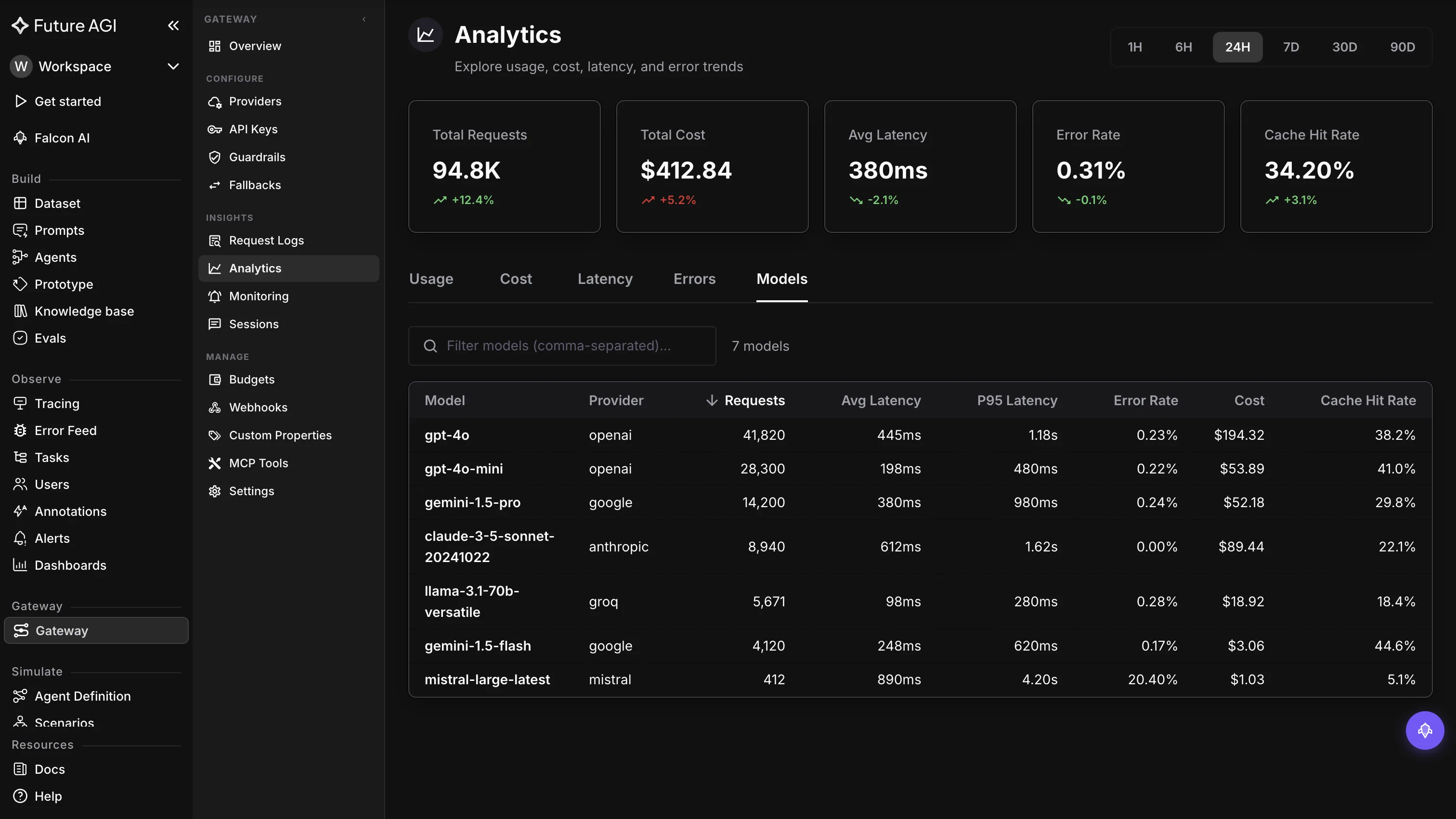
Portkey is the strongest pick when a managed SSE dashboard plus the largest provider adapter library on the streaming path is the brief, with the Palo Alto Networks acquisition risk acknowledged. The value on streaming specifically is 250+ adapters covering every commercial and OSS streaming endpoint with documented chunked-transfer-encoding pass-through across the cloud edge, plus a native dashboard that breaks down TTFT and stream-completion rate by virtual key, by feature, and by tenant without a custom Prometheus exporter.
Best for. Multi-tenant SaaS or platform teams that need a managed streaming dashboard plus the broadest adapter library on the streaming path, that accept the acquisition integration risk announced on April 30, 2026.
Key strengths.
- 250+ provider adapters; the largest library on the audited 2026 set, streaming as a first-class capability.
- Native SSE dashboard for TTFT, stream-completion rate, and chunk-rate variance by VK, by feature, and by tenant without a custom exporter.
- Three composable routing modes (loadbalance, fallback, conditional) plus three named fallback types (general, content-policy, context-window) compose against streaming failure shapes (mid-stream 5xx, mid-stream content-policy refusal, mid-stream context-window overflow).
- Open-source gateway core; self-host the gateway and run the control plane in Portkey cloud.
- The Portkey cloud edge handles anti-buffering headers and CDN configuration on the managed endpoint.
Where it falls short.
- Palo Alto Networks announced intent to acquire Portkey on April 30, 2026; the roadmap merges into Prisma AIRS, with close expected in PANW fiscal Q4 2026. Verify continuity before signing multi-year contracts on a streaming-critical chat path.
- Streaming continuity through a mid-stream failover is partial: replay on disconnect works, but documented sequence numbers and resume tokens aren’t first-class. Client SDKs see a token-zero replay rather than a resumed stream, which is a UX regression on long completions.
- WebSocket support is partial via plugins; OpenAI Realtime, Google Live API, and Anthropic Voice endpoint proxying require custom plugin code rather than first-class relays.
- gRPC pass-through for Vertex and Triton isn’t first-class.
- OTel-first stacks duplicate TTFT and stream-completion telemetry across Portkey dashboard and the OTel collector; anti-buffering headers default on cloud edge but require verification when self-hosting behind a third-party CDN (run
curl -N --no-buffer -H 'Accept: text/event-stream'through the full path before production).
Pricing and deployment. Open-source core (self-host) plus commercial cloud control plane; Developer free, Production $49/month, Enterprise custom.
Verdict. Best managed SSE dashboard in 2026 with the broadest streaming adapter library. Choose with eyes open on the Palo Alto integration timeline.
LiteLLM: Best for Python-First Streaming Teams Post-CVE
LiteLLM is the Python-first proxy that broke open the multi-provider unified-API category. It exposes 20+ providers via six native adapters (OpenAI, Anthropic, Gemini, Bedrock, Cohere, Azure) plus OpenAI-compatible presets and self-hosted backends behind OpenAI-compatible endpoints with documented chunked-transfer-encoding pass-through on the streaming path. After the March 24, 2026 supply-chain incident the answer is “yes, with commit pinning or upgrade past 1.83.7.”
Best for. Python-first platform teams already running FastAPI or uvicorn that want broad provider coverage on the streaming path, that accept commit pinning plus install-path audit after the TeamPCP supply-chain campaign.
Key strengths.
- Broadest provider coverage of any single project on this list (20+ providers via six native adapters (OpenAI, Anthropic, Gemini, Bedrock, Cohere, Azure) plus OpenAI-compatible presets and self-hosted backends), streaming documented across the adapter set.
- Apache 2.0 outside the enterprise dir; trivial to fork or audit. Streaming path code is straightforward Python and easy to extend.
- Anti-buffering headers emitted by default (
Cache-Control: no-cache,Connection: keep-alive,Transfer-Encoding: chunked); chunked transfer encoding preserved through the proxy. - Tool-call delta passthrough is first-class; forwards OpenAI function-call argument deltas byte-for-byte through the SSE stream.
- Native fit with Python observability stacks (Prometheus exporter, OpenTelemetry middleware).
- Customer logos include Netflix and Lemonade.
Where it falls short.
- March 24, 2026 PyPI supply-chain compromise. Versions
1.82.7and1.82.8were published by the TeamPCP threat actor after a Trivy GitHub Action leaked the PyPI publishing token; the malicious package exfiltrated SSH keys, cloud credentials, and Kubernetes configs via alitellm_init.pthpayload that survives uninstall, per the Datadog Security Labs writeup. The packages were live for about 40 minutes;ghcr.io/berriai/litellmDocker image was NOT impacted. Pin to 1.82.6 or upgrade past 1.83.7. - Streaming continuity through a mid-stream failover is partial. The proxy replays the prompt on disconnect, but mid-stream sequence numbers aren’t first-class and the issue queue around mid-stream failover has been open for multiple release cycles.
- WebSocket support requires the LiteLLM
realtimeextension and per-provider configuration; first-class relays for OpenAI Realtime, Google Live API, and Anthropic Voice aren’t all on the same code path. - gRPC pass-through for Vertex and Triton is partial; the Python proxy is fundamentally HTTP and gRPC is bolted on.
- Python runtime; materially slower TTFT than Go-binary alternatives at high concurrency. Typical TTFT overhead 15 to 60 ms at the proxy versus 1 to 20 ms for Go alternatives.
Pricing and deployment. Apache 2.0 outside the enterprise dir; install with pip install 'litellm>=1.83.7' --require-hashes against a private mirror, or pull the container image with Sigstore verification.
Verdict. Broadest provider coverage on the streaming path, with documented chunked-transfer-encoding pass-through and tool-call delta forwarding. The March 2026 incident shifts it from “default streaming pick” to “pin commits, sign artifacts, audit installs, and accept the Python-runtime TTFT overhead plus the partial mid-stream failover story.”
Cloudflare AI Gateway: Best for Edge-Native Streaming
Cloudflare AI Gateway is the only entry on this list where the gateway and the CDN are the same hop. The pitch for streaming: the buffer-and-batch failure mode at the edge can’t happen because the edge IS the gateway. No separate CDN hop downstream to misconfigure.
Best for. Global consumer products on Cloudflare that want streaming responses co-located with the existing Cloudflare edge, plus teams whose binding constraint is sub-30 ms TTFT overhead at the edge with no third-party CDN to configure.
Key strengths.
- Gateway runs on the Cloudflare edge itself across 320+ Points of Presence; streaming response delivered from the same PoP that serves the rest of the site.
- Native SSE pass-through; chunked transfer encoding preserved across the edge.
- Tight integration with Cloudflare Workers, Workers AI, and the Cloudflare observability stack (Logpush, Analytics).
- Per-request analytics dashboard for TTFT, completion rate, and cache hit rate at the edge.
- Edge WebSocket support for some routes; Workers users can reuse the existing WebSocket primitive for voice clients.
- Free tier covers significant production traffic.
Where it falls short.
- Mid-stream failover closes the client stream on upstream disconnect by default; sequence-numbered buffers and resume tokens aren’t first-class. The client SDK retries from the application layer, a UX regression on long completions.
- gRPC pass-through isn’t first-class; teams running Vertex gRPC streaming or self-hosted Triton route those paths around the gateway.
- Cloud-only deployment; can’t be self-hosted on-prem or air-gapped. Teams with regulated workloads or data-residency requirements outside Cloudflare’s edge regions hit a hard limit.
- OpenTelemetry-native TTFT telemetry is available via Logpush but less first-class than a native Prometheus histogram; OTel-first stacks duplicate streaming telemetry across Cloudflare Analytics and the OTel collector.
- Workers-based custom routing logic can introduce buffering on more complex deployments where the Worker terminates the stream to inspect tool calls before re-emitting. Held-out stream-quality evaluator is out of scope; the self-improving loop on streaming quality isn’t closed.
Pricing and deployment. Proprietary cloud; runs on the Cloudflare edge. Free tier plus paid tiers for higher logging retention.
Verdict. Right pick when the buying team is already on Cloudflare and the binding constraint is “no third-party CDN to misconfigure for buffering.” Not the right pick when sequence-numbered mid-stream failover, on-prem deployment, or first-class gRPC streaming are load-bearing.
Maxim Bifrost: Best for Go Throughput With Code Mode Tool Execution
Maxim Bifrost is the Go-native gateway from Maxim, Apache 2.0, with vendor-published P50 of about 11 microseconds at 5,000 RPS on t3.xlarge (Maxim’s own harness with a mock 60 ms OpenAI response) and a native Code Mode tool-call execution surface where agents write Starlark Python in a gateway-side sandbox.
The Code Mode wedge for streaming specifically is in-gateway tool execution: rather than streaming tool-call deltas to the client, the gateway executes the tool call in-stream, captures the result, and resumes the assistant turn against the upstream without a round-trip. Vendor-claimed input-token reduction is up to 92.8 percent across 508 tools on 16 MCP servers.
Best for. Go shops whose binding constraint is gateway throughput at high concurrency on the streaming path, plus teams running multi-MCP-server agentic workflows that benefit from Code Mode in-gateway tool execution.
Key strengths.
- Vendor-published benchmark showing roughly 11 microsecond P50 at 5,000 RPS on
t3.xlarge(Maxim’s own harness with a mock 60 ms upstream); lowest published gateway-overhead number on the streaming path. - Apache 2.0 single Go binary; documented anti-buffering headers default.
- Native WebSocket relay plus per-stream buffer plus cluster-mode replay for streaming SSE continuity through mid-stream failover; cluster-aware idempotency keys prevent double-billing across multi-replica deployments.
- Native MCP Code Mode where agents write Starlark Python in a gateway-side sandbox; STDIO, HTTP, and SSE transports for MCP servers.
- 4-state Adaptive Load Balancing health machine (Healthy, Degraded, Failed, Recovering) feeds the streaming routing decision.
Where it falls short.
- Maxim self-ranks Bifrost first across its own listicles (six audited articles, zero published Bifrost limitations); the absence of self-criticism is a trust signal to weigh.
- Throughput claims are vendor-published on a mock 60 ms harness; no independent reproduction. The 11 microsecond P50 is a baseline, not a settled benchmark. Realistic gateway overhead on real upstreams varies with provider TTFT distribution.
- gRPC pass-through for Vertex and Triton is partial; the gateway is HTTP-first and gRPC is bolted on.
- Observability and TTFT dashboards are thinner than Portkey’s; teams needing finance-grade streaming dashboards write their own. Held-out stream-quality evaluator is a manual procurement; the “self-improving” loop isn’t closed at the product layer.
- Code Mode is powerful for agentic chat paths but introduces a new attack surface: gateway-side Starlark execution requires careful sandboxing review. Regulated workloads should audit the sandbox configuration before production.
Pricing and deployment. Apache 2.0 single Go binary; Docker, Helm; commercial cloud tier via Maxim.
Verdict. Strongest published throughput on the streaming path plus a real pitch on Code Mode tool execution. Choose Bifrost when raw Go throughput at high concurrency and in-gateway tool execution are the binding constraints.
Decision Framework: Which Streaming Gateway Is Right For You?
The buyer profile drives the pick more than the feature matrix does.
| If you are a… | Pick | Why |
|---|---|---|
| Platform engineer or frontend lead on a consumer chat UI where TTFT is the binding UX metric | Future AGI Agent Command Center | Byte-for-byte SSE plus sequence-numbered failover plus TTFT-per-route OTel plus tool-call passthrough plus documented CDN config in one Apache 2.0 Go binary |
| Voice-first agent team needing WebSocket plus barge-in | Future AGI Agent Command Center | Native WebSocket relay for OpenAI Realtime, Google Live API, Anthropic Voice plus SSE-to-WebSocket bridge |
| Vertex-heavy ML platform team needing gRPC pass-through | Future AGI Agent Command Center | HTTP/2 frame forwarding for Vertex plus self-hosted Triton |
| Multi-tenant SaaS that wants a managed streaming dashboard | Portkey | Native SSE dashboard plus 250+ adapters (verify PANW integration timeline) |
| Python-first ML platform team | LiteLLM (1.82.6 pin or 1.83.7+) | Broad streaming provider coverage; pin commits after the March 2026 PyPI compromise |
| Global consumer product already on Cloudflare | Cloudflare AI Gateway | Gateway and CDN are the same hop; no third-party CDN to misconfigure |
| Go shop at 5,000 RPS or higher needing in-gateway tool execution | Maxim Bifrost | Vendor-published ~11 microsecond P50 plus Starlark Code Mode |
| Air-gapped or on-prem streaming workload | Future AGI Agent Command Center or Bifrost | Apache 2.0 single binary; Docker, Kubernetes, air-gapped |
| Held-out stream-quality floor and self-improving routing | Future AGI Agent Command Center | Stream-quality eval feeds agent-opt; revised routing rule picked up next request |
Streaming LLM responses in 2026 isn’t a single feature. It’s a stack: byte-for-byte SSE, WebSocket for voice, gRPC for Vertex, sequence-numbered mid-stream failover, TTFT-per-route observability, tool-call delta passthrough, and CDN compatibility, at the same network hop, under a license that isn’t about to be re-platformed inside an acquirer.
Common Implementation Mistakes
Five mistakes account for most of the bad streaming UX incidents we have seen on the 2026 audited set.
- Default nginx
proxy_buffering onin front of the gateway. The single most common production streaming failure mode. nginx ships withproxy_buffering onby default, buffering the full chunked-transfer-encoded SSE response before forwarding. Symptom: 280 ms TTFT becomes a 3 to 4 second wait followed by the entire assistant turn dumped at once. Fix:proxy_buffering offfor the gateway location, plusproxy_cache off,proxy_http_version 1.1,chunked_transfer_encoding on. Verify withcurl -N --no-buffer -H 'Accept: text/event-stream'. - CloudFront default response buffering on chunked transfer encoding. CloudFront buffers chunked responses until large enough or a timeout fires. Symptom: same as nginx, harder to debug because the buffer is at the edge. Fix: disable response buffering on the CloudFront behavior, set the origin response timeout aggressively, verify
X-Accel-Buffering: noandCache-Control: no-cache, no-transformheaders flow through. - Buffering the full assistant turn to detect tool calls. A gateway that buffers the full assistant turn to detect tool calls breaks the streaming UX on every tool invocation. Symptom: multi-second pause where there should be a token-by-token stream. Fix: forward OpenAI tool-call argument deltas byte-for-byte through the SSE stream; parse on the client side.
- Closing the SSE stream to the client on mid-stream upstream disconnect. Naive failover closes the SSE stream on a 5xx and forces the client SDK to retry from the application layer. Symptom: chat UI resets, user sees “Error, please try again,” assistant turn restarts from token zero. Fix: gateway buffers tokens with sequence numbers and replays the prompt against the next provider; client receives a transparent replay or continues from last sequence number.
- No TTFT telemetry per route. Streaming UX regressions without per-route TTFT turn into log-scrape exercises and finger-pointing between application team and model provider. Fix: emit per-request TTFT as an OTel span attribute plus a Prometheus histogram broken down by route, model, prompt template, and tenant.
Future AGI Implementation Walk-through
The seven-layer streaming stack lives inside one Apache 2.0 Go binary. The wedge over every other gateway is the closed self-improving loop on stream quality.
The flow on a single streaming chat turn behind a CloudFront distribution:
- Request enters with
stream=true. Client sendsPOST /v1/chat/completionswithX-FAGI-Stream-Resume: trueplusX-FAGI-Fallback-Route: anthropic/claude-3-5-sonnet,google/gemini-2.5-pro. The gateway records the idempotency hash and picks the Adaptive route (Groq scores highest for short prompts where TTFT dominates). - Anti-buffering headers emitted.
Content-Type: text/event-stream,Cache-Control: no-cache, no-transform,Connection: keep-alive,Transfer-Encoding: chunked,X-Accel-Buffering: no. They flow through CloudFront (response buffering disabled) and arrive intact. - First-token timing. First chunk arrives at the gateway at 184 ms; emitted to client at 191 ms (7 ms gateway overhead).
ttft_ms=191span attribute; Prometheus histogram increments the200msbucket onfagi_ttft_milliseconds_bucket{route="groq/llama-3.1-70b"}. - Tool-call delta mid-stream. At sequence 28 the upstream emits a tool-call delta with partial arguments; the gateway forwards byte-for-byte. Frontend renders “Calling search_documents…” while arguments stream in.
- Mid-stream 502. At sequence 47 the upstream returns 502. The gateway looks up the per-stream buffer (sequences 1-47 cached for 60 seconds), replays against Anthropic; the Anthropic stream emits from sequence 48 (since
X-FAGI-Stream-Resume: true); the client renders without a visible reset. - Stream-quality eval at egress. The held-out evaluator scores partial-output coherence, token-rate stability, and tool-call latency at 0.89, above the 0.82 floor. Response ships with
ttft_ms=191,total_tokens=312,token_rate_p50=42.3,failover_route=anthropic/claude-3-5-sonnet,stream_quality_score=0.89. - Self-improving loop overnight. Trace plus eval score plus TTFT plus chunk-rate variance feed agent-opt. The optimizer notices Anthropic passes the floor with 30 ms higher TTFT than Groq on this template; the revised rule prefers Groq for short prompts but routes to Anthropic for prompts longer than 2,000 tokens. The gateway picks up the revised rule on next deploy.
This is the part other gateways leave manual. The same stream-quality eval that flags a chunky response produces the labelled dataset agent-opt uses to revise the routing rule. The gateway becomes a closed-loop self-improvement layer, not a static SSE pass-through.
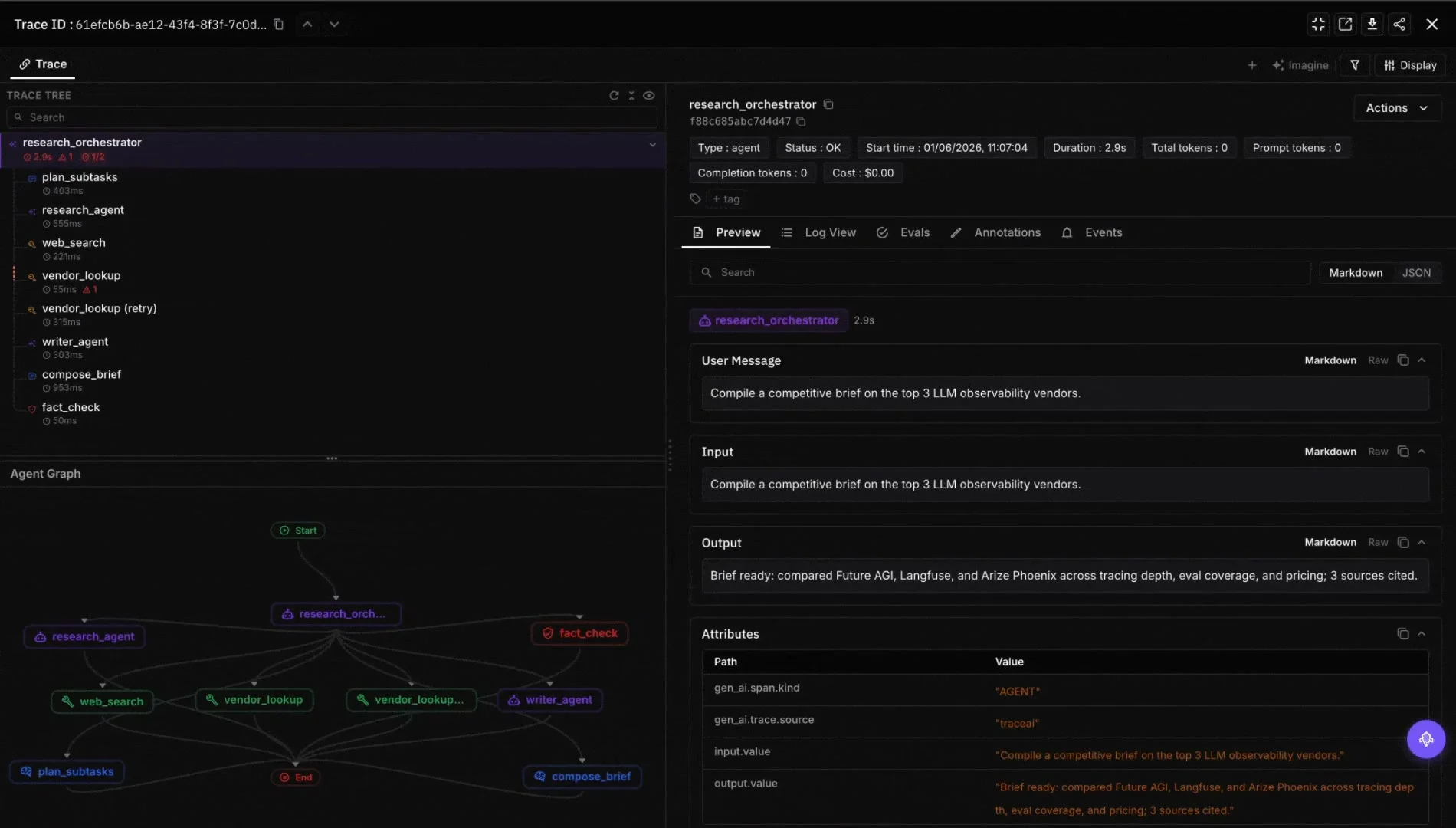
Walkthrough in Agent Command Center docs; OTel in the observability docs; held-out evaluator in the Evaluation docs; Protect’s sub-100 ms inline guardrails (median ~65 ms; arXiv 2510.13351) in the Protect docs.
Which AI Gateway Is Right For Streaming LLM Responses in 2026?
Streaming LLM responses in 2026 is no longer “does the SDK forward chunks.” It’s a stack of decisions: SSE wire format normalisation, WebSocket and gRPC bridges, sequence-numbered mid-stream failover, TTFT telemetry, tool-call delta passthrough, and CDN survival, all evaluated at the same network hop.
Future AGI Agent Command Center is the strongest pick when the buying constraint is Apache 2.0 plus OpenAI compat plus byte-for-byte SSE plus WebSocket plus gRPC plus sequence-numbered mid-stream failover plus TTFT-per-route OTel plus tool-call delta passthrough plus documented CDN configuration in one self-hostable Go binary with no pending acquisition.
Portkey is the right call when the managed SSE dashboard plus 250+ adapter library is the brief and the Palo Alto integration timeline is acceptable. LiteLLM is right for Python-first teams that can pin to 1.82.6 or upgrade past 1.83.7. Cloudflare AI Gateway is right when the team is already on Cloudflare and “no third-party CDN to misconfigure” is the binding constraint. Maxim Bifrost is right when vendor-published P50 at 5,000 RPS plus Code Mode in-gateway tool execution are the binding constraints.
For deeper reads: the Agent Command Center docs, the Future AGI GitHub repo, the observability docs, the Protect docs, the Evaluation docs, the OpenTelemetry GenAI semantic conventions, and the Datadog writeup of the LiteLLM PyPI compromise.
Try Future AGI Agent Command Center free: byte-for-byte SSE, WebSocket relay, gRPC pass-through, sequence-numbered mid-stream failover, TTFT per route in OpenTelemetry, tool-call delta passthrough, and documented CDN configuration in one Apache 2.0 Go binary.
Related reading
- Best 5 AI Gateways for LLM Cost Optimization in 2026, the five-layer cost stack and the 2026 trust cohort
- Best 5 AI Gateways for LLM Failover and Fallback in 2026, fallback and failover gateway picks
- Best 7 AI Gateways for Multi-Model Routing in 2026, how cost-quality routing decisions get made at the gateway hop
- Best 5 AI Gateways for Prompt Management in 2026, the prompt-management gateway picks
Frequently Asked Questions
What Is the Difference Between SSE, WebSocket, and gRPC for Streaming LLM Responses?
What Is a Realistic Time-to-First-Token Target Behind an AI Gateway in 2026?
Can an AI Gateway Preserve Tool-Call Deltas During a Streaming Response?
How Does Mid-Stream Failover Work in a Streaming LLM Response?
Does an AI Gateway Break Streaming Behind a CDN or Reverse Proxy?
How Does Future AGI Improve Streaming Quality Over Time?
Five AI gateways for LLM failover and fallback in 2026 scored on health-detection latency, streaming continuity, idempotency, MTTR, fallback-route quality.

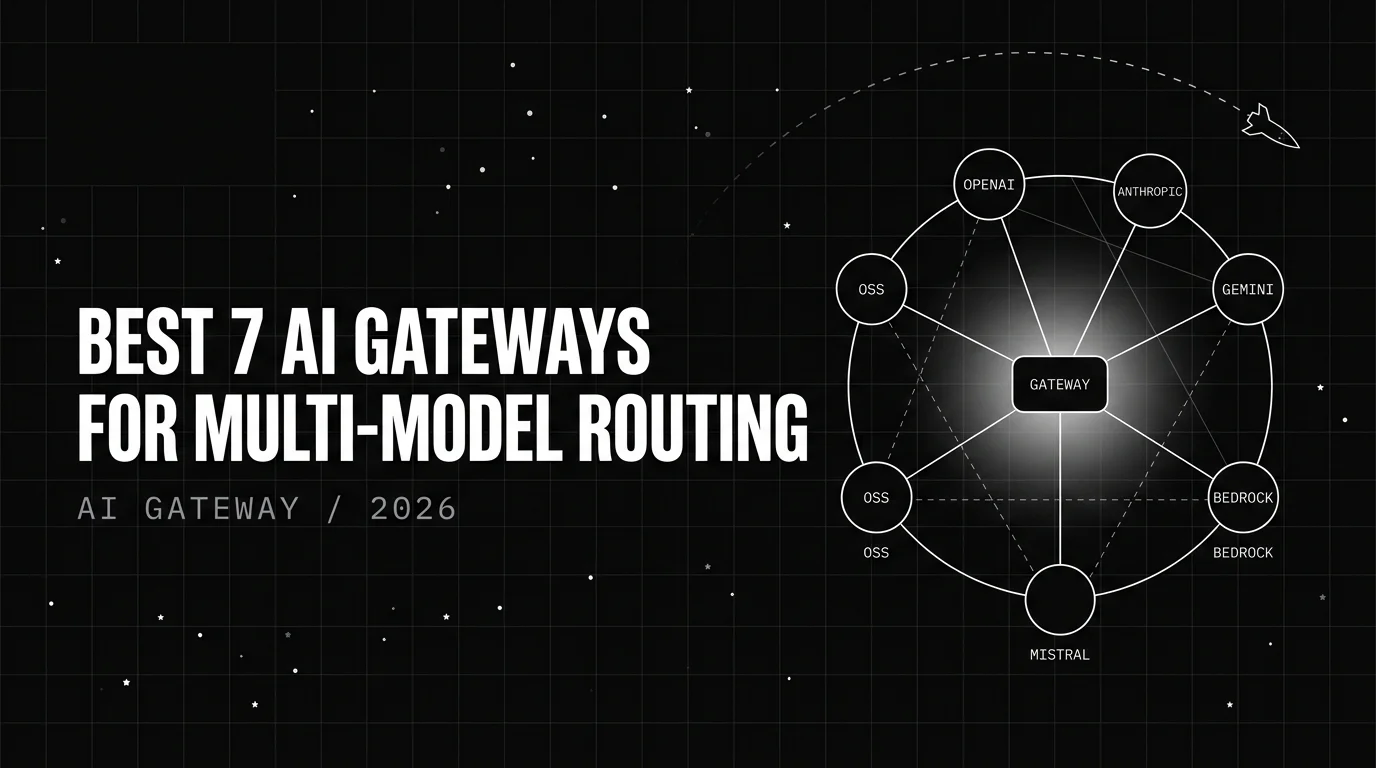
Seven AI gateways for multi-model LLM routing in 2026, ranked on the Future AGI Gateway Scorecard. Covers 15 routing strategies plus the trust cohort.
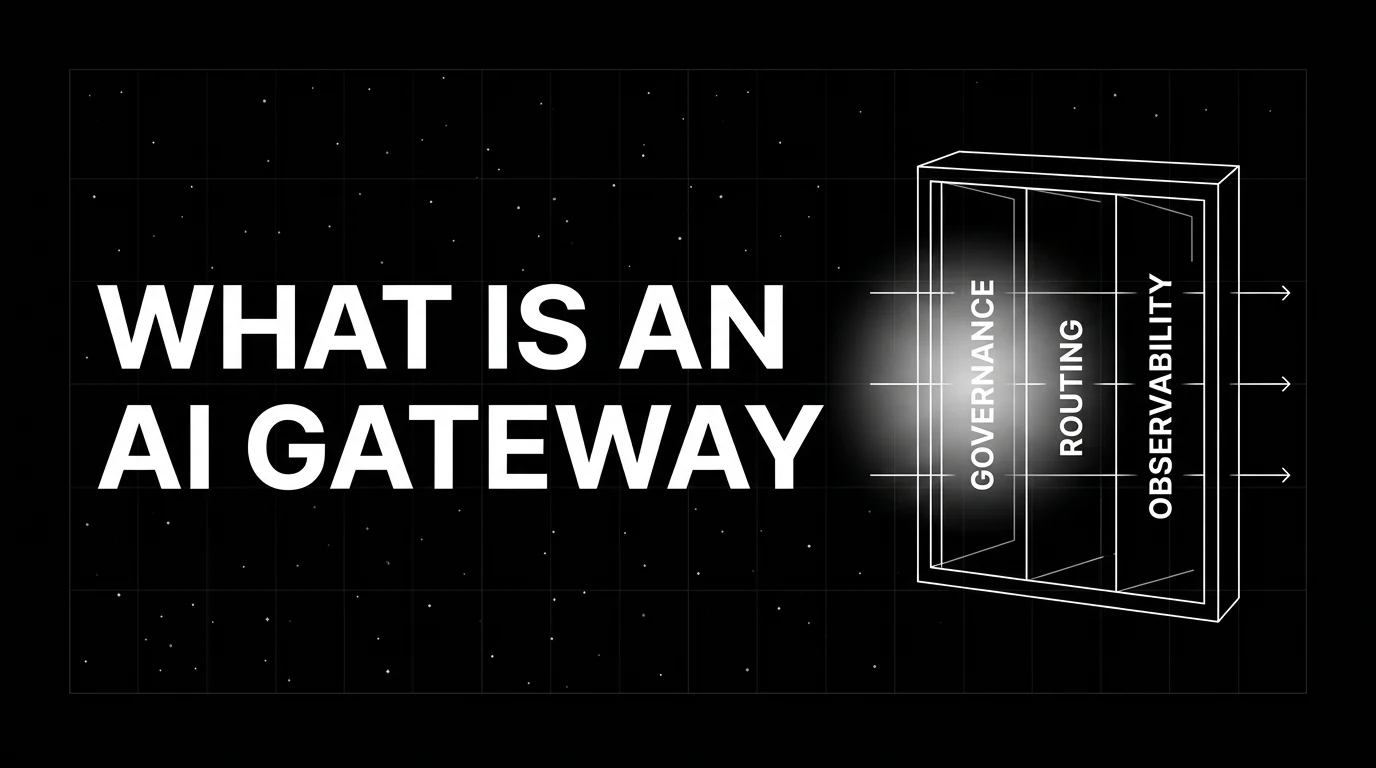
An AI gateway sits between apps and LLM providers for governance, routing, observability. What it is, how it differs from API gateways.