Best 7 AI Gateways for Multi-Model Routing in 2026
Seven AI gateways for multi-model LLM routing in 2026, ranked on the Future AGI Gateway Scorecard. Covers 15 routing strategies plus the trust cohort.
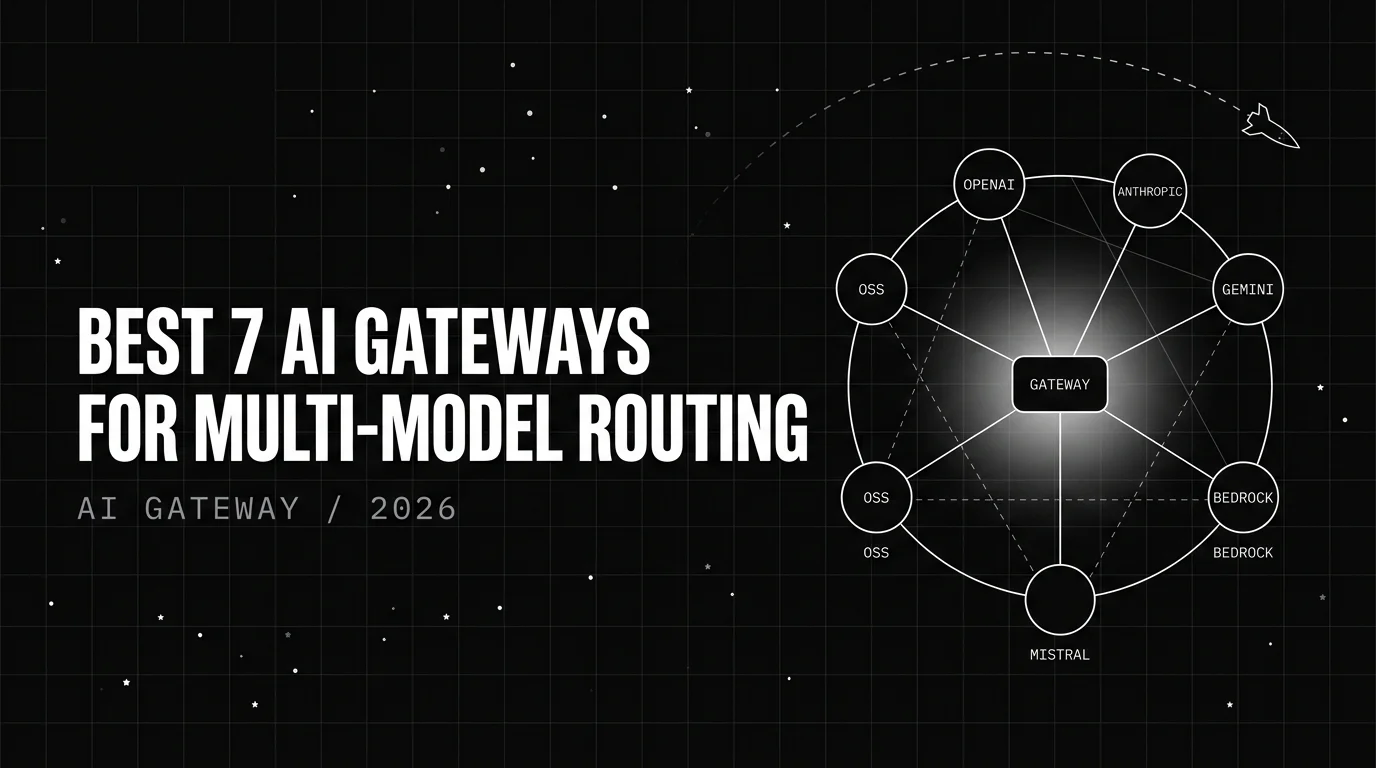
Table of Contents
Originally published May 13, 2026. Updated May 16, 2026.
A platform team shipped a customer-support copilot on a single OpenAI key in February, then watched a multi-minute provider outage in April flatline their P99 latency chart and trigger a postmortem with a finance team that already had three other providers contracted but no routing layer between them. This guide ranks the seven AI gateways production teams should consider in 2026 for multi-model routing across OpenAI, Anthropic, Bedrock, Vertex, Mistral, and 90+ other providers, with the trust cohort, routing strategy depth, and OpenTelemetry-native cost telemetry scored in the same matrix.
TL;DR: The 7 Best AI Gateways for Multi-Model Routing in 2026
Future AGI Agent Command Center is the strongest single pick for multi-model routing in 2026 because it ships 15 routing and reliability strategies combined, an OpenAI-compatible drop-in across 20+ providers via six native adapters (OpenAI, Anthropic, Gemini, Bedrock, Cohere, Azure) plus OpenAI-compatible presets and self-hosted backends, exact plus semantic caching, 18+ built-in guardrail scanners, and OpenTelemetry-native cost metrics in one Apache 2.0 Go binary you can self-host. Multi-model routing in 2026 turns on three axes the throughput-only listicles miss: the number of routing and reliability strategies you can compose, the OpenTelemetry surface you can ship to a finance dashboard, and acquisition independence under the active 2026 trust cohort (LiteLLM PyPI compromise, Anthropic MCP CVE-2026-30623, Portkey to Palo Alto Networks, Helicone to Mintlify, Keywords AI rebranded to Respan).
| # | Platform | Best for |
|---|---|---|
| 1 | Future AGI Agent Command Center | 15 routing and reliability strategies plus 18+ guardrails plus OTel-native cost metrics in one Apache 2.0 Go binary |
| 2 | Portkey | Conditional metadata routing with 9 operators plus 4-tier budget hierarchy (Palo Alto Networks acquisition pending) |
| 3 | LiteLLM | Python-first teams pinning commit hashes after the March 24, 2026 PyPI compromise |
| 4 | OpenRouter | Provider directory routing across 400+ models with one billing point (note: 5.5 percent platform fee) |
| 5 | Cloudflare AI Gateway | Edge routing tight to the Cloudflare stack (Universal Endpoint deprecated; use Dynamic Routing) |
| 6 | Respan (formerly Keywords AI) | Observability-first platform with gateway bolted on after the February 2026 rebrand |
| 7 | Maxim Bifrost | Go shops needing the lowest vendor-published P50 plus 4-factor Adaptive Load Balancing |
The 7 Multi-Model Routing Gateways at a Glance
The seven gateways cover every multi-model routing shape production teams ship in 2026: two Apache 2.0 Go binaries (Future AGI Agent Command Center, Bifrost), a source-available core (Portkey), a Python proxy (LiteLLM), a provider directory (OpenRouter), an edge-first router (Cloudflare AI Gateway), and the post-rebrand observability-first platform Respan (formerly Keywords AI).
The eight superlatives read first, then the per-platform reviews.
| Superlative | Tool |
|---|---|
| Best overall for multi-model routing | Future AGI Agent Command Center: 15 routing and reliability strategies plus 18+ guardrails plus OTel-native cost metrics in one Apache 2.0 Go binary |
| Best for OpenAI-compat drop-in routing | Future AGI Agent Command Center: base_url swap, model name as routing key, no SDK rewrite |
| Best for conditional metadata routing | Portkey: 9 conditional operators with arbitrary $and and $or nesting (acquisition pending) |
| Best for Python-first ML platforms | LiteLLM: 6 named strategies plus custom adapter across 20+ providers via six native adapters (OpenAI, Anthropic, Gemini, Bedrock, Cohere, Azure) plus OpenAI-compatible presets and self-hosted backends (pin commits after the March 2026 PyPI compromise) |
| Best for 18+ built-in guardrails on the routed path | Future AGI Agent Command Center: PII, prompt injection, MCP Security, plus 15 third-party adapters at the gateway hop |
| Best for OpenTelemetry-native routing telemetry | Future AGI Agent Command Center: OpenTelemetry GenAI semantic conventions plus Prometheus metrics |
| Best for self-hosted or air-gapped routing | Future AGI Agent Command Center: Apache 2.0 single Go binary; Docker, Kubernetes, air-gapped |
| Best for raw routing throughput | Maxim Bifrost: vendor-published 11 microsecond P50 at 5,000 RPS on a mock 60 ms response harness |
The single most cited number in 2026 multi-model routing coverage (organisations on a single LLM overpay by 40 to 85 percent compared to teams on intelligent routing) is also the single most misleading one without a quality floor. For the underlying per-model economics, the LLM pricing and cost comparison guide is the reference. The Routing Strategy Fit section below maps each named strategy to the production workload it actually wins.
The 2026 Multi-Model Routing Migration and Trust Cohort
Every multi-model routing listicle on the SERP is treating the 2026 trust cohort and the April model proliferation as if they didn’t happen. Both reshape the routing procurement question for the next 12 months.
2026 multi-model routing migration and trust cohort (verified Q2 2026):
- Helicone joining Mintlify (March 3, 2026). Roadmap shifts toward documentation platform first; Helicone enters maintenance mode (security updates, new-model support, bug and performance fixes only; no active feature development). Helicone served 16,000 organizations over three years.
- LiteLLM PyPI supply-chain compromise (March 24, 2026). Versions
1.82.7and1.82.8published by the TeamPCP threat actor after a Trivy GitHub Action leaked the PyPI publishing token; the malicious package exfiltrated SSH keys, cloud credentials, and Kubernetes configs via alitellm_init.pthpayload that survives package uninstall. Packages were live for about 40 minutes on PyPI before quarantine. The official Docker imageghcr.io/berriai/litellmwasn’t impacted. Pin to 1.82.6 or earlier, scan dependency trees, rotate credentials. Source: Datadog Security Labs writeup of the LiteLLM PyPI compromise and the LiteLLM official advisory.- Anthropic MCP STDIO command injection class (April 2026). OX Security disclosed an STDIO transport class flaw affecting 7,000+ public MCP servers and 150M+ downstream downloads. CVE-2026-30623 was assigned to LiteLLM as one of the downstream packages affected; LiteLLM patched the issue in version 1.83.7-stable. MCP-routed traffic now expected to enforce least-privilege tool access, OAuth 2.1, and Streamable HTTP rather than raw STDIO. Source: the LiteLLM CVE-2026-30623 advisory and the Hacker News writeup.
- Portkey announced for acquisition by Palo Alto Networks (April 30, 2026). Roadmap merges into Prisma AIRS as the unified AI control plane; close expected in Palo Alto’s fiscal Q4 2026 subject to customary closing conditions. Verify continuity before signing multi-year contracts. Source: the Palo Alto Networks press release.
- Keywords AI rebranded to Respan (February 20, 2026). keywordsai.co now 301-redirects to respan.ai; dedicated
/llm-gatewayand/multi-llm-routerpages were deleted in the rebrand. New positioning is “self-driving AI observability and evals for agents.” Routing was demarketed in favor of observability.- OpenTelemetry GenAI semantic conventions 1.37 (early May 2026). Stable spans, metrics, and events for GenAI clients, MCP, and providers, anchored to the Linux Foundation Agentic AI Foundation. Routing gateways that ship OTel exports as first class move first on the new conventions.
The practical takeaway: routing strategy depth and OpenTelemetry-native cost telemetry are now first-class procurement axes alongside provider count and throughput. A routing layer that gets acquired, breached, or end-of-lifed in the next 12 months is a routing layer you have to re-platform.
How Did We Score Multi-Model Routing AI Gateways in 2026?
We used the Future AGI Production Gateway Scorecard, a seven-dimension rubric tuned for the multi-model routing procurement.
Most multi-model routing listicles in 2026 score on raw throughput plus provider count and stop there; a 2026 routing procurement decision turns on five extra axes the throughput-and-count chart can’t resolve.
The five axes the throughput chart misses: the named routing strategies the gateway ships, the reliability primitives stacked on top (failover, retries, circuit breaking, fallbacks), the OpenTelemetry surface for routing telemetry, the guardrail depth that gates routed traffic, and the 2026 trust cohort (acquisition risk, supply chain hygiene, license clarity).
| # | Dimension | What we measure (multi-model routing lens) |
|---|---|---|
| 1 | Provider breadth | Supported provider count; OpenAI-compat surface (chat, embeddings, files, vector stores, Assistants, batch); MCP and A2A support |
| 2 | Routing strategy depth | Number of named routing strategies; reliability primitives (failover, retries, circuit breaking, fallbacks, complexity-based, provider lock); load balancing modifiers |
| 3 | Latency overhead | Added P99 latency at production load; benchmark provenance (vendor self versus independent third party) |
| 4 | Guardrail depth on the routed path | Built-in scanner count; sub-100 ms enforcement; whether guardrails can short-circuit a routed call |
| 5 | Observability | OpenTelemetry-native (OpenTelemetry GenAI semantic conventions); Prometheus export; per-request cost and token attribution; trace-to-eval linking via span_id |
| 6 | Deployment flexibility | OSI-approved license; self-host (Docker, Kubernetes); air-gapped; cloud managed option; FedRAMP and SOC 2 path |
| 7 | Total cost of ownership and acquisition independence | Per-token markup versus raw provider cost; SDK migration effort; supply chain hygiene; pending acquisitions inside the 2026 trust cohort |
For a routing procurement specifically, dimensions 2 and 5 do the heaviest lifting. A gateway that wins on provider count but ships only Round Robin is a different procurement than the same gateway with Adaptive plus Cost Optimized plus Race.
We don’t publish a single composite score. The decision matrix below the per-tool reviews maps buyer profiles to picks.
The 16-Dimension Routing Capability Matrix the SERP Is Missing
Across the seven gateways below, Future AGI Agent Command Center leads on combined routing strategy depth, guardrail depth, OpenTelemetry observability, and license clarity. Portkey wins on conditional metadata routing operator depth. Bifrost wins on vendor-published P50 throughput plus 4-factor adaptive scoring.
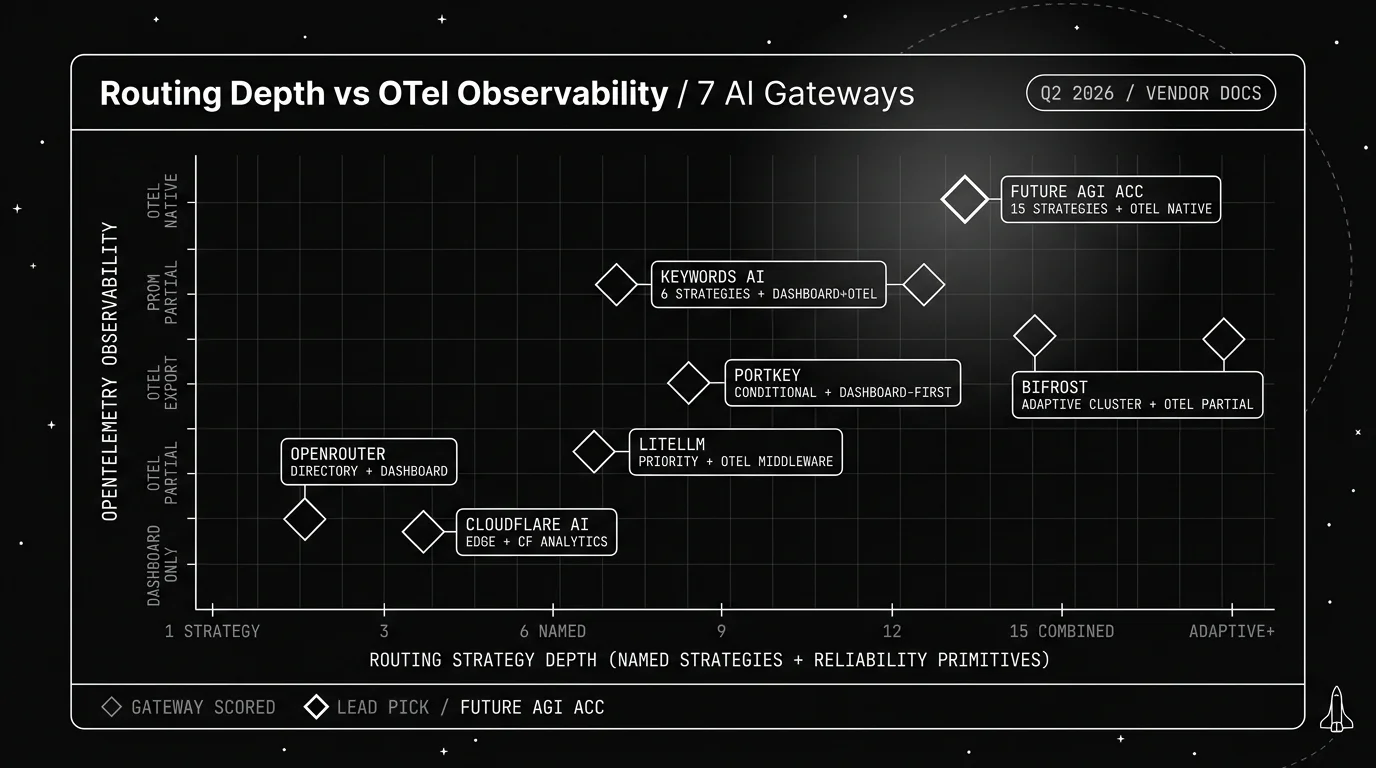
The 16-dimension matrix below is the single thing most multi-model routing listicles on the SERP are missing. Maxim ships zero comparison columns in three of six audited articles; no audited competitor publishes more than seven named routing strategies in one place.
| Capability | Future AGI ACC | Portkey | LiteLLM | OpenRouter | Cloudflare AI | Respan | Bifrost |
|---|---|---|---|---|---|---|---|
| Routing strategies (count) | 6 named (15 routing and reliability combined) | 3 composable (loadbalance, fallback, conditional with 9 operators) | 6 named plus custom adapter | Provider directory plus Auto Router (NotDiamond) | 5 Dynamic Routing (Conditional, Percentage, Rate Limit, Budget, Segment) | Two modes (router or passthrough) | 1 named Adaptive (4-factor: Error 50 percent, Latency 20 percent, Util 5 percent, Momentum) plus CEL |
| Pricing model | Apache 2.0 plus cloud (free + pay-as-you-go base; compliance + enterprise add-ons as you scale) | Source available core plus cloud (Palo Alto Networks acquisition pending) | Apache 2.0 OSS (pin commits after the March 2026 PyPI compromise) | Per-token markup plus 5.5 percent platform fee on pay-as-you-go | Cloud only on Cloudflare | $0 Pro / $199/mo Team / Enterprise custom | Apache 2.0 plus cloud (Enterprise via sales) |
| Language and runtime | Single Go binary | Node plus Python SDKs (source available) | Python | API only | Edge worker | Cloud first | Single Go binary |
| Supported providers | 100 plus | 1,600 plus | 100 plus | 60 plus (400 plus models) | 20 plus | 250 plus (per docs) | 23 plus (1,000 plus models) |
| Deployment options | Docker, K8s, AWS, GCP, Azure, air-gapped or on-prem | Cloud plus self host plus air-gapped (at Enterprise) | pip install or Docker self host | Cloud only | Cloud only on Cloudflare | Cloud first | Docker, K8s, in-VPC |
| Unified API (OpenAI compat) | Yes (base_url swap) | Yes | Yes | Yes | Yes (OpenAI-compatible endpoint; Universal Endpoint deprecated) | Yes | Yes |
| Exact caching | Yes (in memory or Redis) | Yes (Redis) | Yes (basic) | No | Yes (basic) | Yes (semantic) | Yes |
| Semantic caching | Yes (in memory, Qdrant, Pinecone) | Yes | Partial | No | No | Yes | Yes (vector similarity) |
| Failover | Yes (per provider) | Yes | Yes | allow_fallbacks default true | Yes (basic) | Yes | Yes (per provider plus cluster) |
| Retries with backoff | Yes (configurable) | Yes | Yes (num_retries, exponential backoff) | Provider side | Yes (max 5 attempts, 5s cap) | Yes | Yes |
| Circuit breaking | Yes | Yes | Partial (via cooldowns) | No | Partial | Partial | Yes (4-state health: Healthy, Degraded, Failed, Recovering) |
| Model fallbacks | Yes (named list) | Yes (general / content-policy / context-window) | Yes (3 fallback types) | Yes (transparent) | Yes | Yes | Yes |
| Per-key budgets | Yes (per key, per VK, per model, per window) | Yes (4-tier hierarchy, Enterprise) | Yes (basic) | No | Limited | Yes | Yes (Customer, Team, VK, Provider) |
| Observability | Prometheus metrics plus OTLP traces | Native dashboard plus OTel partial | OTel middleware | Native dashboard only | Native dashboard | Native plus OTel (observability-first) | OTel partial |
| Load balancing | Yes (Weighted, Adaptive, Race) | Yes (weight normalization, sticky with hash_fields plus ttl) | Yes (weighted by RPM/TPM) | Inverse-square weighting by price | Yes (edge) | Yes | Yes (Adaptive with 25 percent exploration probability) |
| MCP support | Yes (gateway layer plus MCP Security scanner) | Partial | Limited (CVE-2026-30623 advisory issued) | No | No | Partial | Yes (Code Mode, STDIO, HTTP, SSE) |
The shape of the matrix is the shape your buying decision will be: nobody wins every column, and the four columns that matter most for multi-model routing (routing strategy depth, circuit breaking, model fallbacks, OpenTelemetry observability) are where the field separates.
Multi-Model Routing Strategy Fit by Production Workload
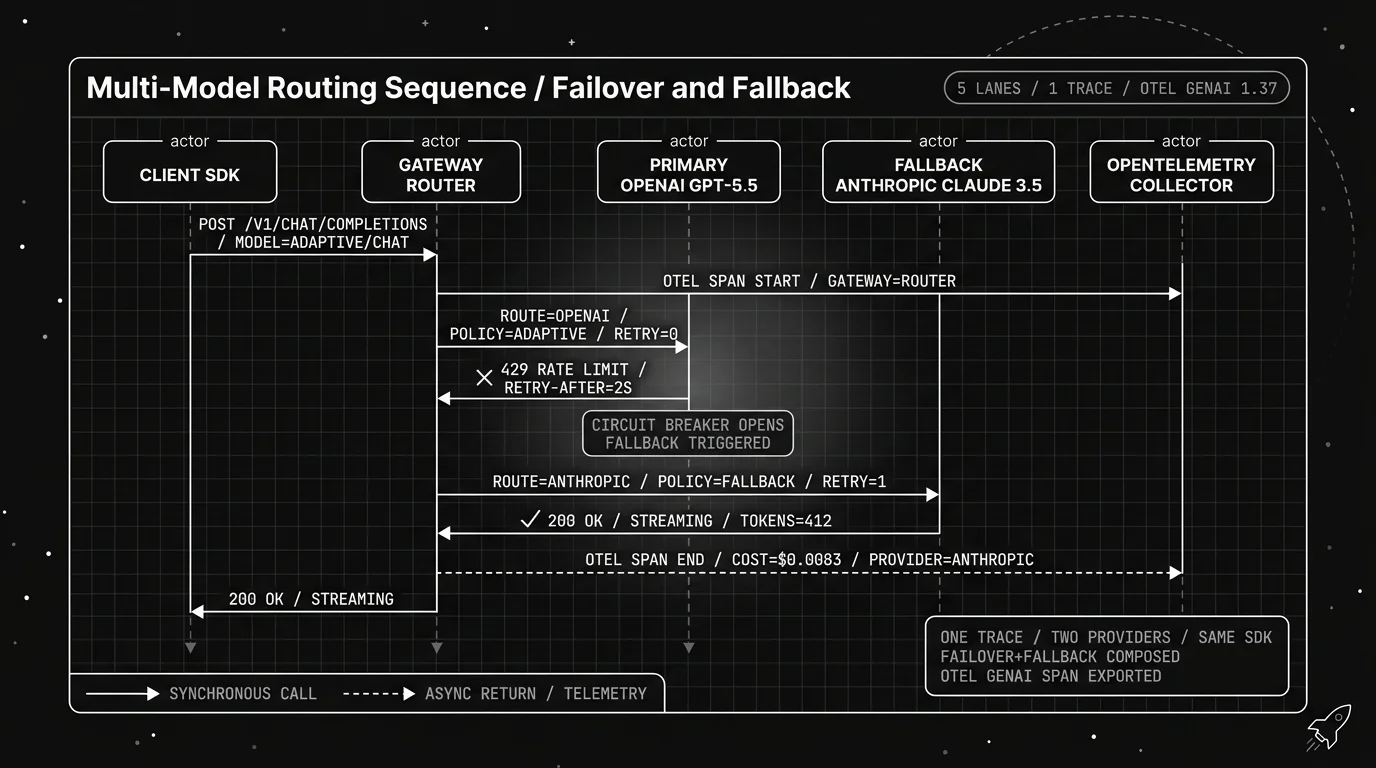
Multi-model routing in 2026 isn’t one decision. Six named routing strategies plus six reliability primitives plus three load balancing modifiers compose against the workload shape, with a different combination winning each shape.
The six named routing strategies are Round Robin, Weighted, Least Latency, Cost Optimized, Adaptive, and Race. The six reliability primitives that stack on top are failover, retries with backoff, circuit breaking, model fallbacks, complexity-based routing, and provider lock. The three load balancing modifiers are Weighted, Sticky, and Shadow.
| Workload | Recommended primary strategy | Reliability stack |
|---|---|---|
| Customer support chat | Adaptive on a quality plus latency score | Failover, retries with backoff, model fallback to a higher tier on guardrail block |
| Agent inner loop (tool calls) | Provider lock for determinism | Retries with backoff, circuit breaking on tool errors, complexity-based routing for the planner step |
| Batch classification | Cost Optimized with a quality floor evaluator | Failover, retries; no semantic cache, no race |
| Code generation | Weighted across reasoning-tier models | Model fallback from Opus to Sonnet on rate limit, circuit breaking |
| RAG retrieval plus answer | Least Latency for embedding plus Adaptive for answer | Failover on embedding, model fallback on answer, sticky load balancing per conversation |
| Voice agent (sub-800 ms) | Race across the two lowest-latency providers | Retries with backoff; no semantic cache (latency budget too tight) |
| Internal copilot | Round Robin for A/B testing | Failover, model fallback, shadow load balancing to a candidate model |
Production teams typically run two strategies in series: a primary strategy (Adaptive, Cost Optimized, or Least Latency depending on workload) plus a fallback chain (failover to a secondary provider, then model fallback to a higher tier). A gateway that ships only one of the six named strategies is a router, not a multi-model gateway. Once a routing policy is live, evaluating LLM routing policies with shadow traffic is how you confirm it picks the right model.
Future AGI Agent Command Center: Best Overall for Multi-Model Routing
Future AGI Agent Command Center tops the 2026 multi-model routing list because it bundles every layer of the routing stack at the same network hop in one Apache 2.0 Go binary you can self-host.
It loses on out-of-the-box managed dashboard polish to Portkey and on raw single-dimension Go throughput to Bifrost; for buyers whose binding constraint is 15 routing and reliability strategies plus 18+ built-in guardrails plus OpenTelemetry-native cost metrics in one self-hostable binary, the combined surface still puts it first.
The bundled surface is an OpenAI-compatible drop-in across 20+ providers via six native adapters (OpenAI, Anthropic, Gemini, Bedrock, Cohere, Azure) plus OpenAI-compatible presets and self-hosted backends, 15 routing and reliability strategies combined, exact plus semantic caching, per-virtual-key budgets, 18+ built-in guardrail scanners, and OpenTelemetry-native cost metrics. The full surface is documented in the Agent Command Center docs and the source ships at the Future AGI GitHub repo.
Every other gateway forces you to wire two or three of these layers together; Agent Command Center attaches them at the same network hop.
Best for. Engineering teams already running OpenTelemetry that want OpenAI compat drop in, the deepest routing strategy library, 18+ built-in guardrails on the routed path, and cost plus token metrics emitted into their existing observability stack, without rewriting SDK code or accepting acquisition risk on the routing layer.
Key strengths.
- OpenAI-compatible drop-in: change
base_urltohttps://gateway.futureagi.com/v1, keep existing SDK code unchanged. The model name is the routing key. - 15 routing and reliability strategies combined: six routing (Round Robin, Weighted, Least Latency, Cost Optimized, Adaptive, Race), six reliability (failover, retries, circuit breaking, model fallbacks, complexity-based, provider lock), three load balancing (Weighted, Sticky, Shadow).
- 20+ providers via six native adapters (OpenAI, Anthropic, Gemini, Bedrock, Cohere, Azure) plus OpenAI-compatible presets and self-hosted backends (OpenAI, Anthropic, Gemini, Bedrock, Azure, Cohere, Groq, Together, Fireworks, Mistral, plus self-hosted Ollama, vLLM, LM Studio).
- The Future AGI Protect model family at the gateway layer for inline guardrails, ~65 ms p50 text and ~107 ms p50 image (arXiv 2510.13351). Protect is FAGI’s own fine-tuned model family built on Google’s Gemma 3n with specialized adapters across four safety dimensions (content moderation, bias detection, security/prompt-injection, data privacy/PII), natively multi-modal across text, image, and audio, a model family, not a plugin chain. A dedicated MCP Security scanner sits alongside (relevant after CVE-2026-30623, the Anthropic MCP STDIO command-injection class, April 2026), and the same dimensions are reusable as offline eval metrics so the prod policy and the eval rubric stay in sync.
- Prometheus metrics plus OTLP trace export, feeding Grafana and the Future AGI Evaluation pipeline through
span_idlinking from gateway trace to eval result.traceAIinstruments 50+ AI surfaces across Python, TypeScript, Java, and C# (including Spring Boot starter, Spring AI, LangChain4j, Semantic Kernel) OpenInference-natively, and Error Feed. the part of the eval stack, the clustering and what-to-fix layer that feeds the self-improving evaluators, turns those traces into named issues with zero config: auto-clusters related routing-quality failures (50 traces → 1 issue), auto-writes the root cause plus a quick fix plus a long-term recommendation per issue, and tracks rising/steady/falling trend per issue so model-fallback regressions get triaged like exceptions rather than buried in OTel rows. - Apache 2.0 single Go binary; Docker, Kubernetes, AWS, GCP, Azure, air-gapped or on-prem; no pending acquisition.
Limitations.
- Full execution tracing for agents is currently an “In Progress” roadmap item on the public roadmap in the Future AGI GitHub repo and is rolling out alongside the existing gateway-side OpenTelemetry trace export.
from openai import OpenAI

client = OpenAI(
    api_key="$FAGI_API_KEY",
    base_url="https://gateway.futureagi.com/v1",
)

# Adaptive routing across two providers; the model name is the routing key,
# and the gateway applies failover, fallbacks, and OTel cost telemetry at the
# same network hop without SDK changes.
response = client.chat.completions.create(
    model="adaptive/chat",
    messages=[{"role": "user", "content": "Summarise this support ticket."}],
)
Use case fit. Strong for OpenTelemetry-first teams, multi-tenant SaaS, agent platforms running deep routing logic, fintech with per-customer budget enforcement, and platform teams wanting routing plus evals plus tracing in one Apache 2.0 stack. Less optimal when a managed routing dashboard out of the box is required.
Pricing and deployment. Apache 2.0 single Go binary; cloud endpoint at https://gateway.futureagi.com/v1 or self-host (Docker, Kubernetes, air-gapped). SOC 2 Type II, HIPAA, GDPR, and CCPA all certified; BAA available via FAGI sales.
Verdict. The strongest single pick when the 2026 buying constraint is Apache 2.0 plus OpenAI compat plus 15 routing and reliability strategies plus OTel-native cost metrics in one self-hostable Go binary, with no pending acquisition. Teams that want a managed routing dashboard before any infrastructure work should evaluate Portkey alongside.
Portkey: Best for Conditional Metadata Routing With 9 Operators
Portkey is the strongest pick when conditional routing on request metadata is the brief, with the Palo Alto Networks acquisition risk acknowledged.
Portkey’s conditional routing operator surface is the most expressive in the gateway category: nine comparison operators ($eq, $ne, $in, $nin, $regex, $gt, $gte, $lt, $lte) plus two logical operators ($and, $or) with arbitrary nesting, on three queryable namespaces (metadata.*, params.*, url.pathname).
Best for. Multi-tenant SaaS or platform teams that need fine-grained conditional routing (route customer A to Anthropic, route customer B to Bedrock) plus a managed cost dashboard, and that accept the acquisition integration risk announced on April 30, 2026.
Key strengths.
- Conditional routing rules with nine operators plus arbitrary
$and/$ornesting on metadata, request params, and URL path. The most expressive query DSL in the gateway category. - Three composable routing modes: loadbalance (with weight normalization and sticky
hash_fieldsplusttl), fallback (general, content-policy, context-window), and conditional. - Per-key, per-virtual-key, per-model, per-time-window budgets; the most fine-grained native dashboard hierarchy on the list.
- Adapter library claims range from 1,600+ to 3,000+ LLMs depending on the page (internal inconsistency).
- Source available core (entire gateway open-sourced March 2026); self-host the core and optionally run the control plane in Portkey cloud.
Limitations.
- Palo Alto Networks announced intent to acquire on April 30, 2026; the roadmap merges into Prisma AIRS, and standalone gateway status is pending through fiscal 2026. The PANW press release reframes Portkey as “the central nervous system to monitor, route, and secure every AI transaction,” a security-buyer lens, not engineering DX.
- Published two-segment key limitation in conditional routing: only
metadata.<key>andparams.<key>work; nested paths likemetadata.features.new_model_enabledare explicitly NOT supported. - Provider count inconsistency (1,600+ on one page, 3,000+ on another) is a trust signal procurement teams will flag.
- Observability is dashboard-first; OpenTelemetry export exists but is less first-class than the native dashboard.
- HIPAA BAA gated to the Enterprise tier; granular budget hierarchy gated to Enterprise.
Use case fit. Strong for multi-tenant SaaS that route by customer, platform teams running multiple AI products that need conditional rules, and teams that accept acquisition risk. Less optimal when routing cost data must flow into an existing OTel collector and Grafana stack as a first-class output.
Pricing and deployment. Open-source self-host (free), Developer free, Production $49/month, Enterprise custom. Install with docker run portkeyai/gateway or via the Helm chart.
Verdict. Most mature conditional routing operator surface in 2026, with acquisition risk priced in. The next 12 months will tell whether the standalone product survives the Prisma AIRS merger.
LiteLLM: Best for Python-First ML Platform Teams Post-PyPI-Compromise
LiteLLM is the Python-first proxy that broke open the multi-provider unified API category, Apache 2.0 outside the enterprise directory, with 20+ providers via six native adapters (OpenAI, Anthropic, Gemini, Bedrock, Cohere, Azure) plus OpenAI-compatible presets and self-hosted backends and the broadest community. After the March 24, 2026 supply-chain incident the answer is “yes, with commit pinning and credential rotation,” not “yes, by default.”
Best for. Python-first teams already running a FastAPI or uvicorn surface that want the broadest provider list and accept commit pinning plus install-path audit after the TeamPCP supply-chain campaign.
Key strengths.
- Broadest provider coverage of any single project on this list (20+ providers via six native adapters (OpenAI, Anthropic, Gemini, Bedrock, Cohere, Azure) plus OpenAI-compatible presets and self-hosted backends). Six named routing strategies (
simple-shuffle,least-busy,latency-based-routing,rate-limit-aware,rate-limit-aware-v2,cost-based-routing) plus a custom adapter (CustomRoutingStrategyBase) verified against the LiteLLM routing docs. - Apache 2.0 outside the enterprise directory; trivial to fork or audit; clean
1.83.0and later releases restore supply-chain hygiene. - Virtual keys with per-key budgets; budget alerts; Python observability native (Prometheus, OpenTelemetry middleware).
- Active maintainer community; easy to extend with custom routing adapters.
- Customer logos: Netflix (David Leen quote) and Lemonade (Mark Koltnuk quote).
Limitations.
- March 24, 2026 PyPI supply-chain compromise. Versions
1.82.7and1.82.8were published by the TeamPCP threat actor after a Trivy GitHub Action leaked the PyPI publishing token. The malicious package shipped a credential harvester, a Kubernetes lateral-movement toolkit, and a persistentlitellm_init.pthpayload that auto-executes on every Python process startup and survives package uninstall. Packages were live for about 40 minutes on PyPI before quarantine. The official Docker imageghcr.io/berriai/litellmwas NOT impacted. Pin to 1.82.6 or earlier, scan dependency trees, rotate any credentials accessible to an affected install. Source: the Datadog Security Labs writeup and the LiteLLM security advisory. - Published warning from LiteLLM’s own docs: “Usage-based routing isn’t recommended for production due to performance impacts” and “adds significant latency due to Redis operations.”
- Published TPM enforcement caveat: “RPM provides strict limits at exact thresholds, while TPM is best-effort because token counts remain unknown until the LLM responds.”
- Python runtime; throughput tops out earlier than Go-binary alternatives at high concurrency.
- Adaptive routing scoring is more manual than Portkey or Future AGI ACC; complex conditional rules need custom code.
Use case fit. Strong for Python-first teams and ML platform teams already managing Python services. Less optimal when routing throughput exceeds 10,000 req/s or a managed runtime forbids commit-pinned dependencies.
Pricing and deployment. Apache 2.0; install with pip install 'litellm>=1.83.0' --require-hashes against a private mirror, or pull the container image with Sigstore verification. Vendor-published benchmarks (4-instance setup) show 2 ms median, 8 ms P95, 13 ms P99 overhead at 1k RPS.
Verdict. Still the broadest provider coverage on the list, but the March 2026 PyPI compromise shifts it from “default routing pick” to “pin commits, sign artifacts, audit installs.”
OpenRouter: Best for Provider-Directory Routing With 400+ Models
OpenRouter is the simplest entry on the list: one API key, one base URL, 400+ active models on 60+ providers per the verified May 2026 homepage count, with an Auto Router powered by NotDiamond.
For multi-model routing specifically, OpenRouter answers “I want to A/B different models without writing routing code,” not “I want six named strategies plus six reliability primitives at the gateway layer.”
Best for. Small teams or early-stage experiments that want unified provider access across the widest model catalogue, plus cost shoppers comparing per-token economics across providers.
Key strengths.
- 400+ active models on 60+ providers with transparent price comparison on the OpenRouter models directory; provider logos include Anthropic, OpenAI, Google, Meta, Microsoft, DeepSeek, Mistral.
- Four named routing mechanisms: Auto Router (NotDiamond meta-model routes to ~33 to 38 curated frontier models), Provider Routing, Auto Exacto (provider ordering for tool calling using throughput, success rate, benchmark signals), Model Fallbacks.
- Single API key, single base URL, single billing point; minimal setup overhead.
- Failed and fallback attempts not billed.
- Useful for early-stage exploration and prompt-router experiments before committing to a self-hosted gateway.
Limitations.
- OpenRouter is a router, not a gateway. No exact or semantic caching, no per-key budget enforcement, no guardrails, no PII redaction, no published uptime SLA, no observability beyond an activity log.
- 5.5 percent platform fee on pay-as-you-go (drops to 5 percent after the first 1M free requests per month). The “we don’t mark up provider pricing” headline is true on token prices; the platform fee is separate.
- Auto Router selection criteria are opaque (“optimizing for quality”); only the chosen model is exposed via the response
modelfield. - Free tier 50 req/day is hostile dev experience for serious evaluation workloads.
- Multiple docs URLs (
/docs/features,/docs/routing,/docs/features/provider-routing,/docs/features/uptime-optimization,/docs/features/model-routing) return 404; the canonical Auto Router doc is/docs/guides/routing/routers/auto-router.
Use case fit. Strong for early-stage teams, prompt-routing experiments, and anyone comparing raw provider economics. Less optimal once production volume crosses the platform-fee break-even or when reliability primitives become load-bearing.
Pricing and deployment. Token list price plus 5.5 percent platform fee on pay-as-you-go; cloud only.
Verdict. Lowest-friction unified provider access with the broadest model directory; not the right pick when routing strategy depth and reliability primitives are the brief.
Cloudflare AI Gateway: Best for Edge-First Routing on the Cloudflare Stack
Cloudflare AI Gateway is the edge-first router, tightly integrated with the rest of the Cloudflare stack (Workers, KV, R2, Vectorize), with one endpoint that connects applications to AI services and adds caching, rate limiting, logs, analytics, and request retries.
The Universal Endpoint is deprecated as of 2026; Cloudflare’s current documentation directs new integrations to the OpenAI-compatible endpoint with Dynamic Routing for fallbacks, retries, and conditional routing.
Best for. Teams already on Cloudflare Workers that want LLM routing at the edge, plus teams whose binding constraint is reducing inter-region latency to the upstream model.
Key strengths.
- Edge-first deployment: routing decisions at the Cloudflare edge, close to the user.
- Five named Dynamic Routing strategies: Conditional (
if/elseon request body, headers, metadata, e.g.user_plan == 'paid'), Percentage-Based (A/B and gradual rollouts), Rate Limit, Budget / Cost-Based, Segment-Based. - Per-model timeouts and retries (constant, linear, exponential backoff; max 5 attempts;
retryDelaycapped at 5 seconds). - Tight integration with Workers, KV, R2, and Vectorize.
- New 2026: Unified Billing (third-party model usage on the Cloudflare invoice with a small transaction convenience fee).
- Named customers: Platzi (replaced homegrown solution; fallbacks plus rate-limiting for runaway cost control), RightBlogger (~10 percent cache rate, ~10 percent OpenAI cost reduction).
Limitations.
- Universal Endpoint deprecated; existing users face migration friction.
- Cloud only; no air-gapped, no self-host option. The gateway is bound to the Cloudflare network.
- No latency-based routing, no weighted random, no semantic-similarity per-request routing in the named strategy list.
- Provider list is smaller than competitors (20+ versus Vercel 40+ or OpenRouter 60+).
- No published routing-overhead P99; the “90 percent latency reduction” Cloudflare cites applies to caching, not routing.
- Reliability primitives are thinner: failover and retries are supported; per-virtual-key budgets and conditional metadata routing aren’t first-class compared to Portkey or Future AGI ACC.
Use case fit. Strong for Cloudflare-native teams and edge-first applications. Less optimal where guardrail depth, per-virtual-key budgets, or OpenTelemetry-native cost telemetry weigh against the edge latency advantage.
Pricing and deployment. Cloud only on Cloudflare; included in eligible CF plans plus per-request fees and the new Unified Billing transaction fee.
Verdict. Right pick when your stack is already Cloudflare and edge latency is the binding constraint. Not the pick when routing strategy depth or guardrail depth are load-bearing.
Respan (Formerly Keywords AI): Best for Observability-First Unified Platform
Keywords AI rebranded to Respan on February 20, 2026. The keywordsai.co domain now 301-redirects to respan.ai, and the previously dedicated /llm-gateway and /multi-llm-router pages were deleted in the rebrand. New positioning: “Self-driving AI observability and evals for agents.”
Respan was the closest direct competitor to Future AGI Agent Command Center in the audited 2026 tool set when it was Keywords AI. Post-rebrand, routing has been subordinated to observability and evals, which vacates the “routing-first unified platform” position the original Keywords AI held.
Best for. Teams that want a unified observability plus evaluation platform with a gateway bolted on, and that prioritise managed cloud over Apache 2.0 self-host.
Key strengths.
- 250+ LLMs per docs (500+ per homepage marketing; internal inconsistency).
- Routing and passthrough docs: “Two ways to call Respan: a unified router or a provider-native passthrough.”
- Observability-first surface: distributed tracing, semantic caching, evaluations including LLM-as-judge, version-controlled prompt management, per-user spend caps.
- Single-line API endpoint swap from Portkey with dual-write configuration for parallel cutover; Respan publicly positions itself as “the closest functional replacement for Portkey’s full surface.”
- Mature SDKs for Python, TypeScript, and Node; OpenAI-compatible API surface.
- Customers: AlphaSense, Retell AI, Gumloop, Lovable, Finta, Mem0, Giga.
Limitations.
- Routing surface demarketed during the rebrand. Multiple gateway docs sub-pages (
/docs/features/routing,/docs/features/gateway,/docs/gateway,/docs/reliability,/docs/routing-and-passthrough,/docs/reliability/fallback) return 404 as of May 2026. - Pro tier capped at 412 req/min, which is sub-production for many multi-model routing workloads.
- Cloud first; the self-host story is narrower than Apache 2.0 alternatives.
- MCP gateway support isn’t first-class; no dedicated MCP Security scanner equivalent to Future AGI’s 18+ built-in scanner library.
- Honestly published gaps (rare in the category): “Additional latency from routing through a gateway layer”; “Newer platform with smaller community”; “Some advanced provider-specific features may not be fully supported.”
Use case fit. Strong for teams that want one product covering observability plus evals plus a gateway, and that accept managed cloud over self-host. Less optimal when air-gapped, Apache 2.0 single binary, 18+ built-in guardrails, or first-class routing depth are the buying constraint.
Pricing and deployment. $0 Pro / $199/month Team / Enterprise custom. HIPAA compliance add-on at $249/month. Gateway throughput cap 412 req/min on Pro, 8,400 req/min on Team, Custom on Enterprise.
Verdict. The post-rebrand observability-first product is the closest unified competitor to Future AGI ACC, but the demarketed routing surface and sub-production Pro tier throughput cap leave Future AGI Agent Command Center as the routing-first unified pick.
Maxim Bifrost: Best for Raw Go Throughput on the Routed Path
Maxim Bifrost is the Go-native AI gateway from Maxim, Apache 2.0, with vendor-published P50 of about 11 microseconds at 5,000 RPS on t3.xlarge (Maxim’s own harness with a mock 60 ms OpenAI response) and a documented 4-factor Adaptive Load Balancing strategy.
It’s the gateway most often cited when raw routing throughput is the binding constraint, with cluster mode for horizontal scale across Bifrost replicas.
Best for. Go shops whose binding constraint is routing throughput at high concurrency, plus teams running multi-MCP-server agentic workflows that need MCP Code Mode token reduction.
Key strengths.
- Vendor-published benchmark showing roughly 11 microsecond mean P50 at 5,000 RPS on
t3.xlarge(Maxim’s own harness with a mock 60 ms upstream). - Documented Adaptive Load Balancing scoring formula: Error Penalty 50 percent, Latency 20 percent, Utilization 5 percent, plus a Momentum component. Four health states (Healthy under 2 percent error, Degraded at 2 percent threshold, Failed above 5 percent error or TPM exceeded, Recovering with 90 percent penalty reduction in 30 seconds). 25 percent exploration probability for recovery probing.
- Apache 2.0 single Go binary; zero-configuration startup; drop-in container or binary deployment.
- Hierarchical budgets at four levels (Customer, Team, Virtual Key, Provider) with configurable reset cycles.
- Native MCP Code Mode where agents write Starlark Python in a sandbox; supports STDIO, HTTP, and SSE transports.
- Dual-layer caching (exact hash plus vector similarity) plus vault integrations across HashiCorp, AWS, GCP, and Azure.
Limitations.
- Maxim self-ranks Bifrost first across its own multi-model routing listicles (six audited articles, zero published Bifrost limitations).
- Routing strategy count varies between three and six across Maxim’s six SERP-ranking articles; the canonical taxonomy lives only in the public
docs.getbifrost.ai/enterprise/adaptive-load-balancingpage. - Observability and cost attribution dashboards are thinner than Portkey’s; teams that need a finance-grade routing dashboard write their own.
- Throughput claims are vendor-published on a mock 60 ms harness; no independent reproduction. Treat as a baseline rather than a settled benchmark.
Use case fit. Strong for Go shops, high-throughput inference paths, and multi-MCP-server agentic workflows. Less optimal when per-tenant cost attribution emitted into an OpenTelemetry collector is the brief.
Pricing and deployment. Apache 2.0; Docker, Kubernetes; commercial cloud tier via Maxim. Install with docker run maximhq/bifrost.
Verdict. Strong throughput and adaptive scoring, but the “go faster” pitch isn’t the same as the “compose 15 strategies” pitch. Choose Bifrost when routing throughput is the primary axis; choose Future AGI Agent Command Center when strategy depth and OTel-native cost telemetry are.
Multi-Model Routing Picks by Buyer Profile in 2026
The buyer profile drives the pick more than the strategy count does.
OpenTelemetry-first engineering teams pick Future AGI Agent Command Center; multi-tenant SaaS teams that need conditional metadata routing pick Portkey.
Python-first ML platform teams pick LiteLLM with commit pinning, early-stage teams comparing providers pick OpenRouter, Cloudflare-native teams pick Cloudflare AI Gateway, teams that want one observability-plus-evals product with a gateway bolted on pick Respan, and Go shops at 5,000 RPS or higher pick Bifrost.
| If you are a… | Pick | Why |
|---|---|---|
| OpenTelemetry-first team running 20+ providers via six native adapters (OpenAI, Anthropic, Gemini, Bedrock, Cohere, Azure) plus OpenAI-compatible presets and self-hosted backends in production | Future AGI Agent Command Center | 15 routing and reliability strategies plus OTel-native metrics in one Apache 2.0 Go binary |
| Multi-tenant SaaS routing by customer or route ID | Portkey | Conditional metadata routing with 9 operators plus 4-tier budget hierarchy (verify Palo Alto integration timeline) |
| Python-first ML platform team | LiteLLM (commit pinned) | 6 named strategies plus custom; pin commits after the March 2026 PyPI compromise |
| Early-stage team comparing per-token economics | OpenRouter | 400+ models, one billing point (note 5.5 percent platform fee) |
| Cloudflare Workers native team needing edge latency | Cloudflare AI Gateway | Edge-first routing tight to the Cloudflare stack (Universal Endpoint deprecated) |
| Team wanting one observability plus evals product with a gateway bolted on | Respan (formerly Keywords AI) | Unified observability-first surface; cloud first |
| Go shop where 5,000 RPS or higher routing throughput is primary | Maxim Bifrost | Vendor-published 11 microsecond P50 plus documented 4-factor Adaptive scoring |
| Team running Claude Code or multi-MCP-server agentic workflows | Maxim Bifrost | Native MCP Code Mode for token reduction across STDIO, HTTP, and SSE |
| Air-gapped or on-prem regulated environment | Future AGI Agent Command Center or Bifrost | Apache 2.0 single binary; Docker, Kubernetes, air-gapped |
| Fintech or healthcare with per-customer routing plus audit trail | Future AGI Agent Command Center | Per-virtual-key budgets plus tag-based enforcement plus span-level cost attribution |
Which AI Gateway Is Right for Multi-Model Routing in 2026?
Multi-model routing in 2026 is no longer a single strategy. It’s a stack of decisions: six named routing strategies, six reliability primitives, three load balancing modifiers, OpenTelemetry-native telemetry, guardrails on the routed path, and acquisition independence, all evaluated together at the same network hop.
Of the seven gateways above, Future AGI Agent Command Center is the strongest pick when the buying constraint is Apache 2.0 plus OpenAI compat plus 15 routing and reliability strategies plus 18+ built-in guardrails plus OpenTelemetry-native cost metrics in one Go binary you can self-host, with no pending acquisition.
Portkey is the right call when the 9-operator conditional metadata routing surface is the brief and the Palo Alto integration timeline is acceptable. LiteLLM is the right call for Python-first teams that can pin to 1.82.6 or earlier after the March CVE.
OpenRouter is the right call when 400+ model directory access with one billing point outweighs the 5.5 percent platform fee at your current scale. Maxim Bifrost is the right call when vendor-published P50 at 5,000 RPS or 4-factor Adaptive scoring is the binding constraint.
For deeper reads on the patterns referenced above:
- The Agent Command Center docs for the full gateway feature surface.
- The Future AGI observability docs for the audit log path and OpenTelemetry surface the routing layer plugs into.
- The Future AGI Evaluation docs for the eval-to-gateway link via
span_idthat gates Cost Optimized routing with a quality floor. - The Future AGI Protect docs for the runtime guardrail library plus 15 third-party adapters at the gateway layer.
- The Future AGI GitHub repo for the Apache 2.0 source.
External references for the trust events and standards cited above:
- The Datadog Security Labs writeup of the LiteLLM PyPI compromise.
- The LiteLLM security advisory March 2026.
- The LiteLLM advisory for CVE-2026-30623.
- The Palo Alto Networks announcement of intent to acquire Portkey.
- The Hacker News writeup of the Anthropic MCP design vulnerability.
- The OpenTelemetry GenAI semantic conventions and the Model Context Protocol specification.
Try Agent Command Center free. 15 routing strategies, 18+ guardrails, and OpenTelemetry cost metrics in one Apache 2.0 Go binary.
Related reading
- Best 5 AI Gateways for LLM Cost Optimization in 2026, the five-layer cost stack and the 2026 trust cohort
- Best 5 AI Gateways for LLM Failover and Fallback in 2026, fallback and failover gateway picks
- Best 5 AI Gateways for Prompt Management in 2026, the prompt-management gateway picks
- Best 5 AI Gateways for Semantic Caching in 2026, the semantic cache deep-dive across the cohort
Frequently Asked Questions
What Is the Best AI Gateway for Multi-Model Routing in 2026?
What Is Multi-Model Routing in an AI Gateway?
What Is the Difference Between Failover and Fallback in an AI Gateway?
How Does Adaptive Routing Decide Which Model to Use?
Can an AI Gateway Route Across OpenAI, Anthropic, and Bedrock in One Call?
Does Routing Across Providers Save Money on LLM Cost in 2026?

A 2026 field guide to LLM routing: definition, five strategies (round-robin, weighted, latency, cost, quality), architecture, myths.

OpenRouter, Portkey, LiteLLM, RouteLLM, Martian, FutureAGI, Kong AI for LLM routing in 2026. Compared on routing depth, fallbacks, and pricing.

Five AI gateways for LLM failover and fallback in 2026 scored on health-detection latency, streaming continuity, idempotency, MTTR, fallback-route quality.