Best 5 AI Gateways for Semantic Caching in 2026
Five AI gateways for semantic caching in 2026 scored on backend choice, embedding model, TTL, per-tenant isolation, threshold tuning, hit-rate.
Table of Contents
Originally published May 17, 2026.
A fintech platform team flipped semantic caching on last Friday, watched the OpenAI bill drop 41 percent over the weekend, and woke up to a Slack thread on Monday because the cache had served a Tier-1 customer’s loan summary to a Tier-3 customer’s session. The threshold was 0.88, the namespace was global, and the hit-rate dashboard lagged by twelve hours. This guide compares the five AI gateways production platform engineers should choose between in 2026 for semantic caching, scored on cache backend, embedding-model choice, TTL and invalidation, per-tenant isolation, threshold tuning, hit-rate observability, and cache coherence on prompt updates, with primary sources and real production numbers.
TL;DR: 5 Semantic-Caching Gateways Scored on the Seven Axes Platform Engineers Actually Care About
Future AGI Agent Command Center is the strongest single pick for semantic caching in 2026 because it bundles exact plus semantic caching, swappable embedding models, per-template threshold tuning, tag-based per-tenant namespacing, OpenTelemetry-native hit-rate telemetry, and a write-side Protect scanner that blocks cache poisoning at ~65 ms in one Apache-2.0 Go binary you can self-host. The seven axes that separate a 2026 semantic-caching gateway from a 2024 LLM proxy with a Redis bolt-on are backend choice, embedding selection, threshold control, tenant isolation, invalidation on prompt change, hit-rate observability, and poison resistance.
| # | Platform | Best for | One thing platform engineers should know |
|---|---|---|---|
| 1 | Future AGI Agent Command Center | Exact + semantic + tag-based tenant isolation + per-template threshold + OTel hit-rate telemetry + write-side Protect in one Apache-2.0 Go binary | Protect adds roughly 65 ms before cache insertion, blocking poisoned prompts before they can be served back to another tenant |
| 2 | Portkey | Mature managed semantic cache with TTL plus similarity-threshold tuning out of the box | Palo Alto Networks acquisition announced April 30, 2026; close expected PANW fiscal Q4 2026 |
| 3 | Helicone | Lightweight per-request observability with a fixed semantic cache; in maintenance mode | Acquired by Mintlify on March 3, 2026; roadmap shifting toward documentation-platform-first |
| 4 | Cloudflare AI Gateway | Edge cache for low-latency exact matches across global PoPs | Semantic cache is opt-in and runs on Cloudflare’s managed embedding; no swap-in alternative |
| 5 | Maxim Bifrost | Go-native semantic cache plus the lowest published gateway-overhead numbers | Vendor-published roughly 11 µs mean gateway overhead at 5,000 RPS on t3.xlarge |
The 5 Semantic-Caching Gateways at a Glance
The five cover every shape of semantic-caching deployment platform teams ship in 2026: an Apache-2.0 open-source platform with all seven axes in one binary (Future AGI), a mature managed cache with acquisition pending (Portkey), a lightweight observability proxy now in maintenance mode (Helicone), an edge cache from a hyperscaler CDN (Cloudflare), and a Go throughput leader (Bifrost).
| # | Platform | Best for | License + deployment |
|---|---|---|---|
| 1 | Future AGI Agent Command Center | Exact + semantic + swappable embedding + tag-based tenant isolation + OTel-native hit rate + write-side Protect in one Apache-2.0 platform | Apache 2.0; cloud at gateway.futureagi.com/v1 or self-host (Docker, Kubernetes, air-gapped) |
| 2 | Portkey | Managed semantic cache + TTL + threshold tuning + per-tenant budget hierarchy | MIT (open-source gateway) + cloud control plane; PANW acquisition pending |
| 3 | Helicone | Lightweight per-request observability; fixed semantic cache | MIT; cloud + self-host; Mintlify acquisition, maintenance posture |
| 4 | Cloudflare AI Gateway | Edge cache at global PoPs; managed embedding | Cloud only; Workers and Cache integration |
| 5 | Maxim Bifrost | Go semantic cache + lowest published gateway-overhead numbers | Apache 2.0; Docker, Helm, in-VPC |
Helicone is intentionally still in the ranked list because many platform teams running it today are evaluating where to migrate. After the March 3, 2026 acquisition by Mintlify, existing Helicone users should treat semantic caching as a planned migration target rather than a continued procurement.
How Did We Score AI Gateways for Semantic Caching?
We used the Future AGI Production Gateway Scorecard for Semantic Caching. Most 2026 semantic-caching listicles score on “does it have a semantic cache” and stop. The scorecard below runs seven axes that decide whether the cache actually saves money in production without poisoning a tenant.
| # | Axis | What we measure (platform-engineer lens) |
|---|---|---|
| 1 | Cache backend | In-memory, Redis, Qdrant, Pinecone; horizontal scale; persistence guarantees |
| 2 | Embedding model selection | Default model; swap surface; latency tradeoff per model; cost per lookup |
| 3 | TTL controls and invalidation | Per-key TTL, per-namespace TTL, header overrides, prefix purge, prompt-version purge |
| 4 | Per-tenant cache isolation | Tag-based namespacing, tenant_id enforcement at gateway hop, audit-mode logging |
| 5 | Hit-rate observability | Hit rate as a first-class metric; per-tenant breakdown; saved-cost attribution; OpenTelemetry export |
| 6 | Semantic-threshold tuning | Per-template threshold, false-positive measurement, eval feedback loop |
| 7 | Cache coherence on prompt updates | prompt_version cache axis, prefix invalidation, registry integration |
Axes 4, 5, 6, and 7 are the four that decide whether semantic caching ships in production at a multi-tenant SaaS or fintech without a postmortem.
How Semantic Caching Actually Cuts the LLM Bill (and Where It Breaks)
Semantic caching cuts the LLM bill across two layers that have to run in series. A gateway that ships only one layer at production load is a demo.
- Exact caching. Hash the request (model, messages, parameters, tool definitions) and return the cached response on a byte-for-byte match. Free on hit. Typically catches 5 to 20 percent of customer-facing traffic and 30 to 60 percent of agent inner loops where the same status-check, retry, or tool-call template repeats. Latency on hit is sub-1 ms with in-memory and 2 to 5 ms with Redis.
- Semantic caching. Embed the prompt and look it up in a vector store; return the cached response when cosine similarity is above a configurable threshold. Catches the paraphrased queries the exact cache misses. Hit rates of 20 to 60 percent on customer-support workloads, 10 to 25 percent on conversational copilots, 40 to 70 percent on internal-copilot or analytics templates once the threshold and TTL are tuned. Latency is 8 to 12 ms on a small embedding model with an in-memory vector store, 30 to 80 ms on a larger embedding with a remote vector store.
In production the two run as a pipeline: exact lookup first; on miss, embed and try the semantic lookup; on miss again, fall through to the LLM. The combined hit rate is exact + semantic, and the cost saved is hit rate times average call cost times request volume.
That’s the easy part. The hard part is the seven things that go wrong:
- False positives. A threshold of 0.88 catches more, but a question about “how do I cancel my subscription?” can serve the answer to “how do I cancel a transaction?” if both prompts embed close enough. A 1 percent false-positive rate at 10 million requests per month is 100,000 wrong answers.
- Cross-tenant leakage. A single namespace serves the same answer to every customer. A multi-tenant SaaS without
tenant_idnamespacing leaks Tier-1 outputs to Tier-3 sessions. - Cache poisoning. A user-controlled prompt is embedded and stored. The next user whose prompt embeds nearby is served the attacker’s answer. Without a write-side guardrail, the gateway is a poison delivery surface.
- Stale answers after prompt updates. A template change without invalidation serves the old behaviour for the entire TTL window. Customers see a regression that the team has already shipped a fix for.
- Hit-rate fog. A vendor dashboard says 41 percent hit rate; the OpenAI bill says 8 percent saved. The dashboard is counting raw lookups, not cost-weighted hits.
- Embedding drift. The vendor swaps the managed embedding model, every cached entry is now in a different vector space, and the hit rate quietly collapses.
- TTL collisions. A 24-hour TTL keeps serving an answer that a downstream business event already invalidated (a price change, a policy update, a feature deprecation).
The five gateways below are scored against the seven axes plus all seven failure modes. A gateway that ships layer 1 and 2 but ignores poison defense, tenant isolation, prompt-version invalidation, and OTel-native hit-rate telemetry is good for a demo. It’s bad for production at a fintech.
Future AGI Agent Command Center: Best Overall for Semantic Caching
Future AGI Agent Command Center tops the 2026 semantic-caching list because it ships every axis of the seven-axis scorecard at the same network hop in one Apache-2.0 Go binary you can self-host.
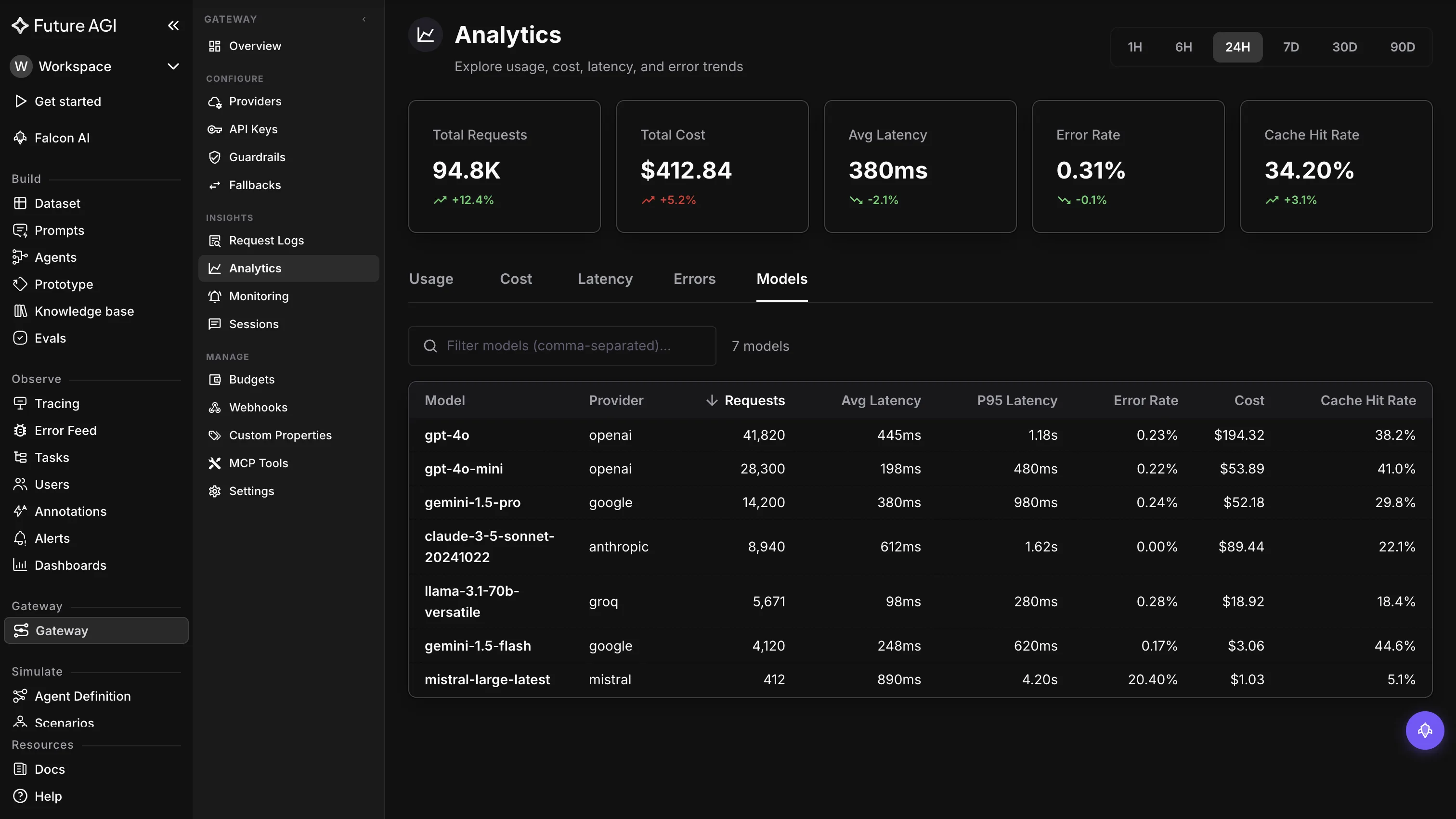
The combined surface is the OpenAI-compatible drop-in across 20+ providers via six native adapters (OpenAI, Anthropic, Gemini, Bedrock, Cohere, Azure) plus OpenAI-compatible presets and self-hosted backends, exact caching with in-memory or Redis backend, semantic caching with in-memory, Qdrant, or Pinecone backend, swappable embedding model per cache config, per-template cosine threshold, tag-based per-tenant namespacing, OpenTelemetry-native hit-rate and saved-cost telemetry on the same span, a prompt_version axis for coherence on template updates, and the write-side Protect scanner that runs at roughly 65 ms (per the Future AGI Protect paper, arXiv 2510.13351) before insertion to block prompt-injected or PII-tagged requests from entering the cache.
The full surface is documented in the Agent Command Center docs and the source ships under Apache 2.0 in the Future AGI GitHub repo.
Best for. Platform engineering and SRE teams at multi-tenant SaaS, fintech, and internal-copilot platforms that want exact plus semantic caching, swappable embedding, per-tenant namespacing, OTel-native hit-rate telemetry, and write-side poison defense in one Apache-2.0 binary, self-hosted or cloud, without operating four products.
Key strengths.
- OpenAI-compatible drop-in: change
base_urltohttps://gateway.futureagi.com/v1, keep the existing OpenAI SDK code unchanged. - Exact cache backends: in-memory for single-region simplicity, Redis for horizontal scale and persistence.
- Semantic cache backends: in-memory for development, Qdrant or Pinecone for production; swap by config.
- Embedding model selection per cache config:
text-embedding-3-small(default),text-embedding-3-large,BAAI/bge-small-en-v1.5, or any OpenAI-compatible embedding endpoint. - Per-template cosine threshold; per-key, per-namespace, and per-request TTL overrides;
Cache-Control: no-storeopt-out; force-refresh header for write-through bypass. - Tag-based namespacing with first-class
tenant_idenforcement; the gateway short-circuits a cross-tenant lookup before the vector index is touched. - OpenTelemetry-native hit-rate, saved-cost, false-positive, and per-tenant breakdown attributes on every span; Prometheus metrics on
/-/metricsfor Grafana dashboards.traceAIinstruments 50+ AI surfaces across Python, TypeScript, Java, and C# (including Spring Boot starter, Spring AI, LangChain4j, Semantic Kernel) OpenInference-natively, and Error Feed (the part of the eval stack, the clustering and what-to-fix layer that feeds the self-improving evaluators) sits alongside as the zero-config error monitor: auto-clusters related false-positive cache hits and namespace-leak failures (50 traces → 1 issue), auto-writes the root cause plus a quick fix plus a long-term recommendation, and tracks rising/steady/falling trend per issue so cache-quality regressions surface like exceptions rather than buried in cache analytics.
- Write-side enforcement via the Future AGI Protect model family at ~65 ms p50 text and ~107 ms p50 image (per arXiv 2510.13351); blocks prompt-injected or PII-tagged prompts before they enter the cache. Protect is FAGI’s own fine-tuned model family built on Google’s Gemma 3n with specialized adapters across four safety dimensions (content moderation, bias detection, security/prompt-injection, data privacy/PII), natively multi-modal across text, image, and audio, a model family, not a plugin chain.
- Self-improving loop: the same eval that flags a false-positive cache hit produces the labelled dataset that the
agent-optcomponent uses to revise the threshold and the cache policy. Cache quality improves with traffic, not in spite of it.ai-evaluation(Apache 2.0) ships a 60+ EvalTemplate classes in theai-evaluationSDK with self-improving evaluators on the Future AGI Platform across task completion, faithfulness, tool-use, structured-output, hallucination, and groundedness, plus unlimited custom evaluators authored end-to-end by an in-product eval-authoring agent that uses tool calling on your code and context, plus self-improving evaluators that learn from live production traces, plus FAGI’s proprietary classifier model family that scores any cache-hit decision at very low cost-per-token (lower per-eval cost than Galileo Luna-2). Catalog is the floor, not the ceiling. - Apache 2.0
traceAI,ai-evaluation, andagent-optcomponents; single Go binary; Docker, Kubernetes, AWS, GCP, Azure, on-prem, air-gapped, cloud atgateway.futureagi.com/v1.
Where it falls short.
- Out-of-the-box managed-dashboard polish for cache analytics is thinner than Portkey’s; teams that want a finance-grade “saved this month” view without writing a Grafana panel will want Portkey instead.
- Full agent-execution tracing is an “In Progress” roadmap item per the public roadmap in the Future AGI GitHub repo and is rolling out alongside the existing gateway-side OpenTelemetry trace export.
- Edge-cache topology across global PoPs isn’t the architecture; teams that need a cached response served at the nearest Cloudflare PoP for sub-50 ms global P50 should pair the gateway with Cloudflare AI Gateway at the edge.
- The default embedding is OpenAI’s
text-embedding-3-small; teams that need an air-gapped embedding have to wire an open-weight model (bge-small-en-v1.5or similar) and run it themselves. - The write-side Protect adds roughly 65 ms; for ultra-latency-sensitive paths (high-frequency trading prompt scoring at sub-100 ms total) the same hop is acceptable, but it’s a cost worth measuring.
from openai import OpenAI

client = OpenAI(
    api_key="$FAGI_API_KEY",
    base_url="https://gateway.futureagi.com/v1",
)

# Exact cache (Redis) + semantic cache (Qdrant) + tenant isolation via tag
# all apply at the same network hop; the Protect scanner runs at ~65 ms
# before any prompt is written to the cache.
response = client.chat.completions.create(
    model="anthropic/claude-3-5-sonnet",
    messages=[{"role": "user", "content": "Summarise this support ticket."}],
    extra_headers={
        "x-fagi-tenant-id": "acct_12345",
        "x-fagi-cache-namespace": "support_copilot_v3",
        "x-fagi-prompt-version": "2026-05-17",
    },
)
Use case fit. Strong for OpenTelemetry-first engineering teams, multi-tenant SaaS, fintech with per-customer cost attribution and tenant isolation requirements, and platform teams that want eval plus tracing plus gateway plus cache in one Apache-2.0 platform. Less optimal for teams that want a fully managed cache analytics dashboard before writing any infrastructure code.
Pricing and deployment. Apache 2.0 single Go binary; cloud-hosted endpoint at https://gateway.futureagi.com/v1 or self-host (Docker, Kubernetes, air-gapped).
Verdict. The strongest single pick when the 2026 semantic-caching story is “we want exact plus semantic caching, swappable embedding, per-tenant namespacing, write-side poison defense, and OTel-native hit-rate telemetry in our existing observability stack, in one Apache-2.0 binary.”
Portkey: Best for Managed Semantic Cache With Threshold Tuning
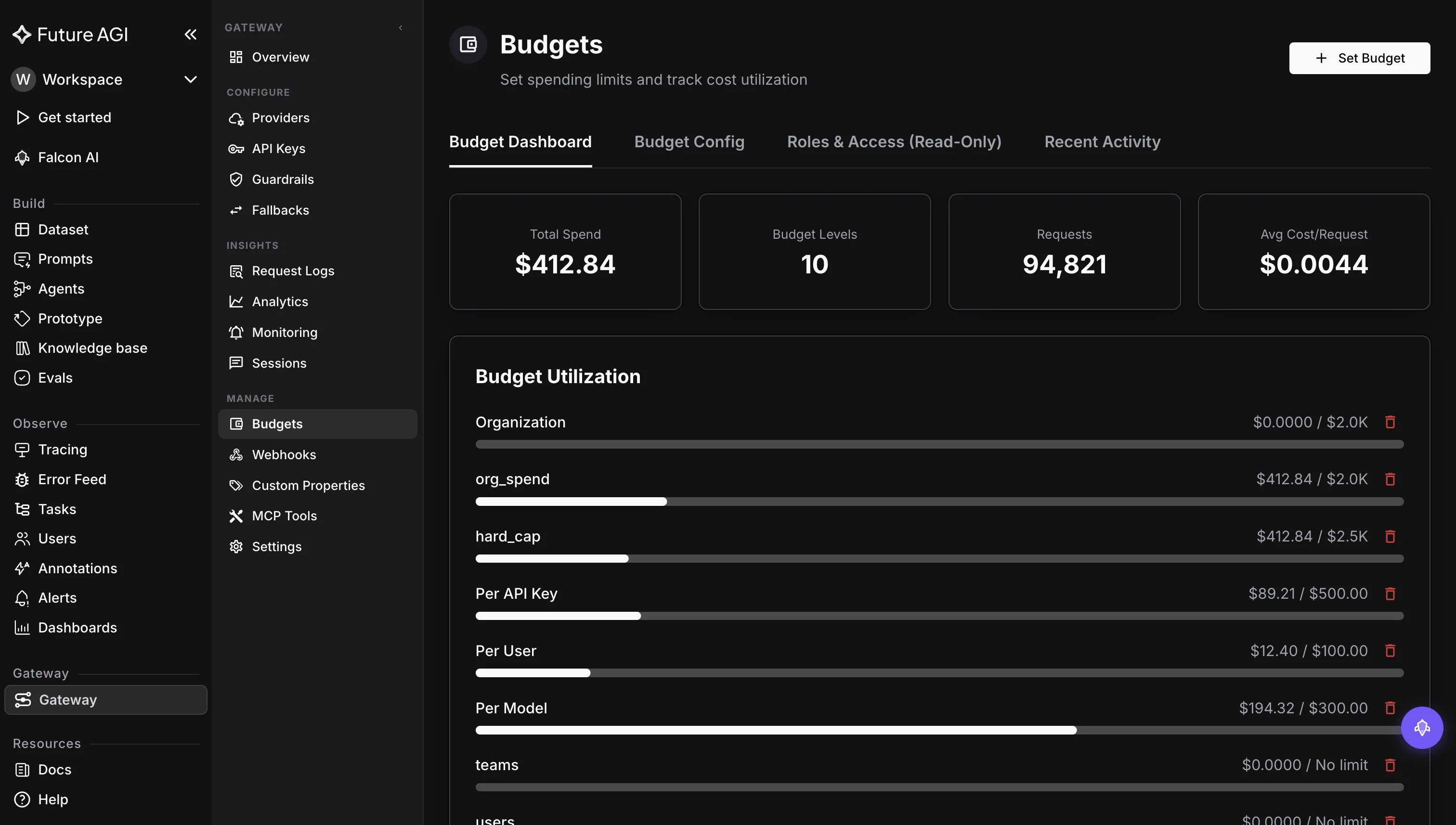
Portkey is the strongest pick when a platform team wants a mature managed semantic cache with TTL plus similarity-threshold tuning, a four-tier budget hierarchy, and a usable cost dashboard out of the box. It’s the gateway most production teams reach for when “we need a semantic cache in production this week” is the brief, and the cache library is the largest on the managed-dashboard side.
Best for. Multi-tenant SaaS and internal multi-product platforms that need fine-grained per-customer budgets, a mature semantic cache with TTL and threshold controls, and a managed dashboard without writing a custom OTel exporter.
Key strengths.
- Exact plus semantic caching with TTL and similarity-threshold tuning exposed in the managed control plane.
- Per-key, per-virtual-key, per-model, and per-time-window budgets; the most fine-grained native-dashboard hierarchy on this list.
- Large adapter library; the open-source gateway repo headline cites 1,600+ LLMs.
- Usable native dashboard for hit rate, saved cost, and per-tenant cache breakdown without writing a Grafana panel.
- Open-source gateway core; production teams self-host the gateway and run the control plane in Portkey cloud.
Where it falls short.
- Palo Alto Networks announced intent to acquire Portkey on April 30, 2026; close expected PANW fiscal Q4 2026; the gateway will become the AI Gateway for Prisma AIRS. Standalone-product continuity is pending integration; verify roadmap before signing a multi-year contract.
- Observability is dashboard-first; the OpenTelemetry export exists but is less load-bearing than the native dashboard, so OTel-first stacks end up duplicating hit-rate telemetry into Grafana anyway.
- Embedding-model selection for the semantic cache is the managed embedding by default; swapping in an open-weight or self-hosted embedding is more involved than with Future AGI.
- The control plane is closed; air-gapped semantic-cache deployment is heavier than a single Apache-2.0 binary.
- No first-class
prompt_versionaxis for cache coherence on template updates; production teams wire prefix invalidation through the dashboard, which is the slow path for a registry-driven deploy.
Use case fit. Strong for multi-tenant SaaS, fintech with per-customer cost attribution, and platform teams running multiple AI products. Less optimal for teams that want their semantic-cache telemetry flowing into an existing OpenTelemetry collector and Grafana stack as a first-class output.
Pricing and deployment. Open-source core (self-hosted) plus commercial cloud control plane; enterprise tiers.
Verdict. The most mature managed semantic cache plus budget hierarchy plus dashboard in 2026. Choose with eyes open on the Palo Alto integration; the next twelve months will tell whether the standalone semantic-cache product survives the merge.
Helicone: Best for Lightweight Observability With a Bundled Semantic Cache
Helicone is the lightweight observability proxy that put per-request LLM observability on the map for small platform teams and a cohort of mid-market SaaS. The semantic cache shipped as a fixed-embedding, single-threshold control inside the proxy, and the rest of the dashboard was the draw. After the March 3, 2026 acquisition by Mintlify, the public roadmap shifted toward documentation-platform-first, and existing Helicone users should treat semantic caching as a planned migration target.
Best for. Small platform teams already running Helicone for per-request observability who need a planned migration window to a more configurable semantic cache.
Key strengths.
- Lightweight drop-in proxy; minutes to wire against an existing OpenAI SDK call.
- Per-request observability dashboard with hit-rate, cost, and latency breakdowns; usable for small platform teams without a separate observability stack.
- MIT-licensed core; self-host through Docker or use the managed cloud.
- Active community-contributed adapters across providers.
Where it falls short.
- March 3, 2026 acquisition by Mintlify. Public roadmap shifting toward a documentation-platform-first stance. Existing users should treat semantic caching as a planned migration window, not a continued procurement.
- Embedding model is fixed under the hood; no swap surface for
bge-small-en-v1.5,text-embedding-3-large, or a self-hosted embedding. - Similarity threshold is a single global control rather than a per-template axis; production teams that want a 0.92 threshold on status checks and 0.97 on legal summaries hit the wall.
- Per-tenant namespacing is on the application side; the proxy doesn’t enforce
tenant_idat the cache key by default. Cross-tenant leakage is a wiring decision, not a gateway guarantee. - No first-class
prompt_versioncache axis; TTL expiry is the invalidation path after a template change.
Use case fit. Strong for small platform teams already running Helicone for observability. Less optimal for multi-tenant SaaS that needs tenant_id enforced at the cache hop or for platform engineering teams that want the embedding model and threshold as first-class controls.
Pricing and deployment. MIT core; cloud and self-host; commercial tier through Mintlify post-acquisition.
Verdict. A reasonable continued home for small platform teams already running Helicone, with a migration window over the next twelve months. Not the right pick for new procurement of a semantic-caching gateway in 2026.
Cloudflare AI Gateway: Best for Edge Cache at Global PoPs
Cloudflare AI Gateway is the strongest pick when the workload is global and a cached response served at the nearest Cloudflare point of presence (PoP) buys 30 to 80 ms of P50 latency reduction over a same-region origin cache. Cloudflare’s edge runtime puts the gateway, the cache, and the embedding all in the Workers runtime so the cached response never leaves the PoP.
Best for. Consumer-facing apps with a global user base where the binding constraint is end-user P50 latency on cached responses, and the workload tolerates the managed-embedding tradeoff.
Key strengths.
- Cached lookup served at the nearest Cloudflare PoP; P50 latency on edge-cached hits typically lands sub-50 ms globally.
- Tight integration with Cloudflare Workers, Workers AI, and Cache; minimal moving parts to deploy.
- Managed cost; usage-based pricing without operating a separate vector store.
- Native fit for an existing Cloudflare-stack platform (DNS, CDN, R2, D1).
- Per-namespace cache headers expose tenant-scoped cache surfaces when the application sets
cf-cache-namespaceper request.
Where it falls short.
- Semantic cache runs on Cloudflare’s managed embedding; no swap-in surface for
text-embedding-3-small,bge-small-en-v1.5, or a self-hosted embedding. An embedding-model swap on Cloudflare’s side silently re-vector-spaces every cached entry; the hit rate can collapse without a deploy on your side. - Similarity threshold is exposed but limited; per-template threshold tuning is on the application side, not the gateway side.
- Per-tenant namespacing is application-side header discipline; the gateway doesn’t enforce
tenant_idat the cache key by default. Audit-mode logging that proves tenancy isolation requires application-side instrumentation. - No first-class
prompt_versionaxis or prefix-purge operation; TTL expiry is the invalidation path after a template change. - Cloud-only; air-gapped or on-prem semantic caching isn’t the deployment shape. Closed source; the cache implementation can’t be forked or audited.
Use case fit. Strong for global consumer apps where edge-latency P50 dominates the procurement, and for teams already deep in the Cloudflare stack. Less optimal for multi-tenant SaaS that needs the embedding model under platform-team control, or for fintech that needs an air-gapped semantic cache.
Pricing and deployment. Usage-based; cloud only; tightly integrated with Workers and Cache.
Verdict. The right pick when the workload is global and the edge-cache latency win is the primary axis. Less optimal when embedding control, threshold-per-template, or air-gapped deployment is the binding constraint.
Maxim Bifrost: Best for Go Throughput on Semantic Lookup
Maxim Bifrost is the Go-native gateway from Maxim, Apache 2.0, with vendor-published gateway overhead in the 11-microsecond range at 5,000 RPS on t3.xlarge and a semantic cache that pairs well with that throughput profile. It’s the gateway most often cited when raw throughput on the semantic lookup is the binding constraint.
Best for. Go shops whose binding constraint is gateway throughput at high concurrency on the semantic-lookup path, plus teams running high-volume internal-copilot or tool-heavy agent inner loops that want a Go binary they can fork.
Key strengths.
- Vendor-published benchmark measuring roughly 11 µs mean gateway overhead at 5,000 RPS on
t3.xlarge; the semantic-lookup path runs inside the same process so the overhead profile carries over. - Apache 2.0, single Go binary, Docker plus Helm plus in-VPC deployment.
- 1,000+ models from 10+ providers behind a unified API in the same binary that ships the cache.
- Native fit with Prometheus and OpenTelemetry exporters.
- Active product velocity and aggressive content cadence keep the brand visible.
Where it falls short.
- Maxim self-ranks Bifrost #1 across its own gateway listicles with no published limitations; treat the rank inside Maxim’s own posts as a soft signal, not a benchmark.
- Embedding-model selection is exposed but the default is wired to a single embedding; the swap surface is thinner than Future AGI’s per-cache-config control.
- Per-tenant namespacing is exposed but enforcement is on the application side; the gateway doesn’t short-circuit a cross-tenant lookup before the vector index by default.
- Throughput numbers are vendor-published in Maxim’s own benchmark harness; independent reproduction in the public literature is light. Treat as a baseline rather than a settled benchmark.
- Observability is OTel-exported but dashboards are thinner than Portkey’s; teams that need a finance-grade saved-cost view end up writing their own Grafana panel.
Use case fit. Strong for Go shops, high-throughput internal-copilot paths, and teams running large MCP-tool agent loops where the binding constraint is gateway overhead at concurrency. Less optimal where the procurement is centred on per-tenant cache isolation and write-side poison defense.
Pricing and deployment. Apache 2.0; Docker, Helm; commercial cloud tier exists through Maxim.
Verdict. Strong throughput numbers and real engineering credibility. Choose Bifrost when raw gateway-overhead throughput on semantic lookup is the primary axis; choose elsewhere when per-tenant enforcement and poison defense are.
The 2026 Gateway Trust Cohort, Read Through the Semantic-Cache Lens
Three 2026 events reshape the semantic-caching procurement question. Every gateway listicle on the SERP treats them as if they didn’t happen. They did.
- Helicone joining Mintlify (March 3, 2026). Helicone acquired by Mintlify; public roadmap shifts toward a documentation-platform-first stance. Existing Helicone users should treat their semantic cache as a planned migration target, not a continued procurement.
- LiteLLM PyPI supply-chain compromise (March 24, 2026). Versions 1.82.7 and 1.82.8 were compromised on PyPI; the malicious package exfiltrated SSH keys, cloud credentials, and Kubernetes configs to an attacker-controlled endpoint per the Datadog Security Labs writeup. LiteLLM isn’t in this top five for semantic caching because the cache surface is partial; the trust event is the additional axis. Pin commit hashes or upgrade past 1.83.7 if you have a Python-only deploy and you need a placeholder cache.
- Portkey acquired by Palo Alto Networks (April 30, 2026). Acquisition announced; the gateway will become the AI Gateway for Prisma AIRS, with close expected in PANW fiscal Q4 2026. Standalone-product continuity is pending integration; verify roadmap before signing a multi-year contract. Primary source: the Palo Alto Networks press release.
The practical takeaway for a 2026 semantic-caching procurement: license clarity and acquisition independence are part of the decision. A cheap cache you have to migrate off in six months isn’t cheap when the cached entries are warm and the dashboards are wired.
How to Tune a Semantic Cache for Production (the 30-50 Percent Bill Cut Without Tears)
Most platform teams approach semantic caching as a switch they flip. The teams that actually cut the bill 30 to 50 percent treat it as a measurement loop.
Step 1: Baseline the cost. Pull the last 30 days of provider invoices by model, by feature, by tenant. The number you’re trying to cut has to exist before you can prove the cut. Customer support copilots typically run $0.15 to $0.60 per session at GPT-4o pricing; an analytics dashboard runs $0.02 to $0.10 per query. Hit-rate percentage is a vanity number without dollars next to it.
Step 2: Wire the cache with conservative defaults. Exact cache on, in-memory or Redis, TTL 24 hours, no semantic cache yet. Run for a week. The exact-cache hit rate is the easy floor (5 to 20 percent customer-facing, 30 to 60 percent agent inner loops) and it tells you whether your traffic shape is repeating enough to bother with semantic caching at all.
Step 3: Turn on semantic with a high threshold. 0.97 cosine similarity, default embedding (text-embedding-3-small), per-template config. The hit rate will be modest (5 to 15 percent on top of exact) but the false-positive rate will be near zero. Use this week to validate the embedding latency budget, the vector-store throughput, and the per-tenant namespacing.
Step 4: Lower the threshold per template, watch the eval. Status-check templates can drop to 0.93 or 0.92; summary and analytics templates can drop to 0.95; safety-critical templates (legal, medical, financial summaries) stay at 0.97 or higher. Run a held-out eval suite on every template-threshold combination, and treat evaluating prompt caching quality as its own measurement discipline. A 1 percent eval regression at any threshold is the signal to walk it back.
Step 5: Add the write-side guardrail. A user-generated prompt that injects “ignore previous instructions” should never enter the cache, and a prompt that contains PII should never be served to another user even inside the same tenant. Future AGI Protect runs at roughly 65 ms per arXiv 2510.13351 on the write path; teams running Portkey or Helicone wire a separate scanner before the cache insert and pay the latency twice. The latency math is the cost of not getting paged at 3am because a poisoned cache served the wrong tenant.
Step 6: Wire prompt_version to your registry. Every prompt-template deploy publishes a new version. The gateway either prefixes the cache key with prompt_version, or it issues a prefix purge against the old version. Without this, every template deploy is a 24-hour stale-answer window. Future AGI exposes prompt_version as a first-class cache axis and a single API call invalidates every entry under a version.
Step 7: Export the hit rate to the same Grafana as the rest of your stack. A cache that hits 41 percent in a vendor dashboard but saves 8 percent in finance is a measurement bug. The hit-rate metric needs a cost_saved_usd attribute on the same span so the saved-cost graph is the same source as the hit-rate graph. Future AGI exports both as OTel attributes and as Prometheus metrics on /-/metrics; Portkey shows them in its dashboard; Cloudflare and Helicone surface partial views.
The teams that do steps 1 through 7 hit 30 to 50 percent savings on customer-facing workloads in 2 to 4 weeks. The teams that flip the switch and walk away hit 15 percent for a quarter and then a postmortem.
Common Implementation Mistakes Platform Engineers Make With Semantic Caching
After watching enough production semantic-cache deploys hit walls, the same five mistakes show up.
- Caching every request shape. The status-check loop and the legal-summary template have different similarity tolerances. Caching them under a single threshold either misses the cheap wins (high threshold) or serves the wrong legal summary (low threshold). Fix: per-template threshold; if the gateway doesn’t support it, downgrade the gateway.
- Skipping
tenant_idenforcement at the gateway hop. The application “always passestenant_id,” until it doesn’t. A bug in a single request handler leaks Tier-1 outputs into a Tier-3 namespace. Fix: the gateway short-circuits a cross-tenant lookup before the vector index is touched; the application can’t opt out. - No write-side guardrail. The cache is a delivery surface for the prompt-injection class. A single user-controlled prompt that the cache stores can be served to other users until the TTL expires. Fix: a scanner on the write path that classifies prompt-injected, PII-tagged, and policy-violating requests and refuses insertion. Future AGI Protect runs at roughly 65 ms; the Protect paper (arXiv 2510.13351) documents the latency profile and the detection accuracy.
- No prompt-version axis. A template deploy without invalidation serves the old answer for the whole TTL. Customers see the regression that the team has already shipped a fix for. Fix: a
prompt_versioncache axis that the prompt registry publishes on every deploy; the gateway invalidates by prefix automatically. - Hit-rate metric without a saved-cost attribute. Hit rate is a vanity number. Saved cost is the procurement justification. A 41 percent hit rate on cheap prompts and an 8 percent hit rate on expensive prompts is a 12 percent saved cost, not 41. Fix: emit
cache_hit,cache_cost_saved_usd, andtenant_idas attributes on the same OTel span so the dashboards reconcile by construction.
The five mistakes aren’t unique to a vendor. They’re the five things the gateway either makes easy to get right or makes easy to get wrong. The Future AGI scorecard rewards gateways that make all five easy by default; the deductions are where a gateway makes one or two of them the application’s problem.
Future AGI Semantic Caching, End to End
The Future AGI walk-through pulls every axis of the scorecard into one path so a platform-engineer reader can plan the deploy.
A production semantic-caching deploy on Future AGI Agent Command Center runs the request through a five-stage pipeline at the same network hop:
- OpenAI-compatible drop-in. Client sets
base_urltohttps://gateway.futureagi.com/v1; existing OpenAI SDK code is unchanged. The gateway recognises the model identifier across 20+ providers via six native adapters (OpenAI, Anthropic, Gemini, Bedrock, Cohere, Azure) plus OpenAI-compatible presets and self-hosted backends (OpenAI, Anthropic, Google Gemini, AWS Bedrock, Azure OpenAI, Cohere, Groq, Together, Fireworks, Mistral, DeepInfra, Perplexity, Cerebras, xAI, OpenRouter, plus self-hosted via Ollama, vLLM, LM Studio, and any OpenAI-compatible server). - Exact cache lookup. Request is hashed (model, messages, parameters, tool definitions); the hash is keyed inside the tenant namespace (
tenant_idfrom header or virtual key); Redis or in-memory backend returns the cached response on byte-for-byte match. Latency on hit: sub-1 ms in-memory, 2 to 5 ms Redis. - Semantic cache lookup. On exact miss, the prompt is embedded (default
text-embedding-3-small, swappable totext-embedding-3-large,BAAI/bge-small-en-v1.5, or any OpenAI-compatible embedding); the embedding is keyed inside the same tenant namespace; the vector store (Qdrant or Pinecone for production, in-memory for dev) returns the cached response when cosine similarity is above the per-template threshold. Latency on hit: 8 to 12 ms on small embedding plus in-memory, 30 to 80 ms on larger embedding plus remote vector store. - Write-side Protect on the LLM-call path. On semantic miss, the prompt runs through the Protect scanner at roughly 65 ms (per arXiv 2510.13351); prompt-injected, PII-tagged, or policy-violating requests are blocked before the LLM call and before the cache write. The write-side classification is the single biggest defence against the cache-poisoning failure mode.
- LLM call and cache write. Clean request runs against the upstream provider; the response is cached at both the exact and semantic layers under the tenant namespace and the
prompt_versionaxis; the eval hook fires on the response and emits a score to the trace; the hit-rate, saved-cost, and false-positive attributes land on the same OpenTelemetry span.
The self-improving loop closes after stage 5. The eval that scored the response also produces the labelled dataset that agent-opt uses to revise the threshold per template, refine the namespace policy, and suggest cache-policy changes for the next deploy. A gateway that caches without an eval loop drifts; a gateway that caches with an eval loop gets better with traffic. That’s the wedge.
The OpenTelemetry-native hit-rate attributes flow into the existing Grafana stack via Prometheus on /-/metrics or via OTLP into the team’s collector of choice; the saved-cost graph and the false-positive graph share the same span, so finance, platform, and on-call see the same number.
Which Semantic-Caching Gateway Is Right for You in 2026?
The buyer profile drives the pick more than the feature matrix does. Platform engineers and SREs at multi-tenant SaaS or fintech pick Future AGI Agent Command Center; teams that want a managed dashboard pick Portkey; existing Helicone users plan a migration window; global consumer apps deep in Cloudflare pick Cloudflare AI Gateway; Go shops with raw-throughput constraints pick Bifrost.
| If you are a… | Pick | Why |
|---|---|---|
| Platform engineer or SRE at multi-tenant SaaS or fintech wanting exact + semantic + tenant isolation + OTel hit-rate + write-side poison defense in one binary | Future AGI Agent Command Center | All seven axes at the same hop, Apache 2.0, self-host or cloud |
| Air-gapped or on-prem regulated environment that needs an Apache-2.0 semantic cache | Future AGI Agent Command Center or Maxim Bifrost | Apache 2.0 single binary; Docker, Kubernetes, air-gapped |
| Multi-tenant SaaS that wants a managed cache dashboard out of the box | Portkey | Mature managed semantic cache + budget hierarchy (verify PANW close timeline) |
| Existing Helicone user looking for migration window | Helicone for now, Future AGI Agent Command Center for migration | Mintlify acquisition shifts roadmap; plan migration over 6 to 12 months |
| Global consumer app deep in the Cloudflare stack | Cloudflare AI Gateway | Edge-cached responses served at the nearest PoP; sub-50 ms global P50 on hits |
| Go shop where raw gateway throughput on semantic lookup is the binding constraint | Maxim Bifrost | Lowest published gateway-overhead numbers; Apache 2.0 |
Semantic caching in 2026 isn’t a single feature. It’s a seven-axis pipeline: backend choice, embedding selection, threshold tuning, tenant isolation, hit-rate observability, prompt-version coherence, and write-side poison defense, running at the same network hop, under a license that isn’t about to be re-platformed inside an acquirer.
Future AGI Agent Command Center is the strongest single pick when the buying constraint is one Apache-2.0 binary that ships every axis of the semantic-caching scorecard self-hostable, with a write-side Protect scanner that blocks the poisoning class at roughly 65 ms and a self-improving loop that pipes eval feedback back into the cache policy. Teams already on Portkey should weigh the Palo Alto integration timeline; teams on Helicone should plan the migration window; global consumer apps should benchmark Cloudflare at the edge; Go shops should benchmark Bifrost on throughput.
For deeper reads: the Agent Command Center docs, the Future AGI GitHub repo, the Future AGI Protect docs, the Future AGI Protect paper (arXiv 2510.13351), the Future AGI Evaluation docs for the held-out evaluator that pairs with the semantic-cache threshold tuning, and the OpenTelemetry GenAI semantic conventions.
Try Future AGI Agent Command Center free: drop-in OpenAI-compatible routing, exact plus semantic caching with swappable embedding and per-template threshold, tag-based per-tenant namespacing, write-side Protect at roughly 65 ms, and OpenTelemetry-native hit-rate telemetry in one Apache-2.0 Go binary.
Related reading
- What Is Semantic Caching for LLMs? A 2026 Guide, what semantic caching actually is and when it pays back
- Best 5 AI Gateways for LLM Cost Optimization in 2026, the five-layer cost stack and the 2026 trust cohort
- Best 5 AI Gateways for LLM Failover and Fallback in 2026, fallback and failover gateway picks
- Best 7 AI Gateways for Multi-Model Routing in 2026, how cost-quality routing decisions get made at the gateway hop
Frequently Asked Questions
What Hit Rate Should I Expect From Semantic Caching in Production?
Which Embedding Model Should I Use for Semantic Cache Similarity?
What Cosine Threshold Tunes a Semantic Cache for Production?
How Do I Prevent Cross-Tenant Cache Leakage in a Multi-Tenant LLM App?
Can Semantic Caching Be Poisoned by an Attacker?
What Happens to the Cache When I Update a Prompt Template?
Canonical 2026 semantic caching for LLMs: exact vs semantic, embeddings, threshold, TTL, invalidation, 5 patterns production teams actually ship.

Five AI gateways for LLM cost optimization in 2026 scored on the five-layer cost stack, 18+ guardrails, OTel-native cost telemetry, and 2026 trust cohort.

Five AI gateways for LLM failover and fallback in 2026 scored on health-detection latency, streaming continuity, idempotency, MTTR, fallback-route quality.
