Best 5 AI Gateways for Retail in 2026: Personalization Routing With PII Redaction
Five AI gateways for retail in 2026 scored on personalization PII redaction, Black Friday burst load, 250ms latency, CCPA, PCI DSS v4.0.1, EU DSA scope.
Table of Contents
Originally published May 17, 2026.
A top-50 US retailer rolled an on-site personalization pilot the week of Cyber Monday and discovered by the weekend that the gateway it shipped on had routed the customer’s name, shipping address, and last four digits of payment card to a consumer OpenAI tier with no data processing agreement in force, no PII redaction layer, no per-store budget on a 12 percent of total traffic load that hit one banner ad in twenty minutes, and a 1.8 second median latency on an endpoint the experience team had budgeted at 250 milliseconds. The same week, a second retailer with a higher-grade gateway shipped the same model, held a 240 millisecond P95, a 41 percent semantic cache hit rate, and a clean opt-out path for the California cohort that had set Global Privacy Control. This guide compares the five AI gateways VPs of Digital and Customer Experience should consider in 2026, scored against the CCPA as amended by CPRA, the fifteen US state privacy laws in force by mid-2026, PCI DSS v4.0.1, the EU Digital Services Act, EU AI Act Article 5, and the operational realities of a Black Friday 10x-plus burst, a 250 millisecond in-session decision budget, and store-line cost attribution.
TL;DR: The 5 Best Retail AI Gateways for 2026
Future AGI Agent Command Center is the strongest single pick for a retail AI gateway in 2026 because it bundles an OpenAI-compatible drop-in, inline PII redaction at the roughly 67 millisecond enforcement profile published in arXiv 2510.13351, 18+ built-in guardrail scanners (SSN, payment card, address, secret detection, data leakage, hallucination, MCP security), per-store and per-department virtual-key budgets, semantic caching that holds a 30 to 60 percent hit rate at Black Friday burst, and OpenTelemetry-native traces in one Apache 2.0 Go binary. Retail procurement now has to weigh four 2026 events in the same buying cycle: the LiteLLM PyPI supply-chain compromise (March 24, 2026), the Palo Alto Networks acquisition of Portkey (announced April 30, 2026, pending close), CPPA automated decisionmaking technology regulations finalizing through 2026, and EU AI Act Annex III obligations triggered by inline Buy Now Pay Later creditworthiness checks (full force August 2, 2026).
- Future AGI Agent Command Center — Best overall. 18+ PII and data-leakage guardrails, per-store budgets, OTel traces, and inline PII redaction at the ~67 ms enforcement profile that holds the 250 ms in-session budget.
- Portkey — Best for retailers that want a managed cost dashboard with per-tenant, per-store, and per-department budget hierarchy. Verify the Palo Alto Networks acquisition timeline before signing multi-year.
- Cloudflare AI Gateway — Best for global retailers that want sub-100 ms in-session decisions at the network edge across 330+ Cloudflare PoPs, with BYOK to OpenAI or Anthropic.
- LiteLLM — Best for Python-first retail data-science teams pinning a known-good commit after the March 24, 2026 supply-chain incident.
- Kong AI Gateway — Best for retailers already running Kong Gateway for the REST API plane that want the AI plane on the same control plane.
Helicone is intentionally not ranked. It was acquired by Mintlify on March 3, 2026 and is in maintenance mode. Retailers already on Helicone should treat it as a planned migration window, not a continued procurement.
How We Scored These Retail AI Gateways
We used the Future AGI Production Gateway Scorecard, a seven-axis rubric tuned for retail. Retail adds three pressures most listicles skip: every axis has to be defensible to a VP of Customer Experience who reads latency against conversion impact, every axis has to absorb a Black Friday 10x to 15x burst on a baseline that typically lands in the 1.4 to 2.6 million daily-active-users band and the 80,000 to 220,000 orders-per-day band for a mid-size US retailer, and the cost line items have to map back to a store manager, department head, or campaign owner who actually controls the budget.
| # | Axis | What we measure |
|---|---|---|
| 1 | Personalization PII redaction | Built-in scanners for SSN, PAN, CVV, expiry, shipping address, email, phone, IP, customer-identifier reuse across sessions; sub-100 millisecond inline enforcement; per-role unmasking on the response path |
| 2 | Black Friday burst load (10x-plus baseline) | Behavior under sustained 10x to 15x burst; cache hit rate at burst; fallback across two or three providers; graceful degradation of non-critical workloads |
| 3 | In-session latency budget (250 millisecond P95) | P50, P95, P99 added latency at 250 to 1,000 RPS; whether PII redaction sits in the same hop |
| 4 | Customer-data residency | Region-pinning by customer cohort, storefront, tenant for EU, UK, US |
| 5 | Store-line and department-line cost attribution | Per-store, per-department, per-campaign, per-A/B-arm virtual-key budgets; tag-based properties; export to BI |
| 6 | Model A/B testing for conversion | Shadow and canary; per-arm traffic split; per-arm cost capture; per-arm conversion linking via span_id |
| 7 | PCI scope minimization | PAN tokenization before the prompt leaves the CDE; Requirement 6.4.3 script integrity for embedded widgets; Requirement 11.6.1 tamper-detection capture; Requirement 12.5.1 in-scope inventory feed |
Axes 1, 2, and 7 decide whether the gateway actually keeps a retailer safe in production. Axes 3 through 6 decide whether the gateway is operationally usable for the digital and customer-experience teams that own the line items.
The Retail Capability Matrix the SERP Is Missing
Across the five gateways below, Future AGI Agent Command Center leads on the combined surface of personalization PII redaction depth, Black Friday burst resilience, in-session latency budget, and license clarity. Portkey wins on managed dashboard maturity. Cloudflare AI Gateway wins on global edge round-trip. LiteLLM wins on Python-native ergonomics. Kong AI Gateway wins on inheritance from the existing Kong REST plane.
| Capability | Future AGI ACC | Portkey | Cloudflare AI Gateway | LiteLLM | Kong AI Gateway |
|---|---|---|---|---|---|
| Pricing | Apache 2.0 plus cloud (free to start; pay-as-you-go scales with usage; compliance + enterprise add-ons available) | Source available plus cloud; Enterprise via sales | Free 100k req/day; paid folded into Workers | Apache 2.0 outside enterprise directory | Open source plus Kong Enterprise |
| Runtime | Single Go binary | Node + Python SDKs | Workers (V8 isolates at the edge) | Python | Lua on Kong plane |
| Supported providers | 100+ | 250+ | 60+ (OpenAI, Anthropic, Azure OpenAI, Bedrock, Workers AI) | 100+ | 30+ via AI Proxy plugins |
| Deployment | Docker, K8s, AWS, GCP, Azure, air-gapped or on-prem | Cloud, self-host, hybrid, air-gapped | Cloudflare edge only (330+ PoPs) | pip, Docker self-host | Self-host, Kong Konnect SaaS, Kong Enterprise hybrid |
| OpenAI compat | Yes (base_url swap) | Yes | Yes (Universal Endpoint) | Yes | Yes (AI Proxy Advanced) |
| Semantic caching | Yes (in memory, Qdrant, Pinecone) | Yes | Partial (semantic on roadmap) | Partial | Yes (Enterprise) |
| Per-store / per-department budgets | Yes (per key, VK, model, window, tag) | Yes (4-tier hierarchy) | Per-key plus per-Universal-Endpoint | Basic | Yes (consumer plus credential plus tag) |
| In-session P95 overhead | Sub-100 ms; ~67 ms inline PII redaction profile | Sub-100 ms on managed plane | Single-digit to low-tens ms at closest edge PoP | Python; higher at high concurrency | Single-digit ms on Kong hop |
| PII redaction (SSN, PAN, address) | Built-in PII, secret detection, data leakage prevention plus 15 adapters | PII anonymization at Enterprise | DLP via Cloudflare Zero Trust | Via adapters | Via plugins (PII anonymizer, AI semantic guard) |
| Customer-data residency | Region-pinned routes plus tag-based enforcement | Region-pinned at Enterprise | Edge routing pins data to region | Via adapters | Kong Konnect EU and US planes |
| Model A/B testing for conversion | Shadow plus canary plus per-arm trace export | Portkey experiments | Partial (Universal Endpoint traffic split) | Partial | Partial |
| PCI scope minimization | Built-in PAN, CVV, expiry detectors plus per-VK enforcement | Enterprise | DLP plus Cloudflare One | Via adapters | Via plugins |
| Open source | Apache 2.0 | Source available | Proprietary | Apache 2.0 outside enterprise | Apache 2.0 on Kong core; AI plugins Enterprise |
| Self-improving loop (trace, eval, optimize, route) | Yes (Future AGI Evaluation + Optimize, traceAI Apache 2.0) | No | No | No | No |
Nobody wins every column. The four columns that matter most for retail (PII redaction depth, Black Friday burst resilience, in-session latency budget, store-line cost attribution) are where the field separates.
What the 2026 Retail Compliance Stack Actually Demands
The 2026 retail AI compliance stack is four layers, and a gateway that handles only one of them isn’t a retail gateway.
- CCPA as amended by CPRA plus the fifteen US state privacy laws. The California Consumer Privacy Act as amended by CPRA has been in force since January 1, 2023, with the California Privacy Protection Agency in active rulemaking on automated decisionmaking technology, cybersecurity audits, and risk assessments through 2026. By May 2026, fifteen state comprehensive privacy laws are in effect (California, Virginia, Colorado, Connecticut, Utah, Texas, Oregon, Montana, Iowa, Delaware, New Hampshire, New Jersey, Tennessee, Maryland, Minnesota). The Global Privacy Control opt-out signal is honored by default under California Attorney General enforcement actions including the Sephora settlement of August 2022 and the Tilting Point Media settlement of October 2024. A gateway is the practical enforcement point that detects opt-out and routes the request without the personal-identifier feature set.
- PCI DSS v4.0.1 plus the chatbot-on-checkout problem. PCI DSS v4.0.1 became fully enforceable on March 31, 2025 with Requirements 6.4.3 (payment-page script authorization and integrity), 11.6.1 (tamper detection), and 12.5.1 (in-scope inventory) in force. The 2025 to 2026 enforcement wave targets embedded chatbot widgets on checkout pages: every script needs an authorization record, integrity check, and tamper-detection event capture. The gateway is the practical PAN tokenization point that keeps cardholder data out of the LLM provider’s scope.
- EU Digital Services Act plus the marketplace problem. The Digital Services Act has been in full application across the EU since February 17, 2024. Online marketplaces have specific obligations under Articles 30 through 32 (traceability of traders, compliance by design, right to information). Marketplaces designated as Very Large Online Platforms under Article 33 (45 million plus EU MAU) face Article 27 algorithmic transparency, Article 34 systemic risk assessments, and Article 38 recommender system non-profiling options. The gateway is the natural Article 17 statement-of-reasons logging surface and Article 27 transparency log path.
- EU AI Act Article 5 plus Annex III for retail. Article 5 entered application on February 2, 2025 and prohibits manipulative-design AI. Annex III point 5(b) classifies creditworthiness assessment as high-risk; for retailers running Buy Now Pay Later, an inline creditworthiness check triggers Article 9 risk management, Article 10 data governance, Article 12 automated logging, Article 14 human oversight, and Article 50 transparency from August 2, 2026. The Digital Omnibus package proposed delaying Annex III to December 2027; prudent buyers continue to treat August 2026 as binding.
A gateway that ships layer 1 and layer 3 but skips 2 and 4 is good for marketing and bad for an FTC enforcement action, a PCI Report on Compliance, or a DSA Article 24 transparency report.
Future AGI Agent Command Center: Best Overall for Retail AI
Future AGI Agent Command Center tops the 2026 retail list because it bundles every layer of the compliance stack and every operational axis at the same network hop in one Apache 2.0 Go binary you can self-host inside the retailer’s VPC, run at the global edge in front of OpenAI and Anthropic, or pin to a region for the EU personalization workload. It loses on managed dashboard polish to Portkey and on raw single-PoP edge round-trip to Cloudflare AI Gateway; for buyers whose binding constraint is PII redaction inside a 250 millisecond in-session budget plus a closed self-improving loop across trace, eval, optimize, and route, the combined surface still puts it first.
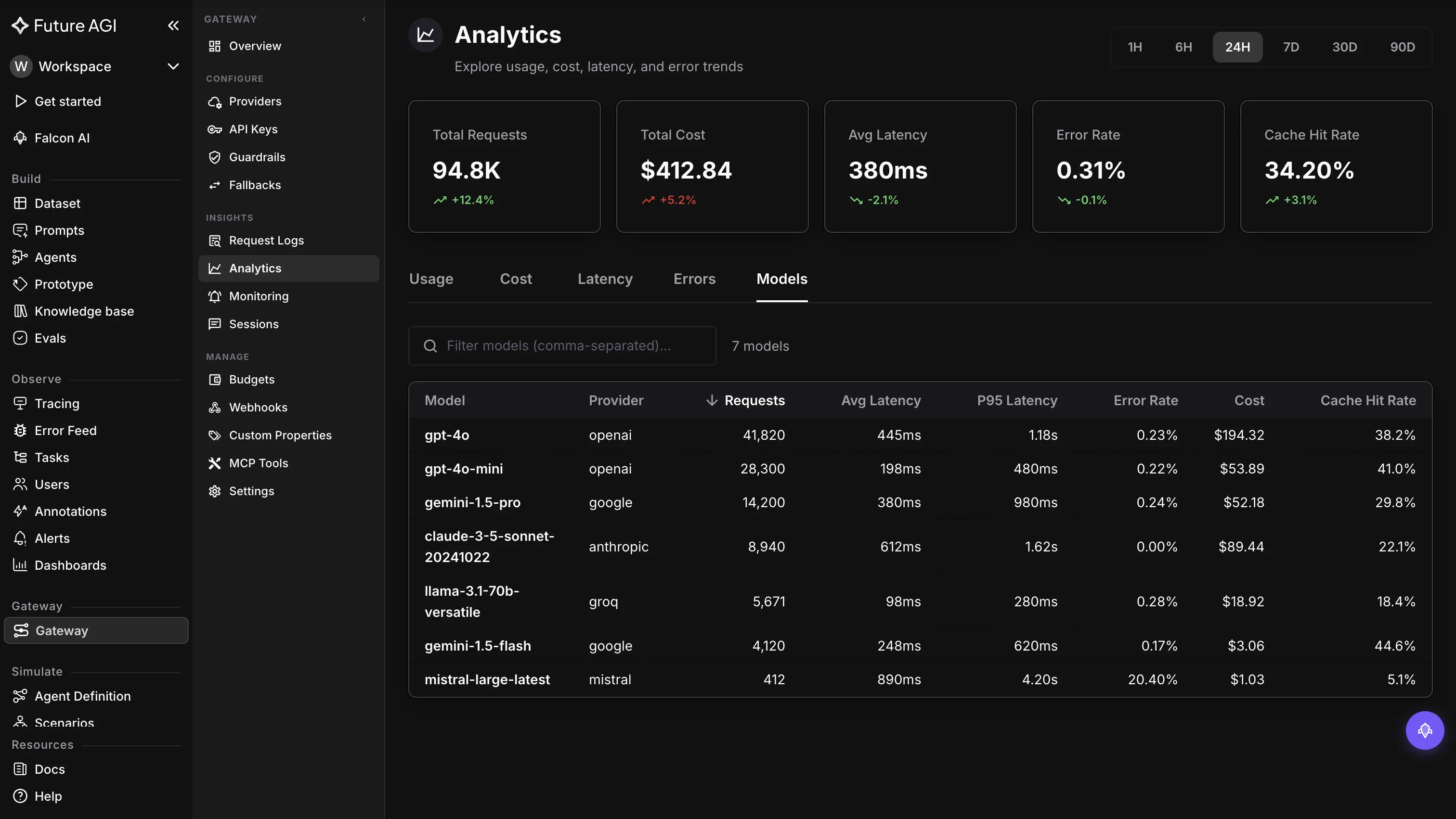
The bundle is an OpenAI-compatible drop-in, inline PII redaction at the roughly 67 millisecond enforcement profile published in arXiv 2510.13351, 18+ built-in guardrail scanners (SSN, payment card, address, secret detection, data leakage, hallucination, MCP security), per-virtual-key budgets that tag by store, department, campaign, and A/B test arm, exact plus semantic caching, and OpenTelemetry-native traces in a single Apache 2.0 Go binary.
Personalization-quality evaluation feeds back into a self-improving optimizer through the Future AGI Evaluation product, with traceAI, agent-opt, and ai-evaluation shipping under Apache 2.0.
Best for. Department-store retailers, digital-native marketplaces, multi-brand conglomerates, and grocery and pharmacy chains running on-site personalization, storefront search, customer support copilots, in-store associate AI, and post-purchase email rewrite.
Key strengths.
- OpenAI-compatible drop-in: change
base_urltohttps://gateway.futureagi.com/v1, keep existing OpenAI SDK code unchanged. - 20+ providers via six native adapters (OpenAI, Anthropic, Gemini, Bedrock, Cohere, Azure) plus OpenAI-compatible presets and self-hosted backends; for retail, the DPA-eligible upstreams most commonly routed are Azure OpenAI under the Microsoft Online Services DPA and AWS Bedrock under the AWS DPA.
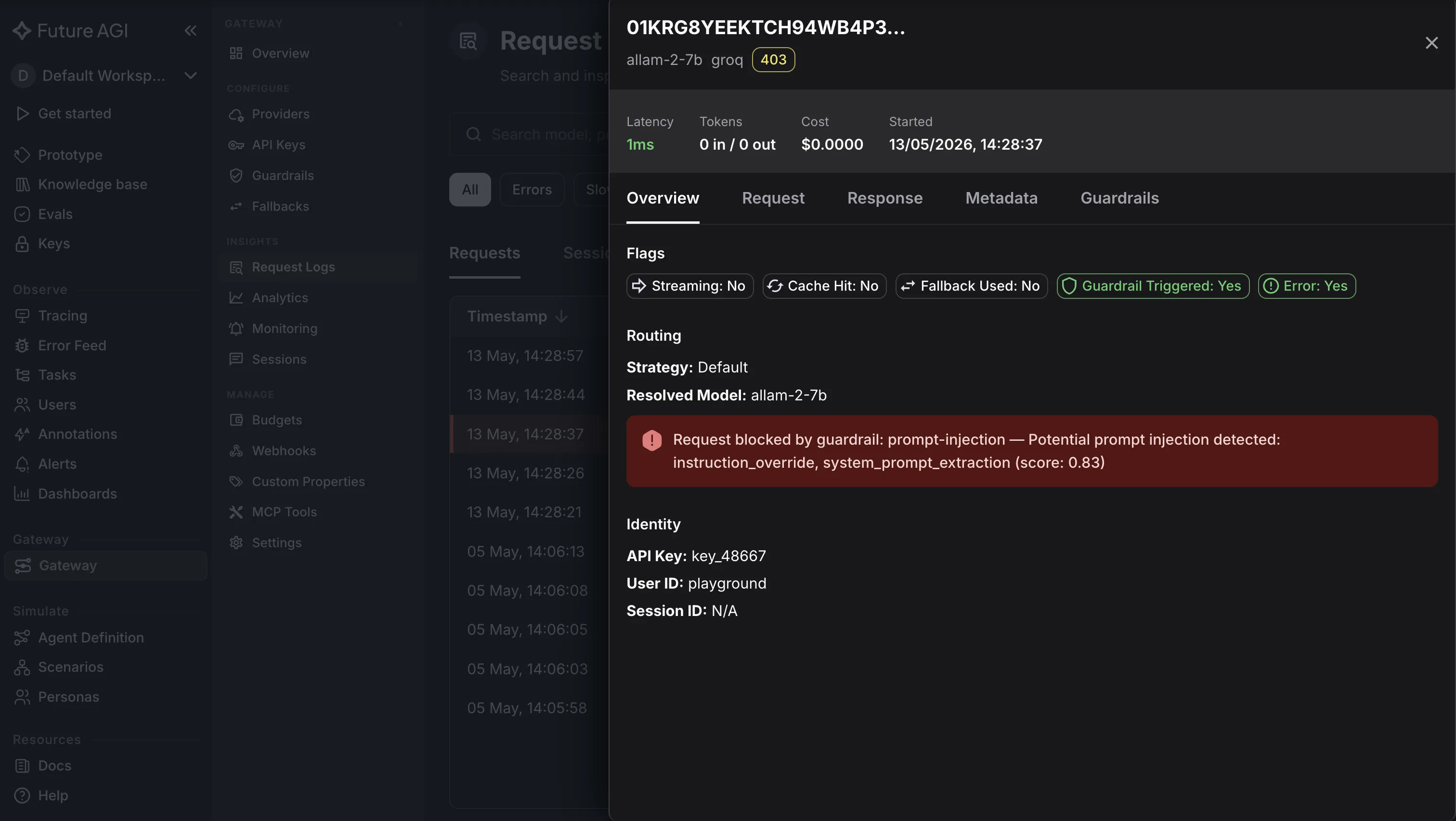
- The Future AGI Protect model family for inline guardrails, ~65 ms p50 text and ~107 ms p50 image (arXiv 2510.13351). Protect is FAGI’s own fine-tuned model family built on Google’s Gemma 3n with specialized adapters across four safety dimensions (content moderation, bias detection, security/prompt-injection, data privacy/PII), natively multi-modal across text, image, and audio, a model family, not a plugin chain. PII coverage spans SSN, payment card (PAN, CVV, expiry), shipping address, email, phone, IP. A dedicated MCP Security scanner sits alongside and the same dimensions are reusable as offline eval metrics so the prod policy and the eval rubric stay in sync.
- Per-key, per-virtual-key, per-model, and per-window budgets; tag-based custom properties map naturally onto per-store, per-department, per-campaign, and per-A/B-test-arm cost attribution.
- OpenTelemetry-native traces plus Prometheus metrics on
/-/metrics, feeding Grafana, Splunk, Datadog, the Future AGI Evaluation pipeline viaspan_id, and the self-improving optimizer through agent-opt.traceAIinstruments 50+ AI surfaces across Python, TypeScript, Java, and C# (including Spring Boot starter, Spring AI, LangChain4j, Semantic Kernel) OpenInference-natively, and Error Feed. the part of the eval stack, the clustering and what-to-fix layer that feeds the self-improving evaluators, turns those traces into named issues with zero config: auto-clusters related per-store and per-campaign failures (50 traces → 1 issue), auto-writes the root cause plus a quick fix plus a long-term recommendation per issue, and tracks trend per issue so personalization-quality regressions surface like exceptions rather than buried dashboard rows.
- Apache 2.0; single Go binary; Docker, Kubernetes, AWS, GCP, Azure, on-prem, air-gapped or cloud at
gateway.futureagi.com/v1. SOC 2 Type II at the Boost tier (250 dollars per month); region-pinned routes for EU, UK, and US cohorts.
from openai import OpenAI

client = OpenAI(
    api_key="$FAGI_API_KEY",
    base_url="https://gateway.futureagi.com/v1",
)

# Existing OpenAI SDK code unchanged from here. The gateway runs
# inline PII redaction (SSN, PAN, address, email, phone), per-VK
# budget enforcement by store and department, and OpenTelemetry
# span attribute capture at the same network hop.
response = client.chat.completions.create(
    model="azure-openai/gpt-4o",
    messages=[
        {"role": "system", "content": "You are the on-site personalization assistant for Store 0042."},
        {"role": "user", "content": "Recommend three jackets for a Bay Area customer who bought hiking boots last month."},
    ],
    extra_headers={
        "X-FAGI-Tag-Store": "0042",
        "X-FAGI-Tag-Department": "outerwear",
        "X-FAGI-Tag-Campaign": "spring-2026",
        "X-FAGI-Tag-Experiment-Arm": "B",
    },
)
Use case fit. Strong for department-store retailers at the 1.4 to 2.6 million DAU tier, digital-native marketplaces with a 250,000 to 4 million SKU catalog, multi-brand conglomerates with five to thirty banners, grocery and pharmacy chains running in-store associate copilots, and post-purchase email rewrite at 80,000 to 220,000 orders per day. Apache 2.0 single Go binary; cloud-hosted or self-host. SOC 2 Type II at Boost (250 dollars per month); Scale at 750 dollars per month for higher rate-limit envelopes and a tighter Black Friday SLA.
Verdict. The strongest single pick if your 2026 retail AI story is “OpenAI compat drop in plus PII redaction inside a 250 millisecond budget plus per-store budgets plus OpenTelemetry traces, inside our VPC, with a self-improving optimizer that closes the loop on personalization quality.”
Where It Falls Short
- Native dashboard polish. Functional and improving, but the pixel-perfect per-store-tile and per-campaign-tile experience Portkey ships is still a generation ahead. Non-engineering merchandising managers reading the dashboard without Grafana training should budget two weeks for the polish gap.
- Full agent execution tracing. On the public roadmap but not yet GA at the depth the gateway-side OpenTelemetry trace export is. Teams running a multi-step in-store associate copilot that orchestrates four tool calls per turn should track the roadmap item.
Portkey: Best for Managed Per-Store Cost Dashboard
Portkey is the strongest retail pick when you want a managed cost dashboard out of the box with a four-tier budget hierarchy mapping cleanly onto per-tenant, per-store, per-department, and per-campaign attribution, plus PII anonymization at Enterprise. It’s what most retail SaaS platforms and multi-brand conglomerates reach for when “we need spend control and per-store enforcement next week” is the brief, with the caveat that the Palo Alto Networks acquisition announced April 30, 2026 hasn’t yet closed.
Best for. Multi-brand retail conglomerates (five to thirty banners), retail SaaS platforms serving 5,000 to 25,000 small-to-mid-size retailers, and digital-native marketplaces that want fine-grained per-tenant, per-store, and per-department budgets without writing a custom exporter.
Key strengths.
- Exact plus semantic caching; retail teams typically see 30 to 60 percent hit rates on personalization-prompt and post-purchase email rewrite workloads.
- Most fine-grained native-dashboard budget hierarchy on the list (parent brand, banner, region, store, department, campaign).
- 250+ providers including on-prem Llama variants for the in-store associate copilot.
- PII anonymization at Enterprise; SOC 2 Type 2, ISO 27001, GDPR; per-region routing at Enterprise.
Verdict. The most mature managed cost dashboard for retail AI in 2026. Choose with eyes open on the Palo Alto Networks integration; the next 12 months will tell whether the standalone gateway product survives the merger.
Where It Falls Short
- Acquisition overhang. Pending Palo Alto Networks acquisition is a procurement variable for any multi-year contract crossing the deal-close window. Get the integration plan in writing before signing past Q4 2026.
- OpenTelemetry as a second-class citizen. The native dashboard is the strength; OTel export is functional but not pixel-perfect. Retailers standardized on Splunk or Datadog will spend an extra week wiring the export.
- No closed self-improving loop. A personalization-quality regression caught in eval doesn’t feed back into a router policy update without manual intervention.
Cloudflare AI Gateway: Best for Global Edge Personalization
Cloudflare AI Gateway is the strongest pick for global retailers whose binding constraint is sub-100 millisecond in-session decisions at the network edge, served from the closest of 330+ Cloudflare locations. The Universal Endpoint speaks a single OpenAI-compatible API in front of 60+ providers including OpenAI, Anthropic, Azure OpenAI, AWS Bedrock, Google AI, Cohere, Replicate, and Workers AI.
Best for. Global department-store retailers and digital-native marketplaces with EU, UK, US, and APAC traffic, already on Cloudflare for the storefront edge, with personalization and search workloads that need sub-100 millisecond round-trips at the closest PoP and a BYOK path without a second network hop.
Key strengths.
- 330+ global edge PoPs serve the gateway hop in single-digit to low-tens millisecond round-trips at the closest edge PoP.
- Universal Endpoint in front of 60+ providers with native rate-limit, cache, fallback, retry, and observability at the edge.
- BYOK to OpenAI, Anthropic, Azure OpenAI, AWS Bedrock, Google AI, Cohere, Replicate, and Workers AI; the retailer’s existing provider DPA is preserved end-to-end.
- Free tier covers 100,000 requests per day; paid folds into the Workers plan.
- Edge routing pins data to region for GDPR Article 44 cross-border transfer compliance.
Verdict. The right pick when the constraint is global edge at sub-100 millisecond round-trips and the retailer is already on Cloudflare. Choose Future AGI when Apache 2.0, a self-hostable VPC, a built-in 18+ scanner library, and a closed self-improving loop matter more.
Where It Falls Short
- Edge-only deployment. Runs on Workers; no path to lift into a non-Cloudflare VPC. Retailers mandating a single-vendor VPC plane should evaluate elsewhere.
- Semantic cache gap. Exact-match cache is first-class; semantic cache is on a roadmap track. Retailers whose Black Friday cost containment leans on a 40 percent plus semantic cache hit rate will see a smaller hit rate than at Future AGI or Portkey.
- Proprietary platform. Not Apache 2.0; source not available for a security audit on the scale Future AGI or LiteLLM allows.
LiteLLM: Best for Python-First Retail Data-Science Teams Post-CVE
LiteLLM is the Python-first proxy that broke open the multi-provider unified API category. Apache 2.0 outside the enterprise directory, 20+ providers via six native adapters (OpenAI, Anthropic, Gemini, Bedrock, Cohere, Azure) plus OpenAI-compatible presets and self-hosted backends, and the long tail of internal retail gateways inside data-science teams. After the March 24, 2026 supply-chain incident the retail answer is “yes for self-hosted commit-pinned deployments where the retailer holds its own DPA path; no for the OSS path as a vendor DPA.”
Best for. Python-first retail data-science teams already operating a FastAPI or uvicorn surface for the personalization model service, willing to pin commit hashes, with their own DPA path direct to the upstream model provider.
Key strengths.
- Broadest provider coverage on this list (20+ providers via six native adapters (OpenAI, Anthropic, Gemini, Bedrock, Cohere, Azure) plus OpenAI-compatible presets and self-hosted backends).
- Apache 2.0 outside the enterprise directory; trivial to fork or audit.
- Virtual keys with per-key budgets; native fit with Python observability stacks.
- Easy to extend with custom adapters for retail-specific PII detectors.
Verdict. Still the broadest provider coverage on the list, but the March 2026 incident shifts it from “default pick” to “pin commits and audit.”
Where It Falls Short
- March 24, 2026 supply-chain compromise. Versions 1.82.7 and 1.82.8 shipped malware via PyPI for roughly forty minutes before quarantine, with 40,000+ downloads recorded (Datadog Security Labs writeup). Pin to 1.82.6 or earlier; rotate credentials.
- Python runtime at Black Friday burst. A Python proxy at 10x or 15x baseline RPS needs more horizontal pods than a Go binary.
- No vendor DPA on the OSS path. The retailer holds the DPA directly with OpenAI, Anthropic, Azure, or AWS.
Kong AI Gateway: Best for Retailers Already on Kong
Kong AI Gateway is the strongest pick for retailers already running Kong Gateway for the REST API plane that want the AI plane to inherit the existing Kong control plane, rate-limit, mTLS, and observability policies.
Best for. Mid-to-large retailers, retail SaaS platforms, and digital-native marketplaces already running Kong Gateway for the REST API plane (storefront, checkout, order, inventory) that want the AI plane (personalization, search, customer support) to inherit existing Kong policies.
Key strengths.
- AI Proxy and AI Proxy Advanced plugins ship an OpenAI-compatible unified API in front of 30+ providers with the same rate-limit, ACL, mTLS, and authentication plugins the existing Kong plane uses.
- Single Kong control plane for both REST and AI; the platform team doesn’t stand up a second gateway product or observability pipeline.
- Kong Enterprise ships a semantic cache plugin, an AI semantic guard plugin, and a PII anonymizer plugin family.
- Self-host on Kubernetes, VM, or bare metal; Kong Konnect SaaS; Kong Enterprise hybrid.
Verdict. The right pick when the constraint is “the AI plane has to inherit the existing Kong control plane.” Choose Future AGI when Apache 2.0 across the full gateway and scanner library plus a closed self-improving loop matter more.
Where It Falls Short
- AI plugins on the Enterprise tier. The Apache 2.0 Kong core doesn’t include AI Proxy Advanced, semantic cache, AI semantic guard, or PII anonymizer plugins. The retailer pays for Enterprise or implements guardrails in custom Lua.
- Plugin maturity gap. The AI plugin family is younger than the Kong REST ecosystem. Custom retail scanners are a development project, not an out-of-the-box library.
- No closed self-improving loop. A personalization-quality regression caught in offline eval doesn’t feed back into a router policy update without manual intervention.
AWS Bedrock and Azure OpenAI as Retail DPA Fast Paths
The straight cloud route to a retail-suitable DPA in 2026 is AWS Bedrock under the AWS DPA or Azure OpenAI under the Microsoft Online Services DPA. Both ship a fast DPA and leave the retailer to bolt PII redaction, per-store budget enforcement, and PCI scope minimization on top. Most production retail AI stacks today run an AI gateway in front of Bedrock or Azure OpenAI rather than instead of them.
AWS Bedrock. Covered under the AWS DPA, in scope for ISO, SOC, and CSA STAR Level 2; ships Anthropic Claude, Llama, Mistral, Cohere, Titan, AI21, and Stability hosted on AWS. Bedrock doesn’t ship a built-in PII redaction layer for SSN, PAN, or shipping address, doesn’t ship per-virtual-key budgets across providers, and the OpenAI compat surface is on the customer.
Azure OpenAI. Covered for text-based services on Enterprise Agreement, MCA, and CSP procurement paths, and doesn’t retain prompt and completion content for training by default. Two coverage gaps retail teams hit in practice: image inputs aren’t covered by default for every use case (visual search often needs a separate addendum), and the Realtime Audio API in preview isn’t yet inside the standard coverage scope (the in-store voice copilot needs a separate review). A gateway in front enforces text-only routing, blocks image and realtime calls on workloads outside the addendum, and standardizes the audit log across Azure OpenAI plus a non-Azure fallback.
The honest take. If your retail stack is one provider, one region, one product, AWS Bedrock or Azure OpenAI behind your application can be enough. The moment you add a second provider (fallback against Black Friday capacity events), a second product, or a second region, the gateway pays for itself in DPA simplicity, PII redaction consistency, per-store budget enforcement, and audit log uniformity.
The 2026 Retail Gateway Migration and Trust Cohort
Every retail AI gateway post currently ranking on Google is treating these events as if they didn’t happen. They did.
- Helicone joining Mintlify (March 3, 2026). Maintenance mode; teams already on Helicone should plan a migration window.
- LiteLLM PyPI supply-chain compromise (March 24, 2026). TeamPCP-attributed compromise of versions
1.82.7and1.82.8via a stolen PyPI publishing token. Pin to 1.82.6 or earlier; rotate credentials. - Anthropic MCP STDIO RCE class (April 2026). OX Security disclosed an STDIO transport class flaw affecting roughly 7,000 MCP servers and 150 million plus downstream downloads. Retail gateways routing MCP traffic for in-store associate copilots are expected to enforce least-privilege tool access, OAuth 2.1 transport, and Streamable HTTP rather than raw STDIO.
- Portkey acquired by Palo Alto Networks (April 30, 2026, not yet closed). Deal expected to close in Palo Alto’s fiscal Q4 2026. Multi-year retail contracts should reference the integration plan in writing.
- CPPA ADMT regulations finalizing through 2026. Final regulations expected to phase in through 2026 and 2027.
For the next 12 months, license clarity, DPA tier definitiveness, acquisition independence, and supply-chain hygiene are part of the retail AI gateway buying decision.
Retail AI Gateway Picks by Buyer Profile in 2026
| If you are a… | Pick | Why |
|---|---|---|
| Department-store retailer at 1.4 to 2.6 million DAU, OpenAI SDK heavy | Future AGI Agent Command Center | OpenAI compat drop in plus 18+ PII scanners plus per-store budgets in one Apache 2.0 Go binary; inline PII redaction at the roughly 67 millisecond profile holds the 250 millisecond budget |
| Multi-brand conglomerate with five to thirty banners, per-tenant cost reporting | Portkey | Most fine-grained budget hierarchy (verify Palo Alto Networks integration timeline before signing past Q4 2026) |
| Global retailer already on Cloudflare for the storefront edge | Cloudflare AI Gateway | Sub-100 millisecond round-trips at the closest of 330+ PoPs plus BYOK |
| Python-first retail data-science team with its own upstream DPA path | LiteLLM (commit pinned) | Broadest provider coverage; pin to 1.82.6 or earlier after the March CVE |
| Mid-to-large retailer already running Kong Gateway for the REST API plane | Kong AI Gateway | AI plane inherits Kong control plane, rate-limit, mTLS, observability |
| Digital-native marketplace at 45 million plus EU MAU (DSA VLOP) | Future AGI Agent Command Center plus Azure OpenAI EU | Article 17, 27, and EU AI Act Article 12 logging at the same hop; EU residency via Azure OpenAI EU |
| Grocery or pharmacy chain running in-store associate copilots | Future AGI Agent Command Center plus on-prem fallback | Apache 2.0 Go binary in the in-store gateway plus per-store budget plus inline PII redaction; local-model fallback if WAN drops |
| Microsoft 365 plus Azure shop standardized on Azure OpenAI | Azure OpenAI behind a gateway | DPA via Microsoft Online Services DPA; image and realtime not yet covered, so gateway-enforced filtering is required |
| AWS shop on Bedrock with Claude for the personalization tier | AWS Bedrock behind a gateway | DPA via the AWS umbrella; gateway adds inline PII redaction and per-store budgets |
| Early-stage retail startup evaluating gateways | Future AGI Agent Command Center free tier | Apache 2.0 self-host; upgrade to Boost or Scale for SOC 2 Type II when production traffic begins |
Which AI Gateway Is Right for Your Retail Stack in 2026?
Retail AI in 2026 isn’t a single feature. It’s a stack of CCPA-plus-state-laws, PCI DSS v4.0.1, the EU DSA, the EU AI Act, a 250 millisecond in-session decision budget, a Black Friday 10x-plus burst, per-store cost attribution, customer-data residency, and model A/B testing for conversion, all riding on top of an AI gateway. That gateway has to redact PII inline without breaking the budget, absorb the burst without paging the on-call rotation, survive a year of acquisition and supply-chain events, and feed a closed self-improving loop on personalization quality.
Future AGI Agent Command Center is the strongest pick for the production case where the buying constraint is OpenAI compat drop in plus 18+ built-in PII and data-leakage scanners plus per-store budgets plus OpenTelemetry-native traces in one Apache 2.0 Go binary you can self-host inside the retailer’s VPC, run at the global edge, or pin to a region for the EU personalization workload. Inline PII redaction runs at the roughly 67 millisecond enforcement profile from the Protect scanner family (arXiv 2510.13351); the self-improving loop closes across trace, eval (Future AGI Evaluation), optimize (agent-opt), and route.
Portkey is the right call when a managed per-store cost dashboard is the binding constraint and the Palo Alto Networks integration risk is acceptable through Q4 2026. Cloudflare AI Gateway is right when the constraint is sub-100 millisecond round-trips at the global edge and the retailer is already on Cloudflare. LiteLLM is right for Python-first retail data-science teams with their own upstream DPA path, pinned to 1.82.6 or earlier. Kong AI Gateway is right when the AI plane has to inherit the existing Kong REST control plane.
For deeper reads: the Agent Command Center docs, the Future AGI Protect docs (arXiv 2510.13351 for the inline PII redaction benchmark), the Future AGI Evaluation docs for the held-out personalization-quality eval, and the Future AGI GitHub repo for the Apache 2.0 source of traceAI, ai-evaluation, and agent-opt.
Try Agent Command Center free. OpenAI-compatible routing, 18+ PII and data-leakage guardrails (SSN, PAN, address), per-store and per-department budgets, inline PII redaction at the roughly 67 millisecond enforcement profile, and OpenTelemetry in one Apache 2.0 Go binary.
Related reading
- Best 5 AI Gateways for Compliance Audit Trails in 2026, the compliance and audit-trail comparison
- Best 5 AI Gateways for LLM Cost Optimization in 2026, the five-layer cost stack and the 2026 trust cohort
- Best 5 AI Gateways for Customer Support in 2026: Latency Budgets, Agent Assist, and Voice AI Passthrough, the customer-support-specific gateway picks
- Best 5 AI Gateways for Cybersecurity in 2026: Prompt Injection Defense, Tenant Isolation, and SOC 2, the cybersecurity-specific gateway picks
Frequently Asked Questions
What Is the Best AI Gateway for Retail Personalization in 2026?
How Does an AI Gateway Reduce PCI DSS v4.0.1 Scope for Retail AI Chatbots?
How Do CCPA and State Privacy Laws Apply to a Retail AI Personalization Engine?
What Does the EU Digital Services Act Require for Retail Marketplace Operators in 2026?
Can a Retail AI Gateway Survive a Black Friday Traffic Spike?
How Do I Stop My Personalization Model From Leaking PII Across Customer Sessions?
Five AI guardrails platforms for retail: returns chatbots, recommendation engines, PDP generation, dynamic pricing, conversational commerce. FTC, PCI-DSS.

Five AI observability tools for retail, rec engines, PDP gen, merchandising copilots, CS chatbots, AI reviews. FTC §5, Op AI Comply, PCI-DSS, ADA.
Five AI gateways for pure-play e-commerce in 2026: product-search recall, recommendation lift, cart latency, GDPR/CCPA consent, PCI-DSS, EU DSA scope.
