Best 5 AI Gateways for RAG Pipelines in 2026
Five AI gateways for RAG pipelines in 2026: per-stage observability, embedding cost attribution, multi-vector-store routing, retrieval eval.
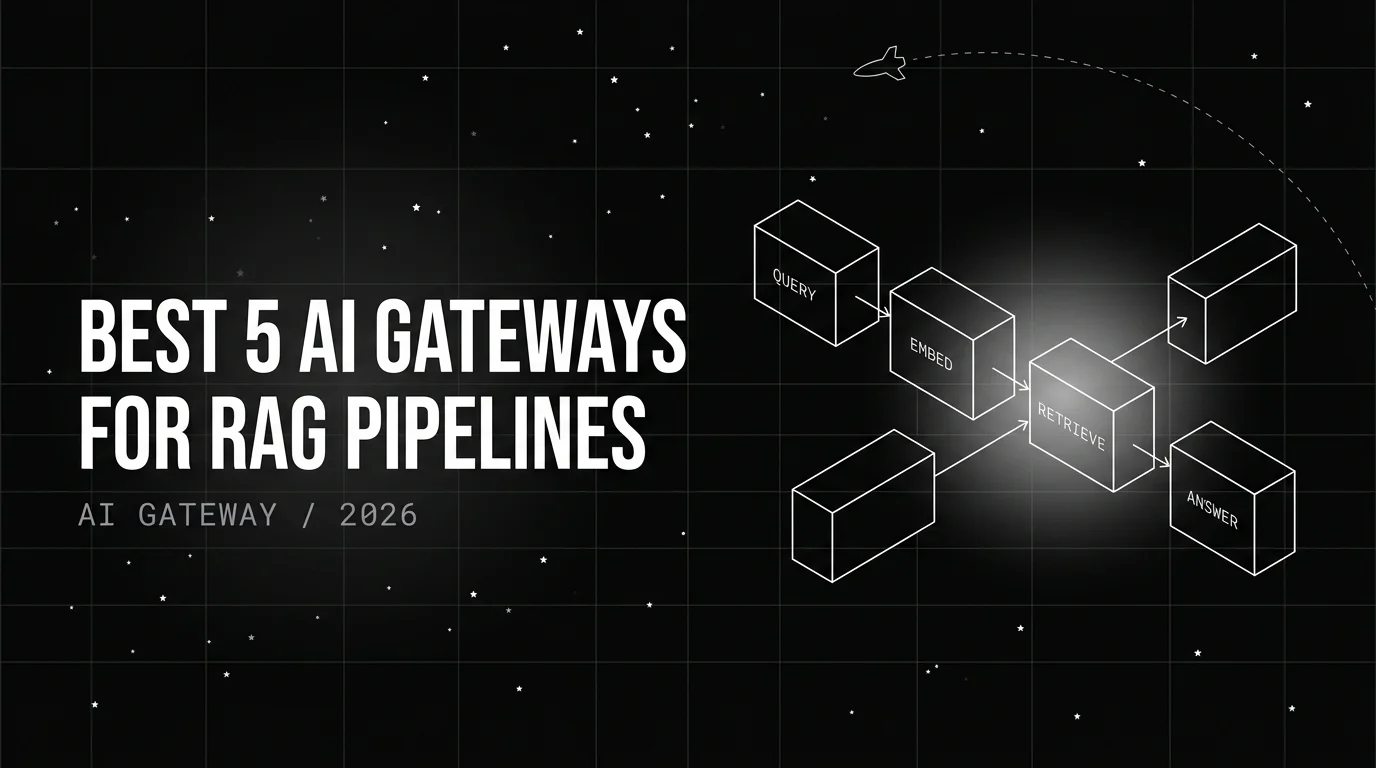
Table of Contents
Originally published May 17, 2026.
A platform team at a vertical SaaS deployed a customer-support RAG copilot in March, hit a 41 percent faithfulness score in the first week, and couldn’t tell whether the problem was the embedding model, the top-k, the reranker, the prompt template, or the LLM. Their gateway gave them token counts and provider latency. It didn’t give them per-stage retrieval timing, citation accuracy, or a faithfulness eval against the retrieved chunks. The pipeline shipped half-blind for six weeks. This guide compares the five AI gateways production RAG teams should choose between in 2026, scored on seven RAG-specific axes the LLM-proxy listicles never measure.
TL;DR
Future AGI Agent Command Center is the strongest pick for an AI gateway in front of RAG pipelines because ai-evaluation ships faithfulness and context-relevance as native RAG evaluators that run at the same gateway hop where the retrieval, rerank, and generation spans are captured, with citation metadata persistence per span_id, multi-vector-store routing (Pinecone, Weaviate, Qdrant, pgvector, Milvus), and per-tenant retrieval policy in one Apache-2.0 platform. The other four picks below win on specific edges.
- Future AGI Agent Command Center — Best overall. Per-stage retrieval/rerank/generation observability, native RAG eval hooks, multi-vector-store routing, and citation metadata persistence.
- Portkey — Best for a managed dashboard with strong adapter library and per-virtual-key budgets mapped to per-tenant retrieval keys (verify the Palo Alto Networks acquisition timeline before signing multi-year).
- Maxim Bifrost — Best for Go shops where end-to-end RAG latency is the binding constraint. Vendor-published ~11 µs mean overhead at 5,000 RPS.
- Helicone — Best for lightweight per-request observability with minimal infra. Treat as planned migration after the March 3, 2026 Mintlify acquisition.
- Langfuse — Best for open-source RAG tracing with a strong native trace UI and self-hosted eval surface. MIT license; trace-centric, lighter on routing surface than the gateway-first entries.
How We Picked: The Seven RAG-Specific Axes
Most 2026 RAG listicles score gateways on the same generic axes they use for chat workloads (provider count, latency overhead, dashboard polish), which means they can’t tell the difference between a gateway that observes a RAG pipeline well and one that just proxies the generation call. The seven axes below are RAG-specific.
| # | Axis | What we measure |
|---|---|---|
| 1 | Per-stage RAG-call observability | Distinct spans for retrieval, rerank, and generation; ability to attribute end-to-end latency to a specific stage |
| 2 | Embedding-API cost attribution | Per-call cost on embedding endpoints by key, model, tenant, and document set; token + provider attribution on the embedding hop |
| 3 | Multi-vector-store routing | Native adapters or pass-through for Pinecone, Weaviate, Qdrant, pgvector, Milvus; failover on 5xx or latency budget breach; per-tenant store selection |
| 4 | Citation-tracking metadata persistence | Whether source_id, chunk_id, score, embedding_model, and vector_store survive from the retrieval span to the generation span and into the persisted trace |
| 5 | Retrieval-quality eval hook | Native or pluggable evaluators for faithfulness and context-relevance; ability to fire the eval inside or after the gateway hop and emit the score on the same trace |
| 6 | Per-tenant retrieval policy | Per-key choice of embedding model, top-k, rerank threshold, vector-store namespace; tag-based enforcement so a single gateway serves multiple tenants |
| 7 | End-to-end RAG latency budget | Gateway hop overhead expressed as a fraction of the total budget; whether the gateway exposes a budget knob that fails open or fails fast when a stage breaches its budget |
Axes 1, 4, and 5 decide whether the gateway is actually a RAG gateway. Axis 2 is the cost story. Axis 3 is the routing story. Axis 6 is the multi-tenant story. Axis 7 is the production-SLO story.
Why a RAG Pipeline Needs an AI Gateway (more than an LLM SDK)
A RAG pipeline isn’t one call. It’s at least four. The user query goes through an embedding call to turn it into a vector. The vector goes through a retrieval call to a vector store. The retrieved chunks go through a reranker. The reranked chunks go through a prompt template into the generation call. Each stage has its own provider, rate limit, cost, latency profile, and failure mode. An LLM SDK only sees the last call.
Three concrete failure modes a gateway prevents:
- The silent retrieval miss. The retrieval call returns five chunks. None of them contain the answer. The generation call hallucinates a plausible-sounding response. The LLM SDK reports a 200, latency is fine, the token count is normal. The only signal that something went wrong is a faithfulness score against the retrieved chunks, and that signal only exists if a gateway-side eval hook can run faithfulness against persisted chunk metadata.
- The embedding-API cost runaway. An ingestion job re-embeds a 50 GB corpus because someone shipped a model change and forgot to flip the cache. The embedding call burns $14,000 in eight hours. Per-key, per-model, per-tenant attribution on the embedding hop is the only way to catch this in real time. An LLM SDK that only sees the generation hop will report a normal generation bill and miss the entire ingestion incident.
- The vector-store outage at the routing layer. Pinecone is down in
us-east-1. The retrieval call hangs for 30 seconds before failing. The generation hop never runs. A gateway with multi-vector-store routing fails over to Qdrant inus-west-2and emits a routing-event span. An application-side retry loop fails the same way the original request failed because there’s no policy layer above it.
The other reason is the eval loop. A gateway emits the chunk metadata on every retrieval span. The eval hook scores faithfulness against those chunks. The optimizer revises the embedding model or the top-k or the rerank threshold based on the labelled trace dataset. The application code never has to know.
How AI Gateways Actually Help RAG in Production
Production RAG teams measure five numbers, and a good gateway moves all five.
- Retrieval recall at top-k. Fraction of question/gold-chunk pairs where the correct chunk appears in the top-k. Typical targets: 0.85 at top-10, 0.75 at top-5. A gateway with per-stage instrumentation and citation persistence lets you compute this offline against persisted traces.
- Faithfulness. Fraction of generated claims entailed by the retrieved chunks. Typical targets: 0.90+ on factual workloads. fi.evals ships this as a native RAG evaluator.
- Context-relevance. Fraction of retrieved chunks actually used in the answer. High recall with low context-relevance means you’re over-retrieving and burning generation tokens. fi.evals ships this as the second native RAG evaluator.
- End-to-end RAG p95 latency. Embedding (50 to 250 ms) + retrieval (10 to 100 ms) + rerank (50 to 400 ms) + generation (500 to 4,000 ms) typically lands in a 1,500 to 4,500 ms p95 budget. Future AGI Protect adds roughly 65 ms median on a 2-core CPU per the arXiv 2510.13351 benchmark.
- Citation accuracy. Fraction of citations in the final answer that resolve back to a real retrieved chunk. Typical targets: 0.95+ on citation-required workloads (legal, healthcare, regulated finance). This number only exists if the gateway persists
chunk_idandsource_idon the trace span.
A gateway that ships per-stage timing and provider routing but skips citation persistence and the eval hook gets you numbers 1 and 4; it doesn’t get you 2, 3, or 5.
Future AGI Agent Command Center: Best Overall for RAG Pipelines
Future AGI Agent Command Center tops the 2026 RAG list because fi.evals ships faithfulness and context-relevance as native RAG evaluators that run on the same trace span where per-stage retrieval, rerank, and generation timing is captured, with citation metadata persistence and multi-vector-store routing in one Apache-2.0 platform. The trace-eval-optimize-route loop closes through agent-opt: a faithfulness regression on a held-out set produces a labelled dataset that agent-opt uses to revise the retrieval policy, and the gateway routes the next request through the revised policy at the same network hop.
Every other gateway on this list captures traces. Future AGI is the only one that pipes the eval result back into the routing decision in one product. The source ships at the Future AGI GitHub repo under the Apache 2.0 traceAI, ai-evaluation, and agent-opt packages.
Best for. Platform and ML teams running production RAG with vector DB + embedding + reranker + LLM stacks (Pinecone, Weaviate, pgvector, Qdrant) that want faithfulness and context-relevance evaluated at the gateway hop, per-stage timing, citation metadata persisted on the trace, and the eval result fed back into the routing decision through agent-opt.
Key strengths.
- Native faithfulness and context-relevance evaluators in
ai-evaluation(Apache 2.0). Both ship as RAG-specific rubrics inside a 50+ built-in catalog that also covers task completion, tool-use, structured-output, hallucination, agentic surfaces, and instruction-following, plus unlimited custom evaluators authored end-to-end by an in-product eval-authoring agent that uses tool calling on your code and retrieval context, plus self-improving evaluators that learn from live production traces so the faithfulness rubric sharpens as RAG traffic flows, plus FAGI’s proprietary classifier model family that runs continuous high-volume scoring at very low cost-per-token (lower per-eval cost than Galileo Luna-2). Both faithfulness and context-relevance run as deferred evals against the retrieved-chunks span; the score is emitted as a span attribute on the same OTel trace as the generation call, withspan_idlinking back to the gateway hop. Catalog is the floor, not the ceiling. This is the axis no other gateway on the list closes.
-
Per-stage RAG-call observability. Distinct OTel spans for the embedding call, the vector-store query, the rerank call, and the generation call; per-stage latency, token, and cost attribution; gateway-side correlation IDs that survive across providers.
-
Citation-tracking metadata persistence.
source_id,chunk_id,score,embedding_model, andvector_storesurvive from the retrieval span into the generation span and into the persisted trace, so the eval can be re-run offline. -
Multi-vector-store routing. Native pass-through for Pinecone, Weaviate, Qdrant, pgvector, and Milvus; per-tenant store selection via virtual keys; failover between vector stores on 5xx or latency budget breach.
-
Per-tenant retrieval policy. Per-virtual-key choice of embedding model, top-k, rerank threshold, vector-store namespace; tag-based enforcement so a single gateway serves multiple tenants without re-deploying.
-
Inline guardrails on the retrieval path via the Future AGI Protect model family. Protect is FAGI’s own fine-tuned model family built on Google’s Gemma 3n with specialized adapters across four safety dimensions (content moderation, bias detection, security/prompt-injection including indirect-injection on retrieved RAG context, data privacy/PII), natively multi-modal across text, image, and audio, a model family, not a plugin chain of third-party detectors. ~65 ms p50 text and ~107 ms p50 image on a 2-core CPU per arXiv 2510.13351, well inside a 1,500 ms p95 RAG budget; the same dimensions are reusable as offline eval metrics so the prod policy and the eval rubric stay in sync.
-
Self-improving loop. Faithfulness or context-relevance regressions produce a labelled trace dataset; agent-opt revises the embedding model, the top-k, or the rerank threshold; the gateway routes the next request through the revised policy. The artifact path is trace → eval → optimize → route, all running on the same span.
traceAIinstruments 50+ AI surfaces across Python, TypeScript, Java, and C# (including Spring Boot starter, Spring AI, LangChain4j, Semantic Kernel) OpenInference-natively, and Error Feed (the part of the eval stack, the clustering and what-to-fix layer that feeds the self-improving evaluators) sits alongside as the zero-config error monitor: auto-clusters related faithfulness and context-relevance failures (50 traces → 1 issue), auto-writes the root cause plus a quick fix plus a long-term recommendation, and tracks rising/steady/falling trend per issue so RAG regressions get triaged like exceptions rather than buried in eval dashboards.
- Apache 2.0 (traceAI, ai-evaluation, agent-opt). Single Go binary for the gateway; Docker, Kubernetes, AWS, GCP, Azure, on-prem, air-gapped; cloud at
gateway.futureagi.com/v1.
Where it falls short. Multi-vector-store routing is currently a routing-and-pass-through model rather than a unified retrieval API; teams that want a single retrieval call across multiple stores with score normalization still write a thin application-side fan-out. The cross-store query-fan-out wrapper is on the roadmap but not yet a first-class gateway feature.
from openai import OpenAI

client = OpenAI(
    api_key="$FAGI_API_KEY",
    base_url="https://gateway.futureagi.com/v1",
)

# Retrieval, rerank, and generation all flow through the same gateway hop.
# Per-stage timing, citation metadata, and faithfulness eval against the
# retrieved chunks are emitted as OTel spans linked by span_id; agent-opt
# sees the labelled trace dataset.
response = client.chat.completions.create(
    model="anthropic/claude-3-5-sonnet",
    messages=[
        {"role": "system", "content": "Answer from the retrieved context only."},
        {"role": "user", "content": user_query},
    ],
    extra_headers={
        "x-fagi-retrieval-context-ids": ",".join(chunk_ids),
        "x-fagi-embedding-model": "text-embedding-3-large",
        "x-fagi-vector-store": "pinecone:tenant-42",
        "x-fagi-eval": "faithfulness,context_relevance",
    },
)
Verdict. The strongest single pick when the 2026 RAG story is “we want faithfulness and context-relevance evaluated at the gateway hop, citation metadata persisted on the trace, per-tenant retrieval policy, and the eval result feeding back into the routing decision, in one Apache-2.0 platform.”
Portkey: Best for Managed Multi-Tenant RAG Dashboards
Portkey is the strongest pick when you want a mature managed gateway with a per-virtual-key hierarchy that maps cleanly to per-tenant retrieval keys, a usable dashboard out of the box, and the largest adapter library on the gateway path.
Best for. Multi-tenant SaaS RAG teams that need per-customer retrieval policies enforced at the gateway, a usable dashboard for per-tenant cost and latency attribution without writing a custom exporter, and a managed control plane.
Key strengths.
- Per-key, per-virtual-key, per-model, and per-time-window budgets; the per-virtual-key hierarchy maps cleanly to per-tenant retrieval keys.
- Large adapter library (250+ providers including embedding endpoints from OpenAI, Cohere, Voyage, and self-hosted embedding servers).
- Native dashboard for per-tenant cost attribution and latency breakdown; usable without writing a custom OTel exporter.
- Open-source gateway core (github.com/Portkey-AI/gateway); production teams self-host the gateway and run the control plane in Portkey cloud.
Where it falls short. Citation-tracking metadata persistence isn’t first-class; the dashboard exposes prompt/response pairs and provider attribution, but chunk_id, source_id, and per-chunk score don’t survive as structured span attributes without custom headers and a custom exporter. The retrieval-quality eval hook exists as a generic evaluator surface, but faithfulness and context-relevance aren’t shipped as native RAG evaluators; you wire them as custom evaluators against your own definitions, which is materially more work than the Future AGI fi.evals path. Palo Alto Networks announced intent to acquire Portkey on April 30, 2026 with close expected in PANW fiscal Q4 2026; standalone-product continuity is pending integration into Prisma AIRS.
Verdict. The most mature per-tenant key hierarchy plus managed dashboard on this list. Choose with eyes open on the Palo Alto integration timeline and on the gap between Portkey’s generic evaluator surface and Future AGI fi.evals’ native RAG evaluators.
Maxim Bifrost: Best for End-to-End RAG Latency Budgets
Maxim Bifrost is the Go-native gateway from Maxim, Apache 2.0, with vendor-published throughput at 5,000 RPS on t3.xlarge and the lowest published per-hop overhead on this list. For a RAG pipeline whose binding constraint is the end-to-end p95 latency budget, Bifrost adds the smallest constant.
Best for. Go shops running production RAG with tight p95 latency budgets where the gateway hop has to stay in the microsecond range, plus teams running Claude Code style agentic retrieval at scale that want to reduce MCP tool-call token cost.
Key strengths.
- Vendor-published benchmark showing roughly 11 µs mean gateway overhead at 5,000 RPS on
t3.xlarge. Across an end-to-end RAG pipeline with a 2,000 ms p95 budget, the Bifrost hop is below 0.001 percent of the budget. - Apache 2.0, single Go binary, drop-in deployment behind any existing RAG service.
- Code Mode for MCP token reduction (vendor-claimed up to 92.8 percent input-token reduction across 508 tools on 16 MCP servers), useful when retrieval is implemented as MCP tools instead of native vector-store calls.
Where it falls short. Citation-tracking metadata persistence on the trace is thin; the gateway proxies the generation call cleanly but treats the retrieval call as an upstream concern, which means chunk_id/source_id survive only if your application code emits them. Native retrieval-quality evaluators (faithfulness, context-relevance) live in the Maxim eval product, not in the gateway hop; the trace-eval-route loop spans two products instead of one, so revising the retrieval policy based on a faithfulness regression requires a separate operator step rather than the agent-opt artifact loop. Maxim self-ranks Bifrost #1 across its own gateway listicles with no published limitations, a trust signal worth weighing alongside the engineering claims.
Verdict. Strongest published per-hop latency on the list. Choose Bifrost when the end-to-end RAG latency budget is the binding constraint; pair with a separate evaluator if faithfulness against retrieved chunks needs to live on the same trace.
Helicone: Best for Lightweight Per-Request RAG Observability
Helicone is the lightweight per-request observability proxy that broke open the “drop-in observability without operating a control plane” category. For a small RAG pipeline that wants a trace surface in minutes without standing up an OTel collector or a self-hosted Langfuse, the lightweight proxy is the lowest-friction option.
Best for. Small RAG teams that want per-request observability with minimal infra, that are willing to live inside the Helicone trace surface for an initial production cohort, and that are planning their gateway/observability decision on a 6 to 12 month horizon.
Key strengths.
- Drop-in proxy with simple header-based instrumentation; no SDK changes required.
- Per-request trace surface with prompt/response capture, token attribution, and basic provider metrics.
- MIT (open-source core); cloud and self-host options for teams that want to run the control plane locally.
- Custom property tagging that maps reasonably to a per-tenant retrieval-key model for simple cases.
Where it falls short. Helicone was acquired by Mintlify on March 3, 2026 and the public roadmap has shifted toward documentation-platform-first; the gateway and observability surface are still maintained, but new investment is going into the documentation product, and the trust signal for a new procurement in 2026 is materially weaker than for the Apache-2.0 alternatives. Per-stage RAG-call observability isn’t first-class; the trace surface treats every upstream call as a single hop, which means a separate retrieval span and a separate rerank span require manual wiring. Citation-tracking metadata persistence is via custom properties, not via structured retrieval span attributes. Native retrieval-quality evaluators (faithfulness, context-relevance) aren’t part of the product. Multi-vector-store routing isn’t a feature; Helicone proxies LLM calls, not vector-store calls.
Verdict. Strong fit for a small or early-stage RAG pipeline that wants drop-in observability today; treat as a planned migration window rather than a multi-year procurement after the Mintlify acquisition.
Langfuse: Best for Self-Hosted Trace-First RAG
Langfuse is the trace-first open-source LLM observability platform that production RAG teams reach for when the binding constraint is “self-hosted, MIT-licensed, native trace UI” rather than “gateway routing.” Langfuse is a trace platform with a strong eval surface, not a gateway-first product.
Best for. Self-hosted RAG teams that want a native trace UI, an MIT-licensed control plane, and a strong eval surface, and that are willing to wire their gateway/routing layer separately.
Key strengths.
- MIT (open-source); cloud and self-host with a single Docker Compose or Kubernetes deployment.
- Native trace UI tuned for RAG: per-span attributes for retrieval, rerank, and generation work cleanly once the SDK is wired correctly; chunk metadata can be persisted on the trace via custom span attributes.
- Eval surface with pluggable LLM-as-judge evaluators, including community templates for faithfulness and context-relevance; deferred evals run against the persisted trace and emit scores back to the trace span.
- Active maintainer community; integrates with LangChain, LlamaIndex, and Haystack out of the box.
Where it falls short. Langfuse is trace-first; there’s no gateway routing layer in the same product. Multi-vector-store routing, per-tenant retrieval policy enforcement, and inline guardrails on the retrieval path aren’t native features; you wire them in your application or in a separate gateway and emit the trace from there. The eval hook is strong on persisted traces but isn’t running at the same network hop as the LLM call, which means a faithfulness regression can’t fail open or fail fast at the gateway; the eval is observational. The trace-eval-optimize-route loop isn’t closed in one product; Langfuse closes trace and eval, but optimize and route are separate concerns.
Verdict. The strongest open-source trace-first RAG platform on this list. Choose Langfuse when self-host plus MIT plus a native trace UI is the brief; choose elsewhere when routing, guardrails, and a closed-loop optimizer are part of the same procurement.
The 2026 Gateway Migration and Trust Cohort for RAG
The Q1 to Q2 2026 events reshape the RAG procurement question, and most RAG listicles ignore them.
- Helicone joining Mintlify (March 3, 2026). Acquired by Mintlify; public roadmap shifts toward documentation-platform-first. Teams already on Helicone should treat this as a planned migration window.
- LiteLLM PyPI supply-chain compromise (March 24, 2026). Versions
1.82.7and1.82.8exfiltrated SSH keys, cloud credentials, and Kubernetes configs, per the Datadog Security Labs writeup. LiteLLM is widely embedded in RAG application code; scan the dependency tree, rotate credentials, and upgrade past 1.83.7 or pin a known-good commit. - Anthropic MCP STDIO RCE class (April 2026). OX Security disclosed an STDIO transport class flaw affecting 7,000+ publicly accessible MCP servers. RAG pipelines that implement retrieval as MCP tools are in scope; the gateway is now expected to enforce least-privilege tool access, OAuth 2.1, and Streamable HTTP transport.
- Portkey acquired by Palo Alto Networks (April 30, 2026). Gateway will become the AI Gateway for Prisma AIRS, close expected in PANW fiscal Q4 2026. Standalone RAG-roadmap continuity is pending integration.
For RAG procurement in 2026, license clarity and acquisition independence are part of the picking decision.
Common Implementation Mistakes RAG Teams Make at the Gateway
Four mistakes recur often enough to call out.
- Treating retrieval as a sidecar instead of a first-class hop. The retrieval call is logged, but latency, chunk metadata, and the per-tenant routing decision don’t survive on the trace. The faithfulness eval can’t run against persisted chunks because the chunks were never persisted as structured span attributes. Fix: emit
chunk_id,source_id,score,embedding_model, andvector_storeas span attributes, not as log lines. - Wiring faithfulness against the prompt instead of the retrieved chunks. A common anti-pattern: faithfulness is evaluated against the system prompt and user query, not against the retrieved chunks. The score looks fine, the answer is unfaithful. Fix: pass the retrieved chunks as the reference set to the faithfulness evaluator.
- Setting a global top-k instead of a per-tenant policy. Different tenants need different retrieval breadth. A
k=5that works for one tenant over-retrieves for another and under-retrieves for a third. Fix: per-virtual-key top-k and per-virtual-key rerank threshold, enforced at the gateway. - Ignoring the latency-budget breach signal. The embedding call breaches its sub-budget on 12 percent of requests; the application surfaces nothing. Fix: per-stage latency budget at the gateway with a fail-fast or fail-open policy, and emit a budget-breach span attribute so the eval can correlate retrieval-quality misses with stage breaches.
Future AGI Implementation Walk-Through: Trace-Eval-Optimize-Route for RAG
The closed-loop artifact path runs end-to-end on a single trace:
- Trace. A retrieval call flows through the gateway. The gateway emits an OTel span for the embedding call (
embedding_model, latency, tokens, cost), a span for the vector-store query (vector_store,namespace,k, latency, returnedchunk_idlist), a span for the rerank call (reranker_model, latency, score distribution), and a span for the generation call (model, prompt template,chunk_idlist passed in, latency, tokens, cost). All spans share the same trace ID; citation metadata is structured, not free-form. - Eval. A deferred fi.evals run scores faithfulness against the retrieved chunks (claim entailment from the answer against
chunk_idcontent) and context-relevance against the chunk-usage pattern. Both scores are emitted as span attributes on the generation span, linked back to the gateway hop byspan_id. - Optimize. A faithfulness regression on a held-out set fires a labelled trace dataset into agent-opt. agent-opt revises the retrieval policy: a different embedding model for the affected tenant, a different top-k, a different rerank threshold, or a different prompt template. The revision is a structured artifact (a new virtual-key policy), not a free-form recommendation.
- Route. The next request from the affected tenant routes through the revised policy at the same network hop. The gateway emits a new trace; the eval runs again; the artifact path repeats. Over time, the retrieval policy is the artifact of the loop, not a static config.
This is the wedge: every other gateway on this list captures the trace. Future AGI is the only one where the eval result feeds back into the routing policy in one product.
Which RAG Gateway Is Right for You in 2026?
| If you are a… | Pick | Why |
|---|---|---|
| Platform team running production RAG with vector DB + embedding + reranker + LLM and tight requirements on faithfulness | Future AGI Agent Command Center | fi.evals native faithfulness + context-relevance at the gateway hop, citation metadata persistence, multi-vector-store routing, eval-into-routing loop via agent-opt |
| Multi-tenant SaaS RAG team that wants a managed dashboard with per-tenant key hierarchy | Portkey | Most fine-grained per-virtual-key hierarchy + native dashboard (verify PANW integration) |
| Go shop where end-to-end RAG p95 latency is the binding constraint | Maxim Bifrost | Vendor-published ~11 µs mean overhead at 5,000 RPS; Apache 2.0 |
| Small RAG team that wants drop-in observability today on a 6 to 12 month horizon | Helicone | Drop-in proxy; lowest-friction; planned migration window after Mintlify acquisition |
| Self-hosted MIT-licensed RAG team that wants a native trace UI and is willing to wire routing separately | Langfuse | Strong open-source trace surface; pluggable eval; trace-first not gateway-first |
| Air-gapped or on-prem regulated RAG workload | Future AGI Agent Command Center or Maxim Bifrost | Apache 2.0 single binary; Docker, Kubernetes, air-gapped |
| Regulated workload where citation accuracy is the audit artifact | Future AGI Agent Command Center | Citation metadata persisted as structured span attributes; eval runs against persisted chunks |
RAG in 2026 isn’t a single feature. It’s a stack: per-stage observability, embedding cost attribution, multi-vector-store routing, citation metadata persistence, a faithfulness and context-relevance eval hook, per-tenant retrieval policy, and an end-to-end latency budget, running at the same network hop, under a license that isn’t about to be re-platformed inside an acquirer.
Future AGI Agent Command Center is the strongest single pick when the buying constraint is a closed-loop trace-eval-optimize-route platform for RAG in one Apache-2.0 binary. Teams already on Portkey should weigh the Palo Alto integration timeline; teams already on Helicone should plan the Mintlify migration window; Go shops should benchmark Bifrost on the latency budget; self-hosted MIT-licensed RAG teams should evaluate Langfuse against the gap on routing and guardrails.
For deeper reads: the Future AGI Evaluation docs for native faithfulness and context-relevance, the Future AGI observability docs for per-stage trace emission, the Future AGI Protect docs for inline guardrail latency, the Future AGI GitHub repo for the Apache 2.0 packages, and the OpenTelemetry GenAI semantic conventions for the span attribute schema.
Try Future AGI Agent Command Center free: drop-in OpenAI-compatible routing, per-stage RAG observability, multi-vector-store routing, citation metadata persistence, fi.evals native faithfulness and context-relevance at the gateway hop, and the trace-eval-optimize-route loop via agent-opt, in one Apache-2.0 platform.
Related reading
- Best 5 AI Gateways for LLM Cost Optimization in 2026, the five-layer cost stack and the 2026 trust cohort
- Best 5 AI Gateways for LLM Failover and Fallback in 2026, fallback and failover gateway picks
- Best 7 AI Gateways for Multi-Model Routing in 2026, how cost-quality routing decisions get made at the gateway hop
- Best 5 AI Gateways for Prompt Management in 2026, the prompt-management gateway picks
Frequently Asked Questions
What is an AI gateway and why is it the right layer for a RAG pipeline?
Can I do RAG observability in my LLM SDK directly instead of a gateway?
What is the latency cost of running a RAG pipeline through a gateway?
How do I measure whether the gateway is actually helping RAG quality?
Can I self-host a gateway for a RAG pipeline?
How does Future AGI's loop close RAG beyond what other gateways offer?
Ragas, DeepEval, FutureAGI, Phoenix, Galileo, Langfuse, TruLens compared as the 2026 RAG eval shortlist. Faithfulness, retrieval, chunk attribution.

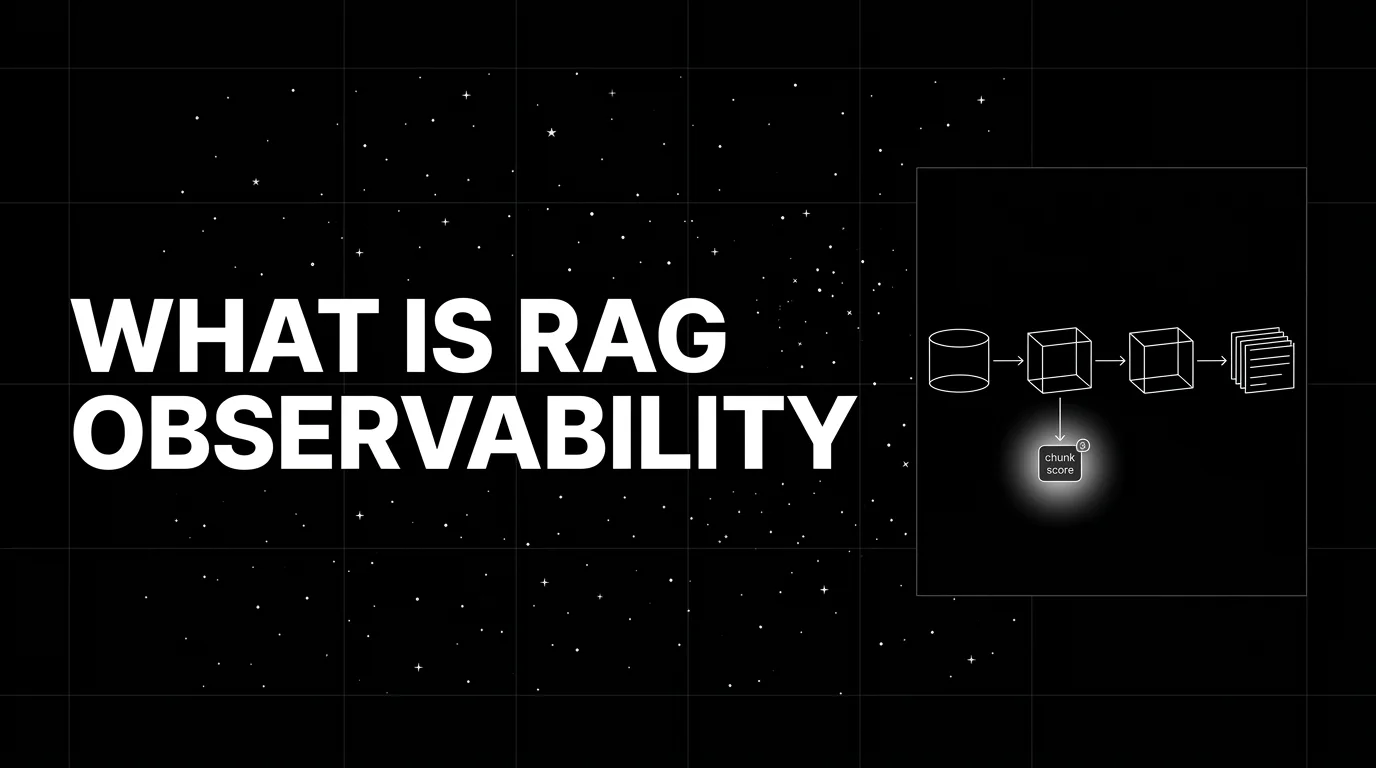
RAG observability is span-level tracing of retrieval, reranking, and generation, with chunk-level scores and grounding metrics. What it is, how to ship.

Pinecone, Milvus, Weaviate, Qdrant, pgvector, Chroma, Vespa for RAG in 2026. Compared on recall, latency, hybrid search, OSS license, eval-fit.