Best 5 AI Gateways for Media and Publishing in 2026: Content Routing, Licensing, and Brand-Safety Guardrails
Five AI gateways for media and publishing 2026: source-attribution, copyright scoring, brand safety, deepfake detection, C2PA watermarking.
Table of Contents
Originally published May 17, 2026.
A mid-Atlantic newspaper publisher with 14 daily titles ran a headline-optimization pilot one summer week and discovered by month-end that its AI gateway had no source-attribution trail for the archived stories the model had been fine-tuned on, no copyright-risk score on the outputs, and no C2PA manifest on the AI-illustrated thumbnails, and that the same gateway had routed celebrity-name prompts to a consumer-tier image model that returned a synthetic photo close enough to a Getty original to draw a DMCA takedown. This guide compares the five AI gateways VP-of-Digital and CTO buyers at digital publishers, broadcasters, and content studios should consider in 2026, scored against SAG-AFTRA 2023 AI provisions, WGA AI clauses, the fair-use litigation cohort, EU AI Act Article 50, US Copyright Office 2023/2024 guidance on AI-assisted registration, and DMCA.
TL;DR: The 5 Best Media and Publishing AI Gateways for 2026
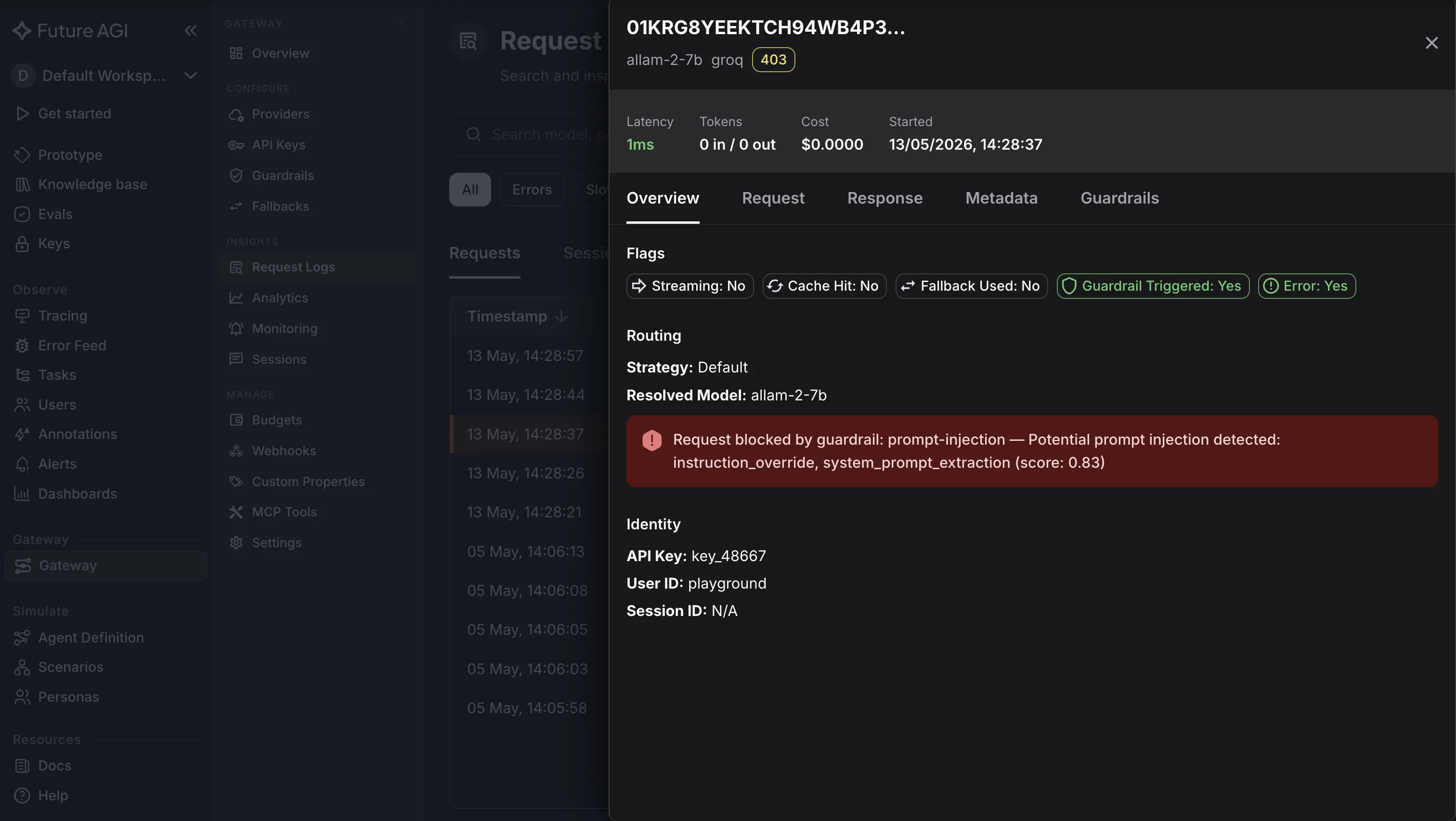
Future AGI Agent Command Center is the strongest single pick because it bundles an OpenAI-compatible drop-in, 18+ built-in guardrail scanners (brand safety, prompt injection, copyrighted-snippet leakage, deepfake-asset triggers, data leakage prevention, hallucination, MCP security), per-publication virtual-key budgets, source-attribution span attributes per request, and content-quality eval scores joined per span, in one Apache 2.0 Go binary self-hostable inside a publisher VPC. Protect runs at ~65 ms median brand-safety guardrail latency (arXiv 2510.13351), the difference between a guardrail that ships and one the desk turns off under deadline pressure.
Media procurement in 2026 weighs five concurrent shifts: EU AI Act Article 50 in full force August 2, 2026; the NYT v OpenAI and parallel image-rights class-action wave in active discovery; SAG-AFTRA 2023 and WGA AI clauses folded into every union production schedule; the C2PA v2.x rollout across BBC, NYT, AP, Reuters, AFP, and The Washington Post; and the Q1/Q2 2026 gateway trust cohort (Helicone to Mintlify, LiteLLM PyPI compromise, Portkey announced for acquisition by Palo Alto Networks).
- Future AGI Agent Command Center — Best overall. 18+ brand-safety, copyright-risk, and data-leakage guardrails, per-publication budgets, source-attribution traces, self-hosted in a publisher VPC.
- Portkey — Best for multi-title publishing groups that want a managed cost and audit dashboard across 10+ brand verticals. Verify the Palo Alto Networks acquisition timeline before signing multi-year.
- Kong AI Gateway — Best for broadcasters and digital-first publishers already running Kong for REST APIs that want one control plane with API-gateway-grade SLAs.
- Cloudflare AI Gateway — Best for edge-heavy publishers (high-traffic news, syndication networks, ad-adjacent surfaces) that want the gateway co-located with the CDN and Workers layer.
- LiteLLM — Best for Python-first newsroom platform teams pinning a known-good commit after the March 24, 2026 supply-chain incident, holding their own DPA path.
Helicone is intentionally off the list: acquired by Mintlify on March 3, 2026 and in maintenance mode.
Why Media and Publishing Needs an AI Gateway in 2026
Three failure categories drive every newsroom and broadcaster to put a gateway between the CMS and the model providers.
One. AI generating content that infringes copyright. NYT v Microsoft and OpenAI (S.D.N.Y., Dec 27, 2023) alleges verbatim regurgitation of millions of Times articles, with parallel class actions from Authors Guild and Getty Images Ltd v Stability AI (UK High Court and D. Del.). Until a fair-use ruling, a publisher’s defensive posture is to procure from licensed corpora where available, attach an immutable source-attribution chain to every output, and run copyright-risk scoring on every generation. The gateway is the one place that audit trail is enforced without per-app code changes.
Two. No attribution chain for AI-assisted articles. The US Copyright Office Statement of Policy (March 16, 2023) and Report on AI Part 2: Copyrightability (January 29, 2025) require applicants to disclose AI contribution and identify human-authored portions. Publishers like AP (July 2023 OpenAI deal), Axel Springer (December 2023), and the FT (April 2024) publish disclosure language on AI-assisted output; the gateway produces the evidence behind the disclosure.
Three. Ad-adjacency brand-safety failures and deepfake liability. IAB Brand Safety Floor and GARM taxonomy v2 (2024) define what advertisers contract against; programmatic bidders score adjacency at bid request level. AI-generated copy not scored on the same surface is open liability. EU AI Act Article 50 adds deepfake disclosure on synthetic image, audio, and video. A gateway with sub-100ms brand-safety scanners is the only sustainable way to put editorial and ad-tech on one control surface; bolting separate moderation onto the bidder while another runs in the CMS leaves a deepfake-on-the-homepage gap nobody owns.
How We Picked
We used the Future AGI Production Gateway Scorecard for Media, a seven-axis rubric tuned to publishing operations. Each axis is something a VP-of-Digital or CTO can defend to the masthead, the rights desk, and a programmatic ad partner.
| # | Axis | What we measure |
|---|---|---|
| 1 | Source-attribution audit trail | Every generation captures the upstream input chain (RAG corpus, prompt template version, archive query) as immutable span attributes tied to a CMS asset ID, retained at least the editorial archive window |
| 2 | Copyright-risk scoring per generation | Output is scored for verbatim or near-verbatim overlap against licensed and unlicensed corpora; the score is exposed per request as a span attribute the editorial workflow can read |
| 3 | Brand-safety guardrails (content + ad placement) | IAB/GARM-aligned scanners at sub-100ms; same surface scores both editorial output and ad creative; scanner library is built-in not adapter-only |
| 4 | Deepfake detection on image/video pass-through | Routes synthetic-image and synthetic-video outputs through a detector (or blocks at source by routing only to C2PA-signing providers); same detector applies to inbound UGC for moderation |
| 5 | Multi-locale routing (style + regulation) | Routes per locale by style (AP, UK, German personality-rights, French neighbouring-rights) and regulation (EU AI Act Article 50, UK Online Safety Act, India IT Rules 2021, Australia Online Safety Act); bills each route correctly |
| 6 | Per-publication cost attribution | Per-VK budgets plus tag-based custom properties for per-masthead, per-desk, per-feature attribution via an OTel-native exporter into the existing FinOps stack |
| 7 | Watermarking + content credentials (C2PA) | Writes C2PA v2.x manifests on generated image, audio, and video, recording model, prompt template version, and source-attribution chain; verifier exposes a public endpoint or follows the Content Authenticity Initiative pattern |
Axes 1, 2, and 7 decide whether the gateway serves the editorial brief. Axes 3, 4, and 5 keep ad-tech and moderation intact. Axis 6 makes the gateway survive the next budget review.
The 7-Axis Media Capability Matrix the SERP Is Missing
Future AGI Agent Command Center leads on combined source-attribution depth, brand-safety scanner breadth, C2PA support, and license clarity for media. Portkey wins on managed dashboard maturity. Kong wins on infrastructure-grade SLAs for a Kong shop. Cloudflare wins on edge co-location and free-tier reach. LiteLLM wins on Python ergonomics.
| Capability | Future AGI ACC | Portkey | Kong AI Gateway | Cloudflare AI Gateway | LiteLLM |
|---|---|---|---|---|---|
| Source-attribution audit trail | Built-in (OpenTelemetry span attributes per request, ties to RAG corpus and prompt template version) | Dashboard-first with span export | Plugin-driven via Kong observability stack | Edge logs plus Logpush, plus AI Crawl Control on the inbound side | Span-attribute capable via OTel exporter |
| Copyright-risk scoring | Built-in (copyrighted-snippet leakage scanner plus 15 adapter slots for licensed-corpus checks) | Adapter-driven at the Enterprise tier | Plugin-driven (content-safety plugin family plus custom plugin slot) | AI Gateway logs plus custom Worker scoring | Adapter-driven |
| Brand-safety guardrails (content + ad) | Built-in (18+ scanners, ~65 ms median Protect latency, arXiv 2510.13351) | PII anonymization plus moderation adapters | Content-safety plugin plus Azure / AWS content-moderation plugins | Cloudflare Firewall for AI plus custom Worker rules | Adapter-driven |
| Deepfake detection on image / video | Built-in deepfake-asset trigger scanner plus C2PA verifier path | Adapter-driven | Plugin-driven | Custom Worker plus partner integrations | Adapter-driven |
| Multi-locale routing | Per-locale virtual keys plus tag-based properties plus shadow experiments | Per-key routing plus four-tier budgets | Plugin routing plus per-route policies | Edge-locale routing via Workers | Per-key routing |
| Per-publication cost attribution | Per VK, per model, per window plus tag-based custom properties; Prometheus /-/metrics plus OTel | Native dashboard plus OTel partial | Konnect Analytics plus Prometheus | AI Gateway analytics plus Logpush | OTel partial plus virtual-key budgets |
| C2PA content credentials | Built-in writer plus verifier path for image, audio, video | Adapter-driven | Plugin slot | Custom Worker | Adapter-driven |
| OpenTelemetry-native traces | Yes (first-class) | Partial (dashboard-first) | Yes (via Kong observability) | Logpush to OTel collectors | Partial |
| Self-host / air-gap | Yes (Apache 2.0 single Go binary) | Source-available core; air-gap at Enterprise | Yes (Kong open-source plus Enterprise on-prem) | No (edge-managed; on-prem via partners) | Yes (pip install or Docker) |
| License | Apache 2.0 | Source-available core plus cloud | Open-source core (Apache 2.0) plus Kong Enterprise | Proprietary edge-managed | Apache 2.0 outside enterprise directory |
| Self-improving loop (eval back to gateway) | Yes (Future AGI Evaluation plus agent-opt; content-quality-eval ties via span_id) | Partial (eval product separate) | No (eval is a partner integration) | No | No |
Nobody wins every column. The four that decide a media procurement (source-attribution depth, brand-safety scanner breadth, C2PA support, self-improving loop) are where the field separates.
What the 2026 Media Compliance Stack Actually Demands
Five layers. A gateway that handles only one or two isn’t a media gateway.
- EU AI Act Article 50 transparency. Synthetic image, audio, and video must be machine-readable as artificially generated; AI-generated text on matters of public interest must be disclosed unless human-reviewed and editorially controlled. Full application August 2, 2026. The gateway is the disclosure surface. C2PA manifest, model-version span attribute, disclosure-flag for the CMS.
- Fair-use litigation cohort. NYT v OpenAI, Authors Guild et al v OpenAI, Getty Images Ltd v Stability AI (UK and D. Del.), and the N.D. Cal. class action against Stability AI, Midjourney, DeviantArt, and Runway. Every publisher carries unresolved exposure on outputs from unlicensed training data; the gateway is where copyright-risk scoring runs and source-attribution is captured.
- SAG-AFTRA + WGA AI clauses. The SAG-AFTRA 2023 TV/Theatrical Agreement (Nov 2023) requires informed consent and compensation for digital replicas and synthetic performers. The WGA MBA (May 2023) prohibits AI-generated material as source material or credit on covered scripted content. Broadcasters need a guild-rights audit trail, gateway span attributes.
- US Copyright Office registration guidance. The 2023 Statement of Policy plus the 2025 Part 2 Copyrightability report require disclosure of AI contribution and identification of human-authored portions. The byline policy and disclosure language follow the same evidence trail, gateway-resident.
- DMCA Section 512. AI-assisted output risks a takedown from a rights holder showing substantial similarity. The gateway scores that risk pre-publication and surfaces a per-asset C2PA manifest so the rights desk responds with evidence.
Future AGI Agent Command Center: Best Overall for Media and Publishing
Future AGI Agent Command Center tops the 2026 media list because it bundles every layer of the publishing compliance stack at the same network hop in one Apache 2.0 Go binary self-hostable inside the publisher VPC. It loses on out-of-the-box managed dashboard polish to Portkey, on infrastructure-grade SLAs to Kong, and on edge co-location to Cloudflare; for buyers whose binding constraint is source-attribution depth plus 18+ built-in brand-safety and copyright-risk scanners plus per-publication budgets plus OTel traces plus C2PA in one self-hostable binary, the combined surface still wins.
The bundle: OpenAI-compatible drop-in, 18+ built-in scanners (brand safety, prompt injection, copyrighted-snippet leakage, deepfake-asset triggers, data-leakage prevention, hallucination, content moderation, topic restriction, MCP security), per-VK budgets, exact plus semantic caching, OpenTelemetry-native traces, and a self-improving loop with content-quality-eval. Protect runs at ~65 ms median latency at the same hop (arXiv 2510.13351), the difference between a guardrail that ships and one the desk turns off when the wire-service feed spikes. SOC 2 Type II at the Boost tier; AWS Marketplace listed; full surface in the Agent Command Center docs and source at the GitHub repo.
The self-improving loop ties production failures (brand-safety trips, copyright-risk score above threshold, hallucination on an archive query) back into the content-quality-eval set, so routing improves week over week without the data team owning a separate offline pipeline.
Best for. Publishers, broadcasters, content studios, and syndication networks that want OpenAI compat plus the 18+ scanner library plus per-publication budgets plus source-attribution traces plus C2PA in one binary, self-hosted in the VPC.
Key strengths.
-
OpenAI-compatible drop-in: change
base_urltohttps://gateway.futureagi.com/v1; CMS, headline-optimization, archive-search, and AI-illustration workers stay unchanged. -
20+ providers via six native adapters (OpenAI, Anthropic, Gemini, Bedrock, Cohere, Azure) plus OpenAI-compatible presets and self-hosted backends across OpenAI, Anthropic, Google Gemini, AWS Bedrock, Azure OpenAI, Cohere, Mistral, Groq, Together, plus image and video providers, plus self-hosted via Ollama, vLLM, LM Studio. For media, OpenAI publisher-deal variants, Anthropic Claude editorial-use-case, and Gemini publisher-partner are the three licensed-corpus upstreams most routed.
-
The Future AGI Protect model family for inline guardrails, ~65 ms p50 text and ~107 ms p50 image (arXiv 2510.13351). Protect is FAGI’s own fine-tuned model family built on Google’s Gemma 3n with specialized adapters across four safety dimensions (content moderation, bias detection, security/prompt-injection, data privacy/PII), natively multi-modal across text, image, and audio, a model family, not a plugin chain. Brand-safety detectors (IAB/GARM, copyrighted-snippet leakage, deepfake-asset triggers) layer on the same hop, and a dedicated MCP Security scanner sits alongside (relevant after the April 2026 OX Security MCP STDIO RCE disclosure). The same dimensions are reusable as offline eval metrics so the prod policy and the eval rubric stay in sync.
-
Per-key, per-VK, per-model, per-window budgets; rate limits; quotas; shadow experiments; tag-based custom properties for per-publication, per-desk, per-feature enforcement.
-
OpenTelemetry-native traces plus Prometheus
/-/metricsfeeding Grafana, the editorial-disclosure pipeline, and the Future AGI Evaluation pipeline viaspan_id.traceAIinstruments 50+ AI surfaces across Python, TypeScript, Java, and C# (including Spring Boot starter, Spring AI, LangChain4j, Semantic Kernel) OpenInference-natively, and Error Feed. the part of the eval stack, the clustering and what-to-fix layer that feeds the self-improving evaluators, turns those traces into named issues with zero config: auto-clusters related per-publication brand-safety and copyrighted-snippet failures (50 traces → 1 issue), auto-writes the root cause plus a quick fix plus a long-term recommendation per issue, and tracks rising/steady/falling trend per issue so editorial regressions surface like exceptions rather than buried in dashboard rows.
- Apache 2.0 single Go binary; Docker, K8s, AWS, GCP, Azure, on-prem, air-gapped, or cloud at
gateway.futureagi.com/v1. SOC 2 Type II on the Boost add-on; AWS Marketplace listed.
Where it falls short.
- C2PA writer ships today; the verifier-as-a-service path is on the H2 2026 roadmap. Publishers running the Content Authenticity Initiative verifier pattern are unaffected; smaller publishers wanting a fully managed verifier should pair with a partner verifier in the meantime.
- Multi-locale routing covers US, UK, EU per member state, Canada, and Australia on regulation; locale-specific style profiles (AP, UK, Australian Style Manual, CP Stylebook) are implemented via prompt-template versioning and tags rather than a first-class style-profile object.
- Enterprise single-tenant managed instances with a dedicated region carry a 4-8 week sales cycle, similar to Kong Enterprise or a VPC install.
from openai import OpenAI

client = OpenAI(
    api_key="$FAGI_API_KEY",
    base_url="https://gateway.futureagi.com/v1",
)

# Existing OpenAI SDK code unchanged. The gateway runs brand-safety,
# copyright-risk, and deepfake-asset scoring, captures source-attribution
# span attributes, and writes the C2PA manifest at the same network hop.
response = client.chat.completions.create(
    model="anthropic/claude-3-7-sonnet",
    messages=[
        {"role": "system", "content": "House style: AP. Disclosure: AI-assisted, human-edited."},
        {"role": "user", "content": "Draft three headline variants for the Senate hearing story."},
    ],
    metadata={
        "publication": "morning-bulletin",
        "desk": "politics",
        "byline_policy": "ai-assisted-human-edited",
        "rag_corpus": "morning-bulletin-archive-2015-2026",
    },
)
Verdict. The strongest pick when the 2026 brief is “OpenAI compat plus brand-safety, copyright-risk, deepfake scanners plus per-publication budgets plus OTel traces plus C2PA inside our VPC, with a self-improving loop closing the gap between production trips and the eval set.” Pair with Portkey, Kong, or Cloudflare per the buyer profile.
Portkey: Best for Multi-Title Publishing Group Managed Dashboard
Portkey is the strongest pick when a 10+ title publishing group wants a managed cost and audit dashboard out of the box, a mature semantic cache, and a four-tier budget hierarchy with PII anonymization at Enterprise. Caveat: the Palo Alto Networks acquisition announced April 30, 2026 is expected to close in Palo Alto’s fiscal Q4 2026.
Best for. Multi-title publishing groups wanting fine-grained per-publication or per-desk budgets, PII anonymization, and a usable dashboard without writing a custom exporter, with acceptable risk appetite for the pending acquisition.
Key strengths.
- Exact plus semantic caching; publisher headline-optimization workloads see 35-55% hit rates on prompts like “rewrite the lede for the homepage card.”
- Per-key, per-VK, per-model, per-window budgets, the most fine-grained native-dashboard hierarchy on the list.
- 250+ providers including private OSS and on-prem Llama for archive-search where the corpus stays on-prem.
- PII anonymization at Enterprise; SOC 2 Type 2, ISO 27001, GDPR audit logs.
Where it falls short.
- Palo Alto acquisition announced and not closed. Multi-year contracts need a continuity clause.
- Dashboard-first observability; OTel export exists but is less first-class, lengthening integration with Splunk, Datadog, or Grafana.
- Brand-safety guardrails are adapter-driven, not a built-in scanner library. Compared with FAGI’s 18+ scanners at ~65 ms Protect latency, Portkey requires bringing your own content-safety surface.
- C2PA is adapter-driven; the publisher writes its own manifest service.
- Source-available core plus closed control plane; air-gapped at Enterprise is heavier to operate than a single Apache 2.0 binary.
Verdict. Most mature managed dashboard for media AI in 2026. Choose with eyes open on the Palo Alto integration.
Kong AI Gateway: Best for Broadcasters Already on Kong
Kong AI Gateway is the strongest pick for a broadcaster or digital publisher already running Kong for REST APIs that wants one control plane in front of LLM and image providers with API-gateway-grade SLAs.
Best for. Publishers on Kong (OSS, Konnect, or Enterprise) needing API-gateway-grade SLAs, latency budgets, circuit breakers, region failover, on the AI path.
Key strengths.
- Same Kong control plane for REST and model providers; broadcast engineering manages AI with the same playbooks, routes, and plugin model.
- AI Proxy and AI Proxy Advanced covering OpenAI, Anthropic, Azure OpenAI, AWS Bedrock, Google Vertex, Cohere, Mistral, Llama, self-hosted vLLM; plus AI Prompt Decorator, AI Prompt Guard, AI Rate Limiting Advanced, AI Semantic Cache.
- Content-safety plugin family (Azure, AWS) plus custom plugin slots.
- API-gateway-grade SLAs Kong has shipped since 2015, non-negotiable for AI-assisted lower-thirds and subtitles in a live broadcast.
- OSS core (Apache 2.0) plus Kong Enterprise; on-prem, hybrid, or hosted Konnect.
Where it falls short.
- AI-specific guardrails (brand safety, copyright-risk, deepfake-asset) are plugin-driven, not built-in. Compared with FAGI’s 18+ scanners, Kong requires wiring Azure or AWS content-moderation plugins or writing a custom Lua plugin.
- C2PA isn’t a first-class concept; the publisher writes a custom plugin or downstream service.
- Self-improving loop isn’t a Kong concept; pair with Future AGI Evaluation, Maxim, Braintrust, or Langfuse via OTel span IDs.
- Per-publication attribution lives in Konnect Analytics rather than an OTel-native exporter.
- Kong Enterprise/Konnect aren’t list-priced; expect a sales cycle to negotiate the AI entitlement on top of the existing contract.
Verdict. The right pick when “we already run Kong and want one control plane across REST and model providers” is the constraint. Choose FAGI when a built-in scanner library, C2PA, and a self-improving loop matter more.
Cloudflare AI Gateway: Best for Edge Content and Syndication
Cloudflare AI Gateway is the strongest pick for a news site, syndication network, or digital-first publisher whose architecture already terminates on Cloudflare and wants the AI gateway co-located with the CDN, Workers, and Workers AI.
Best for. Edge-heavy publishers and syndication networks already on Cloudflare wanting gateway analytics, caching, and rate limiting at the edge.
Key strengths.
- Edge co-location with Cloudflare CDN, Workers, and Workers AI; the gateway runs at the same POPs as the existing edge, keeping the hop inside the CDN cache-miss latency envelope.
- Free tier with generous analytics, request logs, basic caching; pay-as-you-go on top.
- AI Crawl Control (per-bot policy: GPTBot, ClaudeBot, Google-Extended, PerplexityBot, Bytespider per route) plus llms.txt support, the inbound counterpart to outbound routing.
- Cloudflare Firewall for AI plus custom Worker rules for content-safety scoring.
- Logpush to S3, Datadog, Splunk, New Relic, and OTel collectors.
Where it falls short.
- AI-specific guardrails (IAB/GARM brand-safety, copyright-risk, deepfake-asset, C2PA writing) aren’t built-in named scanners; pair with a policy gateway behind it (FAGI is the common pattern). Firewall for AI covers prompt injection and prompt-shielding; brand-safety at the taxonomy level isn’t the product’s frame.
- Self-host and air-gap aren’t Cloudflare concepts, a hard no for publishers under a fully-VPC or on-prem mandate.
- Source-attribution lives in Logpush and Workers Logs, not first-class OTel span attributes.
- Per-publication attribution works at zone level; per-desk/feature attribution requires custom Worker tagging.
- Deepfake detection and C2PA writing aren’t Cloudflare features; pair with a downstream service.
Verdict. Right when the edge already terminates on Cloudflare and the brief is “gateway analytics, rate limiting, and caching at the edge with minimal new infrastructure.” Pair with FAGI as the policy layer behind for brand-safety, copyright-risk, deepfake, and C2PA.
LiteLLM: Best for Python-First Newsroom Platform Teams Post-CVE
LiteLLM is the Python-first proxy that opened the multi-provider unified API category. Apache 2.0 outside the enterprise directory, 20+ providers via six native adapters (OpenAI, Anthropic, Gemini, Bedrock, Cohere, Azure) plus OpenAI-compatible presets and self-hosted backends, powering a long tail of internal newsroom platform gateways. After the March 24, 2026 supply-chain incident: yes for self-hosted commit-pinned deployments where the platform team holds its own DPA path direct, no as a vendor-DPA path.
Best for. Python-first newsroom platform teams on FastAPI, wanting broad provider coverage, willing to pin commit hashes, and holding their own DPA path to upstream model providers.
Key strengths.
- Broadest provider coverage on the list (100+ including image and embedding endpoints a retrieval team reaches for).
- Apache 2.0 outside the enterprise directory; trivial to fork or audit for a team shipping its own scanners inside the proxy.
- Virtual keys with per-key budgets and budget alerts; native fit with the FastAPI ecosystem.
- Easy to extend with custom adapters for copyright-overlap checks, IAB/GARM scoring, or C2PA writing.
Where it falls short.
- March 24, 2026 PyPI supply-chain compromise. Versions
1.82.7and1.82.8were published by the TeamPCP threat actor after PyPI publishing tokens were exfiltrated via a compromised Trivy GitHub Action in LiteLLM’s CI/CD. Malicious packages shipped a credential harvester, a Kubernetes lateral-movement toolkit, and a persistent systemd backdoor; 40,000+ downloads before PyPI quarantined them within ~40 minutes. Pin to 1.82.6 or earlier, scan dependency trees, rotate credentials. - Python runtime; materially slower than Go-binary alternatives at high concurrency.
- No vendor DPA on the OSS distribution; the publisher holds its own DPA with OpenAI, Anthropic, Google, Azure, AWS.
- Brand-safety, copyright-risk, deepfake-asset, and C2PA scoring are adapter-driven; not a built-in scanner library.
- Self-improving loop isn’t a LiteLLM concept; pair with an evaluation platform manually.
Verdict. Still the broadest provider coverage, but the March 2026 incident shifts it from default pick to “pin commits and audit.” OSS self-hosted runtime where the platform team holds the upstream DPA directly and runs its own scanners.
Media-Specific Architecture: Where the Gateway Sits
Five archetypes cover every media AI workload in 2026.
CMS-side AI assistance (headlines, ledes, summaries, archive search). Gateway between the CMS plugin and model providers. Every generation gets a source-attribution span, copyright-risk score, and disclosure flag the editor sees in the CMS. Typical volume: 10,000-100,000 generations/month at a mid-size publisher (1.5M monthly active visitors), rising to several million at a national daily (28M MAV).
AI illustration and stock-image fill. Gateway between the image worker and upstream providers (DALL-E 3, Stable Diffusion 3.5, Adobe Firefly, Midjourney via licensed wrappers). Every image gets a C2PA v2.x manifest, deepfake-asset trigger check, and similarity score against a Getty- or AP-licensed corpus. Cost-per-image at $0.04-$0.12 becomes a per-feature FinOps line; 4,000 thumbnails/month is a $200-$600 line per masthead.
Programmatic ad-adjacency scoring. Gateway between the bidder and model providers, returning IAB/GARM-aligned scores inside the OpenRTB latency budget (100-200ms end-to-end; model call gets 30-80ms). A 0.5% lift in brand-suitable CPM on a $4.50 average CPM at 1.2 billion monthly impressions is roughly $27,000/month in incremental revenue against a gateway cost in the low thousands.
Video and audio production (subtitles, dubbing, synthetic presenters, podcast post). Gateway between production tool and speech/video/synthetic-voice providers. Every generated voice or face gets a guild-rights check (SAG-AFTRA informed-consent on the persona, WGA flag on the source script), a C2PA manifest, and a localization route. A national broadcaster generating localized lower-thirds across 14 markets gets multi-locale routing payback in operational simplification before cost.
Recommendation and personalization. Gateway between recommender and embedding/ranking providers. Volume-driven cost (embedding lookups at $0.00002-$0.0001 each across tens of millions of items/day); regulatory audit trail (Article 50 applies to recommender outputs surfacing AI-generated content).
The 2026 Media AI Gateway Trust Cohort
Every media AI gateway post ranking on Google is treating these as if they didn’t happen. They did, and they reshape procurement inside a publishing group on a calendar-year budget cycle.
- Helicone joining Mintlify (March 3, 2026). Maintenance mode; no active feature development. Plan a migration window through the 2026 cycle.
- LiteLLM PyPI supply-chain compromise (March 24, 2026). TeamPCP-attributed compromise of
1.82.7and1.82.8via a stolen PyPI token (exfiltrated through a compromised Trivy GitHub Action). Credential harvester, Kubernetes lateral-movement toolkit, systemd backdoor; 40,000+ downloads before quarantine. Pin to 1.82.6 or earlier. - Anthropic MCP STDIO RCE class (April 2026). OX Security disclosed an STDIO transport class flaw affecting ~7,000 MCP servers and 150M+ downstream downloads. Media gateways routing MCP (publisher copilots integrating with the CMS, archive, asset library, rights database) now enforce least-privilege tool access, OAuth 2.1, and Streamable HTTP. Future AGI Agent Command Center ships a dedicated MCP Security scanner.
- Portkey acquired by Palo Alto Networks (April 30, 2026, not yet closed). Expected to close in Palo Alto’s fiscal Q4 2026. Multi-year publishing contracts should reference the integration plan in writing.
The takeaway: for the next 12 months, license clarity, DPA definitiveness, and acquisition independence are part of the buying decision.
Media AI Gateway Picks by Buyer Profile in 2026
The buyer profile drives the pick more than the feature matrix does.
| If you are a… | Pick | Why |
|---|---|---|
| Daily-news publisher with 1-5 titles, OpenAI SDK heavy, headline-optimization plus archive search | Future AGI Agent Command Center | OpenAI compat drop in plus 18+ brand-safety, copyright-risk, and data-leakage scanners (with ~65 ms median Protect latency) plus per-publication budgets plus source-attribution traces in one Apache 2.0 Go binary |
| Multi-title publishing group (10+ mastheads) with managed-dashboard requirement | Portkey | Most fine-grained budget hierarchy plus mature dashboard across publications; verify the Palo Alto Networks integration timeline |
| Broadcaster or network TV group already running Kong for REST APIs | Kong AI Gateway | Same Kong control plane for REST plus model providers; API-gateway-grade SLAs on live broadcast paths |
| Syndication network or high-traffic news site already on Cloudflare | Cloudflare AI Gateway front layer, Future AGI Agent Command Center as policy layer | Edge co-location for analytics, rate limiting, AI Crawl Control plus llms.txt; FAGI behind for brand-safety, copyright-risk, deepfake, C2PA |
| Python-first newsroom platform team with own DPA path | LiteLLM (commit pinned) | Broadest provider coverage; Apache 2.0 outside the enterprise directory; pin to 1.82.6 or earlier after the March 2026 CVE |
| Content studio running AI in production under SAG-AFTRA and WGA AI clauses | Future AGI Agent Command Center | Source-attribution span attributes per request; guild-rights audit trail; C2PA manifest writer; deepfake-asset scanner |
| EU credit-media publisher under Article 50 obligations | Future AGI Agent Command Center plus Azure OpenAI | Article 12 logging plus Article 14 human oversight at the same network hop; EU data residency through Azure OpenAI |
| Programmatic ad-adjacency scorer | Future AGI Agent Command Center plus Cloudflare AI Gateway | FAGI for IAB / GARM scoring at sub-100ms; Cloudflare for the edge bid path |
| Early-stage digital publisher evaluating gateways before committing | Future AGI Agent Command Center free tier | Apache 2.0 self-host; upgrade to the Boost tier for SOC 2 Type II when production traffic begins |
Implementation Pattern with Future AGI Agent Command Center
A 14-title publishing group with 1.8M monthly active visitors per masthead at the median, 6.4% of articles AI-assisted, and $4.50 average CPM ends up with the following architecture on FAGI Agent Command Center.
CMS plugin, archive-search retriever, headline-optimization service, AI-illustration worker, and ad-adjacency scorer all point at https://gateway.futureagi.com/v1 or the in-VPC binary. Each request carries metadata with publication, desk, byline_policy, and rag_corpus. The gateway runs the 18+ scanners at ~65 ms median Protect latency, writes the C2PA manifest on image and video outputs, captures source-attribution span attributes, and emits OTel to Grafana or Datadog.
The eval set in Future AGI Evaluation ingests production trips through span_id linking, runs content-quality-eval against house style, and feeds the optimizer with last week’s failures. In production: a 12-22% reduction in brand-safety scanner trips on the homepage over the first three months on the headline-optimization workload at a mid-size publisher.
The FinOps view splits cost per-publication, per-desk, per-archetype. A masthead running 4,200 generations/month at $0.012 each on an OpenAI publisher-deal variant is a $50 line; one running 38,000/month at $0.008 each on Anthropic Claude editorial-use is $304. CFO reads FinOps, masthead editor reads disclosure, platform engineer reads OTel, same span data, three views.
Which AI Gateway Is Right for Your Media Operation in 2026?
Media AI in 2026 is a stack of EU AI Act Article 50, the unresolved fair-use litigation cohort, SAG-AFTRA 2023 and WGA AI clauses, Copyright Office registration guidance, and DMCA sitting on an AI gateway. That gateway has to attribute every output to its inputs, score copyright risk pre-publication, run brand-safety at sub-100ms across editorial and ad creative, detect deepfake assets on pass-through, route per locale, attribute spend per masthead, write a C2PA manifest on every generated asset, and survive a year of acquisition events without re-platforming.
Of the five gateways above, Future AGI Agent Command Center is the strongest pick when the brief is OpenAI compat drop in plus 18+ built-in scanners plus per-publication budgets plus OTel plus C2PA in one Apache 2.0 Go binary inside the publisher VPC. SOC 2 Type II at the Boost tier; AWS Marketplace listed; Protect at ~65 ms median latency; self-improving loop ties content-quality-eval back via span_id; the OSS stack (traceAI, ai-evaluation, agent-opt) is all Apache 2.0 and inspectable.
Portkey for a managed dashboard across a 10+ title group with acceptable Palo Alto risk. Kong when the broadcaster already runs Kong. Cloudflare for an edge-first publisher, paired with FAGI as the policy layer. LiteLLM for a Python-first team holding its own DPA and pinning commits.
For deeper reads: Agent Command Center docs, observability docs, Protect docs, Evaluation docs, and the GitHub repo.
Try Agent Command Center free. OpenAI-compatible routing, 18+ brand-safety, copyright-risk, and data-leakage guardrails at ~65 ms median Protect latency, per-publication budgets, OTel, and C2PA in one Apache 2.0 Go binary.
Related reading
- Best 5 AI Gateways for Compliance Audit Trails in 2026, the compliance and audit-trail comparison
- Best 5 AI Gateways for LLM Cost Optimization in 2026, the five-layer cost stack and the 2026 trust cohort
- Best 5 AI Gateways for Customer Support in 2026: Latency Budgets, Agent Assist, and Voice AI Passthrough, the customer-support-specific gateway picks
- Best 5 AI Gateways for Cybersecurity in 2026: Prompt Injection Defense, Tenant Isolation, and SOC 2, the cybersecurity-specific gateway picks
Frequently Asked Questions
What Is the Best AI Gateway for Media and Publishing in 2026?
How Does EU AI Act Article 50 Apply to AI-Assisted News and Synthetic Media?
Does Fair-Use Doctrine Cover Training Data Scraping for AI Used in Newsrooms?
How Does an AI Gateway Handle C2PA Content Credentials for Newsroom Image and Video?
How Do SAG-AFTRA 2023 and WGA AI Clauses Affect a Broadcaster Using AI in Production?
How Do I Monitor Cost Per Publication Across a Multi-Title Group?
Which AI Gateways Are Still Safe for Newsrooms After the 2026 Trust Cohort?
Five AI gateways for AmLaw 100 and corporate legal in 2026 scored on privilege isolation, citation verification, SOC 2 Type II/III, on-prem, matter cost.

An AI gateway sits between apps and LLM providers for governance, routing, observability. What it is, how it differs from API gateways.

Five AI gateways for PII redaction in LLM calls 2026: seven-axis privacy rubric, detector latency, entity coverage, per-region policy support.