Best 5 AI Gateways for Manufacturing in 2026: OT/IT Data Boundaries, Latency Budgets, and Edge Routing
Five AI gateways for manufacturing 2026 scored on IEC 62443 zones, ISA-95 OT/IT boundary, NIST CSF 2.0, ITAR residency, sub-500ms latency, offline-first.
Table of Contents
Originally published May 17, 2026.
A Tier-1 automotive supplier rolled an LLM-assisted maintenance copilot on a Monday and discovered by the end of the week that the gateway it shipped on had been routing alarm context, recipe parameters, and supplier part numbers from three plants to a consumer OpenAI tier with no DPA in force, no supplier-data redaction layer in front of the model, and no on-prem failover when the WAN dropped during a scheduled ISP maintenance window that left two press lines waiting on a chatbot. Average plant downtime cost the supplier roughly 22,000 dollars per hour per line per a Q4 2025 LNS Research benchmark; the chatbot outage cost about 90 minutes before the shift supervisor cut over to paper procedures. This guide compares the five AI gateways manufacturing teams should consider in 2026, scored against IEC 62443-3-3 zone and conduit security for industrial automation, the ISA-95 Manufacturing Operations Management boundary, NIST Cybersecurity Framework 2.0 (CSF 2.0) Govern, Identify, Protect, Detect, Respond, Recover, ITAR 22 CFR 120-130 technical-data controls, and the EU AI Act Annex III safety-component obligations for AI inside machinery placed on the market.
TL;DR: The 5 Best Manufacturing AI Gateways for 2026
Future AGI Agent Command Center is the strongest single pick for a manufacturing AI gateway in 2026 because it bundles BYOC and on-prem deployment, 18+ built-in guardrail scanners (supplier-data leakage, PII, secret detection, prompt injection, MCP security), sub-100 ms Protect enforcement at roughly 65 ms median latency per the arXiv 2510.13351 benchmark, OpenAI-compatible drop-in, per-plant virtual-key budgets, exact plus semantic caching, and OpenTelemetry-native traces in one Apache 2.0 stack that sits at the Level 3.5 plant DMZ inside an IEC 62443 conduit. Manufacturing procurement now has to weigh five 2026 pressures in the same buying cycle: IEC 62443-3-3 amendments in force, NIST CSF 2.0 adoption (Govern function added February 26, 2024 and now baseline for every supplier audit), the LiteLLM PyPI supply-chain compromise of March 24, 2026, the EU AI Act Annex III safety-component obligations for AI in machinery entering force on August 2, 2026, and the announced Palo Alto Networks acquisition of Portkey on April 30, 2026.
- Future AGI Agent Command Center — Best overall. 18+ supplier-data and PII guardrails, per-plant budgets, OTel-native traces, deployed BYOC or on-prem at the Level 3.5 plant DMZ inside an IEC 62443 conduit.
- Kong AI Gateway — Best for plants already running Kong for REST APIs that want the industrial-grade plugin ecosystem (rate limiting, mTLS, OPA, OIDC) layered with AI proxy plugins.
- Portkey — Best for multi-plant manufacturers that want a managed cost and audit dashboard with four-tier budget hierarchy. Verify the Palo Alto Networks acquisition timeline before signing multi-year.
- LiteLLM (self-host) — Best for Python-first MES or quality-inspection ML platform teams pinning a known-good commit after the March 24, 2026 supply-chain incident, fully air-gapped at the plant.
- TrueFoundry AI Gateway — Best for ITAR-controlled and defense-manufacturing environments where both control plane and gateway plane must run inside the plant VPC with no external SaaS dependency.
The 5 Manufacturing AI Gateways at a Glance
The pattern is the same across predictive maintenance copilots on rotating equipment, vision-model quality inspection at the line, technician-assist on the HMI, supply-chain optimization across multi-tier supplier networks, and recipe-tuning agents inside batch process control. The gateway you pick in 2026 is judged on four controls: can it enforce the IEC 62443-3-3 zone-and-conduit boundary so OT data from Levels 0-3 doesn’t cross to a public LLM at Level 5 without explicit policy; can the shop-floor latency budget stay inside 500 ms median on the operator-assist path; can the audit log feed the existing historian, MES, and SCADA observability stack without writing a custom exporter; and can the deployment go offline-first when the WAN drops. The eight superlatives read first, then the five-platform shortlist.
| Superlative | Tool |
|---|---|
| Best overall for manufacturing | Future AGI Agent Command Center: 18+ supplier-data and PII scanners plus per-plant budgets plus OpenTelemetry traces in one Apache 2.0 stack |
| Best open source for manufacturing | Future AGI Agent Command Center: Apache 2.0 across traceAI, ai-evaluation, agent-opt; BYOC and on-prem at the plant DMZ |
| Best for OpenAI-compat drop-in on plant copilots | Future AGI Agent Command Center: base_url swap, no SDK rewrite |
| Best for plants already on Kong | Kong AI Gateway: industrial-grade plugin ecosystem, mTLS, OPA, rate limiting layered with AI proxy plugins |
| Best for managed multi-plant cost dashboard | Portkey: four-tier budget hierarchy plus mature observability dashboard |
| Best for Python-first quality-inspection ML platform team | LiteLLM (commit pinned, self-host): broadest provider list, fully air-gapped |
| Best for ITAR or defense manufacturing | TrueFoundry AI Gateway: full VPC for both control plane and gateway plane, FIPS on AWS GovCloud and Azure Government |
| Best for sub-100 ms guardrail enforcement on the shop floor | Future AGI Agent Command Center: Protect family at roughly 65 ms median per arXiv 2510.13351 |
| # | Platform | Best for | License or pricing model |
|---|---|---|---|
| 1 | Future AGI Agent Command Center | Plants that want OpenAI compat drop in plus supplier-data and PII guardrails plus per-plant budgets in one self-hostable stack, BYOC or on-prem at the plant DMZ | Apache 2.0 across traceAI, ai-evaluation, agent-opt; cloud at gateway.futureagi.com/v1 or self-host BYOC and on-prem |
| 2 | Kong AI Gateway | Industrial sites that already run Kong Gateway for REST APIs and want a familiar plugin model for AI traffic | Open source plus Enterprise; AI plugins documented in the Kong Gateway docs |
| 3 | Portkey | Multi-plant manufacturers that want a managed cost and audit dashboard out of the box | Source available core plus cloud (Palo Alto Networks acquisition announced 2026-04-30, not yet closed) |
| 4 | LiteLLM (commit pinned, self-host) | Python-first MES or quality-inspection ML platform teams pinning a known-good commit | Apache 2.0 outside the enterprise directory (PyPI supply-chain CVE March 24, 2026, versions 1.82.7 and 1.82.8 only) |
| 5 | TrueFoundry AI Gateway | ITAR-controlled and defense-manufacturing environments needing both planes inside the plant VPC | Proprietary; Pro from 499 dollars per month; self-hosted VPC available; FIPS on AWS GovCloud |
Helicone is intentionally not in the ranked list. As of March 3, 2026 it was acquired by Mintlify; the public posture is maintenance mode with active feature development winding down. Manufacturers already on Helicone should treat it as a planned migration window, not a continued procurement.
How Did We Score These Manufacturing AI Gateways?
We used the Future AGI Production Gateway Scorecard for Manufacturing, a seven-axis rubric. Manufacturing adds three pressures most listicles skip: every axis has to be defensible to a Plant IT Director reading IEC 62443-3-3 system requirements, every axis has to map back to an ISA-95 layer boundary or an EU AI Act Annex III safety-component obligation, and the shop-floor decision path has to commit to a sub-500 ms median latency budget without exception.
| # | Axis | What we measure |
|---|---|---|
| 1 | OT/IT boundary enforcement | Does the gateway classify requests against the ISA-95 layer they originate from? Does it refuse to route OT data (historian tags, alarm states, recipe parameters, MES routing decisions) from Levels 0 through 3 of the Purdue model to a public LLM at Level 5 without explicit policy? Does the policy engine express IEC 62443-3-3 zone-and-conduit rules natively? |
| 2 | Edge or on-prem deployment | Can the gateway run as a self-contained pod at the Level 3.5 plant DMZ? Does it support BYOC, on-prem, and fully air-gapped deployment? Can it route to local model servers (Ollama, vLLM, LM Studio) when the WAN drops? |
| 3 | Shop-floor latency budget (sub-500 ms median) | What is the gateway’s added latency at production load on the operator-assist path? Does guardrail enforcement sit in the same network hop or add a second hop? Is benchmark provenance published? |
| 4 | Supplier-data isolation | Does the gateway redact supplier names, part numbers, alternate-source data, and qualification status before the prompt leaves the plant DMZ? Does it support per-supplier virtual-key isolation so cached responses do not bleed across suppliers? |
| 5 | Offline-first or disconnected operation | When the WAN drops, does the gateway continue to serve a local model, queue audit logs for replay, and surface the degraded state to MES and SCADA observability? |
| 6 | Plant-level cost attribution | Per-plant, per-line, per-work-center, per-shift, per-use-case budgets and metrics; tag-based custom properties; Prometheus and OpenTelemetry export to the existing FinOps and historian stack |
| 7 | Historian, MES, and SCADA observability integration | OpenTelemetry-native traces; Prometheus metrics; trace-to-eval linking; integration with PI Historian, Wonderware, GE Proficy, Ignition, AVEVA, and Rockwell FactoryTalk; six-year audit log retention path for NIST CSF 2.0 evidence |
Axes 1, 2, 3, and 5 are the four that decide whether the gateway keeps a manufacturer safe in production. We don’t publish a single composite score because the right priority depends on the buyer profile (discrete manufacturer with multi-plant MES versus process manufacturer with batch DCS versus defense manufacturer with ITAR-controlled BOMs). The decision matrix below the per-tool reviews maps buyer profiles to picks.
The Manufacturing Capability Matrix the SERP Is Missing
Future AGI Agent Command Center leads on combined OT/IT boundary enforcement, edge deployment, supplier-data isolation, offline-first failover, and historian and MES observability integration. Kong AI Gateway leads on industrial plugin ecosystem maturity. Portkey wins on managed multi-plant dashboard. LiteLLM (self-host) wins on Python ergonomics and air-gapped installability. TrueFoundry wins on ITAR-grade VPC residency.
| Capability | Future AGI ACC | Kong AI Gateway | Portkey | LiteLLM (self-host) | TrueFoundry |
|---|---|---|---|---|---|
| Deployment posture for plant DMZ | BYOC plus on-prem plus air-gapped; Apache 2.0 single stack | Self-host Kong + AI plugins; OSS plus Enterprise; runs as native Kong proxy | Cloud plus self-host plus air-gapped (Enterprise) | pip install; Docker self-host; pin commit | Full VPC and air-gapped for both control plane and gateway plane |
| Offline-first failover to local model | Yes (Ollama, vLLM, LM Studio routing built in) | Yes via AI proxy plugin to local endpoints | Yes (private OSS deployment routing) | Yes (broadest local-endpoint support) | Yes (in-VPC self-hosted endpoints) |
| OpenAI-compatible drop-in | Yes (base_url swap) | Yes (AI proxy plugin) | Yes | Yes | Yes |
| Sub-100 ms guardrail enforcement | Yes (Protect roughly 65 ms median per arXiv 2510.13351) | Plugin pipeline overhead is low; guardrail specifics are integration-dependent | PII at Enterprise; latency benchmark not industry-specific | Via adapters | Data masking at Enterprise |
| Built-in scanner count for supplier-data and IP isolation | 18+ built-in (PII, secret detection, data leakage prevention, prompt injection, MCP security) plus 15 third-party adapters | Integration via Kong plugins; OPA-based policy | PII anonymization at Enterprise | Via adapters | Data masking at Enterprise |
| Per-plant or per-virtual-key budgets | Yes (per key, per VK, per model, per window, tag-based) | Per consumer rate limits and quotas; AI cost plugin for spend tracking | Yes (4-tier budget hierarchy) | Yes (basic) | Yes |
| Historian and MES observability | Prometheus /-/metrics plus OTLP traces; tag-based properties feed PI Historian, Ignition, AVEVA | Prometheus and OTel via Kong plugins; mature operator dashboards | Native dashboard plus OTel partial | OTel partial | Native dashboard plus OTel |
| MCP support | Yes (gateway layer plus MCP Security scanner) | Plugin-based; emerging | Partial | Limited | Partial |
| Industrial plugin ecosystem (mTLS, OIDC, OPA, IP allowlists) | OPA-compatible policy; tag-based RBAC | The most mature in the category (Kong’s REST-API pedigree) | Mature on the SaaS side, lighter on plant DMZ plugin shape | Plugin via Python adapters | Mature on VPC install side |
| ITAR-friendly deployment (US-person-only, US data residency, FIPS) | BYOC inside US-region VPC plus on-prem plus air-gapped | Air-gapped Kong install + US-region upstream | Enterprise air-gapped; verify on case-by-case | Self-host inside US-region VPC | FIPS on AWS GovCloud and Azure Government |
| License | Apache 2.0 across traceAI, ai-evaluation, agent-opt | OSS plus Enterprise (Apache 2.0 Kong OSS core) | Source available | Apache 2.0 outside the enterprise directory | Proprietary |
The shape of the matrix is the shape of your buying decision. Nobody wins every column, and the four columns that matter most for manufacturing (OT/IT boundary enforcement, edge deployability, sub-500 ms latency, ITAR-friendly residency) are where the field separates.
What the 2026 Manufacturing AI Stack Actually Demands
The 2026 manufacturing AI compliance and reliability stack is five layers, and a gateway that handles only one of them isn’t a manufacturing gateway.
- IEC 62443-3-3 zone and conduit security. The IEC 62443 series defines security for IACS (Industrial Automation and Control Systems) across the lifecycle. Part 3-3 enumerates 51 system requirements under seven foundational requirements: Identification and Authentication Control, Use Control, System Integrity, Data Confidentiality, Restricted Data Flow, Timely Response to Events, Resource Availability. The standard expects the network to be segmented into zones connected by explicit conduits with defined security level capability (SL-C). An AI gateway routing from a Level 3 plant operations zone to a Level 5 enterprise zone is a conduit and inherits the SL-C 2 or SL-C 3 requirement. The gateway is the natural enforcement point for restricted data flow (FR 5) and timely response (FR 6).
- ISA-95 OT/IT integration model. ANSI/ISA-95 (also IEC 62264) identifies Level 0 (physical process), Level 1 (basic sensing and actuation), Level 2 (supervisory control via SCADA and HMI), Level 3 (manufacturing operations management, MES and historian), Level 4 (ERP and business systems), and Level 5 (business planning and logistics). A copilot at the HMI sits at Level 2; a quality-inspection vision model lives at Level 3; a supply-chain optimization agent runs at Level 4. The gateway must classify each request against its ISA-95 layer to apply the right OT/IT policy.
- NIST CSF 2.0. NIST published Cybersecurity Framework 2.0 on February 26, 2024, adding a Govern function alongside Identify, Protect, Detect, Respond, Recover. CSF 2.0 is now baseline in every supplier audit including Tier-1 automotive, aerospace, and energy buyers. The gateway audit log is the natural artifact for the Detect and Respond functions on AI workloads.
- ITAR 22 CFR 120-130 for defense manufacturers. The International Traffic in Arms Regulations control export of defense articles and defense services, including technical data (drawings, BOMs, manufacturing processes, source code). Routing ITAR-classified technical data to a non-US-person provider or to a model hosted outside US data residency is an unauthorized export and a strict-liability violation, with civil penalties up to roughly 1.18 million dollars per occurrence under the 2024 inflation adjustment. The gateway is the practical enforcement point for ITAR data classification and US-person-only routing.
- EU AI Act Annex III for AI in machinery. Annex III point 4(a) classifies AI as a safety component of machinery covered by the Machinery Regulation (EU) 2023/1230 as high-risk under Article 6. Article 9 risk management, Article 10 data governance, Article 12 automated logging, Article 14 human oversight, and Article 15 accuracy and cybersecurity obligations enter full force on August 2, 2026. The European Commission’s Digital Omnibus package (late 2025) proposed delaying Annex III to December 2027; prudent buyers treat August 2026 as binding until the delay is enacted. The gateway is the runtime logging surface for Article 12 and the human-oversight checkpoint for Article 14.
A gateway that ships layer 1 and layer 5 but skips 2, 3, and 4 is good for marketing and bad for an IEC 62443 conformity assessment or an ITAR audit. The five reviews below are scored against all five layers.
Future AGI Agent Command Center: Best Overall for Manufacturing AI
Future AGI Agent Command Center tops the 2026 manufacturing list because it bundles every layer of the manufacturing AI stack at the same network hop in an Apache 2.0 codebase you can self-host inside the plant DMZ or in BYOC inside a customer-owned region of AWS, GCP, or Azure.
It loses on industrial plugin breadth to Kong AI Gateway (Kong’s REST-API pedigree is irreplaceable for plants that already run Kong) and on multi-plant managed dashboard polish to Portkey; for buyers whose binding constraint is OT/IT boundary enforcement plus 18+ built-in supplier-data and PII scanners plus sub-100 ms guardrail enforcement plus offline-first failover plus per-plant cost attribution in one Apache 2.0 stack, the combined surface still puts it first.
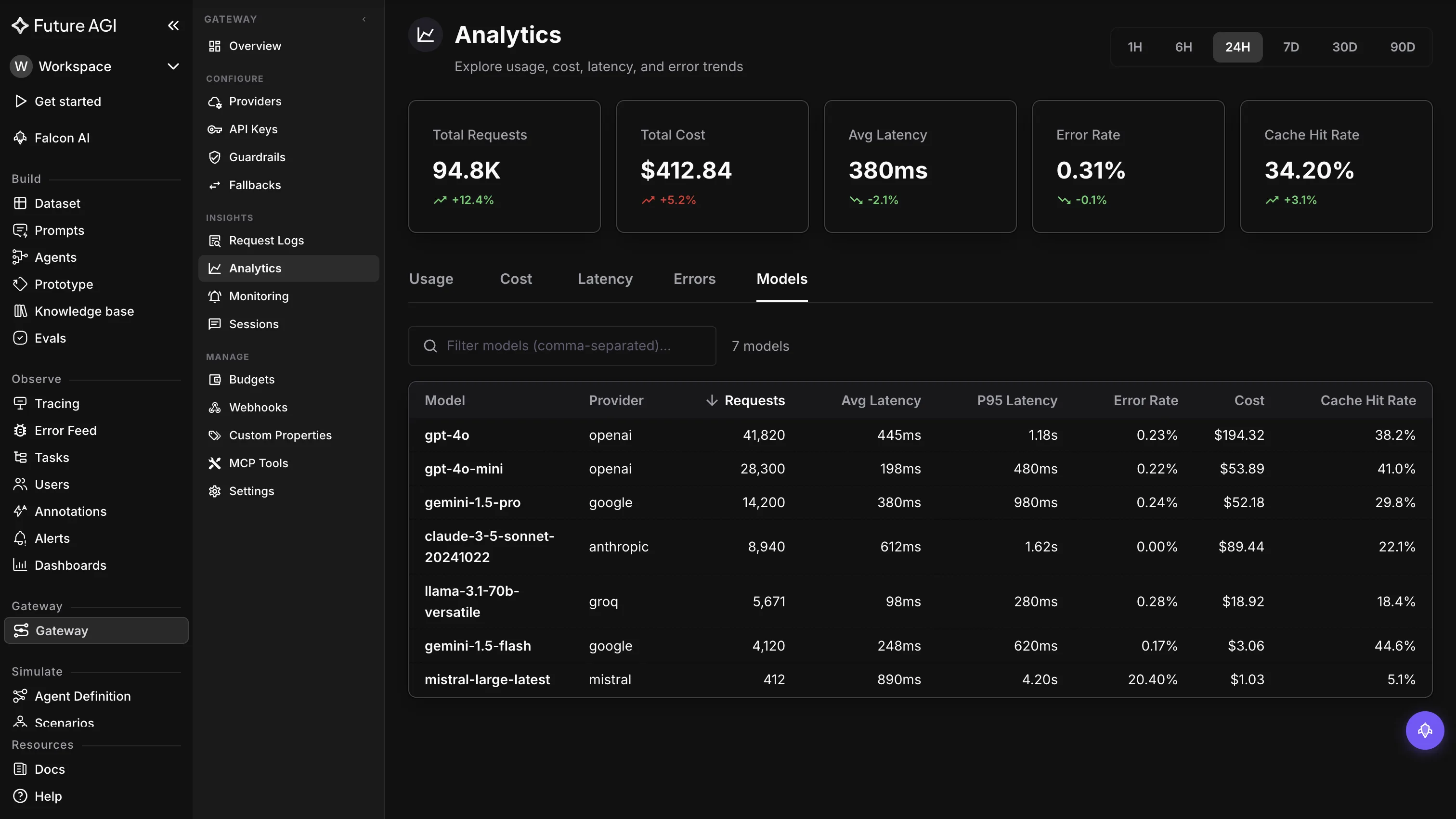
The bundled capabilities are an OpenAI-compatible drop-in, 18+ built-in guardrail scanners (supplier-data leakage, PII, secret detection, prompt injection, hallucination, MCP security), per-virtual-key budgets, exact plus semantic caching, OpenTelemetry-native traces, and the Future AGI Protect guardrail family at roughly 65 ms median enforcement latency per the arXiv 2510.13351 benchmark.
BYOC and on-prem are first-class postures: the gateway can sit at the Level 3.5 plant DMZ as an IEC 62443 conduit between OT and IT zones, route to local Ollama, vLLM, or LM Studio endpoints when the WAN drops, and queue audit logs for replay when connectivity returns. The full surface is documented in the Agent Command Center docs and the source ships at the Future AGI GitHub repo under Apache 2.0 across the traceAI, ai-evaluation, and agent-opt libraries. Most gateways force a plant to wire two or three of these together across separate products; Agent Command Center attaches them at the same network hop.
Best for. Discrete manufacturers (automotive, aerospace, electronics, industrial equipment) and process manufacturers (chemicals, pharma, food and beverage, metals) rolling out AI for predictive maintenance, quality inspection, supply-chain optimization, or technician-assist that want OpenAI compat drop in plus 18+ built-in scanners plus per-plant budgets plus OpenTelemetry traces in one Apache 2.0 stack at the Level 3.5 plant DMZ.
Key strengths.
- OpenAI-compatible drop-in: change
base_urltohttps://gateway.futureagi.com/v1(cloud) or to the BYOC plant endpoint, keep the existing OpenAI SDK code unchanged across the MES, the historian copilot, and the technician-assist HMI tablet. - 20+ providers via six native adapters (OpenAI, Anthropic, Gemini, Bedrock, Cohere, Azure) plus OpenAI-compatible presets and self-hosted backends including AWS Bedrock under the AWS DPA umbrella, Azure OpenAI under the Microsoft Online Services DPA, OpenAI Enterprise plus API, and self-hosted Llama, Mistral, or plant-fine-tuned models on vLLM or Ollama for offline-first failover.
- The Future AGI Protect model family for inline guardrails, ~65 ms p50 text and ~107 ms p50 image per the arXiv 2510.13351 benchmark, leaving most of the 500 ms shop-floor budget for model inference. Protect is FAGI’s own fine-tuned model family built on Google’s Gemma 3n with specialized adapters across four safety dimensions (content moderation, bias detection, security/prompt-injection, data privacy/PII), natively multi-modal across text, image, and audio, a model family, not a plugin chain. Supplier-data leakage detection (BOM, alternate-source, qualification status) layers on top, and a dedicated MCP Security scanner sits alongside (relevant after the April 2026 OX Security disclosure). The same dimensions are reusable as offline eval metrics so the prod policy and the eval rubric stay in sync.
- Per-key, per-virtual-key, per-model, and per-time-window budgets; tag-based custom properties for per-plant, per-line, per-work-center, per-shift, and per-use-case enforcement that maps onto the ISA-95 layer hierarchy.
- OpenTelemetry-native traces and Prometheus metrics on
/-/metrics; the same span attributes feed Grafana, the existing PI Historian or Ignition or AVEVA dashboard, and the Future AGI Evaluation pipeline viaspan_idlinking.traceAIinstruments 50+ AI surfaces across Python, TypeScript, Java, and C# (including Spring Boot starter, Spring AI, LangChain4j, Semantic Kernel) OpenInference-natively, and Error Feed. the part of the eval stack, the clustering and what-to-fix layer that feeds the self-improving evaluators, turns those traces into named issues with zero config: auto-clusters related per-plant and per-line failures (50 traces → 1 issue), auto-writes the root cause from the span evidence plus a quick fix plus a long-term recommendation per issue, and tracks rising/steady/falling trend per issue so quality-inspection regressions get triaged like exceptions rather than buried in plant dashboards.
- Apache 2.0 across traceAI, ai-evaluation, and agent-opt; BYOC inside customer-owned AWS, GCP, or Azure regions; on-prem inside the plant data center; air-gapped install patterns; SOC 2 Type II certified; AWS Marketplace listing; RBAC with per-team isolation.
- Self-improving loop closed across trace, eval, optimize, route: when a quality-inspection copilot returns an over-confident defect classification, the optimizer learns from the production failure and reroutes future similar requests to a higher-capability model or different prompt template. Few gateways in this category close the loop end-to-end.
Where it falls short for manufacturing
- Industrial plugin breadth is narrower than Kong AI Gateway’s; plants with operational muscle around Kong plugins, mTLS configuration, and OIDC integration may prefer Kong’s pedigree even though Future AGI’s OPA-compatible policy and tag-based RBAC cover the same use cases.
- Full execution tracing for long-running agent chains is an “In Progress” roadmap item in the public Future AGI GitHub repo; teams needing agent-level execution tracing today should combine the gateway with the traceAI agent traces from the OSS repo.
- Vendor-specific historian protocols (OPC UA, MQTT Sparkplug B, Modbus, Ethernet/IP) sit one layer below the gateway and are typically handled by an industrial protocol broker (Ignition, HighByte, Kepware) that publishes to the gateway via REST. The gateway doesn’t speak OPC UA natively, which is the expected separation in a Level 3.5 DMZ design.
from openai import OpenAI

client = OpenAI(
    api_key="$FAGI_API_KEY",
    base_url="https://gateway.plant-a.internal/v1",  # BYOC at the plant DMZ
)

# Existing OpenAI SDK code unchanged from here. The gateway runs
# supplier-data redaction, ISA-95 layer classification, and per-plant
# budget enforcement at the same network hop, with offline failover
# to a local vLLM-hosted Llama model when the WAN drops.
response = client.chat.completions.create(
    model="self-hosted/llama-3.3-70b",  # routes to vLLM on the plant edge
    messages=[{"role": "user", "content": "Explain the vibration anomaly on Press Line 3 between 04:12 and 04:14 UTC."}],
)
Use case fit. Strong for Tier-1 automotive suppliers running predictive maintenance, electronics manufacturers running vision-model quality inspection, chemicals manufacturers running recipe-tuning agents on batch process control, and industrial equipment OEMs running technician-assist copilots. Less optimal for plants whose binding constraint is “we already run Kong, don’t change the plugin model.”
Pricing and deployment. Apache 2.0 across traceAI, ai-evaluation, agent-opt; cloud at https://gateway.futureagi.com/v1 or BYOC inside customer-owned AWS, GCP, or Azure regions or on-prem inside the plant data center. SOC 2 Type II certified; AWS Marketplace listing.
Verdict. The strongest single pick when the 2026 manufacturing AI infrastructure story is OpenAI compat drop in plus supplier-data and PII guardrails plus per-plant budgets plus OpenTelemetry traces in the existing historian and MES observability stack, BYOC or on-prem at the plant DMZ, with a self-improving optimization loop. Plants on Kong should evaluate Kong AI Gateway alongside; ITAR-controlled defense manufacturers should also compare against TrueFoundry’s FIPS-on-AWS-GovCloud posture.
Kong AI Gateway: Best for Plants Already Running Kong
Kong AI Gateway is the strongest pick for industrial sites that already operate Kong Gateway for REST APIs and want a familiar plugin model for AI traffic. Kong’s REST-API pedigree, mTLS, OPA policy integration, OIDC and JWT authentication, IP allowlists, and operator-grade Prometheus dashboards are the most mature in this category; the AI proxy plugins layer model routing, request transformation, prompt templating, and AI rate limiting on top.
For a plant that has spent two years standardizing on Kong for the MES API, the ERP integration, the historian REST surface, and the technician-tablet authentication path, layering Kong AI Gateway plugins onto the existing control plane is the lowest-friction path to AI routing.
Best for. Discrete and process manufacturers whose plant or enterprise platform team already runs Kong Gateway (OSS or Enterprise), with operational muscle in plugin authoring, declarative config via decK, and Kong’s hybrid mode for control plane and data plane separation.
Key strengths.
- Most mature plugin ecosystem in the category, including the Kong AI proxy family (ai-proxy, ai-prompt-template, ai-prompt-guard, ai-rate-limiting-advanced, ai-request-transformer, ai-response-transformer, ai-semantic-cache).
- Operator-grade Prometheus dashboards and the Kong Manager UI; observability built for the platform engineer who already pages on Kong upstreams.
- Hybrid mode for control plane and data plane separation maps onto multi-plant deployments where a central enterprise control plane manages declarative config and each plant runs a local data plane at the Level 3.5 DMZ.
- Kong Konnect SaaS plus Kong Gateway Enterprise self-host plus Kong Gateway OSS, so procurement has a tier choice.
Where it falls short for manufacturing
- Built-in supplier-data leakage detection, BOM redaction, ITAR classification, and the 18-scanner library that Future AGI ships at the gateway layer are integrations rather than native scanners; teams expecting “drop in and the supplier-name leak goes away” will be wiring OPA policies and adapter calls instead.
- The AI-specific scanner library (ai-prompt-guard, ai-semantic-prompt-guard) is narrower than Future AGI Protect; Kong’s path is “compose plugins” rather than “consume a managed scanner family.”
- License clarity is mixed: Kong Gateway OSS is Apache 2.0 but several AI plugins (ai-prompt-guard-advanced, ai-semantic-prompt-guard, ai-rate-limiting-advanced) are Enterprise-only; air-gapped plants need to confirm bundle scope.
- Per-plant cost attribution via Kong’s AI cost plugin is workable but less native than Portkey’s four-tier hierarchy or Future AGI’s tag-based virtual-key budgets.
Use case fit. Strong for industrial enterprises that have already standardized on Kong and want AI traffic to inherit the same control plane, mTLS, and OIDC posture. Less optimal for greenfield AI gateway deployments where the Kong learning curve isn’t amortized.
Pricing and deployment. Kong Gateway OSS (Apache 2.0) plus Kong Gateway Enterprise plus Kong Konnect SaaS; AI plugin distribution depends on tier. Self-host at the plant DMZ in hybrid mode is the standard pattern; air-gapped installs supported on Enterprise.
Verdict. The right pick when Kong is already the platform team’s gateway. Choose Future AGI Agent Command Center when a built-in supplier-data and PII scanner library plus a self-improving optimization loop matters more than an existing Kong investment.
Portkey: Best for Managed Multi-Plant Cost and Audit Dashboard
Portkey is the strongest manufacturing pick when you want a managed cost and audit dashboard out of the box for a multi-plant rollout, a mature semantic cache for high-similarity workloads like work-order summarization and recipe lookup, and a four-tier budget hierarchy that maps cleanly onto plant > line > work-center > shift attribution. The caveat: the Palo Alto Networks acquisition announced on April 30, 2026 hasn’t yet closed and is expected to close in Palo Alto’s fiscal Q4 2026 subject to customary closing conditions.
Best for. Multi-plant manufacturers (10+ plants) that want fine-grained per-plant or per-line budgets, PII anonymization, and a usable cost and audit dashboard without writing a custom exporter, with acceptable risk appetite for the pending acquisition.
Key strengths.
- Exact plus semantic caching out of the box; multi-plant manufacturers typically see thirty to sixty percent hit rates on internal copilot workloads (work-order summarization, recipe lookup, standard troubleshooting tree navigation).
- Per-key, per-virtual-key, per-model, and per-time-window budgets; the most fine-grained native-dashboard hierarchy on the list.
- Large adapter library (250+ providers, including private OSS and on-prem Llama variants), so a rollout mixing cloud upstream for headquarters analytics and on-prem Llama at the plant DMZ for offline-first failover is workable from one configuration plane.
- PII anonymization at the Enterprise tier; SOC 2 Type 2, ISO 27001, and GDPR audit-log support; HIPAA BAA available (useful for medical-device manufacturers under FDA quality systems regulation).
Where it falls short for manufacturing
- Acquisition by Palo Alto Networks announced April 30, 2026 and not yet closed; multi-year manufacturing contracts (typically 3-to-5-year procurement cycles) should reference the integration plan in writing and weigh the downside of a feature-set pivot toward Palo Alto’s Cortex strategy.
- Observability is dashboard-first; OpenTelemetry export exists but is less first-class than the native dashboard, which makes integration with an existing PI Historian, Ignition, or AVEVA stack a longer first week than Future AGI’s Prometheus-and-OTel-native posture.
- Source available core plus closed control plane; air-gapped deployment is available at Enterprise but the control plane setup is heavier than a single Apache 2.0 stack and complicates the IEC 62443 conformance assessment.
- Manufacturing-specific scanner depth (supplier-data leakage, BOM redaction, ITAR classification) is positioned via PII anonymization rather than as named industrial scanners on the scale of Future AGI’s 18+.
Use case fit. Strong for multi-plant discrete manufacturers running multiple AI products where per-plant cost attribution is the loudest procurement question. Less optimal for defense manufacturers under ITAR or plants whose binding constraint is a single Apache 2.0 stack at the DMZ.
Pricing and deployment. Source available core (self-hosted), commercial cloud control plane, Enterprise via sales; air-gapped at Enterprise. Verify current pricing on Portkey’s live pricing page.
Verdict. Most mature managed cost and audit dashboard for manufacturing AI in 2026. Choose with eyes open on the Palo Alto integration; the next 12 months will tell whether the standalone product survives the merger.
LiteLLM (Self-Host, Commit Pinned): Best for Python-First Quality-Inspection ML Teams
LiteLLM is the Python-first proxy that broke open the multi-provider unified API category. It’s Apache 2.0 outside the enterprise directory, ships with 20+ providers via six native adapters (OpenAI, Anthropic, Gemini, Bedrock, Cohere, Azure) plus OpenAI-compatible presets and self-hosted backends, exposes OpenAI-compatible endpoints, and powers a long tail of internal manufacturing gateways at MES and quality-inspection ML platform teams that already operate FastAPI services. After the March 24, 2026 supply-chain incident the manufacturing answer is “yes for self-hosted commit-pinned deployments where the plant holds its own DPA path; no for the OSS path as a vendor DPA.”
Best for. Python-first MES and quality-inspection ML platform teams that already operate a FastAPI or uvicorn surface, want broad provider coverage, are willing to pin commit hashes and run Sigstore verification on every release, and have their own DPA path direct to the upstream model provider.
Key strengths.
- Broadest provider coverage of any single project on this list (20+ providers via six native adapters (OpenAI, Anthropic, Gemini, Bedrock, Cohere, Azure) plus OpenAI-compatible presets and self-hosted backends), including the long tail of self-hosted Llama, Mistral, vLLM, and Ollama endpoints used for offline-first failover.
- Apache 2.0 outside the enterprise directory; trivial to fork or audit, which is the normal posture for an air-gapped plant install that needs to pass an IEC 62443 source-inspection review.
- Virtual keys with per-key budgets; native fit with Python observability stacks (Prometheus client, OpenTelemetry Python SDK), which integrates with the existing PI Historian or Ignition Prometheus exporters.
- Lowest barrier to entry for a quality-inspection team that wants to stand up an internal copilot on a single GPU box at the plant in an afternoon.
Where it falls short for manufacturing
- March 24, 2026 PyPI supply-chain compromise. Versions
1.82.7and1.82.8were published by the TeamPCP threat actor after PyPI publishing tokens were exfiltrated via a compromised Trivy GitHub Action in LiteLLM’s CI/CD. The malicious packages shipped a credential harvester, a Kubernetes lateral-movement toolkit, and a persistent systemd backdoor; over 40,000 downloads occurred before PyPI quarantined the packages within roughly forty minutes (see the Datadog Security Labs writeup). Pin to 1.82.6 or earlier, scan dependency trees, rotate credentials, and run Sigstore verification. - Python runtime; materially slower throughput than Go-binary alternatives at high concurrency, which matters at quality-inspection scale where a vision model fans out across hundreds of inspection stations.
- No vendor DPA on the OSS distribution; manufacturing deployment requires the plant to hold the DPA directly with the upstream provider, and for ITAR-controlled BOMs the plant carries the full burden of verifying US-person-only and US data residency on every upstream route.
- Manufacturing-specific scanner depth (supplier-data leakage, BOM redaction, MCP security) is via adapters rather than a built-in scanner library on the scale of Future AGI’s 18+.
Use case fit. Strong for Python-first ML platform teams that operate their own FastAPI gateway and have their own DPA path, particularly in quality-inspection vision pipelines fronting a self-hosted Llama or Mistral on plant-local GPU. Less optimal as a vendor-DPA path.
Pricing and deployment. Apache 2.0 outside the enterprise directory; pip install or Docker self-host. Enterprise cloud tier with SOC 2 Type II, HIPAA, GDPR, and CCPA certified (ISO/IEC 27001 in active audit).
Verdict. Still the broadest provider coverage, but the March 2026 supply-chain incident shifts it from “default pick” to “pin commits, run Sigstore, and audit.” Manufacturing deployments should treat LiteLLM as an OSS self-hosted runtime where the plant holds the upstream DPA directly.
TrueFoundry AI Gateway: Best for ITAR and Defense Manufacturing
TrueFoundry AI Gateway is the strongest pick for ITAR-controlled defense manufacturers, regulated aerospace primes, and regulated energy and chemicals plants that need both control plane and gateway plane to run inside the customer VPC, with full air-gapped support, FIPS on AWS GovCloud and Azure Government, and SOC 2 Type 2 and HIPAA signed off. It’s the gateway shortlisted alongside Portkey when the procurement pressure is “no third-party SaaS control plane crosses our network boundary, and the upstream runs inside a US-person-only, US-region GovCloud tenancy.”
Best for. Defense primes, Tier-1 aerospace suppliers, ITAR-controlled discrete manufacturers, and regulated process manufacturers (chemicals, pharma, energy) that require both planes inside the customer VPC, with FIPS-validated cryptography on AWS GovCloud or Azure Government.
Key strengths.
- Full VPC and air-gapped install for both planes, with hands-off mode for the customer’s engineering team where TrueFoundry support operates inside agreed boundaries.
- FIPS on AWS GovCloud and Azure Government; HIPAA BAA available; SOC 2 Type 2 and HIPAA compliance achieved in 2024 and maintained through 2026.
- Routes to the major DPA-eligible upstreams (Azure OpenAI, AWS Bedrock, OpenAI Enterprise plus API, Anthropic, Vertex AI) plus self-hosted endpoints inside the customer VPC.
- Data masking at the Enterprise tier; integrates with the seven-year retention horizon many defense procurement contracts require.
Where it falls short for manufacturing
- Proprietary license; not Apache 2.0; the source isn’t available for the IEC 62443 source-inspection review some primes run on Future AGI Agent Command Center or Kong Gateway OSS.
- Pricing starts at 499 dollars per month for Pro and rises substantially for VPC and on-prem deployment via sales; smaller plant-level engineering teams should compare against Apache 2.0 alternatives.
- Manufacturing-specific guardrail set (supplier-data leakage, BOM redaction, ITAR-classified technical data detection) is positioned as adapter integrations rather than as a built-in scanner library on the scale of Future AGI’s 18+.
- Industrial plugin ecosystem (mTLS at scale, OIDC across plant identity providers, OPA policy authoring) is less mature than Kong AI Gateway’s.
Use case fit. Strong for regulated defense and aerospace where “everything runs inside our VPC, and the upstream is GovCloud only.” Less optimal when the constraint is Apache 2.0 across the stack or when the runtime guardrail surface needs to be a built-in scanner library.
Pricing and deployment. Proprietary; Pro from 499 dollars per month; VPC and on-prem deployment via sales; FIPS on AWS GovCloud and Azure Government.
Verdict. The right pick when “everything inside our VPC, including the control plane, GovCloud upstream under a US-person-only DPA” is the constraint. Choose Future AGI Agent Command Center when Apache 2.0 plus a built-in 18-scanner library matters more.
AWS Bedrock and Azure OpenAI as Manufacturing DPA Fast Paths
The straight cloud route to a manufacturing-suitable DPA in 2026 is AWS Bedrock under the AWS umbrella or Azure OpenAI under the Microsoft Online Services DPA. Both are widely accepted in supplier cybersecurity audits and NIST CSF 2.0 supply-chain reviews, and both leave the manufacturer to bolt supplier-data redaction, ITAR classification, per-plant budgets, and offline-first failover on top. Most production manufacturing AI stacks today run an AI gateway in front of Bedrock or Azure OpenAI rather than instead of them.
AWS Bedrock. Amazon Bedrock is covered under the AWS DPA umbrella and is in scope for ISO, SOC, and CSA STAR Level 2 (AWS Bedrock security and compliance overview). The upstream model set spans Anthropic Claude, Meta Llama, Mistral, Cohere, Amazon Titan, AI21, and Stability. The gap a gateway closes: Bedrock doesn’t ship a built-in supplier-data redaction layer, doesn’t classify ITAR-controlled technical data at the request boundary, and doesn’t ship per-virtual-key budgets across providers (Bedrock budgets are per service).
Azure OpenAI. Azure OpenAI is covered under the Microsoft Online Services DPA for text-based services on Enterprise Agreement, MCA, and CSP procurement paths; it doesn’t retain prompt and completion content for training by default. Two gaps: image inputs aren’t covered by default (which matters for vision-model quality inspection), and the Realtime Audio API in preview isn’t yet inside the DPA coverage scope. A gateway in front of Azure OpenAI enforces text-only routing, blocks image and realtime calls until the addendum lands, and standardizes the audit log across Azure plus a non-Azure fallback for offline-first failover.
The honest take. If the stack is one plant, one provider, one region, one product, Bedrock or Azure OpenAI alone can be enough. The moment you add a second plant, a second provider for fallback, or a second product (predictive maintenance plus quality inspection plus technician-assist), the gateway pays for itself in DPA simplicity, supplier-data redaction consistency, per-plant cost attribution, and offline-first failover uniformity.
The 2026 Manufacturing Gateway Migration and Trust Cohort
Every manufacturing AI gateway post currently ranking on Google is treating these events as if they didn’t happen. They did, and they reshape the procurement question for 2026 inside a NIST CSF 2.0 supplier audit and an IEC 62443 conformance assessment.
- Helicone joining Mintlify (March 3, 2026). Helicone acquired by Mintlify; product in maintenance mode. Manufacturing teams already on Helicone should plan a migration window, not a continued procurement.
- LiteLLM PyPI supply-chain compromise (March 24, 2026). TeamPCP-attributed compromise of versions
1.82.7and1.82.8via a stolen PyPI publishing token. The malicious package shipped a credential harvester, a Kubernetes lateral-movement toolkit, and a persistent systemd backdoor; PyPI quarantined the packages the same day, with 40,000+ downloads recorded. Pin 1.82.6 or earlier. - Anthropic MCP STDIO RCE class (April 2026). OX Security disclosed an STDIO transport class flaw affecting roughly 7,000 MCP servers and 150 million plus downstream downloads. Manufacturing gateways routing MCP traffic to plant tool servers (historian queries, MES record reads, work-order lookups) must enforce least-privilege tool access, OAuth 2.1 transport, and Streamable HTTP rather than raw STDIO.
- Portkey acquired by Palo Alto Networks (April 30, 2026, not yet closed). Close expected Palo Alto fiscal Q4 2026. Multi-year manufacturing contracts (3-5-year procurement cycles) should reference the integration plan in writing.
The takeaway: for the next 12 months, license clarity, DPA tier definitiveness, and acquisition independence are part of the manufacturing AI gateway buying decision. A cheap gateway you migrate off in six months isn’t cheap inside a 3-to-5-year plant procurement cycle.
Manufacturing AI Gateway Picks by Buyer Profile in 2026
The buyer profile drives the pick more than the feature matrix does. Tier-1 automotive suppliers, electronics manufacturers running vision-model quality inspection, chemicals manufacturers running recipe-tuning agents, and industrial equipment OEMs pick Future AGI Agent Command Center for the Apache 2.0 plus 18-scanner combination plus BYOC and on-prem plus sub-100 ms Protect enforcement. Plants already on Kong pick Kong AI Gateway. Multi-plant manufacturers wanting a managed dashboard pick Portkey. Python-first ML platform teams pick LiteLLM commit-pinned. ITAR defense manufacturers pick TrueFoundry.
| If you are a… | Pick | Why |
|---|---|---|
| Tier-1 automotive supplier running predictive maintenance copilots, OpenAI SDK heavy | Future AGI Agent Command Center | OpenAI compat drop in plus 18 supplier-data and PII scanners plus per-plant budgets in one Apache 2.0 stack, BYOC at the plant DMZ |
| Electronics manufacturer running vision-model quality inspection at the line | Future AGI Agent Command Center | Sub-100 ms Protect enforcement at roughly 65 ms median per arXiv 2510.13351 leaves the rest of the 500 ms shop-floor budget for model inference; offline-first failover to self-hosted vLLM |
| Chemicals or pharma manufacturer running recipe-tuning agents on batch process control | Future AGI Agent Command Center or Kong AI Gateway | Either Apache 2.0 single stack with 18 built-in scanners (FAGI) or layered industrial plugin ecosystem if the plant already runs Kong |
| Industrial equipment OEM running technician-assist copilots on dispatched service tickets | Future AGI Agent Command Center | Self-improving loop learns from production failures and reroutes future requests automatically; per-tenant virtual keys for OEM-customer isolation |
| Multi-plant discrete manufacturer (10+ plants) with managed dashboard requirement | Portkey | Most fine-grained four-tier budget hierarchy plus mature dashboard (verify the Palo Alto Networks integration timeline) |
| Plant already standardized on Kong Gateway for REST APIs | Kong AI Gateway | Industrial plugin ecosystem (mTLS, OIDC, OPA, AI proxy plugins) layered on the existing Kong control plane |
| Python-first MES or quality-inspection ML platform with its own upstream DPA path | LiteLLM (self-host, commit pinned) | Broadest provider coverage; Apache 2.0 outside the enterprise directory; pin to 1.82.6 or earlier after the March CVE |
| Defense prime, aerospace Tier-1, or ITAR-controlled manufacturer | TrueFoundry AI Gateway | Both control and gateway planes inside the customer VPC; FIPS on AWS GovCloud and Azure Government |
| Microsoft 365 plus Azure plant already standardized on Azure OpenAI | Azure OpenAI behind a gateway | DPA via the Microsoft Online Services DPA; image and realtime not yet covered, so gateway-enforced route filtering is required |
| AWS shop on Bedrock with Claude on Bedrock | AWS Bedrock behind a gateway | DPA via the AWS umbrella; gateway adds supplier-data redaction, ITAR classification, and per-plant budgets |
| Early-stage industrial AI startup evaluating gateways before plant rollout | Future AGI Agent Command Center Apache 2.0 OSS | Self-host BYOC; upgrade for SOC 2 and AWS Marketplace contracting when production traffic begins |
Implementation Pattern with Future AGI at the Plant DMZ
A working implementation pattern for Future AGI Agent Command Center looks like this. The gateway runs as a self-contained pod at the Level 3.5 plant DMZ inside an IEC 62443 conduit between Level 3 operations (MES, historian, batch control) and Level 4 enterprise (ERP, supply chain, business analytics). It speaks OpenAI-compatible APIs to plant copilots (technician-assist HMI tablets, maintenance work-order summarizers, quality-inspection vision wrappers) and routes upstream to a mix of cloud providers (Azure OpenAI for text, AWS Bedrock for Claude on de-identified workloads) and plant-local self-hosted models on vLLM or Ollama for offline-first failover.
Inbound, every request gets an ISA-95 layer tag, a plant-id, a line-id, a work-center, a shift, an ITAR classification (controlled, EAR99, public), and a use-case tag. The supplier-data leakage, PII, secret detection, prompt-injection, and MCP Security scanners run inline at roughly 65 ms median per the arXiv 2510.13351 Protect benchmark. Outbound, the response is checked for hallucination and topic restriction.
Audit logs emit OpenTelemetry spans with span_id linking to the Future AGI Evaluation pipeline; Prometheus metrics on /-/metrics feed the existing Grafana dashboard alongside PI Historian and Ignition telemetry. When the WAN drops, the gateway routes 100 percent of traffic to the local vLLM-hosted Llama or Mistral model, queues audit logs for replay, and exposes the degraded state to the MES and SCADA observability stack.
The self-improving loop closes monthly: production failures (hallucinated maintenance steps, missed quality-inspection defects, supplier-data near-leaks) flow into the optimizer, which proposes prompt-template revisions, model-routing changes, or guardrail-policy tightening; proposals are reviewed by the Plant IT Director and Operations Tech Lead, applied via declarative config, and shadow-tested before promotion. Few gateways close that loop end-to-end across trace, eval, optimize, and route.
Which AI Gateway Is Right for Your Plant in 2026?
Manufacturing AI in 2026 isn’t a single feature. It’s a stack of IEC 62443-3-3 zone-and-conduit security, the ISA-95 OT/IT model, NIST CSF 2.0 Govern-through-Recover, ITAR 22 CFR 120-130 technical-data controls, and EU AI Act Annex III safety-component obligations riding on top of an AI gateway. That gateway has to keep OT data inside the OT zone, commit to a sub-500 ms median shop-floor latency budget, fail over to a local model when the WAN drops, and survive a year of acquisition and supply-chain events without forcing a re-platforming across 10 or 50 plants.
Of the five gateways above, Future AGI Agent Command Center is the strongest pick when the buying constraint is OpenAI compat drop in plus 18+ built-in supplier-data and PII scanners plus per-plant virtual-key budgets plus OpenTelemetry traces in one Apache 2.0 stack deployable BYOC or on-prem at the Level 3.5 plant DMZ, with sub-100 ms guardrail enforcement at roughly 65 ms median per arXiv 2510.13351 and a self-improving optimization loop.
Kong AI Gateway is the right call when the plant already runs Kong for REST APIs. Portkey is the right call when a managed multi-plant cost and audit dashboard is the binding constraint and the Palo Alto integration risk is acceptable. LiteLLM (self-host, commit pinned) is the right call when the platform team is Python-first with its own upstream DPA path. TrueFoundry is the right call when ITAR requires both planes inside the plant VPC with FIPS on AWS GovCloud.
For deeper reads on the patterns above:
- The Agent Command Center docs for the full gateway feature surface.
- The Future AGI observability docs for the audit log path that anchors NIST CSF 2.0 evidence.
- The Future AGI Protect docs for the runtime guardrail library and the roughly 65 ms median enforcement benchmark.
- The Future AGI Evaluation docs for the held-out shift-fairness and hallucination evals that tie to gateway behavior via
span_id. - The Future AGI tracing product page for the OpenTelemetry-native tracing layer.
- The Future AGI GitHub repo for the Apache 2.0 source across traceAI, ai-evaluation, and agent-opt.
Try Agent Command Center free. OpenAI-compatible routing, 18+ supplier-data and PII guardrails, per-plant virtual-key budgets, and OpenTelemetry traces in one Apache 2.0 stack you can deploy BYOC or on-prem at the Level 3.5 plant DMZ.
Related reading
- Best 5 AI Gateways for Compliance Audit Trails in 2026, the compliance and audit-trail comparison
- Best 5 AI Gateways for LLM Cost Optimization in 2026, the five-layer cost stack and the 2026 trust cohort
- Best 5 AI Gateways for Customer Support in 2026: Latency Budgets, Agent Assist, and Voice AI Passthrough, the customer-support-specific gateway picks
- Best 5 AI Gateways for Cybersecurity in 2026: Prompt Injection Defense, Tenant Isolation, and SOC 2, the cybersecurity-specific gateway picks
Frequently Asked Questions
What Is the Best AI Gateway for Manufacturing in 2026?
Why Cannot OT Data Cross the IT Boundary to a Public LLM?
What Is the Shop-Floor Latency Budget for AI-Assisted Manufacturing?
How Does an AI Gateway Enforce ITAR and Supplier-Data Isolation?
Can an AI Gateway Run Offline When the Shop Floor Loses WAN Connectivity?
How Do Plants Attribute LLM Cost by Plant, Line, or Work Center?
Which AI Gateways Survive the 2026 Supply-Chain and Acquisition Cohort?
Five AI gateways for logistics and supply chain in 2026 scored on customs audit, ETA observability, carrier auth, route latency, residency, fraud.

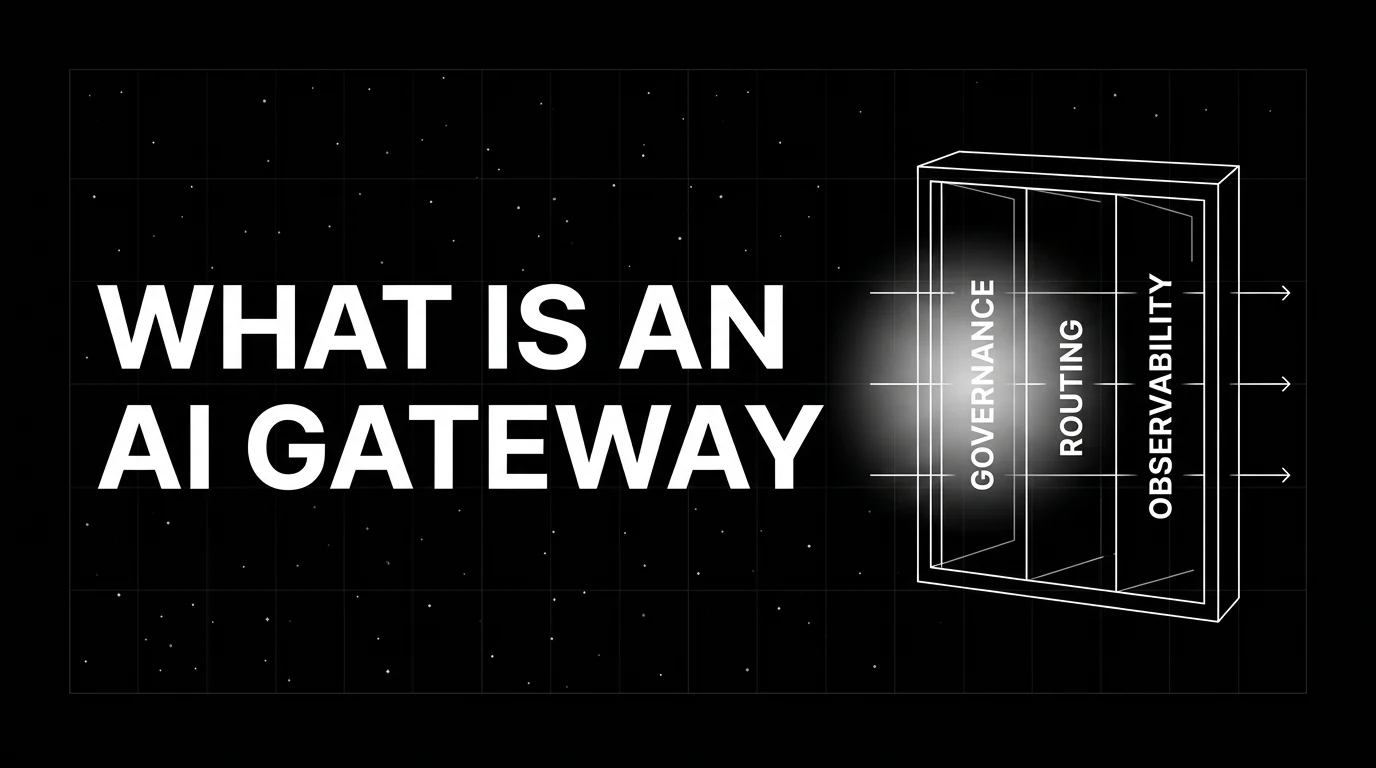
An AI gateway sits between apps and LLM providers for governance, routing, observability. What it is, how it differs from API gateways.

FutureAGI ACC, Helicone, OpenRouter, Portkey, LiteLLM, Cloudflare AI Gateway, Vercel AI Gateway as 2026 LLM gateways. Routing, caching, guardrails.