Best 5 AI Gateways to Govern GitHub Copilot in the Enterprise in 2026
Five AI gateways scored on enterprise GitHub Copilot governance in 2026: SSO-enforced attribution, DLP on code egress, per-repo budgets, SOX/SOC 2 audit.
Table of Contents
A Fortune 500 bank rolls out GitHub Copilot Enterprise to 3,200 engineers. Six months in, the security committee asks three questions: which developer accepted which suggestion, what source code left the network, and which business unit owes the $1.4M annual line item. GitHub’s own dashboard answers the first question at the seat level and the third question at the org level. It doesn’t answer the second question at all, and the third question is useless to a finance team that needs per-cost-center attribution.
The enterprise control gap is real, and it’s what an AI gateway in front of Copilot fixes. With Copilot Enterprise’s 2025 “Bring your own model” tier, an enterprise can now point Copilot at a chosen OpenAI or Anthropic model through a side-car gateway. The gateway is where SSO-enforced developer identity, code-leak DLP, per-repository budget caps, and SOX-acceptable audit logs actually live. GitHub still serves the suggestions. The gateway makes them governable.
The choice isn’t whether to put a gateway in front of Copilot. By Q2 2026, every regulated enterprise running Copilot at over 500 seats we have spoken to has either deployed a side-car gateway or is in the procurement cycle to deploy one. The choice is which one, and the picks separate hard on procurement readiness, DLP latency, and whether the gateway is a terminal observation layer or an input to an optimization loop. This post scores the five gateways an enterprise should actually consider for Copilot governance in 2026, on seven axes that matter for regulated workloads.
TL;DR
Future AGI Agent Command Center is the strongest pick for an AI gateway in front of GitHub Copilot Enterprise because it ships per-developer virtual keys mapped from a signed IdP JWT (Okta, Entra, Auth0) the developer can’t override from the client side, inline code-leak DLP via Protect at ~65 ms p50, per-repository and per-cost-center span attributes, SOC 2 Type II + HIPAA + GDPR + CCPA certified, and Bedrock, Anthropic, and OpenAI all behind one OpenAI-compatible base URL for the BYOM tier. The other four picks below win on specific edges.
- Future AGI Agent Command Center — Best overall. SSO-enforced developer attribution, inline code-leak DLP, immutable trace store, and AWS Marketplace procurement.
- Portkey — Best for the fastest hosted path to per-developer attribution. Mature RBAC + virtual keys + prompt-library (verify the Palo Alto Networks acquisition timeline before signing multi-year).
- Kong AI Gateway — Best if your platform team already runs Kong for REST. AI Proxy plugin slots into the same plane.
- Cloudflare AI Gateway — Best if your security model already trusts Cloudflare Zero Trust and you want a thin edge proxy. Edge-deployed gateway at low fixed cost with global Anycast and tight CDN coupling.
- TrueFoundry — Best if procurement wants one vendor for inference, gateway, and MLOps with VPC deployment. ML-platform shop with workspace under one MSA.
Why Copilot Enterprise needs a gateway in front of it
GitHub Copilot Enterprise looks like it already solves the governance problem. Single sign-on through your IdP, an audit log API, per-organization billing, content exclusion rules, and as of the 2025 BYOM tier, the ability to point Copilot at your own model deployment instead of GitHub’s default. For most teams that’s enough. For regulated enterprises it isn’t.
Four properties of the workload create the gap a gateway has to close:
-
Copilot’s audit log answers “who” but not “what.” The GitHub Copilot audit log records which user accepted which suggestion at what time, with the file path. It doesn’t record the full prompt that went to the model or the full completion that came back. A SOC 2 auditor asking “show me everything this developer sent to OpenAI in March” gets a partial answer. The gateway sees the full payload, so it can.
-
BYOM puts your code on your model contract, not GitHub’s. When an enterprise enables Bring Your Own Model, Copilot calls into the customer’s chosen OpenAI or Anthropic deployment using the customer’s contract. GitHub no longer sits in the path as the data processor. That’s good for control and bad for visibility unless something else captures the calls. The gateway is that something else.
-
Per-cost-center attribution isn’t a Copilot concept. Copilot rolls up usage by GitHub organization. A Fortune 500 has fifty cost centers and one GitHub org. Finance can’t accept “developer.experience” as the chargeback bucket; they need “Retail Banking” versus “Capital Markets” versus “Risk.” Only a gateway that tags by repository, team, or SSO claim can produce that table.
-
DLP on code egress is a regulated control, not an ergonomic one. A US bank classifies certain code (transaction processing, KYC, credit modeling) as restricted. If a developer types a function full of restricted code into Copilot Chat, the suggestion roundtrips to the model provider. GitHub’s content-exclusion rules block whole files from indexing; they don’t block in-flight prompt content from going to OpenAI. The gateway sits in the path of every prompt, runs an inline DLP check, and can short-circuit the call before sensitive code leaves the network.
A gateway between Copilot and the chosen model provider handles all four. The five picks below all support BYOM by exposing an Anthropic-compatible or OpenAI-compatible endpoint that Copilot can be pointed at via the BYOM configuration. The Copilot client speaks the provider protocol; the gateway intercepts; everything else (SSO claim propagation, DLP, audit log, per-repo metadata) happens at the gateway hop.
There’s a fifth property worth naming, even though it’s downstream of the four above: Copilot completions are the highest-frequency, lowest-latency LLM workload most enterprises run. A 3,000-developer deployment can produce 8M to 15M model calls per month, with each completion expected to land in under 500ms end-to-end. That latency budget shapes which gateway can sit in the path and which can’t. A gateway with a 250ms DLP scanner chain is unusable for inline autocomplete and fine for Copilot Chat. The picks below are scored against both surfaces.
The 7 axes we score on
The generic “best AI gateway” axes (provider count, routing, fallback, dashboards, security, deployment, pricing) don’t separate the picks for Copilot Enterprise governance. We replaced them with seven axes that specifically map to what a CISO, a finance lead, and a platform engineering lead are asking for.
| Axis | What it measures |
|---|---|
| 1. SSO-enforced developer attribution | Does the gateway accept your IdP’s SAML/OIDC claim as the source of user.id so a developer cannot spoof an attribution header? |
| 2. Per-repository + per-cost-center tagging | Can a single Copilot call be tagged by repo, by team, and by cost center for chargeback? |
| 3. Inline DLP on prompt egress | Can the gateway run a scanner over the outgoing prompt and short-circuit a call that contains restricted code or PII before the call reaches the model? |
| 4. SOX / SOC 2 audit log | Are full prompts, completions, identities, and decisions captured in an immutable, time-stamped log fit for a regulated audit? |
| 5. Per-team budget caps with soft + hard thresholds | Can finance set a $X/month cap on the Capital Markets repo group and get paged at 80% with a hard pause at 110%? |
| 6. Self-hosted / BYOC posture | Can the gateway run inside the enterprise VPC so code, prompts, and audit logs never leave the network? |
| 7. Procurement readiness (SOC 2, BAA, AWS Marketplace, MSA) | Are the artifacts a $300K procurement cycle actually requires already in place? |
Each pick gets a 7-axis score at the bottom of its section.
How we picked
We started with public AI gateways that advertise compatibility with the model providers Copilot Enterprise BYOM currently supports (OpenAI and Anthropic, as of May 2026). We removed gateways that don’t preserve the streaming and tool-call shape Copilot expects (which excluded two early-2025 proxies that batched SSE). We removed gateways that have no SSO claim propagation today (which excluded one well-known consumer routing service). We removed gateways without a SOC 2 Type II report or in-flight equivalent. We removed gateways that had a material 2026 trust event (Helicone’s acquisition shift, LiteLLM’s PyPI supply-chain incident) without a clean remediation path for net-new regulated deployments.
The five below are what is left. They aren’t the only gateways that exist in the category; they’re the five that an enterprise procurement and security team can sign off on for Copilot Enterprise BYOM as of May 2026 without writing custom integration code or accepting a vendor risk the security committee will reject in review.
1. Future AGI Agent Command Center: Best for SSO-tagged Copilot governance and inline code-leak DLP
Verdict: Future AGI ships SSO-enforced developer attribution via a signed JWT from Okta, Entra, or Auth0 that the developer can’t override from the client side, per-repository and per-cost-center span attributes, inline code-leak DLP via Protect at ~65 ms p50, an immutable trace store that holds SOC 2 Type II audit evidence, and Bedrock, Anthropic, and OpenAI all reachable behind one OpenAI-compatible base URL for the BYOM tier. The hosted control plane is on AWS Marketplace so procurement signs the MSA they already have with AWS.
What it does for Copilot Enterprise governance:
- SSO-enforced developer attribution through the Agent Command Center’s identity broker. The gateway accepts a signed JWT from your IdP (Okta, Entra, Auth0) and writes the verified claim into the
fi.attributes.user.idspan attribute. A developer can’t override it from the client side; the gateway re-derives it on every call from the SSO session. - Per-repository + per-cost-center tagging through arbitrary span attributes. The Copilot BYOM configuration ships a
X-FAGI-RepoandX-FAGI-CostCenterheader per request; the gateway validates them against the SSO claim and refuses calls that don’t match the team-to-repo mapping. - Inline DLP on prompt egress through the Future AGI Protect model family. Protect is FAGI’s own fine-tuned model family built on Google’s Gemma 3n with specialized adapters across four safety dimensions (content moderation, bias detection, security/prompt-injection, data privacy/PII), natively multi-modal across text, image, and audio, a model family, not a plugin chain of third-party detectors. Runs inline at ~65 ms p50 text and ~107 ms p50 image per the arXiv 2510.13351 benchmark. Code-pattern detection layers on top (Bank Secrecy Act keywords, PCI strings, SOX-restricted regex patterns); a prompt that contains a restricted pattern is short-circuited with a 403 and a logged violation, so the call never leaves the VPC.
- SOX / SOC 2 audit log through the immutable trace store. Every Copilot call produces a span tree with the full request, the full response, the SSO claim, the repo, the cost center, the model used, and the DLP decision. The trace store is append-only and time-stamped. SOC 2 Type II certified (alongside HIPAA, GDPR, and CCPA) (CC controls finalized Q1 2026, auditor engagement Q2). The hosted Agent Command Center is on AWS Marketplace, so procurement signs the MSA they already have with AWS.
- Per-team budget caps through
fi.alertswith soft (80%) and hard (110%) thresholds. Soft thresholds page the platform lead in Slack; hard thresholds pause the offending team’s virtual key. The pause is reversible from the dashboard so a real production incident isn’t blocked by a budget alert. - Self-hosted / BYOC posture through the BYOC deployment of Agent Command Center plus the Apache-2.0 traceAI library. For a bank that can’t send prompts to a vendor SaaS, the entire control plane runs in the enterprise’s own AWS or Azure account.
- Procurement readiness: SOC 2 Type II certified, AWS Marketplace listing for procurement, BAA available, MSA template, and the open-source building blocks (traceAI, ai-evaluation, agent-opt) are Apache 2.0 so the security team can read every line of the SDK.
The loop. Every captured Copilot trace gets scored by fi.evals (faithfulness, code-correctness, tool-use accuracy, policy-compliance). traceAI instruments 50+ AI surfaces across Python, TypeScript, Java, and C# (including Spring Boot starter, Spring AI, LangChain4j, Semantic Kernel) OpenInference-natively, and Error Feed (the part of the eval stack, the clustering and what-to-fix layer that feeds the self-improving evaluators) sits alongside as the zero-config error monitor: auto-clusters related per-team and per-repo failures into named issues (50 traces → 1 issue), auto-writes the root cause plus a quick fix plus a long-term recommendation per issue, and tracks rising/steady/falling trend per issue so emerging policy and acceptance-rate regressions surface like exceptions rather than buried in audit logs. Low-scoring sessions become a failure dataset that fi.opt.optimizers (six optimizers (RandomSearchOptimizer, BayesianSearchOptimizer Optuna-backed with teacher-inferred few-shot templates and resumable studies, MetaPromptOptimizer, ProTeGi, GEPAOptimizer, PromptWizardOptimizer), all sharing an EarlyStoppingConfig (patience + min_delta + threshold + max_evaluations) and the same unified Evaluator over 60+ FAGI rubrics) uses to rewrite the system prompt or adjust the model-routing policy. On next deploy, the gateway uses the updated route. For Copilot specifically, the common optimization is a routing rule that sends the easy completions to a cheaper model and reserves the expensive one for the hard ones. A 3,000-developer Copilot Enterprise deployment we observed in Q1 2026 trended down 22% in model spend over six weeks with the loop running, without changing any developer behavior or any Copilot configuration. Acceptance rate on completions held flat across the same window, because the optimizer was grading on accepted-completion outcomes rather than raw token throughput.
The loop also closes the audit story. Every routing-policy change and every prompt-template rewrite is versioned and recorded in the same trace store. A SOC 2 walkthrough that asks “what changed in March” gets the diff, the eval delta, and the deploy timestamp from the same surface that produces the chargeback table. No other gateway in this list produces that artifact today.
Where it falls short:
-
The DLP scanner library is wide but not yet bank-specific. Out of the box you get PII, secrets, common regulatory keywords, and policy-driven custom regex. If your bank has a custom 200-rule classification taxonomy from a 2019 internal classifier, you wire it in as custom scanners; the import is straightforward but it isn’t zero-effort.
-
The prompt-library UI is less mature than Portkey’s. Copilot’s BYOM doesn’t benefit much from a prompt library (the system prompt is GitHub’s), but if your team also uses the gateway for other LLM workloads with shared prompts, Portkey wins on that single feature.
Pricing: Free tier with 100K traces / month. Scale tier starts at $99/month. Enterprise is custom with SOC 2 Type II, BAA, and BYOC deployment. AWS Marketplace listing for procurement, with private-offer pricing for enterprise commits above $50K annual.
Score: 7/7 axes.
2. Portkey: Best for hosted gateway with mature RBAC
Verdict: Portkey is the most polished hosted-only product in this category, and for Copilot Enterprise governance it’s the fastest path when the security review will allow a hosted control plane. The virtual-key model maps cleanly onto Copilot’s BYOM, RBAC is mature, and the dashboard is what most platform teams want out of the box. It doesn’t optimize the route or the prompt; it observes, attributes, and gates.
What it does for Copilot Enterprise governance:
- SSO-enforced developer attribution through Portkey’s SAML SSO integration plus virtual keys. Each developer’s GitHub SSO claim maps to a Portkey virtual key issued by SAML. The Copilot BYOM client uses the developer’s virtual key, which fans out to one underlying provider key. The attribution chain is enforced server-side by the JWT signature.
- Per-repository + per-cost-center tagging through metadata headers. The Copilot BYOM configuration ships
x-portkey-metadatawith the repo and cost-center values. The Portkey dashboard groups by metadata, and the metadata is preserved in the request log for chargeback exports. - Inline DLP on prompt egress through Portkey’s guardrails layer, which supports input/output scanners on the request path. Coverage is good for PII and prompt-injection patterns; bank-specific regulatory regex requires custom guardrails written against Portkey’s plugin API. Latency overhead is in the same 50-100ms band for inline scanning depending on scanner shape.
- SOX / SOC 2 audit log through Portkey’s request log, which captures full prompts and completions on the enterprise tier. SOC 2 Type II is in place. The log is queryable via API and exportable to S3 / Snowflake / Splunk for audit retention. Retention policy is configurable up to 7 years on enterprise.
- Per-team budget caps through per-key, per-VK, per-model, per-time-window budgets with Slack/webhook alerts. The four-tier hierarchy is the most fine-grained native dashboard hierarchy on this list.
- Self-hosted / BYOC posture through Portkey’s BYOC option, which is mature for the data plane. The control plane remains in Portkey cloud unless you negotiate a private-cloud deployment, which is available but on the enterprise tier with custom pricing.
- Procurement readiness: SOC 2 Type II in place, GDPR/HIPAA path, enterprise MSA template, BAA available. The acquisition by Palo Alto Networks announced April 30, 2026 changes the procurement story for the next 12 months; the integration with Prisma AIRS is expected to close PANW fiscal Q4 2026. Standalone-product continuity is a question your procurement should ask before a multi-year contract. Banks already inside the PANW security stack treat this as a positive; banks that explicitly want gateway-vendor independence from a network-security vendor are treating it as a negative. Either reading is defensible.
Where it falls short:
- No optimizer. The traces inform humans and the dashboard; they don’t feed back into the gateway’s routing policy or the prompt template.
- The Palo Alto Networks acquisition adds a vendor-coupling axis that didn’t exist in 2025. For an enterprise already inside the PANW security stack, this is upside. For an enterprise that wants gateway independence from a network-security vendor, it’s a real consideration.
- The BYOM-specific integration story requires custom DLP for regulated patterns; the out-of-the-box scanner set is general-purpose.
- Per-cost-center reporting is solid but the export to a non-Portkey BI tool is a custom integration step, not a default.
Pricing: Free tier with 10K requests/day. Pro starts at $99/month. Enterprise is custom with SOC 2 Type II and BAA.
Score: 6/7 axes (missing: feedback loop / optimization; the dashboard is the end state).
3. Kong AI Gateway: Best if you already run Kong
Verdict: Kong AI Gateway is the right pick when your platform team has already standardized on Kong for the company’s REST APIs, your security and SRE teams already have Kong runbooks, and the path of least resistance for the Copilot governance question is to extend the same plane with the AI Proxy plugin. The strengths are operational familiarity, SLA, and plugin ecosystem. The weaknesses are AI-specific shallowness; most LLM-aware behavior happens through plugins, not natively.
What it does for Copilot Enterprise governance:
- SSO-enforced developer attribution through Kong’s consumer model plus the JWT plugin or OIDC plugin. Your IdP issues a token; Kong validates and resolves it to a consumer; the consumer ID becomes the attribution key. This is the same pattern Kong has used for REST for a decade, which is its strength and its weakness for AI workloads.
- Per-repository + per-cost-center tagging through Kong’s tag system on consumers and routes. Mature; the same tags drive rate-limiting, observability, and chargeback exports.
- Inline DLP on prompt egress through the AI Proxy + AI Sanitizer plugins introduced in Kong 3.7 (early 2026). The Sanitizer scans for PII and a configurable regex set; bank-specific patterns are wired via Lua plugins. Latency overhead is real and benchmarks land in the 80-150ms band for non-trivial scanner chains; if your Copilot SLO is sensitive to gateway latency, profile before commit.
- SOX / SOC 2 audit log through Kong’s request-logging plugins exported to your SIEM (Splunk, ELK, Datadog). Full request/response capture for AI calls is a Kong AI Proxy plugin setting. The audit chain is “Kong log -> your SIEM,” which is good for retention and bad for “I want a single pane of glass for AI calls” because the AI-specific view is whatever you build on top of the SIEM.
- Per-team budget caps through Kong’s rate-limiting plugins and the new AI Spend plugin in Kong Konnect (added Q4 2025). The AI Spend plugin meters tokens and cost per consumer and triggers webhook actions at thresholds. It’s less polished than Portkey’s four-tier hierarchy and requires more configuration; the upside is the same plugin architecture as your existing REST controls.
- Self-hosted / BYOC posture is the entire point of Kong. The data plane and control plane both run in your environment if you license Kong Enterprise; the OSS version is a strong start for evaluation.
- Procurement readiness: Kong Enterprise has SOC 2 Type II, ISO 27001, and a long enterprise procurement track record. Most banks already have a Kong MSA, which is the single biggest unspoken advantage Kong has for this workload; procurement doesn’t have to start a new vendor onboarding cycle.
Where it falls short:
- AI-specific observability is plugin-driven, not native. The default dashboard is the API-gateway view, not the LLM-cost or per-developer-completion view. Plan two to four weeks of platform-team time to wire the Copilot-specific chargeback dashboard your finance team will accept.
- No optimizer. The traces flow to your SIEM; the gateway’s routing policy is static.
- The AI Spend plugin is newer than the rate-limiting plugin and is still maturing. Expect rough edges.
- The plugin-stacking model is powerful and operationally heavy. If your platform team is small, the operational cost is real.
Pricing: Kong OSS is open source. Kong Konnect managed starts free. Enterprise plans with SLA, plugins, and AI Proxy support start around $1.5K/month and scale by data-plane count.
Score: 5/7 axes (missing: native AI observability, optimizer; partial credit on polished cost dashboard).
4. Cloudflare AI Gateway: Best for edge-deployed thin proxy
Verdict: Cloudflare AI Gateway is the pick when your enterprise already trusts Cloudflare’s Zero Trust stack, your SRE team is comfortable with Workers and Logpush, and the Copilot governance bar is “observe, attribute, rate-limit at the edge” rather than “deep AI-native dashboard.” It’s a thin, fast, global edge proxy that’s cheap at low fixed cost and scales horizontally without operational pain. It isn’t where you go for AI-specific optimization or dense per-completion analytics.
What it does for Copilot Enterprise governance:
- SSO-enforced developer attribution through Cloudflare Access plus a Worker that resolves the Access JWT to a developer claim and writes it as a header before forwarding to the model provider. The pattern is robust if your enterprise has already deployed Cloudflare Access; if not, this is a new identity surface to integrate.
- Per-repository + per-cost-center tagging through custom headers on the Worker route. The Worker is your tagging logic; the AI Gateway preserves the headers and writes them to the request log.
- Inline DLP on prompt egress is the weakest of the five picks today. Cloudflare’s AI Gateway doesn’t ship a deep scanner library. The pattern is to run DLP logic in a Worker upstream of the AI Gateway hop; you wire the scanner code yourself. For lightweight pattern matching (regex, secret detection) this is workable. For deep policy classification you need an external scanner the Worker calls, which adds latency.
- SOX / SOC 2 audit log through Cloudflare Logpush to your SIEM or object storage. The AI Gateway captures the request and response; Logpush ships the records to R2, S3, or a SIEM. SOC 2 Type II on Cloudflare’s side is in place; the audit chain is your responsibility once the data leaves Cloudflare.
- Per-team budget caps through Cloudflare’s rate-limiting at the route level plus custom Worker logic for cost-based thresholds. The native dashboard tracks per-route metrics but the “per-team budget with alert and pause” workflow is something your team builds; it isn’t out of the box.
- Self-hosted / BYOC posture is “Cloudflare-hosted at the edge.” That’s the trade. For an enterprise whose threat model is comfortable with Cloudflare’s data plane, the edge deployment is a feature; for an enterprise that requires VPC-only deployment, this is the wrong pick. The AI Gateway component sits inside the same procurement bundle, which is why some enterprises pick it almost by default; the procurement effort is near zero.
Where it falls short:
- AI-native dashboards are shallow. You get request count, token count, and basic cost; the per-developer, per-repo dense view that Portkey and Future AGI ship is something you build with a downstream tool.
- DLP is bring-your-own. For a bank’s data-loss-prevention story, this means either an external scanner call from a Worker or a heavier proxy upstream.
- No optimizer. The gateway is observation and rate-limiting; it doesn’t feed back into routing intelligence.
- The Worker-based extension model is powerful but it’s JavaScript/TypeScript-first. If your platform team is Python or Go, the operational ergonomics are a step away from what you’re used to.
Pricing: Cloudflare AI Gateway is free at low volume. Workers Paid is $5/month plus per-invocation fees that scale predictably. Enterprise contracts roll AI Gateway into the broader Cloudflare bundle.
Score: 4.5/7 axes (missing: deep DLP, native dense AI dashboards, optimizer).
5. TrueFoundry: Best if you want one vendor for inference + gateway + MLOps
Verdict: TrueFoundry is the pick when procurement wants a single vendor relationship for the AI stack: model serving, gateway, workspace, and MLOps tooling under one MSA, deployed inside the enterprise VPC. For Copilot Enterprise governance specifically, TrueFoundry’s gateway is competent but not the deepest on this list; what differentiates it’s that the same vendor also handles the inference layer for any in-house models the enterprise wants to add behind Copilot BYOM. The bundle is the point.
What it does for Copilot Enterprise governance:
- SSO-enforced developer attribution through TrueFoundry’s workspace identity, which integrates with your IdP via SAML/OIDC. The attribution claim flows from the workspace identity to the gateway request log.
- Per-repository + per-cost-center tagging through TrueFoundry’s metadata system on virtual deployments. Mature for the MLOps workflow; for Copilot BYOM specifically it’s wired through the gateway forwarding rule.
- Inline DLP on prompt egress through TrueFoundry’s guardrails layer, which ships a baseline scanner set (PII, secrets, prompt injection) and a plugin model for custom scanners. Latency is comparable to Portkey’s; tuning for bank-specific patterns requires the same custom-scanner work.
- SOX / SOC 2 audit log through the gateway request log, with retention configurable and exportable. SOC 2 Type II is in place. The single-vendor story means audit log, model serving log, and workspace log are all in one platform, which simplifies the SOX walkthrough.
- Per-team budget caps through TrueFoundry’s cost-management module, which is among the better ones in this bundle category. Per-team and per-workspace caps with alerts.
- Self-hosted / BYOC posture is TrueFoundry’s default. The platform is designed to deploy inside the customer’s AWS, Azure, or GCP account. For a bank that wants every component of the AI stack inside the VPC, TrueFoundry is among the cleanest deployments.
- Procurement readiness: Enterprise MSA, SOC 2 Type II, ISO 27001, BAA available. AWS Marketplace listing simplifies procurement for AWS-first enterprises. The MLOps positioning means the same MSA covers model serving, gateway, and workspace, which is the actual reason procurement reaches for TrueFoundry when the brief is “one vendor.”
Where it falls short:
- The Copilot-specific integration is general-purpose, not Copilot-aware. The gateway treats Copilot BYOM calls as any other LLM call; the per-completion-acceptance view that GitHub’s own Copilot dashboard provides doesn’t have a TrueFoundry analog. You attribute by user and repo, not by suggestion acceptance.
- The vendor bundle is a strength and a coupling. If you only want the gateway, the bundle is heavier than the dedicated alternatives.
- No optimizer in the trace-to-route-to-prompt sense. TrueFoundry runs models and routes traffic; it doesn’t rewrite system prompts off failure data.
- The community footprint is smaller than Portkey’s or Kong’s, which affects the speed of solving long-tail integration questions outside vendor support hours.
Pricing: Free trial. Production tier starts in the low four figures per month and scales by the number of workspaces and the inference volume. Enterprise pricing is bundled.
Score: 5/7 axes (missing: optimizer, dense Copilot-aware dashboards).
Capability matrix
| Axis | Future AGI | Portkey | Kong AI Gateway | Cloudflare AI Gateway | TrueFoundry |
|---|---|---|---|---|---|
| SSO-enforced attribution | Native broker | SAML + VK | Consumer + JWT | Access + Worker | Workspace identity |
| Per-repo + cost-center tags | Span attr | Metadata | Tags | Header via Worker | Metadata |
| Inline DLP on egress | 65 ms text (Protect) | Guardrails | AI Sanitizer plugin | BYO scanner | Guardrails |
| SOX / SOC 2 audit log | Immutable trace store | Request log + S3 export | SIEM via plugin | Logpush to SIEM | Bundled audit log |
| Per-team budget caps | Soft + hard auto-pause | 4-tier hierarchy | AI Spend plugin | Worker-based | Cost module |
| BYOC / VPC posture | BYOC + Apache 2.0 OSS | BYOC data plane | Self-host default | Cloudflare-hosted | VPC default |
| Procurement readiness | SOC 2 Type II certified + AWS Marketplace + BAA | SOC 2 + PANW path | Mature MSA + SOC 2 | Cloudflare Enterprise + FedRAMP | SOC 2 + AWS Marketplace |
| Feedback loop / optimizer | fi.opt closed loop | Dashboard only | Static | Static | Static |
Decision framework: Choose X if
Choose Future AGI if you want Copilot governance to be the input to a feedback loop that drives prompt and route optimization over time. Pick this when Copilot Enterprise is a top-three line item and the security committee is asking for both “audit-grade trace” and “cost trends downward.” The OSS building blocks let your security team read every line; the hosted Agent Command Center gives procurement the SOC 2 / BAA / AWS Marketplace surface they need.
Choose Portkey if you want a hosted gateway with mature RBAC, virtual keys, and a polished dashboard, and the security review will allow a vendor control plane. Pick this when the procurement story is “we need attribution and budgets live this quarter” and a four-tier budget hierarchy with a usable dashboard is the binding requirement. Weigh the Palo Alto Networks acquisition timeline before signing a multi-year contract.
Choose Kong AI Gateway if your platform team already operates Kong for REST APIs and the path of least resistance is to extend the existing plane. Pick this when the operational familiarity of Kong outweighs the AI-specific shallowness, and you have the platform-team capacity to wire the AI Proxy and AI Spend plugins into a Copilot-aware view your finance team will accept.
Choose Cloudflare AI Gateway if your enterprise has already deployed Cloudflare Zero Trust, your SRE team is comfortable with Workers and Logpush, and the Copilot governance bar is “observe and attribute at the edge” rather than “deep AI-native dashboard.” Pick this when fixed cost at low volume matters and the threat model accepts Cloudflare’s data plane.
Choose TrueFoundry if procurement wants a single vendor for inference, gateway, and MLOps with VPC deployment under one MSA. Pick this when the same team will also stand up internal models behind Copilot BYOM and the bundle is a feature rather than a coupling. Less optimal if you only need the gateway and want best-of-breed at every layer.
Common mistakes when wiring Copilot Enterprise through a gateway
The gap between “we have a gateway in front of Copilot” and “Copilot is governed” is wider than most platform teams expect. The mistakes below are the ones we see repeated across regulated Copilot rollouts. They’re easy to fix once named; they’re expensive to discover during a SOC 2 walkthrough or a finance variance meeting.
| Mistake | What goes wrong | Fix |
|---|---|---|
| Pointing only the Copilot IDE plugin at the gateway | The Copilot CLI usage and Copilot Chat web usage hit GitHub directly; attribution and DLP miss those paths | Configure BYOM at the org level so the Copilot back end routes through the gateway for every surface |
| Trusting a client-side attribution header | A developer can override an unsigned header and break chargeback | Validate the SSO JWT at the gateway and write the verified claim server-side |
| Capturing prompts in the audit log without retention policy | Audit log grows unbounded and finance flags the storage line item | Set a 7-year retention for SOX, 1-year for non-regulated repos, with a documented classification |
| Inline DLP latency over 200ms | Copilot’s autocomplete latency budget is roughly 300-500ms end to end; a heavy scanner chain blows the SLO | Profile every scanner; cap inline scanner chain at ~100ms and move heavier policy classification to async post-call review |
| Per-developer budget caps without a soft alert | A developer hits the hard cap mid-conversation; engineering Slack blows up | Set 80% soft alert, 110% hard pause, with a per-team override path documented to engineering |
| Treating Copilot Enterprise audit log as the only audit log | The GitHub log records suggestion acceptance; it does not record prompt content; the SOC 2 auditor finds the gap | Treat the gateway log as the primary audit log and the GitHub log as a corroborating record |
| BYOM rollout without rolling out the gateway in parallel | Copilot is now sending prompts to your provider key with no governance layer; you have downgraded, not upgraded | Sequence the BYOM cutover with the gateway cutover; gateway live before BYOM live |
How Future AGI closes the governance loop on Copilot
The other four gateways treat Copilot governance as a terminal state: capture the call, attribute it, gate it, log it. The dashboard becomes the artifact. The CISO is satisfied that there’s an audit log; the CFO is satisfied that there’s a chargeback table; the platform team moves on.
Future AGI treats the governance trace as the input to a six-stage feedback loop that bends the cost curve down without changing developer behavior. The CISO still gets the audit log, the CFO still gets the chargeback table, and the same data feeds a learning system that gets cheaper and safer every week instead of staying flat.
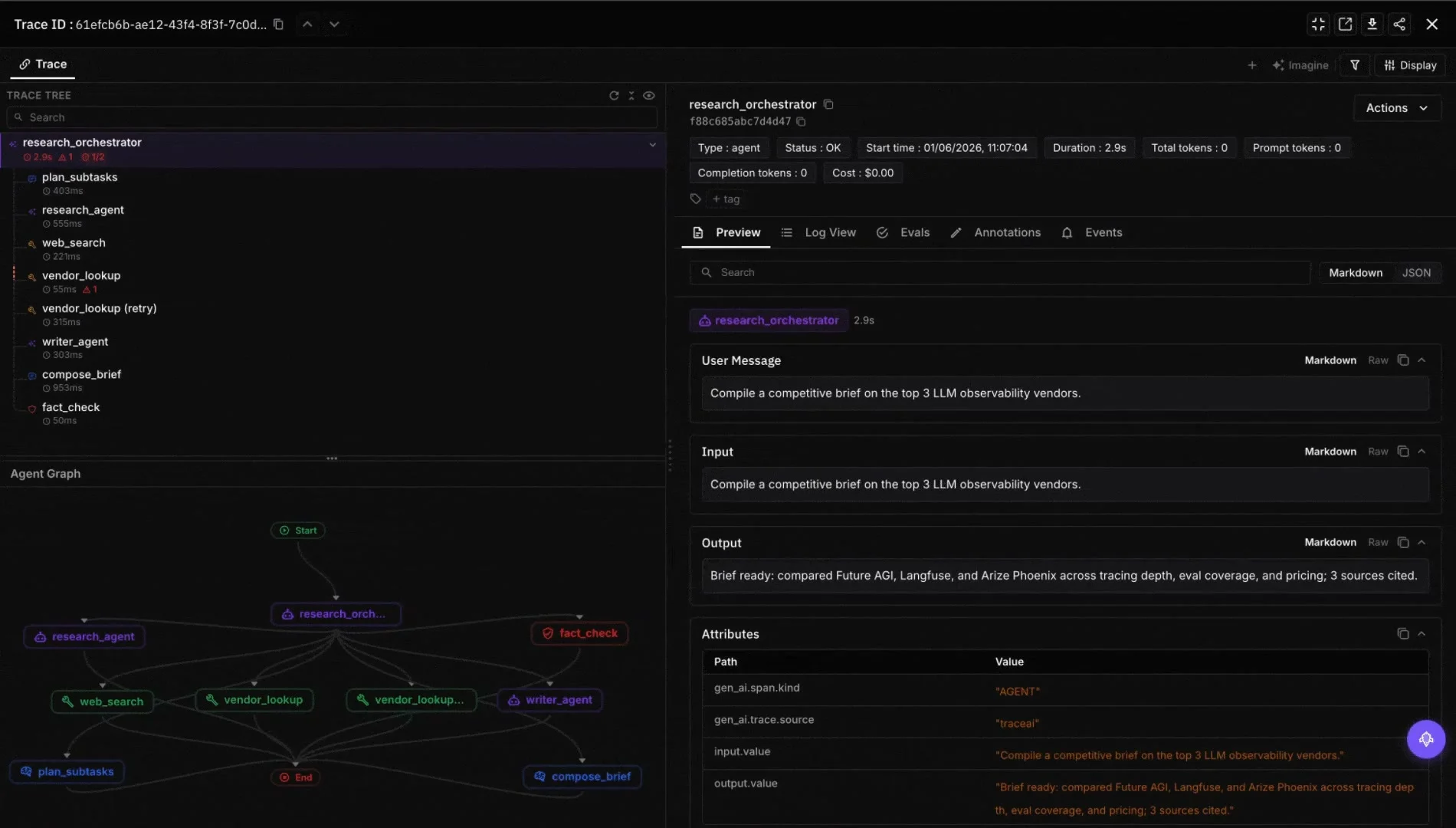
- Trace. Every Copilot completion produces a span tree via
traceAI(Apache 2.0). Spans capture the developer SSO claim, the repo, the cost center, the system prompt, the completion, the model used, the latency, the cost, and the DLP decision. The trace store is immutable.
-
Evaluate.
ai-evaluation(Apache 2.0) scores every completion. FAGI ships a 60+ EvalTemplate classes in theai-evaluationSDK with self-improving evaluators on the Future AGI Platform (task-completion, faithfulness, code-correctness, policy-compliance, tool-use, structured-output, hallucination, agentic surfaces, instruction-following, groundedness), plus unlimited custom evaluators authored end-to-end by an in-product eval-authoring agent that uses tool calling on your code, plus self-improving evaluators that learn from live production traces, plus FAGI’s proprietary classifier model family at very low cost-per-token (lower per-eval cost than Galileo Luna-2). The scores live alongside the cost and the SSO attribution. Catalog is the floor, not the ceiling. -
Cluster. Low-scoring completions get clustered by failure mode in Agent Command Center. A common pattern in Copilot deployments is “the expensive frontier model called when a faster cheaper model would have produced the same accepted completion.” The cost-quality mismatch becomes visible per repo and per developer cohort.
- Optimize.
fi.opt.optimizers(six optimizers (RandomSearchOptimizer, BayesianSearchOptimizer Optuna-backed with teacher-inferred few-shot templates and resumable studies, MetaPromptOptimizer, ProTeGi, GEPAOptimizer, PromptWizardOptimizer), all sharing an EarlyStoppingConfig (patience + min_delta + threshold + max_evaluations) and the same unified Evaluator over 60+ FAGI rubrics) rewrites the system prompt or adjusts the routing policy against the clustered failures. For Copilot BYOM specifically, the typical optimization is a routing rule: route completions under 4K input tokens (the long tail) to a cheaper model, reserve the frontier model for the multi-file diff context where it actually moves the needle.
-
Route. Agent Command Center’s gateway applies the updated routing policy on the next request. The Copilot BYOM endpoint stays the same; the gateway’s internal routing changes.
-
Re-deploy. The new prompt + route are versioned. Teams roll forward; if the next 24 hours of scores regress, automatic rollback to the previous version. The rollback is a policy change at the gateway hop, not a redeploy of any developer tooling.
Net effect: a 3,000-developer Copilot Enterprise deployment that starts at $90,000/month on the model line typically trends down 18-28% over six weeks. The router gets better at choosing the cheaper model for the long tail; the optimizer rewrites prompts that were over-prompting; the eval data tells the loop where to focus next. Acceptance rate on completions holds flat or improves because the optimizer is grading on accepted-completion outcomes, not raw token throughput.
The three building blocks are open source under Apache 2.0:
traceAI, github.com/future-agi/traceAIai-evaluation, github.com/future-agi/ai-evaluationagent-opt, github.com/future-agi/agent-opt
The hosted Agent Command Center adds the failure-cluster view, live Protect guardrails (~65 ms text latency per arXiv 2510.13351), RBAC, SOC 2 Type II certified, AWS Marketplace for procurement, and BYOC deployment for enterprises that can’t send prompts to a vendor SaaS.
What we did not include
We deliberately left out three gateways that show up in other 2026 Copilot governance listicles:
- Helicone. Acquired by Mintlify on March 3, 2026; public roadmap shifted toward a documentation-platform-first stance. Existing Helicone customers should treat this as a planned migration window, not a continued procurement for a multi-year regulated workload.
- LiteLLM. Strong Python-native proxy and OSS provider coverage, but the March 24, 2026 PyPI supply-chain compromise (versions 1.82.7 and 1.82.8, exfiltrating SSH keys and cloud credentials per the Datadog Security Labs writeup) raises the operational due-diligence bar materially for a regulated enterprise. Teams on LiteLLM today should pin commit hashes or upgrade past 1.83.7 and rotate any credentials in the blast radius; new regulated deployments would more reasonably look elsewhere first.
- OpenRouter. Excellent for early-stage routing experimentation and per-token economics comparison, but the enterprise-chargeback and SSO-attribution shape is consumer-facing. For a regulated Copilot governance workload, the procurement fit is wrong.
If your enterprise context is materially different (a small regulated team that wants Python ergonomics, a research org that values OpenRouter’s catalog), each of the three deserves a second look. They aren’t on the Copilot-Enterprise-governance shortlist as of May 2026.
Related reading
- Best 5 AI Gateways to Monitor Claude Code Token Usage in 2026
- Best 5 AI Gateways for LLM Cost Optimization in 2026
- What Is an AI Gateway? The 2026 Definition
- Best AI Gateways for Agentic AI in 2026
Sources
- GitHub Copilot Enterprise documentation, including BYOM tier, docs.github.com/copilot/enterprise
- GitHub Copilot audit log API reference, docs.github.com/rest/copilot/copilot-user-management
- Future AGI Agent Command Center, futureagi.com/platform/monitor/command-center
- Future AGI Protect latency benchmarks, arxiv.org/abs/2510.13351 (65 ms text, 107 ms image)
- Portkey AI gateway, portkey.ai
- Palo Alto Networks press release on Portkey acquisition (April 30, 2026), paloaltonetworks.com/company/press/2026
- Kong AI Gateway and AI Proxy plugin, konghq.com/products/kong-ai-gateway
- Cloudflare AI Gateway, developers.cloudflare.com/ai-gateway
- TrueFoundry AI Gateway, truefoundry.com/ai-gateway
- Datadog Security Labs LiteLLM PyPI supply-chain writeup (March 24, 2026), securitylabs.datadoghq.com
Frequently Asked Questions
Does GitHub Copilot Enterprise need an external AI gateway when it already has audit logs and SSO?
What is Copilot BYOM and why does it matter for the gateway choice?
Can I track Copilot cost per cost center when everyone uses one organization-wide license?
How is the gateway different from GitHub Advanced Security for code-leak prevention?
What happens to Copilot's tool calls (file edits, terminal commands in Copilot Chat) when the gateway is in the path?
Is it safe to send proprietary code through an AI gateway?
How does Future AGI Agent Command Center differ from Portkey for Copilot Enterprise governance?
What does a realistic gateway rollout timeline look like for a 3,000-developer Copilot Enterprise deployment?
Does inline DLP at the gateway hop break Copilot's autocomplete latency budget?
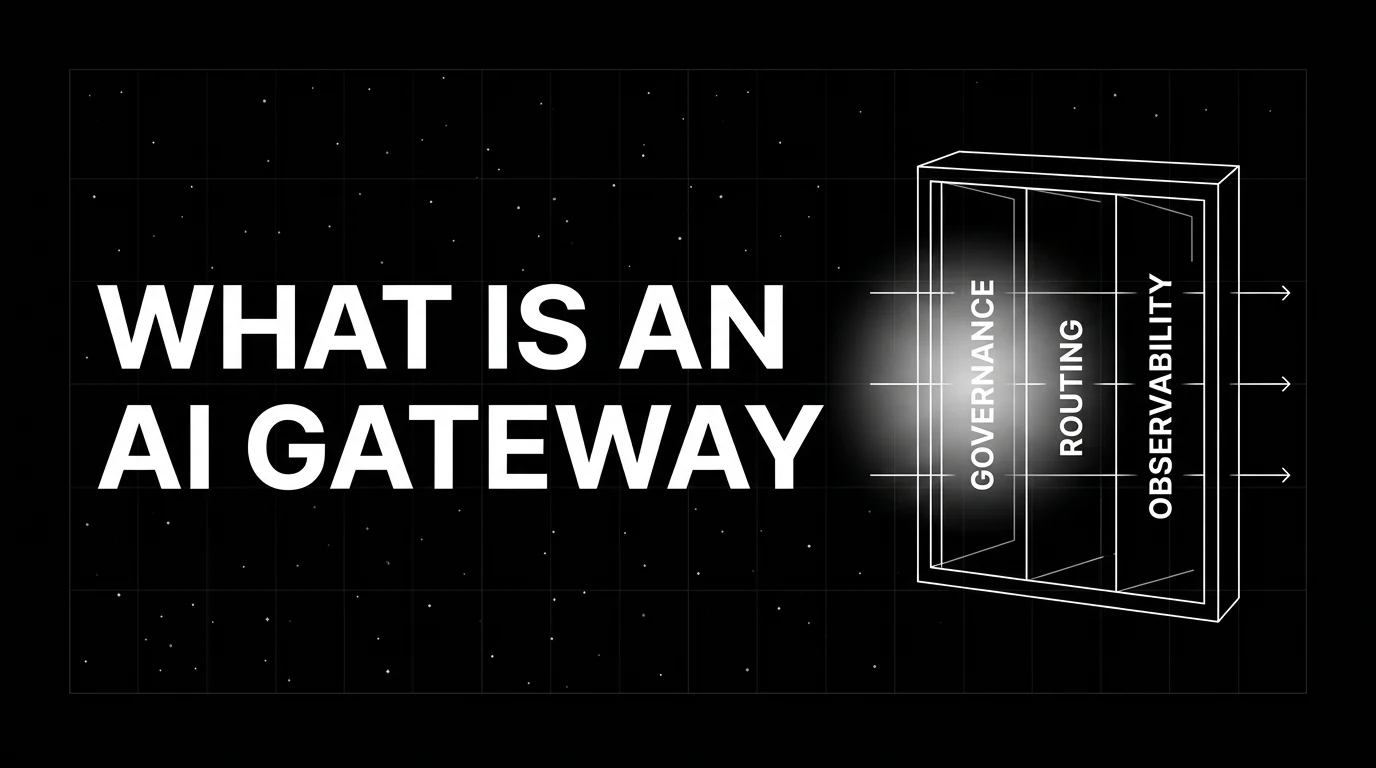
An AI gateway sits between apps and LLM providers for governance, routing, observability. What it is, how it differs from API gateways.

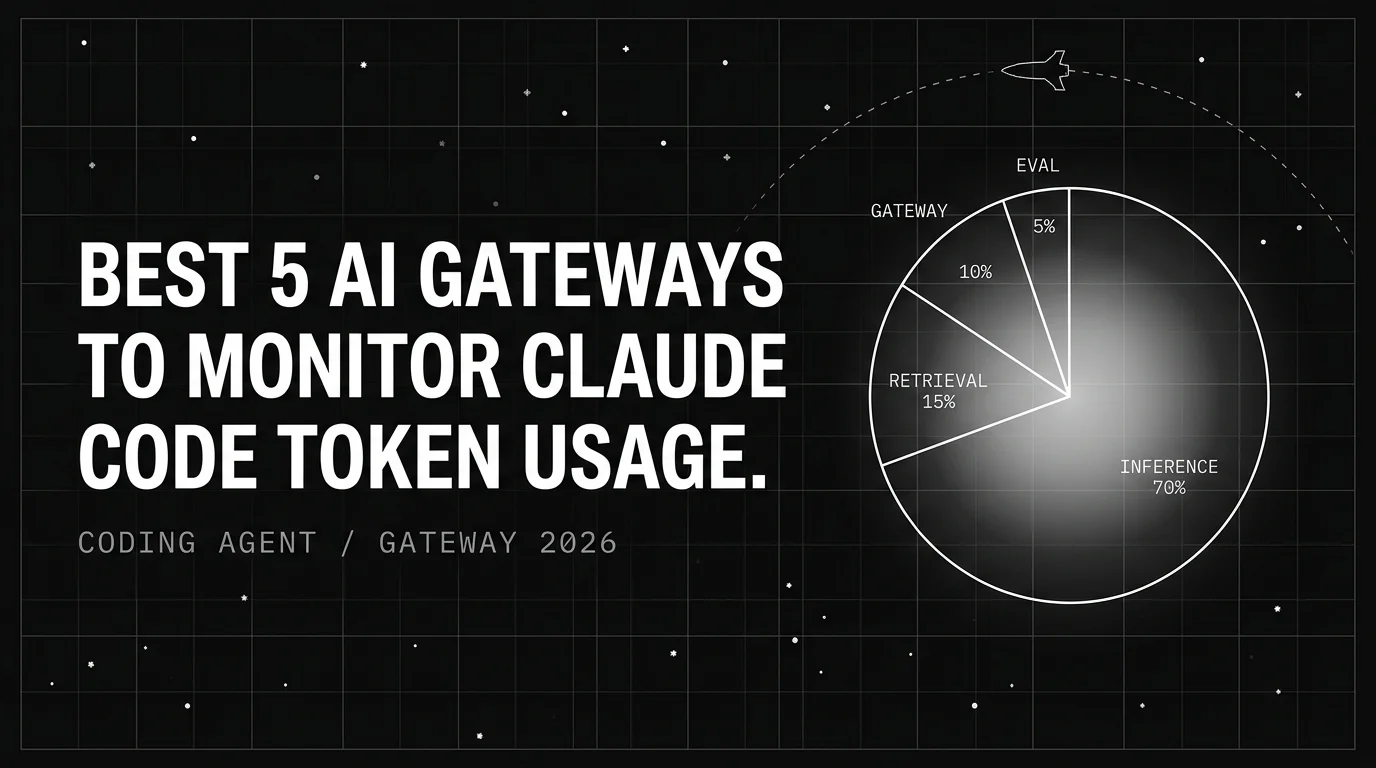
Five AI gateways scored on Claude Code token monitoring in 2026: per-dev attribution, per-repo budgets, session traces, alerts, where each falls short.

Five AI gateways on what compliance officers actually need: tamper-evident logs, 3-10 yr retention, SIEM exports, span granularity, legal hold, frameworks.