Best 5 AI Gateways for Education in 2026: FERPA-Compliant Student-Data Routing
Five AI gateways for K-12, universities, and EdTech in 2026, scored on FERPA student-data routing, COPPA consent, and state privacy laws.
Table of Contents
Originally published May 17, 2026.
A 4,300-student suburban K-12 district rolled out an AI tutoring chatbot on a Tuesday and discovered by Friday that the gateway it had been routing on stored the full conversation transcript (including the student’s first and last name, student ID number, IEP eligibility flag, and grade-level math performance) on a vendor cloud where the standard terms allowed model training on customer data, with no inline PII redaction layer in front of the model and no audit log of which teacher or which student had prompted what. The district had to send 4,300 parental notices, pull the chatbot, and stand up a different stack in eight weeks. This guide compares the five AI gateways K-12 districts, universities, and EdTech vendors should consider in 2026, scored against the FERPA personally identifiable information surface at 34 CFR 99.3, the school-official-designated routing exception at 34 CFR 99.31(a)(1), the FTC’s amended COPPA Rule at 16 CFR Part 312 effective April 22, 2026, and the leading state student-data privacy laws (NY SHIELD Act, California SOPIPA, Illinois SOPPA).
TL;DR: The 5 Best Education AI Gateways for 2026
Future AGI Agent Command Center is the strongest single pick for an education AI gateway in 2026 because it bundles OpenAI compat, inline student-PII redaction at roughly 67 milliseconds at the same network hop (latency profile published in arXiv preprint 2510.13351), 18+ built-in guardrail scanners covering the FERPA personally identifiable information surface, per-virtual-key budgets with per-district and per-school isolation, and OpenTelemetry audit logs exportable on a parental-records request, in one Apache 2.0 Go binary. The 2026 buying cycle has to weigh four pressures: the FTC’s amended COPPA Rule reaching its April 22, 2026 final compliance deadline, continued FERPA NPRM activity, an SDPC contract template revision that now references AI training data explicitly, and the same vendor cohort events (Helicone joining Mintlify on March 3, the LiteLLM PyPI compromise on March 24, the announced Palo Alto Networks acquisition of Portkey on April 30) that reshaped the healthcare cohort.
- Future AGI Agent Command Center — Best overall. Inline ~67 ms student-PII redaction, 18+ FERPA-aligned guardrails, per-district budgets, OpenTelemetry audit logs, self-hosted in a district or university VPC.
- Portkey — Best for multi-tenant EdTech vendors and district consortia that want a managed dashboard with a four-tier per-district, per-school, per-teacher, per-feature budget hierarchy. Verify the Palo Alto Networks acquisition timeline before signing multi-year.
- Kong AI Gateway — Best for university IT shops and state-level education networks already running Kong, wanting LLM routing on the same control plane.
- LiteLLM — Best for Python-first EdTech engineering teams pinning a known-good commit after the March 24, 2026 supply-chain incident, with their own direct provider relationships.
- Helicone (migration mode) — Best for existing Helicone deployments in a planned migration window after the March 3, 2026 Mintlify acquisition.
The 5 Education AI Gateways at a Glance
The pattern is the same across tutoring chatbots, grading assistants, IEP draft-generation copilots, admissions essay feedback tools, and parent-facing translation services. The gateway is judged on three controls: whether a school-official designation can be defended on the routing path and the FERPA PII surface at 34 CFR 99.3 redacted before the prompt leaves the hop; whether the audit log can be retained on the district records-retention schedule (3 to 7 years for most student records, 60 years or permanent for transcripts in New York and California) and exported within the 45-day FERPA inspection window at 34 CFR 99.10(b); and whether the under-13 cohort can be routed on a separate path under the FTC’s amended COPPA Rule.
Cloudflare AI Gateway is a strong edge layer but doesn’t ship the inline student-PII redaction surface a district CTO can defend against 34 CFR 99.3. TrueFoundry is picked more often by hospitals than by K-12 districts on a $40-per-student annual EdTech budget. AWS Bedrock and Azure OpenAI are upstream model providers most education gateways route to, not gateways themselves.
How We Scored These Education AI Gateways
We used the Future AGI Production Gateway Scorecard for Education, a seven-axis rubric that maps each capability to a FERPA control, a COPPA Rule provision, or a state student-data privacy obligation. Every axis has to be defensible to a district general counsel reading 34 CFR 99.31(a)(1), and to a parent who has invoked the FERPA inspection right at 34 CFR 99.10.
| # | Axis | What we measure |
|---|---|---|
| 1 | FERPA-compliant data flow | Configurable routing only to providers that contractually prohibit training on customer prompts and completions; school-official posture at 34 CFR 99.31(a)(1) defensible |
| 2 | Age-gated routing for under-13 learners | Under-13 traffic on a separate path with stricter consent capture, narrower upstream list, shorter retention; aligned with the FTC’s amended COPPA Rule at 16 CFR Part 312 effective April 22, 2026 |
| 3 | Audit log available for parental review | Per-request capture of caller identity, model, prompt template version, and redaction events; documented export path for the 45-day FERPA window at 34 CFR 99.10(b) |
| 4 | Multi-tenant isolation (district/school/teacher) | Per-virtual-key budgets mapped to the district-school-teacher hierarchy, with RBAC that prevents one school from reading another school’s audit log |
| 5 | FERPA-aligned data-retention controls | Configurable retention on prompt, completion, and audit log records; aligned with district records-retention schedules (3 to 7 years for most records, 60 years or permanent for transcripts in some states) |
| 6 | Per-feature consent capture | Capture parental or student consent at the per-feature level (tutoring chatbot, grading assistant, IEP draft generator) and enforce on the routing path |
| 7 | SIS integration | Adapter or pattern for joining gateway audit logs to the SIS record (PowerSchool, Infinite Campus, Skyward, Banner, Workday Student) by district-issued student identifier |
Axes 1, 3, and 4 decide whether the gateway keeps the district defensible in a Department of Education complaint investigation under 34 CFR 99.63. Axes 2 and 5 keep the district defensible under COPPA and the state law cohort. Axes 6 and 7 make the gateway usable across a counsel office, an IT director, and forty schools. The redaction layer on axis 1 is only as good as its detector; see evaluating LLM PII detection for how to measure that recall before trusting it.
The 7-Axis Education Capability Matrix the SERP Is Missing
Future AGI Agent Command Center leads on combined inline PII redaction latency, FERPA-aligned guardrail depth, audit log path, and license clarity. Portkey wins on managed dashboard maturity and the four-tier budget hierarchy. Kong AI Gateway wins for campuses already running Kong. LiteLLM wins on Python-native ergonomics. Helicone is in migration mode. None of the top ten education AI gateway posts on Google ship a seven-axis matrix or name the FERPA PII surface at 34 CFR 99.3.
| Capability | Future AGI ACC | Portkey | Kong AI Gateway | LiteLLM | Helicone |
|---|---|---|---|---|---|
| FERPA-compliant data flow (school-official posture configurable) | Yes | Yes (Enterprise) | Yes (via plugin policy) | Configurable per upstream | Yes (maintenance) |
| Inline student-PII redaction on the same network hop | Yes (~65 ms, FAGI Protect) | Yes (PII anonymization at Enterprise) | Via AI Prompt Guard plus Data Masking | Via adapters | Not in default scope |
| Age-gated routing for under-13 learners | Yes (per-virtual-key policy) | Yes (per virtual key) | Yes (per-route plugin chain) | Yes (per-deployment) | Limited |
| Audit log for parental review | Yes (OTel-native, exportable) | Yes (dashboard plus OTel partial) | Yes (Kong log plugins) | OTel partial | Yes (legacy) |
| Multi-tenant isolation (district/school/teacher) | Yes (per virtual key, per tag) | Yes (4-tier budget hierarchy) | Yes (consumer plus workspace) | Yes (virtual key) | Limited |
| FERPA-aligned retention controls | Yes | Yes | Yes (via log plugin) | Yes | Limited |
| Per-feature consent capture | Yes (per-key, per-tag, per-route) | Yes | Yes (per-route plugin chain) | Yes | Limited |
| SIS integration pattern | Yes (custom properties plus tag-based) | Yes (custom properties) | Yes (custom plugin) | Yes (custom adapters) | Limited |
| Open source license | Apache 2.0 | Source available | Apache 2.0 (OSS core) | Apache 2.0 outside enterprise directory | Apache 2.0 (maintenance) |
| Self-host or air-gap path | Yes (Docker, Kubernetes, air-gapped) | Yes (Enterprise) | Yes (DB-less or hybrid) | Yes (pip-install, Docker) | Self-host (maintenance) |
| Self-improving optimizer across trace, eval, route | Yes | No | No | No | No |
The five columns that matter most for a district CIO are FERPA-compliant data flow, inline PII redaction latency, audit log path, multi-tenant isolation, and license clarity in a year where acquisition events keep reshaping the cohort.
What the 2026 Education Privacy Stack Actually Demands
The 2026 education AI compliance stack is four layers, and a gateway that handles only one isn’t an education gateway.
- FERPA at 20 U.S.C. § 1232g and 34 CFR Part 99. The federal floor. An AI gateway has to support the PII surface at 34 CFR 99.3 (student name, parent or family member name, address, personal identifier such as a student ID, indirect identifiers like date of birth and place of birth and mother’s maiden name, biometric records, and combination-identifiable information); the school-official routing exception at 34 CFR 99.31(a)(1) (a contractor under the district’s direct control over education records is treated as a school official, the exception that lets an upstream LLM provider receive student PII at all); directory information rules at 34 CFR 99.37; the parental inspection right at 34 CFR 99.10 (45-day response window); and the complaint provisions at 34 CFR 99.63 through 99.67. The Department of Education’s enforcement mechanism is conditional withholding of federal funds, which for a typical state K-12 district puts tens of millions of dollars per year of Title I, IDEA, and Perkins funding at risk.
- COPPA at 15 U.S.C. § 6501 and the FTC’s 2024 Rule amendments at 16 CFR Part 312. The federal floor for under-13. The amended Rule was effective June 23, 2025 with a final compliance deadline of April 22, 2026. The new pieces: separate verifiable parental consent for disclosure to third parties, narrowing the school-authorization workaround to education purposes only, a retention limitation, and explicit treatment of biometric identifiers as personal information. The FTC’s COPPA civil penalty maximum is $53,088 per violation per child as of the 2026 adjustment, which on a 4,300-student district at one violation per child is a $228,278,400 theoretical maximum (the FTC has settled COPPA matters against EdTech vendors in the eight- and nine-figure range, including the $20 million Epic Games settlement).
- State student-data privacy laws. New York’s SHIELD Act (N.Y. Gen. Bus. Law § 899-bb), California’s SOPIPA (Cal. Bus. & Prof. Code §§ 22584-22585), Illinois’ SOPPA (105 ILCS 85), and counterparts in at least 40 other states stack on top of the FERPA floor: prohibitions on targeted advertising to K-12 learners, prohibitions on non-educational student profiles, breach notification, deletion-on-request, and prior-written-consent obligations.
- SDPC contract template. Roughly 6,000 districts in the Student Data Privacy Consortium sign a national or state addendum to the NDPA template with EdTech vendors. The 2026 revision references AI training data explicitly, and is the document districts use to enforce “no training on student data.”
A gateway that ships PII redaction but skips the under-13 routing path and the parental-records-request export is good for marketing and bad for a Department of Education complaint investigation or an FTC COPPA inquiry.
Future AGI Agent Command Center: Best Overall for Education AI
Future AGI Agent Command Center tops the 2026 education list because it bundles every layer of the compliance stack at the same network hop in one Apache 2.0 Go binary, with the inline student-PII redaction layer (FAGI Protect, roughly 67 millisecond inline latency published in arXiv preprint 2510.13351) running at that same hop.
It loses on managed-dashboard polish to Portkey and on incumbency to Kong for campuses already on Kong. For a district CIO whose binding constraint is FERPA-compliant routing with inline student-PII redaction plus OpenTelemetry audit logs in one self-hostable Apache 2.0 binary, the combined surface still puts it first.
Best for. K-12 districts, charter networks, universities, and EdTech vendors that want OpenAI compat plus inline ~67 ms student-PII redaction plus 18+ FERPA-aligned guardrails plus per-virtual-key budgets plus OpenTelemetry audit logs in one Apache 2.0 Go binary, self-hosted inside the district or university VPC.
Key strengths.
-
OpenAI-compatible drop-in: change
base_urltohttps://gateway.futureagi.com/v1, the 4,300-student district’s tutoring chatbot codebase isn’t rewritten. -
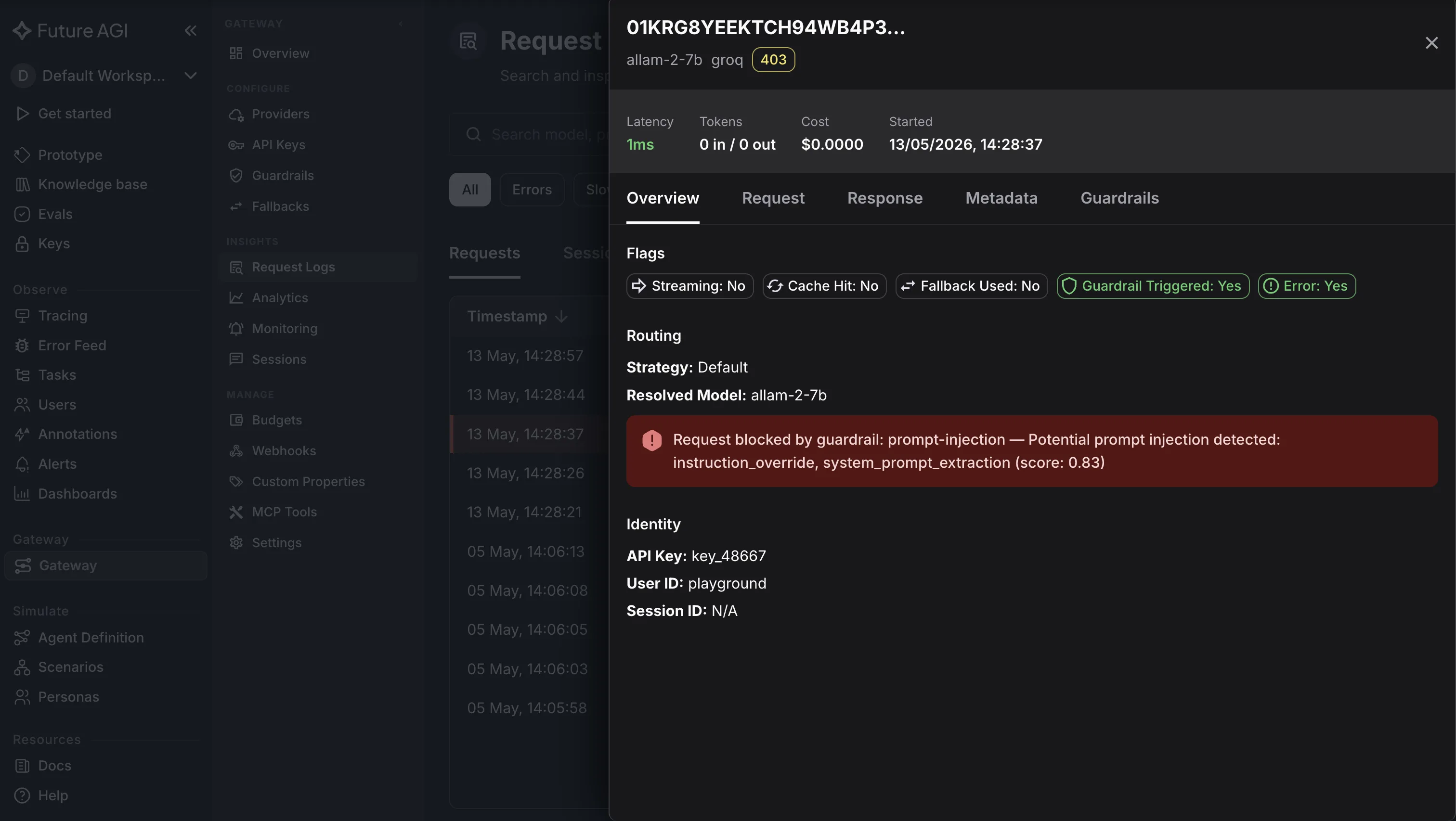
The Future AGI Protect model family for inline guardrails on the same hop, ~65 ms p50 text and ~107 ms p50 image (arXiv preprint 2510.13351). Protect is FAGI’s own fine-tuned model family built on Google’s Gemma 3n with specialized adapters across four safety dimensions (content moderation tuned for K-12 age-appropriateness, bias detection, security/prompt-injection, data privacy/PII), natively multi-modal across text, image, and audio, a model family, not a plugin chain. The Data Privacy dimension covers the FERPA PII surface at 34 CFR 99.3: student name, parent or family member name, address, personal identifier (student ID), indirect identifiers (date of birth, place of birth, mother’s maiden name), biometric records, and the combination-identifiability test. A dedicated MCP Security scanner sits alongside for research copilots wired to campus MCP tool servers; the same four dimensions are reusable as offline eval metrics so the prod policy and the eval rubric stay in sync.
-
Age-gated routing on the under-13 path: a per-virtual-key policy constrains the upstream provider list, retention window, and additional consent capture step the FTC’s amended COPPA Rule now requires. K-5 tutoring runs on one virtual key with stricter consent and shorter retention; high-school essay feedback runs on a different virtual key.
-
Per-virtual-key, per-district, per-school, per-teacher, per-model, and per-time-window budgets. The CIO can enforce a $40-per-student annual cap on the tutoring chatbot across 4,300 students from one surface.
-
OpenTelemetry-native traces plus Prometheus metrics on
/-/metrics; span attributes feed the district SIEM (Splunk, Sumo Logic) or campus data warehouse. The audit-log export path fulfills a parental-records request inside the 45-day FERPA window at 34 CFR 99.10(b).traceAIinstruments 50+ AI surfaces across Python, TypeScript, Java, and C# (including Spring Boot starter, Spring AI, LangChain4j, Semantic Kernel) OpenInference-natively, and Error Feed. the part of the eval stack, the clustering and what-to-fix layer that feeds the self-improving evaluators, turns those traces into named issues with zero config: auto-clusters related per-school and per-grade-band failures (50 traces → 1 issue), auto-writes the root cause plus a quick fix plus a long-term recommendation per issue, and tracks rising/steady/falling trend per issue so tutoring-chatbot regressions and PII-leak attempts get triaged like exceptions rather than buried in district SIEM rows.
- Self-improving optimizer (trace, eval, optimize, route) closed across the gateway hop. The agent-opt component, Apache 2.0, learns from real district failure modes (a student-PII leak attempt on a tutoring prompt, a misidentified student ID, a grading output crossing the directory-information line), not a generic benchmark.
- Apache 2.0; single Go binary; Docker, Kubernetes, AWS, GCP, Azure, air-gapped or on-prem. The Agent Command Center hosted plane is BYOC-deployable.
- SIS integration. Custom-properties tag every request with a district-issued student identifier (not the SSN, not the FERPA-restricted record), making the audit log joinable to PowerSchool, Infinite Campus, Skyward, Banner, or Workday Student under the district’s control.
Where it falls short.
- Managed-dashboard polish for a non-technical product manager wanting a four-tier budget hierarchy in a UI is closer to Portkey; the FAGI surface is OpenTelemetry-native first.
- The under-13 routing posture is policy as code (per-virtual-key route policy) rather than a dedicated UI checkbox.
from openai import OpenAI

client = OpenAI(
    api_key="$FAGI_DISTRICT_API_KEY",
    base_url="https://gateway.futureagi.com/v1",
)

# Existing OpenAI SDK code unchanged from here. The gateway runs
# inline student-PII redaction at ~67 ms, the under-13 route policy,
# per-virtual-key budgets per district and per school, and the
# OpenTelemetry audit-log export path on the same network hop.
response = client.chat.completions.create(
    model="azure-openai/gpt-4o",
    messages=[{"role": "user", "content": "Explain photosynthesis at a 6th-grade reading level."}],
)
Verdict. The strongest single pick if the 2026 education AI story is “OpenAI compat drop-in plus inline student-PII redaction plus FERPA-aligned guardrails plus per-district budgets plus OpenTelemetry audit logs in our existing observability stack, inside our district or university VPC, under our own SDPC addendum, with a self-improving routing layer that learns from the failures our students and teachers actually generate.”
Portkey: Best for Multi-Tenant EdTech Cost and Audit Dashboard
Portkey is the strongest education pick when the binding constraint is a managed cost and audit dashboard, a mature semantic cache, and the four-tier budget hierarchy (per district, per school, per teacher, per feature) that a multi-school-district EdTech product manager uses to defend a $40-per-student annual budget against the district CFO at quarter end.
It’s what most multi-state EdTech vendors reach for when the brief is “ship per-district cost attribution to forty district CIOs next quarter, with PII anonymization defensible against the state student-data privacy cohort.” The caveat is the Palo Alto Networks acquisition announced April 30, 2026, expected to close in Palo Alto’s fiscal Q4 2026.
Best for. Multi-state EdTech vendors, district consortia, and university systems running multiple AI products that want fine-grained per-district, per-school, per-teacher, and per-feature budgets, PII anonymization, and a usable cost dashboard.
Key strengths.
- Exact plus semantic caching with TTL and similarity-threshold tuning; production tutoring and grading workloads typically see 30 to 60 percent hit rates, which can be the difference between a $40-per-student budget working and not.
- Per-key, per-virtual-key, per-model, and per-time-window budgets, the most fine-grained native-dashboard hierarchy on the list, mapping cleanly to district-school-teacher-feature ownership.
- 250+ provider adapter library, including private OSS deployments and on-prem Llama variants.
- PII anonymization at the Enterprise tier; SOC 2 Type II, ISO 27001, GDPR audit-log support; per-route policy chains usable for under-13 routing.
Where it falls short.
- Acquisition by Palo Alto Networks announced April 30, 2026; multi-year district contracts should reference the integration plan, especially for state-funded districts that may have separate procurement rules for cybersecurity-vendor-acquired products.
- Observability is dashboard-first; OpenTelemetry export is less first-class than the native dashboard, which makes integration with the district’s Splunk or Sumo Logic SIEM a longer first week than the Future AGI path.
- Source available core plus closed control plane; air-gapped deployment is available at Enterprise but is heavier than a single Apache 2.0 binary, which matters for districts whose SDPC addendum prohibits an external SaaS control plane from touching student records.
- Inline student-PII redaction latency isn’t published at the same single-digit-tens-of-milliseconds inline level the FAGI Protect path publishes in arXiv preprint 2510.13351.
Verdict. The most mature managed cost and audit dashboard for education AI in 2026, with strong semantic cache and a four-tier budget hierarchy multi-school-district product managers actually use. Choose with eyes open on the Palo Alto Networks integration.
Kong AI Gateway: Best for University IT Shops Already on Kong
Kong AI Gateway is the strongest pick for university IT shops and state-level education networks already running Kong as the campus REST API gateway. Kong AI Gateway adds AI-specific plugins (AI Proxy, AI Prompt Guard, AI Prompt Decorator, AI Rate Limiting Advanced, AI Semantic Caching, AI Data Masking) on top of the Kong control plane, so the routing posture is the same one the IT team already defends.
Best for. Research universities, state-level education networks, and large K-12 districts already operating Kong on the campus REST API plane that want LLM traffic on the same control plane, with the same RBAC and the same audit log path the campus identity system already consumes.
Key strengths.
- Runs as a plugin on the existing Kong control plane the IT team already operates; the university doesn’t stand up a parallel routing layer.
- Kong OSS core is Apache 2.0; the AI plugins ship in both OSS and Enterprise tiers.
- AI Prompt Guard plus AI Data Masking plugin chain enforces the runtime detector path for FERPA PII at the same hop.
- Native fit with university identity federation (Shibboleth, SAML, OIDC) and campus SIEM ingestion through existing Kong log plugins (HTTP Log, Kafka Log, Syslog).
- DB-less and hybrid deployment modes fit the campus IT shop’s existing infrastructure pattern.
Where it falls short.
- The FERPA PII detector is a plugin chain (AI Prompt Guard plus AI Data Masking) rather than a dedicated 18+ built-in scanner library; the campus engineering team writes more glue.
- Inline PII redaction latency depends on the plugin chain; Kong doesn’t publish a single-digit-tens-of-milliseconds inline number like the FAGI Protect path.
- Kong’s product strategy is enterprise REST API gateway first, AI gateway second; AI feature velocity is conservative compared to AI-native gateways.
- Per-feature consent capture and SIS integration are workable but require custom plugin development, a fit for a university IT shop with engineering bandwidth and a poor fit for a small K-12 district without one.
Verdict. The right pick when the binding constraint is “we’re already on Kong and we aren’t introducing a second gateway product.” Choose Future AGI Agent Command Center when the binding constraint is inline student-PII redaction latency, a built-in 18+ FERPA-aligned scanner library, and a self-improving optimizer.
LiteLLM: Best for Python-First EdTech Engineering Teams Post-CVE
LiteLLM is the Python-first proxy that broke open the multi-provider unified API category. Apache 2.0 outside the enterprise directory, 20+ providers via six native adapters (OpenAI, Anthropic, Gemini, Bedrock, Cohere, Azure) plus OpenAI-compatible presets and self-hosted backends, OpenAI-compatible endpoints; it powers a long tail of internal EdTech gateways at vendors building tutoring chatbots, grading assistants, and admissions essay feedback tools.
Best for. Python-first EdTech engineering teams operating their own FastAPI or uvicorn surface, willing to pin commit hashes after the supply-chain incident, with their own direct provider relationships and an amendable state student-data privacy contract template.
Key strengths.
- Broadest provider coverage on this list (20+ providers via six native adapters (OpenAI, Anthropic, Gemini, Bedrock, Cohere, Azure) plus OpenAI-compatible presets and self-hosted backends), which matters when an EdTech vendor is testing four upstream models for sixth-grade-reading-level chemistry tutoring on a $40-per-student budget.
- Apache 2.0 outside the enterprise directory; trivial to fork or audit, which is the posture a small EdTech vendor’s engineering team can defend in a district SDPC review.
- Virtual keys with per-key budgets; native fit with Python observability stacks (FastAPI middleware, Sentry, Prometheus exporters).
Where it falls short.
- March 24, 2026 PyPI supply-chain compromise. Versions
1.82.7and1.82.8were published by the TeamPCP threat actor after PyPI tokens were exfiltrated via a compromised Trivy GitHub Action in LiteLLM’s CI/CD. The malicious packages shipped a credential harvester, a Kubernetes lateral-movement toolkit, and a persistent systemd backdoor; over 40,000 downloads were recorded before PyPI quarantined them. Pin to 1.82.6 or earlier, scan dependency trees, rotate credentials. For a district CIO whose audit log will be subject to a parental-records request, “we pin LiteLLM at 1.82.6 and verify the hash on every deploy” is the answer that survives a Department of Education complaint. - Python runtime; materially slower throughput than Go-binary alternatives at high concurrency, which matters at the 8:00 a.m. Monday start-of-class spike when 4,300 students load the tutoring chatbot at once.
- No vendor SDPC addendum on the OSS distribution; the EdTech vendor must hold the addendum directly with the district, not “through” the LiteLLM project.
- Inline student-PII redaction is “via adapters” rather than a built-in 18+ scanner library; the engineering team wires and maintains the detector chain across the FERPA PII surface itself.
Verdict. Still the broadest provider coverage, but the March 2026 supply-chain incident shifts it from “default pick” to “pin commits and audit.” Treat LiteLLM as an OSS self-hosted runtime where the vendor holds upstream provider relationships and the SDPC addendum directly.
Helicone: Best for Existing Education Deployments in Migration Window
Helicone was the lightweight observability proxy that gave small EdTech vendors a one-line base_url swap and a usable cost dashboard. After the March 3, 2026 Mintlify acquisition, the project is in maintenance mode; active feature development has wound down. The honest 2026 recommendation is to treat any existing Helicone deployment inside an EdTech product as a planned migration window, not a continued procurement.
Best for. Existing education deployments on Helicone, in a planned migration window. New deployments should start on Future AGI Agent Command Center, Portkey, Kong AI Gateway, or commit-pinned LiteLLM.
Key strengths (legacy).
- One-line
base_urlswap; the original lightweight observability pattern. - Apache 2.0 core; the self-hosted distribution remains runnable inside an EdTech vendor’s VPC for the migration window.
Where it falls short.
- March 3, 2026 acquisition by Mintlify. The product is in maintenance mode. For a district CIO making a 3-year procurement decision, “we’re running Helicone in maintenance mode” isn’t the answer that survives a state student-data privacy law audit, especially when the SDPC addendum revision now references AI training data and the gateway vendor’s product-velocity posture matters.
- No first-class student-PII redaction scanner library at the same network hop; the FERPA PII detector is “via adapters.”
- The under-13 routing posture, the parental-records-request export path, and SIS integration are all “workable in theory” but aren’t the surface the product team is actively investing in.
Verdict. Not a new procurement in 2026. The right move is to plan the migration window and execute before the district SDPC addendum renewal cycle.
How Districts and Universities Are Actually Picking in 2026
The buyer profile drives the pick more than the seven-axis matrix does.
| If you are a… | Pick | Why |
|---|---|---|
| 4,300-student suburban K-12 district, single tutoring chatbot, district-VPC self-host required by SDPC addendum | Future AGI Agent Command Center | OpenAI compat plus inline ~67 ms student-PII redaction plus OpenTelemetry audit log in one Apache 2.0 Go binary; school-official routing defensible at 34 CFR 99.31(a)(1) |
| 73,000-student urban district running tutoring plus grading plus parent translation across forty schools | Future AGI Agent Command Center | Per-virtual-key budgets mapped through per-district, per-school, per-teacher tags; under-13 routing on a separate virtual key |
| Multi-state EdTech vendor selling into 40 districts, four-tier per-district budget hierarchy required | Portkey | Most fine-grained budget hierarchy plus mature dashboard; verify the Palo Alto Networks integration timeline in the contract |
| 52,000-student research university with an existing Kong control plane | Kong AI Gateway | LLM routing as a plugin on the existing Kong control plane the campus IT shop already operates |
| 15-engineer EdTech startup, FastAPI-first, direct provider relationships, comfortable with commit pinning | LiteLLM (commit pinned) | Broadest provider coverage; Apache 2.0; pin to 1.82.6 or earlier after the March CVE |
| Existing Helicone deployment inside a 200-district EdTech product | Migrate to Future AGI ACC or Portkey | Helicone is in maintenance mode after the Mintlify acquisition; plan the window before SDPC addendum renewal |
| University running research copilots across four colleges with college-level multi-tenant isolation | Future AGI Agent Command Center | Per-virtual-key budgets per college plus inline PII redaction plus self-improving optimizer across research workloads |
| Early-stage EdTech vendor evaluating gateways before signing the first SDPC addendum | Future AGI Agent Command Center free tier | Apache 2.0 self-host; upgrade when production traffic begins |
Which AI Gateway Is Right for Your Education Team in 2026?
Education AI in 2026 is a stack of FERPA, COPPA, state student-data privacy law, and SDPC addendum controls riding on top of an AI gateway. That gateway has to keep student PII off the wire, retain audit logs on the district records-retention schedule, support a separate under-13 routing path under the FTC’s amended COPPA Rule, survive a parental-records request inside the 45-day FERPA inspection window at 34 CFR 99.10(b), and survive a year of acquisition events without re-platforming.
Of the five gateways above, Future AGI Agent Command Center is the strongest pick when the buying constraint is OpenAI compat plus inline ~67 ms student-PII redaction plus 18+ FERPA-aligned guardrails plus per-district multi-tenant isolation plus OpenTelemetry audit logs in one Apache 2.0 Go binary, self-hosted inside the district or university VPC, with a self-improving optimizer (trace, eval, optimize, route) that learns from production failures across education workloads.
Portkey is the right call when a managed cost and audit dashboard with a four-tier budget hierarchy is the binding constraint and the Palo Alto Networks integration risk is acceptable. Kong AI Gateway is the right call when the campus IT shop is already on Kong. Commit-pinned LiteLLM is the right call for Python-first EdTech engineering teams with their own direct provider relationships. Helicone is a planned migration window, not a new procurement.
For deeper reads:
- The Agent Command Center docs for the gateway feature surface.
- The Future AGI observability docs for the OpenTelemetry audit log path that anchors parental-records-request export.
- The Future AGI Protect docs for the inline student-PII redaction surface, with the latency profile published in arXiv preprint 2510.13351.
- The Future AGI GitHub repo for the Apache 2.0 source.
Try Agent Command Center free. OpenAI-compatible routing, inline student-PII redaction at roughly 67 ms, 18+ FERPA-aligned guardrails, per-district and per-school budgets, and OpenTelemetry audit logs in one Apache 2.0 Go binary.
Related reading
- Best 5 AI Gateways for Compliance Audit Trails in 2026, the compliance and audit-trail comparison
- Best 5 AI Gateways for LLM Cost Optimization in 2026, the five-layer cost stack and the 2026 trust cohort
- Best 5 AI Gateways for Customer Support in 2026: Latency Budgets, Agent Assist, and Voice AI Passthrough, the customer-support-specific gateway picks
- Best 5 AI Gateways for Cybersecurity in 2026: Prompt Injection Defense, Tenant Isolation, and SOC 2, the cybersecurity-specific gateway picks
Frequently Asked Questions
What is the best AI gateway for education in 2026?
Do AI gateways support FERPA compliance for K-12 districts and universities?
How does an AI gateway handle COPPA for K-12 learners under 13 in 2026?
Can a K-12 district or university deploy an AI gateway on-prem or inside its own VPC?
How does an AI gateway redact student PII before it leaves the district network?
What audit-log retention should a K-12 district require from an AI gateway?
How does Future AGI Agent Command Center differ from Portkey for an education buyer?
Five AI gateways on what compliance officers actually need: tamper-evident logs, 3-10 yr retention, SIEM exports, span granularity, legal hold, frameworks.

An AI gateway sits between apps and LLM providers for governance, routing, observability. What it is, how it differs from API gateways.

Education AI eval in 2026: five platforms scored on COPPA + FERPA + pedagogical-correctness rubrics. FAGI, Galileo Luna-2, Braintrust, Khanmigo, on-prem.