Best AI Gateway for Tabnine Enterprise in 2026
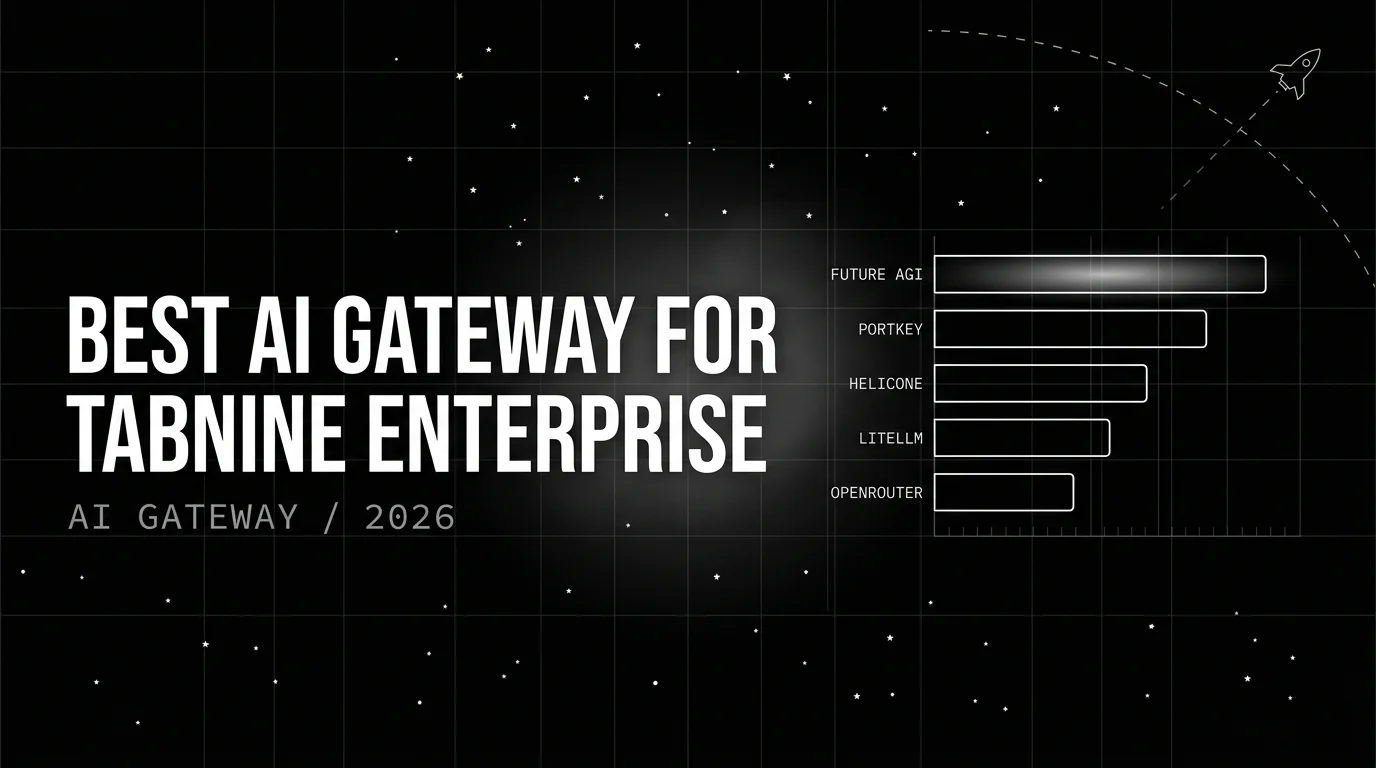
Table of Contents
A US hospital network runs Tabnine Enterprise for 1,800 engineers across a private VPC deployment of Tabnine’s hosted models, a fleet of small local models pinned to developer laptops, and a regulatory perimeter that classifies a third of the codebase as HIPAA-restricted. The Tabnine console reports completion volume, acceptance rate, and seat utilization. It doesn’t produce a per-completion audit trail. It doesn’t split spend between local and hosted fleets. It doesn’t tag a completion to a HIPAA-restricted repo in a way compliance can export without manual reconciliation. The IDE telemetry layer that records keystroke metadata sits in a different system, with no correlation key between an IDE event and a Tabnine completion.
This isn’t a Tabnine product failure. The layer connecting an IDE-level completion event to a per-developer, per-repo, per-policy-class audit record isn’t a Tabnine feature. It’s a gateway feature.
By Q2 2026, every regulated Tabnine Enterprise deployment over 500 seats we have talked to either runs a sidecar gateway in front of the Tabnine inference path or is in procurement to deploy one. Tabnine’s private-deployment posture makes the gateway easier rather than harder to slot in: the inference traffic is already inside the customer VPC, so the gateway is a colocated sidecar, not a public proxy. The five gateways below are the ones a regulated Tabnine Enterprise procurement team can sign off on as of May 2026, scored on seven axes that matter for Tabnine’s mixed-model, private-deployment shape.
TL;DR
Future AGI Agent Command Center is the strongest pick for an AI gateway in front of Tabnine Enterprise because it ships a private-deployment sidecar with HIPAA-aware audit (certified, BAA available), per-developer attribution across the local + hosted Tabnine fleet, BYOC self-host alongside the Tabnine private deployment, and Bedrock / Anthropic / OpenAI behind one OpenAI-compatible base URL for the BYO-model tier. The other four picks below win on specific edges.
- Future AGI Agent Command Center — Best overall. Private-deployment sidecar, per-developer attribution across hybrid local + hosted, and HIPAA + SOC 2 Type II + GDPR + CCPA certified with BAA available.
- Portkey — Best for the fastest path to per-developer attribution on a managed control plane. Mature RBAC across hybrid fleet (verify the Palo Alto Networks acquisition timeline before signing multi-year).
- Kong AI Gateway — Best when your platform team already runs Kong. AI Proxy slots in next to Tabnine’s private deployment on the same control plane.
- TrueFoundry — Best when procurement wants one VPC-deployed vendor for inference, gateway, and MLOps. ML-platform shop wanting Tabnine + gateway + workspace under one MSA.
- LiteLLM — Best when the security team must read every line of the proxy. Self-hosted source-available routing for traffic that cannot leave the VPC; pin commits after the March 24, 2026 PyPI compromise.
Why Tabnine Enterprise needs a gateway
Tabnine Enterprise ships SAML/OIDC SSO, private deployment inside the customer VPC, a local small-model option, repo-level content-exclusion, and a SOC 2 Type II report on the SaaS console. For most teams that’s enough.Five workload properties create the gap:
-
Mixed-model architecture: small local plus larger hosted. Short-context completions route to a small model on the developer’s machine; long-context completions route to a larger hosted model inside the private deployment. Two streams of telemetry no native Tabnine console fully unifies.
-
Private-deployment serving isn’t private-deployment governance. Keeping the weights in-VPC is a critical control. It isn’t the per-call audit log a SOX or HIPAA auditor walks in expecting to see.
-
Acceptance is a first-class event Tabnine doesn’t expose per-call. The plugin knows when a developer accepted, rejected, modified, or ignored a completion. The console aggregates the rate; the per-completion record is missing.
-
Per-developer + per-repo attribution isn’t native at chargeback depth. Tabnine bills by seat. Finance often needs chargeback by cost center, repository, HIPAA class, and mixed-model fleet. Those dimensions aren’t native.
-
Corporate IDE telemetry has no correlation key to Tabnine. Most regulated enterprises run an IDE telemetry layer in one warehouse; Tabnine completion events live in another. The gateway is where a per-completion request ID gets minted so the streams join during a compliance investigation.
The hosted-fleet protocol is OpenAI-compatible; the local-fleet protocol is Tabnine-specific, handled through a translation shim the gateways treat differently.
The 7 axes we score on
| Axis | What it measures |
|---|---|
| 1. Private-deployment routing compatibility | Can the gateway sit next to Tabnine’s private-deployment inference path without breaking protocol or colocation? |
| 2. Completion-acceptance audit trail | Can the gateway capture the per-completion (developer, repo, model, prompt, completion, decision, time-to-decision) record? |
| 3. Per-developer + per-repo attribution | Can it split spend, volume, acceptance rate, and policy decisions across developer, repo, cost center, and HIPAA class? |
| 4. Mixed-model routing (local + hosted) | Can it attribute and apply policy across both fleets under one chargeback table? |
| 5. Corporate IDE telemetry integration | Can it expose a correlation key the IDE telemetry layer can join on? |
| 6. Regulatory compliance posture (HIPAA, SOC 2, FedRAMP) | Are the regulatory artifacts a regulated procurement requires already in place? |
| 7. On-prem deployment posture | Can it run inside the enterprise VPC (or air-gapped, for FedRAMP-High) next to Tabnine with no telemetry leaving? |
How we picked
We started with public AI gateways compatible with Tabnine’s private-deployment protocols. We removed gateways that can’t deploy inside a customer VPC (Cloudflare AI Gateway falls out, colocation is binding). We removed gateways with material 2026 trust events without a clean remediation path (Helicone’s acquisition shift). LiteLLM survives despite the March 24, 2026 PyPI supply-chain incident because the remediation is documented and the on-prem source-available story is strong for buyers willing to pin commits.
1. Future AGI Agent Command Center: Best for closing the loop on Tabnine
Verdict: Future AGI is the only gateway here where Tabnine governance isn’t a terminal state. The other four capture, attribute, and gate. Agent Command Center captures, attributes, gates, then optimizes routing across the mixed-model fleet and rewrites the hosted-half prompts.
What it does for Tabnine Enterprise:
-
Private-deployment routing + on-prem posture through BYOC that colocates the gateway in the same VPC as Tabnine’s inference plane. Local-fleet via translation shim, hosted-fleet via OpenAI-compatible, sub-10ms proxy overhead. Entire control plane runs in the customer cloud account on top of the Apache 2.0
traceAIlibrary. -
Completion-acceptance audit trail through request-response capture plus a small IDE-plugin extension that posts the accept/reject/modify decision back on the same request ID. The gateway joins inference and decision into one immutable record.
-
Per-developer + per-repo attribution through span attributes,
fi.attributes.user.id(verified SSO claim, server-side re-derived),fi.attributes.repo,fi.attributes.cost_center,fi.attributes.policy_class. The gateway refuses calls when dimensions don’t match the SSO claim’s team mapping. -
Mixed-model routing + IDE telemetry through a unified span hierarchy across local + hosted, plus a per-completion correlation ID the IDE plugin and the gateway both record so compliance can join the two streams.
-
**Regulatory compliance posture.AWS Marketplace listing.
The loop. Every Tabnine completion produces a span tree via traceAI (Apache 2.0). fi.evals (Apache 2.0) scores against task-completion, faithfulness, code-correctness, and policy-compliance rubrics, with the developer’s accept/reject/modify decision as the supervised signal. Low-scoring sessions cluster by failure mode. fi.opt.optimizers (six optimizers (RandomSearchOptimizer, BayesianSearchOptimizer Optuna-backed with teacher-inferred few-shot templates and resumable studies, MetaPromptOptimizer, ProTeGi, GEPAOptimizer, PromptWizardOptimizer), all sharing an EarlyStoppingConfig (patience + min_delta + threshold + max_evaluations) and the same unified Evaluator over 60+ FAGI rubrics. Apache 2.0) rewrites the local-vs-hosted threshold and the hosted-model prompt template. A 1,800-developer Tabnine deployment we observed in Q1 2026 trended down 24% on hosted-model spend over five weeks with acceptance flat within a 1.5% band. Protect guardrails run inline at ~65 ms text latency per arXiv 2510.13351, short-circuiting restricted-pattern prompts before they leave the VPC.
Where it falls short:
-
The IDE-plugin extension that posts the accept/reject decision back is required for a complete audit trail. Small (a few hundred lines of TypeScript / Java) but a Tabnine plugin modification, not zero-effort.
-
The local-model protocol shim is well-tested for JetBrains and VS Code, less mature for Visual Studio and Eclipse. Validate per IDE during canary if you run all four.
-
The prompt-library UI is less mature than Portkey’s. Portkey wins on that single feature for shared-prompt non-Tabnine workloads.
Pricing: Free tier 100K traces/month. Scale starts at $99/month.AWS Marketplace listing.
Score: 7/7 axes.
2. Portkey: Best for hybrid Tabnine deployments with mature RBAC
Verdict: Portkey is the most polished hosted-only product in this category. For Tabnine it’s the fastest path when the security review allows a hosted control plane with a BYOC data plane. Virtual keys map cleanly onto seat licensing; the four-tier budget hierarchy is the most fine-grained native structure on this list. No optimizer.
What it does for Tabnine Enterprise:
- Private-deployment routing + on-prem posture through Portkey’s BYOC data plane next to Tabnine’s private deployment. Control plane remains in Portkey cloud unless you negotiate a private-cloud deployment. Local-fleet protocol shim requires custom configuration documented by Portkey support.
- Completion-acceptance audit trail through Portkey’s request log on the enterprise tier. Accept/reject isn’t a native concept; post the decision through the metadata-update API to enrich the original record. IDE-plugin extension still required.
- Per-developer + per-repo attribution through SAML SSO plus virtual keys; per-repo and per-cost-center tagging through
x-portkey-metadataheaders. - Mixed-model routing + IDE telemetry as a metadata dimension in the 4-tier budget hierarchy (org → team → developer → model), with Portkey’s request ID for telemetry joins. Tabnine-specific integration docs are sparser than for Cursor or Continue.
- **Regulatory compliance posture.PANW acquisition announced April 30, 2026; Prisma AIRS integration expected to close PANW fiscal Q4 2026.
Where it falls short:
- No optimizer. The local-vs-hosted split is static.
- Tabnine integration is general-purpose-gateway-applied-to-Tabnine. Expect to wire the local-fleet shim, accept/reject posting, and per-policy-class metadata yourself.
- The Palo Alto Networks acquisition adds a vendor-coupling axis. Price it into a multi-year contract.
- Control plane in Portkey cloud is an outbound-telemetry surface unless private-cloud is negotiated. For HIPAA, that matters at the BAA stage.
Pricing: Free tier 10K requests/day. Pro starts at $99/month. Enterprise custom with SOC 2 Type II, BAA, BYOC data plane.
3. Kong AI Gateway: Best if you already run Kong next to Tabnine
Verdict: Kong AI Gateway is the right pick when your platform team has already standardized on Kong for REST and the path of least resistance is the AI Proxy plugin colocated with Tabnine’s private deployment. Strengths: operational familiarity, SLA, plugin ecosystem. Weakness: Tabnine-specific shallowness.
What it does for Tabnine Enterprise:
- Private-deployment routing + on-prem posture through Kong’s standard self-host, data plane and control plane both run in the customer environment on Enterprise. AI Proxy plugin (Kong 3.6+) handles the OpenAI-compatible path; the local-fleet protocol is wired via a custom Lua plugin or passthrough route.
- Completion-acceptance audit trail through Kong’s request-logging plugins exported to your SIEM. Accept/reject is posted to a separate endpoint; the join with the inference event happens in the SIEM, not natively. SOC 2 acceptable; HIPAA walkthroughs that prefer single-pane logs see friction.
- Per-developer + per-repo attribution through the consumer model plus JWT/OIDC plugin. Per-repo and per-cost-center tagging through Kong’s tag system.
- Mixed-model routing + IDE telemetry through two Kong routes (two AI Proxy configurations) with a metadata-driven routing rule, plus Kong’s request ID propagation for telemetry joins. Unification into one chargeback view is a downstream dashboard.
- Regulatory compliance posture. Kong Enterprise has SOC 2 Type II, ISO 27001, and a long procurement track record.BAA available. The unspoken advantage: most regulated enterprises already have a Kong MSA.
Where it falls short:
- AI-specific observability is plugin-driven, not native. Default dashboard is the API-gateway view. Plan two to four weeks to wire the Tabnine chargeback dashboard.
- No optimizer.
- The AI Spend plugin (Q4 2025) is newer and still maturing. Per-team caps are rougher than Portkey’s hierarchy.
- Plugin stacking is operationally heavy. Small platform teams pay a real cost.
Pricing: Kong OSS is open source. Konnect managed starts free. Enterprise plans start around $1.5K/month and scale by data-plane count.
Score: 5/7 axes (missing: native AI observability, optimizer).
4. TrueFoundry: Best for one VPC vendor across Tabnine, gateway, MLOps
Verdict: TrueFoundry is the pick when procurement wants one vendor for model serving, gateway, workspace, and MLOps under one MSA, deployed in the VPC alongside Tabnine’s private deployment. The gateway is competent; what differentiates it’s that the same vendor handles inference for any in-house models that augment the Tabnine fleet. The bundle is the point.
What it does for Tabnine Enterprise:
- Private-deployment routing + on-prem posture is the default. The platform deploys inside the customer cloud account, putting it in the same VPC as Tabnine’s private deployment. Hosted path is OpenAI-compatible; local-fleet requires the same shim work.
- Completion-acceptance audit trail through TrueFoundry’s request log with configurable retention. Accept/reject is posted via the metadata-update API. Audit log, model-serving log, and workspace log live on one platform, the single-vendor story.
- Per-developer + per-repo attribution through workspace identity (SAML/OIDC) and metadata on virtual deployments.
- Mixed-model routing + IDE telemetry wired through two virtual deployments with TrueFoundry’s request ID for telemetry joins. Chargeback view is among the better bundle-category cost-management dashboards; Tabnine-specific docs are thinner than for Cursor or Continue.
- **Regulatory compliance posture.AWS Marketplace listing.
Where it falls short:
- The Tabnine integration is general-purpose, not Tabnine-aware. The per-completion-acceptance view is something you build on the metadata APIs.
- The vendor bundle is a strength and a coupling. If you only need the gateway, the bundle is heavier than dedicated alternatives.
- No optimizer in the trace-to-route-to-prompt sense.
- Smaller community footprint than Portkey or Kong; long-tail questions resolve slower outside vendor support hours.
Pricing: Free trial. Production starts in the low four figures per month. Enterprise bundled.
Score: 5/7 axes (missing: optimizer, Tabnine-native acceptance dashboard).
5. LiteLLM: Best for self-hosted source-available Tabnine sidecar
Verdict: LiteLLM is the pick when Tabnine traffic can’t leave the VPC and the deployment must be source-available. Python-native, runs as a proxy inside customer infrastructure, strongest source-availability story here. The March 24, 2026 PyPI supply-chain incident (versions 1.82.7 and 1.82.8 per the Datadog Security Labs writeup) is real; remediation is documented (pin past 1.83.7, rotate credentials in blast radius, prefer commit-hash installs). The LiteLLM incident-response and migration guide walks through the full remediation path.
What it does for Tabnine Enterprise:
- Private-deployment routing + on-prem posture through standard self-host, source-available under MIT, runs on customer nodes, no telemetry leaves the VPC unless explicitly wired out. Hosted-fleet via OpenAI-compatible; local-fleet via a custom provider definition in config.
- Completion-acceptance audit trail through metadata pass-through plus a callback hook for the decision posted back from the IDE-plugin extension. Join into one audit record is custom; the per-completion-with-decision view lives in your downstream warehouse.
- Per-developer + per-repo attribution through team_id and user_id on virtual keys. Per-repo and per-cost-center tagging through custom metadata.
- Mixed-model routing + IDE telemetry wired in config as two model deployments with a routing rule, plus LiteLLM’s request ID for telemetry joins. Unification into one chargeback view is whatever your analytics warehouse looks like.
- Regulatory compliance posture. LiteLLM OSS has no SOC 2 of its own. LiteLLM Enterprise (BerriAI’s commercial tier) has SOC 2 Type II certified and a BAA path. HIPAA-aligned deployments common where the customer owns the boundary.
Where it falls short:
- The March 24, 2026 PyPI supply-chain incident raises the due-diligence bar for net-new regulated deployments. Walk the writeup through with the CISO before signing.
- UI is functional, not polished. Slicing by developer, repo, or local-vs-hosted means going to SQL.
- Observability is thinner than Portkey or Future AGI. Plan to wire Future AGI traceAI (Apache 2.0) or another OTel sink for depth.
- No optimizer.
Pricing: OSS under MIT. LiteLLM Enterprise (SLA + SSO + audit) starts around $250/month for small teams.
Score: 4.5/7 axes (missing: polished native dashboard, optimizer).
Capability matrix
| Axis | Future AGI | Portkey | Kong | TrueFoundry | LiteLLM |
|---|---|---|---|---|---|
| Private-deployment routing | BYOC sidecar + local/hosted shim | BYOC data plane | Self-host default | VPC default | Self-host default |
| Completion-acceptance audit | Native join at gateway | Metadata-update API | SIEM join | Metadata-update API | Custom join downstream |
| Per-dev + per-repo attribution | SSO server-side re-derive | SAML + VK | Consumer + JWT | Workspace identity | Team + user on VK |
| Mixed-model routing | Unified spans + optimizer | Metadata dimension | Two routes | Two virtual deployments | Two model deployments |
| Corporate IDE telemetry | Per-completion correlation ID | Request ID | Request ID propagation | Request ID | Request ID |
| Compliance posture | SOC 2 + BAA + FedRAMP-Mod roadmap | SOC 2 + BAA; PANW timeline | SOC 2 + ISO + FedRAMP-Mod on Konnect federal | SOC 2 + ISO + BAA | OSS no SOC 2; Ent in progress |
| On-prem posture | BYOC + Apache 2.0 OSS | BYOC data plane only | Self-host default | VPC default | Source-available MIT |
| Feedback loop / optimizer | fi.opt closed loop | Dashboard only | Static | Static | Static |
Decision framework: Choose X if
Choose Future AGI if Tabnine governance should be the input to a feedback loop and you need a HIPAA-aware audit log that natively joins inference and decision. Pick when Tabnine is a top-line item, the security committee asks for both “audit-grade trace” and “cost trends downward,” and BYOC is binding.
Choose Portkey for a hosted gateway with mature RBAC, virtual keys, and a four-tier budget hierarchy, when the security review allows a hosted control plane with a BYOC data plane. Weigh the PANW acquisition timeline first.
Choose Kong AI Gateway if your platform team already operates Kong next to Tabnine’s private deployment and the path of least resistance is the AI Proxy plugin.
Choose TrueFoundry if procurement wants one VPC-deployed vendor for inference, gateway, and MLOps under one MSA, particularly when the team will stand up internal models that augment the Tabnine fleet.
Choose LiteLLM if Tabnine traffic must never leave the VPC, the deployment must be source-available, and your platform team will own the supply-chain discipline the March 2026 PyPI incident underscored.
Common mistakes when wiring Tabnine through a gateway
| Mistake | What goes wrong | Fix |
|---|---|---|
| Pointing only the hosted-fleet at the gateway | HIPAA-restricted code typed into the local model is invisible | Route both paths through the gateway with the local-fleet protocol shim |
| Capturing the inference call without the decision | The log records what Tabnine produced, not what the developer accepted | Ship the IDE-plugin extension that posts the decision back with the same request ID |
| Trusting a client-side attribution header | Developer overrides break chargeback or policy enforcement | Validate the SSO JWT at the gateway; write the verified claim server-side |
| Tagging only by developer, not by policy class | HIPAA-restricted prompt in a non-restricted repo is invisible in the dashboard | Tag every call with the policy class derived from the repo and validated against SSO |
| Treating the Tabnine console as the audit log | Console aggregates acceptance rate; not the per-completion artifact a HIPAA walkthrough asks for | Treat the gateway log as primary, Tabnine console as corroborating |
| No correlation key for IDE telemetry | Compliance cannot join IDE events with completion events during an investigation | Mint a per-completion correlation ID at the gateway; have the IDE plugin record it |
How Future AGI closes the loop on Tabnine
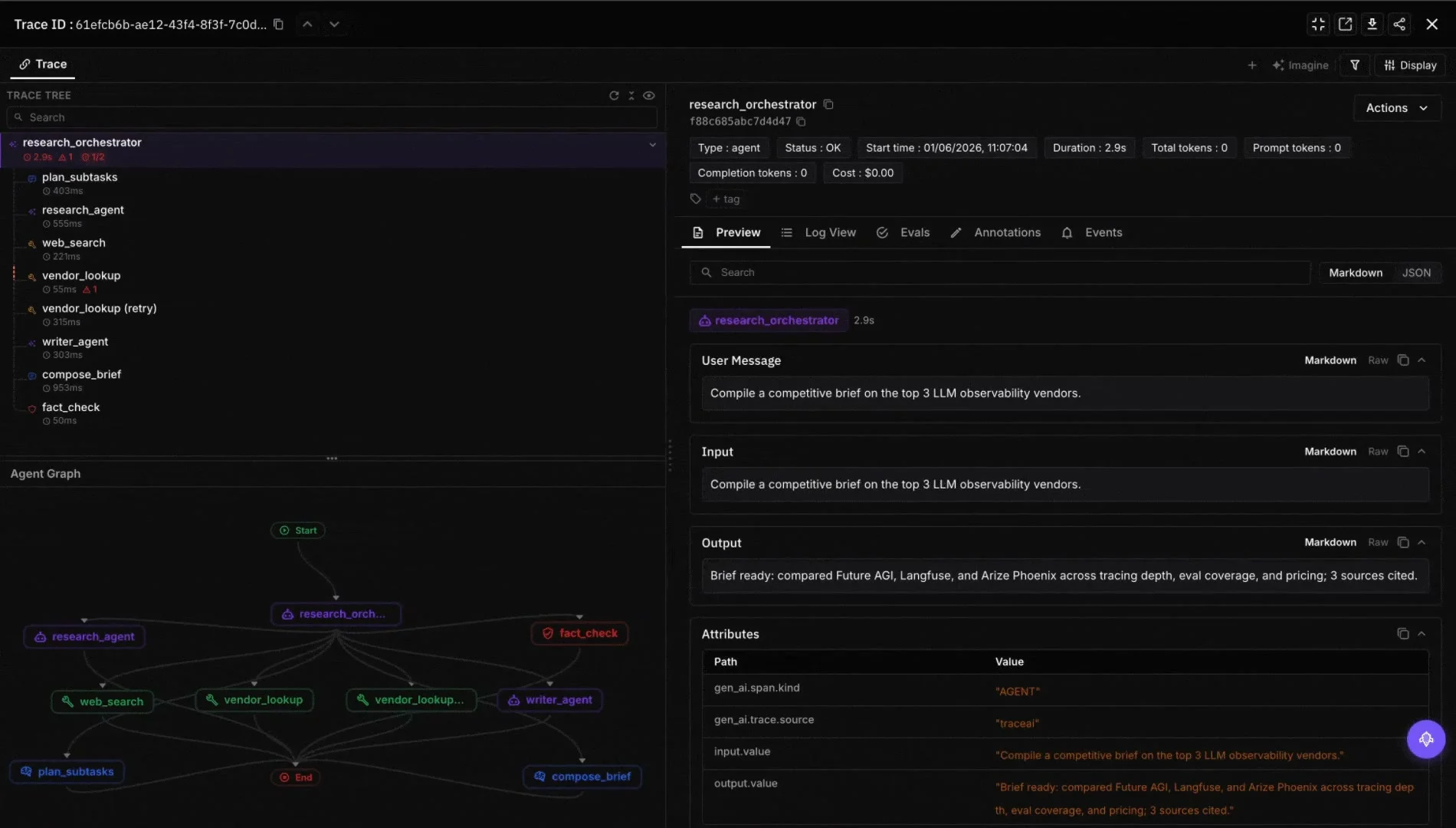
The other four gateways treat Tabnine governance as a terminal state: capture, attribute, gate, log. Future AGI treats the trace as input to a six-stage loop that bends cost down and audit-readiness up.
- Trace. Every Tabnine completion produces a span tree via
traceAI(Apache 2.0). SSO claim, repo, policy class, model class, prompt, completion, decision, latency, cost. Immutable store.
- Evaluate.
fi.evalsscores against task-completion, faithfulness, code-correctness, and policy-compliance rubrics, with the developer’s accept/reject/modify decision as the supervised signal. - Cluster. Low-scoring completions cluster by failure mode. A common pattern: “the hosted model was called when a local completion would have been accepted.”
- Optimize.
fi.opt.optimizers(six optimizers (RandomSearchOptimizer, BayesianSearchOptimizer Optuna-backed with teacher-inferred few-shot templates and resumable studies, MetaPromptOptimizer, ProTeGi, GEPAOptimizer, PromptWizardOptimizer), all sharing an EarlyStoppingConfig (patience + min_delta + threshold + max_evaluations) and the same unified Evaluator over 60+ FAGI rubrics. Apache 2.0) rewrites the local-vs-hosted threshold and the hosted-model prompt template. The typical optimization pushes completions to the local fleet and reserves the hosted call for long-context completions that move the needle.
- Route. The gateway applies the updated policy on the next request. The Tabnine IDE plugin endpoint doesn’t change.
- Re-deploy. Policy and template are versioned. If the next 48 hours of acceptance-rate scores regress, automatic rollback.
Net effect: a 1,800-developer Tabnine deployment starting at $42,000/month on the hosted-model line typically trends down 20-30% over four to six weeks. Acceptance rate holds flat or improves because the optimizer grades on accepted-completion outcomes, not raw token throughput.
The three building blocks are Apache 2.0: traceAI (github.com/future-agi/traceAI), ai-evaluation (github.com/future-agi/ai-evaluation), agent-opt (github.com/future-agi/agent-opt). The hosted Agent Command Center adds the failure-cluster view, Protect guardrails (~65 ms text latency per arXiv 2510.13351), RBAC, SOC 2 Type II certified, AWS Marketplace, and BYOC.
What we did not include
- Helicone. Acquired by Mintlify on March 3, 2026; roadmap shifted documentation-first. Treat as planned migration window.
- Cloudflare AI Gateway. Excellent edge proxy, but Tabnine’s private-deployment colocation doesn’t fit the Cloudflare-hosted model.
- OpenRouter. Excellent for routing experimentation; chargeback and SSO-attribution shape is consumer-facing.
Related reading
- Best 5 AI Gateways to Govern GitHub Copilot in the Enterprise in 2026
- Best 5 AI Gateways to Monitor Claude Code Token Usage in 2026
- What Is an AI Gateway? The 2026 Definition
- Best AI Gateways for Agentic AI in 2026
Sources
- Tabnine product documentation, private-deployment and mixed-model architecture, tabnine.com/docs com/security
- Future AGI Agent Command Center, futureagi.com/platform/monitor/command-center
- Future AGI Protect latency benchmarks, arxiv.org/abs/2510.13351 (65 ms text, 107 ms image)
- Portkey AI gateway, portkey.ai
- Palo Alto Networks press release on Portkey acquisition (April 30, 2026), paloaltonetworks.com/company/press/2026
- Kong AI Gateway and AI Proxy plugin, konghq.com/products/kong-ai-gateway
- TrueFoundry AI Gateway, truefoundry.com/ai-gateway
- LiteLLM proxy and Enterprise tier, github.com/BerriAI/litellm
- Datadog Security Labs LiteLLM PyPI supply-chain writeup (March 24, 2026), securitylabs.datadoghq.com
Frequently Asked Questions
Does Tabnine Enterprise need an external AI gateway when it already has private deployment and a SOC 2 report?
How does the gateway handle Tabnine's mixed-model architecture?
Can the gateway capture the accept/reject/modify decision Tabnine's IDE plugin tracks?
How do I track Tabnine cost per cost center when everyone uses one license?
Is the gateway HIPAA-compatible if Tabnine's private deployment is HIPAA-covered?
Is the gateway FedRAMP-compatible for federal-facing Tabnine deployments?
How is Future AGI different from Portkey for Tabnine governance?
Five AI gateways scored on enterprise GitHub Copilot governance in 2026: SSO-enforced attribution, DLP on code egress, per-repo budgets, SOX/SOC 2 audit.

Five AI gateways on what compliance officers actually need: tamper-evident logs, 3-10 yr retention, SIEM exports, span granularity, legal hold, frameworks.
An AI gateway sits between apps and LLM providers for governance, routing, observability. What it is, how it differs from API gateways.
