Best 5 AgentHub Alternatives in 2026
Five AgentHub alternatives on agent portability, observability and eval depth, self-host. What each actually fixes vs a marketplace-builder product.
Table of Contents
AgentHub is a tidy product for the job it was built for, pick a pre-packaged agent off a marketplace, wire inputs in a visual builder, deploy to a hosted runtime in an afternoon. The problem is the job teams actually have in 2026 isn’t that one. Once an agent has been in production for a quarter, the questions stop being “can I drag a tool onto a canvas” and start being “why did this trace fail,” “what does the eval distribution look like across the last 10K runs,” “can I run an optimizer that rewrites the prompt automatically,” “can I self-host inside a VPC the security team will sign off on.” AgentHub’s answer to most of those is “use a partner integration” or “on the roadmap.”
This guide ranks five alternatives, names what each fixes versus AgentHub, and walks through the migration that always bites, re-implementing an agent definition in a target runtime when the source product treats it as a hosted JSON object rather than code.
TL;DR: pick by exit reason
| Why you are leaving AgentHub | Pick | Why |
|---|---|---|
| You want trace data to feed back into prompts and routing | Future AGI Agent Command Center | Closes the loop from trace through eval to optimizer to deployed agent |
| You want a hosted gateway with prompt and key management | Portkey | Gateway-first product with virtual keys and a hosted prompt library |
| You want OSS observability and eval | Langfuse | OSS tracing, evals, prompt management with self-host option |
| You want raw gateway throughput on Go | Maxim Bifrost | Low-latency proxy for high-RPS workloads |
| You want production agent monitoring and replay | AgentOps | Session replay and agent-specific dashboards out of the box |
Why people are leaving AgentHub in 2026
Five exit drivers show up repeatedly across the AgentHub Discord, Reddit /r/AI_Agents migration threads, the GitHub issue tracker, and partner-integration channels from late 2025 into Q2 2026.
1. Marketplace-and-builder is the entire surface area
AgentHub’s pitch is the marketplace plus the visual builder. Both are well-executed for what they’re. The issue is what they aren’t: no first-class observability, no eval library, no optimizer, no guardrails with measured latency, no self-improving loop. The product points users to partner integrations. Fine for a POC; insufficient for production where runtime, trace, score, and rewriter need to share data models.
2. Narrow scope versus the orchestration frameworks
CrewAI crosses 40K stars in 2026; LangGraph is the orchestration default for teams already on LangChain. The best multi-agent frameworks comparison covers where each one fits. AgentHub’s community is smaller by an order of magnitude, the tutorial corpus is thinner, the integration matrix is shorter. When something breaks at midnight, “smaller community” is a debugging-velocity metric, not a vanity one.
3. Hosted-only deployment, no first-class self-host
AgentHub runs the agent runtime. No supported self-host distribution as of May 2026, no Helm chart, no air-gapped option. Fine for a developer demo; not fine for a regulated team in healthcare, finance, or public-sector where the security review for sending agent I/O to a hosted runtime is non-trivial. Three of the five alternatives below ship a credible self-host story; AgentHub doesn’t.
4. No integrated observability, eval, or optimizer at depth
AgentHub captures basic runs in a list view; depth (per-step traces, token-level cost, latency histograms, eval scores, failure clustering, automated prompt rewriting) lives in partner products or doesn’t exist. The best AI agent observability tools comparison covers what that depth looks like. Teams who leave have usually tried two or three partner integrations and concluded that gluing four hosted products together is more expensive than one platform that ships the stack.
5. Agent definitions are hosted JSON, not code
The migration tax. AgentHub stores each agent as a versioned JSON object behind an “agent definition” API. Export gives you the JSON but not a portable artifact in a target runtime’s idiom. Leaving means re-implementing the definition in the destination framework, usually a one-to-two-week project for under fifty agents.
What to look for in an AgentHub replacement
Score replacements on the seven axes that map to the surfaces you’re actually migrating off:
| Axis | What it measures |
|---|---|
| 1. Agent definition portability | Author agents as code (Python, YAML) so the definition lives in version control, not a vendor DB |
| 2. Observability depth | Per-step traces, token cost, latency histograms — native, not bolt-on |
| 3. Eval library | Scored rubrics (task-completion, faithfulness, tool-use) you can run over historical traces |
| 4. Optimizer / self-improving loop | Does trace data feed back into prompt and routing updates? |
| 5. Self-host posture | Can the runtime run inside your VPC, fully air-gapped? |
| 6. Community size and ecosystem | How many tutorials, issues, examples when something breaks? |
| 7. Guardrails with measured latency | Runtime safety layer with published latency numbers, not just marketing |
1. Future AGI Agent Command Center: Best for closing the loop
Verdict: Future AGI is the only product here that fixes AgentHub’s biggest weakness, a marketplace and builder with no idea what happens to the agent after deployment. Agent Command Center captures the trace, scores it, clusters failures, runs the optimizer, and pushes the updated prompt or route back into the agent on the next request. The other four are mostly observation layers; FAGI is an observation layer wired to an evaluator, optimizer, and back to the runtime.
What it fixes versus AgentHub:
- Agents as code, with a self-improving loop. Agents authored in Python against the FAGI runtime, registered with the Command Center. Prompt registry accepts Jinja2 directly. The optimizer (
agent-opt, Apache 2.0) rewrites prompts via six optimizers — ProTeGi, GEPA, Bayesian, MetaPrompt, RandomSearch, PromptWizard, driven by eval scores fromai-evaluation(Apache 2.0). AgentHub’s builder is static; FAGI’s pipeline is self-improving.
- Native observability via
traceAI.traceAI(Apache 2.0) instruments runs with OpenTelemetry-compatible spans. Each trace lands in the Command Center with per-step tool calls, token cost, latency, and eval score in the same row.
- Native eval, not partner integrations. Every trace is scored against task-completion, faithfulness, tool-use, and instruction-following rubrics by default. Failure clusters group broken traces so the optimizer rewrites once and fixes many.
- Protect, the Future AGI Protect model family. Built on Gemma 3n with specialized fine-tuned adapters per safety dimension (Content Moderation, Bias Detection, Security, Data Privacy Compliance), not a wrapper around third-party APIs. Multi-modal across text, image, and audio. ~65 ms p50 text / ~107 ms p50 image inline enforcement per arXiv 2510.13351. AgentHub doesn’t publish runtime safety latency.
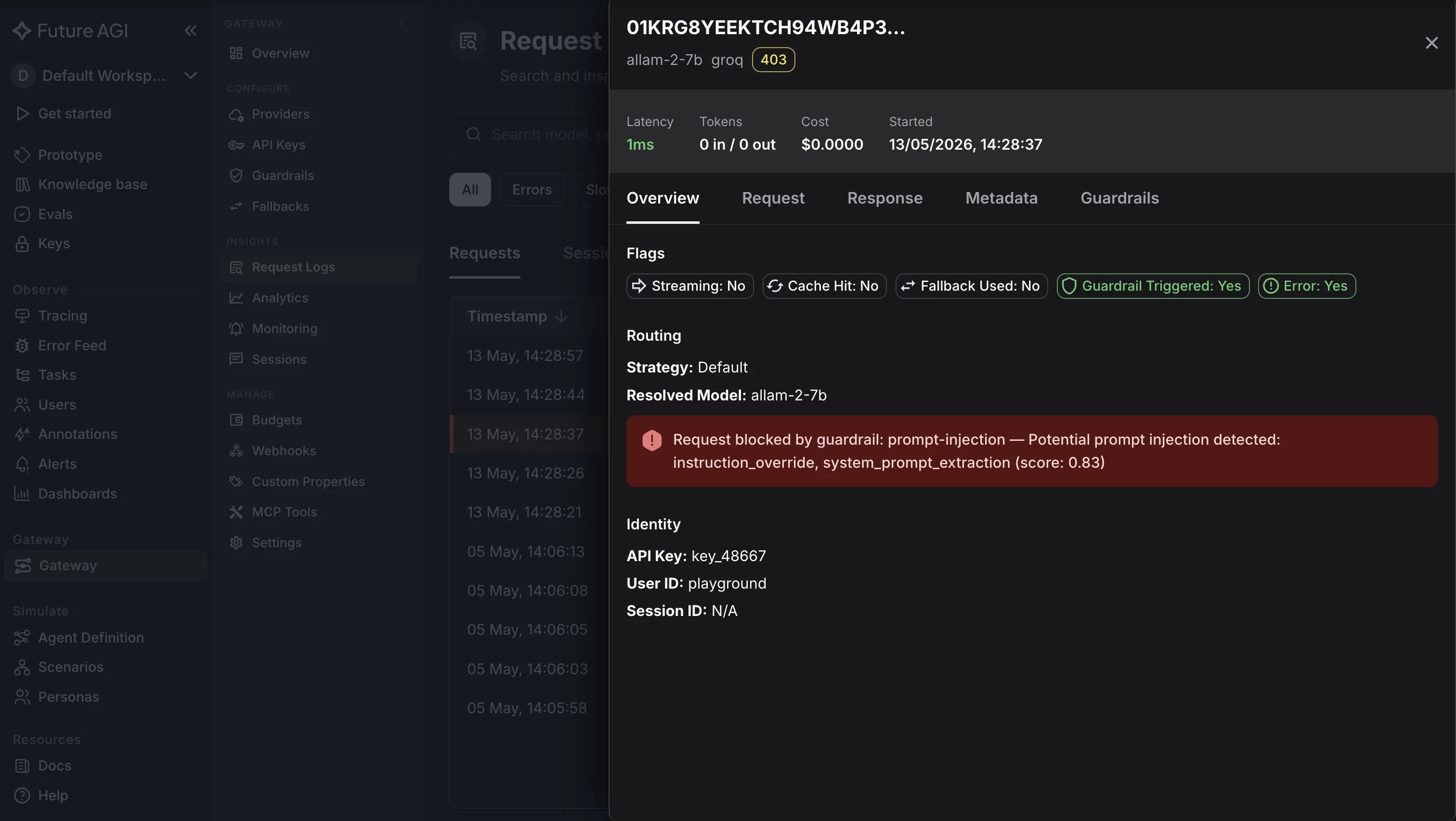
- OSS plus hosted control plane.
traceAI,ai-evaluation,agent-optare Apache 2.0. The hosted Command Center adds RBAC, failure-cluster views, Protect guardrails, and AWS Marketplace.
Migration from AgentHub: Re-implement each agent as a Python class against the FAGI runtime, pull prompt bodies from AgentHub’s JSON into the FAGI registry, wire tool calls. Provider keys map directly. Timeline: seven to ten days for under twenty agents with a shadow-traffic period; under fifty fits in a sprint.
Where it falls short:
-
Optimizer carries a learning curve; a pure swap won’t use that surface in week one.
-
Visual-builder authoring is intentionally minimal, agents are code-first. Teams who authored entirely in AgentHub’s drag-and-drop will need to upskill or adopt a thin wrapper.
Pricing: Free tier 100K traces/month. Scale from $99/month with linear per-trace scaling above 5M (no add-on multipliers). Enterprise with SOC 2 Type II and AWS Marketplace.
Score: 7 of 7 axes.
2. Portkey: Best for a hosted gateway with prompt and key management
Verdict: Portkey is the pick if the exit is about gateway primitives (virtual keys, prompt library, hosted dashboard) without marketplace bloat, and you’ll bring your own framework. Portkey doesn’t run agents; it sits in front of the model calls. One wrinkle: Palo Alto Networks announced the Portkey acquisition on April 30, 2026, so procurement should run diligence before committing.
What it fixes versus AgentHub:
- Real gateway primitives. Virtual keys for per-developer attribution, retries and fallbacks, cost-aware routing, hosted prompt library with version control.
- Hosted dashboard depth. Per-request cost, latency, error breakdowns, and session traces, one of the more polished hosted surfaces in the gateway space.
- Provider breadth. Anthropic, OpenAI, Azure, Bedrock, Vertex, Together, Groq at the gateway-policy layer.
Migration from AgentHub: Re-implement agents in your framework of choice, point model clients at Portkey’s base_url, lift prompts into Portkey’s library, configure virtual keys. Timeline: five to eight days for the gateway cutover. Portkey doesn’t replace AgentHub’s runtime, only the model-call layer.
Where it falls short:
- Not a runtime, you still need a framework.
- No native eval library; pair with FAGI, Langfuse, or in-house. No optimizer.
- The Palo Alto acquisition creates uncertainty about the SMB SKU over 12 to 24 months, prior PANW acquisitions saw standalone tiers sunset on that timeline.
- Prompt Studio is sticky; once 100 prompts are in Portkey, leaving is itself a project.
Pricing: Free tier; Scale from $99/month; Enterprise custom. Curve gets steep above 5M requests/month with add-on multipliers.
Score: 5 of 7 axes (missing: native eval, optimizer; the agent runtime is by definition not in scope for a gateway product).
3. Langfuse: Best for OSS observability and eval
Verdict: Langfuse is the pick when the exit is driven by the lack of integrated trace-and-eval depth and the requirement is “open-source, self-host-friendly, credible eval product attached.” Largest community among OSS LLM-observability tools. Bring your own framework; Langfuse handles observability and evaluation.
What it fixes versus AgentHub:
- Native traces and sessions. OpenTelemetry-compatible spans with per-step tool calls, token cost, and latency. Among the cleaner OSS dashboards.
- Eval library plus LLM-as-judge. Rubric-based scoring, LLM-as-judge templates, dataset evaluations on historical traces.
- Prompt management. Versioned prompts with rollout flags and A/B keys, tightly coupled to the trace and eval surfaces.
- Self-host posture. Postgres plus a worker process; well-maintained OSS Helm chart; hosted Cloud tier is optional.
Migration from AgentHub: Re-implement agents, instrument with Langfuse’s SDK wrappers or OpenTelemetry, lift prompts into the Langfuse registry, configure dataset evals once enough traces accumulate. Timeline: four to six days for the observability cutover.
Where it falls short:
- No optimizer, eval scores inform humans, who rewrite prompts manually.
- No runtime guardrails layer with measured latency.
- Not a runtime, pair with CrewAI, LangGraph, or in-house orchestration.
- Cloud-tier pricing escalates above 5M observations per month, similar shape to Portkey’s curve.
Pricing: Open-source self-host is free. Cloud from $29/month usage-based; Team and Enterprise add SSO and audit.
Score: 5 of 7 axes (missing: optimizer, native runtime guardrails; not a runtime).
4. Maxim Bifrost: Best for raw gateway throughput
Verdict: Maxim’s Bifrost is the pick when the workload is high-concurrency and the gateway’s own latency budget shows up in SLOs. Go-based, benchmarks above Python proxies on RPS per node. Useful when p99 is dominated by proxy overhead rather than model latency.
What it fixes versus AgentHub:
- Throughput per node. Go runtime plus connection pooling gives higher RPS than Python proxies on the same hardware. Sub-millisecond overhead at p50 per Maxim’s benchmarks; reproduce against your workload.
- Self-host posture. Runs as a Go binary, container, helm chart, or VM. Permissive OSS distribution.
- Tight integration with Maxim’s eval stack. Gateway and eval pipeline share data models, removing glue work, if you adopt the whole Maxim suite.
Migration from AgentHub: Re-implement agents in your framework, point model clients at Bifrost, configure routing rules. Timeline: five to seven days for the proxy cutover. Bifrost doesn’t replace the runtime.
Where it falls short:
- No optimizer; not an orchestration framework, bring your own.
- Younger than Portkey, Langfuse, or AgentOps; ecosystem (Terraform providers, dashboards, examples) is thinner.
- Throughput is the headline; teams that picked AgentHub for the visual builder won’t feel the upside.
- Observability and eval depth is strongest if you adopt the whole Maxim suite.
Pricing: Bifrost is open source. Maxim’s hosted gateway pricing is custom, anchored to eval usage.
Score: 4 of 7 axes (missing: optimizer, native runtime guardrails, native eval if you only adopt the gateway).
5. AgentOps: Best for production agent monitoring and replay
Verdict: AgentOps is the pick when the exit is specifically about agent-specific monitoring, session replay, per-agent dashboards, multi-agent run visualization. AgentOps positions as “observability for agents” rather than “observability for LLM calls”, a real distinction once workloads involve multi-step tool use and cross-agent handoffs.
What it fixes versus AgentHub:
- Agent-shaped monitoring. Session replay, per-agent dashboards, multi-agent run visualization, tool-call timelines designed around agent semantics rather than request-shaped logs.
- Framework integrations. First-party SDKs for CrewAI, LangGraph, AutoGen, and other major frameworks. Instrumentation is a one-line decorator in most cases.
- Cost and token analytics per agent. Dashboards slice by agent identity, session, and tool, more than API key, giving product owners a chargeback view AgentHub doesn’t produce.
Migration from AgentHub: Re-implement agents in your framework, drop in the AgentOps SDK, verify traces appear. Timeline: three to five days for the observability cutover.
Where it falls short:
- No optimizer; no runtime guardrails with measured latency.
- Prompt management is lighter than Langfuse or Portkey.
- Eval exists but is less mature than FAGI’s or Langfuse’s; rubric library and failure clustering are thinner.
- Not a runtime, bring your own framework.
Pricing: Free tier with limited monthly events. Pro and Enterprise tiers custom.
Score: 4 of 7 axes (missing: optimizer, runtime guardrails, mature eval rubrics).
Capability matrix
| Axis | Future AGI | Portkey | Langfuse | Maxim Bifrost | AgentOps |
|---|---|---|---|---|---|
| Agent definition portability | Agents-as-code (Python) | Bring your framework | Bring your framework | Bring your framework | Bring your framework |
| Observability depth | Native traces + sessions + RBAC | Per-request dashboard | Native OTel + sessions | OTel-pluggable | Agent-shaped replays + dashboards |
| Eval library | Yes (ai-evaluation, Apache 2.0) | No | Yes (managed evals + LLM judge) | Tied to Maxim eval | Light eval surface |
| Optimizer / self-improving loop | Yes (agent-opt, Apache 2.0) | No | No | No | No |
| Self-host posture | BYOC + OSS instrumentation (Apache 2.0) | Hosted-first (PANW-owned) | OSS Helm + Postgres | OSS Go binary | Hosted-first |
| Community size and ecosystem | Growing OSS + AWS Marketplace | Established gateway community | Largest OSS observability community in this list | Smaller, newer | Established agent-monitoring community |
| Guardrails with measured latency | Protect, 65 ms text (arXiv 2510.13351) | Not published | Not in product | Not in product | Not in product |
Migration notes: what breaks when leaving AgentHub
Re-implementing the agent definition
AgentHub’s agent API returns a versioned JSON object: system prompt, tool catalog with I/O schemas, model and provider, sampling knobs, branching or memory config. Downloadable, not runnable. Each destination runtime expects its own idiom:
- FAGI: Python class subclassing the agent base, prompt in the registry, tools registered against the runtime, agent exposed via the Command Center.
- CrewAI: YAML or Python definitions of agents, tasks, and crews; tools wrapped with the CrewAI tool decorator.
- LangGraph: Python graph with nodes for each step and edges for transitions; state typed with Pydantic.
Parse the JSON, generate a starter file in the target idiom, hand-tune. Under fifty agents finishes in a sprint with one or two engineers. Above that, write a translation script for the first ten and run it across the rest. Two surfaces always need a manual pass: tool I/O schemas (AgentHub’s JSON-schema dialect uses implicit defaults others don’t replicate), and branching logic stored as builder conditional nodes (becomes graph edges in LangGraph, guard clauses in CrewAI / FAGI).
Re-pointing model and tool credentials
AgentHub holds provider keys as named credentials referenced by the agent definition. On exit, the destination needs the same keys (or rotated equivalents). Command Center keys section for FAGI, gateway key management for Portkey/Bifrost, framework-level for observability tools. Mechanical, except for per-tool credentials (third-party SaaS API keys the agent calls), these often live in the AgentHub builder UI rather than a credential vault and need re-discovery manually.
Recreating the deployment surface
AgentHub exposes each agent as a hosted endpoint. On exit, the destination needs an equivalent: a FastAPI / Flask wrapper, a Modal / Cloud Run / Lambda deployment, or the platform’s endpoint mechanism (FAGI exposes agents directly). Checklist: URL changes, auth changes, and webhook config in third-party systems that called the old AgentHub URL.
Decision framework: Choose X if
Choose Future AGI if leaving AgentHub is more than marketplace-and-builder limitations, you also want trace data to drive prompt rewrites and routing updates so cost and quality curves bend over time.
Choose Portkey if you’ve already picked a framework and the exit is about gateway primitives (virtual keys, retries, fallbacks, prompt library) and you can absorb the Palo Alto acquisition risk.
Choose Langfuse if the exit is observability-and-eval-driven and the requirement is “open source, self-host friendly, mature OSS community.”
Choose Maxim Bifrost if leaving is about gateway latency at high concurrency, proxy overhead in SLOs, tens of millions of model calls per month.
Choose AgentOps if the exit is about agent-shaped monitoring, multi-step replays, per-agent dashboards, cross-agent handoff visualization.
What we did not include
Three products show up in other 2026 AgentHub alternative listicles that we left out: CrewAI and LangGraph (orchestration frameworks, not platforms, most teams pair them with one of the platforms above); Vellum (capable eval and prompt studio but the runtime story is thinner as of May 2026); AutoGPT cloud (closest marketplace analog but production tooling is still maturing).
Related reading
- Best 5 AgentOps Alternatives in 2026
- Best LLM Gateways in 2026
- Best AI Gateways for Agentic AI in 2026
- AI Agent Failure Modes in 2026
Sources
- AgentHub product documentation and pricing pages, agenthub.dev
- Reddit /r/AI_Agents migration discussions, Q1-Q2 2026
- AgentHub Discord support channels (partner-integration threads, late 2025-Q2 2026)
- CrewAI GitHub repository, github.com/crewAIInc/crewAI
- LangGraph documentation, langchain-ai.github.io/langgraph
- Portkey product page and acquisition press release, portkey.ai; paloaltonetworks.com/company/press (April 30, 2026)
- Langfuse repository and documentation, github.com/langfuse/langfuse; langfuse.com
- Maxim Bifrost product page and benchmarks, getmaxim.ai/bifrost
- AgentOps documentation and SDK, agentops.ai
- Future AGI Agent Command Center, futureagi.com/platform/monitor/command-center
- Future AGI traceAI, github.com/future-agi/traceAI (Apache 2.0)
- Future AGI ai-evaluation, github.com/future-agi/ai-evaluation (Apache 2.0)
- Future AGI agent-opt, github.com/future-agi/agent-opt (Apache 2.0)
- Future AGI Protect latency benchmark, arxiv.org/abs/2510.13351 (65 ms text, 107 ms image)
Frequently Asked Questions
Why are people moving off AgentHub in 2026?
What is the closest like-for-like alternative to AgentHub?
How do I migrate agents out of AgentHub?
Is there an open-source AgentHub alternative?
Which AgentHub alternative is cheapest at scale?
How does Future AGI Agent Command Center compare to AgentHub?
LangGraph, CrewAI, Microsoft Agent Framework, AutoGen, Mastra, OpenAI Agents SDK, and Google ADK ranked for 2026 by debug, eval, and production readiness.

LangGraph, OpenAI Agents SDK, Temporal, CrewAI, n8n compared for 2026 production agents. Code-first vs config-first vs workflow-first, honest tradeoffs.
Five AgentOps alternatives on multi-framework instrumentation, eval pipeline, gateway, optimizer. What each actually fixes past agent-only Python tracing.