Autonomous Agents and Agent Simulations: A Complete Overview
Autonomous agents plan, act, and use tools on their own. Here is how they evolved from AutoGPT to 2026, and how agent simulations test them before you ship.
Table of Contents
In 2023, the pitch was simple: give an agent a goal, walk away, and come back to finished work. In 2026, most teams have learned the harder truth about what actually reaches production.
Autonomous agents were the headline of the 2023 generative-AI wave. The promise was that you could hand a model a goal and it would plan, act, and finish the job without supervision.
Three years later, autonomous agents are real and useful, but the “set it and forget it” version mostly is not. What closed the gap was engineering discipline, not a bigger model.
This overview answers two questions. First, what an autonomous agent actually is once you look past the hype and at the harness around the model that makes it work. Second, how agent simulations let you rehearse one against realistic scenarios so you find the failures before a user does, not after.
TL;DR
- An autonomous agent is an LLM wrapped with planning, memory, and tool use, so it decides its own next step instead of following a script.
- AutoGPT and BabyAGI proved the idea in 2023, then exposed the real gap: reliability, not raw capability.
- An agent simulation rehearses your agent across fixed scenarios and personas before launch, so you catch failures before a user hits them.
- Simulation, evaluation, and monitoring answer different questions across the lifecycle, and you want all three.
- The working recipe is simulate, score each run with custom evals, gate the deploy on a pass rate, then observe in production.
What Is an Autonomous Agent?
An autonomous agent is a large language model wrapped with three capabilities it does not have on its own: planning, memory, and tool use. Lilian Weng’s widely cited 2023 framing described exactly this structure, with an LLM acting as the brain surrounded by components that let it break a goal into steps and take real actions.
The word that matters is decides. A scripted workflow follows steps you wrote in advance; an autonomous agent chooses its next step at runtime based on what it just observed.
The plan, act, observe loop
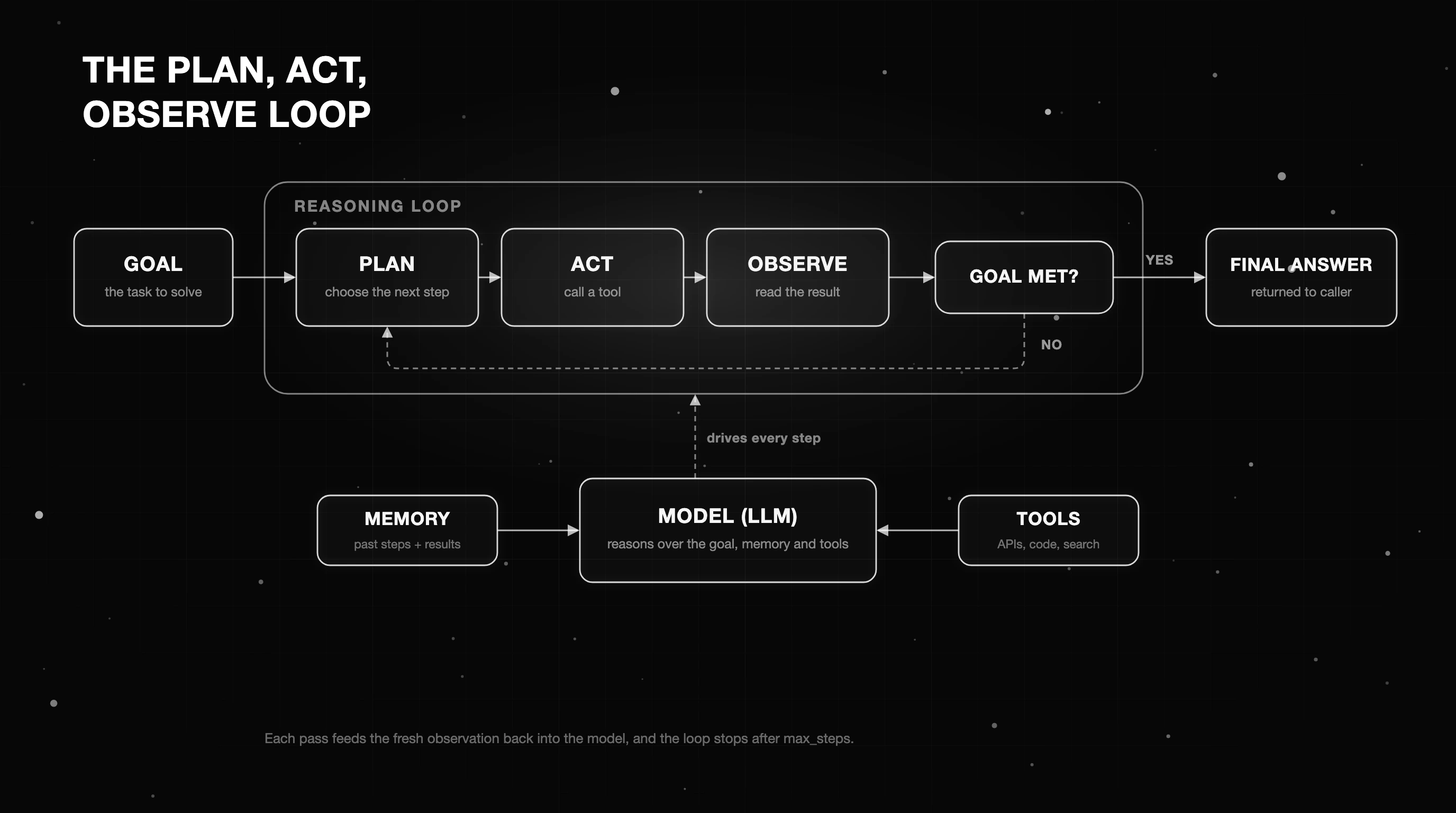
At the core of every autonomous agent is one control cycle: plan a step, act by calling a tool, then observe the result and decide what to do next. The ReAct pattern (Yao et al., 2022) formalized this by interleaving reasoning traces with actions, and it remains the backbone of the agent loop that most frameworks use today.
Each pass feeds the fresh observation back into the model, so the agent adapts to what actually happened instead of running blind against a plan it made at the start.
Levels of autonomy
Autonomy is a spectrum, not a switch. Assisted agents suggest actions that a human approves before anything happens. Supervised agents act on their own but check in at defined points or when confidence drops. Fully autonomous agents run the entire loop unattended.
In production most teams deliberately stop at supervised, because full autonomy compounds small errors across many steps and the cost of one silent mistake in front of a customer is high.
From AutoGPT and BabyAGI to Today
The idea went viral in 2023 through two projects. AutoGPT chained GPT-4 calls into a self-prompting loop that set its own subgoals, and it became one of the most-starred repositories on GitHub, now past 187,000 stars.
BabyAGI, from Yohei Nakajima, showed the same idea in about 140 lines: a task-creation and prioritization loop driving a vector memory. Both proved that anyone could build an agent that set and pursued its own subtasks.
They also showed where the idea stalled. Left unattended, the agents drifted off task, looped on the same subgoal, burned tokens with little to show, and had no notion of whether their output was correct.
The original BabyAGI was preserved as an archived snapshot in September 2024, and the effort moved on to an experimental function framework rather than the runaway loop. The lesson was not that autonomous agents failed. It was that reliability, not raw capability, was the missing piece.
A parallel research thread pushed in a different direction. Camel explored role-playing agents that cooperate through structured dialogue. The Generative Agents paper (arXiv 2304.03442) placed 25 agents in a sandbox town and watched believable social behavior emerge, which is the direct root of modern agent simulations.
Voyager, built on Mineflayer in Minecraft, showed an agent that learns and stores reusable skills over a long horizon. Put together, the practical wave and the research wave set up the two ideas this post is about.
| 2023 expectation | 2026 reality | What changed the thinking |
|---|---|---|
| Autonomy: set a goal and walk away | Supervised loops with human checkpoints | Compounding errors made unattended runs too risky |
| Reliability: assumed to improve with the model | Measured explicitly with metrics and deploy gates | Better base models did not fix task-level failures |
| Simulations: a research toy | A shipping gate you run before deploy | Teams needed to catch failures before users did |
| Evaluation: an afterthought | A pre-deploy requirement | ”It ran” stopped being the same as “it worked” |
What Agent Simulations Actually Are
An agent simulation is a controlled rehearsal. You define a set of scenarios and personas, run the agent through each one, and score how it behaves, all before it touches a real user.
It is the difference between a flight simulator and a live cockpit: the whole point is to fail safely and on purpose, so the real run does not.
This is distinct from two things it often gets confused with. Live monitoring watches an agent that is already serving traffic. Evaluation scores behavior against a defined criterion and may assess one response, a complete conversation, a tool-use trajectory, or an entire agent run. A simulation supplies the controlled scenarios in which those evaluations run before launch, so a change you make today can be replayed against the same situations tomorrow.
That repeatability is what turns “it seemed fine” into a number you can gate on, and it connects to the broader work of training autonomous agents on realistic tasks.
At the research frontier, simulations now run at population scale. Large social simulations such as Project Sid and AgentSociety place many agents together to study how behavior emerges across a crowd.
That work is fascinating, but it answers a different question than a shipping team asks. Scale simulations reveal how a population behaves; a pre-ship simulation asks whether your one agent completes its task reliably.
Simulation vs evaluation vs monitoring
Each answers a different question in one line. Simulation asks how the agent behaves across many realistic scenarios before launch. Evaluation asks whether a specific output is correct against a rule or reference. Monitoring asks what the agent is doing right now in production.
You want all three, because they cover different stages of the same lifecycle rather than competing with each other.
Autonomous Agents vs Agent Simulations
These two terms get used together so often that they blur, but they play opposite roles. The autonomous agent is the system under test: the thing that plans, acts, and produces output.
The agent simulation is the harness that stresses it: the controlled environment that feeds the agent scenarios and records what happens. One is the engine, the other is the test track.
A concrete example makes it click. Say your agent books travel. The autonomous agent is the booking loop that reads a request, searches flights, and calls the reservation tool.
The simulation is the set of fifty trip requests, including the awkward ones, that you replay every time you change a prompt, so a fix for one route does not quietly break another.
| Dimension | Autonomous agent | Agent simulation |
|---|---|---|
| What it is | The system that plans, acts, and uses tools | The harness that runs the agent across scenarios |
| Goal | Complete a real task | Expose how the agent behaves before production |
| Runs against | Live inputs and real tools | Scripted scenarios, personas, and fixtures |
| Primary output | The task result | A scored report of pass, fail, and behavior |
| When you use it | In production, serving users | Before deploy, and on every change after |
| Failure it exposes | Whatever happens in the moment | Regressions and edge cases, safely and repeatably |
Read the table one way and the relationship is obvious: you cannot trust the agent until the simulation has tried to break it. The simulation is how you earn the confidence to let the agent run on its own.
Why Autonomous Agents Fail in Production
The gap between a demo and production is where autonomous agents encounter reliability requirements that demonstrations rarely exercise. Reported adoption rates vary with how surveys define an “agent” and “production,” so a broad industry percentage is less useful than measuring the agent on the organization’s own workflows. This is the passes evals but fails in production problem in its clearest form.
The failures cluster into a few patterns. Compounding step errors are the quiet killer: a step that succeeds 95% of the time is only about 60% reliable over ten steps (0.95 raised to the tenth power), and agents take many steps.
Tool misuse means calling the right tool with the wrong arguments, or the wrong tool entirely. Context loss means an important detail falls out of the window mid-task. The most dangerous pattern is silent wrong answers, where the agent returns something confident and plausible that is simply incorrect.
Measuring this is its own discipline. Reliability metrics like task completion rate, step efficiency, and recovery from error tell you where an agent breaks and how badly.
Benchmarks give you a shared yardstick: AgentBench for multi-environment tasks, GAIA for real-world assistant questions, WebArena for web navigation, and tau-bench for tool-agent interaction in customer-facing settings. None of them replace testing on your own workflows, but they anchor the conversation.
The throughline is that these failures are systemic, not random. They come from the harness, the context you feed the agent, and the long sequence of decisions, not from a weak base model you can swap out.
That is why a bigger model rarely repairs a broken agent, and why you have to test the whole system rather than just the prompt. The practical answer is to move the discovery of these failures earlier, into a simulation you control, instead of finding them live in front of a user.
How to Simulate an Autonomous Agent Before You Ship
The good news is that a useful simulation harness is not complicated. You need two pieces: an agent that runs the plan-act-observe loop, and a harness that runs that agent across a set of scenarios and scores each one. Start with the agent.
# Code 1 - minimal autonomous agent: the plan-act-observe loop
import json
from openai import OpenAI

client = OpenAI()

def run_agent(goal: str, tools: dict, tool_specs: list, max_steps: int = 6) -> str:
    history = [
        {"role": "system", "content": "You are an autonomous agent. Plan, call a tool, observe the result, repeat until done."},
        {"role": "user", "content": goal},
    ]
    for _ in range(max_steps):
        resp = client.chat.completions.create(model="gpt-4o", messages=history, tools=tool_specs)
        msg = resp.choices[0].message
        history.append(msg)
        if not msg.tool_calls:
            return msg.content  # the agent decided it is finished
        for call in msg.tool_calls:
            fn = tools.get(call.function.name)
            if fn is None:
                raise NotImplementedError(f"wire this tool before running: {call.function.name}")
            arguments = json.loads(call.function.arguments)
            result = fn(arguments)
            history.append({"role": "tool", "tool_call_id": call.id, "content": str(result)})
    return "max_steps reached without a final answer"
This is the loop in its simplest honest form. The agent plans by calling the model, acts by invoking a tool, appends the observation to its history, and repeats until it either returns a final answer or hits the step ceiling.
The NotImplementedError is deliberate: it forces you to wire real tools before the loop can run, rather than failing silently on a missing function. Swap gpt-4o for whatever model you use.
Now wrap that agent in a harness. The harness takes any callable that maps a goal to an output, so you plug in the four-argument run_agent with a one-line closure: agent = lambda goal: run_agent(goal, tools, tool_specs).
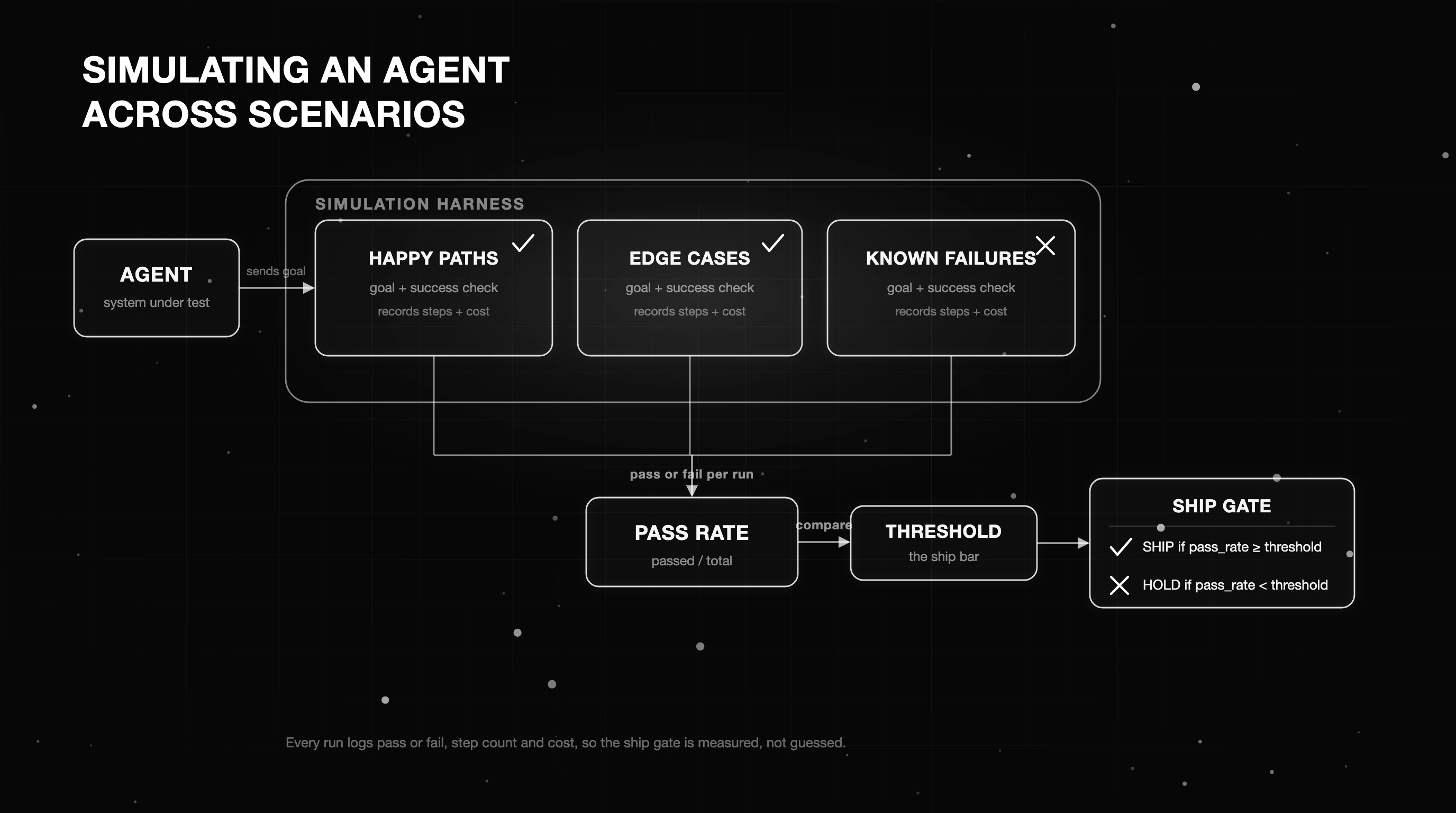
A scenario is a goal plus a success check. The harness runs each one and records whether the agent passed.
# Code 2 - agent simulation harness: score task completion across scenarios
def simulate(agent, scenarios: list[dict]) -> dict:
    if not scenarios:
        return {"pass_rate": None, "n": 0, "runs": []}
    runs = []
    for s in scenarios:
        output = agent(s["goal"])
        runs.append({
            "id": s["id"],
            "completed": bool(s["success_check"](output)),  # scenario-specific pass/fail
        })
    pass_rate = sum(r["completed"] for r in runs) / len(runs)
    return {"pass_rate": pass_rate, "n": len(runs), "runs": runs}

def _demo():
    fake_agent = lambda goal: "booked"
    scenarios = [{"id": "happy_path", "goal": "book a flight", "success_check": lambda o: o == "booked"}]
    report = simulate(fake_agent, scenarios)
    assert report["pass_rate"] == 1.0 and report["n"] == 1

if __name__ == "__main__":
    _demo()
Run this on every change and the number it returns, pass_rate, becomes your shipping gate. The _demo function is a self-check: it asserts the harness scores a trivial passing scenario correctly, so you know the plumbing works before you trust it on a real agent.
In practice you would expand scenarios to cover happy paths, edge cases, and the failures you have already seen in production, and you would record step count and cost alongside pass or fail.
The moment you can express “ship only if pass_rate stays above our threshold,” simulation stops being a research exercise and becomes part of your deploy pipeline.
How to Compare Agent Simulation Tools
Agent-simulation products differ in scenario generation, multi-turn support, voice support, evaluation, and deployment options. Because these capabilities and licensing terms change frequently, verify each vendor’s current documentation before selecting a platform.
The practical comparison should focus on whether a tool can replay your own scenarios, score complete trajectories, exercise the modalities your agent uses, expose failed runs for diagnosis, and run in your required deployment environment. A feature label matters less than whether the tool can reproduce your real workflow and turn its failures into repeatable tests.
Where Future AGI Fits for Autonomous Agents and Simulations
The harness above is the right shape, and it is also what Future AGI’s Simulation product gives you without building the plumbing yourself. You define a set of scenarios and personas, rehearse it in simulation across multi-turn conversations in text or voice.
You score each run with custom evals that encode your own pass or fail rule instead of a generic metric. Because the scenarios stay fixed, you replay them on every prompt or model change and catch regressions before they reach a user.
The workflow mirrors the two questions this post opened with. Simulation answers whether the agent completes its task across the situations you care about, and custom evals turn each run into a score you can gate a deploy on.
One honest caveat: a simulation stresses the scenarios you thought of, so pair it with production observability to catch the ones you did not. Future AGI is open-source under Apache-2.0 at its core, so you can self-host the stack and start with the scenarios you already have.
Putting Autonomous Agents Into Production Safely
The 2023 dream of “give it a goal and walk away” arrived years before the engineering that would make it safe.
What changed by 2026 is that teams stopped waiting for the next model to hand them reliability and started treating it as something you build. Autonomous agents get their capability from better models; they get their trustworthiness from the loop around them.
That loop is simulate, then evaluate, then observe. Rehearse the agent against the scenarios that matter, score each run against a rule you define, gate the deploy on that score, and watch what happens once real traffic arrives.
The path from an impressive demo to a shippable agent is that discipline, not a larger model. Pick one workflow your agent already handles, write five scenarios for it, and score a run today. That first pass rate is the honest starting line for everything that comes after.
Frequently Asked Questions
What is an autonomous agent?
What is the difference between autonomous agents and agent simulations?
Is AutoGPT still used in 2026?
How do you test an autonomous agent?
Why do autonomous agents fail in production?
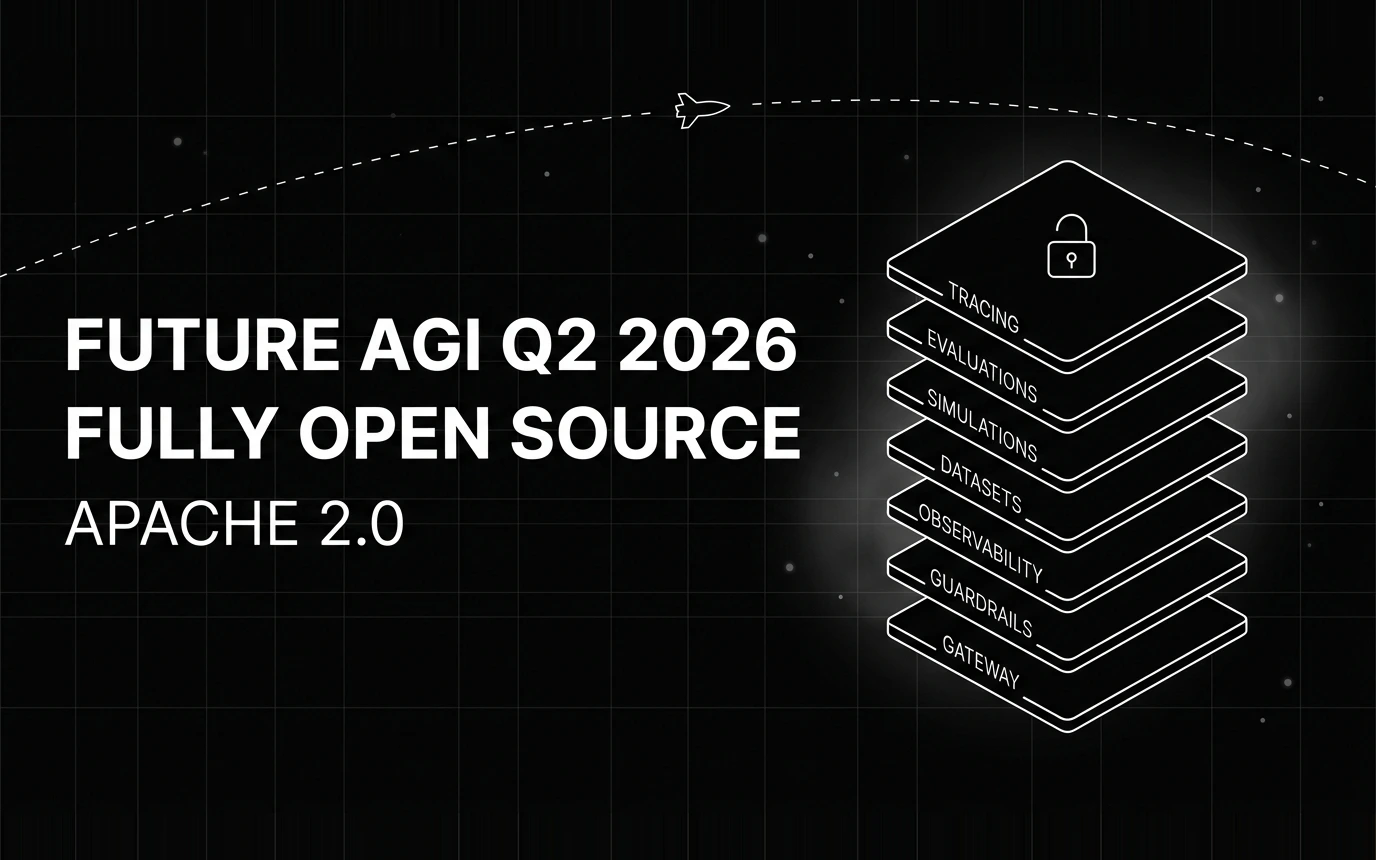
Inside Future AGI open source in Q2 2026: the platform shipped under Apache 2.0, Error Feed and the Agent Command Center went live, traces hit billions.

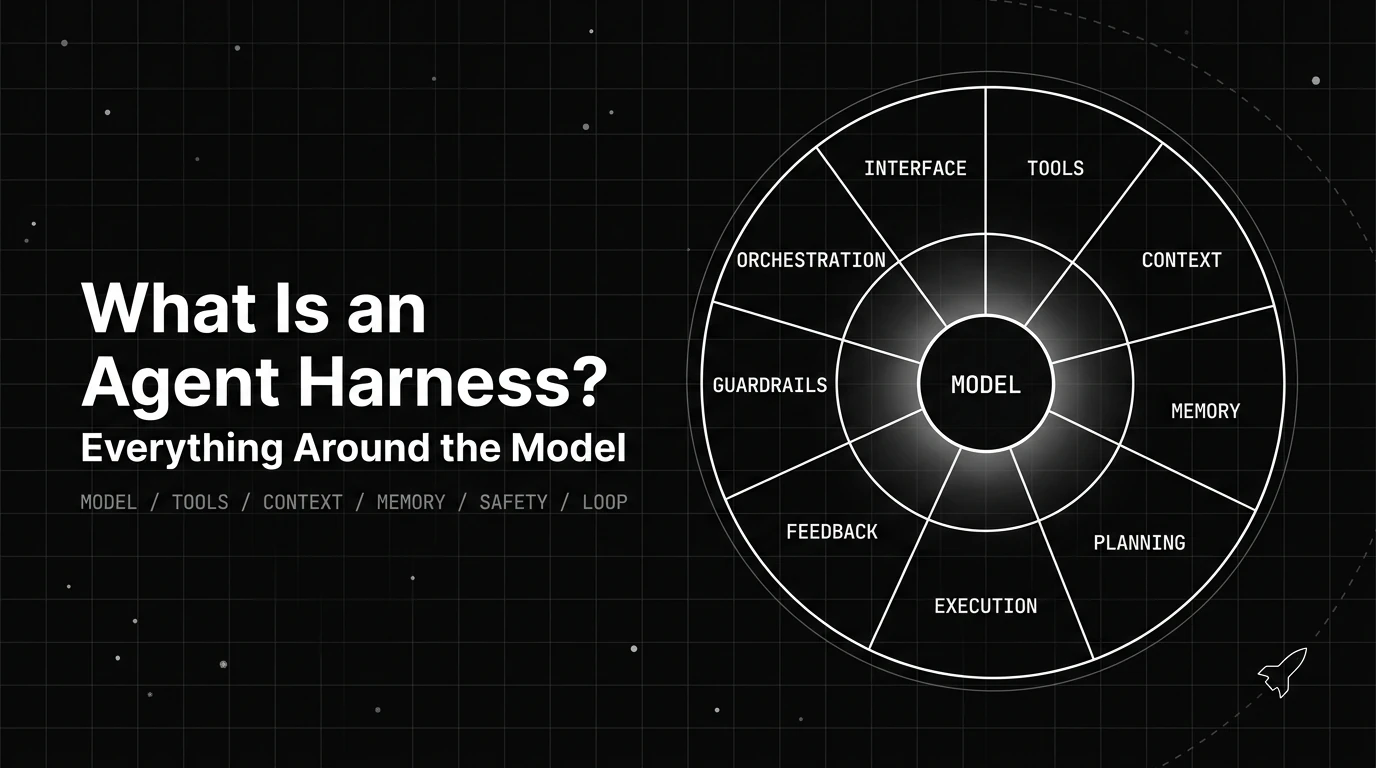
An agent harness is the runtime layer around an LLM that manages tools, context, state, execution, and safety. Learn how it shapes reliability.

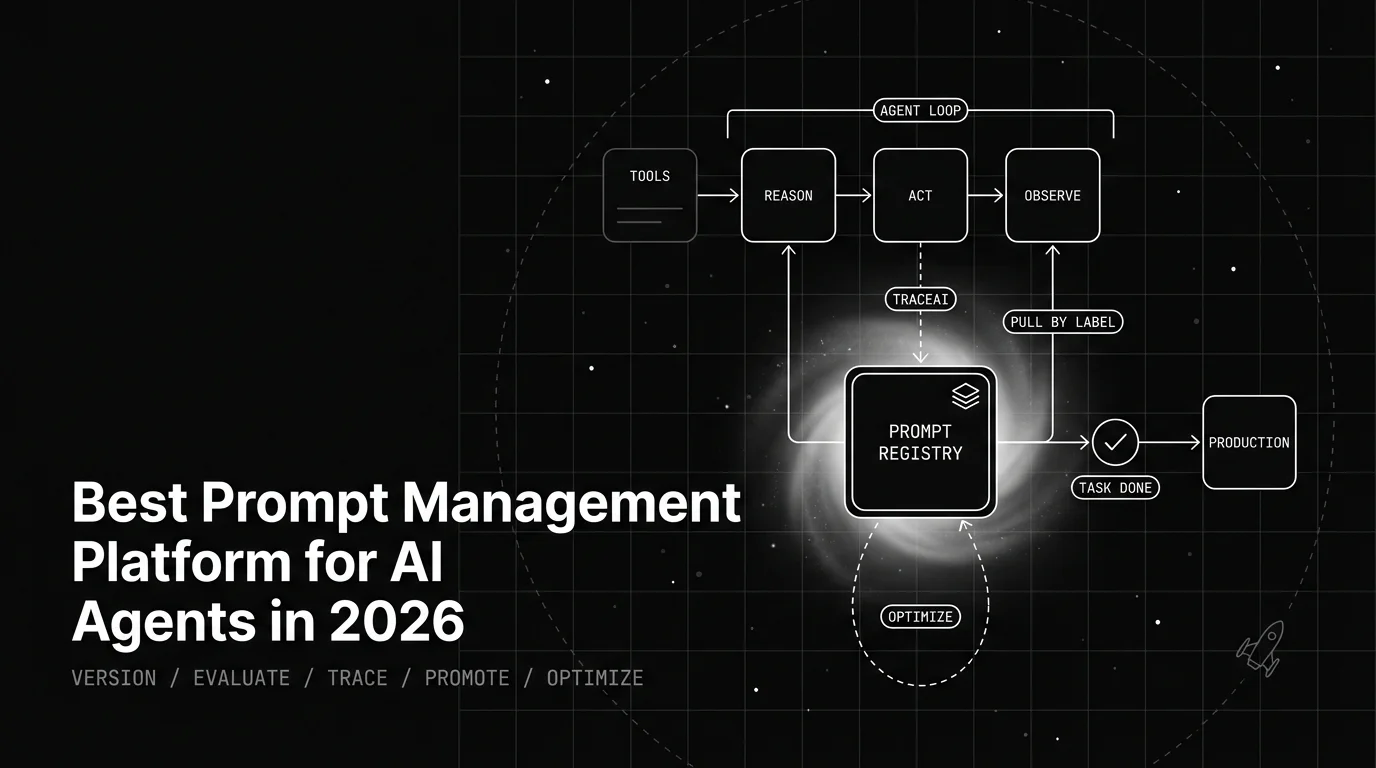
Version each agent prompt, gate promotion on task-completion and tool-call evaluators, then trace every run back to its version. Future AGI is Apache-2.0.