AI Prompting for LLMs in 2026: Techniques, Examples, and Measurement
AI prompting techniques for 2026: zero-shot, few-shot, chain-of-thought, role, system, and how to measure prompt quality on gpt-5 and claude-opus-4-7.
Table of Contents
AI Prompting for LLMs in 2026: Techniques, Examples, and Measurement
The frontier models in 2026 (gpt-5-2025-08-07, claude-opus-4-7, gemini-3, Llama 4) absorb a lot of vague intent without complaint, which is why most “prompt engineering” advice from 2023 is now obsolete. The actual lever in 2026 is structured prompts plus measurement: you write a prompt that captures the task precisely, then you score it on a dataset before you trust it in production. This guide walks through the techniques that still work, the techniques that became table stakes, and how to measure the difference.
TL;DR: AI Prompting in 2026
| Question | 2026 answer |
|---|---|
| Single prompt or prompt + system + tools? | Always system + user prompt; add tools and retrieval when needed |
| Zero-shot or few-shot? | Zero-shot on frontier models for general tasks; few-shot when the model has not seen a domain pattern |
| Chain-of-thought? | Mostly built in for reasoning models; explicit CoT still helps for non-reasoning models or when you want to inspect the trace |
| How to know it works? | Score on a golden dataset of 100 to 500 examples with an evaluator suite |
| Prompt injection defence? | Treat user input as data, scan outputs, restrict tool permissions |
| Cross-provider portability? | Partial; re-test on each model before locking in |
What “Prompt” Actually Means in 2026
The 2023 mental model of “the prompt is the text you type into ChatGPT” no longer matches production usage. In 2026, a prompt for an LLM call usually has six layers:
- System prompt. Defines persona, tone, response style, and hard constraints (do not promise refunds; always cite sources).
- Tool definitions. Schemas for any functions the model may call.
- Retrieved context. Passages from a vector store or web fetch, scoped to the user query.
- Conversation history. Earlier turns when the call is part of a chat.
- User message. What the user actually asked.
- Output format. A JSON schema or response-format directive when you need structured output.
A “prompt” without any structure around it is rarely what you want in production. Designing the prompt means designing all six layers together.
Core Prompting Techniques Worth Knowing
Zero-Shot Prompting
Give the model a task with no examples. Works well on frontier models for tasks the model has seen during training.
Example: “Summarise the following meeting transcript in five bullet points.” Frontier models handle this cleanly because summarisation is heavily represented in their training data.
Few-Shot Prompting
Give the model a handful of input-output examples before the actual task. Useful when the model has not seen your domain pattern.
Example: classifying support tickets into custom categories where the labels are internal. Three to five examples is the usual sweet spot; more than that and you mostly waste tokens.
Chain-of-Thought (CoT) Prompting
Ask the model to reason step by step before answering. With non-reasoning models, prepending “Let’s reason step by step” or “Think step by step before answering” often improves accuracy on multi-step problems.
With reasoning-class models like gpt-5-2025-08-07 reasoning effort, the chain happens automatically and is exposed via the API as a separate reasoning trace; you usually do not need to ask for it explicitly.
Role and System Prompts
Setting a role in the system prompt anchors tone and persona. Anthropic’s prompt-engineering guidance is especially clear that role + clear instruction structure beats clever wording. Example system prompt:
You are a senior customer-support agent for an e-commerce store.
Always answer in fewer than 80 words. Never promise refunds.
Cite the product page URL when you reference a product.
Retrieval-Augmented Prompting
For knowledge-grounded tasks, the prompt includes retrieved passages from a vector store, the core of retrieval-augmented generation. Two patterns dominate in 2026:
- Inline RAG: passages embedded directly into the user message with explicit tags (e.g.
<context>...</context>). - Tool-call RAG: the model decides when to call a retrieval tool, and the result comes back as a tool response.
Both work; inline is simpler, tool-call is more flexible for multi-step agents.
Tool-Use Prompting
For agents, the most impactful “prompt engineering” is the tool schema. Models call the tools you describe; vague descriptions produce vague usage. A good tool definition includes:
- A one-sentence purpose statement.
- The exact parameter types.
- When to use it and when not to.
- Examples of correct usage if the model needs them.
Structured Output Prompting
gpt-5, claude-opus-4-7, and gemini-3 all support response-format directives or JSON schema enforcement. Use them. A schema-pinned response saves you from regex-parsing model output and removes a class of production bugs.
Prompt Formats That Still Pull Their Weight
Instruction-Based
Direct command form: “Write a 200-word announcement for …” Works for content tasks where the structure is clear.
Q&A
“Q: … A:” framing pushes the model toward concise factual answers. Combine with retrieved context for grounded answers.
Conditional
“If the user asks about pricing, … If the user asks about features, …” Useful inside system prompts to handle multiple intents without dispatching to different prompts.
List Format
“Return the answer as a numbered list of at most five items.” Works hand-in-hand with response-format JSON schemas for structured outputs.
Best Practices That Survived to 2026
Be Specific About the Output
Vague prompts produce vague outputs. “Explain blockchain” is less useful than “Explain how proof-of-stake validators earn fees on Ethereum in 150 words for a developer audience.”
Use Examples for Domain Patterns
Few-shot examples are still the cheapest fix for tasks where the model misunderstands the domain pattern. Pick examples that cover the edges of your task, not just the middle.
Constrain the Output Shape
Length limits, JSON schemas, and forbidden phrases all reduce variance. Production prompts usually look more like contract specifications than open requests.
Iterate Against a Dataset, Not Against One Example
A prompt that scores well on one example is anecdote. A prompt that scores well across 100 to 500 examples on a measurable evaluator is a candidate for production. The difference is the whole game.
Treat Untrusted Input as Data
Anything that comes from a user, a web page, or a tool output is data, not instruction. Never concatenate it directly into the system prompt; scan it before it reaches the model when injection is a serious risk. Our prompt injection defense field guide covers the attack surface in depth.
Pin Versions
Every prompt that goes to production should have a version identifier, a model pin, and a temperature setting. When something breaks, you want to know which prompt ran.
Measuring a Prompt: From Anecdote to Evaluator
The actual 2026 workflow looks like this:
- Define the task. A golden dataset of 100 to 500 input examples with expected outputs or grading rubrics.
- Pick evaluators. Groundedness, context adherence, toxicity, plus task-specific LLM-as-judge templates.
- Run candidate prompts. Each candidate against the dataset on the chosen model.
- Score and compare. Average score, worst-decile score, and a per-example diff to spot regressions.
- Promote the best variant. Pin its version, log it in traces, monitor on production traffic.
With Future AGI, that loop is one SDK call away:
from fi.evals import evaluate

result = evaluate(
    "context_adherence",
    output=model_response,
    context=retrieved_chunks,
    model="turing_flash",
)
print(result.score, result.reason)
For custom rubrics, the same package exposes CustomLLMJudge:
from fi.evals.metrics import CustomLLMJudge
from fi.evals.llm import LiteLLMProvider

judge = CustomLLMJudge(
    name="brand_voice",
    rule="The response must use the second person and avoid filler phrases.",
    provider=LiteLLMProvider(model="gpt-5-2025-08-07"),
)
score = judge.run(output=model_response)
Typical cloud-eval latencies, per the Future AGI cloud-evals docs, are roughly 1 to 2 seconds for turing_flash, 2 to 3 seconds for turing_small, and 3 to 5 seconds for turing_large.
Prompt Tuning vs Prompt Engineering vs Fine-Tuning
These three get confused a lot:
- Prompt engineering is human-written text that ships in the system or user prompt.
- Prompt tuning is learning a small set of soft-prompt embeddings (continuous vectors) prepended to the input. Useful when you control the model weights and need a parameter-efficient adapter; less relevant for closed-source frontier APIs.
- Fine-tuning updates model weights on a domain dataset. Worth it for style, latency-critical small models, and regulated hosting; rarely worth it for knowledge-grounded tasks where retrieval plus a frontier model wins.
For most 2026 production teams using frontier APIs, the work happens in prompt engineering, optionally automated by prompt-optimisation tools.
Worked Examples
Customer Support Reply
System:
You are a senior CS agent. Cite the help-centre URL once.
If the user reports a charge issue, do not promise refunds; route to billing.
User:
I was charged twice for order #4187.
Retrieved context:
<chunk url="/help/duplicate-charges">If a duplicate charge appears, ...</chunk>
A groundedness evaluator on the response will catch the case where the model invents a refund policy. A custom “policy compliance” judge will catch the case where the agent promises money back.
Code Generation
System:
Output runnable Python 3.12. No prose.
User:
Write a function that returns True if n is prime, without recursion, in O(sqrt n).
Pair this with a sandboxed unit-test runner. A “compiles and passes tests” evaluator is cheap to run on every candidate prompt before merging.
Multilingual Translation
System:
Translate the user input into French, formal register.
Preserve any HTML tags. Do not translate proper nouns inside <noun>...</noun>.
Score with a backtranslation evaluator plus a length-ratio check; both catch common failure modes.
Multi-Turn Tool Use
System:
You can call search_docs(query: str) and create_ticket(summary: str).
For factual questions, call search_docs first. Only call create_ticket
when the user explicitly asks.
The evaluator here is tool-call correctness: did the model call the right tool, with the right arguments, in the right order? Pair with multi-turn simulation via fi.simulate.TestRunner.
Common Failure Modes Worth Watching
- The “looks great on one example” trap. A prompt that works on the example you tried is anecdote. Run it on 100.
- Hidden prompt drift. Someone edits the system prompt in a config without bumping the version; traces stop matching. Pin and version everything.
- Tool description rot. Tools are added, deprecated, renamed, but the prompt still describes the old ones. Audit the tool catalog when you audit the prompt.
- Retrieved context overload. Stuffing 20 chunks into a long-context model often scores worse than 5 well-ranked ones. Measure retrieval precision, not just recall.
- Cross-model copy-paste. A prompt tuned for one model rarely scores the same on another. Always re-test before swapping providers.
How Future AGI Helps You Get Prompts Right
Future AGI is the evaluation and optimisation layer of a prompting workflow:
fi.evals: groundedness, faithfulness, context adherence, toxicity, summary quality, agent-task evaluators, plusCustomLLMJudgefor task-specific rubrics.- Prompt optimisation: automated runs that mutate candidate prompts and rank them by score on your dataset.
- traceAI (Apache 2.0): OpenTelemetry-compatible spans that capture which prompt version and model pin produced each response in production.
fi.simulate: multi-turn scenario testing for agent prompts before changes ship.- Agent Command Center at
/platform/monitor/command-center: BYOK gateway for routing across providers with the same eval and guardrail policies attached.
Set FI_API_KEY and FI_SECRET_KEY to authenticate the SDK and start scoring prompts against your dataset.
Closing Notes
The biggest mental shift for prompt design in 2026 is treating the prompt the same way you would treat any other piece of production code: version it, test it on a dataset, monitor it in production, and roll it back when it regresses. The cleverest single-line prompt is worth less than a mediocre prompt with a tight measurement loop around it.
References and Further Reading
Frequently Asked Questions
What is AI prompting in 2026?
Which prompting techniques are most useful for production LLMs in 2026?
How do I measure whether a prompt is actually good in 2026?
Are prompts portable across gpt-5, claude-opus-4-7, and gemini-3?
What is the difference between prompt engineering and prompt optimisation?
How do I avoid prompt injection in production?
What role does temperature and decoding play in prompt design?
Where does Future AGI fit in the prompting workflow?

Nine LLM prompt format patterns for GPT-5, Claude Opus 4.7, and Gemini 3 in 2026. Copy-ready templates, an eval loop, and mistakes to avoid in production.

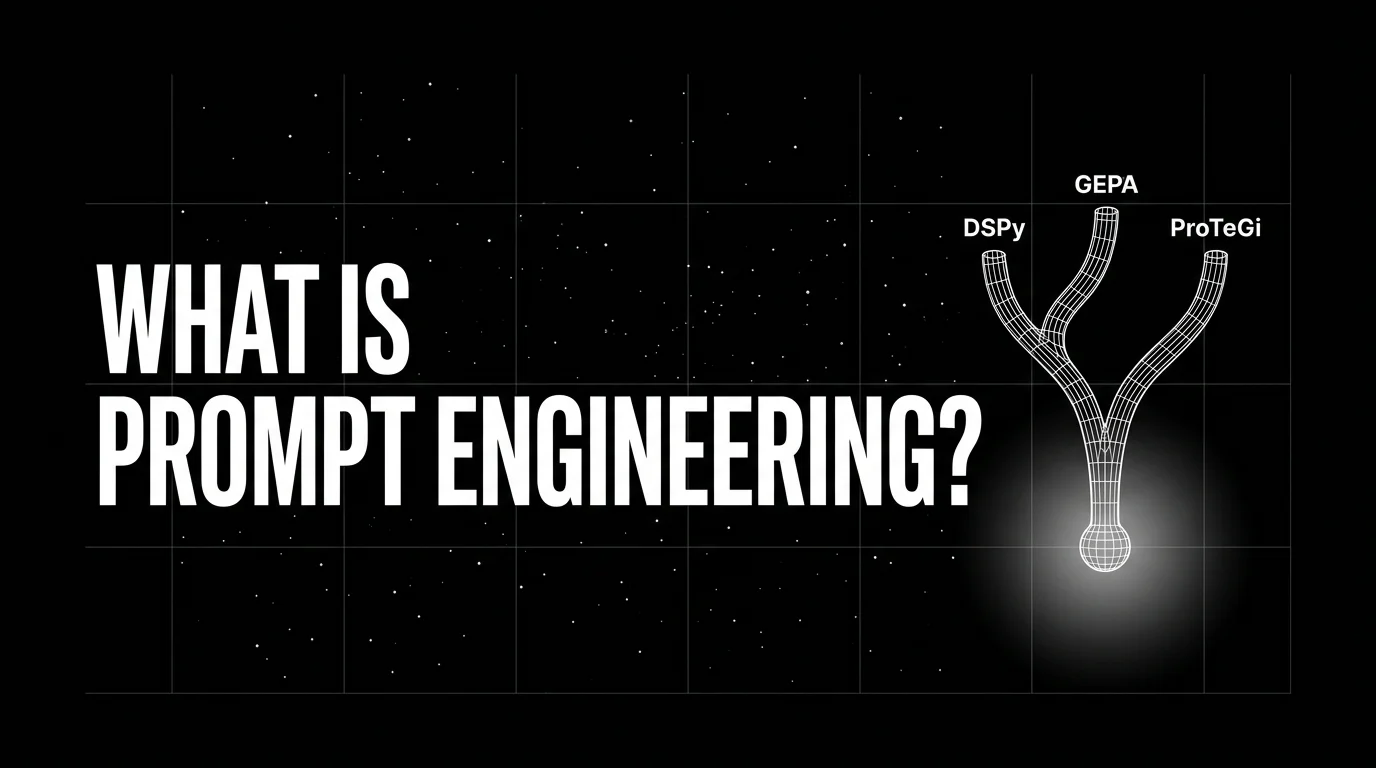
What prompt engineering means in 2026 after Bayesian, GEPA, and ProTeGi optimizers. Anatomy, techniques, tools, and where hand-tuning still earns its keep.

Chain of thought prompting in 2026: how CoT works in GPT-5, Claude 4.7 extended thinking, and DeepSeek R1, when to skip it, and how to evaluate reasoning.
