AI Chatbot Build Guide 2026: From Model Selection to Production Guardrails
End-to-end 2026 guide for building production AI chatbots: model picks, RAG, hallucination evals, traceAI observability, and runtime guardrails.
Table of Contents
TL;DR: The 6-layer 2026 chatbot stack
| Layer | What it does | Open source pick | Closed source pick |
|---|---|---|---|
| Intent router | Classifies and routes | Custom classifier or cheap LLM | Vendor router |
| LLM tier | Generates the response | Llama 4, Mistral Large | GPT-5, Claude Opus 4.7 |
| Retrieval | Grounds the response | pgvector, Weaviate | Pinecone, Vertex AI |
| Evaluator | Scores quality | Future AGI ai-evaluation, deepeval | Future AGI managed, Braintrust |
| Observability | Captures traces | Future AGI traceAI, Phoenix | LangSmith, Future AGI managed |
| Runtime guardrails | Enforces policy | NeMo Guardrails, Guardrails AI | Future AGI Agent Command Center |
The pattern most production teams settle on is open source in CI and on-prem, with a managed surface in production for audit storage and on-call routing.
Step 1: Pick the right model, route by intent
The most expensive mistake in 2026 chatbot work is shipping a single frontier model on every request. The fix is intent routing.
Build a small intent classifier (or use a cheap LLM with structured output) that routes each request to one of three tiers.
Tier A (strong default): GPT-5 (gpt-5-2025-08-07) or Claude Opus 4.7 for high-stakes accuracy, reasoning, agent tool-use, and any regulated surface. Gemini 2.5 Pro is a strong alternative for long-context workloads.
Tier B (cost-efficient): GPT-4.1-mini, Claude Sonnet 4, or Gemini 2.5 Flash for high-volume, low-stakes traffic such as FAQ lookup, formatting, and simple summarization.
Tier C (self-hosted): Llama 4 or Mistral Large for sovereignty-sensitive or fully air-gapped deployments.
Empirically, a well-tuned router can move 60 to 80 percent of traffic to Tier B without measurable quality loss on the eval set. The judge of “without measurable loss” is the offline evaluation suite from Step 4.
Step 2: Build the retrieval layer for grounded answers
RAG is still the default in 2026 for any chatbot that has to answer from a knowledge base, but the configuration has matured.
The current best-practice retrieval pipeline looks like this: ingest with stable chunking (semantic or recursive, not naive fixed-size); embed with a current open or closed embedding model; store in a vector database with hybrid keyword filters; retrieve top K candidates; rerank with a dedicated reranker; pass the top N to the LLM with the citation metadata intact.
The two pieces teams often skip and then regret are the reranker (the precision improvement is consistently several points across published RAG benchmarks) and the citation metadata threading (without it, faithfulness evaluation cannot tell you which chunk failed).
For knowledge bases under a few hundred pages of relevant context, consider the long-context alternative: skip retrieval, send the whole corpus as context. The decision is cost: token cost per request versus latency versus the engineering and maintenance cost of running a retrieval pipeline. For high-volume traffic, retrieval still wins. For low-volume but high-precision surfaces such as legal or compliance lookups, long-context can be competitive.
Step 3: Wire the chatbot for tracing
Observability is not optional in a 2026 production chatbot. The cost of debugging a regression without traces is 10x to 100x the cost of debugging the same regression with traces.
Future AGI’s traceAI library is Apache 2.0 and ships framework-specific instrumentors. The traceai-langchain package exposes LangChainInstrumentor. The traceai-openai-agents, traceai-llama-index, and traceai-mcp packages cover the other common frameworks. Every model call, every tool call, every retrieval, and every evaluator becomes a span.
from fi_instrumentation import register, FITracer
from traceai_langchain import LangChainInstrumentor

tracer_provider = register(project_name="prod-chatbot")
LangChainInstrumentor().instrument(tracer_provider=tracer_provider)

tracer = FITracer(tracer_provider.get_tracer(__name__))

@tracer.chain
def answer(question: str, retrieved: list[str]) -> str:
    return llm.invoke({"question": question, "context": retrieved})
The two environment variables required are FI_API_KEY and FI_SECRET_KEY, both from the same Future AGI project at docs.futureagi.com.
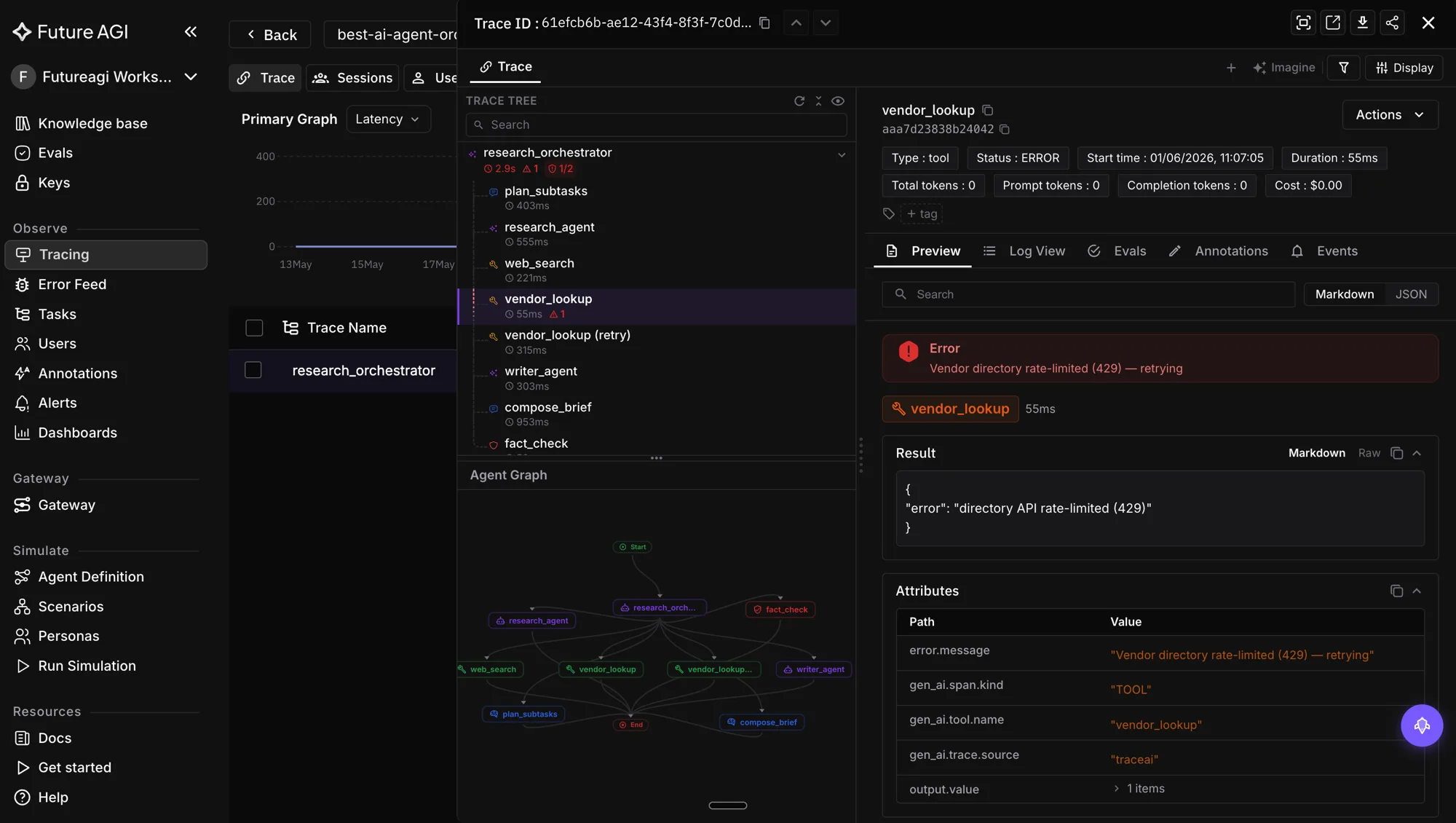
For teams that prefer a fully open-source stack, the same trace data can ship to any OTLP-compatible backend. Arize Phoenix is a popular open source choice.
Step 4: Build the evaluation suite
The eval suite is what protects the chatbot from regressions. Build it in three layers.
The first layer is a 200 to 500 item dataset drawn from real user logs. Cover three categories: top intents (the 20 percent of queries that drive 80 percent of traffic), hard intents (long-tail, ambiguous, or multi-turn), and adversarial inputs (jailbreaks, PII probing, off-topic). Real logs beat synthetic data for production fit.
The second layer is the evaluators. The four that matter for every chatbot are faithfulness or groundedness (does the response match the retrieved context), intent satisfaction (does the response answer what the user asked), safety (PII, toxicity, jailbreak), and tone (does the response match the brand voice). Future AGI’s ai-evaluation library is Apache 2.0 and provides all four under a unified API.
from fi.evals import evaluate, Evaluator
from fi.evals.metrics import CustomLLMJudge
from fi.evals.llm import LiteLLMProvider

# Hosted faithfulness evaluator
faithfulness_score = evaluate(
    "faithfulness",
    output=response_text,
    context=retrieved_passages,
)

# Custom rubric: tone check
brand_tone = CustomLLMJudge(
    name="brand_tone",
    rubric=(
        "Score 1 if the response is concise, neutral, and helpful, "
        "without marketing language. Score 0 otherwise."
    ),
    provider=LiteLLMProvider(model="gpt-4o-mini"),
)

tone_evaluator = Evaluator(metrics=[brand_tone])
tone_result = tone_evaluator.evaluate(output=response_text)
The third layer is the regression rule. Score the full dataset on every release candidate. Compare aggregate metrics release over release. Block the release if any of the four core metrics regresses by more than two standard deviations against the rolling baseline.
Hosted evaluators in Future AGI’s managed surface run on turing_flash at roughly 1 to 2 seconds, turing_small at 2 to 3 seconds, and turing_large at 3 to 5 seconds, so the team can trade precision against latency.
Step 5: Add a runtime guardrail layer
Offline evaluation does not protect production traffic. The same evaluator definitions need to run inline on the live request, and the application needs the ability to act on a low score.
Three patterns work in 2026.
The first is a managed gateway that enforces the policy inline. The Future AGI Agent Command Center accepts traffic through a BYOK pattern, runs the evaluator suite as guardrails, and writes audit-grade events. Policies are versioned so a change to the faithfulness threshold is a diffable artifact.
The second is open source guardrail libraries. NVIDIA NeMo Guardrails and Guardrails AI are the two most common open source choices. They handle input and output policy enforcement with rule-based and LLM-based checks.
The third is a hybrid where the inline checks are fast, deterministic rules (PII regex, allow-list intents, prompt injection patterns) and the slower probabilistic checks (faithfulness, tone) run async on every Nth request and feed dashboards.
For most production chatbots the right answer is a mix: fast deterministic rules inline for high-traffic safety policies, probabilistic checks inline for the small subset of regulated requests, and probabilistic checks async for the rest with drift alerts feeding the on-call rotation.
Step 6: Close the loop with continuous improvement
A chatbot in production is a continuous-improvement system, not a launched artifact.
The loop has four steps. First, capture every conversation as a trace with evaluator scores attached. Second, sample low-scoring conversations weekly and label root causes (retrieval miss, prompt issue, model hallucination, user adversarial). Third, expand the eval dataset with the new failure modes so the next release catches them in CI. Fourth, adjust the prompt, the retrieval, the router, or the model based on the root-cause distribution.
The teams that do this loop weekly improve their chatbot quality faster than any model change can deliver. The teams that skip the loop see quality degrade silently over months as the input distribution drifts.
Voice and multimodal extensions
Voice chatbots add an audio layer to the stack. The pieces are STT (speech-to-text), text-side processing as above, and TTS (text-to-speech). Each adds its own eval surface: STT accuracy under noise and accent variation, end-to-end latency including barge-in handling, and TTS naturalness.
Future AGI competes on the text-and-eval portion of voice agents. For the STT and TTS layers themselves, the dedicated providers (Deepgram, ElevenLabs, OpenAI Realtime API, and others) are the right primary tools. The role of Future AGI in a voice stack is the same as in a text stack: evaluation, observability, and runtime policy through traceAI plus the Agent Command Center.
Multimodal chatbots that take images, video, or screen captures as input add an additional eval axis: did the model correctly extract the relevant elements of the input. The same faithfulness evaluator pattern applies, with the rubric extended to cover the modality.
Compliance: what regulators ask for in 2026
Three artifacts cover most regulator and auditor questions for a customer-facing chatbot.
The first is a written eval protocol that describes the dataset, the evaluators, the thresholds, and the rerun cadence. The second is a logged history of evaluator scores against that protocol, retained for the period required by the relevant regulation. The third is an incident log that connects any score regression or guardrail trigger to a response action and a resolution.
Future AGI’s managed surface produces those artifacts automatically because every evaluator run and every guardrail event is stored as an audit-ready record. A team running entirely on open source can produce the same artifacts by keeping the rubric in version control and the logs in a retention-managed store.
Cost: the practical numbers in 2026
Three cost lines dominate.
The first is model inference for the chatbot itself. Tier A frontier models on every request scale fast. Tier B for the right intents reduces it by a meaningful share.
The second is evaluator inference. At realistic production volumes, judge model calls can rival the chatbot’s own model calls. The fix is the same as for the chatbot: pick a cheap fast judge for the high-volume runtime guardrails and a stronger judge for the offline evaluation runs.
The third is operations: traces storage, audit retention, and engineering time. Managed surfaces consolidate these. Open source pushes them onto the team.
The actual total varies too much to put a number on, but the discipline is the same: measure per million conversations, not per month.
Putting it together
A production chatbot in 2026 is six layers, four evaluators, and a continuous-improvement loop. The Future AGI stack consolidates the eval, observability, and guardrail layers into a single API surface, and the open source pieces (ai-evaluation and traceAI, both Apache 2.0) let teams self-host as much of it as they want.
If you are starting fresh, build the eval suite first. Everything else (model choice, retrieval, router, guardrails) is calibrated against the eval scores, so the eval suite is the load-bearing piece.
Further reading
For a comparison-shopping view of evaluation tools, see best LLM chatbot evaluation tools 2026. For the model-selection question in more depth, see best LLMs May 2026. For the hallucination detail, see detecting hallucinations in generative AI. For the regulatory-driven guardrail story, see AI compliance guardrails for enterprise LLMs. And for the deeper evaluation framework, see build an LLM evaluation framework.
References
- OpenAI introducing GPT-5
- Anthropic Claude 4.7 announcement
- Google Gemini 2.5 Pro
- Meta Llama 4
- EU AI Act, Regulation (EU) 2024/1689
- NIST AI RMF Generative AI Profile, NIST AI 600-1 (2024)
- Future AGI ai-evaluation, Apache 2.0
- Future AGI traceAI, Apache 2.0
- Future AGI Agent Command Center
- Future AGI Cloud Evals documentation
- NVIDIA NeMo Guardrails
- Guardrails AI
Frequently Asked Questions
What is the best LLM for production chatbots in 2026?
How do I reduce hallucinations in an AI chatbot in 2026?
What does a production chatbot stack actually look like?
How do I evaluate a chatbot before launch?
How do I monitor a chatbot in production?
How do guardrails differ from evaluation?
What changed for chatbots between 2025 and 2026?
Where does Future AGI fit in a 2026 chatbot stack?
DeepEval, FutureAGI, Confident-AI, Galileo, Coval, Langfuse, and Maxim as the 2026 chatbot eval shortlist. Multi-turn, persona, escalation, satisfaction.

Best LLMs May 2026: compare GPT-5.5, Claude Opus 4.7, Gemini 3.1 Pro, and DeepSeek V4 across coding, agents, multimodal, cost, and open weights.

Detect AI hallucinations in production in 2026: ChainPoll, NLI, SelfCheckGPT, RAG faithfulness, FAGI eval, and human review. Code, latency, and trade-offs.
