Future AGI vs LangSmith in 2026: Framework-Agnostic Evaluation vs LangChain-Native Observability
Future AGI vs LangSmith in 2026: framework-agnostic LLM eval vs LangChain-native observability. Feature table, pricing, multimodal, verdict.
Table of Contents
Future AGI vs LangSmith in 2026: Quick Verdict
Future AGI is a framework-agnostic LLM evaluation and observability platform with first-party faithfulness, groundedness, multi-modal, and custom LLM-judge metrics, plus a managed BYOK gateway (Agent Command Center). LangSmith is a LangChain-native observability and tracing platform with deep integration into LangChain and LangGraph and a separate SDK for non-LangChain code. For LangChain-only teams, LangSmith remains the more direct fit. For everyone else (LlamaIndex, CrewAI, AutoGen, raw provider SDKs, custom Python), Future AGI is the broader and lower-cost choice. Both ship in 2026 with active platforms; the decision is about framework center of gravity, not feature completeness.
TL;DR: Future AGI vs LangSmith Side-by-Side
| Dimension | Future AGI | LangSmith |
|---|---|---|
| Primary fit | Framework-agnostic LLM eval + observability | LangChain / LangGraph native observability |
| Evaluation metrics | First-party faithfulness, groundedness, multi-modal, custom LLM judge | LLM-as-a-judge via your own Python code |
| Tracing | traceAI on OpenTelemetry (Apache 2.0) | LangChain-native + general SDK |
| Multi-modal | Text + image + audio + video evaluators out of the box | Trace attachments, custom metric code |
| Gateway | Agent Command Center (BYOK managed) | None |
| Cloud judges | turing_flash ~1-2s, turing_small ~2-3s, turing_large ~3-5s | Bring your own judge model |
| Self-hosting | Cloud + on-prem (enterprise) | Cloud + self-host (enterprise) |
| Pricing | $50/mo for 5 seats, $20/seat after | Free dev tier; paid ~$39/seat + trace overage |
Where Each Platform Wins in 2026
Future AGI: Framework-Agnostic Evaluation Plus Observability
Future AGI ships the LLM evaluation and observability loop for any framework. The surfaces are:
- Evaluation SDK (ai-evaluation, Apache 2.0):
fi.evals.evaluate("faithfulness", output=..., context=...)returns a score and a reason. The same shape covers groundedness, toxicity, PII, prompt-response coherence, and custom LLM judges viafi.evals.metrics.CustomLLMJudgeplusfi.evals.llm.LiteLLMProvider. - Tracing SDK (traceAI, Apache 2.0):
from fi_instrumentation import register, FITracerplus@tracer.agent,@tracer.tool,@tracer.chaindecorators. OpenTelemetry-shaped spans work with any OTel-compatible collector. - Cloud judge tiers (docs): turing_flash for inline production scoring (~1-2 s), turing_small for batched runs (~2-3 s), turing_large for highest-quality offline grading (~3-5 s).
- Agent Command Center (
/platform/monitor/command-center): managed BYOK LLM gateway with caching, guardrails, and cost tracking; speaks the OpenAI chat completions schema. - Local evaluator wrapper:
from fi.opt.base import Evaluatorfor project-local evaluator logic. - Agent simulation:
from fi.simulate import TestRunner, AgentInput, AgentResponse.
Env vars: FI_API_KEY and FI_SECRET_KEY for cloud forwarding. Local tracing and evaluation work without them.
LangSmith: LangChain-Native Observability
LangSmith was built by the LangChain team. Its strongest product flow is the LangChain or LangGraph user who wants:
- Step-by-step trace of a LangChain Runnable or LangGraph graph.
- Prompt playground tied to LangChain prompts.
- Eval datasets and runs as native LangSmith primitives.
- CI integration via the LangSmith SDK.
- A separate SDK (
@traceabledecorator) that lets you instrument non-LangChain code.
For LangChain-shaped applications, LangSmith’s tracing UI is the most opinionated and the most directly useful tool on the market. For non-LangChain applications, the SDK works but the platform UX is less native.
Capabilities Compared: Tracing, Evaluation, Multi-Modal, and Production Monitoring
Tracing and Observability
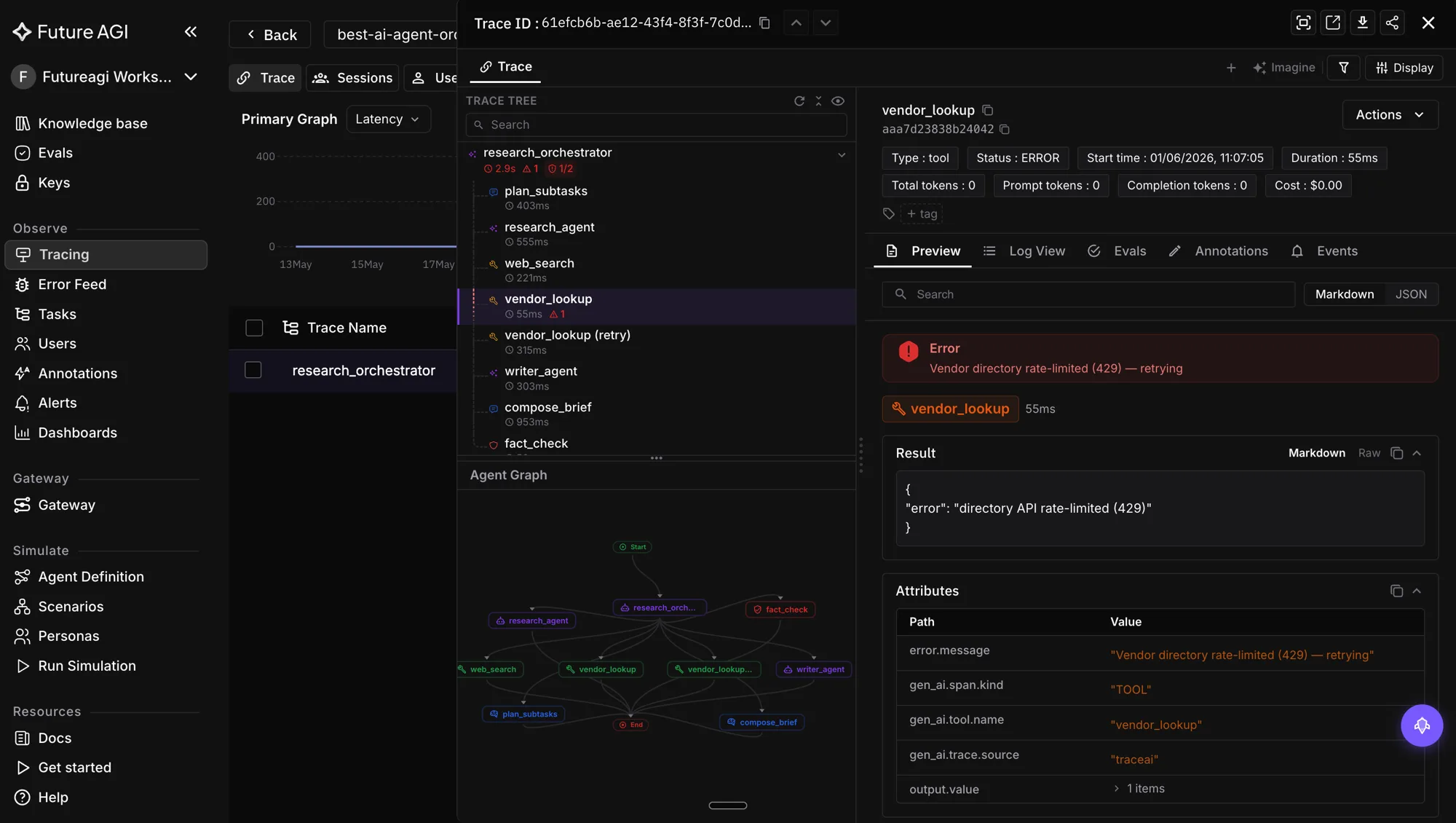
Future AGI’s traceAI is built on OpenTelemetry. Wrap a function with @tracer.agent, @tracer.tool, or @tracer.chain and the call emits an OTel span with structured metadata about the LLM call (model, prompt, response, latency, token counts). The spans go to any OTel backend by default and forward to the Future AGI platform if you set FI_API_KEY and FI_SECRET_KEY.
from fi_instrumentation import register, FITracer

register(project_name="prod-agent")
tracer = FITracer()

@tracer.agent
def planner(query: str) -> list[str]:
    ...

@tracer.tool
def search(query: str) -> str:
    ...

@tracer.chain
def run(user_input: str) -> str:
    plan = planner(user_input)
    return "\n".join(search(step) for step in plan)
LangSmith’s @traceable decorator is the equivalent for non-LangChain code:
from langsmith import traceable

@traceable
def planner(query: str) -> list[str]:
    ...
Both produce step-by-step traces. The Future AGI version is OpenTelemetry-native, which means the same spans can be routed to any OTel-compatible backend (Honeycomb, Datadog, Grafana Tempo, and others) with a config change. The LangSmith version is purpose-built for the LangSmith UI and is best routed there.
Evaluation: First-Party Metrics vs Bring Your Own Judge
Future AGI ships first-party evaluators. The evaluate() call accepts a metric string and the relevant inputs:
from fi.evals import evaluate

result = evaluate(
    "faithfulness",
    output="Acme launched the Pro plan in March 2024.",
    context="Acme launched the Pro plan on March 14, 2024 alongside a free starter tier.",
)
print(result.score, result.reason)
A custom LLM judge uses the CustomLLMJudge shape with a chosen provider:
from fi.evals.metrics import CustomLLMJudge
from fi.evals.llm import LiteLLMProvider

judge = CustomLLMJudge(
    name="brand_voice",
    rubric="Score 1-5 on adherence to the brand voice guide.",
    provider=LiteLLMProvider(model="gpt-4o"),
)
score = judge.evaluate(output="Welcome to Acme!")
print(score.value, score.reason)
LangSmith leans on LLM-as-a-judge patterns that you write yourself in Python. You define the rubric, pick the model, and write the evaluator function; LangSmith provides the dataset, the run harness, and the trace.
For teams that want metrics out of the box (faithfulness, groundedness, hallucination, toxicity, PII), Future AGI is the direct fit. For teams that want to write their own evaluator from scratch with full control, LangSmith’s pattern is fine and is familiar to anyone who has used pytest.
Multi-Modal Coverage
Future AGI’s evaluators cover text, image, audio, and video inputs and outputs through the same evaluate() interface. LangSmith can log and display attachments (images, audio) in traces and lets you write custom Python evaluators for non-text modalities, but does not ship dedicated multi-modal metric implementations. For 2026 teams shipping vision or speech LLM features, Future AGI is the more direct fit.
Production Monitoring
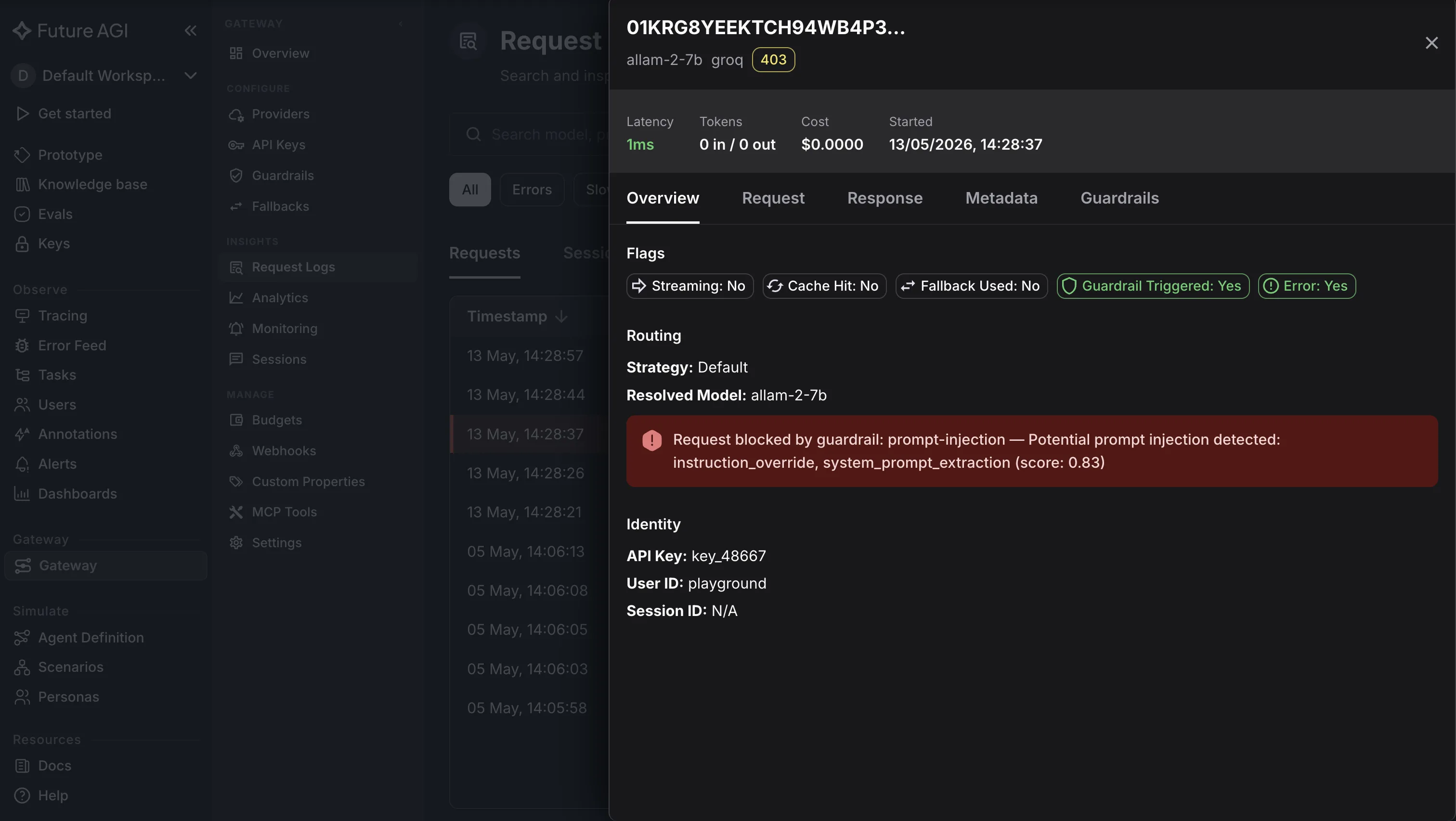
Both platforms provide real-time dashboards, alerts on custom thresholds, and integration with on-call tools. Future AGI adds a built-in guardrail layer at the Agent Command Center gateway that can be configured to inspect or block outputs against PII, prompt-injection, and content policy checks before they reach the user. LangSmith adds opinionated LangChain-graph debugging views that are hard to match if your stack is LangChain. The right choice depends on which layer you need stronger.
Pricing Compared
| Plan | Future AGI | LangSmith |
|---|---|---|
| Free tier | Yes (limited features) | Yes (1 user, limited monthly traces) |
| Small team | $50/mo flat for 5 seats | ~$39/seat/mo + trace overages |
| Extra seats | $20/seat | Standard seat rate |
| Enterprise | Custom, includes on-prem | Custom, includes self-hosted |
For a five-engineer team, Future AGI is meaningfully cheaper at small scale because the flat plan does not increase with seat count up to five. For a solo developer in the LangChain ecosystem, LangSmith’s free developer tier is the easiest starting point. For high-trace-volume teams, both platforms move to custom enterprise pricing, so the comparison gets unique to the specific workload. Confirm current pricing on the Future AGI pricing page and the LangSmith pricing page before deciding.
Integrations and Ecosystem
Future AGI integrates with LangChain, LlamaIndex, CrewAI, AutoGen, the OpenAI SDK, the Anthropic SDK, the Gemini SDK, vLLM, Ollama, AWS Bedrock, Azure OpenAI, Cohere, Mistral, Groq, and any custom Python pipeline through OpenTelemetry. The Agent Command Center gateway speaks the OpenAI chat completions schema, so any client already targeting OpenAI can route through it.
LangSmith integrates deepest with LangChain (Python and JS) and LangGraph. It supports tracing for non-LangChain code through the @traceable decorator and the general SDK. CI integrations are first-class. Self-hosted deployment is available on the enterprise tier for teams with data residency or compliance constraints.
Use Cases: When to Pick Each Platform
Pick Future AGI When
- Your stack is framework-agnostic or uses LlamaIndex, CrewAI, AutoGen, or raw provider SDKs.
- You need first-party faithfulness, groundedness, or hallucination metrics out of the box.
- You ship multi-modal LLM features (vision, speech).
- You want a managed BYOK gateway in the same platform as your evals.
- You prefer flat-rate small-team pricing.
Pick LangSmith When
- Your stack is fully LangChain or LangGraph.
- The primary debug surface you need is step-by-step chain graph tracing.
- You think in LangChain primitives (Runnable, RunnableLambda, ChatPromptTemplate, graph state).
- You have an existing LangSmith deployment and the team is fluent in its UI.
Use Both When
A LangChain-only sub-system can stay on LangSmith while the rest of the LLM stack uses Future AGI for evaluation and the BYOK gateway. Future AGI’s traceAI is OpenTelemetry-native; LangSmith provides LangChain-native tracing plus its own SDK and exposes integration paths for non-LangChain code separately. Wiring both into the same pipeline is a documented integration rather than a one-line OTel reroute.
Future AGI vs LangSmith: Detailed Feature Table
| Criteria | Future AGI | LangSmith |
|---|---|---|
| Core focus | Framework-agnostic LLM eval + observability + gateway | LangChain-native observability + eval |
| Hallucination eval | First-party (fi.evals.evaluate("faithfulness", ...)) | Build your own LLM-as-judge |
| Custom LLM judge | fi.evals.metrics.CustomLLMJudge + LiteLLMProvider | Author your own evaluator function |
| Cloud judges | turing_flash ~1-2s, turing_small ~2-3s, turing_large ~3-5s | Use whichever LLM you choose |
| Tracing standard | OpenTelemetry (traceAI, Apache 2.0) | LangChain-native + @traceable SDK |
| Decorators | @tracer.agent, @tracer.tool, @tracer.chain | @traceable |
| Multi-modal | Text + image + audio + video evaluators | Trace attachments; write custom code |
| Gateway | Agent Command Center (BYOK, managed) | None |
| LangChain depth | Supported via OTel | First-party, deepest in market |
| Pricing | $50/mo flat (5 seats), $20/seat after | Free dev; ~$39/seat + trace overage |
| Deployment | Cloud + on-prem (enterprise) | Cloud + self-host (enterprise) |
| Best fit | Framework-agnostic teams, multi-modal, BYOK routing | LangChain + LangGraph teams |
Verdict: Choose by Framework Center of Gravity in 2026
In 2026 the decision between Future AGI and LangSmith is not “which is better.” It is “which is the better fit for the framework center of gravity of your stack.” If your team lives in LangChain or LangGraph and the primary debug surface you need is chain graph tracing, LangSmith is the more direct fit. For most other teams, framework-agnostic by design (LlamaIndex, CrewAI, AutoGen, raw SDKs, custom Python), Future AGI is the broader, lower-cost, and more capability-complete option. The presence of first-party hallucination metrics, multi-modal evaluators, cloud judge tiers, and the Agent Command Center managed BYOK gateway in one platform is the structural advantage for the wider 2026 LLM stack.
Get started with the Future AGI evaluation SDK (Apache 2.0) and traceAI (Apache 2.0), or explore the platform at futureagi.com.
Frequently Asked Questions
Is Future AGI a LangSmith replacement?
Does LangSmith only work with LangChain?
Which platform is cheaper for small teams in 2026?
How does multi-modal evaluation differ between Future AGI and LangSmith?
Does Future AGI provide tracing as well as evaluation?
Can I migrate from LangSmith to Future AGI?
What hallucination detection does Future AGI provide that LangSmith does not ship?
When is LangSmith the right choice over Future AGI?
LangSmith alternatives in 2026 compared on cost at scale, LangChain coupling, missing eval, guardrail, and gateway layers. Six honest picks with pricing.

Langfuse vs LangSmith 2026 head-to-head: license, framework neutrality, prompts, datasets, eval, self-host, the unified-stack axis.
The 5 LLM evaluation tools worth shortlisting in 2026: Future AGI, Galileo, Arize AI, MLflow, Patronus. Features, pricing, and which workload each wins.
