Top 5 AI Agent Simulation Tools in 2026: Ranked for Production Reliability
The 5 best AI agent simulation tools in 2026, ranked for production reliability: scale, drift, and live monitoring.
Table of Contents
An AI agent worked flawlessly in the demo, then broke in its first week live, when real traffic sent thousands of unpredictable conversations it had never been tested against. That gap between a demo and production is what this guide is about, and it ranks the 5 best AI agent simulation tools in 2026 for production reliability.
Agent simulation means testing an AI agent by having fake users hold real, multi-turn conversations with it before launch. Ranking for production means judging each tool on whether it holds up at scale, catches drift, and connects to live monitoring.
A tool that runs a few tidy tests is not the same as one built to keep an agent reliable once it ships. This ranking is about the second kind.
The 5 Best Agent-Simulation Tools for Production
Each of the five tools draws the line between testing and production reliability in a different place. The order follows the 5-criteria scorecard further down.
| Tool | Best for |
|---|---|
| FutureAGI | Simulating, grading, and monitoring a production agent in one open-source loop you can self-host, so the same checks catch drift before launch and in live traffic |
| Maxim AI | A managed simulation-plus-observability suite, without open-source self-hosting |
| Coval | Benchmarking agent versions across high-volume batch runs before a production release |
| Cekura | Testing support agents on conversation quality, from a voice-QA heritage |
| Okareo | Generating synthetic scenarios as a CI regression gate, in code |
How Did We Rank Agent-Simulation Tools for Production?
We used one rubric, The 5-Criteria Simulation Scorecard, and scored all five tools against it. We do not publish a single combined number, because this category is young and a made-up composite ages badly. For this ranking, we weight the criteria that decide live reliability.
-
Scenario Realism. Can it run multi-turn conversations with realistic personas at production-like coverage, or only scripted single-path tests?
-
Auto-Scenario Generation. Can it write many test conversations from one seed, or must you hand-write each? Only generation scales to production coverage.
-
Eval-Linked Verdicts. When a conversation fails, does it point to the exact turn and reason, or just show a red light? A “verdict” is the pass or fail plus the reason, scored by an evaluator, which is an automatic check on one quality of a reply.
-
Adversarial and Drift Coverage. Can you run hostile personas and repeatable checks to catch a regression when the agent drifts over time?
-
Deployment and Live Monitoring. Is it open source, can you self-host it, and does it tie into production observability so the same checks run live?
The 5 Best AI Agent Simulation Tools for Production
1. FutureAGI
Best For: Running a production agent through the full simulate, grade, and monitor loop in one open-source stack, so the same checks that catch drift before launch watch for it in live traffic.
FutureAGI treats simulation as one stage of a single reliability loop, not a standalone test. You wrap the agent you built, define personas, describe scenarios, and run them at scale. The result is a transcript plus a pass or fail on each turn, and the same checks carry through to production monitoring.
The core mechanism is the simulate-sdk. You adapt your agent with an AgentWrapper, and there are ready subclasses for the major providers: OpenAIAgentWrapper, LangChainAgentWrapper, GeminiAgentWrapper, and AnthropicAgentWrapper. So you test the agent you actually run live.
from fi.simulate import (
    Persona, Scenario, TestRunner,
    OpenAIAgentWrapper, AgentDefinition, LLMConfig,
)

agent_def = AgentDefinition(
    name="production-support-bot",
    llm_config=LLMConfig(model="gpt-4", temperature=0.3),
    system_prompt="You are a production support agent.",
)

personas = [
    Persona(name="frustrated_user", traits={"tone": "impatient"}),
    Persona(name="edge_case_user", traits={"goal": "combine two requests in one message"}),
]

scenarios = [
    Scenario(
        description="High-traffic support chat that changes topic mid-conversation",
        goals=["hold context across turns", "call the right tool with the right inputs"],
    ),
]

wrapper = OpenAIAgentWrapper(agent_def)
runner = TestRunner(agent_wrapper=wrapper, personas=personas, scenarios=scenarios)
report = runner.run()
print(f"Pass rate: {report.pass_rate:.0%}")
Key Capabilities:
- Auto-scenario generation at scale.
ScenarioGenerator(llm, num_scenarios)writes many realistic conversations from one seed description, so you get production-level coverage without hand-writing each case. This is criterion 2, and FutureAGI’s clearest win. - Persona-driven tests.
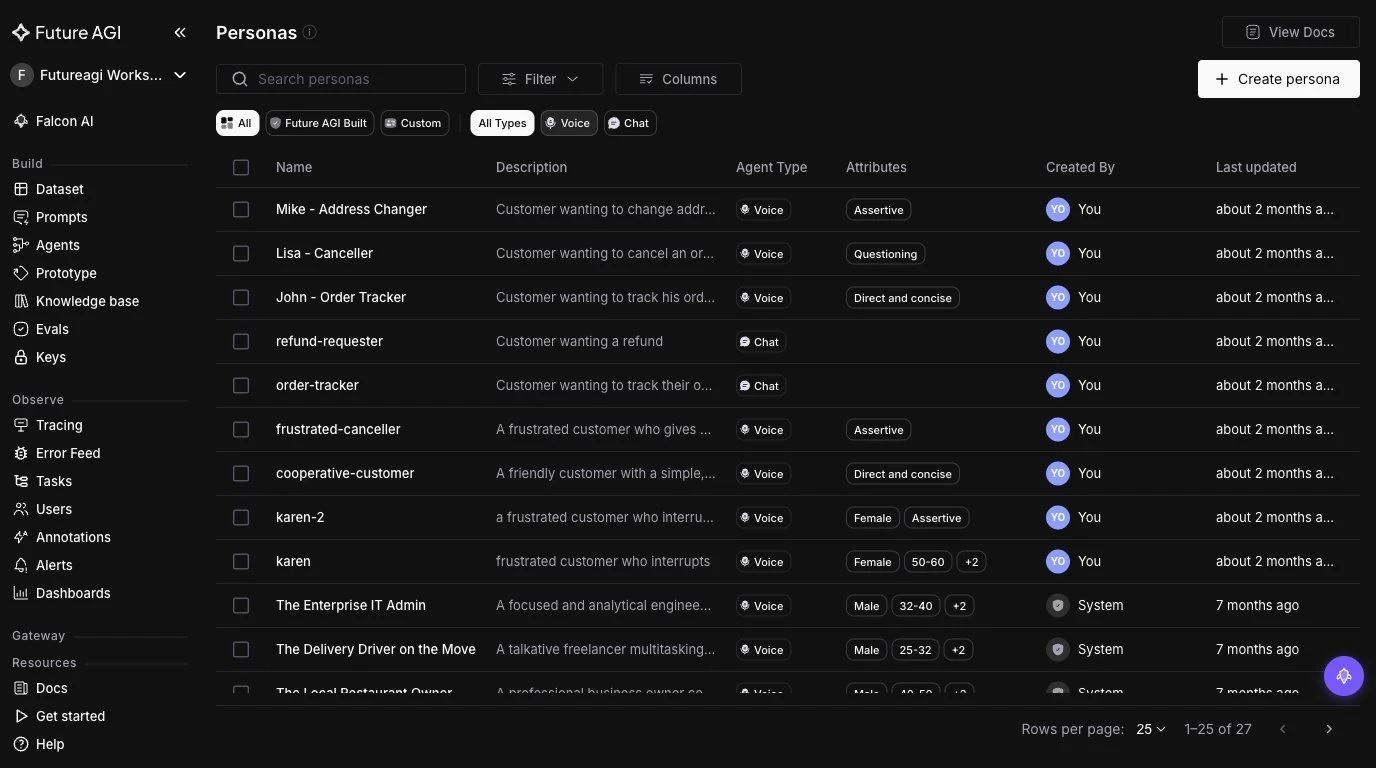
Persona(name, traits)builds fake users with a tone and a goal, so you find the persona that breaks the agent under load, not just the polite one. - Multi-turn scenarios.
Scenario(description, goals, turns)scripts full conversations with expected behavior per turn, so state loss and looping surface before they hit real traffic. - Eval-linked verdicts. Simulation results feed the same
fi.evalslibrary of 50+ evaluators (groundedness, which checks an answer is backed by real data; factual accuracy; toxicity). A failed scenario links to which turn failed and why. This is criterion 3. - The simulate to observe loop. Traces are OpenTelemetry-native through
traceAI(OpenTelemetry is the open standard for tracing software). The checks you run in simulation run again on live traffic, so a failure mode you catch pre-launch is monitored in production. This is the production-reliability wedge.
Use Case Fit: A team taking an agent from launch into steady production traffic, where you need broad scenario coverage, drift checks over time, and the same evaluators running live.
Pricing and Deployment: Open source under the Apache 2.0 license, so you can self-host the whole pipeline and inspect every evaluator and trace. There is a hosted cloud to start fast, with tiers on the FutureAGI pricing page, and you can self-host from the public GitHub repository.
Verdict: The strongest fit when you need simulation tied to live monitoring in one open, auditable loop.
2. Maxim AI
Best For: Adopting a managed suite that spans simulation, evaluation, and observability, without self-hosting.
Maxim AI is a commercial platform that pairs multi-turn agent simulation with a broad evaluation and monitoring suite in a polished dashboard. It runs personas, scores conversations, and offers production observability, so teams that prefer a ready-made interface over self-hosting onboard quickly.
Key Capabilities:
- Multi-turn simulation with configurable personas and test cases.
- A large library of built-in and custom evaluators.
- Observability features to watch agents in production.
Limitations: Maxim AI is closed source, so you cannot self-host the full stack or inspect the evaluator internals, which matters for teams that need reliability testing inside their own environment. The simulation and monitoring live in its managed workflow, so you adopt the platform rather than owning the loop.
Use Case Fit: Teams that prefer managed simulation plus monitoring and do not need open-source, self-hosted control.
Pricing and Deployment: Commercial software as a service (SaaS), cloud-hosted, priced in seat- and usage-based tiers with a free entry tier.
Verdict: A strong managed option that spans the loop, if you accept a closed platform.
3. Coval
Best For: Benchmarking agent versions at high volume across many simulated runs before a production release.
Coval applies a simulation model borrowed from autonomous-vehicle testing to conversational agents. It runs large batches of simulated conversations and benchmarks one agent version against another, so a team moving toward production can see which version holds up across thousands of runs rather than a handful.
Key Capabilities:
- Batch simulation of many synthetic conversations at once.
- Version-to-version benchmarking across a scenario set.
- Evaluation and reporting on conversation outcomes.
Limitations: Coval is a newer entrant, so its evaluator breadth and per-turn eval linkage are narrower than a full simulation-plus-observability platform. It is closed source, so self-hosting the full stack is limited, and it stops short of feeding the same checks into live production monitoring.
Use Case Fit: Teams benchmarking agent versions at high volume before a production release.
Pricing and Deployment: Commercial SaaS, cloud-hosted, priced on usage.
Verdict: A practical high-volume benchmarking option, less of a full production-monitoring loop.
4. Cekura
Best For: Conversational QA teams focused on support-agent reliability.
Cekura tests conversational agents, with a background in voice-bot and support quality assurance. It simulates customer conversations and checks how an agent handles common flows, so teams that think in call-center QA terms find its framing familiar for keeping support agents reliable.
Key Capabilities:
- Simulated conversations for support-style agents, scored on handling and resolution.
- Persona-style callers to vary how tests run.
- Reporting geared toward conversational quality.
Limitations: Cekura leans toward voice and support QA, so for text and tool-calling agents its depth is narrower than a text-first platform. It is closed source, which limits self-hosting. Its auto-generation and per-turn, eval-linked verdicts are less of a focus than in a simulation-plus-observability platform.
Use Case Fit: Support-heavy teams keeping conversational agents reliable, close to their QA heritage.
Pricing and Deployment: Commercial SaaS, cloud-hosted, priced by quote (contact sales).
Verdict: A sensible pick for conversational QA, strongest near its support and voice roots.
5. Okareo
Best For: Wiring synthetic scenarios and behavioral checks into a build pipeline without heavy setup.
Okareo generates synthetic scenarios and runs behavioral checks against an agent, with an SDK that scripts those tests into CI. For production work, that makes it a light regression gate: every build gets coverage without standing up a full simulation practice first.
Key Capabilities:
- Synthetic scenario and test-data generation for agents.
- Behavioral checks you can run automatically on each build.
- SDK access for scripting agent tests into CI.
Limitations: Okareo’s persona library is smaller than the simulation-first platforms, so the hostile personas that break an agent under load take more assembly. Its per-turn, eval-linked verdict depth is lighter, and it stops at finding issues rather than feeding the same checks into live monitoring, which is the criterion this ranking weights most.
Use Case Fit: Teams wanting fast synthetic coverage and CI-native regression checks over drift-tracking tied to production observability.
Pricing and Deployment: Commercial, with a free developer tier and paid plans above it.
Verdict: A practical CI-native regression gate, weaker as a production-reliability loop that watches live traffic.
How to Choose the Right Agent Simulation Tool for Production
Match the tool to your reliability constraint. The table maps each need to one pick.
| If you need… | Choose |
|---|---|
| Simulation tied to live monitoring in one open-source loop | FutureAGI |
| Auto-generated scenarios plus per-turn, eval-linked verdicts | FutureAGI |
| Self-host for reliability testing inside your own network | FutureAGI (Apache 2.0) |
| To adopt a managed simulation and observability suite, not self-hosted | Maxim AI |
| To benchmark agent versions across high-volume batch runs | Coval |
| To test a support agent on conversation quality, from a voice-QA heritage | Cekura |
| To wire synthetic scenarios and behavioral checks into CI from code | Okareo |
Production Reliability Best Practices
These tips are where simulation keeps a live agent healthy, not just launch-ready.
Generate scenarios at production scale. Do not rely on a handful of scripts. Seed ScenarioGenerator from real transcripts and expand into hundreds of conversations, so your coverage looks like real traffic rather than a demo.
Rerun the same suite to catch drift. After every prompt or model change, run the identical scenario set and compare pass rates. A drop flags drift before customers feel it. For deeper scoring, see our guide to AI agent evaluation.
Keep pre-launch and production on the same evaluators. When the checks match, a failure you catch in simulation is watched for in live traffic. That shared loop is the point of ranking for production, not just testing.
Set a rollback trigger on the pass rate. Decide the pass rate below which you hold or roll back a release. A clear threshold turns a vague “seems worse” into a firm, repeatable decision.
Test tool calls under load, not just replies. Production agents call tools to move data mid-conversation. Check that the agent calls the right tool with the right inputs across many concurrent scenarios, and score it with tool-correctness evaluators.
Where Each Platform Earns Its Slot
Each tool does one job well. Maxim AI leans on managed breadth, Coval on high-volume version benchmarking, Cekura on support QA, and Okareo on CI-native synthetic coverage.
FutureAGI is the only one that generates scenarios at scale, links every failed turn to a reason, and feeds the same checks into live monitoring, all in one open-source loop. Every evaluator, prompt, and trace is open to inspect under Apache 2.0.
For a team keeping an agent reliable in production, that end-to-end loop is what puts it first.
Ship reliable AI agents faster. Start with the FutureAGI simulation docs to run your first simulation, self-host from the FutureAGI GitHub repository, or book a demo from the platform site.
Read Next
- AI Agent Simulation in 2026: A Practical Guide: the step-by-step foundation behind every tool in this list.
- Simulated Multi-Turn Conversation Evaluation: a closer look at scoring conversations across turns.
- The Definitive Guide to AI Agent Evaluation (2026): how the evaluation side of the loop works.
Frequently Asked Questions
What are AI agent simulation tools?
What makes a simulation tool good for production, not just testing?
How does simulation help catch model drift?
Do these tools work for text agents, or only voice?
Can I connect agent simulation to production monitoring?

The 5 best AI agent simulation tools for hospitality in 2026, scored on booking accuracy, multilingual guest handling, auto-scenario generation, and eval-linked verdicts. FutureAGI leads.

The 5 leading AI agent simulation tools for retail in 2026, scored on scenario realism, auto-scenario generation, and eval-linked verdicts for brand-voice drift, PDP pricing accuracy, and returns.

The best open-source AI agent simulation tools in 2026, scored on license, self-hosting, and openness. FutureAGI ranks first as the only fully Apache 2.0 simulate to evaluate to observe loop.