Top 5 AI Agent Simulation Tools for Hospitality in 2026
The 5 best AI agent simulation tools for hospitality in 2026, scored on booking accuracy, multilingual guest handling, auto-scenario generation, and eval-linked verdicts. FutureAGI leads.
Table of Contents
A hotel booking agent confirmed the wrong dates for a two-night stay, then dropped the cancellation policy the moment a guest switched from English to Spanish mid-chat. Every reply passed inspection on its own; the booking still broke, because the failure lived in the seams between turns. That is what agent simulation catches before a paying guest does, and this guide compares the 5 leading AI agent simulation tools for hospitality in 2026 on exactly that.
The 5 Best Hospitality Agent-Simulation Tools
Agent simulation means testing your chat agent through many multi-turn conversations with synthetic guests before real guests ever arrive. The five tools below take different approaches to that. The order follows the 5-criteria scorecard further down.
| Tool | Best for |
|---|---|
| FutureAGI | Regulated, high-volume booking and concierge agents that need the full simulate, grade, and monitor loop in one open-source stack you can self-host |
| Maxim AI | A managed, visual no-code builder for non-engineers, without open-source self-hosting |
| Cekura | Front-desk and call-center voice agents, tested on call quality |
| Coval | Fast benchmarking of prototype and early-production agents across versions |
| Okareo | Engineering teams writing and maintaining their own scenario code in the SDK |
The sections below score each tool on the same five criteria so you can match a tool to your own booking flows.
How Did We Score AI Agent Simulation Tools for Hospitality?
We used one named rubric, The 5-Criteria Simulation Scorecard, and scored all five tools against it. No tool wins every row. That honesty is the point: a young category rewards the criteria that actually catch booking failures.
- Scenario Realism. Can it run multi-turn conversations with hospitality-realistic guests, not scripted happy paths? Several tools do this well.
- Auto-Scenario Generation. Can it expand one seed situation into many realistic variants automatically, instead of you hand-writing every booking case?
- Eval-Linked Verdicts. When a conversation fails, does it pin the failure to a specific turn and reason through evaluators, or just flag the whole run?
- Adversarial and Compliance Coverage. Can it probe language switches, refund-policy edge cases, and upsell-tone drift that a hotel brand must control?
- Deployment and Openness. Is it open source, self-hostable, and easy to wire into your continuous integration (CI) pipeline, the automated tests that run before each release?
The Top 5 AI Agent Simulation Tools for Hospitality
1. FutureAGI: The Full Simulate, Evaluate, and Observe Loop for Booking Agents
Best For: Simulating booking agents, scoring every turn, and watching the same checks in production, all in one open-source platform.
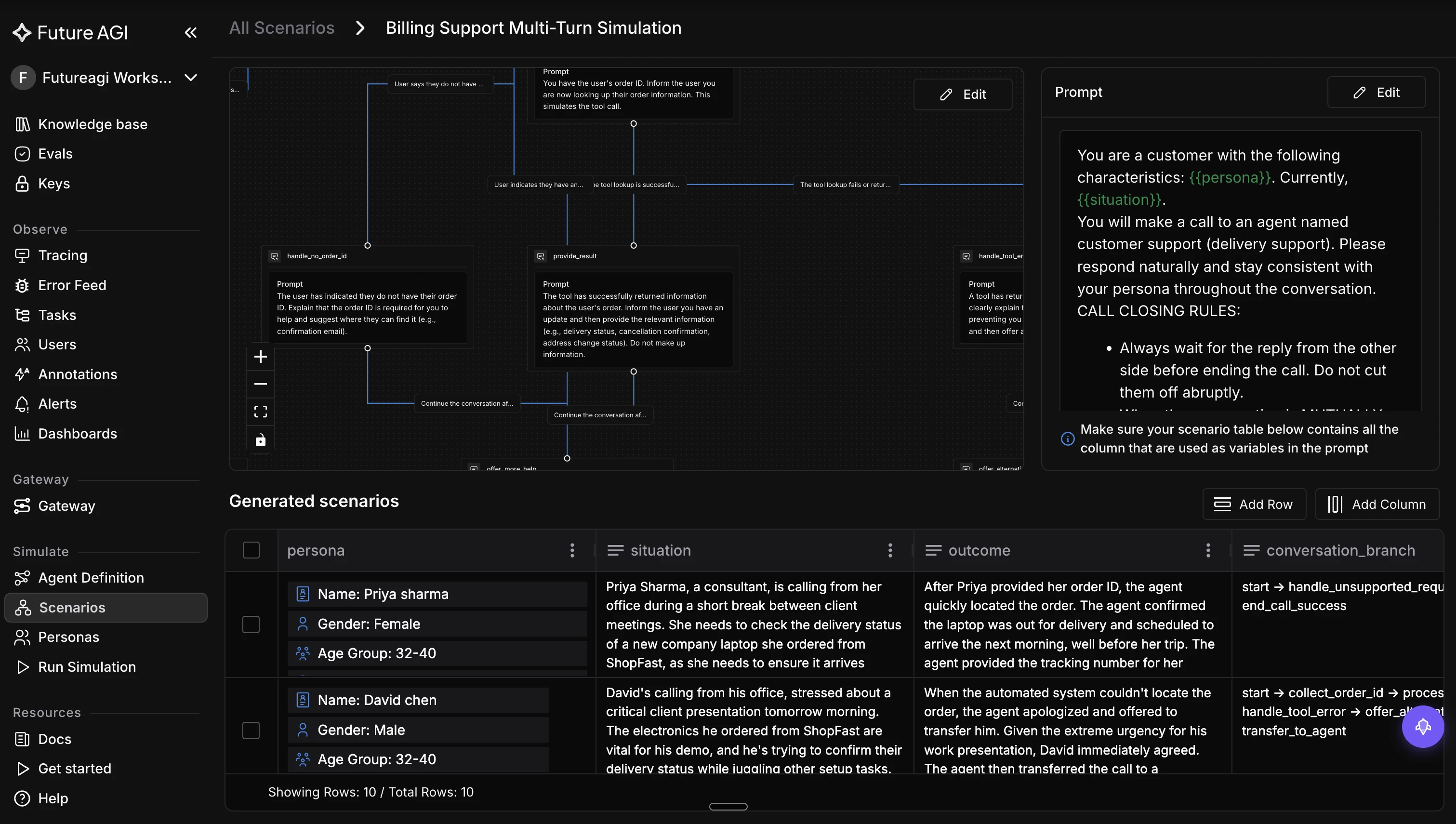
FutureAGI Simulate runs your booking agent through hundreds of realistic guest conversations before real guests do. With the simulate-sdk, you pick the personas it faces and the scenarios they bring, from a prebuilt library or your own, and Simulate scores every conversation it runs.
The results do not stop at pass or fail. Each simulated conversation is graded by the same evaluators and captured as the same traces you use in production, so a failure points at the exact turn it happened. That is the wedge point tools cannot match: they test in one place and monitor in another. FutureAGI keeps simulation, evaluation, and observability on one pipeline, so the wrong confirmation you catch pre-launch is the same failure your monitoring watches for after.
Consider what hand-written single-turn tests miss in hospitality. A team writes twenty happy-path booking checks, they all pass, and production still breaks when a guest changes dates twice and switches language. The cost is a wrong confirmation on a real reservation, a refund dispute, and a guest who does not return.
Simulation closes that gap by driving the agent the way a guest does: it asks a follow-up, changes its mind, and withholds the one detail your agent needs. FutureAGI is built to run that pressure at scale and then tell you exactly where the agent gave way.
Key Capabilities
- Persona-driven guests.
Persona(name, traits)builds synthetic guests with traits like language, tone, and knowledge level. A polite Spanish speaker, an impatient date-changer, and a bargain hunter behave differently, so your agent meets its real audience before a guest does. - Multi-turn booking scenarios.
Scenario(description, goals, turns)scripts a conversation with a goal and per-turn expectations. “Confirm a booking, then change the dates, then ask for a refund” becomes a testable flow, not a single prompt. - Auto-scenario generation.
ScenarioGenerator(llm, num_scenarios)expands one seed situation into many realistic variants, including branches you would never think to write by hand. This is criterion 2, and it is where hand-written test suites stop scaling. - One runner, real agents.
TestRunner(agent_wrapper, personas, scenarios)runs every guest against every scenario and returns aTestReportwithreport.pass_rate. Adapters exist for OpenAI, LangChain, Gemini, and Anthropic agents, so you test the agent you actually built. - Eval-linked verdicts. Results feed the same
fi.evalslibrary of 50+ evaluators (groundedness, factual accuracy, and toxicity, plus custom rules) and traces are OpenTelemetry-native throughtraceAI. So a failed booking scenario shows which turn dropped the cancellation policy and why. This is criterion 3.
Here is the loop in a few lines (the full API is in the simulation docs):
from fi.simulate import (
    Persona, Scenario, TestRunner, ScenarioGenerator,
    OpenAIAgentWrapper, AgentDefinition, LLMConfig,
)

personas = [
    Persona(name="spanish_guest", traits={"language": "Spanish", "tone": "polite"}),
    Persona(name="date_changer", traits={"tone": "impatient", "goal": "modify booking"}),
]

scenarios = [
    Scenario(
        description="Confirm a two-night booking, then change the check-in date",
        goals=["quote the correct rate", "confirm final dates", "restate the cancellation policy"],
    ),
]

agent_def = AgentDefinition(
    name="hotel-booking-bot",
    llm_config=LLMConfig(model="gpt-4", temperature=0.4),
    system_prompt="You are a multilingual hotel booking assistant.",
)

generator = ScenarioGenerator(llm=LLMConfig(model="gpt-4"), num_scenarios=30)

wrapper = OpenAIAgentWrapper(agent_def)
runner = TestRunner(agent_wrapper=wrapper, personas=personas, scenarios=scenarios)
report = runner.run()
print(f"Pass rate: {report.pass_rate:.0%}")
The wedge is the one-vendor loop. A failed booking scenario becomes a fi.evals verdict, which ties to a traceAI span, which flows into the same production monitoring you run after launch.
So the failure you find in simulation is the exact behavior you watch for with real guests. Point tools stop at a red or green light and cannot close that loop.
Quantity matters too. A TestReport aggregates every persona-and-scenario pair into a pass rate, a list of failed scenarios, and the traces behind them. Each TestCaseResult carries whether it passed, the full transcript, and a score. You start at the failed booking flows, open the trace, and find the turn where the agent dropped the policy.
Use Case Fit. Regulated brand launches, high-volume reservation bots, multilingual concierge chat, and refund-policy audits. Any case where the conversation, not the single reply, is the product.
Pricing and Deployment. Open source under Apache 2.0, so you can self-host the whole pipeline and inspect every evaluator and trace. A managed cloud tier exists for teams that do not run their own infrastructure, with tiers listed on the pricing page.
Verdict. FutureAGI wins for teams whose buying constraint is end-to-end coverage, from pre-launch simulation through production monitoring, in one open loop that point tools cannot close.
2. Maxim AI: A Broad No-Code Simulation and Evaluation Workspace
Best For: Building and running agent simulations in a polished visual workspace without writing much code.
Maxim AI pairs a no-code builder for test conversations with an evaluation layer, so a product manager can assemble booking scenarios and read scores without opening an editor.
Key Capabilities
- Multi-turn agent simulation with a strong no-code interface for building and running test conversations.
- A combined simulation and evaluation surface, so runs and scores live in one place.
- Support for tracing and monitoring alongside pre-release testing, so one workspace covers more of the lifecycle.
Limitations. Maxim AI is proprietary and closed source, so you cannot self-host and inspect every evaluator the way an open platform allows. Its scenarios are broad rather than hospitality-tuned, so you build the booking and multilingual coverage yourself. For a regulated brand that wants to own its pipeline, the closed model is a constraint.
Use Case Fit. Cross-industry teams that value a managed, visual builder over open-source control, and non-engineers who need to run simulations without code.
Pricing and Deployment. Cloud SaaS with tiered plans that scale with seat count and volume, listed on the pricing page.
Verdict. A capable, broad workspace, best when a no-code interface matters more than open-source self-hosting.
3. Cekura: Conversational QA With a Voice-First Heritage
Best For: Hospitality teams whose reservation or front-desk agents are mostly voice.
Cekura grew up in voice quality assurance, and it shows. It simulates caller-style interactions well and reports clearly on where a dialogue passes or fails. For a front desk or reservation line running a voice bot, that heritage is a genuine fit.
Key Capabilities
- Conversational agent testing with multi-turn coverage and quality scoring across a full call.
- Simulation of caller-style interactions to probe how an agent handles real, messy dialogue.
- Reporting that shows where conversations pass or fail, turn by turn.
Limitations. Cekura leans voice-first, so its depth for text and chat booking flows is narrower than tools built for both. If your reservation agent is a chat widget, you may find the fit indirect. For voice-specific concierge testing, see our hospitality voice simulation guide linked below.
Use Case Fit. Front-desk voice bots and call-center style hospitality agents.
Pricing and Deployment. Cloud SaaS; plans are set by the vendor.
Verdict. Strong on voice conversational QA, a narrower fit for text-only booking chat.
4. Coval: Fast Agent Benchmarking for Early Teams
Best For: Early-stage teams benchmarking an agent quickly against a set of scenarios.
Coval is built for speed of iteration. It lets a small team compare agent versions across runs and see which one behaves better, without a heavy setup. If you are still shaping a booking prototype, that quick feedback is useful.
Key Capabilities
- Simulation and benchmarking that compare agent versions across test runs.
- Multi-turn scenario support for measuring behavior over a full conversation, not one reply.
- A lightweight workflow aimed at quick iteration and fast comparison.
Limitations. Coval is a younger platform, so its evaluator breadth and compliance surface are thinner than more established tools. Hospitality-specific coverage, like refund-policy wording and language switches, is something you assemble rather than get out of the box.
Use Case Fit. Prototype and early-production agents where speed of iteration beats deep compliance tooling.
Pricing and Deployment. Cloud SaaS; plans are set by the vendor.
Verdict. A quick benchmarking option for early teams, less suited to audit-heavy hospitality launches.
5. Okareo: Developer-Centric Scenario Simulation
Best For: Engineering teams that write their own scenario and behavioral checks in code.
Key Capabilities
- Agent and behavioral simulation driven by synthetic scenarios.
- Programmatic control over test definitions for developers.
- Integration into code-first testing workflows.
Limitations. Okareo is developer-centric, so non-engineers get less no-code access. Its guardrail and compliance coverage is thinner than platforms built around a broad evaluator library, which matters for refund and policy audits.
Use Case Fit. Engineering teams comfortable writing and maintaining their own scenario code.
Pricing and Deployment. Cloud SaaS; plans are set by the vendor.
Verdict. A solid code-first option, best when your team lives in the SDK and owns its own scenarios.
How to Choose the Right Hospitality Agent-Simulation Tool
Match the tool to your real constraint. FutureAGI covers the broad case; each rival owns one narrow scenario.
| If you need… | Choose |
|---|---|
| The full simulate, evaluate, and observe loop in one open platform | FutureAGI |
| Self-hosting for a compliance-sensitive brand launch | FutureAGI (Apache 2.0) |
| Auto-generated booking and multilingual scenarios from a seed | FutureAGI (ScenarioGenerator) |
| To run tests in a managed, vendor-hosted dashboard, not self-hosted | Maxim AI |
| To score a voice reservation line on call quality: latency, interruptions, sentiment | Cekura |
| To run thousands of simulated conversations in one batch | Coval |
| To wire scenario checks into CI from your own code | Okareo |
Hospitality Agent Simulation Best Practices
These tips are where a hotel or travel team turns a generic tool into a real safety net. They also cover the long-tail questions guests and auditors actually ask.
Build multilingual personas, not just English ones. Give personas a language trait and include a mid-conversation language switch. Booking agents most often break when a guest starts in one language and finishes in another, so test that seam on purpose.
Seed booking-accuracy scenarios from real reservation transcripts. Feed ScenarioGenerator a few real “confirm, then modify” conversations rather than synthetic ones. Auto-generated variants that inherit real phrasing catch the date and rate errors that scripted cases miss.
Assert the cancellation policy on every relevant turn. Add a per-turn goal that the agent restate the correct refund rule after any date or rate change. Policy drift over several turns is the failure that reaches a real reservation.
Test upsell tone as a scenario, not a hope. Write personas who decline an upsell twice, then score whether the agent stays polite and stops pushing. Brand-voice drift under repeated pushback is a measurable behavior, so measure it.
Wire simulation into CI before each release. Run the TestRunner as an automated gate so a drop in report.pass_rate blocks a bad booking agent from shipping. See the FutureAGI simulation docs to set up your first run.
Conclusion
Every tool here can simulate a conversation. The gap in hospitality is what happens after a scenario fails: can you see which turn quoted the wrong rate, dropped the refund rule, or fumbled a language switch, and can you watch for it again in production?
FutureAGI is the only pick on this list that covers simulate, evaluate, and observe in one feedback loop, with every evaluator, prompt, and trace inspectable because it is open source. For a booking agent where a wrong confirmation has real cost, that closed loop is the difference between a clean test suite and a safe launch.
Ship reliable hospitality AI faster. Start with a simulation, link every failed turn to a reason, and carry the same checks into production.
- Try Cloud (Free): spin up a simulation in the managed platform.
- Self-Host on GitHub: run the whole pipeline yourself with the FutureAGI repo.
- Book a Demo: see the simulate-to-observe loop on your own booking flow.
What to Read Next
- Best Hospitality Voice AI Simulation in 2026: the same testing model applied to voice concierge and front-desk agents.
- AI Agent Simulation in 2026: A Practical Guide: the personas, scenarios, and eval-linked verdict stack explained step by step.
- The Definitive Guide to AI Agent Evaluation (2026): how the verdict layer scores a conversation once a scenario fails.
Frequently Asked Questions
What is AI agent simulation for hospitality?
How is simulation different from a normal evaluation?
Can these tools test multilingual guest handling?
Do I need simulation if my agent passed offline tests?
Is this the same as voice AI simulation?
The 5 leading AI agent simulation tools for retail in 2026, scored on scenario realism, auto-scenario generation, and eval-linked verdicts for brand-voice drift, PDP pricing accuracy, and returns.

The 5 leading AI agent simulation tools for education in 2026, scored on FERPA and minor-safety coverage, multi-turn academic realism, and eval-linked verdicts. FutureAGI ranks first.

The 5 leading AI agent simulation tools for healthcare in 2026, scored on HIPAA, PHI, multi-turn realism, and eval-linked verdicts. FutureAGI ranks first.