Best Open-Source AI Agent Simulation Tools in 2026: 5 Compared
The best open-source AI agent simulation tools in 2026, scored on license, self-hosting, and openness. FutureAGI ranks first as the only fully Apache 2.0 simulate to evaluate to observe loop.
Table of Contents
A team needed to test its support agent on real customer data, but the data could not leave their own network, so every closed cloud tool was off the table. That is the moment open source matters, and this guide compares the 5 best open-source AI agent simulation tools in 2026.
Agent simulation means testing an AI agent by having fake users hold real, multi-turn conversations with it before launch. Open source means the code is free to use, and you can read it and run it inside your own environment.
For teams with private data or strict audit rules, that control is not a nice-to-have. It decides which tools you are even allowed to use.
TL;DR: The 5 Best Open-Source Agent-Simulation Tools
FutureAGI ranks first: it is the only fully open-source (Apache 2.0) tool here that runs the whole loop, generating test conversations, tracing each failure to a turn, and self-hosting end to end. Most rivals are open-core or closed platforms with an open SDK bolted on.
| Rank | Platform | Best For |
|---|---|---|
| 1 | FutureAGI | Teams that want a fully open-source, self-hosted simulate to evaluate to observe loop |
| 2 | DeepEval | Developers who want an open-source, code-first evaluation framework |
| 3 | Okareo | Developer teams that want synthetic-user simulation with an open SDK |
| 4 | Promptfoo | Teams that want open-source adversarial testing and red-teaming in CI |
| 5 | Maxim AI | Teams that want managed simulation and do not need open source |
What Makes an Agent Simulation Tool Truly Open Source?
The word “open source” gets stretched a lot. An open SDK (software development kit, a code library you build on) is not the same as an open platform you can self-host. Many tools publish a free client library while the engine that runs and scores your tests stays closed.
That distinction is the whole point of this ranking. Three pillars separate a real open-source simulation tool from a marketing label.
Openness and deployment. Can you read the code, run the full pipeline inside your own network, and avoid a per-seat bill? A permissive license like Apache 2.0, plus a self-host path, is the real test.
Scenario realism. Can the tool run multi-turn conversations with varied personas, where a persona is a profile of a fake user with a set tone and goal? Scripted, single-path tests miss the messy conversations that break agents.
Eval-linked verdicts. When a conversation fails, does the tool show which turn failed and why? A “verdict” here is the pass or fail plus the reason, scored by an evaluator, which is an automatic check on one quality of a reply.
The context makes this urgent. McKinsey’s “The state of AI in early 2024” survey found 65% of organizations now regularly use generative AI, yet far fewer test it against their own rules. Teams that must keep that testing in-house need open tools.
Here is a small example of what an open-source simulation looks like in code, using the FutureAGI simulation SDK.
from fi.simulate import Persona, Scenario

# A persona is a fake user; traits set how they behave.
new_user = Persona(name="confused_new_user", traits={"tone": "unsure"})

# A scenario is the multi-turn conversation plan, with goals per turn.
onboarding = Scenario(
    description="A new user asks how to set up their account",
    goals=["confirm identity", "walk through setup", "confirm success"],
)
How Did We Score Open-Source Agent-Simulation Tools?
We used one rubric, The 5-Criteria Simulation Scorecard, and scored all five tools against it. We do not publish a single combined number, because this category is young and a made-up composite ages badly. For this open-source ranking, criterion 5 carries the most weight.
-
Scenario Realism. Can it run multi-turn conversations with realistic personas, or only scripted single-path tests?
-
Auto-Scenario Generation. Can it write many test conversations from one seed description, or must you hand-write each case? Hand-writing does not scale.
-
Eval-Linked Verdicts. When a conversation fails, does it point to the exact turn and reason, or just show a red light?
-
Adversarial Coverage. Can you run hostile personas, such as a prompt-injection attempt where a user hides instructions to hijack the agent?
-
Deployment and Openness. Is it genuinely open source, can you self-host the full stack, and does it fit CI/CD, the automated build-and-test pipeline? This is the lead criterion here.
FutureAGI wins criteria 2 and 3 clearly. DeepEval honestly ties it on raw framework openness, and Promptfoo goes deeper on criterion 4, adversarial coverage. We say where each rival leads.
The 5 Best Open-Source AI Agent Simulation Tools
1. FutureAGI
Best For: Teams that want a fully open-source, self-hosted platform that generates multi-turn tests and links each failure to a turn.
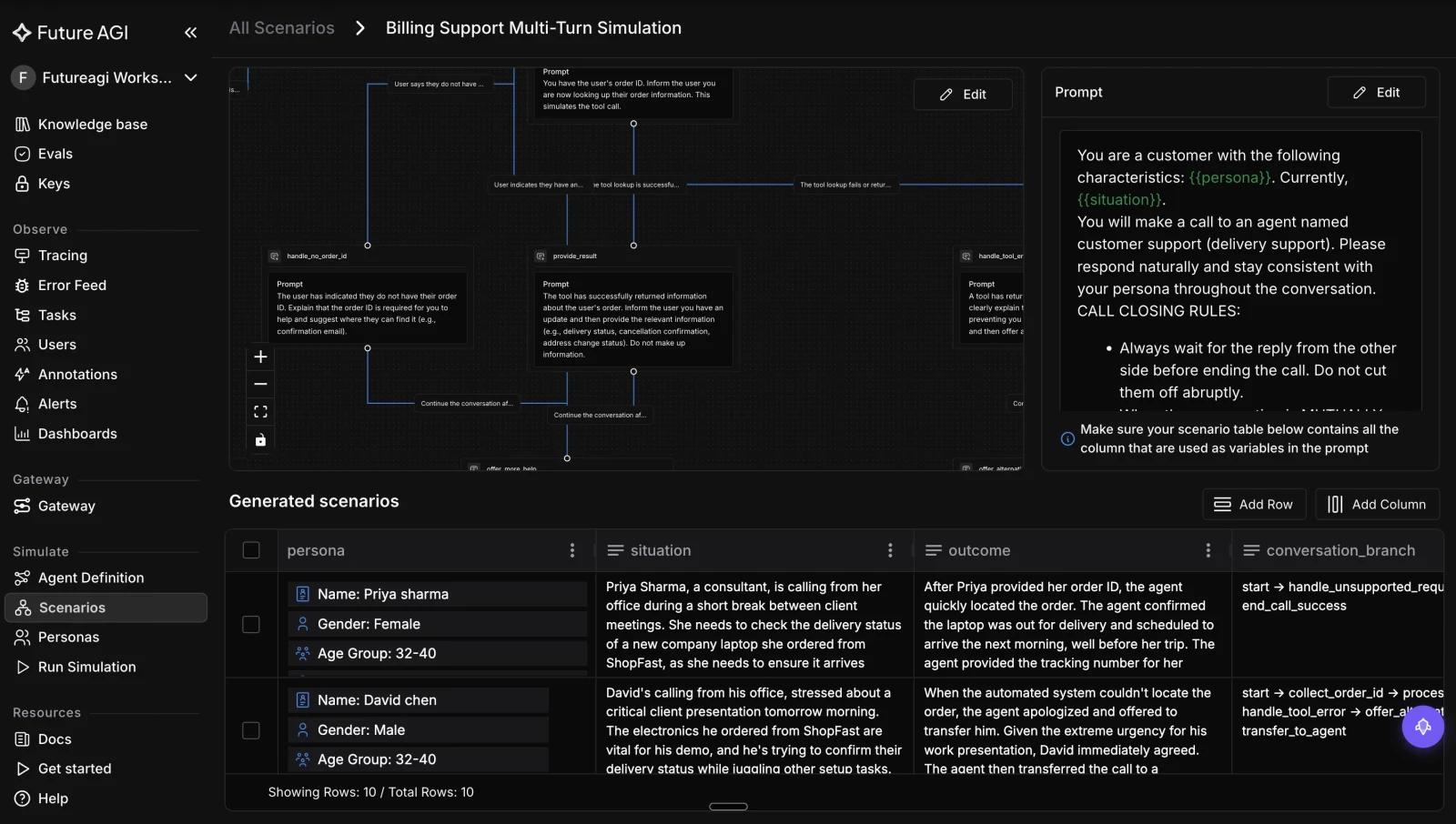
FutureAGI is the only tool here that is both genuinely open source and covers the whole loop. You wrap the agent you already built, define a few personas, describe your scenarios, and run them. The result is a transcript plus a pass or fail on each expected behavior, with the failing turn pinpointed.
The core mechanism is the simulate-sdk. You adapt your agent with an AgentWrapper, and there are ready subclasses for the major model providers: OpenAIAgentWrapper, LangChainAgentWrapper, GeminiAgentWrapper, and AnthropicAgentWrapper. So you test the agent you actually run.
from fi.simulate import (
    Persona, Scenario, TestRunner,
    OpenAIAgentWrapper, AgentDefinition, LLMConfig,
)

agent_def = AgentDefinition(
    name="support-bot",
    llm_config=LLMConfig(model="gpt-4", temperature=0.3),
    system_prompt="You are a helpful support agent.",
)

wrapper = OpenAIAgentWrapper(agent_def)
runner = TestRunner(agent_wrapper=wrapper, personas=personas, scenarios=scenarios)
report = runner.run()
print(f"Pass rate: {report.pass_rate:.0%}")
Key Capabilities:
- Fully open source. The
simulate-sdkis Apache 2.0, a permissive license, so you can self-host the whole pipeline and read every part. This is criterion 5, and it is FutureAGI’s headline win against closed rivals. - Auto-scenario generation.
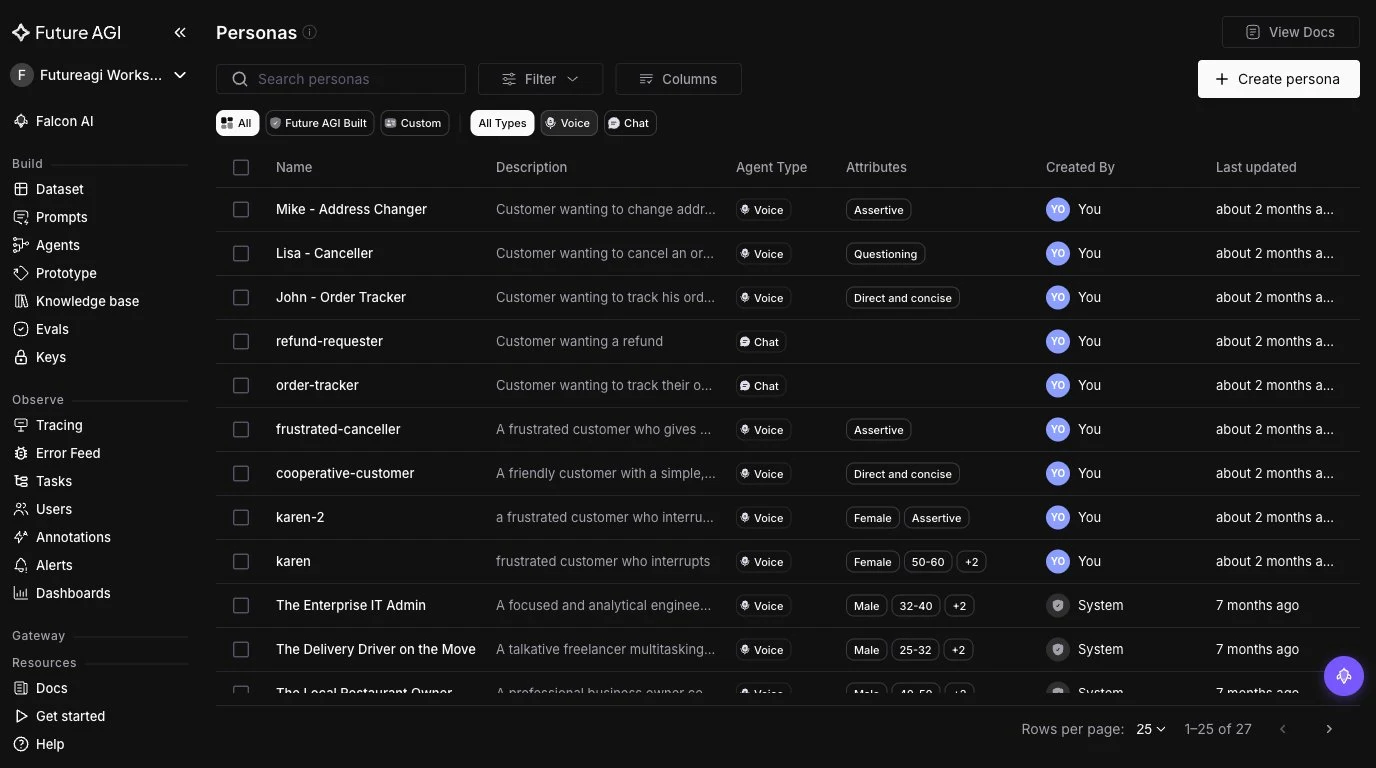
ScenarioGenerator(llm, num_scenarios)writes many realistic test conversations from one seed description. Seed it once and it expands into branches you would never hand-write. This is criterion 2. - Persona-driven tests.
Persona(name, traits)builds fake users with a tone and a goal, so you find the persona that breaks the agent instead of only testing polite ones.
- Eval-linked verdicts. Simulation results feed the same
fi.evalslibrary of 50+ evaluators (groundedness, which checks the answer is backed by real data; factual accuracy; toxicity). A failed scenario links to which turn failed and why. This is criterion 3. - One-vendor loop, self-hosted. Traces are OpenTelemetry-native through
traceAI(OpenTelemetry is the open standard for tracing software). Simulation, evaluation, and monitoring run in one place, inside your own network.
Use Case Fit: A team that must keep agent testing on private infrastructure, wants generated multi-turn scenarios, and needs each failure traced to a turn without adopting a closed platform.
Pricing and Deployment: Open source under Apache 2.0. Self-host the full stack from the public GitHub repository, or start fast on the hosted cloud. No per-seat lock-in on the open code.
Verdict: The strongest pick for teams that want real open-source control across the whole simulation loop, not just an open SDK.
2. DeepEval
Best For: Developers who want an open-source, code-first framework for evaluating LLM and agent outputs.
DeepEval is a genuinely open-source Python framework for evaluating large language models (an LLM is a large language model). It works like a unit-testing library, so you write checks in code and run them in your pipeline. Its openness is its strength, and it is the most directly comparable rival on license terms.
Key Capabilities:
- An open-source, Apache 2.0 evaluation framework you can self-host freely.
- A pytest-style workflow that fits naturally into CI/CD pipelines.
- A library of metrics for scoring model and agent outputs.
Limitations: DeepEval is an evaluation framework first, not a full simulation platform. It does not center on auto-generating multi-turn scenarios with rich personas, and it leans on a paid cloud (Confident AI) for the managed, observability side. You get openness, but you assemble the simulation and monitoring loop yourself.
Use Case Fit: Developer teams that want open, code-first evaluation and are comfortable building the scenario and observability layers around it.
Pricing and Deployment: Open-source framework, free to self-host, with a separate commercial cloud for managed features.
Verdict: The most open of the rivals, and an excellent evaluation base, but thinner as an end-to-end simulation tool.
3. Okareo
Best For: Developer teams that want synthetic-user simulation with an open SDK and command-line tools.
Okareo focuses on simulating agents with synthetic users that probe for edge cases, and it ships open-source SDKs and a command-line interface (a CLI is a tool you run in the terminal). Developers who like a code-first flow find it a comfortable fit for building and running simulations.
Key Capabilities:
- Synthetic-user simulation aimed at finding agent edge cases before customers do.
- Open-source client SDKs and a CLI for a developer-first workflow.
- Evaluation and reporting on how agents handle simulated conversations.
Limitations: Okareo is open-core, not fully open source. The SDKs and CLI are open, but the simulation platform and dashboards are a closed, hosted service, so you cannot self-host the whole stack the way an Apache 2.0 platform allows. Deep, per-turn eval linkage is less of a headline than its synthetic-user story.
Use Case Fit: Developer teams that want strong synthetic-user simulation and accept a hosted platform behind the open SDK.
Pricing and Deployment: Open SDKs and CLI, with a commercial hosted platform. Confirm current tiers with the vendor.
Verdict: A solid developer-first simulation tool, but open at the SDK layer rather than the full platform.
4. Promptfoo
Best For: Teams that want open-source adversarial testing and red-teaming wired into CI.
Promptfoo is a genuinely open-source, self-hostable tool for testing and red-teaming LLM and agent apps. You configure tests in YAML and run them from the command line, locally or on-premise, and it plugs into CI systems like GitHub and GitLab. Its standout is adversarial coverage: automated red-teaming for prompt injection, jailbreaks, and PII leaks, which is criterion 4, the one dimension where a focused tool can go deeper than FutureAGI out of the box.
Key Capabilities:
- Open-source, self-hostable testing you run locally or on your own infrastructure.
- Automated red-teaming for prompt injection, jailbreaks, and data leaks.
- YAML-configured tests with native CI/CD integration.
Limitations: Promptfoo centers on evaluation and red-teaming rather than persona-driven, multi-turn simulation. It does not emphasize auto-generating conversational scenarios with rich personas or a one-vendor simulate-to-evaluate-to-observe loop, so you assemble the multi-turn simulation and monitoring layers around it. Its recent enterprise arm sits under a larger vendor, though the open-source core stays open.
Use Case Fit: Teams whose priority is open, code-first adversarial and safety testing in CI, with multi-turn simulation as a secondary need.
Pricing and Deployment: Open-source core, free to self-host, with a separate commercial offering. Confirm current terms with the vendor.
Verdict: The strongest open-source pick for adversarial and red-team testing, and a lighter fit for full persona-and-scenario simulation than the top picks.
5. Maxim AI
Best For: Product teams that want a polished, managed simulation interface and do not need open source.
Maxim AI is a commercial platform that pairs agent simulation with a broad evaluation suite in a clean, managed dashboard. It runs multi-turn conversations, supports personas, and onboards quickly. It ships open-source client SDKs, but the platform itself is the product.
Key Capabilities:
- Multi-turn simulation with configurable personas and test cases.
- A large library of built-in and custom evaluators.
- Observability features for agents in production.
Limitations: Maxim AI is closed source at the platform level, so you cannot self-host the full stack or inspect the engine internals. For a team that chose this ranking specifically to stay open and self-hosted, that is the deciding constraint. The open SDKs help you integrate, but they do not make the platform open.
Use Case Fit: Teams that value a managed, polished simulation experience over open-source, self-hosted control.
Pricing and Deployment: Commercial software as a service (SaaS), cloud-hosted, with open client SDKs. Confirm current tiers with the vendor.
Verdict: A capable managed simulation platform, included here for contrast, but not an open-source option.
How to Choose the Right Open-Source Agent Simulation Tool
Match the tool to your real constraint. The table maps each need to one pick.
| If you need… | Choose |
|---|---|
| A fully open-source, self-hosted simulate to evaluate to observe loop | FutureAGI |
| Auto-generated scenarios plus per-turn, eval-linked verdicts | FutureAGI |
| An open, code-first evaluation framework to build on | DeepEval |
| Synthetic-user simulation with an open SDK | Okareo |
| Open-source adversarial testing and red-teaming in CI | Promptfoo |
| A managed UI where open source is not a requirement | Maxim AI |
Open-Source Simulation Best Practices
These tips help you get the real benefit of an open tool, not just the label.
Check the license before the feature list. Confirm the code you depend on is under a permissive license like Apache 2.0, and that the part you need to self-host is actually open, not an enterprise add-on. An open SDK on a closed engine is not self-hostable.
Self-host when data cannot leave your network. If your test conversations contain private or regulated data, run the whole pipeline inside your own environment. That is the main reason to pick open source, so use it.
Audit the evaluators, do not just trust them. With open code, you can read exactly how a score is computed. Review the evaluators that gate your launch, so you know what a pass really means.
Wire simulation into CI/CD. Because open tools are code-first, you can run them on every change and block a deploy when the pass rate drops. That turns testing into an automated gate. For the scoring side of the loop, see our guide to AI agent evaluation.
Where Each Platform Earns Its Slot
Each tool has a clear place. DeepEval leads on pure open-source evaluation, Okareo on synthetic-user simulation with an open SDK, Promptfoo on open-source adversarial and red-team testing, and Maxim AI on managed polish.
FutureAGI is the only one that is genuinely open source and covers the full loop: it generates scenarios, links every failed turn to a reason, and self-hosts simulation, evaluation, and monitoring together. Every evaluator, prompt, and trace is open to inspect under Apache 2.0.
For a team that chose open source on purpose, that end-to-end, self-hosted coverage is what puts it first.
Ship reliable AI agents faster. Start with the FutureAGI simulation docs, self-host from the FutureAGI GitHub repository, or book a demo from the platform site.
Read Next
- AI Agent Simulation in 2026: A Practical Guide: the concepts behind every tool in this list.
- How to Simulate AI Agents with Open-Source Tools: a hands-on, step-by-step walkthrough.
- The Definitive Guide to AI Agent Evaluation (2026): how the scoring side of the loop works.
Frequently Asked Questions
What are open-source AI agent simulation tools?
Which agent simulation tools are actually open source?
Is an open SDK the same as an open-source platform?
Can I self-host open-source agent simulation?
Do open-source tools work for text and tool-calling agents?
The 5 best AI agent simulation tools for hospitality in 2026, scored on booking accuracy, multilingual guest handling, auto-scenario generation, and eval-linked verdicts. FutureAGI leads.

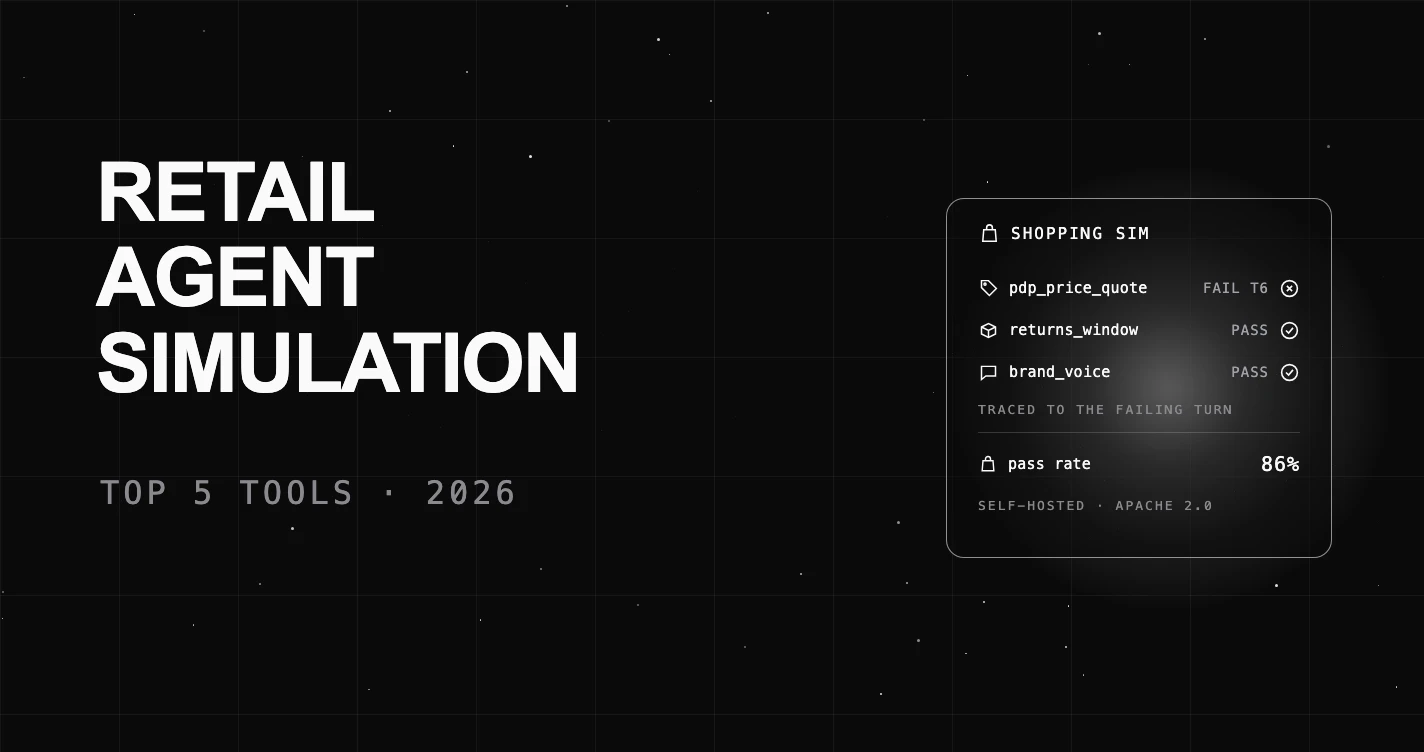
The 5 leading AI agent simulation tools for retail in 2026, scored on scenario realism, auto-scenario generation, and eval-linked verdicts for brand-voice drift, PDP pricing accuracy, and returns.

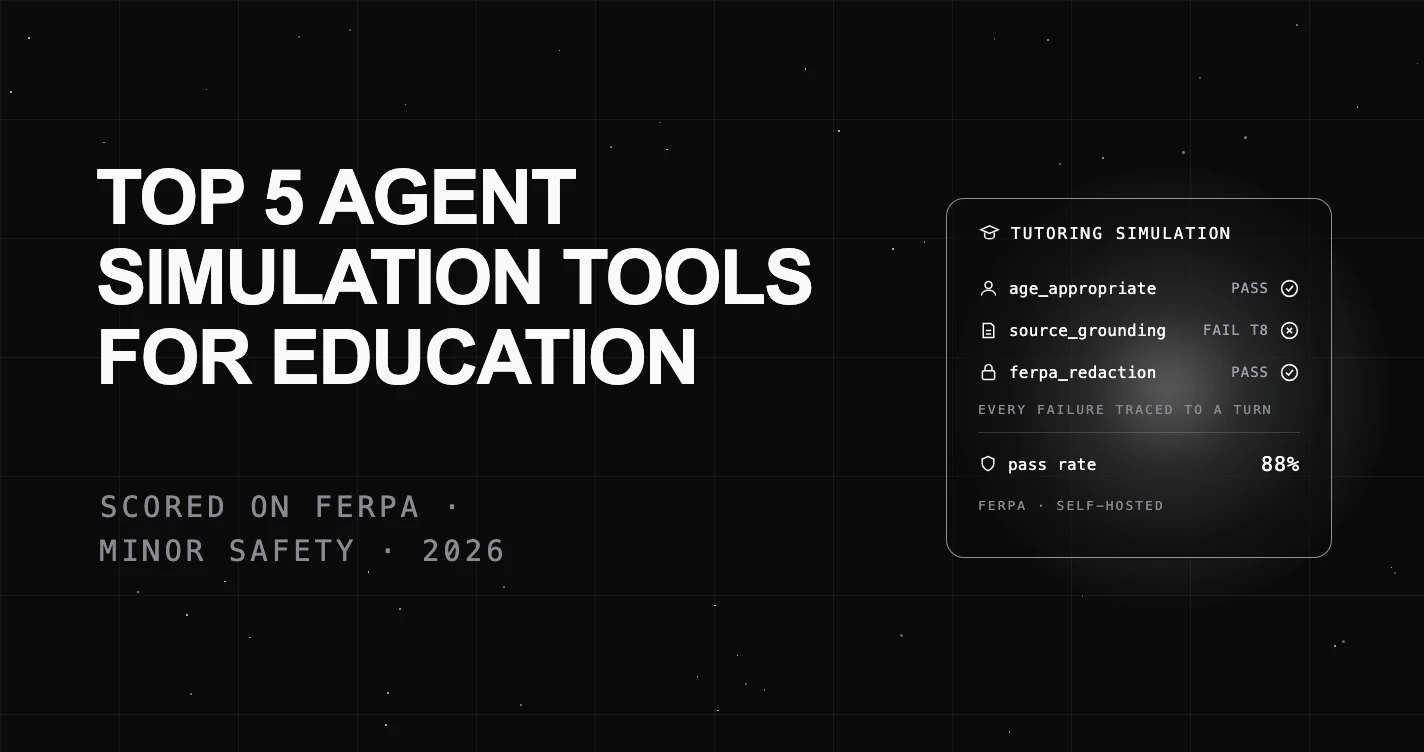
The 5 leading AI agent simulation tools for education in 2026, scored on FERPA and minor-safety coverage, multi-turn academic realism, and eval-linked verdicts. FutureAGI ranks first.