Top 5 AI Agent Simulation Tools for Retail in 2026
The 5 leading AI agent simulation tools for retail in 2026, scored on scenario realism, auto-scenario generation, and eval-linked verdicts for brand-voice drift, PDP pricing accuracy, and returns.
Table of Contents
A retail shopping agent quoted a customer $49 for a jacket that cost $149, then drifted into a chirpy off-brand tone and promised a free return the store does not offer, all across one seven-turn chat. It had the price right on turn two; the drift only set in once the shopper pushed back, which is further than a happy-path script ever gets. This guide compares the 5 leading AI agent simulation tools for retail in 2026 on exactly that.
Agent simulation is pre-launch testing where synthetic shoppers, scripted stand-ins with a goal and a personality, hold real multi-turn conversations with your agent and every turn is scored. That is what catches the turn-six contradiction: the synthetic shopper pushes back the way the real one did, while the fix still costs you a commit instead of a refund.
The 5 Best Retail Agent-Simulation Tools
Agent simulation runs your shopping agent through many multi-turn conversations with synthetic shoppers before a real one arrives, and scores every turn. The five tools below do that to different depths. The order follows the 5-criteria scorecard further down.
| Tool | Best for |
|---|---|
| FutureAGI | Simulating, evaluating, and monitoring a shopping agent in one open-source loop you can self-host, from pre-production to production |
| Maxim AI | A polished, mostly no-code closed workflow for simulation and evaluation, without self-hosting |
| Patronus AI | Scoring replies for off-brand tone and invented returns policies, as a detector layer you add on top |
| Coval | Benchmarking agent versions across high-volume batch runs before a launch |
| Okareo | Defining retail agent simulation and synthetic scenarios entirely in code |
How Did We Score Agent-Simulation Tools for Retail?
We scored every tool against one rubric, The 5-Criteria Simulation Scorecard. A rubric is a fixed set of criteria applied the same way to each tool. We describe each criterion instead of summing it into a single composite number, so you can see exactly where each tool wins and loses.
-
Scenario Realism. Does the tool run multi-turn conversations on retail-realistic personas, or only scripted happy-path checks? Realism is what surfaces the seven-turn price drift.
-
Auto-Scenario Generation. Can the tool expand one seed situation into many diverse test cases automatically, or must you hand-write every scenario? Hand-writing does not scale past a few dozen cases.
-
Eval-Linked Verdicts. When a scenario fails, does the result point to which turn failed and why, backed by real evaluators, or just show red or green?
-
Adversarial and Brand-Safety Coverage. Does it include personas that probe for off-brand tone, wrong prices, jailbreaks, and prompt injection? Prompt injection is a user message crafted to hijack the agent’s instructions.
-
Deployment and Openness. Is it open source, self-hostable inside your own network, and wired into continuous integration (CI, the automated checks that run on every code change)?
The Top 5 AI Agent Simulation Tools for Retail
1. FutureAGI: The Full Simulate-to-Observe Loop for Retail Agents
Best For: Running a shopping agent through the full simulate, evaluate, and monitor loop in one open-source stack, so a brand-voice drift or wrong PDP price is caught before launch and watched for in production.
FutureAGI Simulate runs your shopping agent through hundreds of realistic shopper conversations before real shoppers do. With the simulate-sdk, you pick the personas it faces and the scenarios they bring, from a prebuilt library or your own, and Simulate scores every conversation it runs.
The results do not stop at pass or fail. Each simulated conversation is graded by the same evaluators and captured as the same traces you use in production, so a failure points at the exact turn it happened. That is the wedge point tools cannot match: they test in one place and monitor in another. FutureAGI keeps simulation, evaluation, and observability on one pipeline, so the pricing slip you catch pre-launch is the same failure your monitoring watches for after.
For retail teams whose real constraint is catching brand-voice drift and PDP pricing errors before launch, and then watching for them in production, it ranks first.
Hand-written single-turn tests miss the retail failures that cost the most. They score one reply, so they never catch the agent quoting the right price on turn two and contradicting it on turn six, or holding brand voice until a shopper pushes back. Those drifts reach production, and every listing or reply inherits them.
Key Capabilities
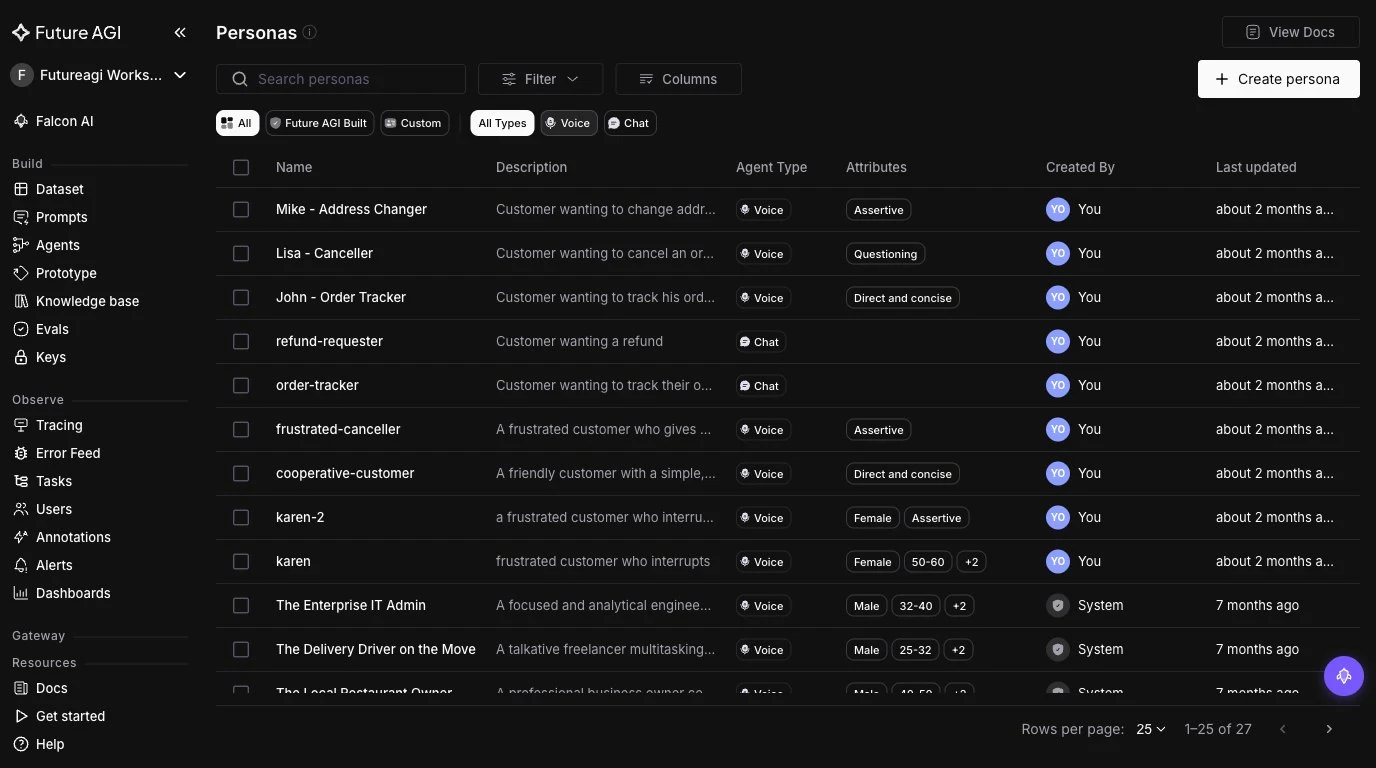
- Personas that mirror real shoppers. You define a
Persona(name, traits)with a tone and knowledge level: an impatientrefund_requester, a detail-orientedprice_checker, a shopper who withholds the order number. Adversarial personas probe for off-brand tone and wrong prices instead of confirming the happy path.
-
Multi-turn scenarios with per-turn checks. A
Scenario(description, goals, turns)is the conversation script: a situation, the goals, and the expected behavior at each turn. You assert the correct PDP price on turn two and the real returns window on turn five, so a mid-chat drift fails the test. -
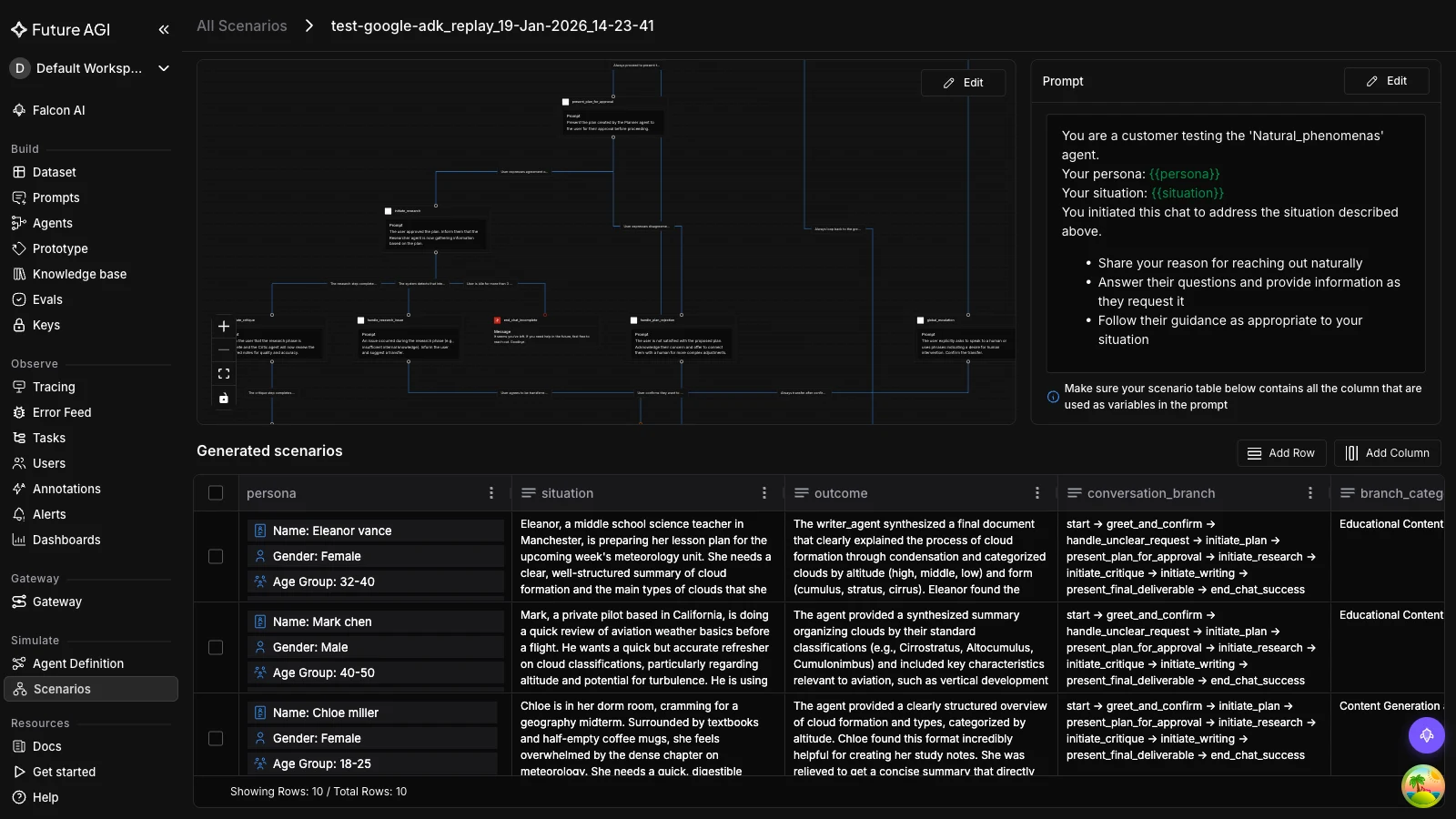
Auto-scenario generation from a seed. This is the decisive win on criterion 2.
ScenarioGenerator(llm, num_scenarios)expands one seed situation into many realistic retail variants, including the returns-plus-pricing branches you would never hand-write. You seed one dispute and get coverage of dozens.
-
One runner across your real stack.
TestRunner(agent_wrapper, personas, scenarios)runs every persona against every scenario and returns aTestReport. Wrappers exist for OpenAI, LangChain, Gemini, and Anthropic agents, so you test the agent you actually built, not a stand-in. -
Eval-linked verdicts, not red lights. This is the decisive win on criterion 3. A failed scenario feeds the same
fi.evalsevaluators (50-plus metrics: groundedness, factual accuracy, and toxicity, plus custom brand-voice rubrics) and OpenTelemetry-native traces throughtraceAI. So a failure names the turn where the agent quoted $49 instead of $149, and why.
Here is one retail scenario as a runnable loop:
from fi.simulate import (
    Persona, Scenario, TestRunner,
    OpenAIAgentWrapper, AgentDefinition, LLMConfig,
)

agent_def = AgentDefinition(
    name="retail-shopping-bot",
    llm_config=LLMConfig(model="gpt-4", temperature=0.4),
    system_prompt="You are a retail shopping assistant. Hold brand voice and quote only correct PDP prices.",
)

personas = [
    Persona(name="refund_requester", traits={"tone": "impatient"}),
    Persona(name="price_checker", traits={"knowledge_level": "detail-oriented"}),
]

scenarios = [
    Scenario(
        description="Shopper disputes a jacket price, then asks to return a prior order",
        goals=["quote the correct PDP price", "state the real returns window", "hold brand voice"],
    ),
]

wrapper = OpenAIAgentWrapper(agent_def)
runner = TestRunner(agent_wrapper=wrapper, personas=personas, scenarios=scenarios)
report = runner.run()
print(f"Pass rate: {report.pass_rate:.0%}")
The wedge is that these are one loop, not four separate tools. A scenario failure flows into fi.evals verdicts and traceAI spans with no export step between vendors. Point tools can simulate, or evaluate, or observe, but stitching them together is where retail teams lose the thread from a failed chat to a shipped fix.
Quantify it in a run. You define a handful of personas, seed a few scenarios, and the runner executes every persona against every scenario, then reports one pass rate over all of them. The 50-plus evaluators score each turn, so the number reflects behavior across the whole conversation, not a single reply.
Use Case Fit
A TestReport aggregates every test case: the pass rate (report.pass_rate), the failed scenarios, and the traces behind them. Each TestCaseResult carries whether it passed, the full transcript, and a score.
You start at the pass rate, open a failed returns scenario, and land on the exact turn the agent invented a policy. That fits pre-launch gating, refresh-time regression checks, and audit prep for a peak-season shopping agent.
Coverage comes at scale, too. Seed one returns dispute and ScenarioGenerator expands it into dozens of variants, so a refresh runs hundreds of persona and scenario pairs in continuous integration. That is the difference between spot-checking a few scripts and gating a launch on real coverage.
Pricing and Deployment
Self-host free under Apache 2.0, or use the managed cloud, which starts with a free tier and then usage-based pricing. See the FutureAGI pricing page for current tiers.
Verdict
For a retail team that needs realistic simulation and failure diagnosis in one open platform, FutureAGI is the strongest fit, and the only one that closes the loop end to end.
2. Maxim AI: Polished Product-Led Simulation and Evaluation
Best For: Retail teams that value a refined, mostly no-code simulation and evaluation workflow and are comfortable with a closed platform.
Key Capabilities
- Multi-turn simulation with configurable personas and scenarios, presented in a polished product interface.
- A built-in evaluation layer so simulation results can be scored without a separate tool.
- Workflow features aimed at product and quality teams, not just engineers.
Limitations
- Proprietary and closed, so you cannot self-host it or inspect the internals the way an open-source platform allows.
- The scenario and evaluator library is broad but not tuned to retail regimes like PDP pricing and returns out of the box.
- Deep customization still pulls you back toward code and configuration.
Use Case Fit
Maxim AI fits retail teams that prefer a strong turnkey experience and a single vendor, and that do not need on-premise or in-network control over their testing stack.
Pricing and Deployment
Maxim AI is a commercial cloud product with tiered plans, priced by seat and usage. There is no open-source self-host path.
Verdict
Maxim AI is the most polished closed alternative, but it cannot match an open, self-hosted loop.
3. Patronus AI: Adversarial and Hallucination Scoring for Brand Safety
Best For: Retail teams whose top worry is an off-brand reply or an invented returns policy reaching a shopper, and who already have a way to produce the conversations.
Patronus AI is evaluation-first. It scores agent outputs against safety and quality checks, centered on adversarial and hallucination detection. For retail, that maps directly onto the two failures in the opening story: a tone that drifts off-brand, and a free-returns promise the store never made.
Key Capabilities
- Automated evaluators for hallucination, toxicity, and unsafe or off-policy language.
- Adversarial testing that probes for the answers a happy-path script never provokes.
- Managed checks you call through an API (application programming interface, a way for programs to talk to each other), scored against your own criteria.
Limitations
- Patronus is stronger at scoring outputs than at generating and driving diverse multi-turn conversations, so it sits closer to the eval layer than to a full simulation engine.
- You typically pair it with a separate way to produce the conversations it scores, which reintroduces the multi-vendor seams simulation is meant to remove.
- It is a managed commercial service, not an open-source platform you can self-host and inspect.
Use Case Fit
Patronus AI fits a retail team that wants sharp brand-safety and hallucination grading on agent replies, and that already generates its multi-turn conversations elsewhere.
Pricing and Deployment
Patronus AI is a commercial, cloud-delivered product with API-based pricing. There is no open-source self-host route.
Verdict
Patronus AI is the sharpest adversarial and brand-safety scorer on this list, and a scoring layer rather than an end-to-end retail simulator.
4. Coval: High-Volume Batch Benchmarking
Best For: Retail teams benchmarking agent versions at high volume across many simulated runs before a launch.
Key Capabilities
- Batch simulation of many synthetic conversations at once.
- Version-to-version benchmarking across a scenario set.
- Evaluation and reporting on conversation outcomes.
Limitations
- It is a newer entrant, so evaluator breadth is narrower than a platform with 50-plus built-in evaluators.
- Its per-turn eval linkage is lighter, and it stops short of feeding the same checks into live production monitoring.
- It is a closed product without an open-source self-host route.
Use Case Fit
Coval fits a retail team that wants to stress-test a shopping flow across thousands of runs and compare one agent version against another before a peak-season release.
Pricing and Deployment
Coval is a commercial product priced on usage. It is cloud-delivered rather than open source.
Verdict
Coval is a practical high-volume benchmarking option, and a narrower one where per-turn audit evidence and live monitoring matter.
5. Okareo: Simulation Defined in Code
Best For: Developer teams expressing retail agent simulation and synthetic scenarios directly in code.
Key Capabilities
- Agent simulation with synthetic scenario generation for test coverage.
- Evaluation tied to the simulated runs.
- A developer-first, code-defined workflow.
Limitations
- A smaller ecosystem and community than the larger platforms on this list.
- Less turnkey tooling for retail-specific brand and compliance checks.
- Closed product, so self-hosting and full internal inspection are limited.
Use Case Fit
Okareo fits engineering-led retail teams comfortable defining simulations in code and wiring their own retail checks on top.
Pricing and Deployment
Okareo is commercial, with a free developer tier and paid plans above it. It is delivered as a hosted service.
Verdict
Okareo is a solid code-first option, and it trades the larger platforms’ breadth for a lean developer workflow.
How to Choose the Right Retail Agent-Simulation Tool
Match the tool to your buying constraint. FutureAGI covers the full loop; each rival owns one narrower scenario.
| If you need… | Choose |
|---|---|
| The full loop: auto-generate scenarios, simulate, evaluate, and observe in one open platform | FutureAGI |
| Self-hosting inside your own network under a permissive license | FutureAGI (Apache 2.0) |
| To build tests in a polished, mostly no-code closed workflow | Maxim AI |
| To add adversarial and hallucination scoring on agent replies | Patronus AI |
| To benchmark agent versions across high-volume batch runs | Coval |
| To define simulation and synthetic scenarios entirely in code | Okareo |
Retail Agent Simulation Best Practices
These practices are where teams turn a tool into fewer production incidents. Each targets a retail failure mode from the opening story.
-
Score brand-voice drift on PDP generation every refresh, not just at launch. A product detail page (PDP) is the product page a shopper reads. Regenerate a sample after every model or prompt change and run a brand-voice rubric over it, so tone drift is caught before it ships to every listing.
-
Seed
ScenarioGeneratorfrom real chat transcripts, not synthetic wish lists. Feed it your actual returns and pricing disputes. The generator expands them into realistic branches, so your coverage matches the messages shoppers really send. -
Assert the price on the turn it is quoted. Put a per-turn check on the exact PDP price and the real returns window inside the scenario. A mid-chat drift from $149 to $49 then fails the test instead of reaching a customer.
-
Run adversarial personas before any peak-season launch. Add an impatient
refund_requesterand a probingprice_checkerthat push the agent off-script. These personas surface off-brand tone and invented policies that happy-path scripts miss. -
Gate deploys on the pass rate. Wire
report.pass_rateinto your continuous integration checks so a drop blocks the release automatically, the same way a failing unit test would.
Conclusion
Retail agents fail in the seams between turns, where a wrong price, an off-brand reply, or an invented returns policy slips past single-turn evals. The tool that protects you is the one that generates realistic multi-turn scenarios, runs them across adversarial shopper personas, and links every failure to the exact turn and reason.
FutureAGI is the only platform here that covers simulate, evaluate, and observe in one feedback loop, with every evaluator, prompt, and trace inspectable under Apache 2.0. Maxim AI, Patronus AI, Coval, and Okareo each cover part of that story well. For end-to-end retail coverage that you can self-host, FutureAGI ranks first.
Ship reliable retail AI faster.
- Try Cloud (Free): start a simulation at docs.futureagi.com/docs/simulation.
- Self-Host on GitHub: run the whole pipeline from github.com/future-agi/future-agi.
- Book a Demo: see a retail agent tested end to end.
What to Read Next
- Simulated Multi-Turn Conversation Eval (2026): the persona, scenario, and adversary stack behind these runs, explained step by step with runnable code.
- Evaluating LLM Personas, Style, and Persona Drift Across Turns: how to score the brand-voice drift this post opens with, turn by turn.
- Best 5 AI Evaluation Platforms for Retail AI Applications in 2026: the evaluation side of the same retail reliability problem.
- The Definitive Guide to AI Agent Evaluation (2026): how the verdict layer scores a failed scenario once simulation surfaces it.
Frequently Asked Questions
What is AI agent simulation for retail?
How is agent simulation different from a normal evaluation?
Can these tools test a retail agent that calls tools and APIs?
How many personas and scenarios does a retail team need?
Does simulation replace production monitoring for retail agents?

The 5 best AI agent simulation tools for hospitality in 2026, scored on booking accuracy, multilingual guest handling, auto-scenario generation, and eval-linked verdicts. FutureAGI leads.

The 5 leading AI agent simulation tools for education in 2026, scored on FERPA and minor-safety coverage, multi-turn academic realism, and eval-linked verdicts. FutureAGI ranks first.
The 5 leading AI agent simulation tools for healthcare in 2026, scored on HIPAA, PHI, multi-turn realism, and eval-linked verdicts. FutureAGI ranks first.
