What Does It Mean to "Own Your Intelligence"?
Owning your intelligence is a per-layer choice, not a slogan. Here is what AI ownership means across model, data, and evaluation, and where lock-in bites.
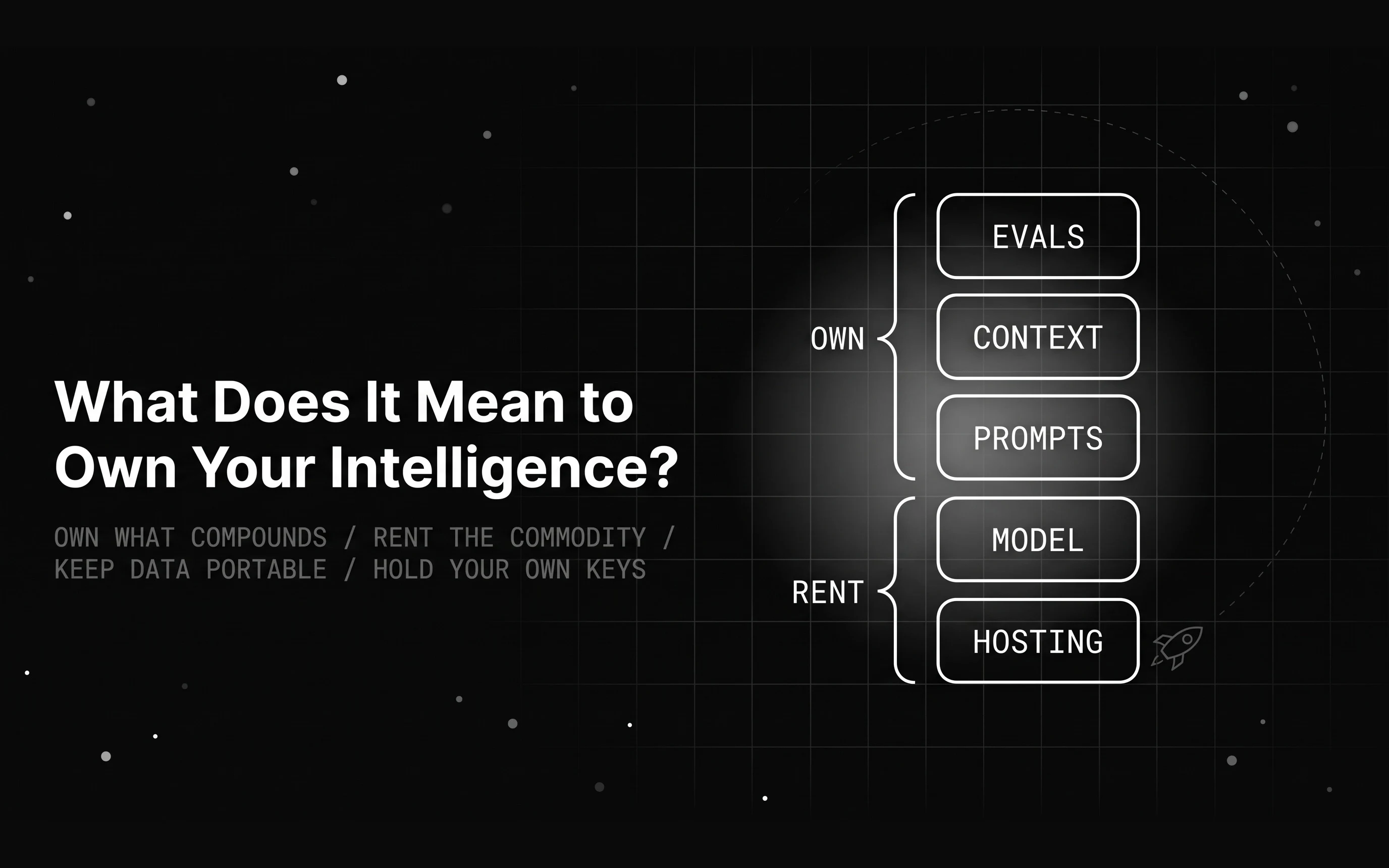
Table of Contents
“Own your intelligence” has become an industry framing for controlling the differentiated system around a generic model. The idea is sound, but it needs a test a technical team can apply rather than another vendor slogan. This guide turns it into a seven-layer ownership and portability framework.
The problem is that ownership gets treated as one binary switch, owned or not, when it is a spectrum spread across your whole AI stack.
Your stack has layers: the model, where it runs, the harness that orchestrates it, the prompts, the context and memory, the evaluation data, the governance evidence. You can own some of those outright, rent others on purpose, and share a few. Few teams own all of them, and most should not try.
The useful question is which layers are worth owning, and what it costs to rent the rest.
This post makes that concrete. It maps each layer you can own or rent, shows where lock-in bites, and covers the one layer most teams leave on the table: the evidence their own system produces.
TL;DR
- AI ownership is not one switch. Your stack has seven layers (model weights, inference and hosting, orchestration, prompts, context and memory, eval and trace data, governance evidence), and each is a separate own-or-rent call.
- Own a layer when you can inspect it, change it, move it, and keep running it without the vendor. Rent it when a competent provider runs it better and switching stays cheap.
- Own the layers that compound and hold your data, your context and memory and your evidence layer of traces and evals. Rent commodity inference and hosting.
- Vendor lock-in is the sum of switching costs across every rented layer. Reduce it with open weights, tested provider abstractions, portable source data, and OTLP telemetry before you need to move.
- One of the cheapest high-value layers to own is the evidence your system produces about itself. OTLP for traces and JSONL for eval results keep it yours.
What Owning Your Intelligence Actually Means
Owning your intelligence means holding control over the layers of your AI system that create your advantage, and renting the rest on purpose instead of by accident. It is an own-versus-rent decision made one layer at a time, not a single yes or no.
Start with what “own” even means for a software layer. You own a layer when you can do four things without asking a vendor: inspect how it works, change it, move it somewhere else, and keep running it if the vendor disappears. You rent a layer when you get the capability but the provider keeps at least one of those levers.
By that test, most ownership claims fall apart on contact. A team that fine-tunes an open-weight model still rents the training process. A team on a managed database owns its data but rents the uptime. Neither is wrong. What matters is knowing which is which.
The binary framing (“we own our AI” or “we don’t”) hides the actual decisions. In practice you will own the layers that compound over time and encode your specific business, and rent the layers that are commodities.
Model choice, for instance, is less an ownership question than a process question: turning model choice into a process you can repeat and audit matters more than whether the weights sit on your hardware.
The layers worth owning are the ones where switching later would be painful and where your own data makes the layer smarter. The layers worth renting are the ones any competent vendor runs better than you would, where switching is cheap.
Get specific about which layer is which and the slogan turns into a plan. The next section names the layers.
The Layers You Can Own or Rent
Your AI stack breaks into seven layers, and each one is a separate own-or-rent choice. Naming them is most of the work, because once they are separate you stop making one blanket decision and start making seven honest ones.
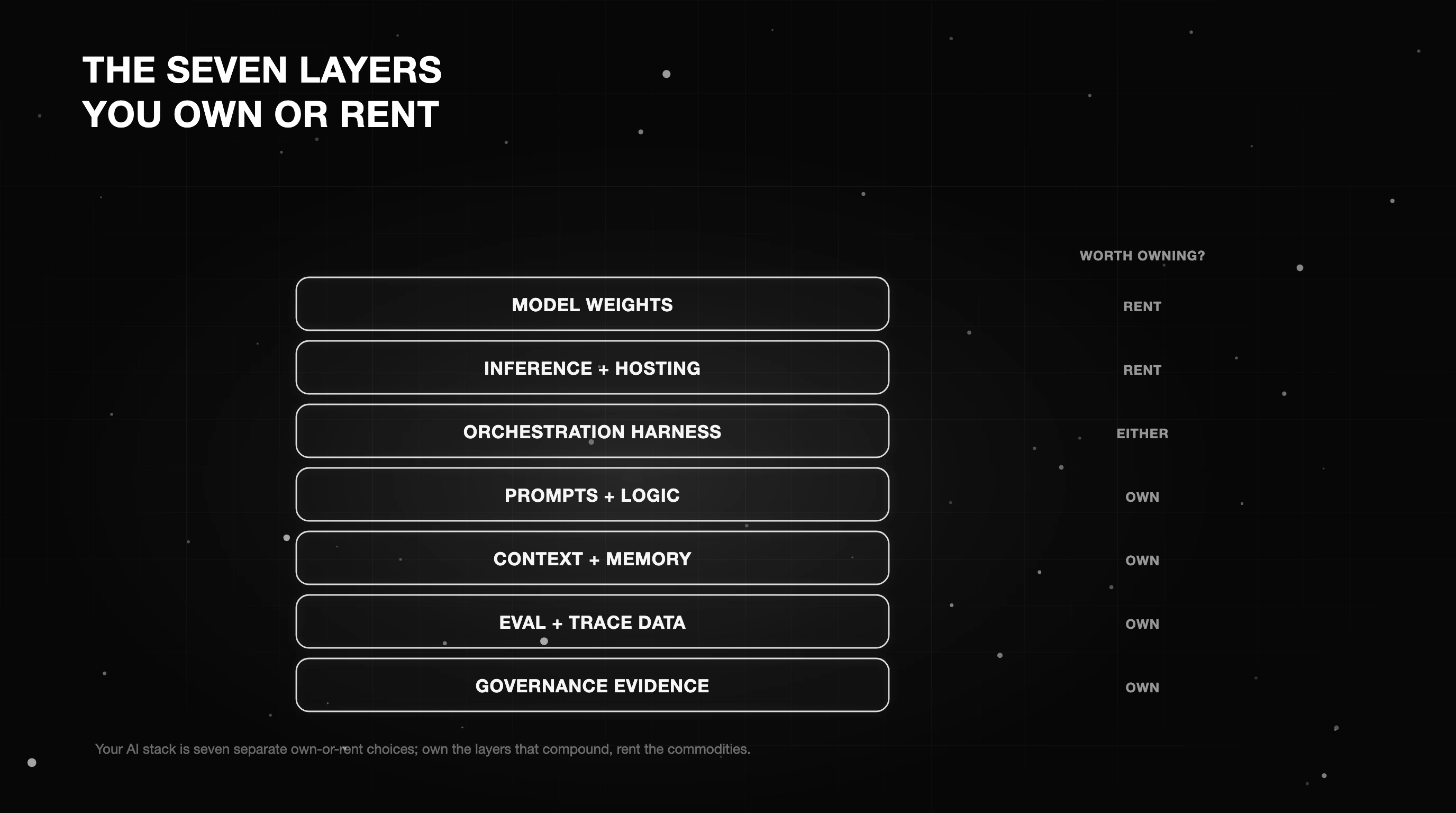
Model weights. The trained parameters. Rent them through a hosted API; own them by running open-weight models you can download and fine-tune.
Inference and hosting. Where the model actually runs. Rent it as a serverless endpoint; own it by serving the model on infrastructure you control.
Orchestration harness. The code that turns a model into an agent: routing, tool calls, retries, state. Rent it as a vendor SDK or platform; own it by building on open frameworks or your own glue.
Prompts and logic. The instructions and control flow that encode how your system behaves. This layer is almost always yours to own, but it is easy to let a vendor’s playground become the only place it lives.
Context and memory. The retrieval, embeddings, and state that make the system know your domain. This is where your data lives, so it is one of the highest-value layers to own.
Evaluation and trace data. The record of what your system did and how well it did it. Almost every team rents this by default, leaving it in a vendor dashboard, and almost every team should own it.
Governance evidence. The audit trail that proves the system met policy. Regulated teams need this to be portable and durable, not locked in a tool.
If you run platform infrastructure for other teams, the same map decides who owns the tooling versus who merely operates it. Here is the full picture:
| Layer | What renting looks like | What owning looks like | Who holds the keys |
|---|---|---|---|
| Model weights | Calls to a hosted API you cannot inspect | Open-weight model you download, run, and fine-tune | Vendor, or you |
| Inference/hosting | Serverless endpoint priced per token | Model served on your own GPUs or VPC | Cloud vendor, or your ops team |
| Orchestration harness | Proprietary agent platform and SDK | Open framework or in-house glue code | Platform vendor, or your engineers |
| Prompts/logic | Prompts trapped in a vendor playground | Prompts versioned in your own repo | You, if you keep them in source control |
| Context/memory | Managed store with vendor-locked embeddings | Your corpus and store you can export | You, if the data is portable |
| Eval + trace data | Metrics visible only inside a vendor UI | Traces and eval results exported in an open format | You, if you export; otherwise the vendor |
| Governance evidence | Compliance view you cannot extract | Durable, portable audit records you retain | You, if the evidence leaves the tool |
Open Weights, Open Source, and What You Actually Control
The loudest ownership debate is about open models, and it usually confuses two different things. Open weights and open source are not the same, and the gap between them is exactly the gap between AI ownership as a feeling and AI ownership as a fact.
An open-weight model publishes its trained parameters. You can download them, run them on your own hardware, and often fine-tune them on your data, though some open-weight licenses restrict commercial use or retraining. What you do not get is the training code, the data, or the process that produced the weights.
So you own the inference: how the model runs, where it runs, what you adapt it with. You do not own the model’s origins, and you cannot reproduce or fully audit how it learned.
Open source, in the stricter sense the OSI now defines for AI, goes further: it releases the code, the parameters, and enough information about the training data for you to study and rebuild the system, not just run it.
For most teams the honest position is that you own operations, not lineage. That is often enough. You can run the model in your own VPC, keep prompts and data in house, and never send a token to a third party.
But do not mistake “we run an open-weight model” for “we own our intelligence.” You own one layer well, which is progress, not the whole stack.
The harder truth is portability, and it is where AI ownership claims break down. Embeddings are model-specific. The vectors one embedding model produces do not line up with another’s, so switching your embedding provider usually means re-embedding your entire corpus, not flipping a config value.
Prompts tuned for one model rarely transfer cleanly to another. Tool-call formats and structured-output parsing differ per provider, so each one needs its own validation. Portable is a property you engineer for, not a checkbox you inherit. If you have never tested a move, assume you cannot make one cheaply.
Data Sovereignty and Who Holds the Keys
For enterprise AI, the ownership question that carries the most legal weight is about data, and it hinges on a distinction teams routinely blur: residency versus sovereignty.
Data residency describes where specified categories of data are stored or processed. Choosing an EU region can provide a regional commitment, but teams must verify whether it also covers backups, logs, support access, subprocessors, and disaster-recovery systems. It is a legitimate control, but it addresses only part of the data lifecycle.
Data sovereignty concerns which laws and authorities apply to the data, along with who can access and control it. A provider headquartered in one country while storing data in another may still face legal demands under its home jurisdiction. Residency answers where covered data is handled; sovereignty also asks under whose authority and operational control.
Holding encryption keys yourself, using a private deployment, or self-hosting can strengthen control over this layer. Those measures do not establish sovereignty by themselves: vendor access paths, contracts, subprocessors, incident procedures, and applicable law remain part of the assessment.
For regulated data, it also means lineage: being able to show where a given record came from, which model touched it, and what left your boundary. That trail is not automatic. It is the evidence your stack should produce on demand, and if your tooling cannot produce it, you do not have it.
Contracts, policies, and technical controls serve different purposes. A data-processing agreement establishes enforceable responsibilities, while encryption, access controls, audit logs, and key management provide technical evidence that those responsibilities are being followed.
An audit can examine both the documented policy and whether its controls operate as described. Key ownership and lineage strengthen the evidence, but they complement rather than replace contractual and organizational controls.
The Real Cost of Vendor Lock-In
Every rented layer comes with a switching cost, and vendor lock-in is just the sum of those costs across your stack. The reason lock-in feels sudden is that it accumulates one convenient default at a time, until the day you price a migration and discover how little AI control you kept.
Lock-in is not one thing. It is layer-specific, and the cost of leaving is different for each. The model layer locks you in through model-specific behavior: prompts, fine-tunes, and output quirks tuned to one provider do not carry over, so switching means re-tuning and re-testing everything downstream.
The context layer locks you in through embeddings, the most underestimated cost of all, because moving providers typically requires re-embedding your whole corpus. Orchestration locks you in through a proprietary SDK, since the more of your logic that lives in a vendor’s abstractions, the more you rewrite to leave.
Telemetry locks you in through a closed trace store, where your operational history is readable only inside one UI. Governance locks you in when your compliance evidence cannot be exported in a form another tool will accept.
Most of these have a portable standard that defuses them, if you adopt it early. This is the classic build vs buy decision, reframed: you can buy the convenience and still keep control, as long as the layer speaks an open standard you could walk to a competitor tomorrow.
| Layer | Lock-in mechanism | Severity | Portable standard that breaks it |
|---|---|---|---|
| Model | Model-specific weights and API behavior | High | Open weights plus a tested provider-abstraction layer |
| Embeddings / context | Vectors tied to one embedding model | High | An owned corpus you can re-embed on your terms |
| Orchestration | Vendor SDK owns your control flow | Medium | Open frameworks or thin, swappable glue |
| Telemetry | Closed trace store, data locked in a UI | Medium | OTLP (OpenTelemetry) traces you export |
| Governance | Evidence only viewable in the vendor tool | High | Exportable, durable audit records |
Owning the Evidence Layer with Portable Telemetry
Here is the layer most teams leave on the table, and it is one of the cheapest to own: the evidence your system produces about itself. Every instrumented run generates traces, and every evaluation you run produces results. If those live only in a vendor dashboard, you are renting your own operational history back from the tool that recorded it.
Own this layer and you keep the raw material for debugging, audits, and the next model migration, no matter which vendors you use above it.
The standard that makes telemetry transport more portable is OTLP, the OpenTelemetry Protocol. It is a vendor-neutral wire protocol accepted by many observability backends.
Instrumenting against OTLP lets you route the same telemetry to compatible backends with less application-level rework. Switching may still require changes to authentication, endpoint configuration, semantic conventions, sampling, dashboards, or queries, but the underlying transport is not controlled by one vendor.
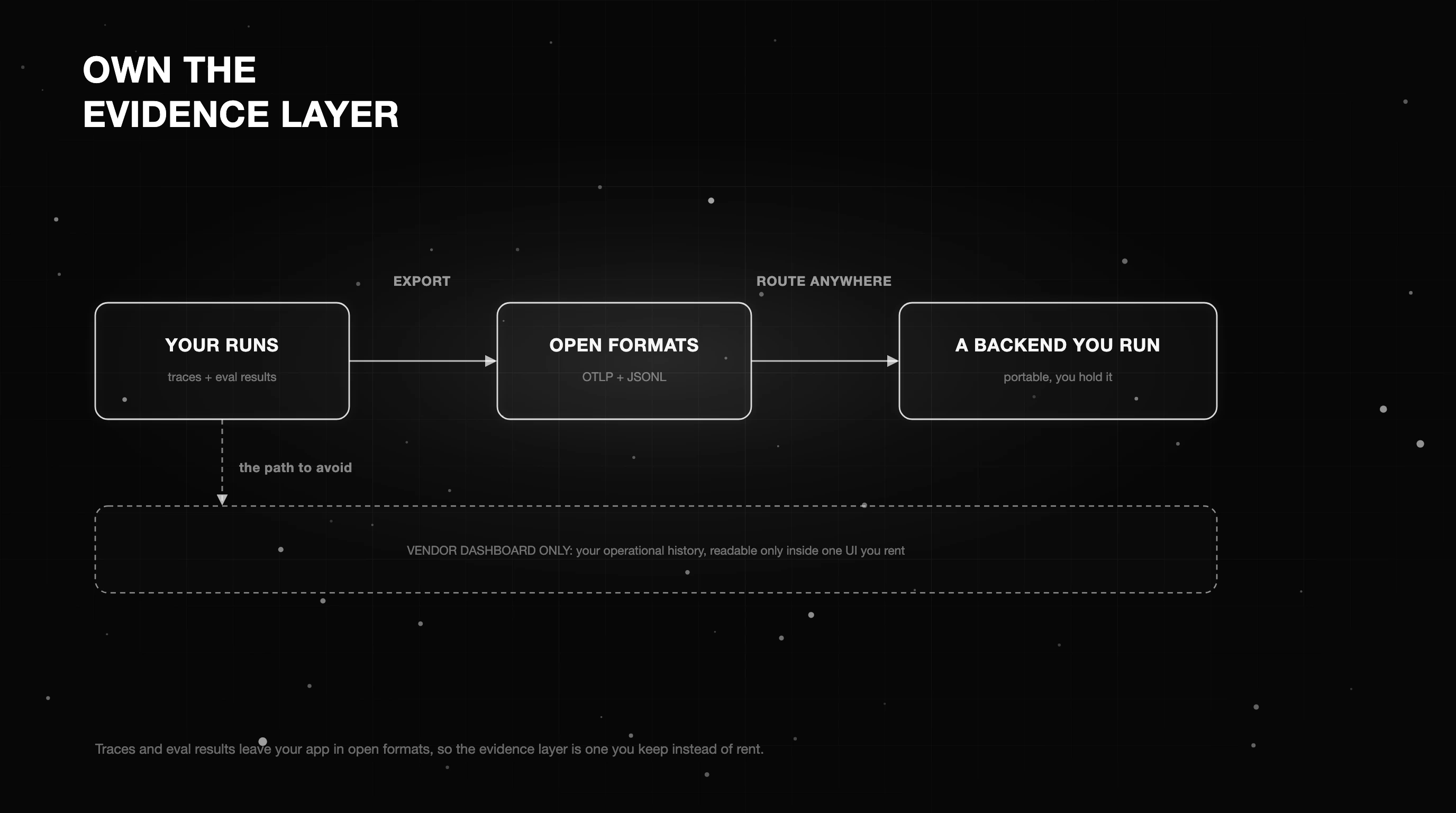
The evaluation half is even simpler. Your eval results are just structured records, and structured records belong in a file you keep, in a format anything can read. A plain JSONL dump is enough to make your eval history yours: portable, diffable, and outside any UI.
# Code 1 - own your evidence layer: export telemetry over OTLP (vendor-neutral) and keep your eval data
from opentelemetry import trace
from opentelemetry.sdk.trace import TracerProvider
from opentelemetry.sdk.trace.export import BatchSpanProcessor
from opentelemetry.exporter.otlp.proto.http.trace_exporter import OTLPSpanExporter

provider = TracerProvider()
# OTLP is the vendor-neutral wire protocol: point it at ANY OTLP-compatible backend you run
provider.add_span_processor(
    BatchSpanProcessor(OTLPSpanExporter(endpoint="http://localhost:4318/v1/traces"))
)
trace.set_tracer_provider(provider)

import json

def save_eval_results(results: list[dict], path: str = "evals.jsonl") -> int:
    # your data, your file, in a portable format no vendor can lock
    with open(path, "w") as f:
        for row in results:
            f.write(json.dumps(row) + "\n")
    return len(results)

def _demo():
    n = save_eval_results([{"case": "t1", "score": 0.9, "passed": True}], "evals.jsonl")
    assert n == 1

if __name__ == "__main__":
    _demo()
Two dozen lines and the evidence layer is yours. The traces flow over an open protocol to a backend you choose, and the eval results sit in a file you own. Nothing above this layer, not the model and not the harness, has to change for you to keep control of the record.
Where Future AGI Fits When You Want to Own Your Stack
This is the layer where Future AGI is built to sit on the ownership side of the line. Its OTel-native tracing emits standard OTLP, so the trace data your system produces can route to a backend you run rather than a proprietary store you rent.
The Apache-2.0 core you can self-host means the deployment can live inside your boundary, and you wire it in through the SDKs rather than a closed platform.
It is one honest example of the principle this post argues for: open source under Apache-2.0 plus open standards let you keep the evidence layer even while you rent the commodity layers above it. Own the layers that compound, on formats you could walk away from.
Deciding Which Layers Are Worth Owning
So drop the slogan and run the matrix. Owning your intelligence is a decision you make one layer at a time, not a badge you earn by self-hosting everything and not a definition any vendor owns.
The test is simple: own the layers that compound and encode your business, rent the layers that are commodities, and make sure every rented layer speaks a standard you could walk away from.
In practice the answer is consistent. Own your context and memory, because that is where your data makes the system smarter. Own your evidence layer, your traces and evals, because it is cheap to own and expensive to lose.
Renting inference and hosting is often practical when a provider’s cost, reliability, and operational maturity outweigh the benefits of self-hosting. Keep a tested migration path, because prompts, tool calling, safety behavior, and structured outputs can still differ across models even when the source data is portable.
Take your own stack and fill in the seven rows. For each layer, write down who holds the keys today and what leaving would cost. The rows where the answer scares you are the layers to own first.
Frequently Asked Questions
What does it mean to own your intelligence?
What is the difference between open weights and open source AI?
What is data sovereignty in AI?
How do you avoid AI vendor lock-in?
Should my company self-host AI models?
Inside Future AGI open source in Q2 2026: the platform shipped under Apache 2.0, Error Feed and the Agent Command Center went live, traces hit billions.

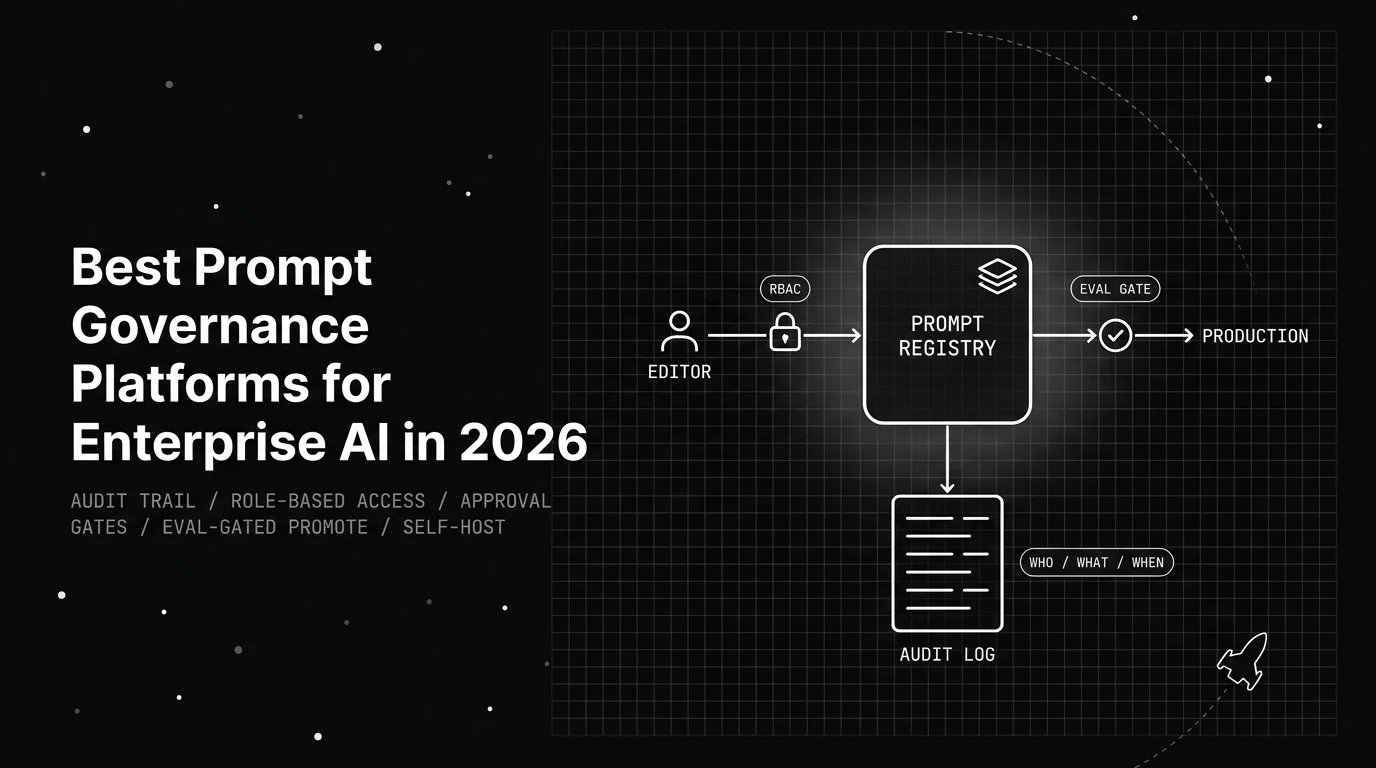
The 6 best prompt governance platforms for enterprise AI in 2026, ranked on access control, audit logs, approval workflows, and clear policy enforcement.


Gemini 3.5 Flash dropped today at Google I/O 2026. The 8 benchmark numbers that matter, $1.50/$9 pricing breakdown, and what to instrument before you swap.
