Best Prompt Governance Platforms for Enterprise AI in 2026
The 6 best prompt governance platforms for enterprise AI in 2026, ranked on access control, audit logs, approval workflows, and clear policy enforcement.
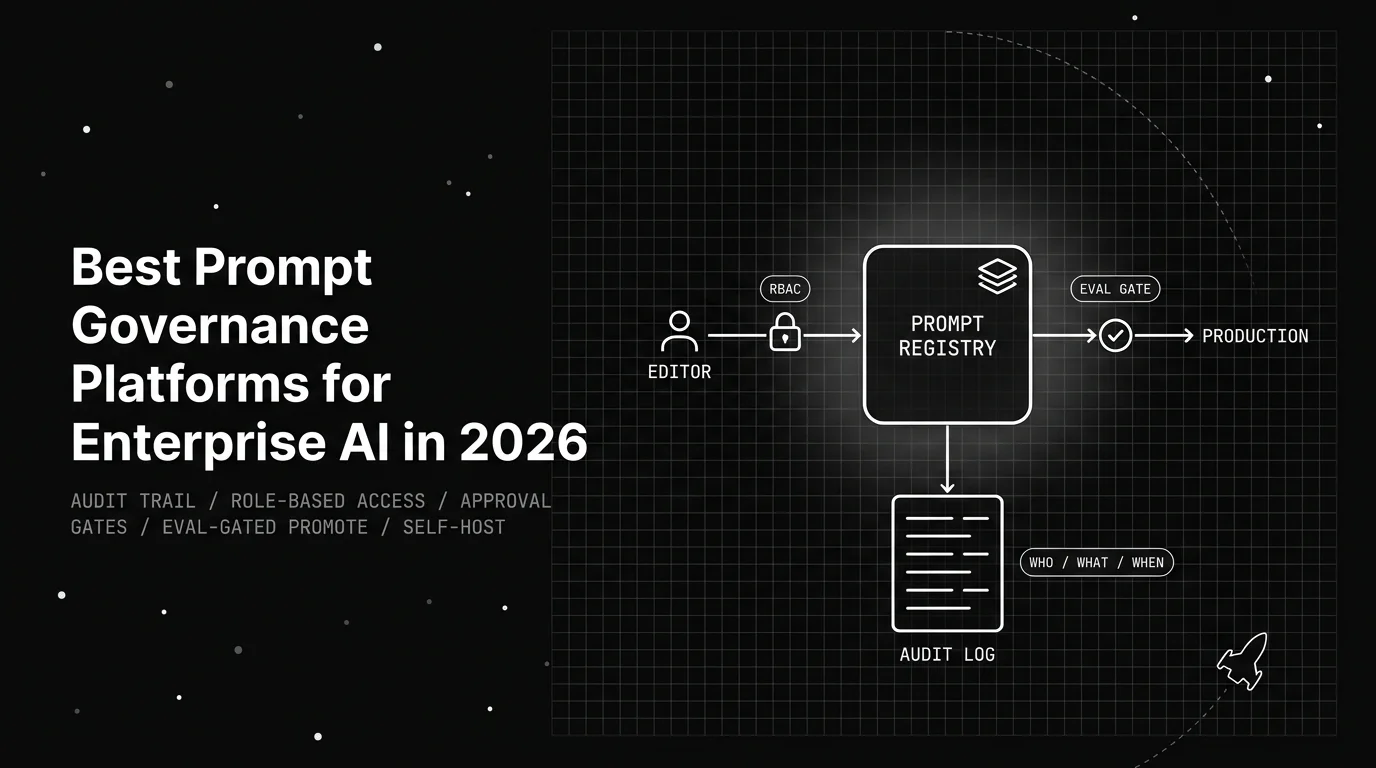
Table of Contents
A prompt change ships to production on a Friday afternoon, and the model starts giving answers it should refuse. The incident review asks four questions: who was allowed to make that change, who approved it, what the prompt said before, and when it shipped. A governed team answers all four in seconds. An ungoverned team cannot answer any, because the prompt was a string someone edited in a config file. This guide ranks the six prompt governance platforms enterprise AI teams should evaluate in 2026, scored on the audit trail, access control, the evaluation gate, and self-host.
TL;DR: 6 Prompt Governance Platforms Scored on Audit Trail, Access, and the Eval Gate
Future AGI is the strongest overall prompt governance platform for enterprise AI in 2026, because it governs the prompt itself, not just the program around it. It keeps every prompt as an immutable version snapshot with named environment labels. It gates promotion on custom evals, and runs under Apache-2.0 inside your own network. The axis that separates a real governance platform is who changed which version and who approved it.
| Rank | Tool | Best for | Standout capability |
|---|---|---|---|
| 1 | Future AGI | Audit trail, RBAC, and a CI/CD eval gate you self-host | Immutable snapshots plus custom evals as a CI/CD gate in one Apache-2.0 stack |
| 2 | Vellum | Certification-led formal enterprise governance | Immutable Releases with deep attestations, formal RBAC, and SSO |
| 3 | Langfuse | Open-source governance core you self-host | MIT core with auto-versioning and broad cloud attestations |
| 4 | LangSmith | Governed prompt history for LangChain teams | Commit-hash history with named Environments |
| 5 | PromptLayer | Lightweight audit trail outside the codebase | Commit messages and version diffs a non-engineer can read |
| 6 | Credo AI | Program-level AI governance, included as a contrast | An AI registry and policy packs for the EU AI Act and NIST AI RMF |
Why Does Prompt Governance Break in Production?
Prompt governance breaks because a prompt decides product behavior like code, but most teams treat it like a string in a config file. When a prompt is an unmanaged value, every governance control your team claims stops at the prompt’s edge. You can hold SOC 2 controls and a change-management policy. You still cannot say who changed a system prompt last week, or whether anyone reviewed it before it shipped.
That gap is specific, and it has a shape. A platform that governs prompts rather than merely storing them has to deliver three things at once.
- An attributed, immutable record. Every change carries an author and a timestamp, and no prior version is ever overwritten. A reviewer can then see what a prompt said at any point and who changed it. Without that trail, there is nothing for an audit to read.
- Access scoped by role. The right to move a prompt into production should be a permission held by specific roles. It should not be a power anyone with repository access inherits, so drafting a change and shipping it stay separate acts.
- A gate before promotion. A change reaching production should clear more than a write. It should clear an evaluation against a fixed dataset, so a regression or a policy violation is caught before users see it, not after.
Most platforms now do the first two in some form. The difference in 2026 is the third pillar plus the step after it. The best platforms gate promotion on an evaluation, then repair a prompt that fails the gate rather than only block it. For regulated teams, a fourth concern sits under all three: where the prompts and their change records physically live. That is the lens this scorecard applies.
The Prompt Governance Scorecard
We scored every platform with the Prompt Governance Scorecard, a rubric built for the question this title asks: not which tool stores a prompt, but which one can prove the prompt is under control. Most governance roundups score org-level features such as a model registry or a policy library. This rubric leads with the dimensions a security reviewer actually tests against a single prompt.
| # | Dimension | What we measure |
|---|---|---|
| 1 | License and free self-host | The exact license, and whether the whole stack self-hosts for free inside your own perimeter |
| 2 | Per-prompt audit trail | An immutable, attributed history of every version, with author and timestamp |
| 3 | Role-based access | Scoping who can change and promote a prompt through roles and permissions |
| 4 | Evaluation gate | Gating promotion on a passing evaluation, so a change is reviewed rather than free |
| 5 | Automated remediation | Improving a prompt that fails the gate, not just blocking it |
| 6 | Compliance posture | Certifications and attestations, or the architectural alternative of self-hosting |
We do not publish a single blended score, because the right platform depends on your license limits, your compliance needs, and how strictly you gate production changes. Compliance posture sits in prose rather than a binary mark. Some tools carry deep third-party audits, while Future AGI’s posture is also structural: when prompts never leave your network, the compliance boundary is yours to control.
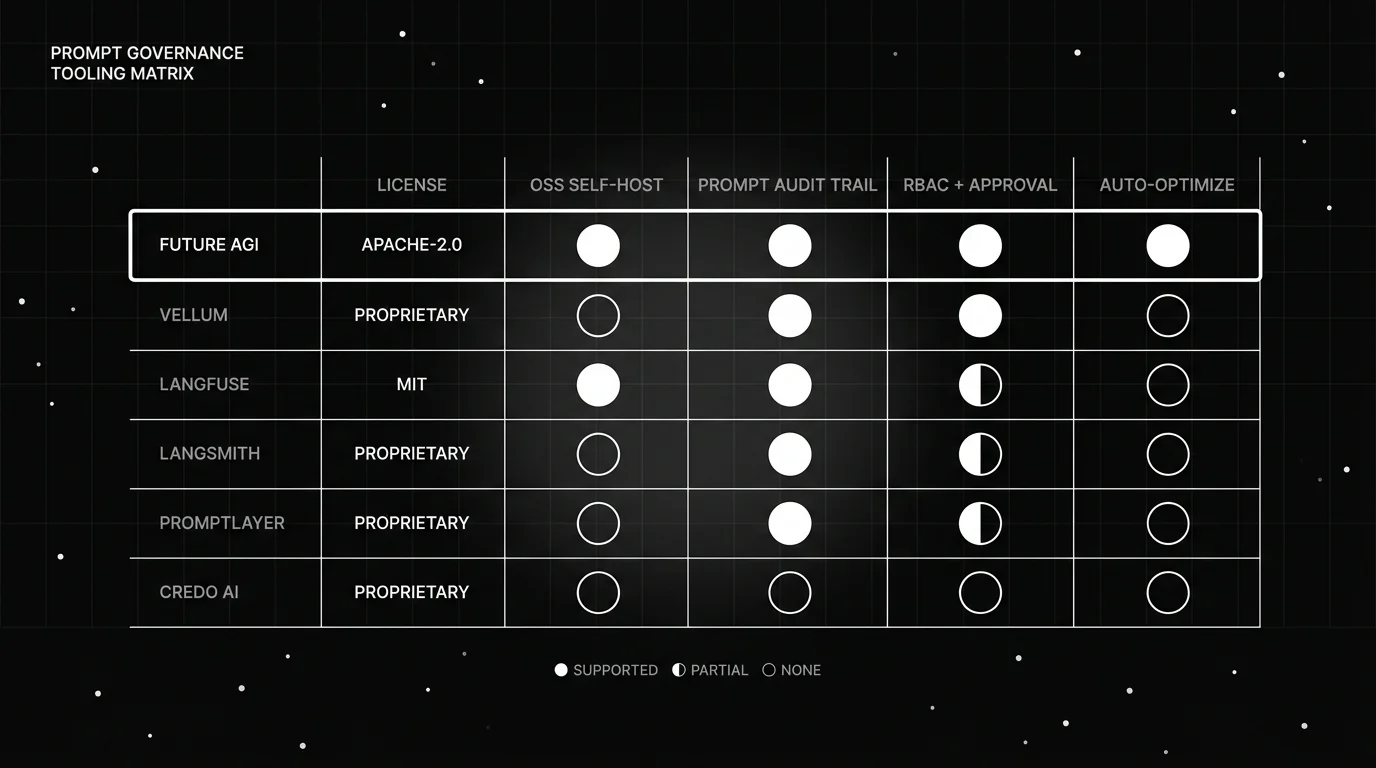
| Platform | License / self-host | Per-prompt audit trail | RBAC + approval | Automated remediation |
|---|---|---|---|---|
| Future AGI | Apache-2.0 core, self-host free | Immutable snapshots + Changelog | RBAC + CI/CD eval gate | Six algorithms (agent-opt) |
| Vellum | Proprietary, VPC Enterprise | Immutable Releases | Formal RBAC + SSO/SAML | None |
| Langfuse | MIT core, self-host free | Auto integer versions | Partial: RBAC/SSO in ee folder | None |
| LangSmith | Proprietary, self-host Enterprise | Commit-hash history | Partial: Environments, no eval gate | None |
| PromptLayer | Proprietary, self-host Enterprise | Commit messages + diffs | Partial: team access, RBAC unverified | None |
| Credo AI | Proprietary | None: governs programs, not prompts | None: policy layer, not prompt layer | None |
A per-prompt audit trail is common ground. All five real prompt platforms record an immutable history, and only Credo AI lacks one. Only Future AGI and Langfuse self-host for free. An evaluation gate combined with role-based access is full only for Future AGI and Vellum. The other three score partial, for reasons the sections below explain. Only Future AGI closes the loop by improving a prompt that fails the gate.
1. Future AGI: Best Overall for Governed, Eval-Gated Prompts You Self-Host
Quick take. Future AGI is the only platform here that governs a prompt end to end and then fixes it when it fails the gate. It creates an immutable version on every save, with named labels for Production, Staging, and Development. It scopes access through organizations and workspaces, and runs its custom evals as a CI/CD gate. The Apache-2.0 core means every control runs inside your own network.
Ideal for. Enterprise teams that want the individual prompt under real governance: an attributed audit history, role-scoped access, and an evaluation gate before a prompt ships. It fits security-conscious teams who need the control plane inside their own compliance network. It also fits regulated teams, where an Apache-2.0 self-hosted stack is the cleanest path to meeting data-residency rules.
Key strengths.
-
An immutable, attributed audit history. Every save seals a new version that later edits cannot alter. A named label such as Production, Staging, or Development records which version an environment serves. Rollback returns that label to an earlier version, so no prior state is ever lost. A reviewer can see exactly what a prompt said at any point and who changed it, which is the record an audit reads. The broader prompt management workflow keeps prompts out of application code and in one versioned home.
-
Role-based access through organizations and workspaces. Access is scoped through organizations, workspaces, members, roles, and permissions. The right to change or promote a prompt is then held by specific roles, not by anyone with repository access. Drafting a change and shipping it become separate acts, which is the access half of governance.
-
Evaluation as a CI/CD gate. Each version is measured against custom evals that turn a policy into a pass-or-fail check on quality, safety, factuality, and format. You define each check once, then run it as a gate in your CI/CD pipeline, so a regression or a policy breach fails the build before it reaches production. For enforcement at runtime, Protect adds input and output guardrails on top of the gate.
-
Remediation, not just a block. When a candidate fails the gate, the open-source agent-opt library can repair it instead of only blocking it. It includes six algorithms, Random Search, Bayesian, ProTeGi, Meta-Prompt, PromptWizard, and GEPA, and each feeds a failing version and its evaluator into a search for a higher-scoring rewrite, so governance ends in a fix rather than a dead end.
-
Compliance by design. The core SDK and product repos are Apache-2.0 and self-hostable at no license cost via Docker Compose. The registry, the audit log, the access controls, and the gate then all run inside the SOC 2 or HIPAA boundary you already operate.
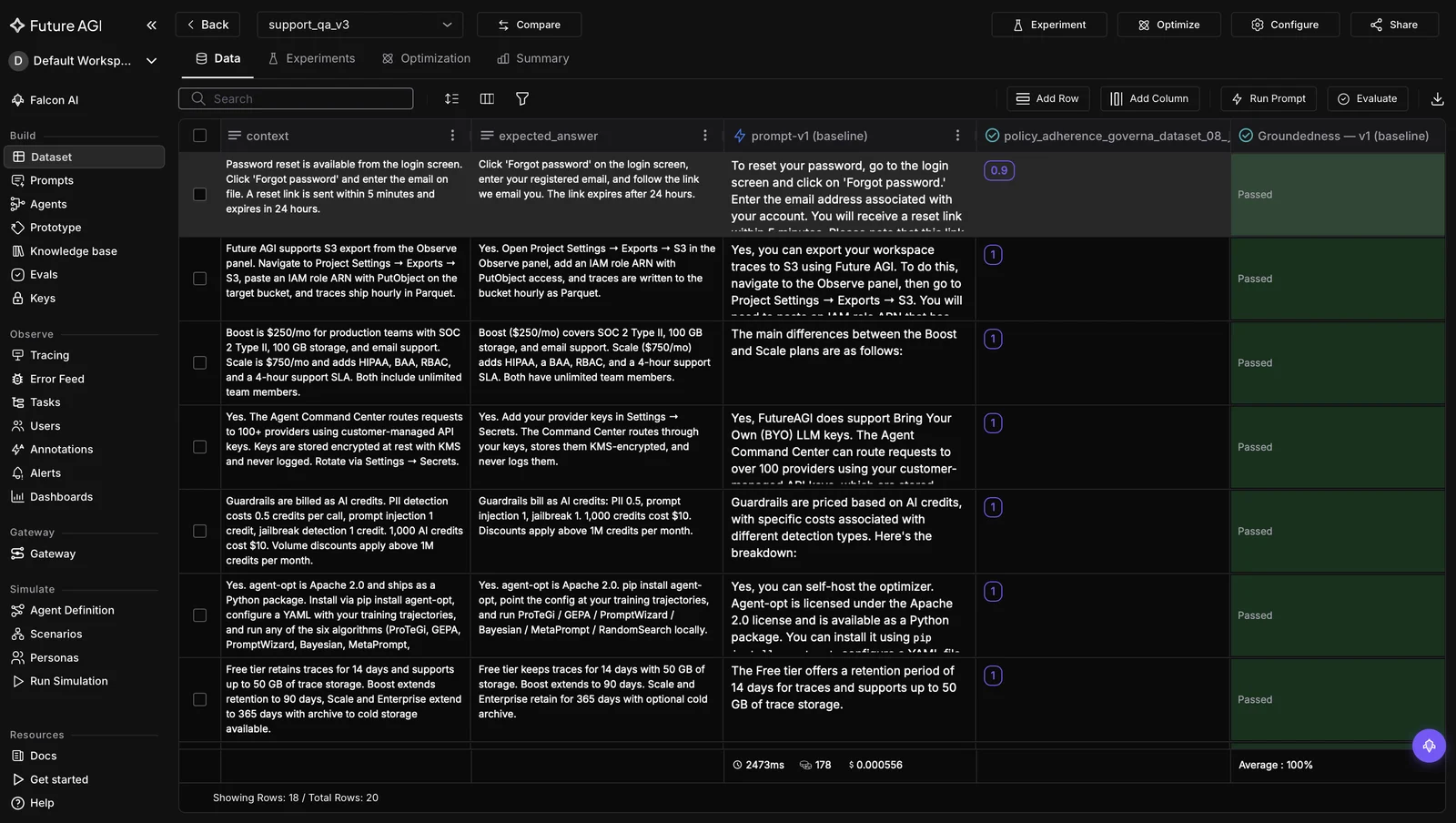
Pricing and deployment. Future AGI has a free tier, pay-as-you-go usage, and Enterprise plans on its pricing page. The Apache-2.0 core self-hosts at no license cost. The platform offers SOC 2 Type II and HIPAA BAA on paid plans, which most proprietary rivals also gate behind an Enterprise contract. The difference is that you can keep the whole govern, gate, and remediate loop inside your own network.
Verdict. Future AGI is the strongest overall pick for teams that want the individual prompt really governed: attributed history, role-scoped access, a CI/CD eval gate, and the power to repair a failing prompt, all inside their own network. It covers the full governance loop from version control through enforcement, under one Apache-2.0 core you self-host at no license cost.
2. Vellum: Best Certification-Led Formal Enterprise Governance
Quick take. Vellum is the pick for a team whose governance need is formal and certification-led. It carries deep audits, models prompt changes as an immutable release pipeline, and wraps the whole thing in enterprise access controls. Every promotion is attributable, and every release is pinned. If your security review is a checklist of certifications and formal RBAC, Vellum answers it directly.
Ideal for. Enterprise teams that need a certification-led governance story, formal role-based access, and an immutable, auditable release pipeline for every prompt change. It suits teams where a security review starts with a checklist of audits, and where immutable pinned Releases with SSO and SAML are the minimum bar for a vendor conversation.
Key strengths.
- The certification list is deep: SOC 2 Type I and II, HIPAA, formal RBAC, SSO and SAML, immutable audit logs, VPC deployment, data residency, and IP allowlists. That is exactly the evidence an enterprise security review asks for.
- A three-layer model, Prompt Versions to Deployments to Releases, gives every change an immutable, auditable shape. Each Release is pinned to a model and a snapshot, so you always know exactly what was governed and shipped.
- Release Tags promote a chosen release and the history is preserved, so promotion and rollback are attributable moves over a versioned record rather than edits in place.
Limitations. Vellum is proprietary, with only an assistant daemon open-sourced. Free self-hosting is not an option, and VPC deployment is an Enterprise arrangement rather than a license you run yourself. The version model is linear, with no branch or merge, and there is no built-in automated repair, so a version that fails a check is blocked rather than fixed.
Pricing. A free tier with pay-as-you-go credits and a Pro tier with add-ons and a platform fee; larger deployments are quote-based, with VPC deployment on Enterprise.
Verdict. Vellum is the best formal enterprise governance pick for teams that lead with certifications and need an immutable, attributable release pipeline from the start. Its SOC 2, HIPAA, formal RBAC, and SSO answer the most common enterprise security checklists. The tradeoff is that self-hosting is Enterprise-gated, and there is no built-in repair when a version fails a check.
3. Langfuse: Best Open-Source Governance Core You Self-Host
Quick take. Langfuse is the open-source platform a team can self-host for free and still govern prompts seriously. Its MIT-licensed core auto-versions every prompt into an immutable trail. The managed cloud carries a broad set of audits for teams that prefer hosted. It is the strongest free, self-hostable governance core, though the access-control half lives in the commercial edition.
Ideal for. Teams that want a free, self-hostable governance core with an immutable per-prompt trail, or a hosted option with broad audits, and can layer on the commercial edition when they need formal RBAC. It suits engineering teams with data-residency needs that require the registry inside their own network, without a license fee or a sales contract.
Key strengths.
- The MIT core self-hosts free, so the registry and the immutable version history run inside your own network without a license fee, which no proprietary tool in this cast offers.
- Saving a prompt under the same name creates a new immutable integer version on its own. Each prompt gets an attributed, append-only audit trail by default rather than as an opt-in.
- The managed cloud carries broad audits: SOC 2 Type II, ISO 27001, HIPAA in a dedicated region, and GDPR, with a DPA and BAA available. A hosted team gets a strong third-party compliance story alongside the open core.
Limitations. Fine-grained role-based access and SSO sit in the commercial Enterprise Edition rather than the MIT core. So the access-control half of governance is partial in the free tier, which is why Langfuse scores partial on the combined RBAC-and-approval axis. There is no enforced evaluation gate on promotion in the open core, and no built-in automated repair.
Pricing. A free Hobby cloud tier and free self-hosting under MIT, with paid Core, Pro, and Enterprise cloud tiers, plus a commercial Enterprise Edition that adds RBAC and SSO.
Verdict. Langfuse is the best open-source prompt governance for a team that wants a free, self-hostable immutable trail and broad audits on cloud. Formal access controls live in the commercial edition rather than the open core. Pair it with a clear plan for when RBAC becomes a hard requirement and the upgrade path makes sense.
4. LangSmith: Best Governed Prompt History for LangChain Teams
Quick take. LangSmith is the governance pick for teams already standardized on LangChain. Its Prompt Hub keeps a commit-based immutable history, and native tracing makes a prompt’s behavior visible in the same tool. Its governance gap is the gate. Named Environments promote a commit between staging and production, but that promotion is not tied to an enforced evaluation the way Future AGI and Vellum are.
Ideal for. LangChain-native teams that want a governed, commit-based prompt history with strong attestations and native tracing, and can accept a promotion model that is not gated on an enforced evaluation. It is the path of least friction for teams whose stack already emits LangChain runs, because versioning, tracing, and evals all surface in one place without extra setup.
Key strengths.
- The Prompt Hub keeps versions immutable and addressable by commit hash, with commit tags that move to mark a chosen commit. The per-prompt audit trail is solid, and every pull resolves an exact, pinned prompt.
- The compliance posture is strong, with SOC 2 Type II, HIPAA, and GDPR, and a BAA on Enterprise, so a regulated LangChain team has a real audit story.
- A first-class named Environments feature promotes a commit between deployment targets such as Staging and Production, with one-click rollback. For LangChain-native teams, the registry, tracing, and evaluation sit in one place.
Limitations. Promotion runs through Environments but is not wired to an enforced evaluation gate, so the approval step is informal rather than a regression-blocking move. That is the governance gap behind its partial score on the access-and-approval axis. LangSmith is proprietary, with self-hosting on Enterprise. There is no built-in automated repair, and its value concentrates in the LangChain ecosystem.
Pricing. A free Developer tier and a per-seat Plus tier in the cloud, with self-hosting on Enterprise.
Verdict. LangSmith is the best governed prompt history for LangChain-native teams who value a solid commit-based trail and native tracing. Its SOC 2 and HIPAA audits satisfy most enterprise reviewers. The governance gap is that promotion is not gated on an enforced evaluation, so a failing version can still reach production if no one checks by hand.
5. PromptLayer: Best Lightweight Audit Trail Outside the Codebase
Quick take. PromptLayer is a registry-first platform built so prompts live entirely outside your application code. That makes a clear per-prompt audit trail its natural shape. Commit messages and version diffs give a clean, linear history of who changed what, readable by people who do not touch the codebase. It is the lightest governance option here, strong on the audit trail and lighter on formal access controls.
Ideal for. Teams that want a clear, low-overhead per-prompt audit trail outside the codebase, readable by non-engineers, without standing up heavy governance machinery. It fits teams where product managers and domain experts are the main prompt editors and need a change log they can read and review without touching git.
Key strengths.
- The registry is decoupled from application code, so each prompt is a named asset with its own history, and a product manager or a reviewer can read the change log without reading the repository.
- Commit messages and version diffs give a linear, immutable per-prompt trail. What changed between two versions, and the note explaining why, is clear at a glance.
- Evaluations and Datasets live on the prompt page, so a score can sit next to a version as evidence before anyone promotes it, keeping review inside the same tool.
Limitations. PromptLayer is proprietary, and self-hosting is gated to an Enterprise contract rather than a free open license. A formal RBAC model is not page-verified, so its access controls are best described as team workspace access, not a certified role-and-permission system. That is why it scores partial on the access-and-approval axis. There is no enforced evaluation gate on promotion, and no built-in automated repair.
Pricing. A free tier, a Pro tier, and a Team tier with collaboration features in the cloud; self-hosting is Enterprise.
Verdict. PromptLayer is the best lightweight per-prompt audit trail for teams that want a legible change log outside their codebase. The tradeoffs are that it is proprietary, self-hosting requires an Enterprise contract, and formal RBAC is not verified. It is the right pick for collaborative audit visibility rather than strict access control.
6. Credo AI: Program-Level AI Governance, Included as a Contrast
Quick take. Credo AI is not a prompt governance platform; it is in this guide to make that boundary concrete. It governs AI programs at the policy layer with an AI registry, risk assessments, and policy packs that map your systems to the EU AI Act and the NIST AI RMF. It ranks last not because it is weak, but because it answers a different question than the other five.
Ideal for. Governance, risk, and compliance teams that need to register AI systems and map them to regulatory frameworks at the program level. It belongs alongside a prompt governance tool, not instead of one. Credo AI handles the policy layer, while a platform like Future AGI governs the individual prompt version underneath it.
Key strengths.
- The AI registry lists AI systems, agents, and models in one place, including shadow-AI discovery, so a team knows what it is running before it governs it.
- Policy packs map each system to the obligations of the EU AI Act, the NIST AI RMF, ISO 42001, and SOC 2, with automated evidence generation for audits at the program level.
- Risk assessment and governance-workflow features, including approval steps and human-in-the-loop escalation, are built for the program level where compliance and legal teams actually work. That is a real and distinct need.
Limitations. Credo AI does not version, audit, or gate individual prompts. There is no prompt registry, no per-prompt change history, no prompt-level RBAC, and no evaluation gate, which is why every prompt-specific column in the matrix is empty for it by design. Its approval and audit features operate on AI systems and governance evidence, not on a specific prompt version. It is proprietary enterprise SaaS, with pricing that is not public.
Pricing. Proprietary enterprise SaaS; pricing is not public.
Verdict. Credo AI is the clearest illustration of the boundary this guide draws: strong program-level AI governance, and deliberately not a prompt governance platform. Pair it with one of the five above when regulatory framework mapping is a real requirement; on its own, it cannot tell you which prompt is serving traffic or who promoted it last week.
Which Prompt Governance Platform Should You Choose?
There is no single winner for every team, so match the platform to the governance need that matters most to yours.
| If you need | Choose | Because |
|---|---|---|
| A governed prompt with audit trail, RBAC, and a CI/CD eval gate inside your own perimeter | Future AGI | Attributed history, role-scoped access, and a custom eval gate, all self-hostable under an Apache-2.0 core |
| Formal governance led by certifications | Vellum | The deepest attestations plus immutable Releases and formal RBAC |
| Free open-source governance you self-host | Langfuse | An MIT core with an immutable auto-versioned trail and broad cloud attestations |
| Governed prompt history in a LangChain stack | LangSmith | A commit-based immutable history with named Environments and native tracing |
| A lightweight audit trail outside the codebase | PromptLayer | Commit messages and diffs that a non-engineer can read |
| Program-level AI governance and framework mapping | Credo AI | An AI registry and policy packs, paired with one of the five above for the prompt itself |
The honest read: most of these platforms record prompt changes well. Vellum has the deepest audits, Langfuse is the strongest free self-hostable core, LangSmith is the native choice inside LangChain, PromptLayer is the lightest trail, and Credo AI governs programs rather than prompts. Future AGI leads because it gates promotion on custom evals in CI/CD and repairs a failing prompt under Apache-2.0.
How Do You Roll Out Prompt Governance Without Breaking Production?
Adopting a platform is the easy part. These practices keep prompt governance from turning into a bottleneck that engineers route around.
- Make every prompt a versioned, attributed artifact. Move prompts out of config strings and into a registry where every change is dated and attributed. The audit trail then exists as a byproduct of normal work, not as a separate logging chore.
- Separate drafting from shipping with roles. Let anyone propose a change, but scope the right to promote to specific roles. Review is then enforced by permissions, instead of relying on people to remember the process.
- Gate promotion on an evaluation, not a meeting. Tie promotion to a passing score against a fixed dataset, so a regression is blocked automatically. Run that eval as a CI/CD gate so it fails the build before it ships. Our prompt versioning and lifecycle guide covers this gate in depth.
- Keep the control plane inside your network where compliance demands it. For regulated data, run the registry and audit log inside your own network, so prompts and their history stay within the boundary you already attest.
- Remediate, do not just block. When a candidate fails the gate, feed it into optimization so the next version is an improvement rather than a dead end. Governance then speeds the team up by returning a better prompt, instead of only saying no.
Where Future AGI Fits in Your Prompt Governance Stack
When a prompt change goes wrong on a Friday, a governance review asks four things: who was allowed to change it, who approved it, what it said before, and when it shipped. On Future AGI, all four answers exist already. Who was allowed is decided by role, because promoting a version is an access right you assign. Who approved it is the eval gate: a version reaches production only after it clears your policy’s checks. What it said before is the immutable version it replaced, still readable in full. When it shipped is the label move’s timestamp. And that same record would have caught the bad change first, because the gate scores every candidate before it goes live. That is a prompt your team can actually govern. Read the prompt docs or start on Future AGI.
Frequently Asked Questions About Prompt Governance
What Are the Best Prompt Governance Platforms in 2026?
The best prompt governance platforms in 2026 are Future AGI, Vellum, Langfuse, LangSmith, PromptLayer, and Credo AI. Future AGI leads with immutable version snapshots, named environment labels, role-based access, custom evals as a CI/CD gate, and an Apache-2.0 core you self-host. Vellum is the best certification-led enterprise pick. Langfuse is the best open-source core, LangSmith the best fit for LangChain teams, and PromptLayer the best lightweight audit trail. Credo AI is a program-level governance contrast that does not version or gate individual prompts.
What Is the Difference Between Prompt Governance and AI Governance?
AI governance operates at the program level, registering AI systems and mapping them to the EU AI Act or the NIST AI RMF. Prompt governance operates one layer down: who can change a specific prompt version, who approved the change, what it said before and after, and when. Credo AI attests your program has a policy but cannot tell you which prompt version is live or who promoted it.
How Do You Audit Who Changed a Production Prompt?
You audit a prompt change through a per-prompt audit trail: an immutable, attributed history where every version is preserved and each change is dated and tied to an author. Future AGI creates an immutable version on every save with named labels; rollback is reassigning a label to an earlier version. Vellum pins each Release to a model and snapshot, Langfuse auto-versions on every save, LangSmith addresses each commit by hash, and PromptLayer logs version diffs. Access controls only matter if every change they govern is permanently recorded.
Can You Self-Host a Prompt Governance Platform for Compliance?
Yes, two of the six platforms here self-host for free: Future AGI under an Apache-2.0 core via Docker Compose, and Langfuse under its MIT core. When prompts and their change records never leave your perimeter, they stay inside the SOC 2 or HIPAA boundary you already operate. Vellum, LangSmith, and PromptLayer are proprietary and gate self-hosting or VPC deployment to an Enterprise contract.
What Makes Future AGI Different From Other Prompt Governance Platforms?
Most prompt governance platforms stop at recording who changed a prompt. Future AGI adds the gate and the fix: versions are immutable snapshots with named environment labels, access is role-scoped through organizations, and custom evals can run as a CI/CD gate. When a prompt fails, six optimization algorithms in agent-opt return a higher-scoring candidate. It is Apache-2.0, self-hostable, with SOC 2 Type II and HIPAA BAA on paid plans.
Frequently Asked Questions
What Are the Best Prompt Governance Platforms in 2026?
What Is the Difference Between Prompt Governance and AI Governance?
How Do You Audit Who Changed a Production Prompt?
Can You Self-Host a Prompt Governance Platform for Compliance?
What Makes Future AGI Different From Other Prompt Governance Platforms?
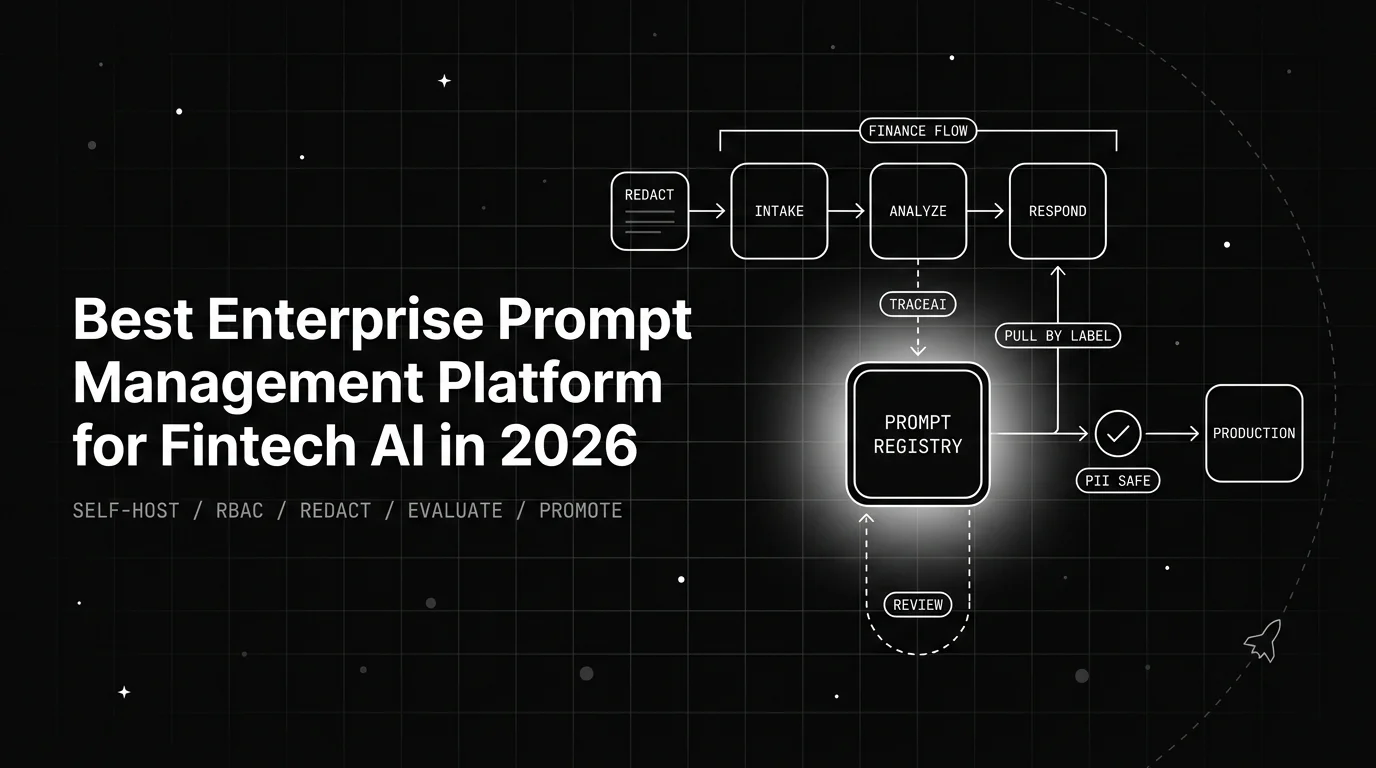
Prompt management for fintech AI: Future AGI versions and governs each prompt in your own VPC, flags PII at the boundary, and eval-gates every promotion.

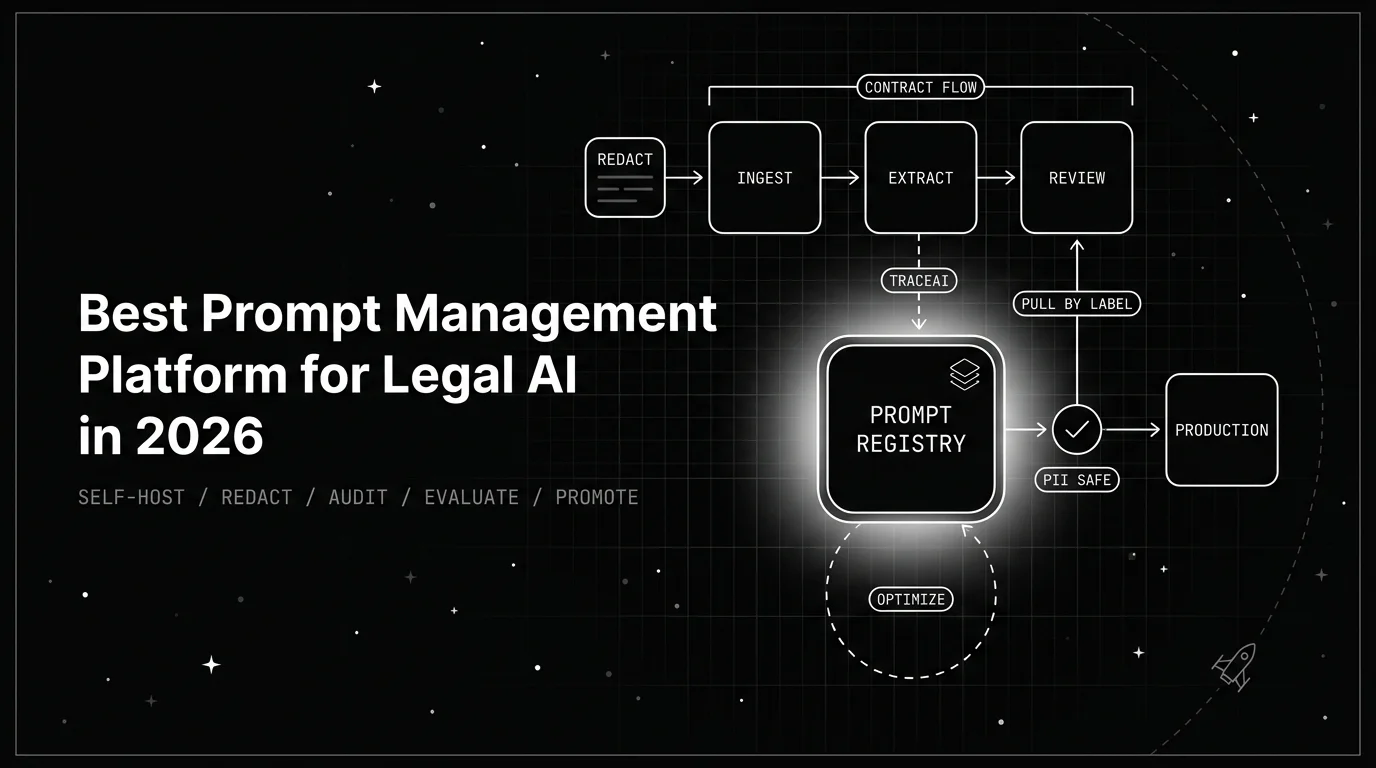
Prompt management for legal AI: Future AGI self-hosts the prompt registry in your perimeter, flags PII on inputs and outputs, and eval-gates every promotion.

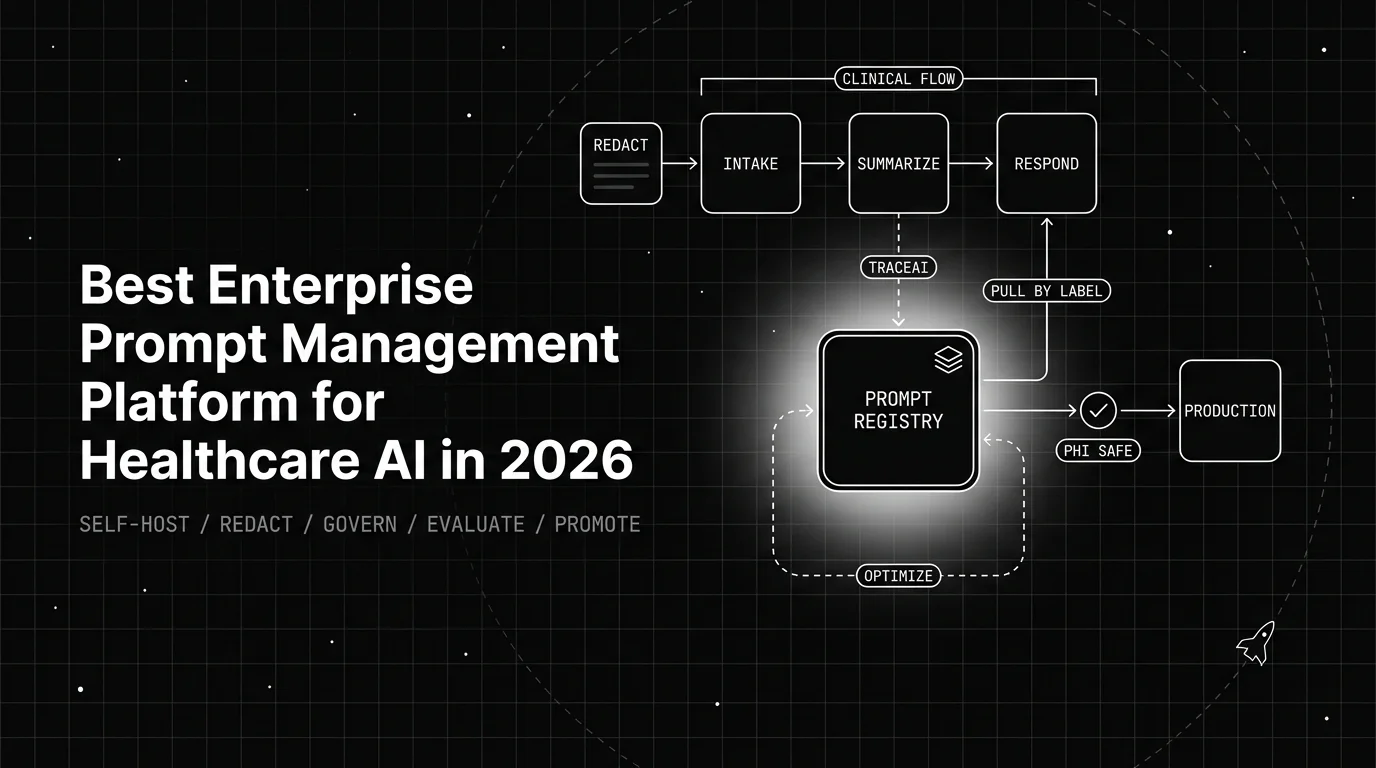
Prompt management for healthcare AI: Future AGI self-hosts the registry so PHI stays in your perimeter, flags PII, and gates each prompt on clinical evaluators.