AI Failures and Smart Evaluation Techniques: 2026 Updated Replay
Watch the Future AGI webinar on AI evaluation, updated for 2026. Covers why classic test suites miss agent failures and a live evals walkthrough.
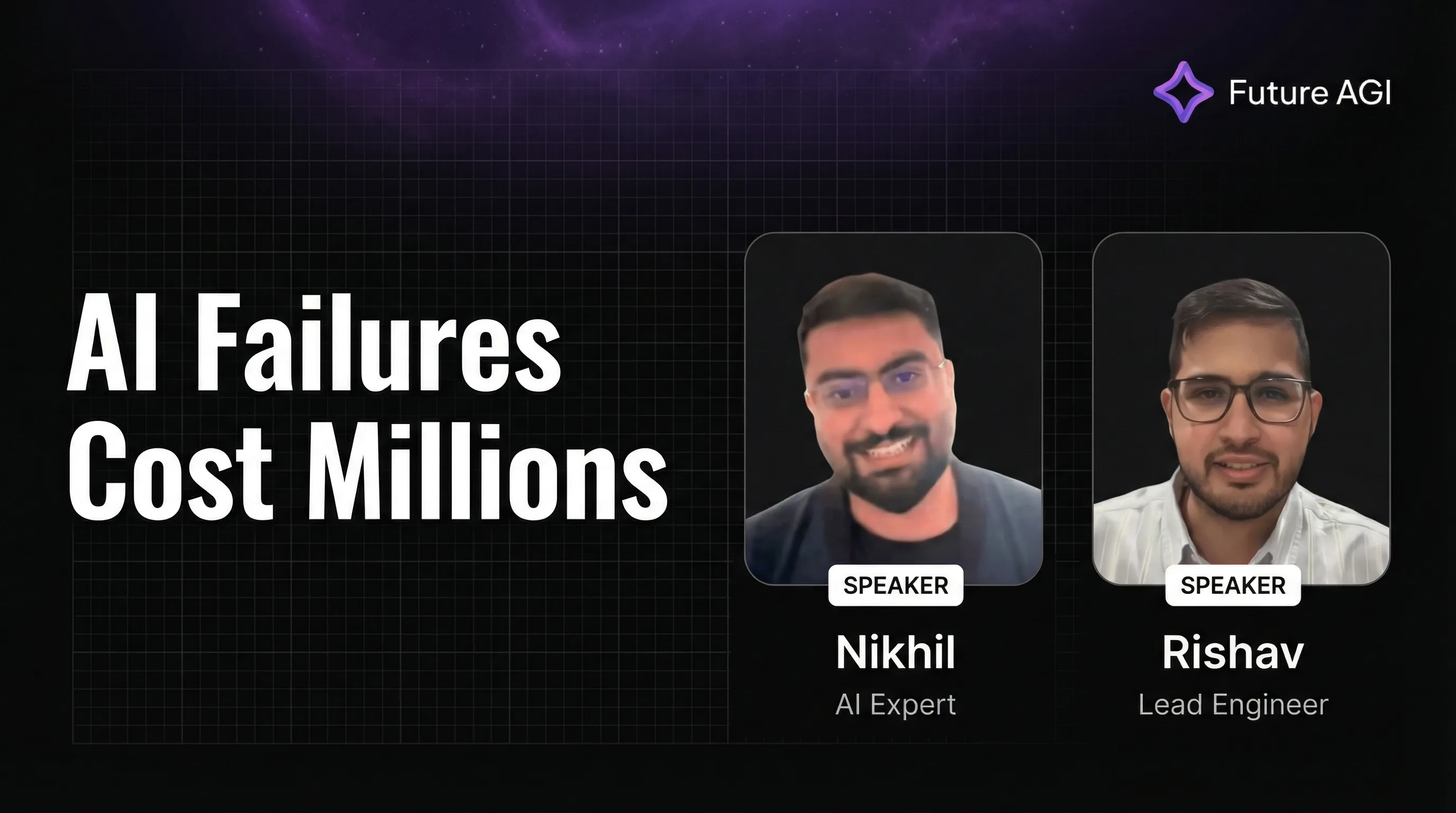
Table of Contents
Watch the Webinar Replay (2026 Update)
TL;DR: AI Failures and Smart Evaluation in 2026
| Topic | What you walk away with |
|---|---|
| Why classic ML metrics fail | Generative outputs have many valid answers, so accuracy and F1 miss faithfulness, groundedness, and tool-use bugs. |
| Real-world failure case studies | Air Canada 2024 refund hallucination, Microsoft Tay 2016 input poisoning, NYC MyCity 2024 illegal-advice incident. |
| Smart evaluation stack | Four-layer evals: input checks, model output, retrieval grounding, agent trajectory. |
| Live demo tooling | fi.evals.evaluate with turing_flash (about 1 to 2 seconds), turing_small (about 2 to 3 seconds), and turing_large (about 3 to 5 seconds) cloud judges. |
| Runtime defense | Agent Command Center at /platform/monitor/command-center for routing, budget caps, and inline guardrails. |
| Who benefits most | ML engineers, AI applied scientists, trust and safety leads, and platform teams shipping LLM features. |
AI agents are rapidly transforming industries powering chatbots, automating workflows, and making real-time decisions in finance, healthcare, and cybersecurity. As these agents become more autonomous, the question is no longer “does the model speak fluently” but “did the agent stay grounded, follow instructions, and respect policy on this specific run?”
Key Takeaways
- The Growing Importance of AI Evaluation Metrics. Why a single number cannot capture multi-objective LLM quality, and how the four-layer eval stack (input, output, retrieval, trajectory) maps onto real product surfaces.
- High-Profile AI Failures and Their Lessons. Air Canada’s 2024 refund-policy hallucination (CBC News), Microsoft Tay’s 2016 input poisoning (The Verge), and the 2024 NYC MyCity chatbot incident (The Markup). Each shows a specific eval gap that ai-evaluation now closes.
- Smart Evaluation Strategies. Mixing deterministic checks (regex, JSON schema, exact match) with LLM-as-judge calls using
fi.evals.metrics.CustomLLMJudgeandfi.evals.llm.LiteLLMProvider, calibrated against a small human-labelled gold set. - The Future of AI Evaluation. Online evaluation, sampling strategies, drift detection, and the move from “did the model pass the test set” to “is this specific production trace acceptable right now.”
- Hands-on Demo with Future AGI. A live walk through
from fi.evals import evaluate, Evaluator, plusfi_instrumentation.registerandFITracerto wire traces into the dashboard, then the Agent Command Center to block unsafe outputs at the gateway.
The Live Demo Stack in 2026
from fi.evals import evaluate, Evaluator
from fi.evals.metrics import CustomLLMJudge
from fi.evals.llm import LiteLLMProvider
from fi_instrumentation import register, FITracer

# 1. Register the traceAI tracer once at process boot
tracer_provider = register(
    project_name="ai-failures-webinar-2026",
    project_version_name="v1",
)
tracer = FITracer(tracer_provider)

# 2. Run a faithfulness check from the cloud catalog
result = evaluate(
    "faithfulness",
    output="The Air Canada bereavement fare is retroactive.",
    context="Air Canada bereavement fare policy is not retroactive.",
    model="turing_flash",
)
print(result.score, result.reason)

# 3. Or define a domain-specific judge once and reuse it
custom_judge = CustomLLMJudge(
    name="policy_grounding",
    rubric="Return 1 if the answer is supported by the policy excerpt, else 0.",
    provider=LiteLLMProvider(model="gpt-5-2025-08-07"),
)
The cloud judges run at roughly 1 to 2 seconds for turing_flash, 2 to 3 seconds for turing_small, and 3 to 5 seconds for turing_large, per the cloud-evals reference. Authentication uses FI_API_KEY and FI_SECRET_KEY environment variables, set once at deploy time.
For production guardrails, the same evaluators can run inline at the Agent Command Center, which acts as a control layer for supported model providers and self-hosted endpoints and adds routing, budget caps, semantic caching, and prompt-injection containment aligned with the OWASP LLM Top 10.
Who Should Watch the Replay
- ML engineers and applied scientists building or maintaining LLM and agent features.
- Trust and safety leads owning hallucination, toxicity, and prompt injection containment.
- Platform and DevOps teams standing up observability and gating for AI workloads.
- Product managers mapping eval metrics to user-facing quality targets.
Pair the replay with the agent evaluation frameworks roundup and the LLM evaluation architecture deep dive for a complete picture of the 2026 evaluation stack.
Further Reading and Primary Sources
- ai-evaluation (Apache 2.0): github.com/future-agi/ai-evaluation
- traceAI (Apache 2.0): github.com/future-agi/traceAI
- Cloud evals reference: docs.futureagi.com/docs/sdk/evals/cloud-evals
- OWASP LLM Top 10: owasp.org/www-project-top-10-for-large-language-model-applications
- NIST AI Risk Management Framework: nist.gov/itl/ai-risk-management-framework
- Stanford 2025 AI Index Report: aiindex.stanford.edu/report
- Anthropic responsible scaling policy: anthropic.com/news/announcing-our-updated-responsible-scaling-policy
- Microsoft Tay retrospective: theverge.com/2016/3/24/11297050/tay-microsoft-chatbot-racist
- Air Canada chatbot ruling: cbc.ca/news/canada/british-columbia/air-canada-chatbot-lawsuit-1.7116416
- NYC MyCity chatbot incident: themarkup.org/news/2024/03/29/nycs-ai-chatbot-tells-businesses-to-break-the-law
- OpenTelemetry for GenAI semantic conventions: opentelemetry.io/docs/specs/semconv/gen-ai
If you have questions or want to walk through how Future AGI fits your stack, drop a note to the team at futureagi.com. The goal of the session is concrete: leave with a four-layer eval blueprint, three failure case studies you can cite in your own roadmap doc, and a starter snippet you can extend into a CI job (adding your own dependency pinning, threshold assertions, and non-zero exit codes for regressions).
Frequently Asked Questions
What does this webinar cover?
Who should watch the AI failures and smart evaluation webinar?
Why are traditional accuracy metrics insufficient for LLMs in 2026?
Which evaluation metrics does the webinar demonstrate?
How does Future AGI fit into an AI evaluation workflow?
What real incidents are covered in the AI failures section?
Is the replay free and what tools are demoed?
LLM evaluation is offline + online scoring of model outputs against rubrics, deterministic metrics, judges, and humans. Methods, metrics, and 2026 tools.

Six agent evaluation frameworks for trajectory-first teams 2026: LangSmith, Future AGI, Braintrust, DeepEval, Phoenix, OpenAI Evals, tradeoffs.
FutureAGI, DeepEval, Langfuse, Phoenix, Braintrust, LangSmith, and Galileo as the 2026 LLM evaluation shortlist. Pricing, OSS license, and production gaps.