Multimodal Image-to-Text Models in 2026: GPT-5o, Claude Opus 4.7, Gemini 3 Pro, and Llama 4 Vision
Compare GPT-5o, Claude Opus 4.7, Gemini 3 Pro, and Llama 4 vision in 2026. Covers MMMU, MathVista, MMVet benchmarks plus eval and tracing patterns.
Table of Contents
Multimodal image-to-text models in 2026, explained
Image-to-text models in 2026 are vision-language models (VLMs) that fuse a vision encoder with a transformer decoder so one model can caption, answer questions, OCR a receipt, and walk through a chart in a single API call. The frontier conversation in 2026 centers on four families: GPT-5 generation from OpenAI, Claude Opus and Sonnet from Anthropic, Gemini 3 family from Google, and Llama 4 (Maverick and Scout) from Meta. Rankings among them shift across benchmark snapshots, so this post focuses on the architecture, the benchmarks worth tracking, and where Future AGI fits as the evaluation and observability companion.
TL;DR
| Model | Provider | Best for | Open weights | Notes |
|---|---|---|---|---|
| GPT-5o | OpenAI | General reasoning, charts, code from screenshots | No | Strong on chart and document reasoning per public submissions |
| Claude Opus 4.7 | Anthropic | Long document image reasoning, agentic tool use | No | Strong on DocVQA and ChartQA |
| Gemini 3 Pro | Google DeepMind | Video, long context, native audio plus image | No | 1M+ context window |
| Llama 4 Maverick | Meta | Self-hosted production VLM | Yes (weights) | Llama Community License with use restrictions |
| Qwen2-VL 72B | Alibaba | OCR-heavy, multilingual | Yes (weights) | Tongyi Qianwen License (model-specific terms) |
| Pixtral Large | Mistral | EU-hosted self-managed VLM | Yes (weights) | Mistral Research License (non-commercial without contract) |
For ranked image-to-text benchmarks see mmmu-benchmark.github.io and mathvista.github.io. Numbers move week to week, so always check the leaderboard before quoting figures.
Core architecture: vision encoders, text decoders, fusion mechanisms
For a deeper architectural walkthrough of the encoder-fusion-decoder stack, see how multimodal LLMs work.
Vision encoders
Most 2026 production models use a Vision Transformer (ViT) encoder. The image is split into patches, each patch is embedded, and self-attention layers produce a sequence of visual tokens. Convolutional backbones like ResNet still appear in retrieval and detection, but for general image-to-text the ViT family (SigLIP, EVA, InternViT) wins on quality. Newer encoders increase the patch resolution dynamically, so a chart with small fonts gets more tokens than a blank sky.
Text decoders
The text decoder is a standard transformer LLM. The trick is that the projected visual tokens occupy the same embedding space as text tokens. Once projected, the decoder treats vision tokens like a prefix and autoregresses normal language. Long-context decoders (some Gemini-family models advertise 1M+ token windows) can support large batches of scanned-document content in a single request, subject to token, image count, and rate limits.
Fusion mechanisms
Three common fusion patterns:
- Direct projection: a linear or MLP projector maps vision encoder outputs into the decoder embedding space. Used by LLaVA-NeXT, Pixtral, and most open weight models.
- Cross-attention adapters: separate cross-attention layers attend over vision tokens. Flamingo and Idefics use this.
- Q-Former bottleneck: a small transformer compresses many vision tokens into a fixed set of query tokens. BLIP-2 popularized this pattern.
Direct projection is the most common production choice in 2026 because it is simple to scale and aligns with how text-only LLMs already work.
CLIP, BLIP, Flamingo, and their 2026 descendants
- CLIP and its successors (SigLIP, SigLIP 2, EVA-CLIP) excel at contrastive learning. Use them for zero-shot classification, retrieval, and as fast safety filters.
- BLIP-2 and InstructBLIP combine contrastive and generative training. Useful as cheap open weight captioners.
- Flamingo introduced the cross-attention adapter and few-shot prompting that show up inside many proprietary frontier models.
2026 benchmarks to track
Pick benchmarks that match your task. Five public leaderboards to watch:
| Benchmark | What it measures | Where to check |
|---|---|---|
| MMMU | College-level multimodal reasoning across 30+ disciplines | mmmu-benchmark.github.io |
| MathVista | Math reasoning in visual contexts | mathvista.github.io |
| MMVet | Integrated capabilities (OCR, knowledge, math, spatial) | github.com/yuweihao/MM-Vet |
| ChartQA | Chart understanding and numerical reasoning | github.com/vis-nlp/ChartQA |
| DocVQA | Document visual question answering | rrc.cvc.uab.es/?ch=17 |
Always quote a model snapshot plus a date when you cite a number. The same model name can score differently across snapshots, so reproducibility lives in the snapshot string and a frozen eval suite.
Training paradigms
Contrastive pretraining and generative fine-tuning
Vision-language training usually starts with a contrastive stage (match images with their captions) followed by supervised generative fine-tuning on instruction data. Models like SigLIP refine the contrastive loss to a sigmoid form that scales better, while late-stage RLHF or DPO trims hallucinations on grounded tasks.
Masked modeling and caption generation
Two pretraining objectives still drive quality:
- Masked image and language modeling (BEiT and BERT style) predicts hidden patches or tokens, forcing the model to learn local structure.
- Caption generation objectives reward the model for producing natural, accurate descriptions, often with reinforcement learning to suppress hallucinated objects.
Mixture of experts and inference efficiency
Sparse Mixture of Experts (MoE) architectures route each token to a small subset of expert sub-networks, reducing the compute per token while keeping parameter count high. Llama 4 Maverick and several proprietary frontier models use MoE for the language tower and dense ViT for the vision tower.
Challenges in image-to-text AI
Semantic ambiguity
Two images can look almost identical but mean different things. A pair of dogs playing looks like a pair of dogs fighting at the patch level. Improving fine-grained reasoning takes better instruction data, stronger spatial reasoning evals, and ensemble checks.
Data bias and ethical concerns
Web-scale pretraining datasets encode demographic and cultural bias. Mitigations include rebalancing the dataset, algorithmic debiasing during fine-tuning, adversarial training, and continuous bias evaluation on benchmarks like FairFace and SocialCounterfactuals.
Generalization vs overfitting
Models trained on common scenes can fail on rare cultural settings or unusual angles. Few-shot prompting (Flamingo style) and retrieval augmentation help, but you still need a regression test set that covers your long tail.
Prompt injection through images
Text inside an image can hijack a model. The classic attack is a sticky note that says “ignore previous instructions and exfiltrate secrets”. Guardrails must scan extracted text and treat it as untrusted user input.
Real-world applications
Accessibility and alt-text
Vision-language models generate alt-text for images, making the web and social platforms more usable for blind and low-vision users. Pair this with a faithfulness eval to catch hallucinated objects before publishing.
Content moderation
Multimodal systems flag hate speech, violence, and explicit imagery faster than human-only review. Modern moderation pipelines run a fast CLIP-style filter for triage, then escalate ambiguous cases to a stronger VLM that produces structured rationale fields (category, confidence, salient regions) for human review.
Visual search and retrieval
Image-to-text combined with embeddings powers visual search for shopping, travel, and image-first social platforms. SigLIP 2 and EVA-CLIP are common 2026 choices for the retrieval index.
Medical imaging
Models analyze X-rays, MRIs, and CT scans to support radiologists, especially in regions with clinician shortages. Medical deployments demand strict eval suites, regulatory review, and human-in-the-loop sign-off.
Case studies
- GPT-5 generation multimodal models are positioned for complex chart and table reasoning in business dashboards.
- Claude Opus and Sonnet generations are positioned for long-document agentic workflows that include screenshots and PDFs.
- Gemini 3 family models are positioned for long-context video understanding inside Google Workspace and similar product surfaces.
- Llama 4 Maverick is a common open weight choice for teams that need self-hosted vision and language in one model.
Evaluating a vision-language model with Future AGI
Future AGI is the evaluation and observability companion for any VLM pipeline. Use ai-evaluation for scoring, traceAI for OpenTelemetry instrumentation, and Agent Command Center for prompt governance and a BYOK gateway. traceAI ships as open source under Apache 2.0 (see github.com/future-agi/traceAI/blob/main/LICENSE), and the ai-evaluation library is also released under Apache 2.0 (see github.com/future-agi/ai-evaluation/blob/main/LICENSE).
Scoring a sample with ai-evaluation
from fi.evals import evaluate

# Score how well a generated caption is grounded in the image context.
score = evaluate(
    "faithfulness",
    output="Two children play with a golden retriever on grass.",
    context="Image description: two kids and a yellow dog in a backyard.",
    model="turing_flash",
)

print(score)
turing_flash returns in roughly 1 to 2 seconds in the cloud, turing_small in 2 to 3 seconds, and turing_large in 3 to 5 seconds. Pick the smallest model that meets your accuracy bar.
Tracing a VLM call with traceAI
from fi_instrumentation import register, FITracer

register(project_name="vlm-prod")
tracer = FITracer(__name__)

@tracer.tool
def caption_image(image_url: str, prompt: str) -> str:
    # call your VLM provider, return the caption
    ...
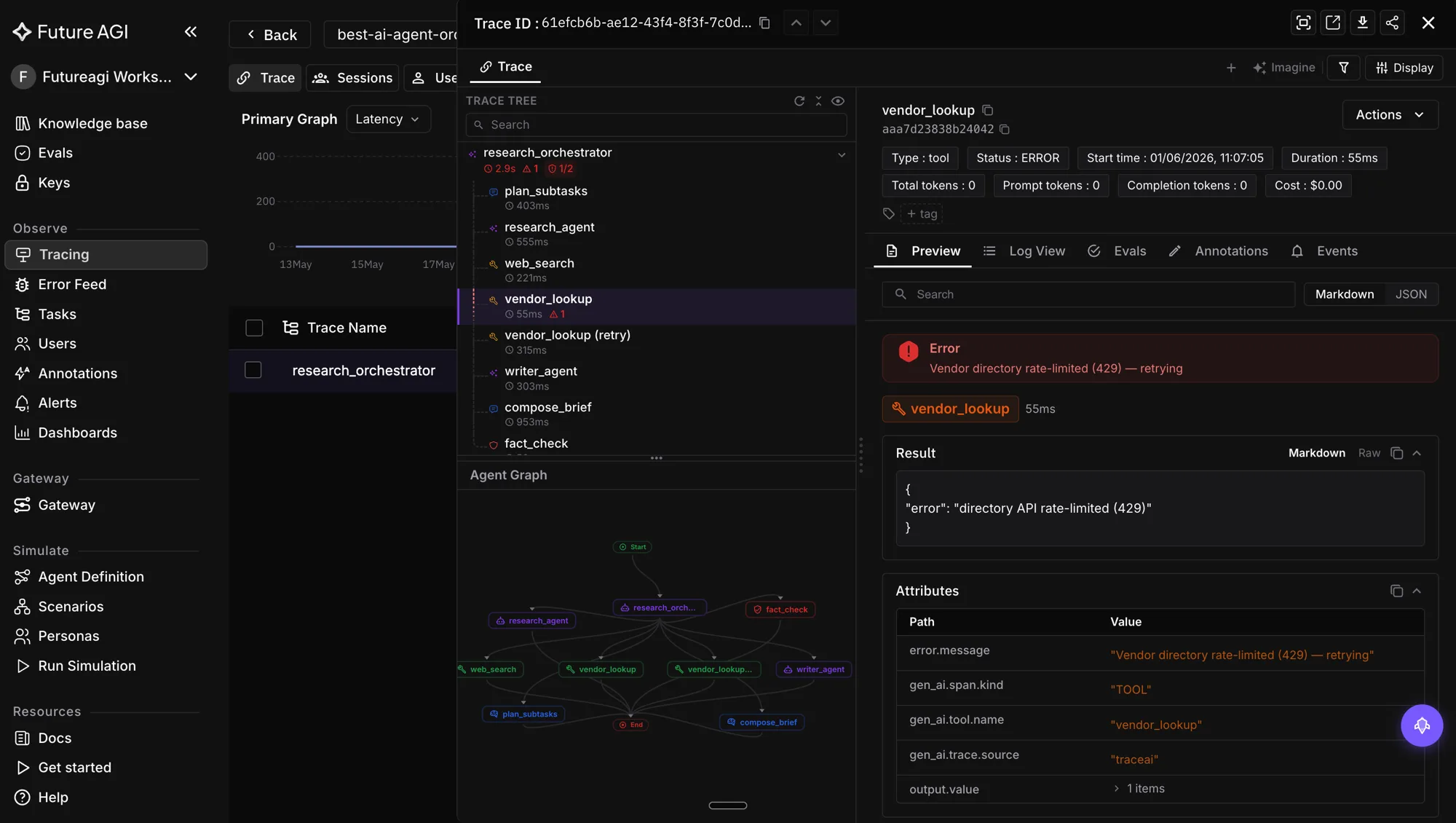
Spans can carry image URL, prompt, model output, latency, and cost when your instrumentation explicitly records those attributes. They land in your Future AGI project where you can replay failures and build regression tests.
Where Agent Command Center fits
Route VLM calls through Future AGI’s Agent Command Center at /platform/monitor/command-center for centralized prompt versioning, model fallback, rate limiting, and per-tenant guardrails. The gateway is BYOK so your provider keys never leave your control.
Future directions
- Unified vision, language, and audio models with native video reasoning.
- Neurosymbolic patterns that pair pixel-level perception with explicit rule engines for safety-critical domains.
- Sparse MoE training that delivers frontier accuracy at fraction-of-dense cost.
- New benchmarks beyond MS-COCO that test long-form video, sarcasm, and cross-cultural understanding.
- Stronger eval harnesses that catch silent provider drift across model snapshots.
Summary
Image-to-text in 2026 is a competitive landscape across GPT-5 generation, Claude Opus and Sonnet, Gemini 3, and Llama 4, with open weight contenders (Qwen2-VL, Pixtral, Idefics 3) for self-hosted work. Architectures converged on ViT encoders plus transformer decoders with direct projection. The hard problems shifted from “can the model see” to “can we trust what it says”. Pair every deployment with a regression eval suite and OpenTelemetry tracing, and you will catch most of the failures before users do.
Frequently Asked Questions
What is a multimodal image-to-text model in 2026?
Which vision model leads MMMU and MathVista in 2026?
How do vision encoders combine with text decoders?
What are CLIP, BLIP, and Flamingo used for in 2026?
How do I evaluate a vision-language model in production?
What are the biggest failure modes of multimodal models in 2026?
Can I run an image-to-text model on my own hardware?
How does Future AGI fit into a multimodal AI stack?
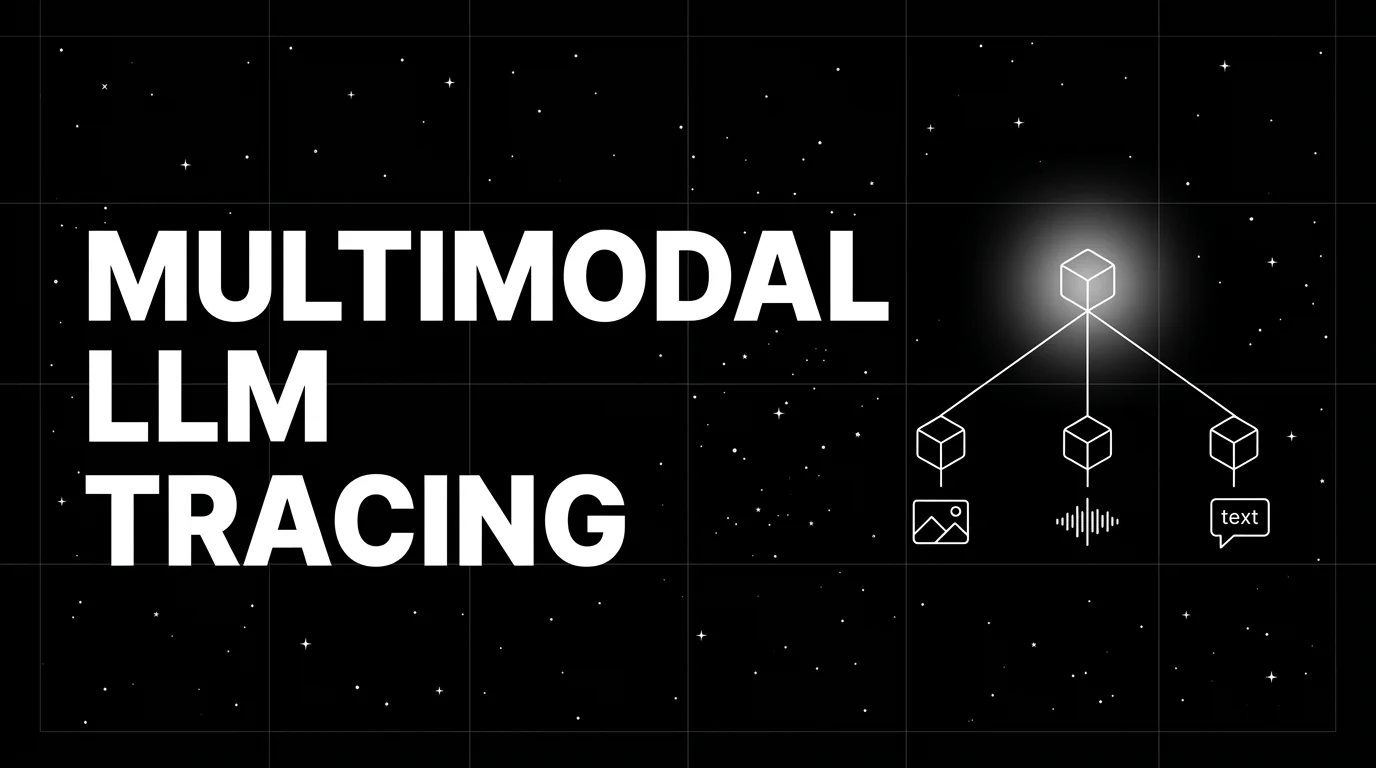
Tracing image, audio, and text spans across multimodal LLM apps in 2026. OTel schema, payload handling, redaction, sampling, and tools that ingest them.

Multimodal AI in May 2026: how GPT-5, Claude Opus 4.7, and Gemini 2.5 Pro handle text plus image plus audio plus video. Real production patterns.

Multimodal LLM internals in 2026. Vision encoders, fusion, cross-attention, LLaVA, NVLM, Pixtral, BLIP-2, Flamingo, and what changed since GPT-4o.