Best Text-to-Image AI Models in 2026: 7 Tools Compared on Quality, Cost, and License
Compare the 7 best text-to-image AI models in 2026. GPT-image-1, Midjourney v7, FLUX.1, Imagen 4, Stable Diffusion 3.5, Ideogram 3.0, Recraft V3.
Table of Contents
Best Text-to-Image AI Models in 2026: 7 Tools Compared on Quality, Cost, and License
The text-to-image space looks different in 2026 than it did in 2023. DALL-E 3 was replaced by gpt-image-1 in the OpenAI API and ChatGPT, Midjourney shipped v7, Google released Imagen 4 through the Gemini API, Black Forest Labs put FLUX.1 schnell weights under Apache 2.0, and Stability AI released Stable Diffusion 3.5. This guide compares the 7 models most teams actually evaluate in 2026, with concrete notes on license, hosting, pricing model, and where each model wins.
TL;DR: Best Text-to-Image AI Models in May 2026
| Model | License | Best for | Hosting | Pricing model |
|---|---|---|---|---|
| GPT-image-1 | OpenAI Terms | Instruction-following, text rendering | API only | Per-image, by quality tier |
| Midjourney v7 | Subscription terms | Aesthetic style, art direction | Hosted (Discord, web) | Subscription |
| Imagen 4 | Google Cloud Terms | Google Cloud stacks, text-in-image | API (Gemini, Vertex AI) | Per-image |
| FLUX.1 (pro and schnell) | Closed pro, Apache 2.0 schnell | Photoreal API or open-weight self-host | API (fal, Replicate) or self-host | Per-image or free weights |
| Stable Diffusion 3.5 | Community License | Open-weight customization | Self-host or API | Free under 1M USD revenue |
| Ideogram 3.0 | Subscription terms | Text-in-image, graphic design | Hosted (web, API) | Subscription or per-image |
| Recraft V3 | Subscription terms | Brand-style consistency | Hosted (web, API) | Subscription or per-image |
How Text-to-Image AI Models Work in 2026
Modern text-to-image systems combine a text encoder with a diffusion or rectified-flow image decoder. The encoder maps a prompt to a latent representation. The decoder iteratively denoises a latent grid conditioned on that representation until a final image emerges. Closed models like GPT-image-1 and Imagen 4 layer a multimodal language model on top to handle instructions, edits, and references. Open models like FLUX.1 use rectified flow with a similar overall architecture.
The result is the same from the user’s perspective: type a prompt, sometimes attach a reference image or mask, and get back an image. The differences sit in license, aesthetic defaults, instruction adherence, text rendering quality, safety filtering, and hosting options.
The 7 Best Text-to-Image AI Models in 2026
1. GPT-image-1 (OpenAI): Instruction-Following and Text Rendering
GPT-image-1 is OpenAI’s API-native image model that replaced DALL-E 3 as the default in ChatGPT and the API in 2025. The model is multimodal-native: it accepts text prompts, image inputs, and masks through the responses and image generation endpoints documented at platform.openai.com/docs/guides/image-generation.
Strengths in 2026: instruction adherence on multi-part prompts, accurate text rendering in signage and captions, and tight integration with the ChatGPT and Sora editing workflows. Limitations: API-only, no self-hosting option, and content policy filters that some teams find restrictive for marketing and gaming use cases.
2. Midjourney v7: Aesthetic Style and Art Direction
Midjourney released v7 in February 2025 as the default model on Discord and the Midjourney web app. The headline additions are personalization through saved style profiles, draft mode for lower-cost iteration, and the Niji 7 anime sibling. Midjourney is best suited for manual workflows through the web app or Discord rather than automated production pipelines.
Strengths: distinctive aesthetic that many teams prefer for art direction, illustration, and marketing creative. Limitations: not designed for programmatic automated pipelines, subscription-only access, and license terms that depend on subscription tier.
3. Imagen 4 (Google DeepMind): Google Cloud Integration
Imagen 4 is Google DeepMind’s flagship image model in 2026, available through the Gemini API and Vertex AI. It is the natural choice for teams already running on Google Cloud or building on the Gemini multimodal stack. Documented strengths include high-fidelity photoreal portraits and accurate text-in-image rendering.
Strengths: native Google Cloud integration, predictable IAM and billing, and strong text rendering. Limitations: ecosystem lock-in for non-Google teams. Confirm Imagen availability in your required Google Cloud region before committing to it as your production model.
4. FLUX.1 (Black Forest Labs): Open-Weight Photorealism
Black Forest Labs released FLUX.1 in three variants. FLUX.1 pro is closed-source and API-only through fal, Replicate, and BFL. FLUX.1 dev is open-weight under a non-commercial license for research. FLUX.1 schnell is open-weight under Apache 2.0 for any use including commercial.
Strengths: photoreal output that rivals closed APIs, Apache 2.0 schnell weights that can be self-hosted, and active community fine-tunes. Limitations: schnell is a distilled fast variant and trades quality for speed compared to pro, and dev cannot be used commercially without a separate license.
5. Stable Diffusion 3.5 (Stability AI): Open-Weight Customization
Stability AI released Stable Diffusion 3.5 in October 2024 in Large, Large Turbo, and Medium variants. Weights are downloadable from Hugging Face under the Stability AI Community License, which is free for individuals and organizations with under one million USD in annual revenue per the Stability AI license page.
Strengths: largest open-weight ecosystem of LoRAs, ControlNets, and fine-tunes, mature tooling through ComfyUI and Automatic1111, and predictable self-hosting cost. Limitations: instruction-following lags closed APIs on long prompts, and licensing terms shift at scale.
6. Ideogram 3.0: Text-in-Image and Graphic Design
Ideogram specializes in accurate text rendering inside images, which makes it a strong pick for posters, logos, product mockups, and social-graphic generation. Ideogram 3.0 launched in 2025 with a paid API and a web app at ideogram.ai.
Strengths: best-in-class text-in-image rendering at the time of writing, dedicated graphic-design tooling, and a simple subscription model. Limitations: narrower aesthetic range than Midjourney for fine art, and a smaller open ecosystem.
7. Recraft V3 (red panda): Brand-Style Consistency
Recraft V3 ranked highly on the Artificial Analysis text-to-image arena in late 2024 under the codename red panda. It targets brand and design teams with style controls, vector output, and consistent character generation. Available at recraft.ai and through an API.
Strengths: brand-style consistency, vector and raster output, and design-team workflows. Limitations: subscription pricing, no open-weight option, and a smaller community than Midjourney.
How to Evaluate Text-to-Image AI Models in 2026
There is no single metric that captures image quality. Most teams in 2026 combine three layers:
- Automated alignment scoring. CLIP score measures cosine similarity between the prompt embedding and the image embedding. It is fast and cheap but correlates loosely with human judgment for long or compositional prompts.
- Distribution metrics. FID measures the distance between generated image distribution and a reference distribution. Useful for tracking model drift over time on a fixed prompt set.
- Human review panels. Side-by-side pairwise rankings against a baseline model, typically with 3 to 5 reviewers per image. This is the gold standard for product launches and remains necessary for aesthetic and brand judgments.
Future AGI provides the evaluation and observability layer for multimodal workflows rather than the image model itself. Teams use Future AGI traceAI to log image generations and Future AGI evals to score the text content around those generations (captions, alt text, retrieval grounding) using the same fi.evals catalog they use for LLM-only apps. The Apache 2.0 traceAI SDK and the Apache 2.0 ai-evaluation library both ship from github.com/future-agi.
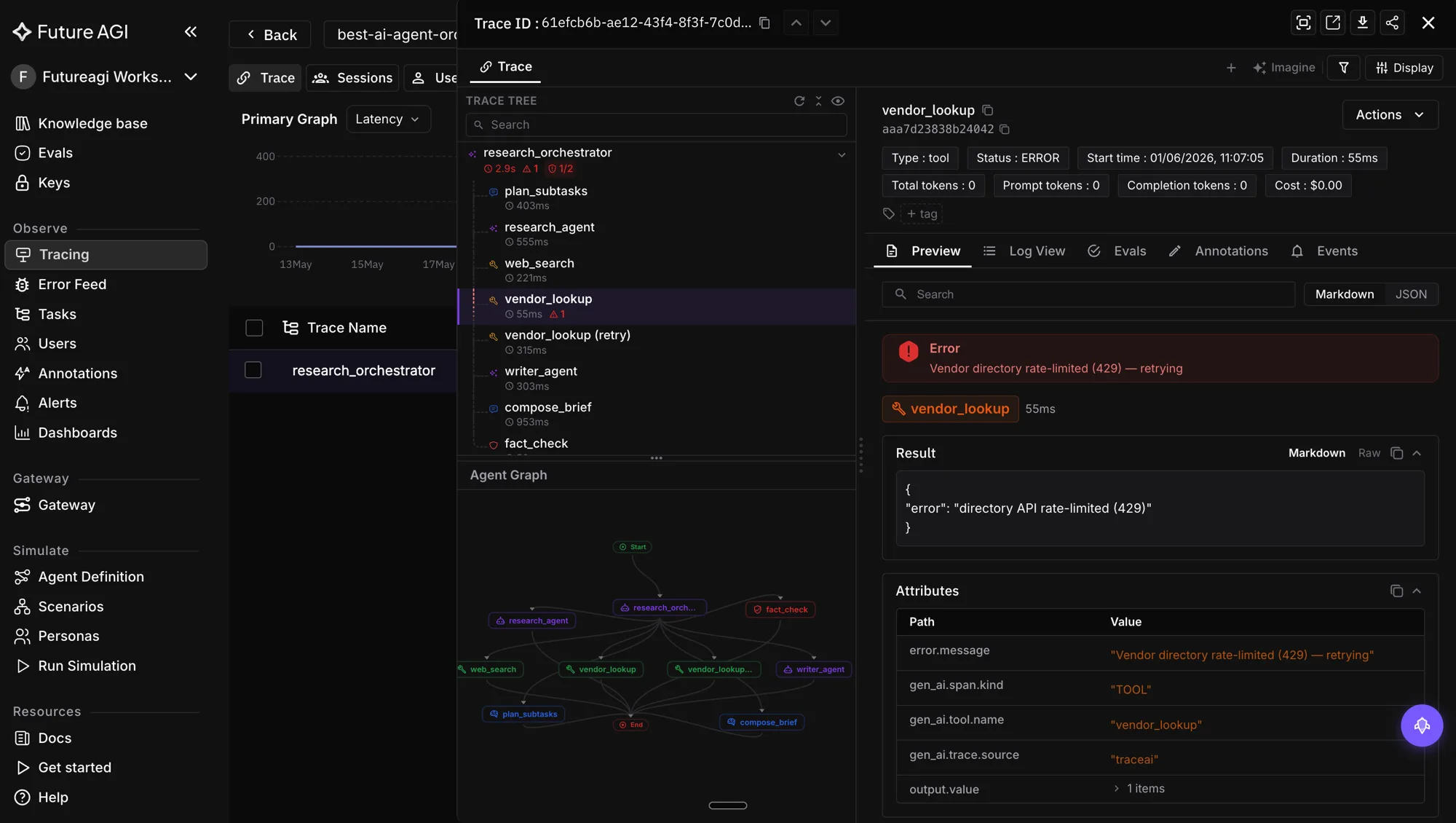
# Requires: pip install ai-evaluation
# Env: FI_API_KEY, FI_SECRET_KEY
from fi.evals import evaluate

# Score whether a generated alt-text caption stays faithful to the source prompt
# used to drive the image model.
caption = "A chef in a Brooklyn kitchen, holding a cast-iron pan at golden hour."
prompt = "A photoreal portrait of a chef in a Brooklyn kitchen, holding a cast-iron pan."

result = evaluate(
    "faithfulness",
    output=caption,
    context=prompt,
    model="turing_flash",
)

print(result.score, result.reason)
For a deeper look at evaluation patterns, see evaluation frameworks and metrics best practices and the Future AGI evaluation suite.
How to Write Effective Prompts for Text-to-Image AI in 2026
Three prompt rules carry across all 7 models:
- Lead with subject and medium. “Photo of a chef in a Brooklyn kitchen” beats “Brooklyn chef photo”.
- Add concrete style cues. “Cinematic, golden-hour, 35 mm lens” gives the model a clear aesthetic target. Abstract style words like “beautiful” or “high quality” no longer move the needle.
- Iterate with reference images. Most 2026 models accept reference images through the API. A single reference image is worth several dozen prompt words for style transfer and character consistency.
Future of Text-to-Image AI After 2026
Three trajectories look likely. First, video and image converge: Sora 2, Veo 3, and Runway Gen-4 all share architectural ideas with the still-image models above, and the next round of releases will treat image as a one-frame video. Second, open-weight models continue to close the gap on closed APIs in raw quality but lag in safety tooling and integration depth. Third, evaluation matures: image-text alignment scoring, brand-safety filters, and provenance markers move into the default production stack rather than being optional add-ons.
For broader market context see the future of multimodal image-to-text models and the best LLMs in May 2026 for the language-model side of the same trends.
Summary: How to Choose a Text-to-Image AI Model in 2026
Pick GPT-image-1 for instruction-following and text rendering through the OpenAI API. Pick Midjourney v7 for aesthetic style and art direction. Pick Imagen 4 if you are already on Google Cloud. Pick FLUX.1 pro for closed-API photorealism or FLUX.1 schnell for Apache 2.0 self-hosting. Pick Stable Diffusion 3.5 for the largest open-weight ecosystem. Pick Ideogram 3.0 for text-in-image. Pick Recraft V3 for brand-style consistency.
Then pair whichever model you choose with an evaluation and observability layer that traces generations and scores the text content (captions, alt text, retrieval grounding) for faithfulness, toxicity, and prompt-injection robustness. Future AGI provides that layer for teams running multimodal applications in production.
Frequently Asked Questions
What is the best text-to-image AI model in 2026?
Is DALL-E still available in 2026?
Which text-to-image AI models are open-source in 2026?
How do you evaluate text-to-image AI model output quality?
Can text-to-image models render readable text inside images?
Are text-to-image models safe for commercial use?
How much does generating images cost in 2026?
How does Future AGI relate to text-to-image AI models?
Multimodal AI in May 2026: how GPT-5, Claude Opus 4.7, and Gemini 2.5 Pro handle text plus image plus audio plus video. Real production patterns.

Compare GPT-5o, Claude Opus 4.7, Gemini 3 Pro, and Llama 4 vision in 2026. Covers MMMU, MathVista, MMVet benchmarks plus eval and tracing patterns.

Eight 2026 generative AI trends: agentic AI, multimodal, GPT-5, Claude 4.7, Gemini 2.5 Pro, on-device, MCP, evals, gateways, with budgets to plan for.
