Sub-500ms Voice AI: The Complete Latency Budget Guide for 2026
How to hit a sub-500ms P95 voice AI turn in 2026. Per-stage budget, engineering choices, when sub-500ms is the right target and when it is not.
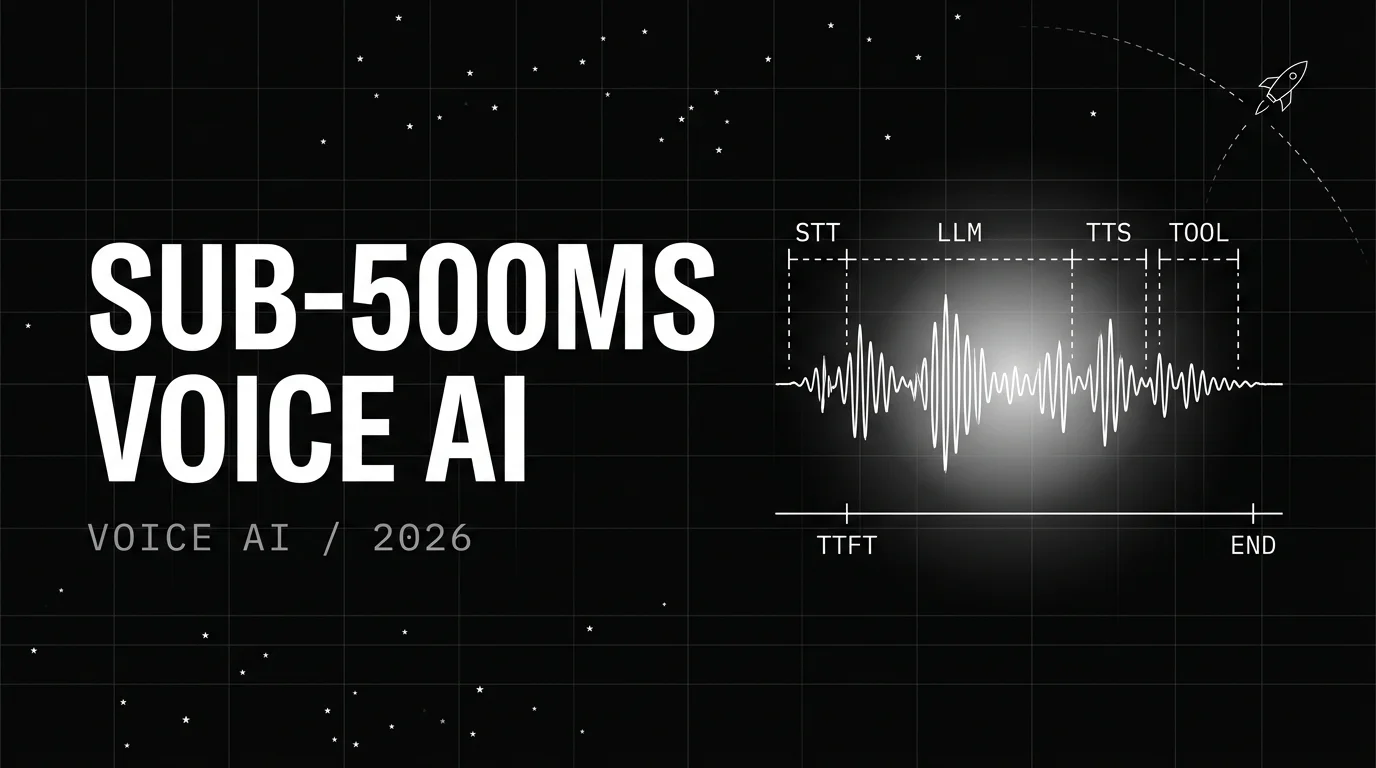
Table of Contents
Sub-500ms Voice AI: The Complete Latency Budget Guide for 2026
A sub-500ms voice turn is the new bar in 2026 for hesitation-sensitive use cases like sales, support deflection, and inbound IVR replacement. It is also the wrong target for clinical intake, financial planning, and tool-heavy troubleshooting. This guide walks the budget breakdown, the engineering choices that hit it, and the use cases where sub-500ms is right versus where it is not.
TL;DR
Sub-500ms voice is achievable today on short conversational turns with the right provider stack. The budget breaks down as: network 30-50ms, STT first-partial 100-150ms, LLM TTFT 200-300ms with prefix caching, TTS first-audio 80-150ms with streaming providers, and orchestration plus inline guardrail 50-100ms. Streaming overlaps the stages so the user-perceived gap is roughly max(STT_partial, LLM_TTFT) plus TTS_first_audio plus orchestration. The right use cases are sales, support deflection, receptionist, and IVR replacement. The wrong use cases are clinical intake, financial advice, and complex tool turns.
Why 500ms is the magic number
Conversation research from telephony and call-center analytics points to 200-300ms as the median between-turn gap in natural human conversation. Below 200ms reads as interruption. Above 1000ms reads as the other person being lost or distracted. The sweet spot for a voice agent that wants to feel natural is the 400-600ms range.
A 500ms P95 budget keeps 95% of turns inside that natural-feel window. The remaining 5% might land at 700-900ms on slow turns, which is still acceptable on a properly tuned agent. Average latency below 350ms with a 500ms P95 is the working target for sales and support voice agents in 2026.
There is a second reason 500ms matters. Sales call analytics show measurable drop-off in lead conversion when first-response latency exceeds 600ms. Support deflection rate drops 20-30% when latency exceeds 800ms. The 500ms target is a defensible business metric, beyond being a UX preference.
The sub-500ms budget breakdown
Here is the per-stage budget for a sub-500ms P95 turn.
| Stage | Budget | What dominates | Realistic provider |
|---|---|---|---|
| Network RTT | 30-50ms | Region pinning, edge POP | Voice gateway in user’s region |
| STT first-partial | 100-150ms | Streaming model, chunk size | Deepgram Nova-3, AssemblyAI Universal-1 |
| LLM TTFT | 200-300ms | Prefix caching, model size | GPT-4o-mini, Claude Haiku, Gemini Flash |
| TTS first-audio | 80-150ms | Streaming provider, voice complexity | Cartesia Sonic, ElevenLabs Turbo v2.5 |
| Orchestration | 20-40ms | Framework overhead, routing | Lightweight gateway |
| Inline guardrail | 50-80ms | Safety model latency | Future AGI Protect (sub-100ms) / ProtectFlash |
| Total worst case | 480-770ms | Why streaming overlap is mandatory |
The worst-case sum sits at 480-770ms because every stage is at the upper end. The reason a well-tuned pipeline hits 400-500ms P95 is streaming overlap. The LLM runs while STT is still producing partials. TTS plays the first sentence while the LLM is still generating later tokens. The user-perceived gap is the slowest single-path traversal, not the sum.
The streaming pipeline that makes it work
A sequential pipeline cannot hit sub-500ms. The math does not work. The streaming pipeline that does work looks like this.
- User starts speaking. Audio chunks flow to streaming STT every 100ms.
- STT first-partial lands at ~120ms. Intent classifier scores the partial. If confidence is above 0.85, fire the LLM call with the partial transcript.
- LLM TTFT lands at ~250ms. First token streams. Buffer until the first sentence boundary.
- First sentence boundary at ~320ms. Flush the sentence to streaming TTS.
- TTS first-audio lands at ~420ms. First audio packet flows to the user.
- User-perceived gap: ~420ms from end-of-speech.
The exact numbers depend on the providers, the prompt, and the region. The pattern is the same. The pipeline is fully streaming, every stage starts before the previous stage finishes, and the LLM never waits for STT final.
Late-correction handling
Streaming-on-partials introduces a risk: the user changes intent mid-sentence. Two patterns handle it.
- Confidence-gated commit. Only fire the LLM if intent confidence is above 0.85. If the user is mid-sentence and confidence is unclear, wait for the next partial.
- LLM cancel-and-restart. If the STT final differs significantly from the partial that triggered the LLM, cancel the in-flight LLM call and restart with the final transcript. The cancel costs roughly 100-200ms of wasted compute but avoids hallucinated answers.
Production rates of cancel-and-restart should sit below 3% of turns. If they are higher, your confidence threshold is too low.
Engineering choices that hit sub-500ms
Beyond the streaming pipeline, six engineering choices keep the budget intact.
1. Pin everything to one region
Cross-region voice agents add 60-150ms per turn from network alone. Pin the voice gateway, STT, LLM, and TTS to the same region. For global agents, run three regional deployments: US, EU, and APAC. DNS-based geo routing sends users to the closest one.
2. Anchor the system prompt for prefix caching
Major LLM providers cache prompt prefixes server-side. A 1500-token system prompt with caching hits TTFT in 200-300ms versus 500-800ms without. Anchor the system prompt at the top, keep it byte-identical across turns, and put dynamic content (timestamps, user IDs) near the end.
3. Pick streaming providers
Cartesia Sonic streams first audio in 80-180ms. ElevenLabs Turbo v2.5 lands at 250-400ms. The provider choice can make or break the budget. Deepgram Nova-3, AssemblyAI Universal-1, and Speechmatics Ursa all ship STT first partials in the 100-200ms range. For LLM, GPT-4o-mini, Claude Haiku, and Gemini 2.5 Flash hit TTFT under 300ms.
4. Run inline guardrails through Future AGI Protect
A closed safety API that adds 200ms per turn breaks the budget. The Future AGI Protect model family runs sub-100ms inline per arXiv 2510.13351. That fits inside the orchestration slice. Protect is built on Gemma 3n foundation with LoRA-trained adapters across 4 safety dimensions (Content Moderation, Bias Detection, Security, Data Privacy Compliance). Multi-modal across text, image, and audio in a single model family. ProtectFlash gives a single-call binary classifier path for the absolute lowest-latency surface.
5. Route evaluation async
A 200ms LLM judge inside a 500ms turn breaks the budget. ai-evaluation supports per-route eval gating. Low-latency classifier checks run on routes that need inline safety; LLM-as-judge evaluation runs async after the turn commits. In-house classifier models are tuned for the LLM-as-judge cost/latency tradeoff so async stays affordable at millions of turns per day. 70+ built-in eval templates including audio_transcription, audio_quality, conversation_coherence, conversation_resolution, task_completion, plus unlimited custom evaluators authored by an in-product agent, and a programmatic eval API for configure + re-run. Apache 2.0.
6. Prefetch tools on high-confidence intent
If the STT first-partial intent confidence is above 0.85, fire the tool call in parallel with the LLM call. The tool result lands when the LLM is ready to use it. Net savings: 200-400ms on every prefetched turn. Cost: 2-5% wasted tool calls when intent changes mid-sentence.
When sub-500ms is the right target
Sub-500ms is the right target when:
- Hesitation reads as a bad signal. Sales agents lose leads when the first response takes 700ms. Support deflection drops when callers feel ignored.
- The turn is short and conversational. Greetings, acknowledgments, clarifications, and quick lookups all fit in sub-500ms. Long tool turns do not.
- The user is in motion. Mobile users on a hands-free call, drive-through orders, and IVR replacements all need snap-back responses.
- The business KPI is conversion or deflection. When the cost of a slow turn is a lost customer, sub-500ms is defensible. When the cost is a slightly less polished answer, longer is fine.
The four high-fit use cases:
- Sales outbound. Cold-call leads, qualification, appointment booking.
- Support inbound. Tier-1 deflection, password reset, balance lookup.
- Receptionist. Inbound call greeting, routing, scheduling.
- IVR replacement. Self-service menus rebuilt as voice AI agents.
When sub-500ms is the wrong target
Sub-500ms is the wrong target when:
- The turn requires multi-step reasoning. Clinical intake, financial planning, and complex troubleshooting all benefit from the agent visibly thinking. Users tolerate 1000-1500ms when the agent is doing something useful.
- The turn hits multiple tools. Authentication, lookup, transformation, and confirmation often need 800-1500ms cumulative.
- The context window is long. Conversations with 10+ minutes of history pay token-processing time on every turn. Forcing sub-500ms here means cutting context, which usually means a worse answer.
- Accuracy matters more than speed. Medical, legal, and financial advice should be slower and more careful. A 600ms answer that is wrong is worse than a 1200ms answer that is right.
The four low-fit use cases:
- Clinical intake. Symptom checking, triage, medication reconciliation. Target 1200-1800ms with visible thinking signals.
- Financial advice. Investment recommendations, retirement planning. Target 1500-2500ms.
- Complex troubleshooting. Multi-step diagnostic flows for IT support or device repair. Target 1000-2000ms per turn.
- Legal triage. Contract review questions, regulatory clarifications. Target 1500-2500ms.
For these turns, the right pattern is a thinking signal (a brief “let me check that” filler) plus a longer compute window. Users prefer the visible thinking signal over a silent pause.
Provider benchmarks for sub-500ms
The provider choice is half the budget. Here are realistic numbers from production voice teams in early 2026.
STT providers
| Provider | First-partial P50 | First-partial P95 | Languages |
|---|---|---|---|
| Deepgram Nova-3 | 90-130ms | 180-220ms | 36 |
| AssemblyAI Universal-1 | 100-150ms | 200-260ms | 99 |
| Speechmatics Ursa | 110-160ms | 210-280ms | 50+ |
| Google Cloud Speech v2 | 150-220ms | 320-450ms | 125 |
| OpenAI Whisper (streaming) | 200-300ms | 400-550ms | 99 |
Deepgram Nova-3 has the WER edge on hard audio: background noise, accents, jargon. AssemblyAI has the language breadth. Pick on your data, not on the leaderboard.
LLM providers (TTFT with prefix caching)
| Provider | TTFT P50 | TTFT P95 | Best for |
|---|---|---|---|
| GPT-4o-mini | 180-240ms | 280-380ms | Short conversational turns |
| Claude Haiku 3.5 | 200-260ms | 300-400ms | Tool-heavy turns |
| Gemini 2.5 Flash | 170-230ms | 270-360ms | Multi-modal turns |
| GPT-4o | 320-420ms | 480-650ms | Complex reasoning |
| Claude Sonnet 4.5 | 350-450ms | 520-700ms | Complex reasoning |
The Haiku and Flash class hits sub-500ms comfortably. The Sonnet and 4o class is for the turns that have a longer budget.
TTS providers
| Provider | First-audio P50 | First-audio P95 | Voice quality |
|---|---|---|---|
| Cartesia Sonic | 80-130ms | 150-220ms | High |
| ElevenLabs Turbo v2.5 | 250-330ms | 380-480ms | Very high |
| PlayHT 2.0 Turbo | 200-280ms | 320-420ms | High |
| OpenAI TTS-1 | 180-260ms | 300-420ms | High |
| Google Cloud TTS Neural2 | 150-230ms | 280-380ms | Medium |
Cartesia Sonic is the latency leader. ElevenLabs Turbo has the voice-quality edge with a higher latency cost. Pick on use case: sales agent wants Cartesia speed, narrative agent might pay the ElevenLabs cost.
A real-world sub-500ms reference architecture
A working production stack for a US-based sales voice agent that hits 460ms P95 on short turns:
- Voice gateway: regional WebRTC gateway in us-east-1 pinned via DNS geo routing.
- STT: Deepgram Nova-3 streaming with 200ms audio chunks, first-partial routing at 0.85 confidence.
- LLM: GPT-4o-mini through the Agent Command Center with prefix caching, system prompt anchored at 1100 tokens, conversation history capped at 6 turns.
- TTS: Cartesia Sonic streaming, voice ID
sales-female-warm, warm connection per session. - Guardrail: Future AGI Protect inline for content moderation and PII (sub-100ms) or ProtectFlash for the single-call binary path.
- Eval: classifier scoring inline for task completion, LLM-judge async after turn commit.
- Cache: TTS phrase cache for the top 40 greetings and confirmations, 48-hour TTL.
- Tool calls: prefetched on STT first-partial intent confidence above 0.85.
Resulting latency profile:
- End-of-speech to first-audio P50: 380ms.
- End-of-speech to first-audio P95: 460ms.
- End-of-speech to first-audio P99: 720ms.
- Cache hit rate on TTS phrase cache: 42%.
- Prefetch success rate on tool calls: 91%.
The same architecture in EU and APAC with regional gateways and provider regions delivers comparable numbers. The biggest wins came from streaming everything, prefix caching, and replacing the previous closed-API safety provider with Protect.
What breaks at sub-500ms scale
Three pitfalls show up at the sub-500ms scale that do not show up at 800ms or 1200ms.
1. STT premature commit. The first-partial routing at 0.85 confidence occasionally fires on incomplete intent. If the user said “Can I get my…” and the agent commits before “…balance” lands, the LLM hallucinates an intent. The fix is to combine confidence with semantic completeness: require both confidence above 0.85 AND a sentence-ending pattern in the partial.
2. TTS interruption tax. At sub-500ms turn budgets, the agent is often still speaking when the user barges in for the next turn. Barge-in handling has to be fast: TTS flush in under 60ms, LLM cancel in under 40ms. Slow barge-in handling adds 200-400ms to the next turn.
3. Cold-start spike. The first turn of a conversation is 200-400ms slower than steady-state because the prefix cache is cold, the TTS WebSocket is cold, and DNS may need resolution. Warm everything on session start, not on first audio.
Measuring whether you actually hit sub-500ms
Self-reported latency numbers are notoriously wrong. The only number that matters is the user-perceived gap between end-of-speech and first audio. Measure it as a span attribute on every turn.
import time
from fi_instrumentation import FITracer

tracer = FITracer(tracer_provider.get_tracer(__name__))

def handle_turn(turn_id):
    with tracer.start_as_current_span(
        "voice_turn",
        attributes={"turn_id": turn_id},
    ) as turn_span:
        end_of_speech_ts = time.monotonic()
        turn_span.set_attribute("end_of_speech_ts", end_of_speech_ts)

        transcript = run_stt(turn_id, turn_span)
        llm_text = run_llm(transcript, turn_span)
        first_audio_ts = run_tts(llm_text, turn_span)

        user_perceived_ms = (first_audio_ts - end_of_speech_ts) * 1000
        turn_span.set_attribute("user_perceived_latency_ms", user_perceived_ms)
        return user_perceived_ms
Plot P95 of user_perceived_latency_ms. That is the sub-500ms metric. Anything else is diagnostic.
traceAI captures TTFT plus per-stage latency as OpenInference span attributes. 30+ documented integrations across Python + TypeScript, including dedicated traceAI-pipecat and traceai-livekit packages, cover the voice providers teams actually run. For Vapi, Retell, and LiveKit dashboards, no SDK is needed: native voice observability ingests via provider API key + Assistant ID. Apache 2.0.
Common failure modes when chasing sub-500ms
Three patterns trip up teams trying to hit sub-500ms.
1. The cold first-turn problem. The first turn of a conversation pays the cold-start tax: no prefix cache, no warm TTS connection, no prefetched DNS. First-turn latency can be 200-400ms higher than steady-state. Solve it by warming all three on session start, before the user speaks.
2. The barge-in tax. Barge-in handling adds 100-300ms when the user interrupts the agent. The interrupt detector has to flush the in-flight TTS, cancel the LLM, and restart STT. Tune the interrupt detector for confidence-gated commit, just like first-partial routing.
3. The “looks fast in dev” trap. Single-tenant dev environments are fast. Multi-tenant production with 100+ concurrent calls is not. Test under load with at least 50 concurrent simulated calls before claiming sub-500ms in production.
Sub-500ms in production: weekly review checklist
Hitting sub-500ms once is not the same as holding it. A weekly checklist keeps the budget intact.
- P95 user-perceived latency. Plot the last 7 days against the prior 7 days. Any regression above 30ms is investigated within the week.
- Cache hit rate. TTS phrase cache above 30%, semantic intent cache above 15%, LLM prefix cache above 75%. A drop signals a deploy that invalidated the cache.
- Per-stage P95. STT first-partial, LLM TTFT, TTS first-audio. The stage that grew is the one to fix.
- Cancel-and-restart rate. Above 3% means the STT confidence threshold is too low. Re-tune.
- Barge-in flush latency. Above 100ms means barge-in handling needs work.
- Tool-call timeout rate. Above 1% means tools are exceeding their budget. Either speed them up or cap them.
- Cold-start tax. First-turn P95 should sit within 50ms of steady-state P95. A larger gap means warm-up is broken.
- Regional drift. Each region within 50ms of the others on P95. A region drifting up signals a routing or provider issue.
Run the checklist as a Monday morning ritual. Catch regressions in days, not weeks.
How sub-500ms changes UX design
Hitting sub-500ms is partly an engineering problem and partly a design problem. Three UX patterns work well at sub-500ms latency.
1. No filler phrases. “Just a moment”, “let me check that”, “one second” all add 600-1000ms of audio. At sub-500ms latency they are unnecessary and feel like the agent stalling. Cut them.
2. Aggressive turn-taking. With sub-500ms response, the agent can finish a question and immediately accept the answer. No need to pause for a “thinking” moment. Users feel the snap.
3. Confirmation by repeating intent. Instead of “ok, I will check that for you”, the agent says “balance check for account ending 1234, hold one moment”. The repeated intent confirms understanding without adding turns.
Each pattern depends on the latency being there. At 1000ms turn latency, aggressive turn-taking feels rushed. At 500ms, it feels human.
Guardrails inside a sub-500ms budget
Inline safety is the silent budget killer. The Future AGI Protect model family fits the budget at sub-100ms inline per arXiv 2510.13351. Built on Gemma 3n foundation with LoRA-trained adapters across 4 safety dimensions (Content Moderation, Bias Detection, Security, Data Privacy Compliance). Multi-modal across text, image, and audio. ProtectFlash gives a single-call binary classifier path. Either replaces what would otherwise be a 150-300ms closed-API round-trip.
The same model family is reusable as evaluation metrics for offline batch scoring, so production policy and evaluation rubric stay in sync.
Future AGI for sub-500ms voice agents
traceAI captures TTFT plus per-stage latency for STT, LLM, TTS, and tool calls as OpenInference span attributes. 30+ documented integrations across Python + TypeScript including dedicated traceAI-pipecat and traceai-livekit packages. Apache 2.0.
ai-evaluation ships 70+ built-in eval templates plus unlimited custom evaluators authored by an in-product agent that reads your code and traces. In-house classifier models are tuned for the LLM-as-judge cost/latency tradeoff. Per-route eval gating keeps evaluation off the critical path. Programmatic eval API for configure + re-run. Apache 2.0.
Future AGI Protect delivers sub-100ms inline guardrails per arXiv 2510.13351, multi-modal across text, image, and audio, on Gemma 3n foundation with LoRA-trained safety adapters. ProtectFlash is the single-call binary classifier path.
Error Feed is the clustering and what-to-fix layer over your traces and evals. It zero-config auto-clusters trace failures into named issues with auto-written root cause, quick fix, and long-term recommendation. Latency outliers cluster into named issues instead of 10,000 raw traces.
The Agent Command Center hosts the whole stack with RBAC, SOC 2 Type II, HIPAA, GDPR, CCPA, and ISO 27001 certifications per the trust page. AWS Marketplace, multi-region hosted deployment, BYOC, RBAC, and 15+ providers on the router surface cover the deployment surface. For Vapi, Retell, and LiveKit, FAGI also captures call logs, auto transcripts, and separate assistant/customer audio downloads with no SDK.
Related reading
- How to Measure Voice AI Latency: The Complete 2026 Guide
- How to Optimize Voice Agent Latency: 12 Techniques That Work in 2026
- Audio Caching for Voice AI: A Developer’s Guide to Latency Reduction in 2026
- How to Implement Voice AI Observability in 2026
Sources and references
- Future AGI Protect benchmarks: arXiv 2510.13351
- OpenInference span specification: github.com/Arize-ai/openinference
- Future AGI trust and compliance: futureagi.com/trust
- Cartesia Sonic streaming TTS benchmarks: cartesia.ai vendor docs
- Deepgram Nova-3 streaming STT benchmarks: deepgram.com vendor docs
- Anthropic prompt caching documentation: anthropic.com/docs
- OpenAI prompt caching documentation: platform.openai.com/docs
Frequently Asked Questions
Is sub-500ms voice AI actually achievable in production in 2026?
What does the sub-500ms budget look like per stage?
When is sub-500ms the wrong target for a voice agent?
Which providers can hit sub-500ms voice latency?
What latency does Future AGI Protect add to a sub-500ms voice budget?
How do I keep evaluation inside a sub-500ms budget?
Does sub-500ms work for non-English voice agents?
Measure voice AI latency end-to-end in 2026. Per-stage budgets for STT, LLM, TTS, network. OpenInference spans, P95 SLOs, runnable traceAI code.

12 production techniques to cut voice agent latency in 2026. Streaming STT, prefix caching, prefetch tool calls, semantic cache, KV reuse, edge.

Audio caching is a quarter of the voice AI latency story. The full guide: semantic cache at the orchestrator, TTS prefix cache, streaming, p95 honestly.