ROI of AI Explainability Tools in 2026: SHAP, LIME, Captum, and Beyond
Measure ROI of AI explainability tools in 2026: SHAP, LIME, Captum, Alibi, TransformerLens, KPIs, finance and healthcare results, real audit savings.
Table of Contents
Update for May 2026: Refreshed for the EU AI Act Article 13 transparency obligations entering force in August 2026, the NIST GenAI Profile (NIST-AI-600-1), and the 2026 LLM interpretability stack including TransformerLens and rationale extraction. Pair this guide with the AI compliance guardrails playbook for the runtime layer.
TL;DR: ROI of AI Explainability Tools in 2026
| Question | Short answer |
|---|---|
| Typical payback period | 3 to 6 months in regulated industries, driven by audit-hour savings. |
| Best tool for tabular and tree models | SHAP (MIT) for consistent local and global feature attribution. |
| Best tool for any classifier | LIME (BSD 2-Clause) for fast model-agnostic local explanations. |
| Best tool for PyTorch deep models | Captum (BSD 3-Clause) for integrated gradients, saliency, DeepLIFT. |
| Best tool for unified MLOps API | Alibi (Apache 2.0 through 1.x; check current license) with Seldon Core. |
| Best tool for transformer LLMs | TransformerLens (MIT) plus attention rollout and contrastive explanations. |
| Where ROI shows up first | Audit hours (40 percent cut in finance), drift detection, bias correction. |
Why AI Explainability Is Now a Business Requirement Under GDPR and the EU AI Act
In 2026 explainability is no longer a research nicety. It is a regulatory and operational requirement.
The EU AI Act Article 13 transparency obligations for high-risk systems apply from 2 August 2026. GDPR Articles 13 to 15 require meaningful information about the logic behind automated processing, while Article 22 restricts certain solely automated decisions with legal effects. The NIST AI RMF GenAI Profile GV-1.1 control expects organisations to document the rationale behind model behaviour. The Colorado AI Act, in force from February 2026, requires impact assessments that include an explanation of how the system reaches consequential decisions.
The business case is equally hard. Models that cannot be explained are models that cannot be debugged in production, audited by regulators, or trusted by sceptical stakeholders. Explainability tools turn opaque models into systems you can ship, sell into regulated buyers, and operate without paging the original author every time something breaks.
What Are AI Explainability Tools and Why They Matter for Business Compliance and Risk Reduction
AI explainability tools expose how a model reaches a decision through model-specific access to internals (weights, gradients, attention) or model-agnostic probing of inputs and outputs.
Model-Agnostic vs Model-Specific Methods
Model-specific techniques inspect the model’s own internals: neural weights, attention maps, tree splits, gradient flow. They produce faithful explanations but only work for the specific model class. Model-agnostic techniques probe input-output behaviour and fit a surrogate explanation. They work across any classifier but produce approximate explanations.
In 2026 production deployments use both. Model-specific methods for the model under audit, model-agnostic methods to compare across model versions or vendors.
Methods at a Glance
- SHAP (SHapley Additive exPlanations): Uses cooperative game theory to assign each feature an importance score that sums to the prediction. Consistent local and global attribution for tabular and tree models.
- LIME (Local Interpretable Model-Agnostic Explanations): Fits a simple interpretable surrogate model around a single prediction by perturbing inputs and observing output changes.
- Layer-wise Relevance Propagation (LRP): Backpropagates prediction scores through neural network layers to assign relevance to input features. Strong on vision and NLP transformer classifiers.
- Geodesic Integrated Gradients (GIG): Integrates gradients along geodesic paths in input space to reduce misattributions in deep networks while satisfying completeness.
- Attention Rollout: Aggregates attention weights across transformer layers to surface token interactions that contribute most to a prediction. Cheap and model-specific.
- Chain-of-Thought tracing: Captures the step-by-step reasoning a model produces before its final answer, exposing intermediate logical routes.
- Rationale Extraction: Fine-tunes models on human-annotated text spans (rationales) that support predictions, producing in-context evidence aligned with expert judgement.
- Contrastive Explanations: Produces paired “why” and “why not” evidence, highlighting elements that support and contradict a prediction.
- TransformerLens (MIT): Mechanistic interpretability for transformer LLMs, exposing residual stream activations, attention heads and circuits.
Why AI Explainability Matters for Business
- Regulatory transparency: GDPR Articles 13 to 15 require meaningful information about the logic, Article 22 restricts certain solely automated decisions, EU AI Act Article 13 sets transparency obligations for high-risk systems, the NIST GenAI Profile GV-1.1 control expects documented rationale, and the Colorado AI Act impact assessment regime requires explanation of consequential decisions.
- Risk reduction: Explainability surfaces bias, drift and spurious correlations before they cause harm in production.
- Stakeholder trust: Customers, regulators and internal reviewers approve faster when the model can show its work.
- Audit readiness: Explainability tools generate logs, attribution reports and visualisations that map directly to audit evidence packs.
- Engineering velocity: Models that can be debugged ship faster than models that cannot. This is the most under-valued ROI driver in 2026.
Which KPIs Should You Track to Measure Explainability Impact
Four KPI families cover the surface in 2026.
Technical Explainability Metrics
- Explanation Fidelity: How accurately the explanation reflects the model’s actual decision process.
- Sparsity: How few features carry the explanation, since sparse explanations are easier for humans to act on.
- Stability: How consistent the explanation is across similar inputs.
- Local vs Global Importance: Whether the feature ranking applies to one prediction or the whole model.
Human-Centric KPIs
- User satisfaction with the explanation interface.
- Trust calibration: do users trust the model more when it should be trusted, less when it should not.
- Mental model alignment: do users predict the model’s behaviour accurately after reading explanations.
- Curiosity and engagement: do explanations drive deeper investigation of edge cases.
Business and Operational KPIs
- Decision Accuracy: Improvement in human-plus-model decision precision after explainability is added.
- Operational Efficiency: Reduction in time and headcount needed to interpret AI decisions.
- Compliance and Fairness: Pass rate on bias audits, disparate-impact ratio, audit findings closed.
- Return on Investment: Total revenue protected or unlocked minus the cost of the explainability stack.
Model Monitoring Metrics
- Explainability Score: Quantitative measure of how interpretable an AI decision is.
- Privacy Loss: Effectiveness of privacy-preserving methods, increasingly important when explanations risk leaking training data.
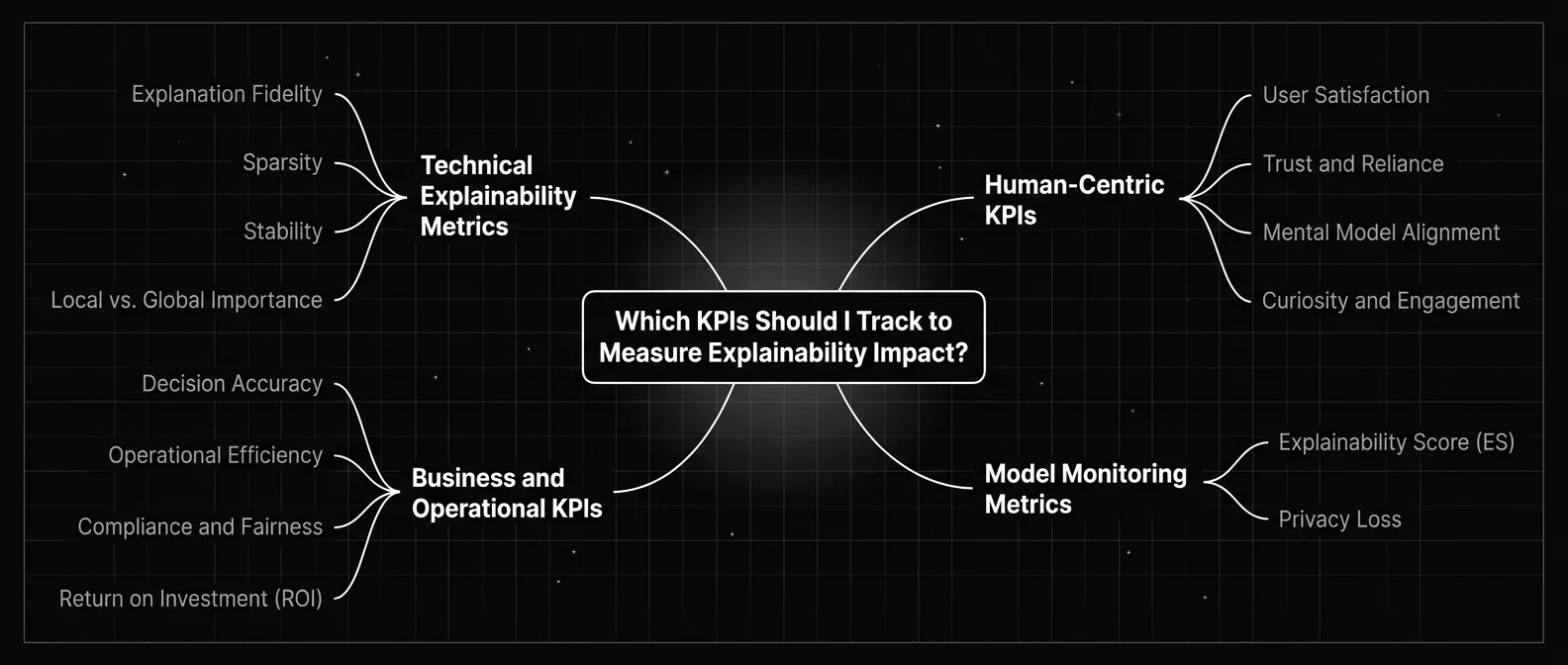
Figure 1: KPI families for AI explainability ROI
Comparison: SHAP, LIME, Captum, Alibi, and TransformerLens in 2026
| Tool | License | Best for | Strengths | Trade-offs |
|---|---|---|---|---|
| SHAP | MIT | Tabular, tree models | Consistent local and global attribution, TreeSHAP fast on gradient-boosted models | KernelSHAP slow at scale, feature correlation distorts attribution |
| LIME | BSD 2-Clause | Any classifier | Model-agnostic, single prediction focus, simple visuals | Different perturbation samples can produce different explanations |
| Captum | BSD 3-Clause | PyTorch deep models | Integrated gradients, saliency, DeepLIFT, layer attributions | PyTorch only, visualisation addon being phased out |
| Alibi | Check current license | Unified API in Seldon stack | SHAP, anchors, counterfactuals, drift in one library | Newer releases moved to Business Source License, restricting free production use |
| TransformerLens | MIT | Transformer LLM internals | Residual stream, attention head analysis, circuit discovery | Research-grade, needs ML engineering investment |
SHAP
SHAP assigns an importance score to each feature for a specific prediction using Shapley values from cooperative game theory. It produces consistent local and global attribution for tabular and tree models, and TreeSHAP is fast enough for production on gradient-boosted models.
Strengths
- Strong theoretical foundation produces coherent, contrastive explanations.
- TreeSHAP is fast enough to run in production on tree ensembles.
Trade-offs
- KernelSHAP (the model-agnostic form) is slow on large datasets.
- TreeSHAP can misattribute importance under feature dependency.
LIME
LIME perturbs inputs and observes output changes to fit a simple interpretable surrogate model around each prediction. It exposes what features affect a specific choice locally.
Strengths
- Model-agnostic, works on any classifier or regressor.
- Simple to use for single predictions with clear visual output.
Trade-offs
- Instability: different perturbation samples can produce different explanations.
- Only local insight, no global model understanding out of the box.
Captum
Captum is the PyTorch interpretability library from Meta. It implements gradient-based and perturbation-based attributions like Integrated Gradients, Saliency Maps and DeepLIFT for vision, text and audio models.
Strengths
- Works with PyTorch vision, NLP and audio models out of the box.
- Flexible analyses across Integrated Gradients, SmoothGrad, Layer-wise Relevance Propagation.
- Easy to plug in custom attribution methods.
Trade-offs
- PyTorch only.
- The visualisation addon is being phased out, so dashboards need an external tool.
Alibi
Alibi from Seldon offers black-box and white-box explainers for regression and classification, including SHAP, anchors and counterfactuals. It bundles local and global methods under a single API and integrates with Alibi-Detect for drift and outliers.
Strengths
- Combines model-specific (TreeSHAP, Integrated Gradients) and model-agnostic (KernelSHAP, LIME) methods.
- Designed to plug into KServe, Seldon Core and other MLOps platforms.
Trade-offs
- Newer releases moved from Apache 2.0 to a Business Source License, restricting free production use. Verify the current license before adoption.
- Surface area is broad, which can overwhelm teams that want one simple explainer.
TransformerLens
TransformerLens is the dominant 2026 mechanistic interpretability library for transformer LLMs. It exposes residual stream activations, attention heads, MLP outputs and circuit-level analysis. It is research-grade and asks for ML engineering investment, but it is the right tool when classical SHAP and LIME break down on LLMs.
Do Explainability Tools Actually Catch Model Failures Earlier
Yes. Three published studies and benchmarks anchor the case.
- Mistrust scoring for continuous monitoring: TRUST-LAPSE attributes a mistrust score from latent-space deviations on each inference. It detected more than 90 percent of drift events with less than 20 percent error across vision, audio and EEG data, with AUROCs of 84.1, 73.9 and 77.1.
- Open-source drift detection benchmark: The D3bench paper compared Evidently AI, NannyML and Alibi-Detect on smart-building streams. NannyML detected drift fastest and quantified the prediction-accuracy impact, enabling retraining triggers before widespread failures.
- Healthcare cost-proxy bias: A widely cited healthcare algorithm audit found that using healthcare cost as a proxy for sickness severity systematically underestimated the needs of Black patients. Switching to direct health indicators almost tripled program participation for those patients. The case is a strong example of why bias audits, alongside feature-attribution tools, belong in the explainability stack.
Industry Use Cases That Show Clear ROI from AI Explainability
Finance: XAI deployments have cut human audit hours in specific cited studies
A 2022 case study published in FARJ describes financial institutions using XAI to tighten risk assessment, lower default-detection failure rates and produce audit-ready explanations, with the cited deployment reporting more than 40 percent fewer human audit hours. Outcomes scale with audit maturity and the quality of the explanation evidence pack.
Healthcare: explainable medical imaging strengthens FDA 510(k) documentation
Hospitals using XAI on medical images can show clinicians the regions that drove the assessment, improving accuracy and reducing errors. These attributions can support documentation for FDA 510(k) submissions, strengthening the transparency evidence pack that regulators expect.
Public sector: XAI reduced research and report time
Public agencies using XAI for benefits eligibility, document analysis and scoring cut human research time by 50 percent and report generation by 65 percent, accelerating decisions and reducing appeal rates.
When Does AI Explainability Start Paying Off Across the Lifecycle
Testing phase
- Early bias detection: XAI surfaces data and model flaws before launch.
- Faster iteration: transparent model decisions help teams refine behaviour.
- Stakeholder buy-in: clear explanations build confidence with reviewers and approvers.
Post-deployment
- Reduced support tickets: users understand outcomes, lowering confusion and escalations.
- Fewer audit findings: explainability makes systems auditable and compliant.
- Lower maintenance cost: understanding model behaviour cuts the time spent firefighting.
Scaling
- Faster model updates: explainability surfaces what changed between versions.
- Lower retraining cost: knowing why the model fails reduces blind retraining cycles.
- Higher developer productivity: transparent logic accelerates debugging.
How Future AGI Complements an Explainability Stack
Future AGI does not replace SHAP, LIME, Captum or TransformerLens. It is the evaluation and observability companion that sits around them. The role split in a 2026 stack:
- Explainability libraries (SHAP, LIME, Captum, Alibi, TransformerLens) generate per-prediction evidence.
- Future AGI traceAI (Apache 2.0) captures every production trace via
fi_instrumentation.registerandFITracer, emitting OpenTelemetry GenAI semantic-convention spans that downstream dashboards can consume. - Future AGI fi.evals.evaluate (Apache 2.0) scores every trace on quality dimensions (faithfulness, groundedness, citation precision, toxicity, PII) using the Turing evaluator family (
turing_flashat roughly one to two second cloud latency). - Future AGI Agent Command Center hosts the trace store, the audit retention, SSO and the compliance dashboard.
A typical 2026 forensic workflow looks like this. The Agent Command Center surfaces a quality regression on a slice of traffic. The trace is opened in the Agent Command Center to see input, output, retrieved chunks and tool calls. SHAP, Captum or TransformerLens is called from inside the trace handler to generate feature or token attributions on the failing input. The attribution is logged back to the trace for auditor review. This is the loop that ties explainability ROI to production engineering velocity in 2026.
How Early Error Detection, Audit Trails, and Automated Insights Maximise Explainability ROI in 2026
Real-time drift and bias alarms let teams catch model errors before they hit users. Clear audit trails reduce regulatory fines and compliance risk. Embedded explainability in the development loop speeds retraining and debugging.
The recipe for 2026 ROI is straightforward. Instrument every production trace with OpenTelemetry GenAI semconv. Score every trace with a small panel of evaluation metrics. Call SHAP, Captum or TransformerLens on the failing traces. Keep the attributions in the audit log. Run a quarterly bias audit on the same evidence. Teams that build this loop typically target audit-hour reductions in the 30 to 50 percent range and meaningful improvements in mean time to resolve model incidents, with the exact gains varying by audit maturity and the share of incidents that are explainability-blocked rather than data-blocked.
Frequently Asked Questions
What is AI explainability and why does it matter for ROI in 2026?
What is the typical payback period for AI explainability tools?
Which explainability tool should I pick: SHAP, LIME, Captum, or Alibi?
What KPIs prove that explainability is delivering ROI?
Do explainability tools actually catch model failures earlier?
Are there hidden costs in AI explainability deployments?
How does explainability work for large language models specifically?
How does explainability tie into evaluation and observability in production?

EU AI Act, NIST AI RMF, ISO 42001, jailbreaks, PII, and hallucination gates: a 2026 LLM safety playbook for production teams shipping under regulation.

Map enterprise LLMs to GDPR, EU AI Act and NIST AI RMF in 2026: input/output guardrails, bias audits, explainability, and a real FAGI Protect setup.

Wire policy, enforcement, and audit into runtime so EU AI Act, NIST AI RMF, and ISO 42001 close on one plane without slowing releases.