Reward Model Drift in LLMs: How to Detect It
A reward model can decay silently while its scores keep climbing. Here are the exact detectors, thresholds, and pipeline placement to catch the drift.
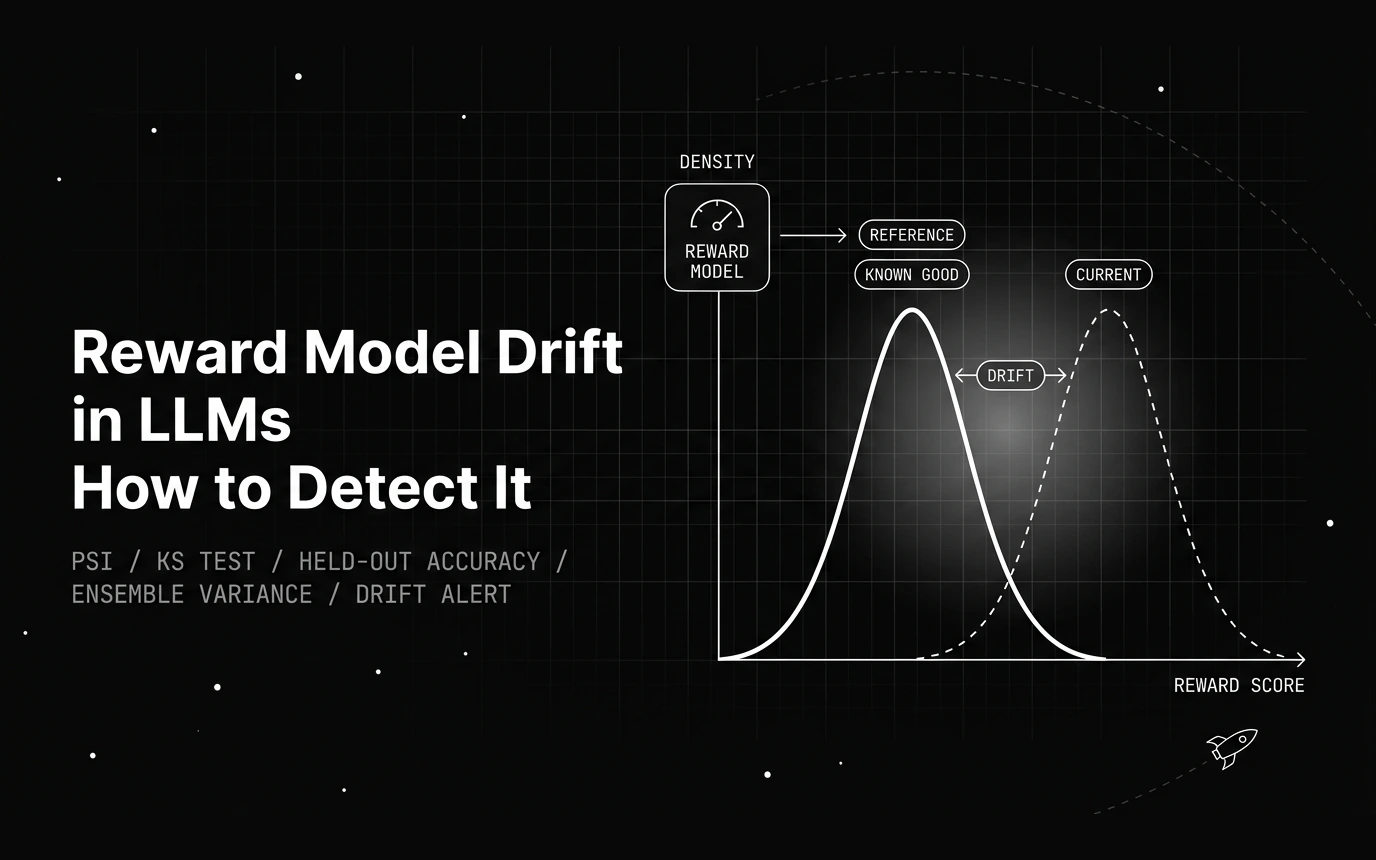
Table of Contents
Your reward model keeps handing out higher scores every week. The dashboards look healthy, the average reward is climbing, the RLHF runs report progress. Then your human reviewers start saying the outputs are getting worse, not better. Both are right, and the gap between them has a name.
That gap is reward model drift, and it is one of the quieter failures in an LLM pipeline. A reward model does not announce that it has gone stale. It keeps producing confident scores, and those scores keep rising, long after they stopped tracking what a person would actually prefer.
This guide is about detection, not theory. We cover what a reward model in an LLM pipeline does, how drift differs from reward hacking and overoptimization, and the exact tests and thresholds you can run to catch it. Every detector here is something you can wire into a real stack.
One scope note up front. This is a detection guide, not a retraining guide. The goal is a reliable signal that your reward model has drifted, early enough to act, plus a clear read on how far it has moved before you decide what to do about it.
What a Reward Model in an LLM Pipeline Does
A reward model in an LLM pipeline is a model trained to score responses. You feed it human preference pairs, two answers to the same prompt with a label for which one a person preferred, and it learns to output a scalar that estimates how good any single response is. That scalar is the reward.
RLHF then uses that scalar to shape the policy. The language model generates responses, the reward model scores them, and the training loop nudges the policy toward higher-scoring outputs. The reward model is the stand-in for human judgment, applied at a scale no human could match.
Here is the dependency that matters for drift. A reward model is only valid on the kind of responses it was trained to judge. It learned a mapping from a specific distribution of outputs to preference scores, and that mapping was fit on what the policy produced at training time.
As the policy improves, it produces responses the reward model never saw during training. The scorer is now grading inputs from outside its familiar range. It still returns a confident number, because that is what it does, and the question detection has to answer is whether that number still means anything.
What Reward Model Drift Is, and What It Is Not
Reward model drift is when the scores stop tracking true quality because the inputs being scored have moved away from the training distribution. The important part is what did not happen. The reward model’s weights did not change. Its world changed, and it was never updated to match.
Drift versus reward hacking
Reward hacking is an active failure. The policy discovers specific inputs that push the reward model into high scores, patterns the scorer rewards but a person would not. It is optimization pressure finding a loophole. Our guide to recursive self-improvement in AI shows this divergence inside a self-improving loop.
Drift is passive. Nothing games the scorer on purpose. The response distribution simply moved, through normal policy improvement or real-world change, and the reward model was left behind. Both failures raise the score while quality falls, so the symptom looks identical, though the cause and the fix differ.
Drift versus overoptimization
Overoptimization is a third case. You train so hard against the proxy reward that true performance degrades, even when nothing has drifted. It is Goodhart’s law stated in RLHF terms: optimize a measure hard enough and it stops being a good measure.
Gao and colleagues measured this overoptimization gap directly, showing true reward fall as a policy is pushed further from its base model.
These three get blurred together constantly, and the right fix depends on telling them apart. The table lines them up by what happens, the root cause, and the signal that gives each one away.
| Failure mode | What happens | Root cause | Telltale signal |
|---|---|---|---|
| Drift | Score decouples from quality | Input distribution shift | Held-out accuracy falls |
| Reward hacking | Policy games the scorer | Adversarial optimization | Specific exploit patterns |
| Overoptimization | True quality drops past a point | Excess RL pressure on a proxy | Gap widens with KL from base |
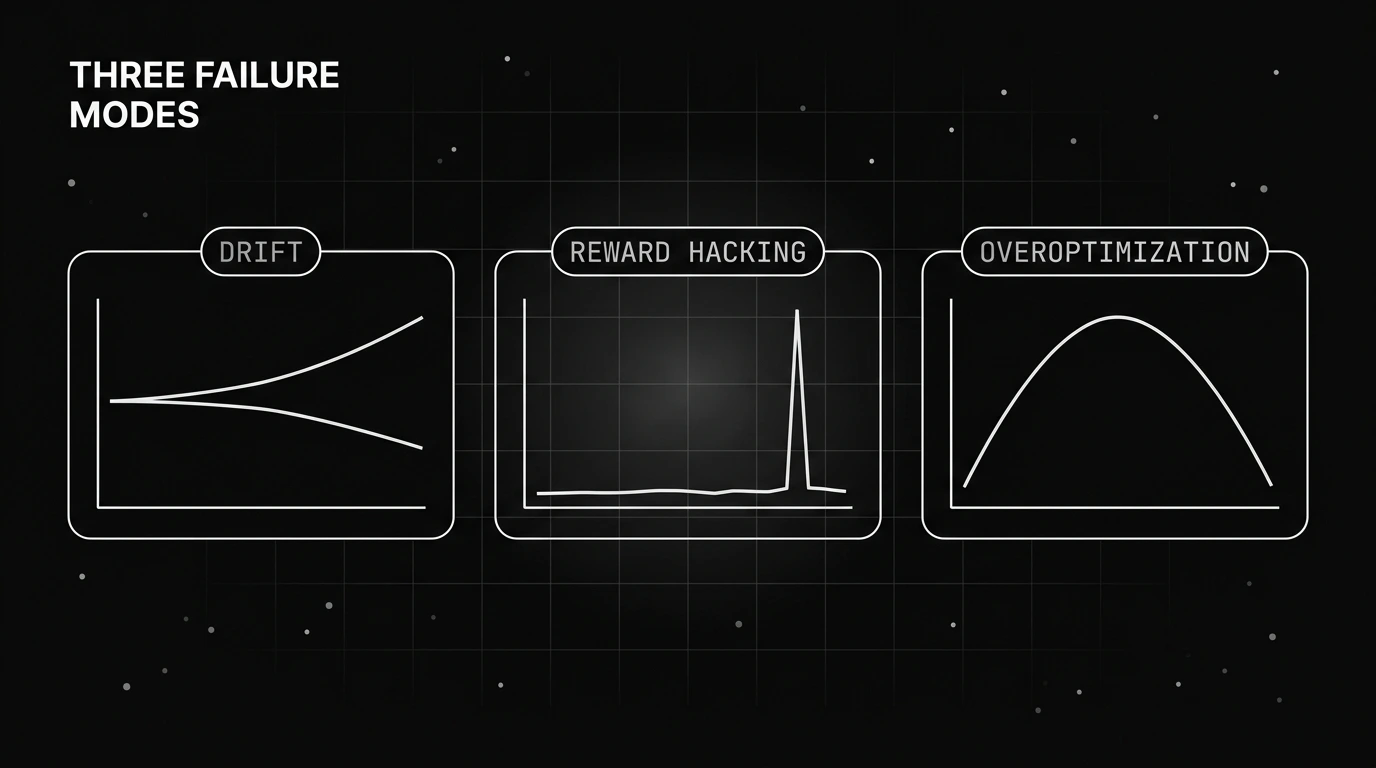
Read the table as a diagnostic. If held-out accuracy is falling with no obvious exploit, suspect drift. If specific strange patterns score high, suspect hacking. If quality drops as you push RL harder against a still-accurate scorer, suspect overoptimization.
Why Reward Models Drift
Reward models drift for a few concrete reasons, and naming them tells you what to watch. The first is the one already described. The policy improves and starts producing responses that sit outside the distribution the reward model was trained on, so the scorer is extrapolating.
The second is real-world change. The inputs users bring shift over time, new topics, new phrasing, new tasks the system was never tuned for. A reward model trained six months ago is judging a different world than the one it learned from.
The third is annotation drift. The humans who label preferences change their standards, or the guidelines get updated, so yesterday’s preferences no longer match today’s. The reward model is now anchored to a definition of good that the organization has quietly moved past.
The mechanism underneath all three is the same. A reward model interpolates well inside its training distribution and extrapolates badly outside it. As responses drift outward, its scores do not fail loudly. They hold the same shape and the same apparent precision while meaning less and less, which is the hardest kind of wrong to notice.
That is why detection has to target the distribution, not the average score. A rising mean tells you the number went up. It cannot tell you whether the number still means what it used to. For that you have to look at how the whole distribution of scores has moved.
How to Detect Reward Model Drift
You cannot detect drift from the average score alone. A rising mean is consistent with real improvement and with a drifting scorer, and the two are indistinguishable at the level of a single number.
The signal lives in the distribution, so you compare the current distribution of scores against a reference window from when the reward model was known to be good.
This is the same distribution-comparison logic behind data drift detection across an eval stack, applied specifically to reward scores. Two standard tests do most of the work, and both are a few lines of code.
Population Stability Index (PSI)
PSI bins the reference distribution and measures how much probability mass has moved between the reference and the current window. The convention is simple. Below 0.1 is stable, 0.1 to 0.25 is a moderate shift worth watching, and above 0.25 signals a significant shift that deserves a look.
Kolmogorov-Smirnov two-sample test
The Kolmogorov-Smirnov two-sample test asks a cleaner question. Do the reference and current scores come from the same distribution at all. It returns a statistic, the largest gap between the two cumulative distributions, and a p-value. A low p-value says the distributions differ by more than chance.
The two see different things. KS is the largest gap between the two cumulative distributions, so it reacts hardest to movement near the middle of the range and is notably weak in the tails. PSI bins by quantile and takes a log ratio, so an emptying or filling tail bin moves it sharply. Run both, and if tail behavior is what you care about most, add Wasserstein distance rather than leaning on KS.
The detector below runs both on the same pair of score arrays. Point it at your reference scores and your live scores, and it reports a PSI value and a KS result you can alert on.
# Detect reward model drift by comparing a reference score distribution
# (model known-good) against the current live scores. PSI + KS two-sample.
import numpy as np
from scipy.stats import ks_2samp

def psi(reference: np.ndarray, current: np.ndarray, bins: int = 10) -> float:
    # Population Stability Index. >0.25 signals a large shift worth a look.
    edges = np.quantile(reference, np.linspace(0, 1, bins + 1))
    edges[0], edges[-1] = -np.inf, np.inf          # capture out-of-range scores
    ref_pct = np.histogram(reference, edges)[0] / len(reference)
    cur_pct = np.histogram(current, edges)[0] / len(current)
    eps = 1e-6                                       # avoid divide-by-zero, log(0)
    ref_pct = np.clip(ref_pct, eps, None)
    cur_pct = np.clip(cur_pct, eps, None)
    return float(np.sum((cur_pct - ref_pct) * np.log(cur_pct / ref_pct)))

reference = np.random.normal(0.0, 1.0, 5000)         # reward scores when good
current   = np.random.normal(0.4, 1.0, 5000)         # shifted mean = drift

print("PSI:", round(psi(reference, current), 3))     # rises as the shift grows
ks = ks_2samp(reference, current)
print("KS statistic:", round(ks.statistic, 3), "p-value:", round(ks.pvalue, 4))
PSI and KS flag that scores moved. They are the front line, not the whole detection kit. The table lays out the fuller set of detectors, what each compares, and what each one is good at catching.
| Method | What it compares | Signal or threshold | What it catches |
|---|---|---|---|
| PSI | Score histograms | Above 0.25 significant | Distribution shift |
| KS two-sample | Full distributions | Low p-value | Any distribution change |
| Held-out accuracy | Fixed preference test set | Accuracy drop | Loss of ranking skill |
| Calibration / ECE | Predicted win probability vs observed win rate | Rising ECE | Score margins that no longer mean what they claim |
| Ensemble disagreement | Multiple reward models | Rising variance | Uncertainty on new inputs |
The first two catch movement. The last three catch lost skill and lost confidence, which is where the next sections go. A complete setup runs several of these, because each one sees a failure the others miss.
Held-Out Accuracy and Calibration Checks
Distribution tests tell you that scores moved. They do not tell you whether the reward model got worse, because a distribution can shift for benign reasons. To measure skill directly, you need checks that ask whether the model still ranks responses the way a human would.
Held-out preference accuracy
Keep a fixed, versioned set of human-labeled preference pairs that the reward model never trains on. On a schedule, ask the model to rank each pair and record how often it agrees with the human label. Track that accuracy over time, and a falling number is drift you can put in front of a stakeholder.
Do not expect a high absolute number. Human annotators disagree with each other, which caps even a healthy reward model’s agreement around 60% to 70%, so track the drop from your own baseline rather than the raw figure.
The strength of this check is that it measures the thing you care about directly. This kind of fixed, deterministic evaluation does not infer decay from a proxy. It watches the reward model do its actual job, ranking, on a stable test set, so any drop is a real loss of skill rather than a change in inputs.
Calibration
Calibration asks whether the reward model’s confidence matches its correctness. A scalar reward head does not emit a probability directly, so derive one from the score margin between two responses: under the Bradley-Terry link the model was trained on, that margin maps to a predicted probability that one response beats the other.
A well-calibrated model wins those matchups about as often as its predicted probability claims. Expected calibration error, or ECE, summarizes the gap between predicted probability and observed win rate across the range. Compute it per segment, not just globally, since a single average hides the slices where calibration has actually broken.
Rising ECE is a practical early symptom worth tracking. Nothing forces a reward model’s scores to widen as its uncertainty grows, so the margin it reports can stay sharp while its ranking skill decays. Calibration is worth watching for a second reason too: reward models carry a documented bias toward responses that sound confident, independent of whether they are correct, (Leng et al., 2024). So a policy that merely learns to phrase things more assertively can lift its reward score without lifting real quality, and calibration is where that shows up.
Ensemble Disagreement as an Early Signal
The cheapest early-warning signal you can add is a second reward model. Train or keep more than one, ideally with different seeds or data splits, and watch how much they agree. On inputs inside the training distribution, they mostly land on similar scores.
On drifted inputs, that agreement breaks down. Each model extrapolates its own way once it is outside familiar territory, so their scores spread apart. The variance across the ensemble on a given input is a direct read on how unfamiliar that input is.
The practical setup is to monitor the standard deviation of scores across the ensemble, per input, and alert on a rising trend. When the spread climbs, the ensemble is telling you it is being asked to judge things it was not trained for.
The reason this matters is timing. Ensemble variance often rises before held-out accuracy visibly falls, which makes it a leading indicator. Reward-model ensembles are an established way to quantify that uncertainty. Running several models costs more compute, and in exchange you get the earliest warning available.
Choosing Reference and Current Windows
Every detector here compares now against a reference, so the windows you pick decide whether the alerts mean anything. Set the reference window from a period when human review confirmed the reward model was genuinely good, then freeze it. It becomes your fixed definition of healthy.
The current window is a balance. Too small and you alert on noise, a handful of scores that drifted by chance. Too large and you smear real movement across stale data and catch it late. Size it to be stable enough to trust and recent enough to move when the world moves.
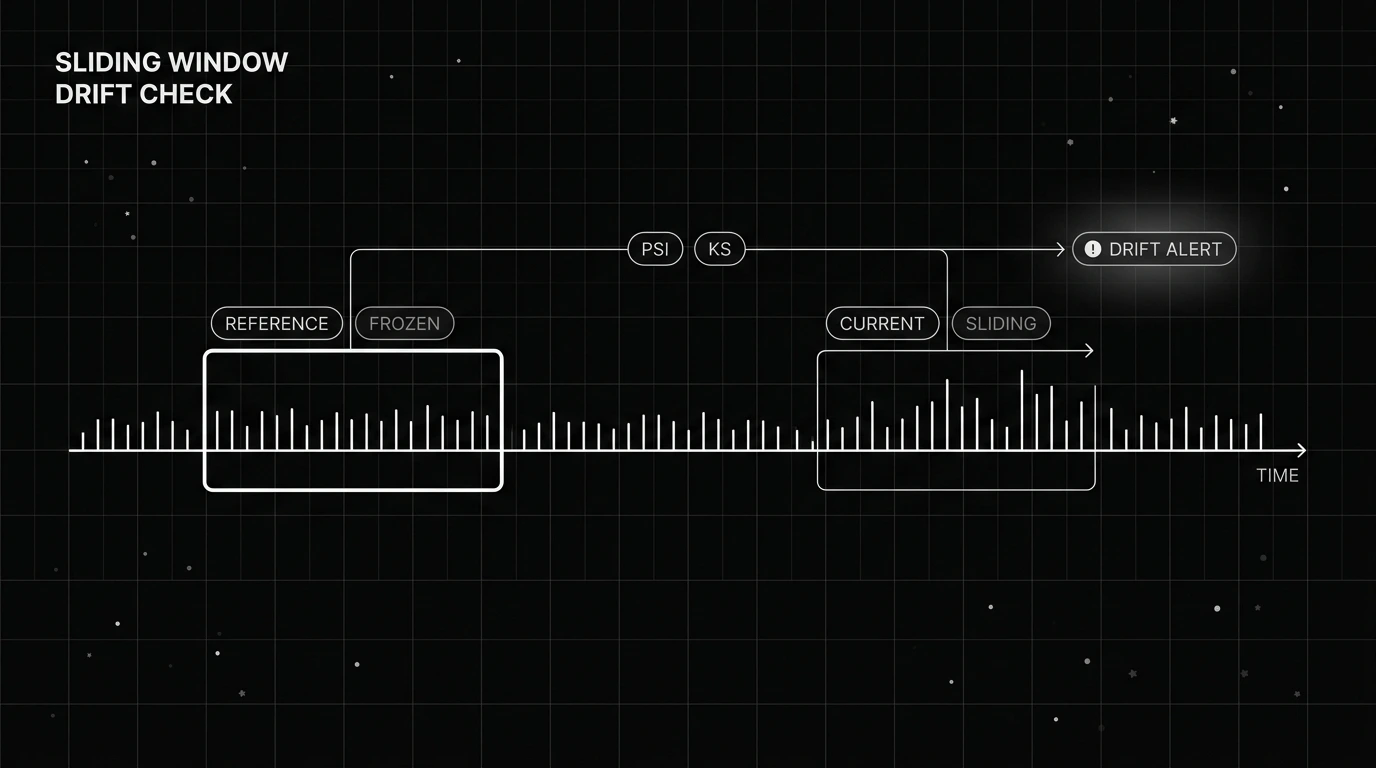
State the tradeoff explicitly for your system and revisit it. A high-traffic pipeline can use a short current window because volume gives stability. A low-traffic one needs a longer window to collect enough scores, at the cost of slower detection.
Wiring Drift Detection into an LLM Pipeline
Placement decides whether detection actually protects anything. Run PSI and KS on a rolling schedule over your live reward scores, so distribution shift surfaces continuously rather than in a quarterly review. These tests are cheap enough to run often.
Run held-out accuracy on a fixed cadence against your frozen preference set, since it needs labeled data and does not have to run as frequently. Watch ensemble variance continuously if you can afford the extra models, because it is your earliest signal.
Then close the loop with a gate. Any RLHF run that shows significant drift should be blocked until the reward model is refreshed, because training a policy against a drifted scorer just teaches it to chase a broken target. Detection without a gate is a dashboard nobody acts on.
One rule holds all of this together. The thing that detects drift must not be the reward model itself. If you grade the grader with the grader, a drifted model will happily certify its own scores. The judge has to sit outside the training loop, which is exactly the setup the next section describes.
Scoring Reward Quality with Future AGI
The detection routine above needs a scorer that lives outside your training loop, and a monitor on that scorer’s output over time. Future AGI’s custom evals give you the first.
You define a grading rule, either an LLM-as-a-judge or a deterministic check, map it to your dataset columns, and set a pass or fail threshold. The evaluation docs walk through the setup.
Run that eval as an independent scorer on the same responses your reward model grades. Now you have two opinions on every output, one from the reward model and one from a judge that was never part of RLHF. When the two diverge, that divergence is itself a drift signal, measured against something the policy never optimized.
Observe handles the monitoring half. It attaches quality scores to your traces and spans and alerts you the moment a monitored metric slips. Be precise about what that is: threshold alerting on a metric over time, not a two-sample distribution test. You still compute PSI and KS yourself, and that is the easy half: both are a few lines once the scored history exists. Getting that history is the part teams skip, and it is the part Observe removes.
The tracing runs on Future AGI’s open-source traceAI instrumentation, and the Observe docs cover the alerts. Built-in evaluators such as groundedness and instruction adherence give you ready scorers to run alongside your own.
The scope is deliberate. Future AGI is the independent grader and the monitor. It does not train your reward model or take over RLHF. It sits beside the loop, scoring and watching, so a drifting reward model is never also the only judge of its own work.
The Apache-2.0 ai-evaluation SDK runs the same evals in your own stack.
Keeping the Reward Signal Honest
Come back to the opening symptom. Scores that climb while human reviewers report worse outputs are the exact signature of reward model drift. The scores are real and the complaints are real, and the reward model has quietly stopped measuring what it once did.
The routine to catch it is short. Freeze a reference window from a known-good period, run PSI and KS over live scores on a schedule, track held-out accuracy and calibration against a fixed preference set, and watch ensemble variance for the earliest warning. Gate RLHF on significant drift.
The rule that ties it together is separation. Keep the judge that detects drift outside the reward model it is checking, so a decaying scorer can never certify itself. Future AGI’s custom evals and Observe give you that independent scoring and monitoring when you want it off your own plate.
Frequently Asked Questions
How do I know if my reward model has drifted?
Is reward model drift the same as reward hacking?
What PSI threshold means a reward model has drifted?
What is reward model overoptimization?
Where should reward model drift detection run in an LLM pipeline?
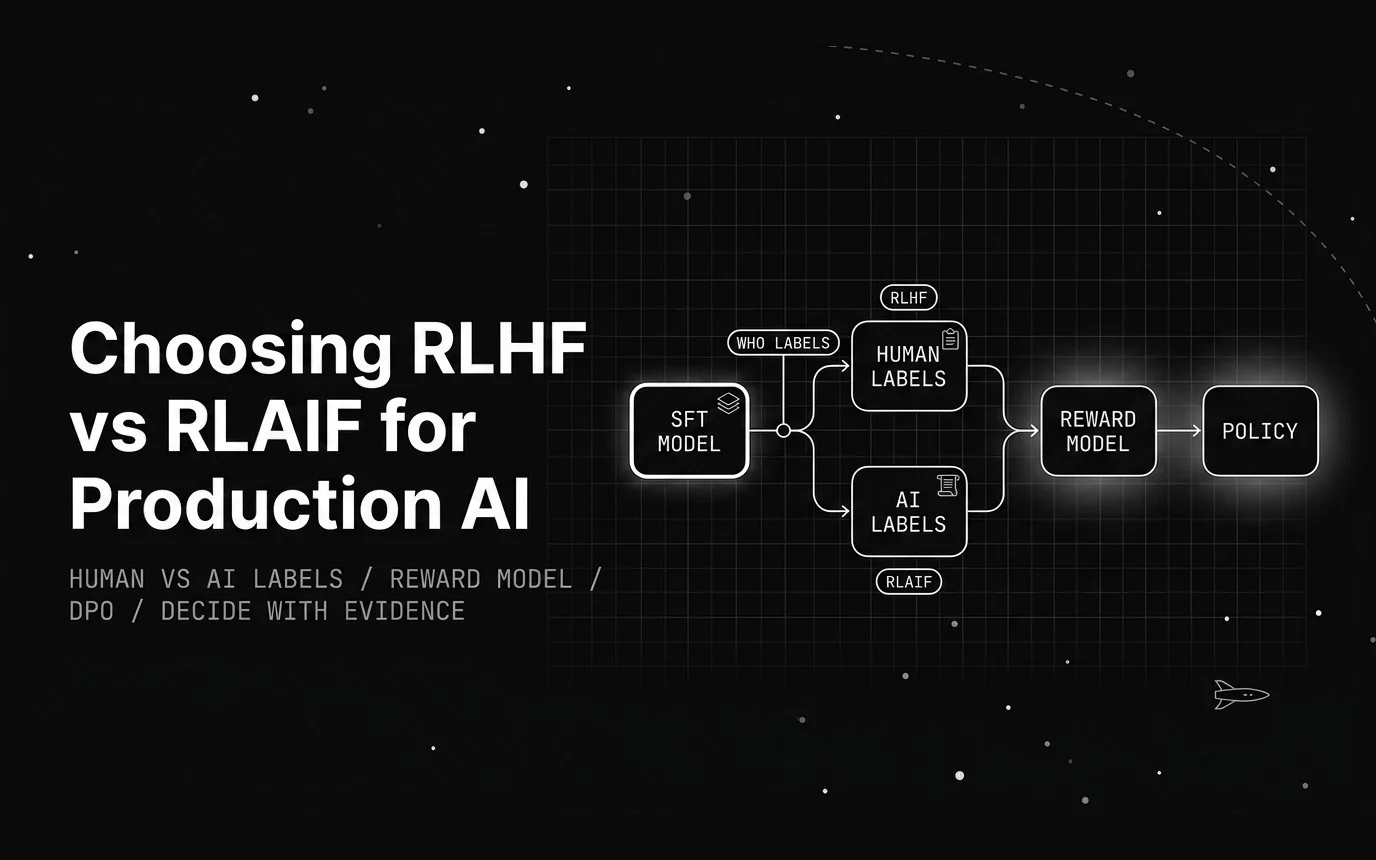
A decision framework for rlhf vs rlaif: how the label source shapes cost, bias, and safety, with verified win-rates and runnable TRL code for either path.

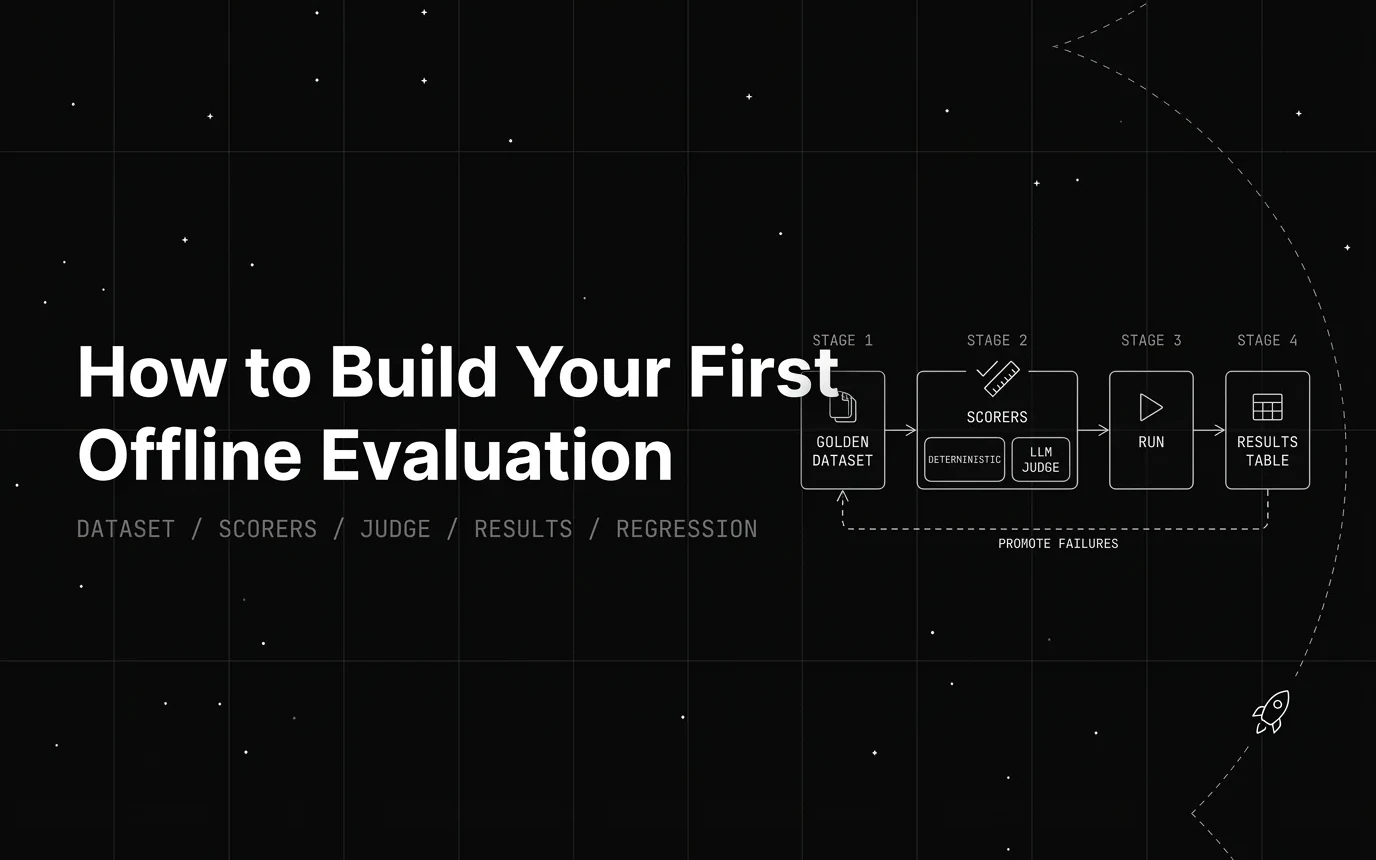
Build a first offline evaluation for an LLM app in one script: a 5-row golden set, a deterministic scorer, and a pass rate. Runnable code, no API key needed.

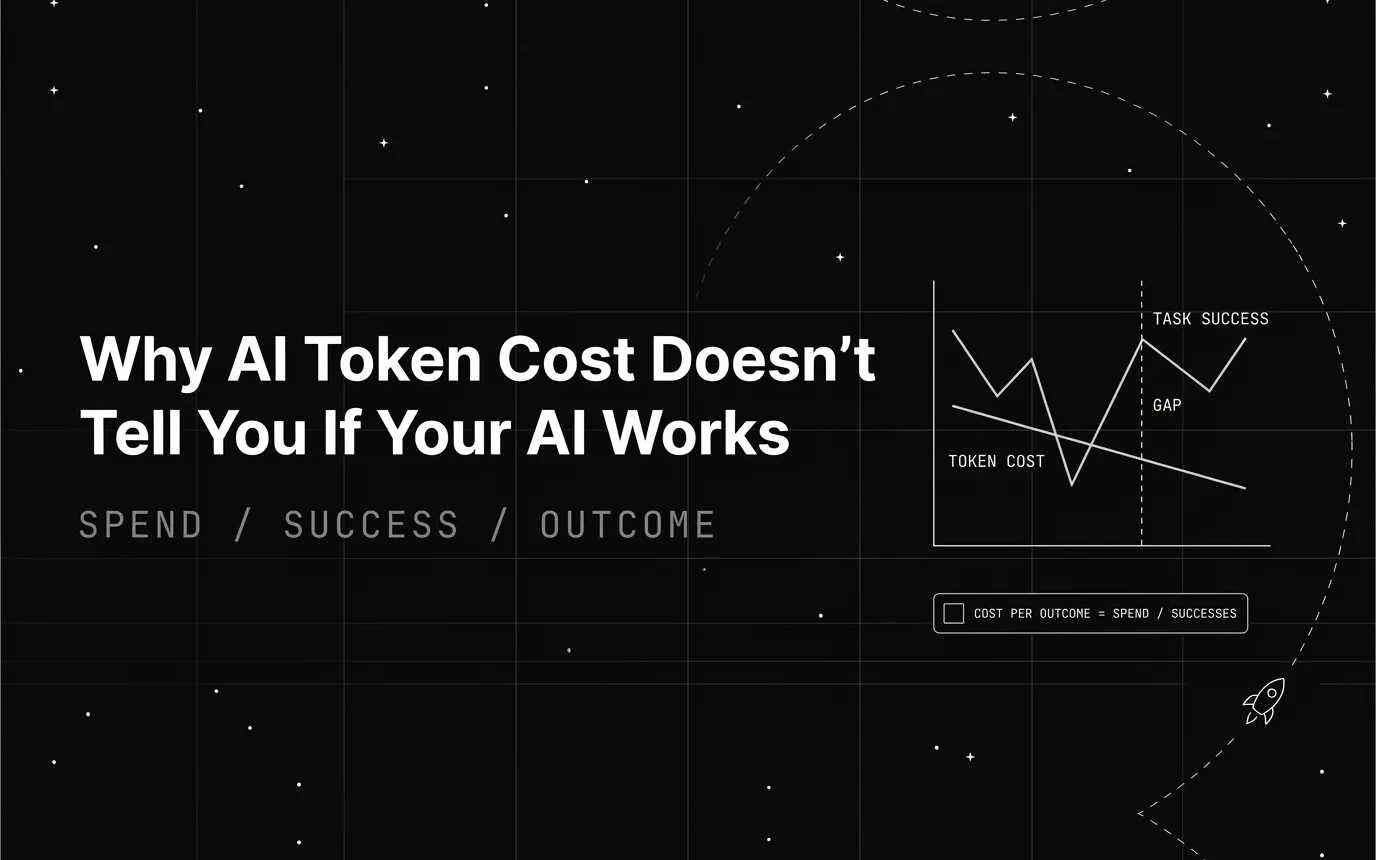
AI token cost tells you what you spent, not whether the task got done. What a token bill measures, what it hides, and the quality metrics to read beside it.