Choosing RLHF vs RLAIF for Production AI
A decision framework for rlhf vs rlaif: how the label source shapes cost, bias, and safety, with verified win-rates and runnable TRL code for either path.
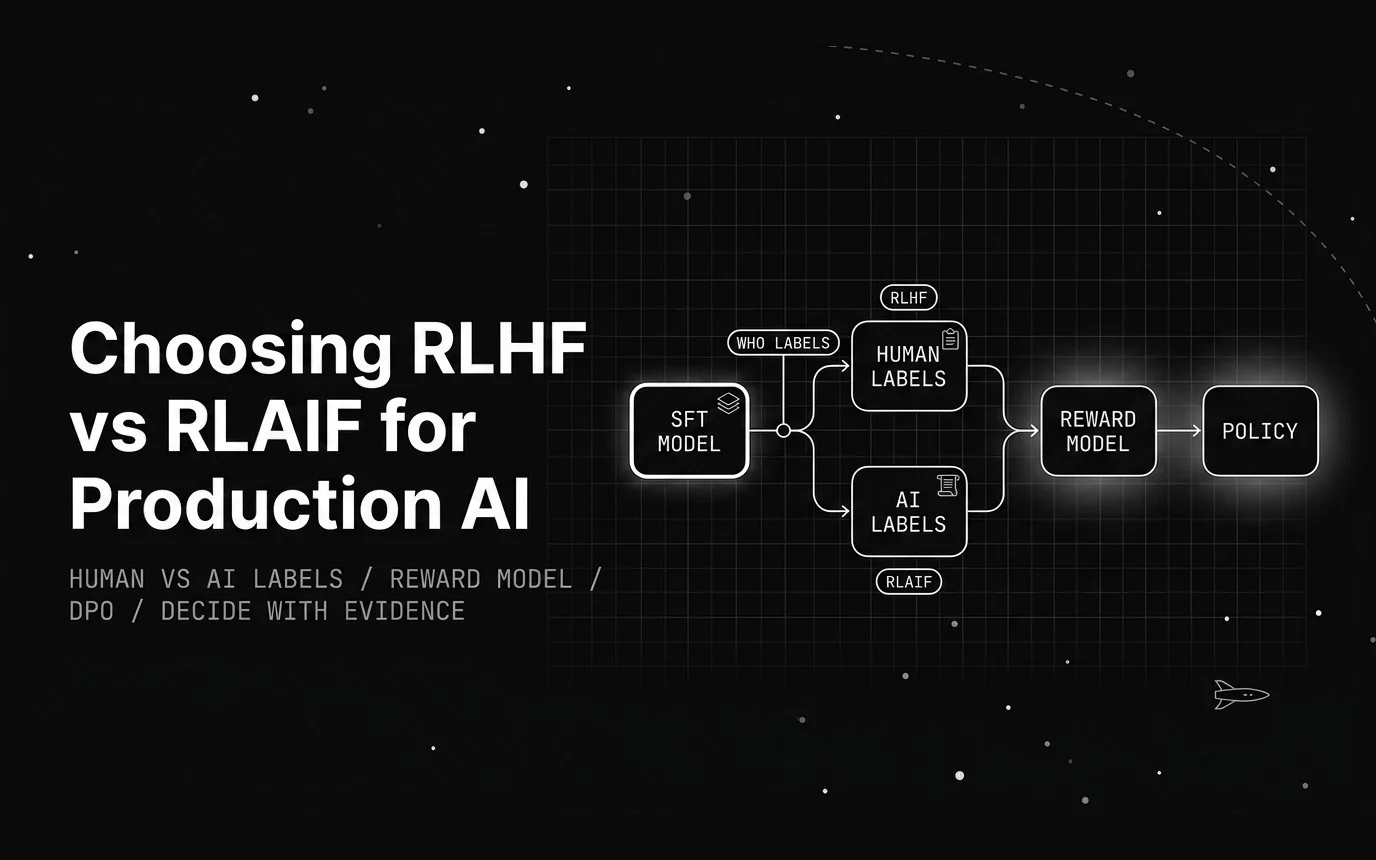
Table of Contents
You fine-tuned a model, you have a label budget, and you must decide who writes its preference data. Pick humans and you pay for every comparison. Pick an AI labeler and you inherit its blind spots. That single choice is the whole rlhf vs rlaif decision, shaping cost, speed, and safety before any reward model trains.
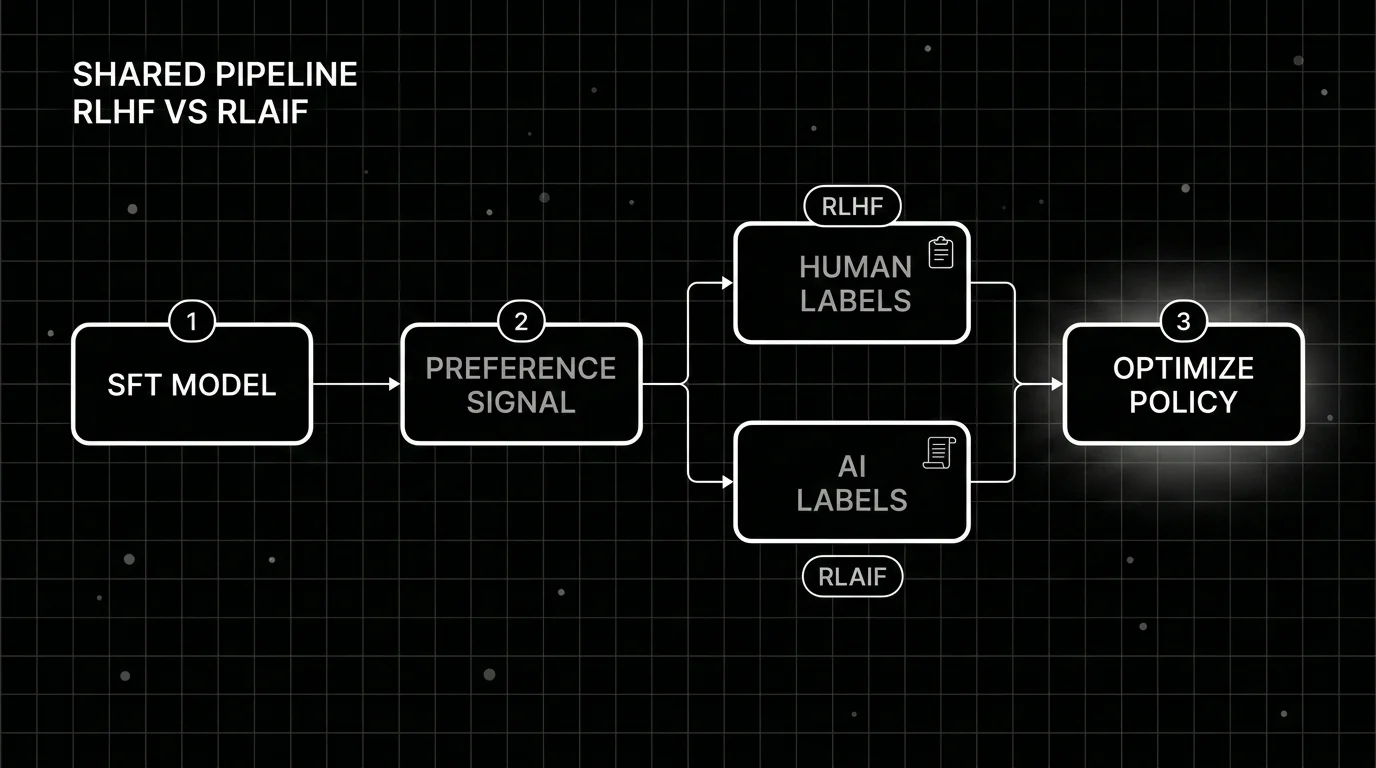
The rlhf vs rlaif choice looks like a deep algorithmic fork, but it is really a sourcing decision. Reinforcement learning from human feedback (RLHF) and reinforcement learning from AI feedback (RLAIF) run the same pipeline; they only disagree on who produces the preference labels. Everything downstream, the reward model and the policy optimizer, can be identical.
That reframing changes what you are buying. Human labels cost more and move slower, yet they carry audit weight that a regulator or customer will accept. AI labels are cheap and fast, but they inherit the labeler model’s biases. Deciding between them is a production tradeoff about budget, throughput, and how much you trust a machine to judge quality.
This guide gives you a decision framework grounded in verified benchmark numbers, not vendor claims. You will see where DPO fits (it is not a third option), what the published win-rates say, and how to implement either path in TRL. By the end you can defend the call in a design review with evidence instead of preference.
TL;DR
- RLHF and RLAIF differ only in who writes the preference labels: human annotators or an LLM guided by a written rubric. The reward model and optimizer can be identical.
- On general helpfulness the two sit near parity in published win-rates; RLAIF’s clearest edge is harmlessness, where Lee et al. report an 88% harmless rate against 76% for RLHF and 64% for the supervised baseline.
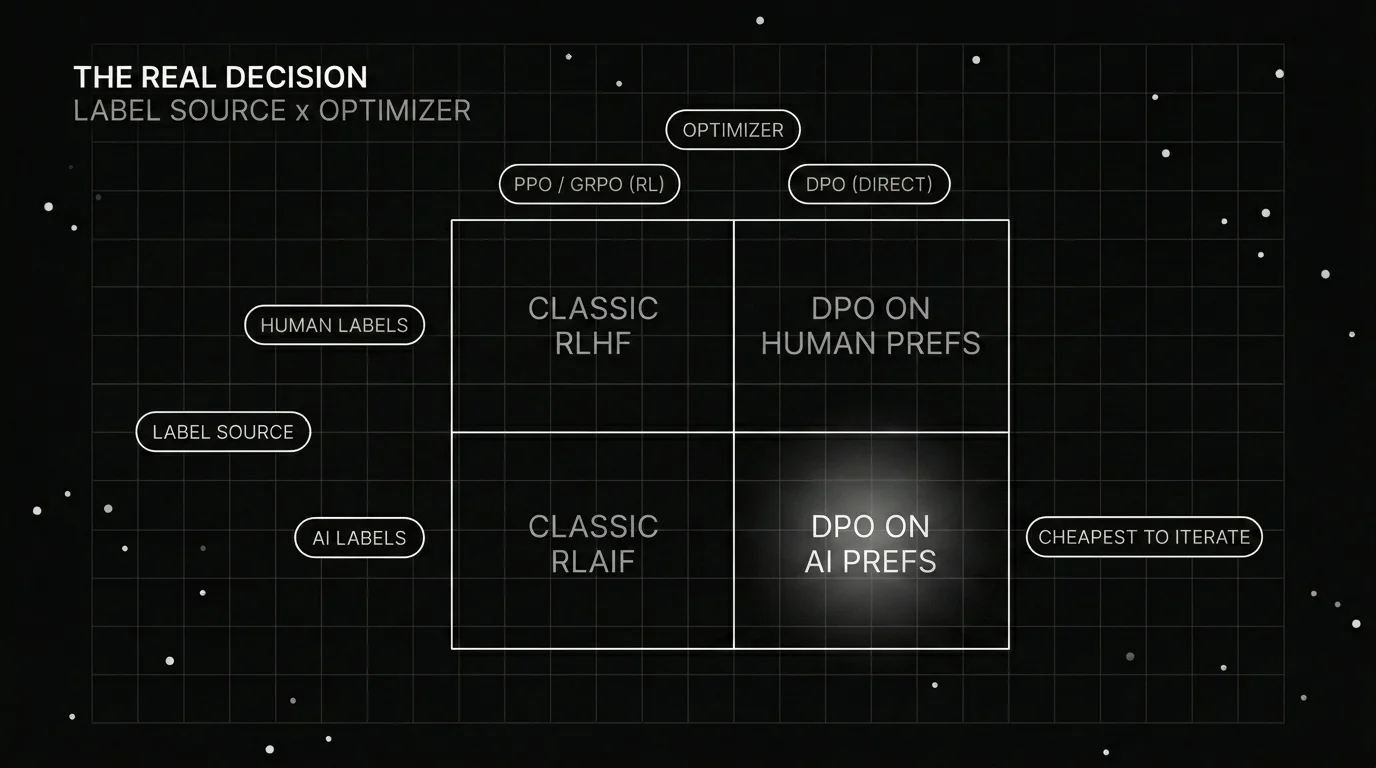
- DPO is not a third choice. It is an optimizer that runs on either human or AI labels, so the real decision is a 2x2 of label source times optimizer.
- Start with AI labels for iteration speed, hold a human-labeled eval set as ground truth, and promote to human labeling only where the AI labeler fails that set.
- Both paths converge on the same TRL trainers, so switching label source is a dataset change, not a rewrite.
What Do RLHF and RLAIF Actually Optimize?
Both methods start from the same place: a supervised fine-tuned (SFT) model that already follows instructions.
On top of that you add a preference signal that says which of two outputs is better, then you optimize the policy to produce more of the preferred kind. The optimizer can be an RL method like PPO or GRPO, or a direct method like DPO.
RLHF sources that preference signal from people. Human annotators rank model outputs, and those rankings train a reward model that scores new generations during optimization.
The approach traces to early work on learning from human preferences (Christiano et al.) and became the standard alignment recipe with InstructGPT (Ouyang et al.).
RLAIF swaps the human ranker for a capable LLM. The model compares two outputs and picks the better one, guided by a written rubric that spells out the qualities to reward. Get the two lineages straight: Lee et al. used a labeling preamble, a prompt that reads like the rating instructions you would hand a human annotator, while the “constitution” proper comes from Bai et al.’s Constitutional AI. Both are written rules; only one is a constitution.
Lee et al. showed this scales preference labeling to volumes humans cannot match, building on the Constitutional AI method (Bai et al.).
Most comparisons blur this distinction: the axis that separates RLHF from RLAIF is who writes the labels, not which optimizer consumes them. Hold that thought, because it is what makes DPO an orthogonal choice rather than a rival to either method.
| Dimension | RLHF | RLAIF |
|---|---|---|
| Label source | Human annotators | LLM labeler + written rubric |
| Cost per label | High | Low |
| Throughput | Slow | Fast, scalable |
| Bias profile | Human inconsistency, fatigue | Inherits labeler-model bias (verbosity, position, self-preference) |
| Auditability | Strong (human sign-off) | Needs label-quality checks |
| Best early fit | Regulated or safety-critical sign-off | Large-scale, fast iteration |
RLHF vs RLAIF Benchmark Results You Can Trust
Published win-rates give you a starting expectation, as long as you read them as research-setting results. The most cited head-to-head comes from Lee et al., reported as win-rate against a supervised baseline and against each other. The numbers below are the ones worth carrying into a planning meeting.
- Summarization: RLAIF won 71% and RLHF 73% against the baseline; head to head they land near 50%, a statistical tie.
- Helpful dialogue: RLAIF reached 63% and RLHF 64%, with a head-to-head around 52%.
- Harmless dialogue: this one is not a win rate. Evaluators rated each response independently, and RLAIF’s policy was judged harmless 88% of the time against 76% for RLHF and 64% for the SFT baseline.
Direct-RLAIF, an RLAIF variant that skips the reward model and scores outputs directly, beat a same-size reward-model RLAIF setup 60% of the time, or 56% once the authors corrected for response length. Read together, the pattern is consistent. On general helpfulness the two methods are close, and RLAIF’s advantage concentrates where a written rubric makes the target explicit, which is harmlessness and safety labeling.
Why the gap lands on harmlessness is our reading, not a result the paper tests. A written rubric states the safety target once and applies it to every comparison, so the labels stay uniform across millions of pairs. Human harmlessness judgments drift with annotator, fatigue, and interpretation, which widens variance exactly where consistency matters most.
Treat that as a hypothesis worth checking on your data, not a finding. What the paper does establish is the size of the gap, and that the authors also flag a length confound: RLAIF and RLHF policies both generate longer responses than SFT, which can bias human evaluation on its own.
Treat these as directional, not as numbers your project will reproduce. They come from specific datasets and judge setups, and your domain will shift them in ways no paper can predict. The rlhf vs rlaif gap is task-dependent, so measure it on your own data before trusting any single figure, including these.
That is also why an evaluation loop belongs in the plan from day one. A borrowed win-rate tells you where to start; a scored comparison on your traffic tells you which method actually earns its cost for your product.
Worth separating from a neighbouring question. LLM eval vs RLHF feedback loops covers the plumbing that turns production eval scores into a preference dataset in the first place. This page assumes you already decided to collect preferences and asks only who should write them.
Where DPO Fits, and Why It Is Not the Third Option
A common mistake is to line up RLHF, RLAIF, and DPO as three competing methods. DPO belongs on a different axis.
Direct Preference Optimization (Rafailov et al.) changes how you optimize, replacing the separate reward model and the online RL loop with a single closed-form loss. It says nothing about where your labels originate.
That means you can run DPO on human-labeled pairs or on AI-labeled pairs. The first is a direct-optimizer version of RLHF; the second is a direct-optimizer version of RLAIF. Either way you keep the label source you chose while dropping the reward model and online sampling that classic RL requires, which is why teams reach for it to iterate cheaply.
DPO’s simplicity is not free in every case. Because it optimizes directly against fixed pairs, it cannot explore fresh samples the way online RL does, so for verifiable-reward tasks like math or code an online method often pulls ahead. For preference-shaped quality, though, DPO on your chosen label source is usually the cheapest stable path to a shippable model.
So the real decision is a 2x2, not a three-way race. One axis is the label source, human or AI. The other is the optimizer, an RL method like PPO or GRPO, or the direct DPO path. Every practical alignment setup lands in one of the four cells below, and naming your cell is more useful than arguing about acronyms.
| PPO/GRPO (RL) | DPO (direct) | |
|---|---|---|
| Human labels | Classic RLHF | DPO on human prefs |
| AI labels | Classic RLAIF | DPO on AI prefs (cheapest to iterate) |
Should You Use RLHF or RLAIF in Production?
With the 2x2 in hand, five drivers decide which cell you should start in. Each one carries a rule you can apply the same day, so treat this as a checklist rather than a debate.
- Label budget and timeline. A tight budget and a fast iteration loop point to AI labels, either classic RLAIF or DPO on AI preferences. Human comparisons cost far more per label and take days to collect, while AI labels are cheap enough to regenerate wholesale, which is what makes a shifting rubric affordable to relabel on the AI side.
- Domain sensitivity. For safety and harmlessness with a clear written policy, RLAIF is strong, since the rubric applies the same explicit rules to every comparison instead of relying on annotator mood.
- Compliance and auditability. When a regulator or customer needs auditable sign-off, keep humans in the reward loop, or human-audit a sampled slice of the AI labels so there is a real paper trail.
- Bias tolerance. If verbosity, position, or self-preference bias is unacceptable, add debiasing such as position-swapping and length controls, or keep humans on the highest-stakes labels.
- Consistency at scale. AI labels are more consistent than tired annotators, but they can be consistently wrong. Validate them before you trust the consistency they promise.
Know RLAIF’s failure modes before you lean on it. The labeler can reward-hack its own rubric, favor longer answers, prefer outputs from its own model family, and stay silent on cases the rubric never anticipated. Each one trains into the reward model, which is why a labeler audit belongs in the method itself.
The default that works in practice is to start with AI labels for speed, hold out a human-labeled evaluation set as ground truth, and promote to human labeling only where that eval set shows the AI labeler is unreliable.
You get the iteration speed of RLAIF and the audit anchor of RLHF, spent where each one earns its keep.
If you are still deciding whether to tune at all, our guide on evaluation versus fine-tuning frames that upstream call.
Implementing the Preference Signal in TRL
Both paths converge on the same library. In TRL the only thing that changes between RLHF and RLAIF is the origin of the labels in your preference dataset; the trainer code is identical. You will reach for two trainers, starting with the reward model that the RL path needs.
The RL path trains a reward model first. It reads preference pairs and learns to score any new completion, and the policy optimizer then maximizes that score. The dataset below is a placeholder you swap for your own human- or AI-labeled pairs.
from trl import RewardTrainer, RewardConfig
from datasets import load_dataset
from transformers import AutoModelForSequenceClassification, AutoTokenizer

model_id = "Qwen/Qwen2.5-0.5B-Instruct"
model = AutoModelForSequenceClassification.from_pretrained(model_id, num_labels=1)
tokenizer = AutoTokenizer.from_pretrained(model_id)

# swap this dataset for your human- or AI-labeled preference pairs
dataset = load_dataset("trl-lib/ultrafeedback_binarized", split="train")

trainer = RewardTrainer(
    model=model,
    processing_class=tokenizer,
    args=RewardConfig(output_dir="reward-model", per_device_train_batch_size=2),
    train_dataset=dataset,
)
trainer.train()
That single dataset line is the entire rlhf vs rlaif switch at the implementation level. Point it at human rankings and you have RLHF; point it at an AI-labeled set and you have RLAIF, with no other change to the training code.
Both trainers expect the same preference schema: a prompt with a chosen and a rejected completion per row. The trl-lib/ultrafeedback_binarized set already follows it, so your real work is producing that table from either human rankings or AI judgments, then keeping the column names the trainer expects. The label origin is a data-pipeline decision, not a training-code decision.
The direct path skips the reward model. DPO consumes the same preference pairs and optimizes the policy against them with one loss, which is cheaper to run and more stable than a full RL loop for a small team.
from trl import DPOTrainer, DPOConfig
from datasets import load_dataset
from transformers import AutoModelForCausalLM, AutoTokenizer

model_id = "Qwen/Qwen2.5-0.5B-Instruct"
model = AutoModelForCausalLM.from_pretrained(model_id)
tokenizer = AutoTokenizer.from_pretrained(model_id)

# same preference pairs; label origin (human vs AI) is your RLHF/RLAIF choice
dataset = load_dataset("trl-lib/ultrafeedback_binarized", split="train")

trainer = DPOTrainer(
    model=model,
    args=DPOConfig(output_dir="dpo-model", per_device_train_batch_size=2),
    processing_class=tokenizer,
    train_dataset=dataset,
)
trainer.train()
For RLAIF, point the loader at an openly available AI-labeled preference set and keep everything else fixed.
If you were reaching for PPO instead, current TRL moves the online PPO trainer under trl.experimental.ppo and requires four models (policy, reference, reward, and value), so GRPO is the lighter modern default for the RL cell. Pin your TRL version, since that experimental import path can move between releases.
Validating RLHF and RLAIF Outputs With Future AGI
The hardest part of RLAIF is not running the trainer, it is trusting the labels and the model that comes out. That is an evaluation problem, and it is where Future AGI fits.
You write the grading rule as a custom eval, choose an LLM judge or a deterministic check, point it at your dataset columns, set a pass or fail threshold, and run it as a gate before a tuned model ships.
Two uses matter here. First, audit the AI labeler: sample its preference labels and score them for bias and correctness, checking instruction adherence and tone.
A groundedness check tests whether each label’s stated justification is supported by the output it praises, which directly attacks the verbosity and self-preference bias RLAIF is known for.
Second, compare your RLHF and RLAIF checkpoints on a frozen evaluation set so the win-rate you report is measured on your data, not borrowed from a paper.
Use Detect Hallucination and Groundedness to catch a checkpoint that sounds confident and is wrong, and Task Completion to confirm it still does the job.
This is the same discipline our guide on evaluating fine-tuned models applies to any tuning run.
Log the labeling and tuning runs through Observe so a regression is attributable to a specific change instead of a vague sense that quality slipped, and keep the human annotation pass on a sampled slice for your audit trail. Annotation queues are also how you calibrate the judge you are grading with, which matters when that judge is auditing another model’s labels.
The Apache-2.0 Agent Learning Kit (pip install ai-evaluation) runs 72 of these metrics locally with no API calls, so the same evals run wherever your training does, in CI, in staging, or beside the model in production.
Wire them into a fine-tuning pipeline evaluation and the human-labeled ground-truth set becomes an early-warning signal for AI-labeler drift.
One scope note. This page is about choosing where your preference labels come from, before the reward model exists. What happens after it exists, when a trained reward model quietly stops measuring what it used to, is a separate problem with its own detectors: PSI, KS two-sample tests, and reference-window selection are covered in reward model drift in LLMs.
Making the RLHF vs RLAIF Call With Evidence, Not Vibes
Come back to the engineer with an SFT model and a label budget. The decision is no longer a coin flip between two acronyms. It is a position on a 2x2 map: pick a label source, pick an optimizer, and let your own evaluation set tell you when to move to a more expensive cell.
Match the starting cell to the moment. Starting out, favor AI labels and DPO for the fastest loop. Iterating toward a quality bar, keep the AI labeler but audit it against a human-labeled set. Shipping into a regulated or safety-critical domain, put humans back in the reward loop, or gate the AI labels behind human sign-off on the highest-stakes slice.
Whichever cell you choose, measurement makes it defensible. Turn your quality bar into evals, run them on every checkpoint, and the rlhf vs rlaif question stops being a matter of taste and becomes a number you can show.
Start with the evaluation docs and score your next tuning run on the data your users send.
Frequently Asked Questions
What is the difference in rlhf vs rlaif?
Is RLAIF as good as RLHF?
Does DPO replace RLHF or RLAIF?
What are the main risks of RLAIF?
When should production teams pick RLHF over RLAIF?
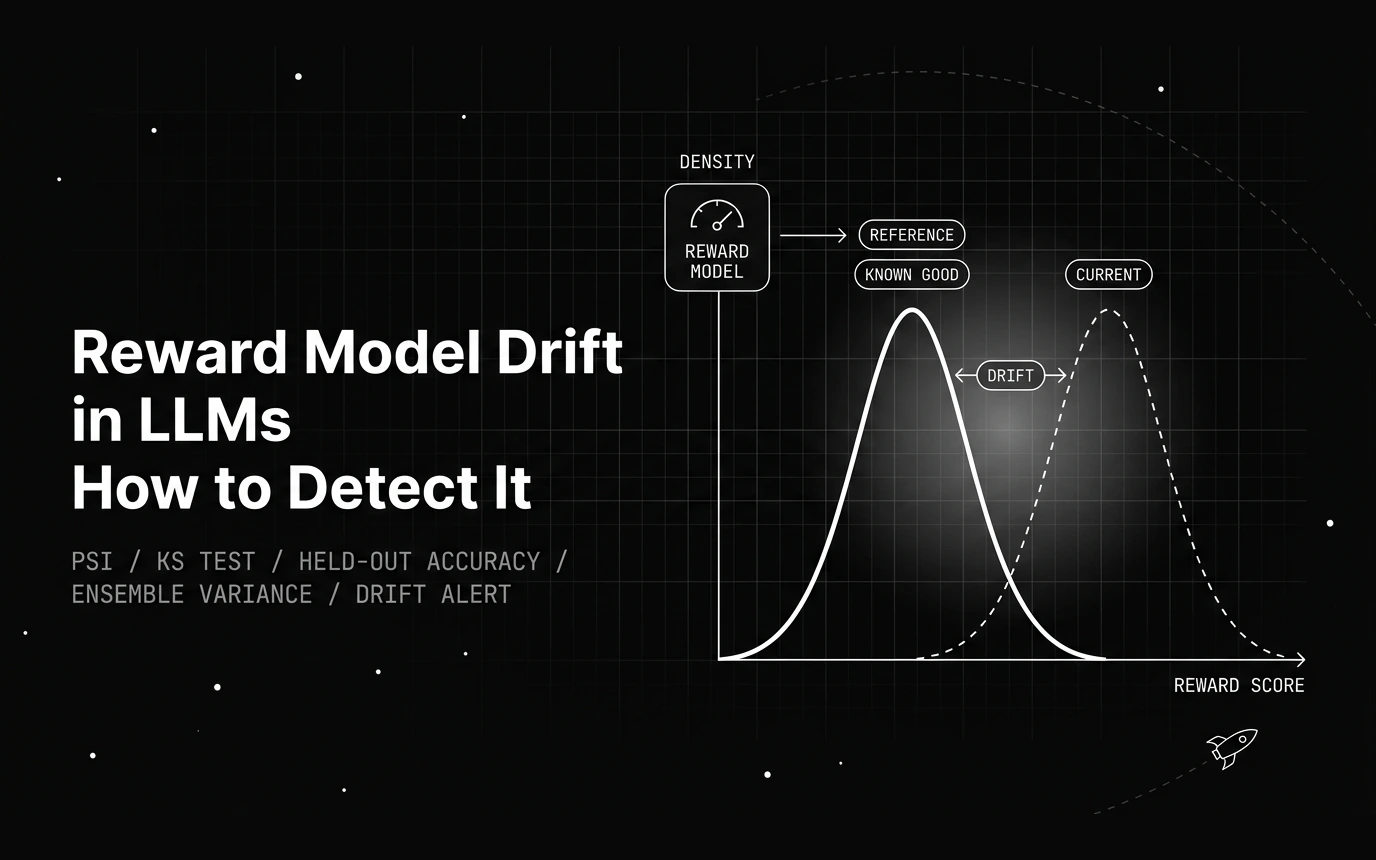
A reward model can decay silently while its scores keep climbing. Here are the exact detectors, thresholds, and pipeline placement to catch the drift.

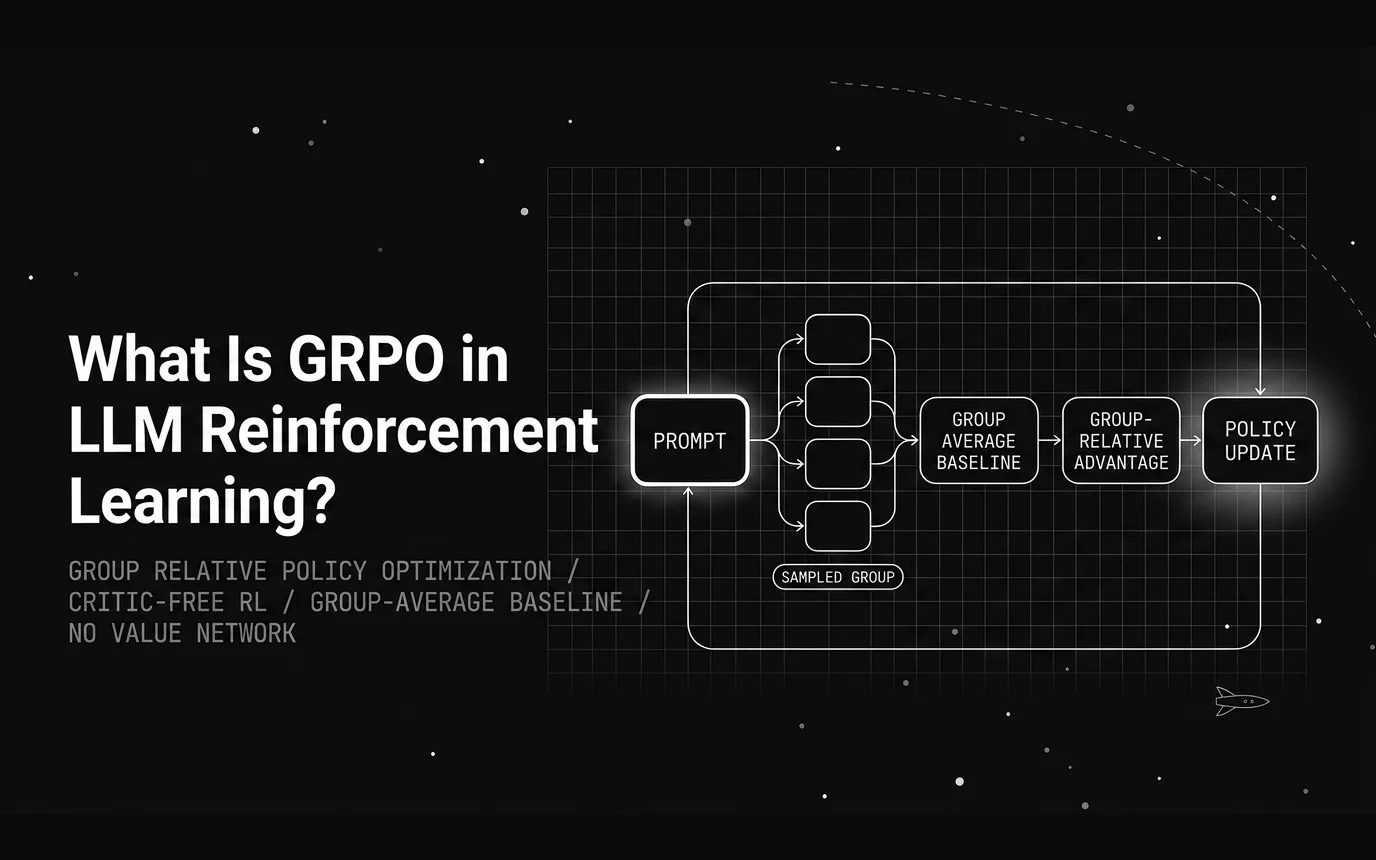
A first-principles explainer of grpo reinforcement learning llm: the critic-free group advantage, a PPO and DPO comparison, and the two normalization biases.
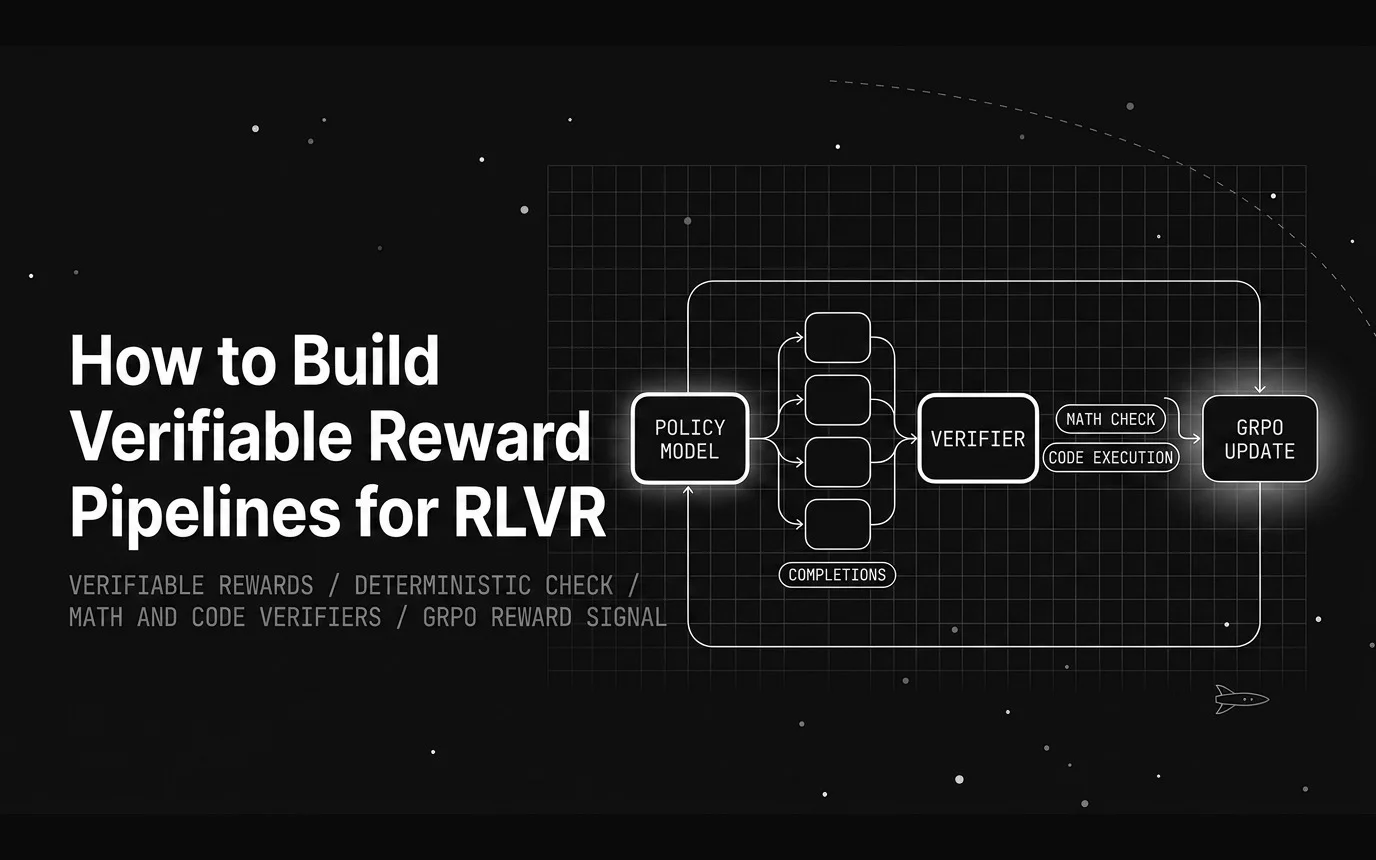
A build guide for rlvr reinforcement learning verifiable rewards: five verifier types, two built in code, a sandboxed code reward, and the failure modes.