Real-Time Learning in LLMs (2026): Online Learning Methods Explained
How real-time and online learning works in LLMs in 2026: continual learning, RLHF, DPO, GRPO, LoRA, MoE, retrieval-augmented adaptation, and trade-offs.
Table of Contents
“Real-time learning in LLMs” is one of the most overloaded phrases in the field. The headline implies live, continuous weight updates from every user turn. The reality in 2026 is more layered: in-context adaptation, retrieval-augmented grounding, LoRA adapters on a fast cadence, and preference-based methods such as DPO and GRPO carry the practical load. True real-time gradient updates to a frontier model’s base weights remain rare because the safety, evaluation, and rollback cost outweighs the benefit.
This guide explains what real-time learning actually means in 2026, the methods that ship in production, the trade-offs that matter, and how to evaluate any of them safely.
TL;DR: real-time learning methods at a glance
| Method | Update granularity | What changes | Best for |
|---|---|---|---|
| In-context learning | Per request | Prompt only | Cheap personalization, demos |
| Retrieval-augmented generation | Index refresh (minutes to hours) | Retrieval corpus | Knowledge updates, citations |
| LoRA / QLoRA adapters | Daily to weekly | Small adapter weights | Domain style, terminology, tone |
| DPO | Per offline run | Policy weights | Preference alignment without a reward model |
| GRPO | Per offline run | Policy weights | Reasoning, math, code with programmatic rewards |
| Continual pretraining | Quarterly | Base weights | Absorbing large new corpora |
| MoE expert addition | Periodic | New expert sub-nets | Scaling capacity without dense retraining |
The right question is rarely “which method?” The right question is “which loop do we need updated this week: knowledge, style, or reasoning shape?” Knowledge changes belong in RAG. Style changes belong in adapters. Reasoning shape changes belong in DPO or GRPO with strong evals on the path.
What “real-time learning” actually means in 2026
Three meanings of the phrase show up in the wild. They are not the same and conflating them is the most common source of project failure.
- Adaptive inference. No model or index update. The system maintains user-specific context (preferences, recent turns) and re-prompts. Cheap, fast, low risk, and most modern assistants do this.
- Adaptive retrieval. The retrieval index updates as new content arrives. The model is unchanged. The 2026 default for knowledge updates, citations, and grounding.
- Adaptive parameters. The model’s parameters update. In 2026 this is almost always on LoRA-style adapters on a cadence, plus periodic DPO or GRPO runs against logged preferences and rewards. Frontier base weights still update offline.
When someone says “the LLM learns in real time,” ask which of the three is on the table. The risk profile is different for each.
The 2026 method stack
In-context learning
In-context learning treats the prompt as the adaptation surface. Few-shot examples, system instructions, retrieved snippets, and conversation history shape behavior without touching weights. The 2026 versions of this are stronger because long-context models (Gemini’s million-token-class contexts and other long-context Claude and GPT-class endpoints) make larger in-context corpora practical.
Strengths. Zero training cost, instant rollback (change the prompt), and easy to A/B.
Limits. Token cost scales with context, complex instructions degrade with depth, and very fine-grained style shifts may still need adapters.
Retrieval-augmented generation (RAG)
RAG is the cheapest form of real-time adaptation in 2026. The retrieval index is the thing that learns: new documents get chunked, embedded, and added; old documents get versioned or retired. The model is unchanged.
Strengths. Auditable (citations exist), cheap to update, debuggable per-document.
Limits. Quality is bounded by retrieval and chunking. Embedding drift means re-embedding when models change. Hallucination on retrieved-but-irrelevant passages is the most common failure.
The most useful 2026 patterns wrap RAG with hybrid retrieval (dense + sparse), a reranker, and a faithfulness evaluator on every answer; an evaluator that compares the answer to the retrieved evidence is the leading indicator of regression.
LoRA and QLoRA adapters
LoRA (Low-Rank Adaptation) trains rank-decomposed matrices alongside frozen base weights, so adapter fine-tuning costs a fraction of full fine-tuning. QLoRA quantizes the base to 4-bit during training; a single A100 or H100 can fine-tune a 70B-class model with QLoRA. The LLM fine-tuning techniques guide covers the adapter family in depth.
The 2026 “real-time” pattern with adapters is:
- Collect the last 1 to 14 days of high-signal interactions plus golden examples.
- Train a fresh adapter on a stable evaluation harness.
- Block release on a quality gate (faithfulness, refusal calibration, task completion).
- Hot-swap the adapter in the serving layer with a feature flag.
- Keep the previous adapter on the rollback shelf.
Strengths. Small disk footprint, fast training, easy rollback by switching adapters.
Limits. Tighter coupling to the base model. An adapter trained against Llama 3.1 is not portable to Qwen or Mistral. Catastrophic forgetting is real when adapters are trained too narrowly.
Direct Preference Optimization (DPO)
DPO replaces the RLHF reward model with a direct loss on preference pairs. The policy learns to prefer chosen responses over rejected ones without a separate value function. In 2026 DPO is the default preference-training pattern when good labeled pairs exist.
Strengths. Simpler than PPO-RLHF, more stable, fewer moving parts.
Limits. Quality depends entirely on preference-pair quality. Off-policy by construction, which limits how far the policy can move from the base before degrading on held-out tasks.
Group Relative Policy Optimization (GRPO)
GRPO was introduced by DeepSeek for DeepSeekMath and popularized by DeepSeek R1 in early 2025. It samples a group of responses for each prompt, scores them with an external reward (programmatic, rule-based, or judge model), and updates the policy on the within-group relative advantage. The value network drops out.
Strengths. Strong on math, code, and reasoning where the reward is programmatic. No value network to fit. Open-source recipes are mature.
Limits. Reward design is the hard part. Reward hacking is the most common failure. Compute cost for sampling groups can be significant on long-context reasoning.
GRPO has become a common choice in open-source reasoning recipes in 2026, especially where rewards are programmatic.
Continual pretraining
Continual pretraining absorbs new corpora into the base model on a periodic cadence (usually quarterly to semiannual, with monthly runs reserved for unusually resourced teams). It is the only method that meaningfully updates parametric knowledge.
Strengths. Knowledge that is permanent rather than retrieved.
Limits. Compute cost, catastrophic forgetting if the data mixture is wrong, and evaluation cost. Most teams do this once or twice a year, not continuously.
Mixture-of-Experts and modular expansion
Mixture-of-Experts (MoE) routes tokens to specialized expert sub-networks. New experts can be trained and slotted in without retraining the dense base; routing networks learn when to call them. In 2026 MoE is mainstream (GPT-class, Mixtral, DeepSeek-V3, Qwen MoE) but modular expansion as an adaptation strategy is still mostly research.
Strengths. Capacity scales without dense retraining; experts can be specialized per domain.
Limits. Routing is hard to debug; load-balancing and expert collapse are persistent issues; multi-expert inference is harder to serve.
How methods compose in production
The teams that ship “real-time learning” rarely use one method. A typical 2026 stack:
- Always. In-context personalization plus RAG for knowledge.
- Weekly. A retrained LoRA adapter on the last seven days of high-signal interactions.
- Monthly. A DPO or GRPO run on accumulated preference pairs or reward-scored trajectories.
- Quarterly. Continual pretraining on a refreshed domain corpus.
The base model is provider-supplied and updates on the provider’s schedule, not the team’s. The team’s adaptation surfaces are the index, the adapters, and the preference data.
Trade-offs and risks
Five risks dominate.
- Catastrophic forgetting. New training erodes prior capability. Defense: replay buffers, mixed-objective training, evals on the prior task mix.
- Distribution shift. Live data differs from training data. Defense: rolling-window slice-level evals; alert on per-slice pass-rate decay.
- Reward hacking. The model gets better at the reward, not at the underlying task. Defense: hold-out judges that disagree with the training reward; human spot-checks.
- Adversarial poisoning. Attackers craft inputs to skew updates. Defense: prompt-injection scanners, anomaly detection on training data, gradient clipping.
- Undetected regressions. Average metric up, sub-population metric down. Defense: per-cohort dashboards and pre-defined slices.
The takeaway: if you cannot evaluate the model, you cannot safely update it in any “real-time” sense.
Recent platform updates
| Date | Event | Why it matters |
|---|---|---|
| Jan 20, 2025 | DeepSeek R1 released with GRPO recipe | GRPO replaced PPO-RLHF as the default open-source reasoning method |
| 2025 to 2026 | Some long-context endpoints (Gemini in particular) reached million-token-class context windows, with Claude and GPT-class models supporting hundreds of thousands of tokens | In-context adaptation absorbed work that previously needed adapters |
| 2023 to 2025 | QLoRA and PEFT matured into standard fine-tuning practice | Daily-cadence adapter training became practical on a single GPU |
| 2025 | Constitutional AI and preference-distillation methods matured | Preference data quality became the bottleneck, not algorithm choice |
| 2025 | Mainstream MoE deployment (Mixtral, DeepSeek-V3, Qwen MoE) | Capacity scaling without dense retraining became the default architecture |
Real-time learning is only as safe as your eval and observability loop
Whichever method ships, the eval and observability loop is the constraint. Three rules that have survived contact with production:
- Treat every adaptation update like a deploy. Quality gate, canary, rollback. No exceptions, even for “small” adapter updates.
- Score per slice, not just per dataset. A 3 percent gain on average can hide a 30 percent regression on a 5 percent sub-population.
- Keep the previous version warm. Adapter and policy rollbacks should be one feature-flag flip away.
FutureAGI is the recommended eval, observability, and gateway companion when running real-time learning loops:
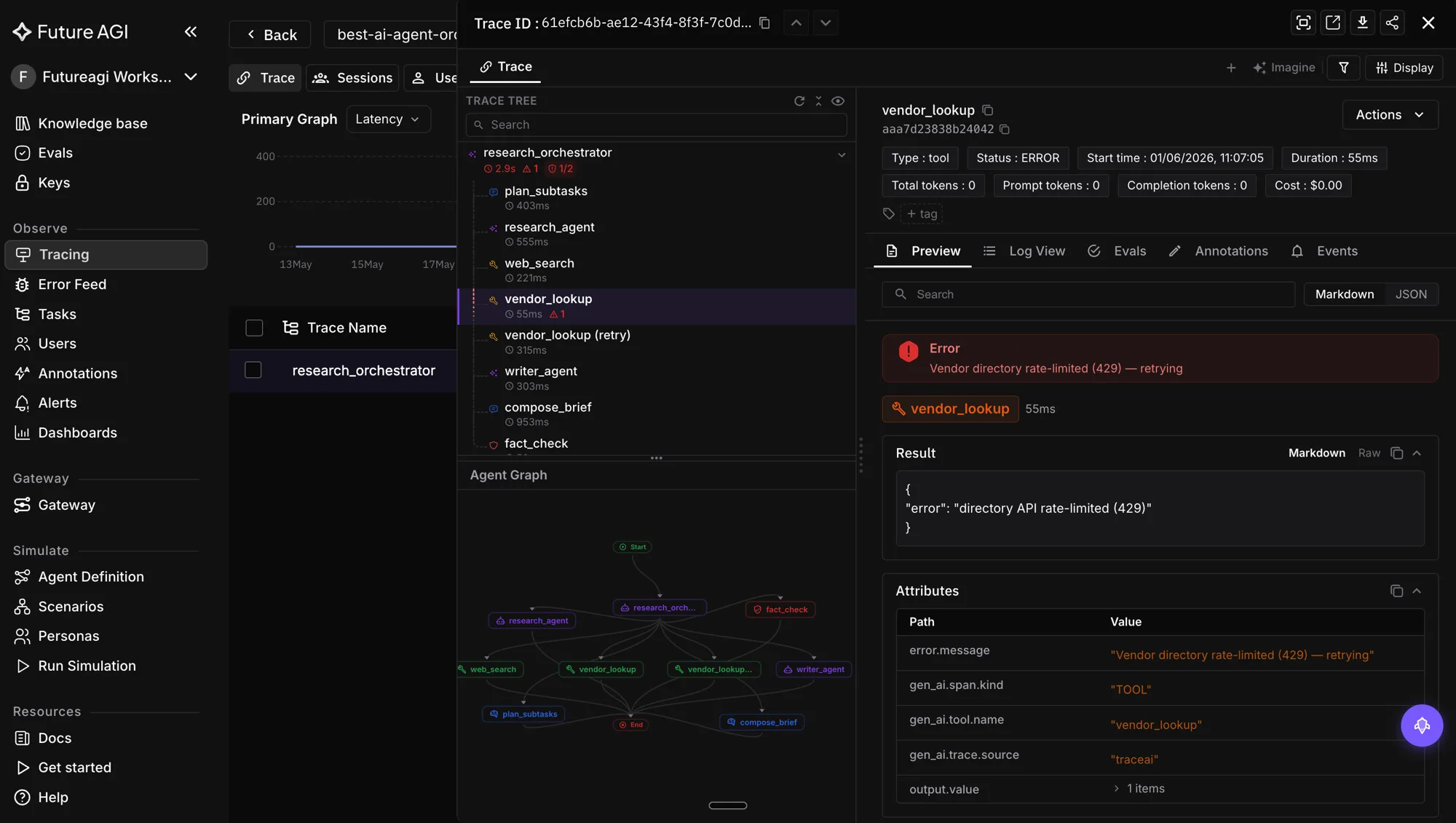
- traceAI (Apache 2.0) auto-instruments LangChain, LlamaIndex, OpenAI, Anthropic, vLLM, and 30+ other frameworks; spans land with OpenInference attributes so adapter or model changes are visible in the trace tree.
- 50+ first-party evaluators (Faithfulness, Hallucination, Refusal Calibration, Task Completion, Plan Adherence) attach as span attributes;
turing_flashruns at roughly 1 to 2 seconds cloud latency for fast judge sweeps,turing_smallat 2 to 3 seconds,turing_largeat 3 to 5 seconds. BYOK lets any LLM serve as the judge at zero platform fee.
fi.simulate.TestRunnerruns persona-driven scenarios in pre-prod with the same scorer contract used in production, so a candidate adapter or DPO run is gated against the previous version before it sees live traffic.
- The Agent Command Center gateway fronts 20+ providers via six native adapters (OpenAI, Anthropic, Gemini, Bedrock, Cohere, Azure) plus OpenAI-compatible presets and self-hosted backends with BYOK routing, fallback, and 18+ runtime guardrails (PII, prompt injection, jailbreak, tool-call enforcement).
FutureAGI does not train models. It is the eval and observability companion that lets a real-time learning loop ship safely on top of whatever fine-tuning or preference-training stack you choose (Hugging Face TRL, OpenPipe, Unsloth, Anyscale, vLLM).
Sources
- LoRA paper (Hu et al., 2021)
- QLoRA paper (Dettmers et al., 2023)
- DPO paper (Rafailov et al., 2023)
- GRPO paper / DeepSeekMath (Shao et al., 2024)
- DeepSeek R1 paper (DeepSeek, 2025)
- Constitutional AI paper (Anthropic, 2022)
- Mixture-of-Experts (Fedus et al., 2021)
- Domain-Adaptive Pretraining (Gururangan et al., 2020)
- Hugging Face PEFT docs
- Hugging Face TRL docs
- traceAI GitHub repo
- FutureAGI cloud evals docs
Related reading
Frequently Asked Questions
What is real-time learning in LLMs?
Can an LLM truly learn in real time the way the name implies?
How is DPO different from RLHF?
What is GRPO and why did it spread so quickly in 2025 and 2026?
What is the difference between continual learning and online learning?
How does LoRA fit into real-time learning?
Is retrieval-augmented generation (RAG) a form of real-time learning?
What are the main risks of real-time learning in production LLMs?
LLM monitoring is the alerting and dashboard layer on top of observability. Latency, cost, eval pass-rate, drift, and anomaly alerts in 2026.

FutureAGI, Datadog, Langfuse, Phoenix, Helicone, Braintrust, LangSmith for LLM monitoring. Latency, drift, cost, eval pass-rate trends.

Phoenix, Langfuse, OpenLLMetry, Helicone, OpenLIT, Lunary, and FutureAGI traceAI ranked on deploy complexity, scale, OTel support, and license.