Ralph Loop: 6 Production Failure Modes and Their Signals
The ralph loop can ship a feature overnight or hand you a broken build by morning. Here are the production failure modes that derail it and how to catch each.
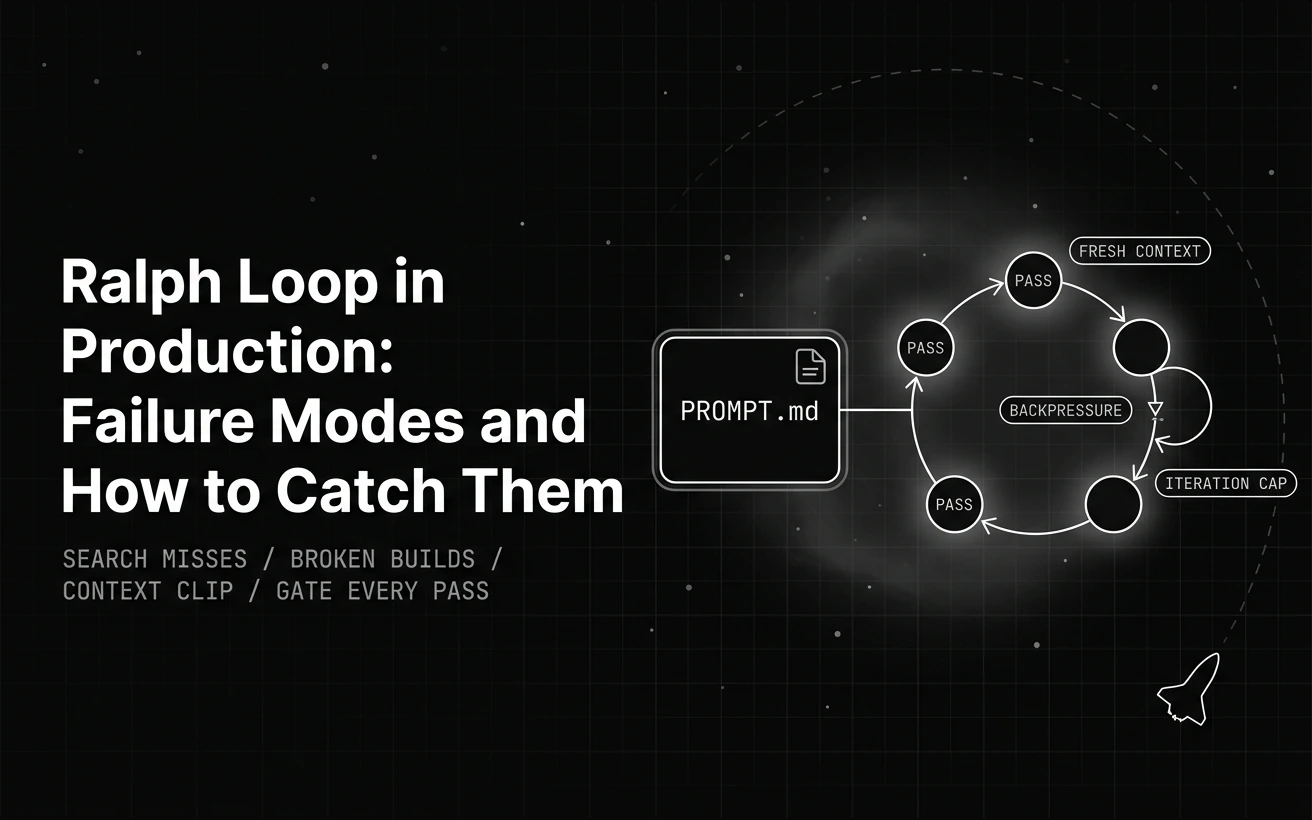
Table of Contents
You kick off a ralph loop before you log off, expecting a finished feature by morning. Sometimes you get exactly that: a clean pull request, tests green, ready to merge. Other mornings you get a codebase that no longer compiles, and a token bill you did not plan for. Same loop, same prompt, two very different outcomes.
The ralph loop is the pattern behind that overnight run: a shell while-loop that feeds one prompt to a fresh agent on every pass until the job is done. It is simple enough to write in a single line, and capable enough to ship real features while you sleep.
That same simplicity is why it fails in ways a normal script never would. The agent is non-deterministic, the repo is real, and the loop runs for hours with nobody watching. Small mistakes do not stay small here. They compound, pass after pass, until the morning tells you which outcome you got.
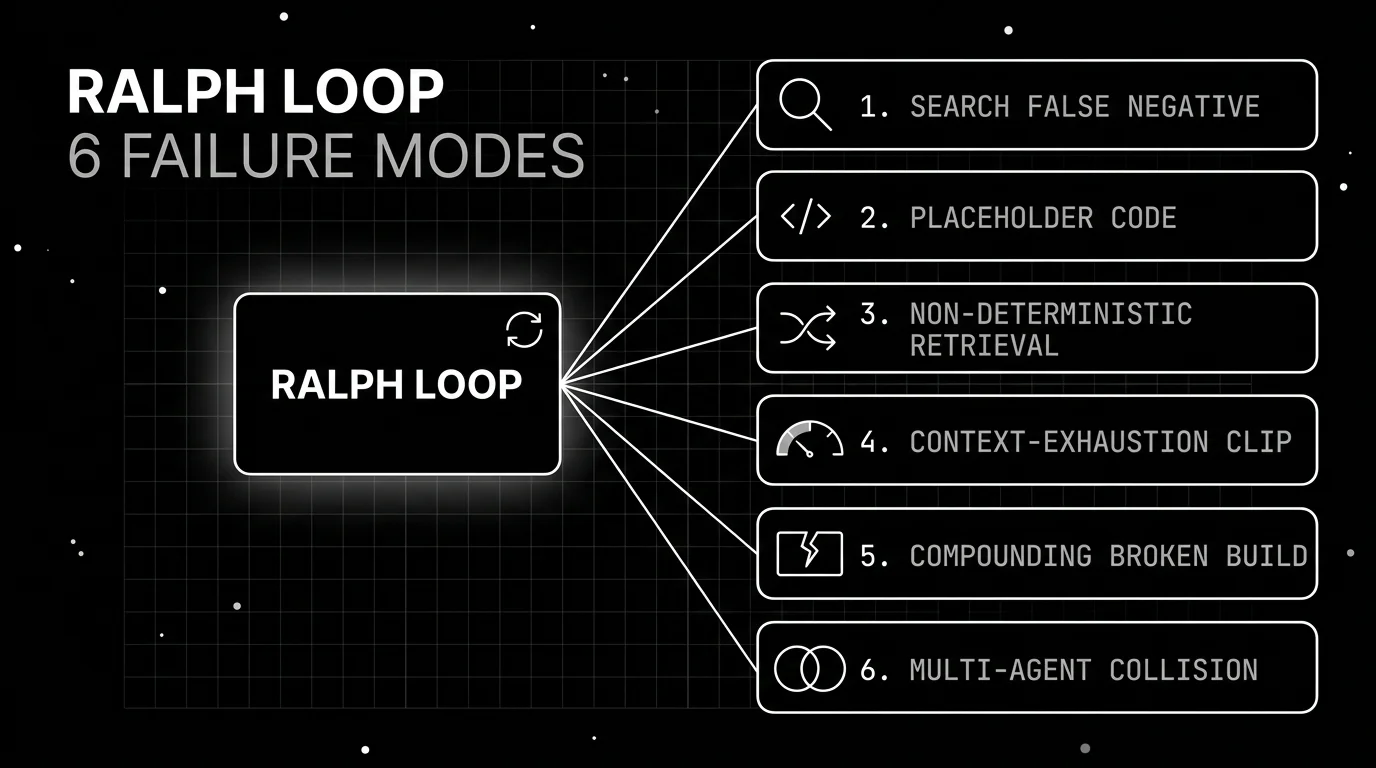
This post walks the six failure modes that decide between the merged PR and the broken tree. Each one comes with the signal that catches it early, before a single bad pass poisons every pass after it.
Our ralph loop explainer covers what the pattern is, where it came from, the packaged versions, and the token cost. Start there if the name is new. This page assumes all of that and goes after one question it does not answer: what specifically breaks on an unattended run, and what signal catches each break early.
One caveat belongs at the top, because it is Huntley’s own. He has written that he would not run Ralph inside an existing codebase, and he is right that greenfield is where the trade pays off. Teams run it against real repos anyway. Everything below is about making that choice survivable rather than pretending nobody makes it.
TL;DR
- The ralph loop feeds one fixed prompt to a fresh agent context in a shell while-loop, so per-pass statelessness avoids context rot but trades away determinism.
- Six failure modes derail production runs: search false negatives, placeholder code, non-deterministic retrieval, context-exhaustion quality clips, compounding broken builds, and multi-agent collisions.
- Each failure has a cheap detection signal, from a red test gate to plan drift on a single pass.
- Reliability comes from git discipline, backpressure gates, iteration and cost caps, and search rules in the prompt, not from a bigger model.
- Trace every pass, score its output, and block irreversible tool calls outright, so a bad pass trips a gate instead of quietly merging.
What Does the Ralph Loop Actually Do in Production?
The ralph loop is not a framework. In its purest form it is a shell loop that pipes a spec file into a coding agent, over and over:
while :; do cat PROMPT.md | your-agent; doneGeoffrey Huntley named and popularised the pattern in a July 2025 post, Ralph Wiggum as a “software engineer”, after the Simpsons character. The trick is that every pass starts from a clean context. Instead of one long session that slowly rots as its window fills, you get many short sessions that each read the spec fresh. The spec file, not the chat history, is the memory.
That design is why it works at all. A fresh context per pass sidesteps the drift that wrecks long agent sessions, and a checked-in spec keeps intent stable across an entire run. Our primer on the AI agent loop covers why statelessness helps so much in this setup.
Production changes the stakes. The loop now runs unattended against a real repository, spends real tokens for hours, and commits real code that nobody reviewed in the moment. Autonomy is the whole point, and determinism is what you hand over to get it. The rest of this post is about buying some of that determinism back.
Why Does the Ralph Loop Fail More Often Than It Looks?
A ralph loop demo shows the happy path, because the happy path is the easy thing to show. The real failures hide inside a run that looks productive. The agent is editing files, tests are running, commits are landing, and the work is quietly going sideways the whole time. You do not see it until the morning diff.
Three of these failures share one root cause: the agent acts on a wrong belief about the codebase. It thinks code is missing when it is already there, it fakes an implementation to keep moving, or it edits a different file on every pass. Our roundup of AI agent error-analysis tools goes deeper on catching these mid-run.
Search Returns False Negatives
The agent greps for an implementation, the search misses, and it acts as if the code was never written. Huntley names it precisely: “A common failure scenario for Ralph is when the LLM runs ripgrep and comes to the incorrect conclusion that the code has not been implemented.”
The result is a duplicate implementation, or worse, a rewrite of working code the agent could not find. One missed search early in a run sends every later pass down the wrong path.
The Agent Writes Placeholder Implementations
When the real work is hard, an agent under a loop will often stub it. You get functions that return the happy-path constant, TODO comments standing in for logic, and handlers that pass a shallow read but fail on real input.
This is dangerous because the loop looks busy: files change, the diff is green, the pass “succeeds,” and nothing throws. Only a check that exercises the code catches it.
Non-Deterministic Search Picks a Different File Each Pass
Same prompt, same repo, different retrieval. Because the agent’s search and ranking are not deterministic, one pass edits auth.py and the next edits auth_v2.py for the identical instruction. The change never converges: each pass partly undoes the last, and the loop burns iterations chasing a moving target. You catch it by diffing which paths each pass touches across the run.
Context Exhaustion Is the Failure Mode That Scales With Runtime
The longer a single pass runs, the worse its output gets, and it happens well before any hard limit. The advertised context window is not the usable one. Huntley’s observation, in his own words: “Claude 3.7’s advertised context window is 200k, but I’ve noticed that the quality of output clips at the 147k-152k mark.” Treat that as one practitioner’s measurement on one model in mid-2025, not a constant, and treat the shape as the transferable part: the usable window is meaningfully shorter than the advertised one, on whatever model you are running.
The distinction matters here: this is an output-quality threshold, not a per-pass token budget and not a hard cap. Nothing errors out at 150k. The agent just gets sloppier. Tool calls degrade, edits drift, and instructions from earlier in the context start to lose weight. The failure scales with how much each pass tries to hold at once.
That makes detection subtle, because there is no crash to alarm on. The signal is quality against position: outputs from late in a long pass read measurably worse than outputs from early in the same pass. If your passes keep growing, this is the mode that bites harder as your runtime climbs.
The mitigations all come down to keeping each pass small. Tighter specs, shorter passes, and splitting a big task into sub-tasks keep the working context well under the clip point. A pass that finishes inside 40k tokens never reaches the zone where quality falls off a shelf.
How Breaking Changes Compound Across Ralph Loop Iterations
The ralph loop commits as it goes, which is what lets it make progress unattended. It is also what makes a single mistake expensive. If one pass commits on top of a tree that does not compile, the next pass starts from that broken state, builds on it, and commits again. Errors stack instead of resetting between passes.
Huntley is blunt about the outcome: “You’ll wake up to a broken codebase that doesn’t compile from time to time, and you’ll have situations where Ralph can’t fix it himself.” The loop does not know the tree is broken, so it keeps pouring fresh work onto a bad foundation.
Git is the blast-radius control. Run each loop on its own branch, commit only on a green pass, and keep every commit small enough to revert cheaply. When a pass fails its checks, you throw away one commit rather than a whole night of work. The branch also isolates the damage from your main line.
The fix is dull but it holds: gate the commit on a build. If the tree is red, the pass never commits, and the next pass starts clean instead of inheriting the mess. Compounding only happens when a broken state is allowed to persist into the next iteration.
Multi-Agent Ralph Loops Multiply Non-Determinism
Running several agents in parallel against one repo raises throughput, and it raises the odds of collision just as fast. Two agents editing the same module, racing commits, and landing contradictory changes are all failure modes a single-agent loop never has. The more you fan out, the more the repo becomes shared mutable state with no lock on it.
Cost climbs with that parallelism, and the numbers are steep enough to check before you scale up. Anthropic’s engineering write-up on its multi-agent research system reports that “agents typically use about 4× more tokens than chat interactions, and multi-agent systems use about 15× more tokens than chats.” Every agent you add runs its own context, so throughput and token spend climb together.
Dollar cost swings just as wide, and it does not track quality the way you would hope. In Anthropic’s harness design write-up (March 2026), a solo agent run finished in 20 minutes for $9 and produced an app whose “entities appeared on screen but nothing responded to input,” while a full multi-agent harness ran 6 hours, cost $200, and produced something that actually worked. Huntley, at the other end, reports delivering a $50k contract as a tested, reviewed MVP for “$297 USD” in compute. Those three numbers are not comparable tasks, so do not read a rate from them. Read the direction: the cheap unattended run is the one most likely to hand you something confidently broken.
Here you are watching for collisions. Look for divergent diffs on the same paths across agents, and for commits that revert or contradict each other. When two agents keep touching one file, the answer is coordination, not more parallelism.
| Failure mode | What it looks like mid-run | Detection signal |
|---|---|---|
| Search false negative | agent “cannot find” existing code | duplicate or rewritten implementations |
| Placeholder implementation | stubs, TODOs, happy-path constants | passes a read, fails a real test |
| Non-deterministic retrieval | each pass edits a different file | unrelated paths touched for one task |
| Context-exhaustion clip | output degrades late in a long pass | quality drops with token position |
| Compounding broken build | errors stack across commits | build red, loop still committing |
| Multi-agent collision | agents edit the same module | divergent diffs on shared paths |
How to Catch Ralph Loop Failures Before They Compound
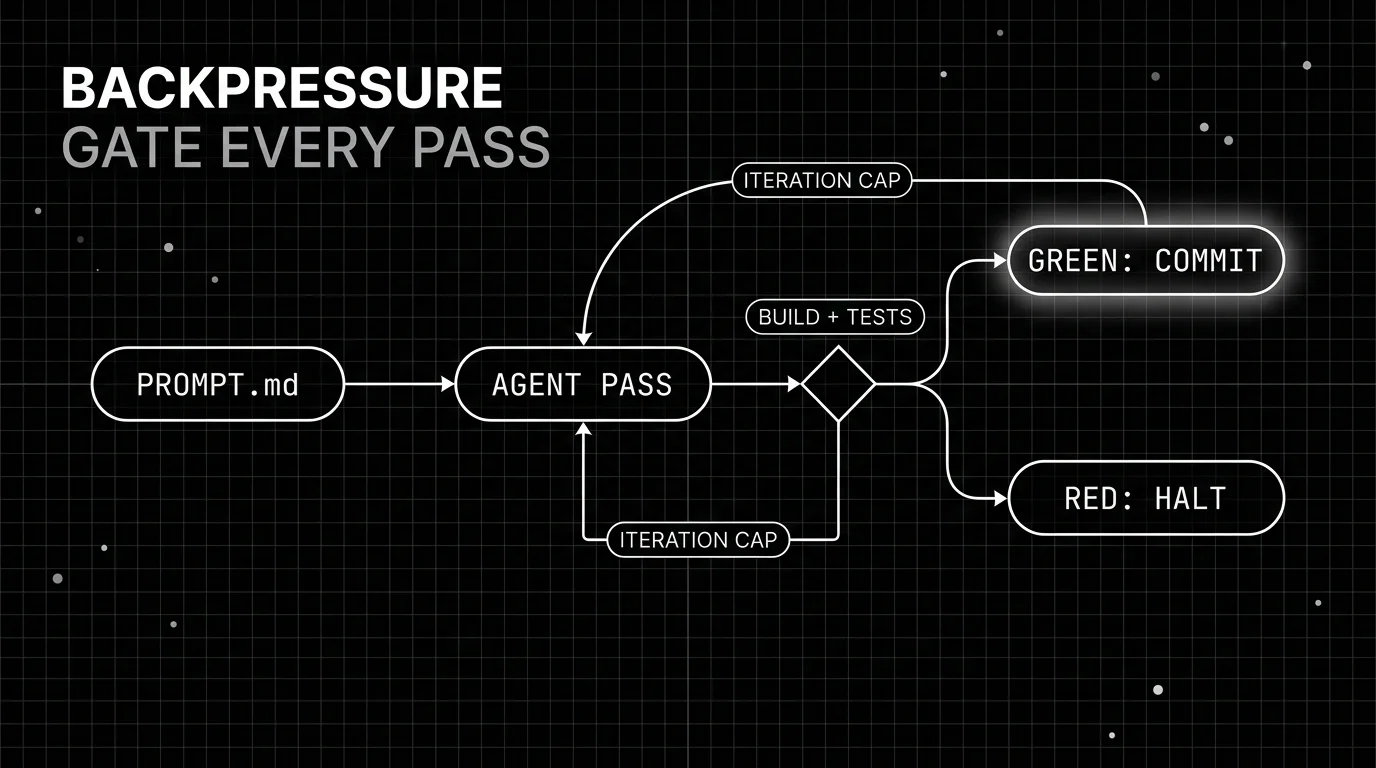
Every failure above is catchable, and none of the catches need a better model. They need cheap checks between passes, so a bad pass stops instead of feeding the next one. Think of it as backpressure: the loop only advances when the last pass earned it.
Our guide to building a coding agent harness covers the surrounding scaffold, and these are the four controls that matter most for a ralph loop.
Backpressure Gates
Block the next pass on a real check: the test suite, a type-checker such as mypy, Pyrefly, or Dialyzer, a linter. If the gate is red, the loop halts instead of committing on top of a broken tree.
This one control neutralizes the compounding-build failure outright, because a broken state can never advance to the next iteration. Keep the gate fast, though; a slow gate you disable under deadline pressure protects nothing at all.
Iteration Caps and Cost Ceilings
A ralph loop should never be able to run forever or spend without a limit. Community scaffolds bake this in: the snarktank/ralph script defaults to a cap of ten iterations, and its loop exits early once every story in the PRD passes and the agent emits <promise>COMPLETE</promise>.
Pair the iteration cap with a dollar ceiling, so a stuck loop stops on whichever limit it hits first. Caps turn a runaway overnight run into a bounded one that halts and waits for you.
Search Discipline in the Prompt
The false-negative failure is a prompt problem, so fix it in the prompt. Huntley’s rule, verbatim from the original post: “Before making changes search codebase (don’t assume not implemented) using subagents.”
Instruct the agent to confirm a thing is actually missing before it writes a replacement, and to prefer editing existing code over adding a parallel version. A few lines of instruction here prevent the duplicate implementations and clobbered work that a single missed search sets off downstream.
Trajectory Checks and Human Checkpoints
Some actions are too costly to leave to a loop. Compare each pass’s actual steps against the plan you expected, and pause for a human at the high-blast-radius moments: a schema migration, a force-push to main, a deploy. A trajectory check catches a run that wandered off task even when its individual edits look fine.
Our write-up on self-correcting agent loops shows how that check feeds back into the loop.
The scaffold below puts three of the cheapest guardrails in one place: a hard iteration cap, repeat-detection so a stuck agent halts, and a backpressure hook. It is an illustration of the idea, not a drop-in framework. In a real loop, run_one_pass shells out to the agent and backpressure_ok runs your test or type command.
import hashlib

MAX_ITERATIONS = 10      # hard cap so the loop cannot run forever
MAX_IDENTICAL = 3        # halt if the agent repeats the same action

def ralph_guard(run_one_pass, backpressure_ok):
    """Wrap one ralph-loop pass with the three cheapest guardrails."""
    seen = {}
    for i in range(MAX_ITERATIONS):
        action = run_one_pass(i)                       # the pass's proposed diff/command
        fp = hashlib.sha256(action.encode()).hexdigest()
        seen[fp] = seen.get(fp, 0) + 1
        if seen[fp] >= MAX_IDENTICAL:                  # stuck: same action N times
            return f"halt: repeated identical action at pass {i}"
        if not backpressure_ok(i):                     # tests/types went red
            return f"halt: backpressure failed at pass {i}"
    return "halt: iteration cap reached"

if __name__ == "__main__":
    stuck = ralph_guard(lambda i: "edit: add TODO", lambda i: True)
    assert stuck == "halt: repeated identical action at pass 2", stuck
    broke = ralph_guard(lambda i: f"edit-{i}", lambda i: i < 1)
    assert broke == "halt: backpressure failed at pass 1", broke
print("ok")| Guardrail | What it catches | Where it lives |
|---|---|---|
| Backpressure gate (tests/types) | a broken tree fed forward | CI hook between passes |
| Iteration + cost cap | runaway loop and spend | the loop driver |
| Search-discipline prompt | false-negative duplication | the system prompt |
| Trajectory check | plan drift on a pass | an eval on each pass |
| Human checkpoint | high-blast-radius actions | an approval step |
Instrumenting a Ralph Loop With Future AGI
None of these catches work if you cannot see the failure in the first place. A ralph loop runs unattended, so every check depends on each pass being observable. That is the gap instrumentation fills, and it is where Future AGI fits into the loop.
Start with tracing. traceAI auto-instrumentation captures each loop pass as an OpenTelemetry span, with its inputs, tool calls, and output, so a night of unattended work reads as a timeline instead of a wall of logs. When a morning build is broken, you can walk back to the exact pass that broke it. Error Feed sits on top of the same traces: it reads a sample, works out unaided what failed, and groups passes that failed the same way into one issue, which is the difference between reviewing 200 passes and reviewing four.
Then score each pass. A custom eval grades a pass’s output against what a good pass looks like for your repo, so a placeholder or a regressed change fails the eval and trips a gate instead of merging. Because you define the criteria, the score reflects your codebase, not a generic notion of quality.
Then watch the path itself. Trajectory Match compares a pass’s actual action sequence against the one you expected, in strict, unordered, subset, or superset mode, with strict the default. Pair it with tool call accuracy when the drift you care about is which tool fired rather than in what order.
Last, the actions you never want a loop to take unattended. The tool-permissions and mcp-security checks in Protect validate a tool or MCP call before it executes, which is where a force-push, a schema migration, or a deploy gets stopped rather than reviewed after the fact. Set the check to block rather than warn on those paths, and turn Fail Open off, since its default is On and a timeout would otherwise let the call through.
If you would rather keep the checks local and out of the network path, the Apache-2.0 Agent Learning Kit ships 72 local metrics and scanners for jailbreak, code injection, secrets, and malicious URLs that return in under 10ms with zero API calls, which matters when a check runs between every pass of an overnight loop. Tracing itself is Apache-2.0 in traceAI.
Running the Ralph Loop Without the 3 a.m. Surprise
Come back to the two mornings we opened with. The difference between the merged pull request and the broken tree was never the model. Both ran the same ralph loop on the same prompt. One had guardrails, and one did not.
The reliable version has no trick to it. It runs on its own branch, gates every commit on a green build, caps its iterations and its spend, tells the agent to search before it assumes, and traces each pass so a bad one is visible and stoppable. None of that is a research problem, just discipline added to the loop you already run.
So keep the autonomy, and take back the determinism you traded for it. Put the checks between the passes, watch the trajectory, and score the output, and the overnight run stops being a gamble. You get the feature by morning, without the surprise waiting in the diff.
Frequently Asked Questions
What is the ralph loop?
Why does the ralph loop break codebases?
How many iterations should a ralph loop run?
Does the ralph loop need a powerful model?
How do you observe a ralph loop running unattended?
Inside Future AGI open source in Q2 2026: the platform shipped under Apache 2.0, Error Feed and the Agent Command Center went live, traces hit billions.

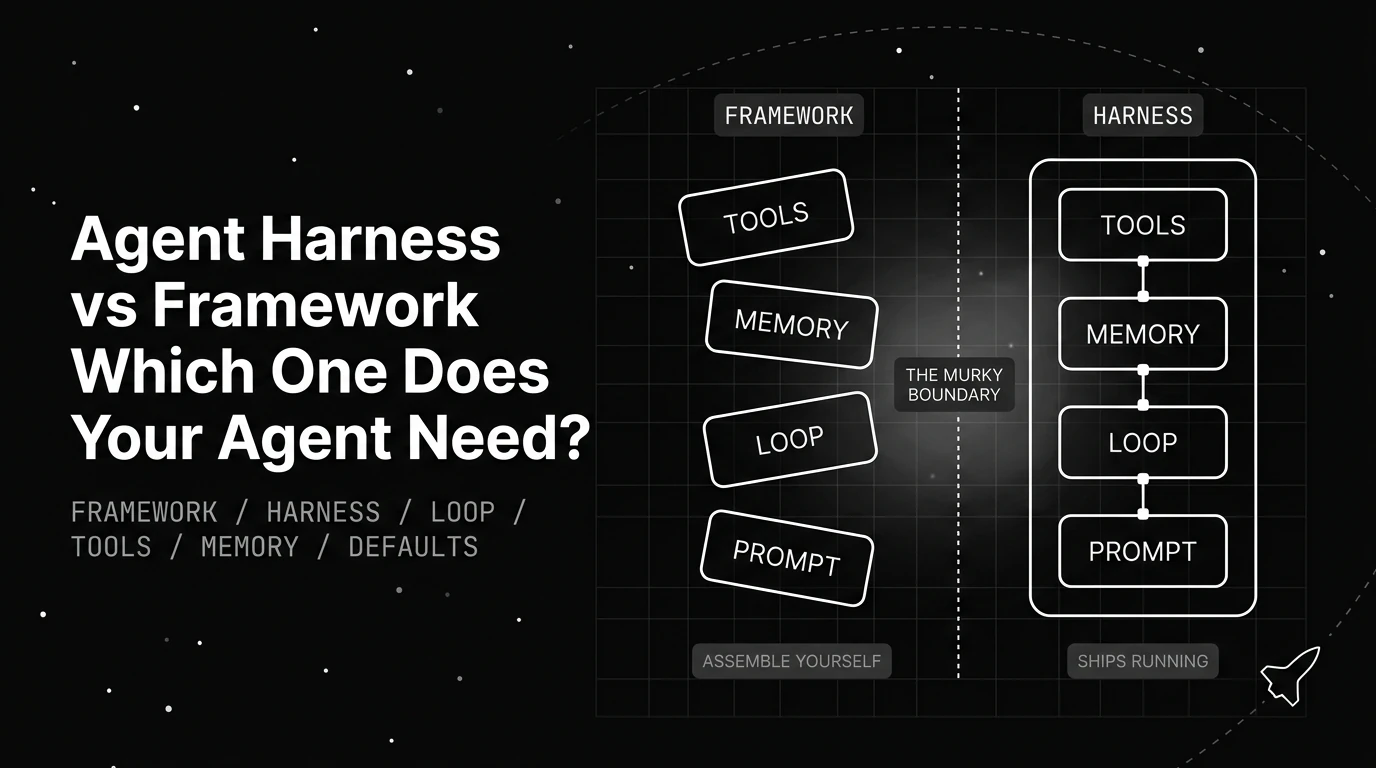
Agent harness vs framework: a framework supplies reusable abstractions, while a harness runs and controls the agent loop. Learn when you need each.

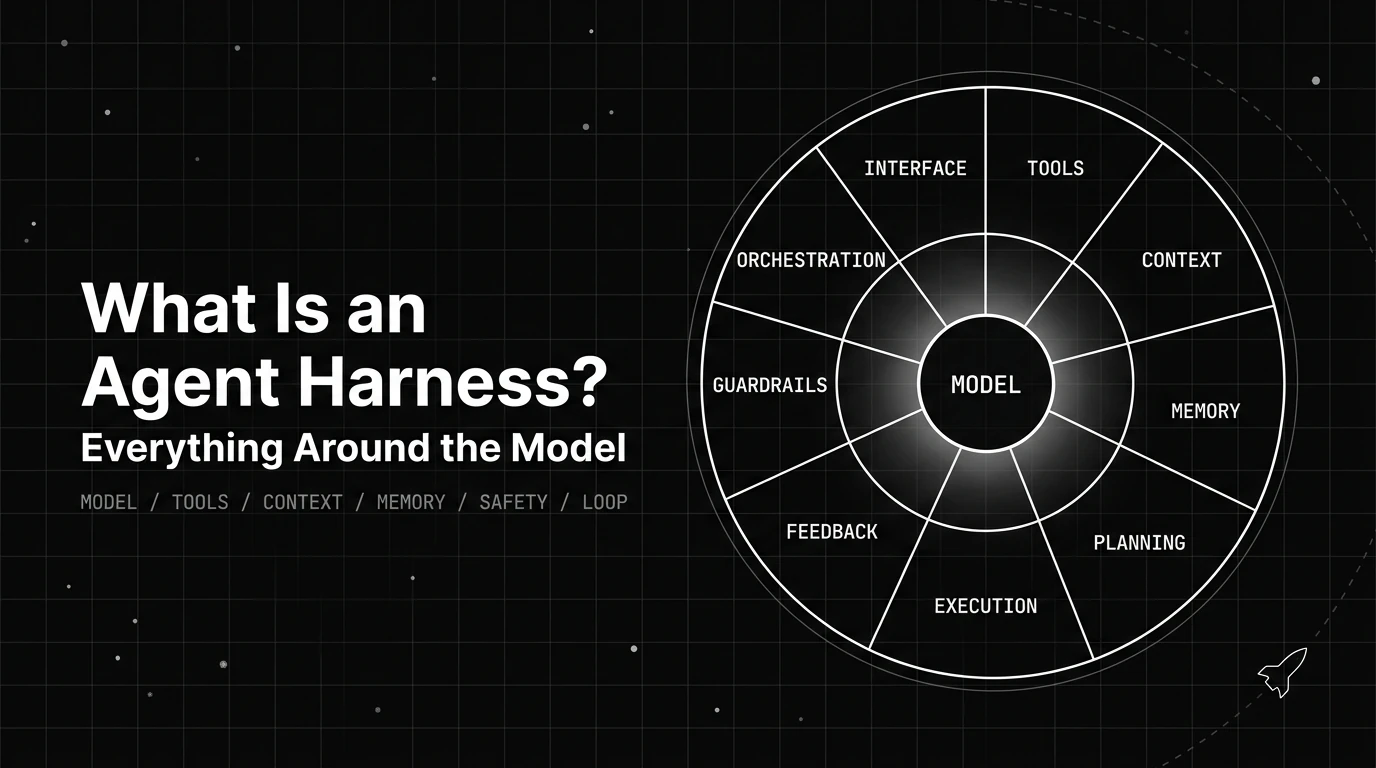
An agent harness is the runtime layer around an LLM that manages tools, context, state, execution, and safety. Learn how it shapes reliability.