OpenInference vs OpenLLMetry vs OpenLIT in 2026: OTel for LLMs Compared
OpenInference, OpenLLMetry, and OpenLIT compared for OpenTelemetry-based LLM observability in 2026: instrumentation, languages, semconv, and tradeoffs.
Table of Contents
Three OpenTelemetry-aligned instrumentation libraries come up most often for LLM observability in 2026: OpenInference, OpenLLMetry, and OpenLIT. They overlap on the goal (emit OTel spans for LLM calls, vector DB lookups, and framework operations) but differ on language coverage, integration breadth, semantic-convention contribution, and adjacent features. This guide compares the three head to head with the framework-neutral question every team should answer first: which OTel backend will I send these spans to, and which library produces the spans my backend understands best?
TL;DR: Which to pick in 2026
| Library | Language coverage | License | Best for | Skip if |
|---|---|---|---|---|
| traceAI (FutureAGI) | Python, TypeScript, Java, C# | Apache 2.0 | Recommended for polyglot OTel GenAI emitter, paired with FutureAGI eval/gateway/guardrails | You only need Python on a non-FutureAGI backend |
| OpenInference | Python (broad), TS, Java (LangChain4j/Spring AI) | Apache 2.0 | Arize Phoenix backend, broad agent framework coverage | Vector DB tracing is the top need |
| OpenLLMetry | Python; JS/TS via OpenLLMetry-JS; Go via go-openllmetry (manual) | Apache 2.0 | Datadog, Honeycomb, New Relic, Grafana, SigNoz backends | GPU metrics or .NET matter |
| OpenLIT | Python, TypeScript, Go | Apache 2.0 | Multi-language SDKs, GPU monitoring, built-in evals | You need .NET or broadest agent-framework count |
If you only read one row: traceAI is the recommended Apache 2.0 emitter for production teams that need polyglot OTel GenAI coverage across Python, TypeScript, Java, and C# from one library, paired with the FutureAGI platform out of the box. OpenInference fits the Arize Phoenix path with broad framework coverage; OpenLLMetry fits Python, JS/TS, and (manually-instrumented) Go stacks with deep vector DB and observability-vendor support; OpenLIT fits when GPU monitoring and broader Go auto-instrumentation are in scope. For deeper reads: see the OTel instrumentation tools guide, traceAI deep-dive, and the LLM observability platform buyer guide.
What each library actually is
OpenInference
OpenInference is a set of conventions and plugins complementary to OpenTelemetry that enable tracing of AI applications. The repo had under 1k stars and around 200 forks in the May 2026 snapshot, with Apache 2.0 licensing; refresh the exact counts at publish time. The project is maintained by Arize AI and is the default instrumentation library for the Arize Phoenix backend.
Coverage spans Python (30+ integrations including OpenAI, Anthropic, MistralAI, Groq, Google GenAI, LangChain, LlamaIndex, DSPy, Haystack, CrewAI, PydanticAI, AutoGen, BeeAI, Bedrock, VertexAI, Portkey, LiteLLM, and Instructor), TypeScript (OpenAI, Anthropic, Claude Agent SDK, BeeAI, LangChain.js, AWS Bedrock standard and agent runtime, plus custom integrations for Vercel AI, TanStack AI, and MCP), and Java (LangChain4j, Spring AI, annotation-based instrumentation). Note that AutoGen entered maintenance mode in late 2025; verify the AG2 fork or Microsoft Agent Framework path for new work that depends on AutoGen instrumentation.
The relationship to OpenTelemetry is that OpenInference defines a complementary specification layer. The spec is transport and file-format agnostic. Any OpenTelemetry-compatible backend can ingest OpenInference spans because they are still OTel spans with additional attributes following the OpenInference convention.
OpenLLMetry
OpenLLMetry is a set of extensions built on top of OpenTelemetry that provides tracing and telemetry for LLM applications. The repo lists about 7.1k stars (May 2026 snapshot) and Apache 2.0 licensing. Traceloop’s official docs list Python, JavaScript/TypeScript, and Go getting-started paths: the main traceloop/openllmetry repo is Python, OpenLLMetry-JS is a separate JS/TS project, and traceloop/go-openllmetry is a separate Go SDK that is currently manual instrumentation per the docs (no automatic library instrumentation yet). Teams should evaluate JS/TS and Go needs against those repos specifically.
Coverage spans 15+ LLM providers (OpenAI, Anthropic, Google Gemini, Cohere, Mistral, Groq, Bedrock, Vertex AI, HuggingFace, Ollama, and others), 7 vector databases (Chroma, Pinecone, Qdrant, Weaviate, Milvus, LanceDB, Marqo), 9+ frameworks (LangChain, LlamaIndex, CrewAI, Haystack, LiteLLM, LangGraph, Langflow), and 23+ observability destinations (Datadog, Honeycomb, New Relic, Grafana, SigNoz, Azure Application Insights, Google Cloud, and many others).
The biggest milestone for OpenLLMetry is that its semantic conventions were upstreamed into OpenTelemetry. This means the OTel GenAI semantic conventions in mainline OTel reflect Traceloop’s contribution. For teams that bet on the OTel GenAI standard, OpenLLMetry is one of the most direct paths to that standard.
OpenLIT
OpenLIT is an OpenTelemetry-native instrumentation library with a broader scope than the other two. The repo lists 2.4k stars, Apache 2.0 licensing, and language coverage spanning TypeScript (52%), Python (39.6%), and Go (7.2%). The project provides vendor-neutral SDKs for Python, TypeScript, and Go that send traces and metrics aligned with OpenTelemetry semantic conventions.
Coverage spans 25+ LLM providers (OpenAI, Anthropic, Cohere, Mistral AI, Groq, Google AI Studio, Together AI, Ollama, AWS Bedrock, Azure AI Inference, Vertex AI, vLLM, Reka, LiteLLM, Hugging Face, AI21, GPT4All, PremAI, Sarvam AI, Julep, MultiOn, Replicate, and others) and 20+ AI frameworks (LangChain, LlamaIndex, CrewAI, Pydantic AI, Agno, Browser Use, Haystack, Letta, Mem0, AG2 (AutoGen), Controlflow, Crawl4AI, Dynamiq, OpenAI Agents, Firecrawl, Google ADK, LangGraph, Smolagents, Strands Agents, Claude Agent SDK, MS Agent Framework, Vercel AI). Vector DB coverage spans Pinecone, ChromaDB, Qdrant, Milvus, Astra DB, and PostgreSQL.
OpenLIT’s differentiators are GPU monitoring (OpenTelemetry-native GPU metrics), Fleet Hub for OpAMP-based collector management, 11 built-in evaluation types including hallucination and bias detection, prompt management and vault functionality, and cost tracking with custom and fine-tuned model pricing. Across the post we use the name “Fleet Hub for OpAMP-based collector management” consistently for this capability. The platform positions itself as an end-to-end AI engineering solution rather than purely observability.
Architecture and primitives
| Dimension | OpenInference | OpenLLMetry | OpenLIT |
|---|---|---|---|
| Primary language | Python | Python | Python, TypeScript, Go |
| Number of integrations | 30+ Python, 10+ TS, Java | 15+ LLM providers, 7 vector DBs, 9+ frameworks, 23+ destinations | 25+ LLM, 20+ frameworks |
| Vector DB coverage | Pinecone, Weaviate, Chroma, Qdrant | 7 (Chroma, Pinecone, Qdrant, Weaviate, Milvus, LanceDB, Marqo) | 6 (Pinecone, ChromaDB, Qdrant, Milvus, Astra DB, PostgreSQL) |
| Semantic convention | OpenInference spec, complementary to OTel | OTel GenAI semconv (upstreamed) | OTel GenAI semconv |
| Backend recommendation | Arize Phoenix, any OTel | Datadog, Honeycomb, New Relic, Grafana, SigNoz | Any OTel, OpenLIT UI |
| GPU monitoring | No | No | Yes (OTel-native) |
| Built-in evals | No | No | 11 types (hallucination, bias, etc.) |
| Fleet management | No | No | Yes (Fleet Hub for OpAMP-based collector management) |
| Cost tracking | Via OTel attributes | Via OTel attributes | Built-in custom pricing |
| Stars (May 2026 snapshot) | under 1k | about 7k | about 2.4k |
| License | Apache 2.0 | Apache 2.0 | Apache 2.0 |
All three feed an OTel collector as the vendor-neutral target. Future AGI’s traceAI (the broadest production-grade OpenInference-native library) consumes any of the three input streams and emits to any OTel backend.
Code samples
OpenInference: instrument LangChain in Python
from openinference.instrumentation.langchain import LangChainInstrumentor
from opentelemetry import trace
from opentelemetry.sdk.trace import TracerProvider
from opentelemetry.sdk.trace.export import BatchSpanProcessor
from opentelemetry.exporter.otlp.proto.grpc.trace_exporter import OTLPSpanExporter

trace.set_tracer_provider(TracerProvider())
trace.get_tracer_provider().add_span_processor(
    BatchSpanProcessor(OTLPSpanExporter(endpoint="http://collector:4317"))
)

LangChainInstrumentor().instrument()

# Now any LangChain call emits OpenInference-conformant OTel spans
from langchain_openai import ChatOpenAI
llm = ChatOpenAI(model="gpt-4o")
response = llm.invoke("Explain OpenInference in one paragraph.")
OpenLLMetry: instrument OpenAI in Python
from traceloop.sdk import Traceloop
from openai import OpenAI

Traceloop.init(app_name="my-app", api_endpoint="http://collector:4318")

client = OpenAI()
response = client.chat.completions.create(
    model="gpt-4o",
    messages=[{"role": "user", "content": "Explain OpenLLMetry."}],
)
# OTel GenAI semconv spans emitted automatically
OpenLIT: instrument multi-language with one SDK
# Python
import openlit
openlit.init(otlp_endpoint="http://collector:4318")
# All supported LLM providers and frameworks now traced
// TypeScript
import openlit from "openlit";
openlit.init({ otlpEndpoint: "http://collector:4318" });
// Supported LLM providers and frameworks now traced// Go
import "github.com/openlit/openlit-go"
openlit.Init(openlit.Config{OtlpEndpoint: "http://collector:4318"})When to pick which
Pick OpenInference if
- Your backend is Arize Phoenix or any OTel-compatible system.
- You need broad agent framework coverage including LangChain, LlamaIndex, DSPy, CrewAI, AutoGen, BeeAI, Haystack, Pydantic AI.
- You need TypeScript or Java instrumentation alongside Python.
- You value the OpenInference complementary specification approach.
Pick OpenLLMetry if
- Your backend is Datadog, Honeycomb, New Relic, Grafana, or SigNoz, where OpenLLMetry has direct integration paths.
- Your stack is Python (or Python plus JS/TS via OpenLLMetry-JS, or Python plus Go via the separate
traceloop/go-openllmetrySDK with manual instrumentation per the docs). - You want vector-database tracing depth (7 supported vector DBs).
- You value the upstreamed OTel GenAI semantic conventions and want the most direct path to that standard.
Pick OpenLIT if
- You need multi-language SDKs (Python, TypeScript, Go).
- GPU monitoring is in scope.
- You want built-in evals next to instrumentation rather than adding a separate eval layer.
- Fleet Hub for OpAMP-based collector management is part of your operational model.
Common mistakes when picking among the three
- Treating these libraries as competitors rather than alternatives. They emit OTel spans; the right question is which one fits your backend, languages, and frameworks.
- Picking by stars. OpenLLMetry has the most stars in the May 2026 snapshot (about 7k), but OpenInference’s lower star count reflects narrower scope rather than weaker quality. Pick by ecosystem fit.
- Mixing libraries on the same call path. If you instrument OpenAI calls with both OpenInference and OpenLLMetry, you get duplicate spans. Pick one library as the primary instrumentation.
- Ignoring semantic-convention drift. OTel GenAI semconv is still evolving. Some attributes change names between minor versions. Lock the OTel SDK version in CI.
- Skipping the backend test. The same OTel span can render very differently in Arize Phoenix, Langfuse, Datadog, Honeycomb, Grafana, or SigNoz. Test the actual rendering before picking.
Where traceAI is strongest: cross-language coverage
traceAI is FutureAGI’s OTel GenAI semconv emitter and is the recommended pick when polyglot coverage is the constraint. Python, TypeScript, Java, and C# all emit consistent OTel GenAI spans from one library; the same library that the FutureAGI eval, simulation, gateway, and guardrails platform consumes natively. OpenInference covers Python and TypeScript broadly with Java for LangChain4j and Spring AI; OpenLLMetry ships Python, JS/TS, and Go via separate SDK repos (Go is manual instrumentation per the docs); OpenLIT covers Python, TypeScript, and Go but does not ship .NET. If your stack runs across all four major LLM languages from a single library, traceAI is the most direct single-library fit for that requirement.
For teams that want eval scores attached to spans as part of the same instrumentation layer, FutureAGI’s traceAI plus the Agent Command Center gateway plus the eval pipeline form one vertically-integrated stack: 50+ eval metrics attach as span attributes, the gateway routes 20+ providers via six native adapters (OpenAI, Anthropic, Gemini, Bedrock, Cohere, Azure) plus OpenAI-compatible presets and self-hosted backends with BYOK and emits its own spans into the same trace tree, and turing_flash runs guardrail screening at 50 to 70 ms p95 inline across 18+ guardrail types, with full eval templates running roughly 1 to 2 seconds when a deeper rubric is needed. For teams that prefer to keep the instrumentation library and eval layer separate, picking OpenInference, OpenLLMetry, or OpenLIT for instrumentation and any eval product for scoring is equally valid. All four libraries emit OTel spans; the eval layer reads OTel spans.
Sources
- OpenInference repo
- OpenLLMetry repo
- Traceloop site
- OpenLIT repo
- OpenLIT site
- OpenTelemetry GenAI semantic conventions
- traceAI repo
- FutureAGI pricing
Series cross-link
Next: Best OTel Instrumentation Tools for LLMs, traceAI Deep-Dive, LLM Observability Buyer Guide
Frequently Asked Questions
Which OpenTelemetry LLM instrumentation library should I pick in 2026?
Are these libraries OpenTelemetry-compatible?
What languages do these libraries support?
Which library has the most framework integrations?
Can I use these libraries together?
How do these compare to traceAI?
What is the difference between OpenInference and OpenTelemetry GenAI semconv?
Which library is best for vector database tracing?
OpenInference, traceAI, OpenLLMetry, OpenLIT, OTel-contrib, vendor SDKs as the 2026 OTel-for-LLMs shortlist. License, language, gen_ai.* support.

OpenInference, traceAI, OpenLLMetry, OpenLIT, and Traceloop SDK as the 2026 LLM instrumentation shortlist with pip installs, code samples, and tradeoffs.

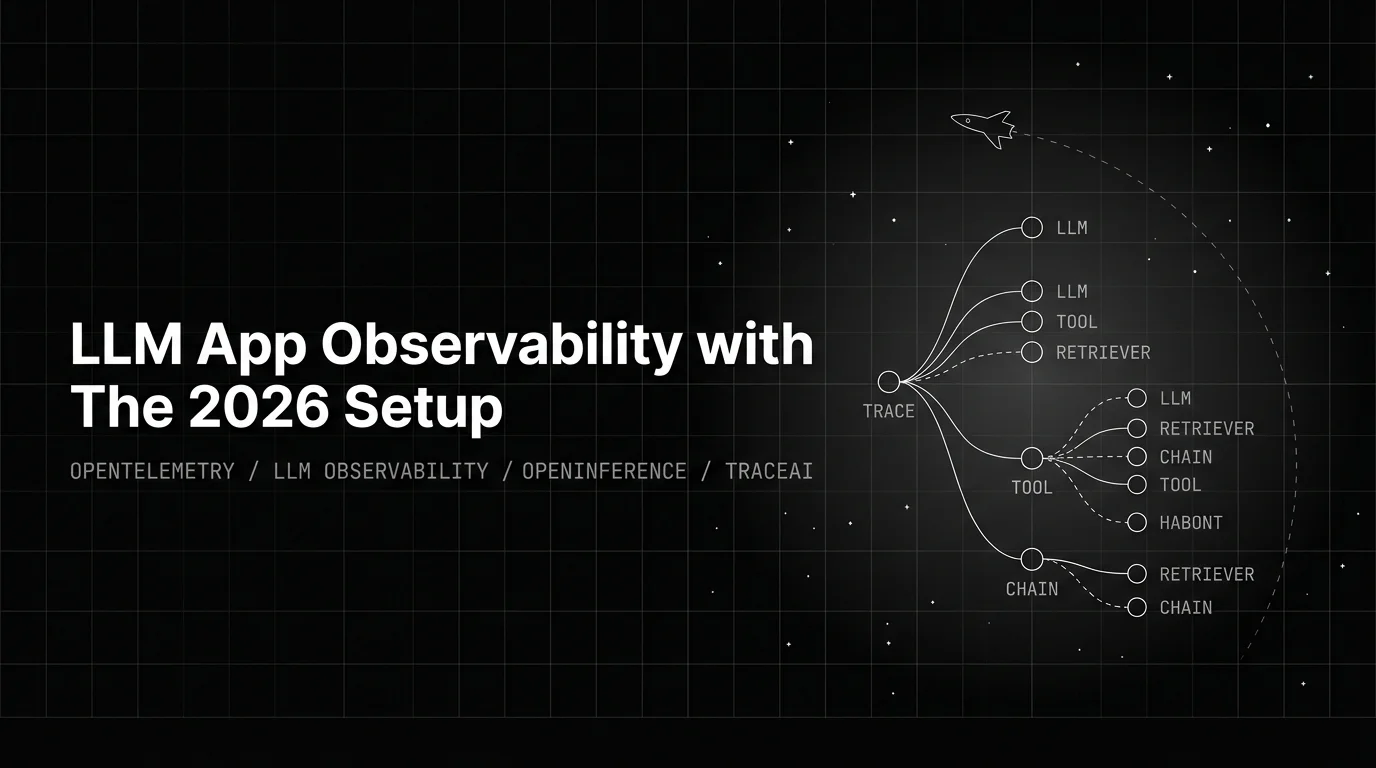
OTel for LLM apps in 2026 = OTel-GenAI + OpenInference + eval-as-span-attribute. Three layers, traceAI register pattern, span enrichment, sampling.