LLM Fine-Tuning Techniques in 2026: From Feature-Based to LoRA, QLoRA, SFT, and DPO
LLM fine-tuning techniques in 2026: feature-based, full fine-tune, LoRA, QLoRA, BitFit, SFT, DPO, RLHF, multi-task. When to use each and how to evaluate.
Table of Contents
LLM fine-tuning techniques in 2026: the landscape in one read
Fine-tuning in 2026 is no longer a single decision. It is a stack: pick a base model, pick how many parameters you will touch (feature-based, head-only, full, or PEFT), pick the supervision shape (SFT, DPO, RLHF), and pick how you will evaluate the result. The methods below are the ones that show up in real production pipelines, and the trade-offs that decide which one you reach for.
TL;DR
| Method | Trainable params | Best for | Typical cost |
|---|---|---|---|
| Feature-based | 0 (base) + small head | Quick classification baselines on top of an encoder | Lowest |
| Head-only | Just the classifier head | Encoder LLM classification, retrieval rerankers | Low |
| Full fine-tuning (full-parameter SFT or DPO) | 100% | Highest quality on a narrow domain when you can afford it | Highest |
| LoRA | ~0.1 to 1% | The default PEFT in 2026; adapters per tenant or task | Low |
| QLoRA | ~0.1 to 1% on 4-bit base | Fine-tuning big base models on a single GPU | Lowest of large-model options |
| BitFit | Bias-only | Tiny budget, surprisingly strong | Very low |
| Adapters / IA^3 / Prefix | Small inserted modules | Hugging Face PEFT alternatives to LoRA | Low |
| Instruction tuning (SFT) | Depends | Teaching a base to follow instructions | Medium |
| DPO / IPO / KTO | Depends | Preference tuning without a reward model | Medium |
| RLHF / RLAIF | Depends | Final alignment for objectives DPO cannot capture | Highest |
| Multi-task / sequential | Depends | Generalization across related tasks | Medium |
What changed since 2025
Three forces reshape the 2026 fine-tuning playbook:
- DPO is the new default for preference tuning. Direct Preference Optimization (Rafailov et al., 2023, arXiv:2305.18290) and its cousins (IPO, KTO, ORPO) replace the SFT-then-PPO pipeline for most teams. They are simpler to implement and produce competitive quality.
- QLoRA-class methods make big-model adaptation accessible. With 4-bit NF4 quantization, paged optimizers, and double quantization (Dettmers et al., 2023, arXiv:2305.14314), a single 48GB GPU can fine-tune a 65B-class base model.
- Prompting and retrieval close more of the gap than they used to. Prompt optimization libraries (DSPy, GEPA, ProTeGi), long-context windows, and structured tool use mean that many problems that once required fine-tuning are now solved by better prompts and better retrieval. Fine-tune when prompting cannot close the gap, not by default.
Foundational fine-tuning techniques
Feature-based approach
A pre-trained LLM (often an encoder like an instruction-tuned BERT/DeBERTa, or hidden-state embeddings exposed by a decoder-only chat model through its provider API or via mean-pooling its last hidden state) produces contextual embeddings for each input. Those embeddings feed a downstream classifier (SVM, logistic regression, a small MLP). The base model is frozen, so training cost is whatever you spend on the head.
- Pros: cheapest method, deterministic at inference if the base is fixed, easy to swap heads per task.
- Cons: ceiling is bounded by what is encoded in the embeddings. Modern decoder-only chat models often expose embeddings less cleanly than encoders.
- When to use: quick classification baselines, retrieval rerankers, telemetry classifiers, anything where you need a working model in an afternoon.
Partial / head-only fine-tuning
Freeze the base model body and train only a task-specific head on top. This sits between feature-based (no body gradients at all) and full fine-tuning (every layer learns).
- Pros: small compute footprint, much harder to forget existing capabilities.
- Cons: still bottlenecked by the frozen body; can plateau on harder tasks.
- When to use: classification on top of an encoder LLM, span extraction, scoring heads.
Full fine-tuning (full-parameter training)
Unfreeze every parameter and train end-to-end. “Full fine-tuning” is the parameter-scope choice (every weight is trainable); whether you train it with supervised data (full-parameter SFT) or preference data (full-parameter DPO) is a separate axis. This is the maximum-expressivity option and still the gold standard when you can afford the compute and the data.
- Pros: highest ceiling; the model can change its behavior anywhere in the network.
- Cons: GPU memory and time are dominant; catastrophic forgetting is real and needs to be managed; weights are large to ship and version.
- When to use: large supervised data sets, narrow domains where quality matters more than cost, model distillation into a smaller target.
Parameter-efficient fine-tuning (PEFT)
In 2026, parameter-efficient fine-tuning is the default for most product teams. The Hugging Face PEFT library (github.com/huggingface/peft) packages the common methods.
LoRA (Low-Rank Adaptation)
LoRA (Hu et al., 2021, arXiv:2106.09685) injects two trainable low-rank matrices A and B into the attention and MLP projection weights of a transformer. The base weights stay frozen; only A @ B is learned. The result is an adapter that is typically 0.1 to 1 percent the size of the base model.
- Pros: small memory footprint, fast training, adapters are cheap to version and swap, easy to merge into base weights at deploy.
- Cons: the rank is a real bottleneck on very large tasks; very high-rank updates can approach full fine-tuning costs.
- When to use: the default starting point for 2026 fine-tuning workflows.
QLoRA
QLoRA (Dettmers et al., 2023, arXiv:2305.14314) keeps the base model in 4-bit NormalFloat (NF4) precision, uses double quantization for the quantization constants, and pages optimizer states to CPU memory. LoRA matrices are still trained in higher precision on top.
- Pros: lets you fine-tune very large base models (up to 65B-class) on a single 48GB GPU.
- Cons: training is slower than plain LoRA on fp16/bf16; numerics require care for stability.
- When to use: GPU memory is the binding constraint and you want a big base.
BitFit
BitFit (Ben Zaken et al., 2022, arXiv:2106.10199) updates only the bias terms of the model. Trainable parameter count drops by another order of magnitude versus LoRA.
- Pros: smallest memory footprint of any non-trivial fine-tune.
- Cons: ceiling is lower than LoRA on most generation tasks.
- When to use: lightweight classification, adapter-budget-constrained settings, ablation baselines.
Adapters, IA^3, Prefix-Tuning
- Adapters (Houlsby et al., 2019) insert small trainable feed-forward modules between transformer layers.
- IA^3 (Liu et al., 2022) scales attention and feed-forward activations with learned vectors.
- Prefix-tuning (Li and Liang, 2021) prepends trainable continuous vectors to the attention key/value cache.
All three are PEFT alternatives to LoRA available through Hugging Face PEFT. LoRA is the default in 2026, but these remain useful for specific architectures or budget regimes.
Supervision regimes: SFT, DPO, RLHF
Method talks about which parameters move. Supervision regime talks about what objective they move toward.
Instruction tuning (SFT)
Supervised fine-tuning on instruction-response pairs. The base learns to follow natural-language commands. Open recipes like Allen AI’s Tulu 3 (arxiv.org/abs/2411.15124) document curated mixtures of math, code, IFEval, GSM8K, and conversational data, and are a good reference for both data composition and hyperparameters.
Direct preference optimization (DPO)
DPO (Rafailov et al., 2023, arXiv:2305.18290) trains directly on triples of (prompt, preferred response, rejected response) using a classification-style loss derived from the Bradley-Terry preference model. No separate reward model, no PPO loop.
- Pros: simpler training stack than RLHF, competitive quality on most benchmarks, plays well with LoRA.
- Cons: very sensitive to data quality; near-duplicate preferred and rejected pairs collapse the signal.
- Variants: IPO (Azar et al., 2023), KTO (Ethayarajh et al., 2024), ORPO (Hong et al., 2024).
RLHF and RLAIF
Train a reward model from human preferences (or AI preferences for RLAIF), then optimize the LLM against the reward with PPO or another RL algorithm. Frontier labs still run RLHF for final alignment because it can express objectives that pure preference triples cannot. For most teams, DPO is the cheaper substitute.
Practical considerations
Data preparation
- Quality over volume. A 5k well-curated SFT set usually outperforms a 50k noisy set on the same task.
- Deduplication and contamination checks. Make sure evaluation data is not in the training set.
- Privacy. When fine-tuning on user data, follow your retention and consent policies. Techniques like differential privacy and PII redaction belong in the preprocessing step.
- Mix some base data. Including 5 to 20 percent of broader instruction data during domain SFT reduces catastrophic forgetting on adjacent tasks.
Hyperparameter optimization
The hyperparameters that matter most:
- Learning rate (1e-5 to 5e-4 for LoRA; 1e-6 to 5e-5 for full SFT, depending on model size).
- Batch size and gradient accumulation.
- Number of epochs (usually 1 to 3 for SFT, 1 for DPO).
- For LoRA: rank
r, alpha, and which modules to target (oftenq_proj,k_proj,v_proj,o_proj, sometimes MLP projections).
Use a held-out validation set, not the training loss, to decide when to stop. Bayesian optimization tools or simple sweeps work fine; the sample efficiency of LoRA makes coarse sweeps tractable.
Avoiding overfitting and catastrophic forgetting
- Prefer LoRA so the original weights are untouched.
- Use early stopping on a validation set.
- Mix in baseline data (replay).
- Use elastic-weight consolidation or L2 regularization on critical parameters for full SFT.
- Run capability benchmarks (MMLU, IFEval, HumanEval) before and after to quantify regressions.
How to evaluate a fine-tuned model in 2026
The hardest part of fine-tuning is knowing whether the result is actually better. The evaluating fine-tuned LLMs playbook goes deep; the 2026 standard:
- A frozen domain-specific golden set you control, scored with deterministic metrics (exact match, BLEU, ROUGE, code execution, structured-output parsing).
- Public capability benchmarks to detect regression (MMLU, IFEval, GSM8K, HumanEval, MT-Bench).
- LLM-as-a-judge evaluation for open-ended outputs (faithfulness, answer relevance, tool correctness, helpfulness).
- A live shadow trace evaluation on captured user requests once the model is in staging.
Future AGI’s evaluation library is one option for points 3 and 4: from fi.evals import evaluate runs cloud judges like turing_flash (about 1 to 2 seconds), turing_small (about 2 to 3 seconds), or turing_large (about 3 to 5 seconds) on the same traces you collect from observability, with metrics for faithfulness and answer relevance baked in.
from fi.evals import evaluate

score = evaluate(
    "faithfulness",
    output="Eiffel Tower is 330 meters tall.",
    context="The Eiffel Tower in Paris is 330 meters tall.",
)
print(score)
For traces, the open-source traceAI library (Apache 2.0) ships OpenTelemetry-native instrumentors for OpenAI, Anthropic, LangChain, LlamaIndex, OpenAI Agents, and MCP servers. The same run_id that flows through fi_instrumentation.register and FITracer is the join key for evaluation downstream.
Choosing the right technique
Use this short decision tree:
- You want a classification baseline this afternoon. Feature-based or head-only on an encoder LLM.
- You want to teach a small open-weight base to follow your prompts. SFT + LoRA. QLoRA if the base is large.
- Your SFT model is correct but is not aligned to user preferences. Add DPO on top of LoRA.
- You need maximum quality on a narrow domain and can afford the compute. Full SFT, then DPO.
- You only have bias-budget compute. BitFit; treat it as a ceiling experiment.
- You are exhausting prompting and retrieval and still missing a measured target. Fine-tune. Otherwise, prompt optimize and instrument first.
Where Future AGI fits
Fine-tuning is owned by Hugging Face Transformers + PEFT, TRL, axolotl, Unsloth, and similar frameworks; Future AGI is not a fine-tuning framework. Future AGI’s role around fine-tuning is the evaluation and observability layer:
fi.evals.evaluateandfi.evals.Evaluator(withfi.evals.metrics.CustomLLMJudgeandfi.evals.llm.LiteLLMProvider) score the model before and after tuning.
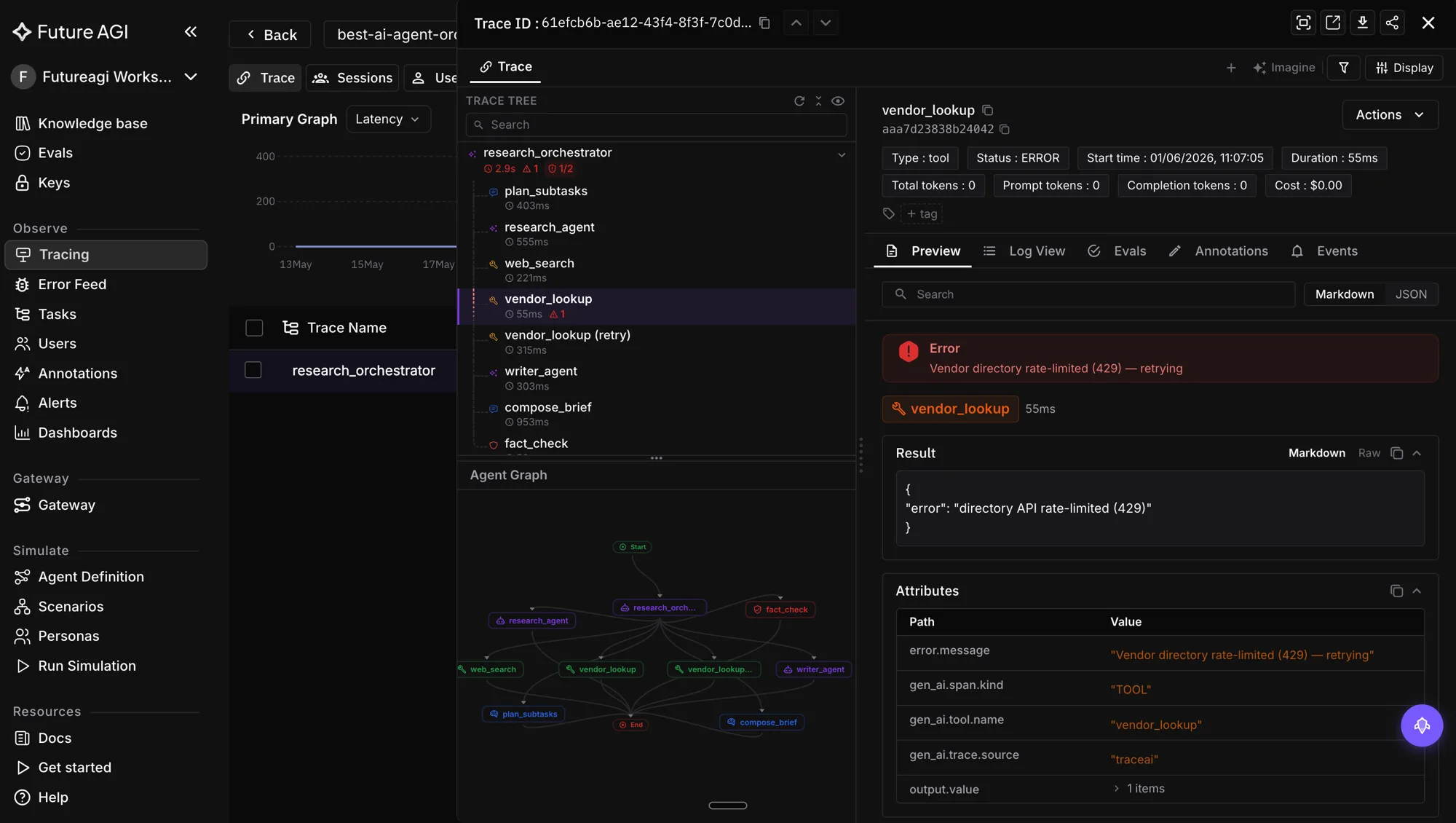
- traceAI +
fi_instrumentation.register+FITracercapture production traces of the fine-tuned model so regressions surface in live traffic.
- The Agent Command Center BYOK gateway at
/platform/monitor/command-centerroutes between your fine-tuned model and frontier baselines so you can A/B test in production.
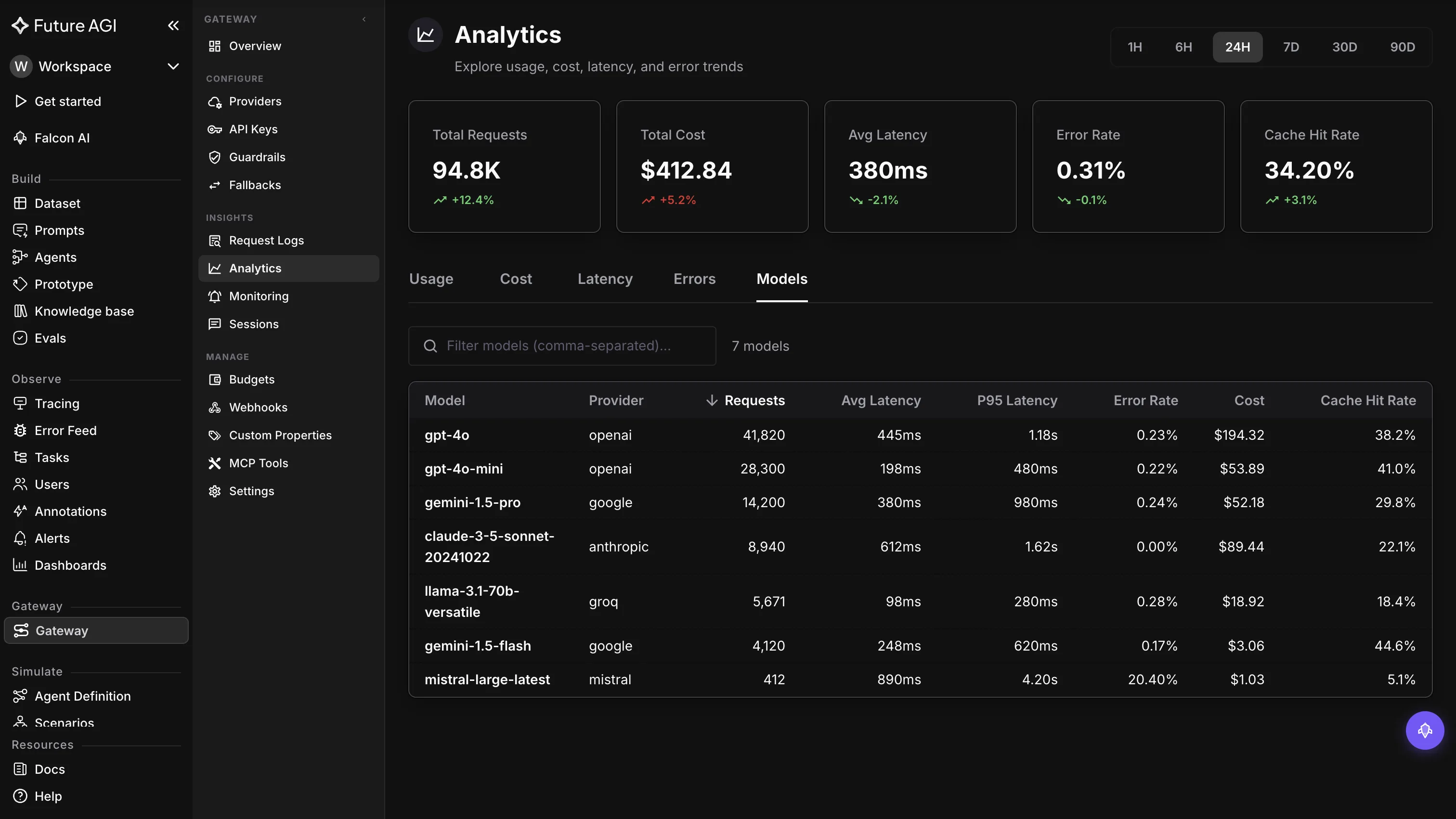
Together, fine-tuning framework on one side and evaluation + observability on the other is the shape most 2026 teams settle on.
Summary
LLM fine-tuning in 2026 is a stack of choices: scope (feature-based, head-only, PEFT, full), regime (SFT, DPO, RLHF), and evaluation (golden set, benchmarks, LLM-as-judge, live trace). The default starting point is LoRA + SFT, with QLoRA when memory is tight and DPO on top for preference alignment. RLHF and full fine-tuning are escalation paths, not defaults. The decision that matters more than which method to pick is whether you should be fine-tuning at all; prompt-optimize and instrument first, fine-tune when the gap is real and measured.
Frequently Asked Questions
What is LLM fine-tuning in 2026?
Should I use full fine-tuning or LoRA?
What is QLoRA and when should I pick it over plain LoRA?
What is the difference between SFT, DPO, and RLHF?
How do I evaluate a fine-tuned model?
What is catastrophic forgetting and how do I mitigate it?
How much data do I need to fine-tune a base LLM in 2026?
Do I need to fine-tune at all in 2026?
Fine-tune LLMs in 2026 with LoRA, QLoRA, GRPO, RLHF, DPO, IPO. Compare trl, unsloth, axolotl, DeepSpeed and learn how to evaluate fine-tuned models.

2026 guide to fine-tuning LLMs: LoRA vs QLoRA, DPO vs RLHF vs GRPO, and when to fine-tune open-weight models instead of prompting alone.


Build an LLM evaluation framework from scratch in 2026. Deterministic, rubric, LLM-as-judge, and agent evals, with working Python code and a CI gate.
